by Cindy Derby

Today your Storystorm inspiration is in the form of a video!

Cindy Derby is the author and illustrator of How to Walk an Ant, Two Many Birds, and Blurp’s Book of Manners (Roaring Brook Press 2022). She is the illustrator of Outside In by Deborah Underwood, The Boy and the Gorilla by Jackie Azua Kramer, and How to Have a Birthday by Mary Lyn Ray.  Cindy’s background is in puppetry and she has performed all over the world. She enjoys building apartments for insects and has a beagle named Banjo who she takes on road trips in her camper van. For more info visit: cindyderby.com and on Twitter @cindyderby and Instagram @cindyderby.

Cindy is giving away two signed copies of TWO MANY BIRDS.

Two separate winners will be randomly selected.

Leave one comment below to enter.

You’re eligible to win if you’re a registered Storystorm participant and you have commented once below.

by Rosie J. Pova

Every story has its own way of sneaking into my subconscious. I keep my mind open, and on the lookout, so that, in its tiny kernel form, the idea could find a crack and jump into my precious pool of ideas to draw from.

I’ve noticed that there isn’t just one process for me that works the same way each time and I love that! I can relax, knowing that the muse can tap on my shoulder, whisper in my ear, tug on my pajama pants or even pull my leg, occasionally, to get my attention.  Or I can summon her up with some tricks up my sleeve, too. But one thing’s for sure―she will show up! I can trust that the well will never dry up and my next story may spring at any moment.

It’s a game, and it’s a playful challenge. And it’s always fun to discover the clues leading up to a new inspiration for writing my next piece!

Today, I’d like to share my top three tried-and-true techniques for collecting or retrieving story ideas.

1. A Theme

Sometimes, my starting point for generating ideas is a theme. I have a specific one in mind that I want my story to reflect. My picture book, SARAH’S SONG, is an example of that.
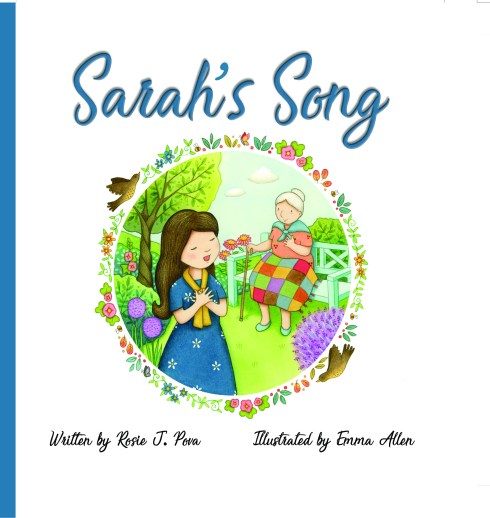
Reading other books with a similar theme, I wanted to write a story about something precious, cherished that is lost or transformed into something different in a way that the character would have to let go, and either find peace with it or adapt to the new and transformed “something precious.” Not in so many words in my mind, just very basic sense for the direction in which to focus.

The story I wrote was about a special tradition a girl and her grandma shared through dance and music, but then it altered when Grandma was no longer able to dance and sing like she used to.

2. A Phrase

Listen! A character might be talking to you. A narrator may be feeding you a phrase to draw your attention. That happens to me often. Usually when I’m driving, washing dishes, taking a shower or when I first wake up.

I’d hear a line of dialogue and my curiosity takes over, leading me on a path to discovery. Who is that character talking? What are they like? What do they want?

Other times, an interesting sentence pops into my mind as was the case recently with this one: “Mule mulled over the idea. . .” I thought it sounded cool and was funny to me. I also knew what he mulled over, but won’t give it away here ;). So, this turned into a new story I wrote.

Initially, I believed that would be my opening line for the story. Well, it turned out it wasn’t. I added a new opening and the mulling mule paragraph moved down. But that’s not all! Later, in revisions, that sentence changed, and Mule no longer mulled. That verb was replaced with another one. So, poof! There went my consonance, too! But I have no regrets! This little phrase worked to get me to write a brand-new story! And here’s what one of my critique partners had to say about it after I polished it and sent it back to her: “It’s spectacular! It’s glamorous and hysterical! Well done!”

I have no clue whether this story would ever become a book, but no doubt, I consider that a win!
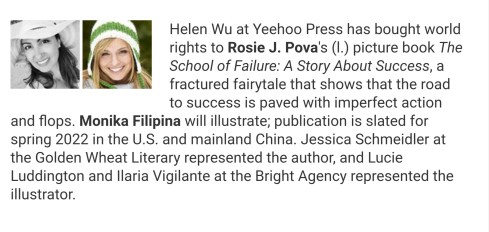
Another instance of a story that sprang from a sentence was when this came to my mind: “The school of failure was located in the middle of nowhere, but it was the center of everything.”

Oh, how I admired this opening sentence! Genius! So clever! I was patting myself on the back… for a while. Then the story went through a gazillion revisions. I kept the sentence, even though it was no longer the opening sentence. Then more revisions followed. I still didn’t have the heart to kill my darling, so it stayed, stubbornly and selfishly saved by its author.

Fast-forward a couple of years (at least!) the story sold! Here came a gazillion more revisions after it was acquired. At some point, the editors asked me to get rid of that sentence―they thought it was vague and not kid-friendly and just did not serve the story at all. GASP! What? But that was the one that started this whole story creation! I was attached to it now!

Well, I had to cut it and I knew it. Eventually, I gave it my farewell and showed it the exit.

The journey of that book was long and hard, unlike some of my other books. But here’s the result and I am so happy and excited for it!
3. A Prompt

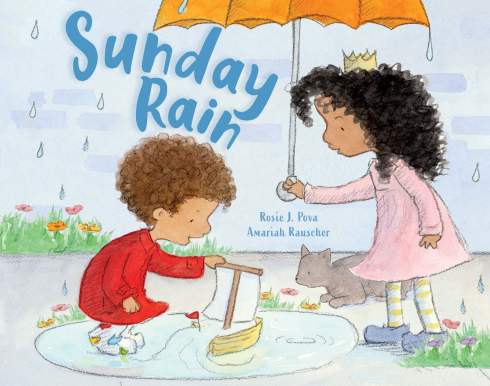
My upcoming book, SUNDAY RAIN, was born out of a prompt. There was a submission opportunity through 12 x12 to submit to an editor. I wanted to take advantage of this call for submissions, but I had no story that matched the taste of that editor. So, I decided to write a new one, just for them. I looked at their guidelines again and what piqued my interest was a “story that captures a moment.”

I thought about it and brainstormed. I wondered what childhood moment I could reflect in a story.

And then an image of kids playing in the rain popped into my head.

I have a vivid childhood memory of swirling and twirling in delight, soaking wet, in a heavy summer rain. But in my case, I was the only one — all my friends who were there ran for shelter when it started pouring. The rain was so warm, I stayed. I felt happy, adventurous, and carefree at that moment.

So that served as the spark for my story. The words started pouring out of me. I finished a first draft pretty quickly.

Well, long story short, that publisher did not pick the book, but another one loved it and did! So now it’s a book that will soon be out into the world and in the hands of many kids!
Another story I recently wrote was also born from a prompt. This time, it came from a dear critique partner. I wanted to write a story for a specific publisher and when I shared that with her, we tossed around some ideas of general themes that would be a good match for that house. Then my friend suggested I write a story about community coming together. Once I had that prompt, the idea quickly flooded in and I poured it out on paper the same day. Her feedback on it? “It’s AMAZING Love it!!!!”

So, these three methods have proven the most fruitful in sparking story ideas for me lately and I hope you will try them all!

Have any of those worked for you? Let me know how ideas pop up for you most often.
Rosie J. Pova is a multi-published, award-winning children’s author, poet, speaker, and writing coach on a mission to inspire children not only to read and write more, but to use their creativity, follow their passions, dream big and believe in themselves. She is also a Writing Instructor for the Dallas Independent School District through The Writer’s Garret, an instructor with Writing Workshops Dallas, teaching picture book courses to children’s writers, and the founder of two children’s writing contests–KWEST and Haiku Hype–as well as the organizer of The Write Universe Kidlit Writers Workshops in Dallas, TX. She also serves as a judge for Rate Your Story.

Rosie visits schools and shares her inspirational journey as an immigrant from Bulgaria and how she became a published author, encouraging kids to persist, push through obstacles, and hold a high vision of themselves.

Her upcoming picture book, Sunday Rain, celebrates imagination, the love of books, and new friendships. You can pre-order a signed copy. Her latest book, The School of Failure: A Story about Success will be released in spring 2022. Visit Rosie at rosiejpova.com, on Twitter @RosiePOV,  Instagram @rosiepova and Facebook. 

Rosie is giving away a signed copy of SUNDAY RAIN.

Leave one comment below to enter.

You’re eligible to win if you’re a registered Storystorm participant and you have commented once below.
by Kjersten Hayes

Here we are, Storystorm day 22—how’s it going? Do you have 22 shiny new picture book ideas? If yes, hooray! If not…

There’s still time!

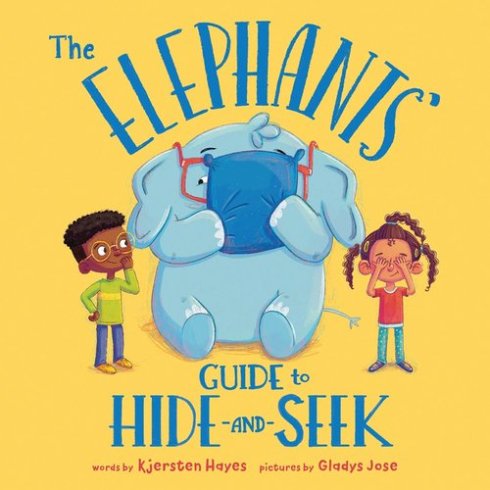
In my book THE ELEPHANTS’ GUIDE TO HIDE-AND-SEEK, the main character is invited to play a game, but the odds are stacked against him. He’s awkward and unsure. He feels like he’s behind the other players, not as good at playing as they are. But he gets in the game anyway! Which is what I invite you to do now. And so, I present…

THE WRITERS’ GUIDE FOR TURNING ONE IDEA INTO TEN!

Let’s do this!

The Guidelines:

1. Lower the bar.

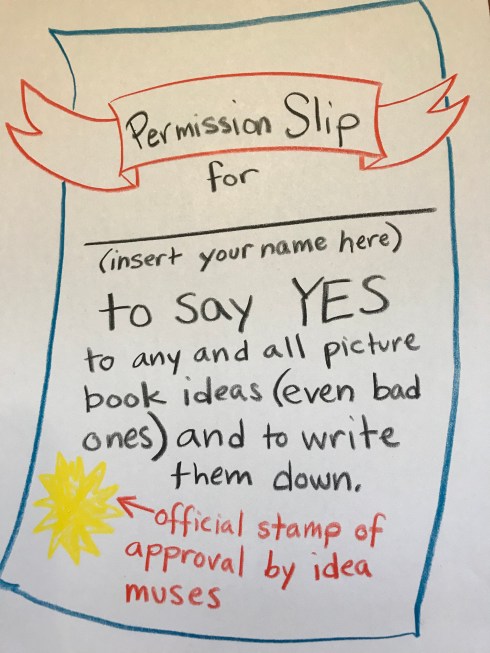
Completely set aside your excellent standards for this exercise. Say YES to every idea, even ones that strike you as genuinely bad, write them down anyway. You won’t find better ideas if you’ve set yourself up to say no while brainstorming, so say yes to everything.

Once I wrote an idea containing only the barest start, it basically said: write a parody guidebook of some kind. I wrote it down anyway.

2. Think quantity, not quality.

Quantity leads to quality. I teach art, and I see this with my students all the time. When they focus on quantity, they focus on practicing lots, and practicing lots is how you get better at anything. Focus on quantity if you want to find quality!

Try this: turn one idea into ten right now. Pluck an idea out of your idea pile. Maybe it’s an idea for a character. Or a setting. Or a problem. Or just pick a random animal as a character idea. Now, write that idea at the top of a piece of paper. And below, challenge yourself to add to it or to change it up at least ten different ways. Commit to ten variations of that one idea.

Try adding or changing the setting. Or the problem. Or the antagonist. Or the main character. Say yes to ridiculous variations. Say yes to the first thing that pops in your brain, and the second, and the third. You are not trying to be brilliant (this is key); you are just trying to make it to ten. Combine that one idea with another in your stack. And no worries, if you like the first idea best, you can always go back to it later.

My son and I meeting some elephant babies. Yay, elephants!

Remember that parody guidebook idea? While Storystorming one year, I decided to brainstorm different kinds of parody guidebooks (one idea into ten!). I searched through my other ideas and found a memory. When my son was young, we lived in Malaysia, where we learned about, met, and fell in love with elephants. One Christmas, home in Washington state for a visit, my son looked out the car window and said “Look mom! A forest! That’s where the elephants live!” It made me think of elephants hiding.

So from that, I wrote down a new idea: a parody guidebook about elephants playing hide-and-seek. And that idea eventually became my first published book.

3. Gamify.

You are playing. Not committing. You are trying out ridiculous things with wild abandon. But if finding ten variations of one idea is taking a while, make it a game. Set a timer. Say, ten minutes. See if you can do it in that amount of time, like you would for a low stakes boardgame. Can you get all ten variations in ten minutes? Write fast. Faster! Say yes to all the things, no matter how silly!

If you don’t make it, lower your standards, give yourself an extra minute, and try again. Repeat until you do make it. Incidentally if you want to write funny picture books, this is an excellent exercise. A person gets goofy when searching for many solutions fast.

Storystorm invites us to come up with lots of ideas in a short amount of time—31 ideas in 31 days! Year in and year out, Storystorm posts mention actual published books (like mine!) that originally came from this process—it works. So why not play with the process in an even more condensed fashion? Ten ideas in ten minutes? Why not? As I write this, I am at least four days behind, so I’ll be joining you! Let’s get back in the game! Right now. Ready, set, go!

Kjersten Hayes is the author of the picture book, THE ELEPHANTS’ GUIDE TO HIDE-AND-SEEK, illustrated by Gladys Jose and published by Sourcebooks Jabberwocky. She lives in Bellingham, Washington, in a century-old house full of color, books, pottery, art, music and happy kid noises. Besides writing she spends her time teaching art, taking adventures, and creating and selling collage art, greeting cards, and handmade journals. Visit her at kjersten.com, on Twitter @kjerstenhayes and Instagram @kjerstenhayes.

Kjersten is giving away a copy of THE ELEPHANTS’ GUIDE TO HIDE-AND-SEEK.

Leave one comment below to enter.

You’re eligible to win if you’re a registered Storystorm participant and you have commented once below.

by Chana Stiefel

Hello Storystormers! It’s hard to believe we’re already three weeks in. How’s it going? Are you churning out ideas like this?

If not, I’d like to jumpstart your idea machine by training your brain to ask a single question:

Where did that come from?

As you go about your day, start thinking about origin stories. Your fluffy slippers, your toothbrush, toilet paper, jeans, Cap’n Crunch, a nest in a tree on your first walk of the day….just look around. Origin stories are everywhere!

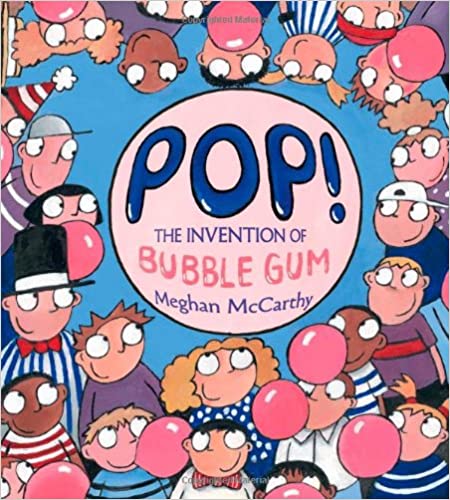
They might revolve around something very small.


Or something HUMONGOUS.


They might be about something incredibly important.


Or inventions that made a big splash!


They might even be about something we cherish.

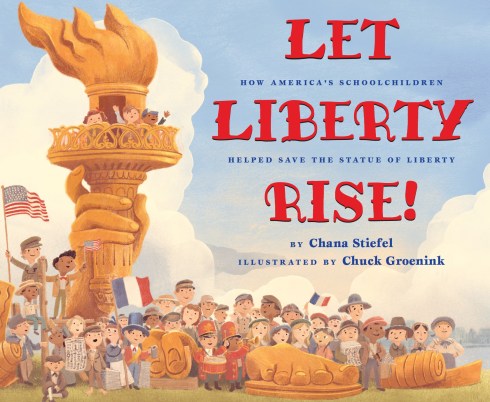
My next picture book LET LIBERTY RISE (illustrated by Chuck Groenink, Scholastic, March 2) is the origin story of one of America’s favorite icons, the Statue of Liberty. Where did Lady Liberty come from? Most of us know she was a gift from France. But did you know that when she arrived in New York City in 350 pieces, America didn’t want her? Americans were supposed to build the pedestal for Liberty to stand on, but when she arrived, the pedestal was only half built and funds had run out. Liberty’s parts, from her torch to her toes, lay strewn about Bedloe’s Island in rain and snow. But Joseph Pulitzer, a Jewish Hungarian immigrant and publisher of the New York World newspaper, felt that Liberty must stand in New York harbor. He said, if anyone gives a penny for the pedestal, he would print their name in his newspaper. And guess what? Schoolchildren came to the rescue by donating their pennies! The World raised $100,000 to build Liberty’s pedestal! How’s that for an origin story?

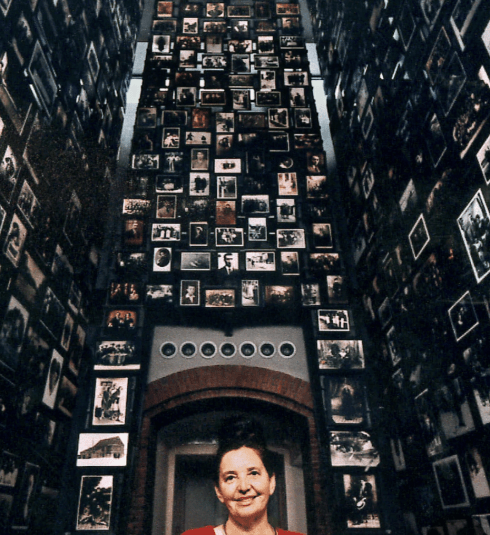
Here’s another story that’s near and dear to my heart. A few years ago, I read an obituary about Yaffa Eliach, a Jewish historian who spent 17 years traveling the world to rebuild her village in stories and photos after her community was obliterated during World War II. Yaffa’s collection became the three-story high Tower of Faces in the U.S. Holocaust Memorial Museum in Washington, D.C. I’m honored to share that this origin story is the subject of my picture book THE TOWER OF LIFE, illustrated by Susan Gal, coming from Scholastic in 2022.

Still a bit stuck? Make a list of things kids love. Then ask: Where did that come from?

THE WILLIAM HOY STORY by Nancy Churnin is about the origin of baseball signs. Did you know that they came from a deaf baseball player who played in the major leagues in the early 1900s?

Of course, these titles are all nonfiction. But this idea can work for fiction too. Here’s a funny origin story.

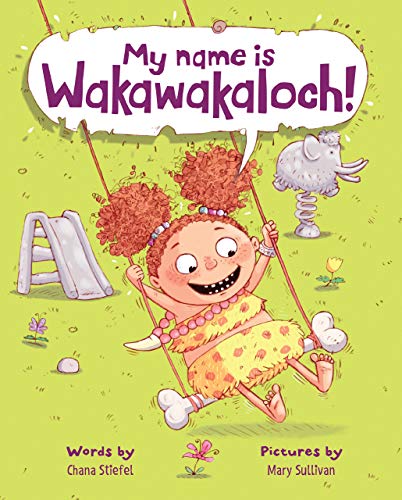
My picture book MY NAME IS WAKAWAKALOCH is about a cave girl who wants to change her hard-to-pronounce name (ahem). It’s also about the origins of our names and why names are important.

I was named for my great grandmother Chana who arrived in America 100 years ago. You can learn more here. That’s my origin story. What’s yours?

What are your favorite picture books based on origin stories? And if the hunt for an origin-story idea works for you, please let me know!

Chana Stiefel is the author of more than 25 books for kids. Her next picture book, LET LIBERTY RISE (illustrated by Chuck Groenink, Scholastic, 3-2-21), is the true story of how America’s schoolchildren helped build the Statue of Liberty. Her other picture books include MY NAME IS WAKAWAKALOCH!, illustrated by Mary Sullivan (HMH, 2019) and DADDY DEPOT, illustrated by Andy Snair (Feiwel & Friends, 2017). Recent non-fiction titles include ANIMAL ZOMBIES…& OTHER REAL-LIFE MONSTERS (National Geographic Kids, 2018). Her picture book THE TOWER OF LIFE: HOW ONE WOMAN REBUILT HER VILLAGE IN STORIES AND PICTURES (illustrated by Susan Gal) will be coming out from Scholastic in 2022. Chana loves visiting schools and libraries and sharing her passion for reading and writing with children. She is represented by Miranda Paul at Erin Murphy Literary Agency. Follow her on Facebook, Twitter @chanastiefel, and Instagram @chanastiefel. To hear Chana pronounce her name, click here.
Chana will be giving away a signed copy of LET LIBERTY RISE when it launches in March.

Leave one comment below to enter.

You’re eligible to win if you’re a registered Storystorm participant and you have commented once below.

by Margaret Chiu Greanias 

Since 2020, I’ve been distracted. By the pandemic. By my kids being home twenty-four seven (hello distance learning!). By the election.

My creative energy, like my time, has been sapped. But one thing that invigorates me, even during times like these, is the promise of a new story idea. Yes, this is why I love Storystorm.

Today, instead of focusing outward for a source of inspiration, I’m focusing inward—on our own failed and discarded stories.

HUH?

If you’re like me, you have tens if not hundreds of partially written and even finished stories. These may range from stories that never left your computer (or notebook) all the way to stories that went on submission but were never acquired. They are stories that are still unfinished puzzles, stories that were never quite right, stories that weren’t marketable enough, stories that never found the right champion. They are the stories we shelved, never intending to read them again.

But WHAT IF one of these stories has:

  • a character you love but just wasn’t in the right story?
  • a side character that deserves a story of their own?
  • a fantastic world that doesn’t shine because the others story elements didn’t work?
  • a concept or problem that still resonates with you?
  • a phrase, a metaphor, some dialogue, or a description—perhaps insignificant to the failed story—that could become the nugget of a new story?
  • a story element, when woven together with other elements from other failed stories, that could be made into an entirely new story?

Just because a story didn’t work as a whole doesn’t mean it has no value. These stories are mineable. Elements from these stories could be the inspiration for something new, something fresh, something fantastic.

My picture book AMAH FARAWAY, publishing next year by Bloomsbury, began as a failed story. The central concept, one of the growing relationship between a girl and her long-distance grandmother and ancestral culture, is close to my heart. It’s the story of my own experience growing up with a grandmother who lived in a different country. Our necessarily infrequent visits always began with shyness and always ended with not wanting to say goodbye.

The failed story was called GRANDMA ROBOT. It involved a girl, her stand-in robot grandmother, and her actual grandmother who lived very far away. I wrote it, revised it, and re-wrote it many times. But I could never get it quite right (now I see why—another benefit of re-reading these long-filed away stories).

Several years later, I was determined to write a story in a format based on the poem “Lost Generation” by Jonathon Reed. Read forward, the poem has a pessimistic tone. But read in reverse (from bottom to top), the tone transforms. The effect is amazing, and I get chills whenever I read the poem.

My idea was to write a story using a similar format. The first half would be the forward read, and the second half would be the reverse read. I thought for months about what kind of story would fit this structure. Finally, I remembered the central concept behind GRANDMA ROBOT and…

AMAH FARAWAY was born.

A child gets to know her Taiwanese grandmother during an all-too-rare visit. AMAH FARAWAY is an intergenerational story in a unique format. In the first half of the story, Kylie keeps Amah at arm’s length. The story peaks in the middle with an invitation from Amah which Kylie accepts. After this, the story lines reverse, and their relationship transforms!

So, take another read through your failed yet mineable stories—there may be a promising story idea waiting to be discovered.

Margaret Chiu Greanias writes stories with heart for children. She is the author of MAXIMILLIAN VILLAINOUS (illustrated by Lesley Breen Withrow) and the forthcoming AMAH FARAWAY (illustrated by Tracy Subisak). Even though she wrote her first terrifically terrible book at age 9, it wasn’t until age 46 that she became a published author. She currently lives in the San Francisco Bay Area with her husband, three children, and a fluffle of dust bunnies.
Visit her online at margaretgreanias.com, or on Twitter @margaretgreania, Instagram @margaretgreanias and Facebook.

Margaret is giving away a non-rhyming picture book and a copy of MAXIMILLIAN VILLAINOUS from Running Press Kids.

Two separate winners will be randomly selected.

Leave one comment below to enter.

You’re eligible to win if you’re a registered Storystorm participant and you have commented once below.

by Katie Frawley

Say what you will about 2020, it sure was a year of comfortable pants. Sweat pants, pajama pants, yoga pants, no pants. I’m all for being comfortable in our clothes, but being comfortable in our writing lives? Not so much.

When I first started writing picture books in 2016, funny manuscripts poured out. Silly stories. Kooky characters. Goofy gags. That was my jam! My debut picture book, TABITHA AND FRITZ TRADE PLACES, is a funny story about a cat and an elephant who do a vacation home swap through a website called LairBnB. It was a pleasure to write, and I hope it’s a hoot for kids to read!

I wore my comfortable picture book pants day in, day out. They were familiar, well-worn, and had just the right amount of stretch around the waist. Ahhhh.

Then, a few months back, opportunity knocked. Unanticipated, unfamiliar, uncomfortable OPPORTUNITY.

A friend in the movie business reached out and asked if I’d like to participate in a writer’s lab for a children’s animation studio. Here’s how the conversation went…

Her: Have you ever thought about writing children’s animation?

My brain: What? Animation? Like movies and stuff? COOL!

Me: I haven’t! Do you have something specific in mind?

Her: I’d like to get you into a writer’s lab. You’d need to come up with 10 movie or TV series pitches in two weeks. What do you think?

My brain: Say yes! Say YES! YES, YOU IDIOT!!!!!

Me: I’d love to give it a try! Thanks for thinking of me!

Her: I’ll be in touch with details.

Me: Talk soon!

My brain: Wait! We don’t know anything about writing for the screen. We only write picture books. WHAT IS THE MATTER WITH YOU???

Writing these pitches was miles outside my comfort zone. Not only had I never thought about writing a screenplay, I’d never even read one. I can pitch a picture book like Nolan Ryan, but animation pitches? It was a whole new ballgame. But there was no backing out now. So I put on my big girl pants (which are MUCH less comfortable than sweatpants, by the way) and got to work.

It wasn’t easy. Most of it wasn’t fun. But I cranked it out. I flexed different parts of my brain, I repurposed old Storystorm ideas, I almost cried a few times! And the result? Well, I don’t actually know yet! My fingers are still very much crossed. But I know one thing. I am a stronger writer for the journey. The mere act of pushing myself was the reward.

So, here’s my advice to you: Get out of your comfort zone! If you only write humor, try something soulful. If you’ve been a rhymer so far, slip into some prose. If you tend toward true stories, see how fiction feels. As you jot your way through StoryStorm, write down ANY idea that calls to you, whether it feels familiar or not. Maybe you’ll writer a winner; maybe you won’t. But you’ll benefit from the journey either way.

And remember, if you’re going to push yourself outside your comfort zone, you might as well wear comfortable pants.

Katie Frawley studied English at the University of Florida (GO GATORS!) and earned a Master’s Degree in British and American literature from Florida Atlantic University. Before having her children, she had the distinct honor of teaching English to rowdy teenagers. When not banging away on the keyboard, Katie can be found testing new recipes with her miniature sous chefs, shooing iguanas away from her garden, or reading picture books to a captive audience on the couch. Katie lives in Fort Lauderdale, Florida with her husband, five children, and a handsome mutt named Nantucket.
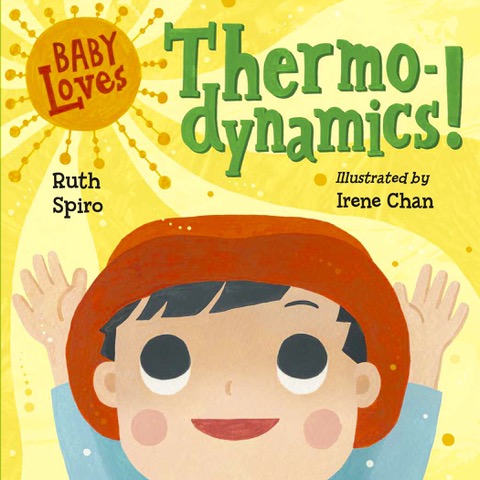
Find Katie on Twitter @KatieFrawley1 or at her website katiefrawley.com. Katie’s debut, TABITHA AND FRITZ TRADE PLACES, is traveling to shelves on the first of June! If you’d like to pre-order, please support your local indie!

Katie is giving away one picture book and one copy of TABITHA AND FRITZ TRADE PLACES when it’s released.

Two separate winners will be randomly selected.

Leave one comment below to enter.

You’re eligible to win if you’re a registered Storystorm participant and you have commented once below.

by Ruth Spiro

As we head into a new week of Storystorm, you may (or may not) have a growing list of ideas. But if you’re anything like me, you’re staring at that list and thinking, “Now what?” Because stories almost never come to me fully formed. They usually start with just a glimmer. A thought. An image. A feeling. So, how do I turn an idea into a story?

I ask, “What does this make me think of?”

When someone asks me where my book ideas come from, I basically re-enact a scene from the movie Working Girl. You know, the one where Melanie Griffith is asked how she came up with the idea for investing in a radio station. She pulls out a folder with seemingly random notes and news clippings, then proceeds to connect the dots, showing how each bit of information made her think of something else that eventually led her to the Big Idea.

Here’s an example of how that might work:

Idea:  Apples

What does that make me think of?

Apple-picking with my kids

What does that make me think of?

Apple trees

What does that make me think of?

If this gets tedious, you can switch it up and ask a different question. (Especially helpful if you’re writing nonfiction.)

What does this make me wonder?

What more do I want to know?

Getting back to our apple trees, the thing I wanted to know was “How?” How do apples grow on trees?

If you’re curious too, you’ll find the answer here:

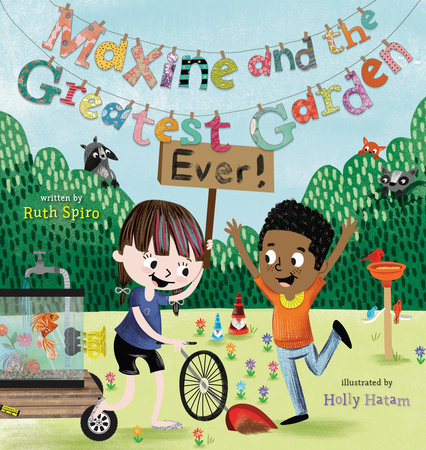
I used the same technique to come up with a story for my newest book, MAXINE AND THE GREATEST GARDEN EVER, the sequel to MADE BY MAXINE.

For those who haven’t read the first Maxine book, she’s a girl who loves to make things, but not in the crafty sense. She’s a true Maker at heart who uses her tinkering and coding skills to build things that solve problems around the house. Her motto is, “If I can dream it, I can build it!”

As I began brainstorming ideas for MAXINE AND THE GREATEST GARDEN EVER, I made a list of locations and things kids like to do.

Idea:  Do stuff in the backyard

What does that make me think of?

Planting a garden

What does that make me think of?

A challenge I experienced in my own garden.

A-Ha! Now I had something to work with.

Like many gardeners, I’ve had my share of frustration when critters nibbled on the fruits of my labor. If my STEM-loving Maxine had this same problem, how would she solve it in a way true to her character? I couldn’t wait to let her show me!

Without revealing too much more, MAXINE AND THE GREATEST GARDEN EVER is about friendship, creativity, persistence, and being kind to one another. Maxine discovers there are often multiple solutions to a problem, and sometimes a problem isn’t really a problem at all, but an opportunity to grow.

I can’t sign off here without acknowledging the importance of today, Marin Luther King Jr. Day. We honor the life, work, and legacy of an important civil rights leader in our country’s history. What does this make me think of?

In 2017 I was invited to present at the LA Times Book Festival and had the opportunity to attend a talk with Representative John Lewis and Andrew Aydin about their recent release, MARCH: BOOK THREE. (From the front row, no less!)

What does this make me think of?

Representative Lewis said, “Find a way to get in the way.”

What does this make YOU think of?

Go write it!

Ruth Spiro is the author of the Baby Loves Science board book series, published by Charlesbridge. There are 21 current and forthcoming titles including Baby Loves Aerospace Engineering, Baby Loves Coding and Baby Loves the Five Senses. She continues her signature style of introducing complex subjects to little listeners with Baby Loves Political Science, a new series perfect for election year and beyond. Democracy and Justice are now available, Congress and The Presidency arrive this April. The Science books are illustrated by Irene Chan and Political Science by Greg Paprocki.
Ruth’s STEM-themed picture book series, Made by Maxine (Dial), is about an inspiring young Maker who knows that with enough effort, imagination and recyclables, it’s possible to invent anything. Made by Maxine sold at auction as a three-book series, Maxine and the Greatest Garden Ever comes out on February 16. Maxine is illustrated by Holly Hatam.

A frequent speaker at schools and conferences, Ruth’s previous presentations include the Los Angeles Times Festival of Books, Chicago Tribune Printer’s Row LitFest, Children’s Festival of Stories, Nerd Camp Michigan, NAEYC and more. Ruth hopes her books inspire kids to observe the world, ask questions, and when it comes to their futures, DREAM BIG!

Ruth’s books are all available from your favorite bookseller. When possible, please support independent bookstores!

Visit Ruth online at Penguin Classroom, ruthspiro.com, Facebook, Twitter @RuthSpiro, and Instagram @ruthspiro.

Ruth is giving away 2 signed copies of MAXINE AND THE GREATEST GARDEN EVER and one of BABY LOVES POLITICAL SCIENCE: DEMOCRACY.

Three separate winners will be randomly chosen.

Leave one comment below to enter.

You’re eligible to win if you’re a registered Storystorm participant and you have commented once below.

by Katey Howes

Happy 2021, StoryStormers! How is the month of brainstorming treating you so far?

Maybe your idea engine is chugging steadily along with an “I think I can, I think I can,” attitude. You might feel your creativity bouncing out of control like five little monkeys jumping on a bed. Or perhaps, in spite of an influx of inspirational sights, sounds and friendly blog posts, your brain snores on??

Well, no matter which classic picture book your mind most resembles today, I’m pretty sure you can guess my chosen theme: refrains!

From CHICK-A CHICK-A BOOM BOOM to I LOVE MY WHITE SHOES, children’s literature is full of fabulous refrains. Why not channel their power jumpstart your creativity today?

A refrain is a phrase repeated throughout a book, generally in a predictable position in the text structure. A good refrain:

  • adds to the MEANING of the story
  • contributes to the PACING and FLOW of the story
  • compliments the SPIRIT of the story
  • is fun to say!

An effective refrain is repeated frequently enough to be memorable, but not so often it overwhelms. It may get a “twist” or variation once or twice in the book to keep readers on their toes or to emphasize a significant plot point.

Done well, refrains boost a book’s place in a child’s heart from blasé to “read it ten times a day!” Refrains may make a book rhythmic or melodic, add predictability, improve participation at bedtime and circle time, form a lasting impression, teach, soothe, or motivate.

On the other hand, done poorly, a refrain can come across as unnecessary, lazy, trite or annoying. It can distract from the heart of your story or – even worse – showcase that there’s not much story there at all.

Refrains are a risky business, people. This writing thing is not for the faint of heart.

In my upcoming book, RISSY NO KISSIES, I utilized a refrain for several reasons. First, to showcase building tension, caused by repeated conflicts. Rissy is a lovebird, but she doesn’t like kisses. In one situation after another, family and friends try to share affection with her through kisses. Each time she repeats the refrain to refuse kisses, they speculate as to what might be wrong with her. Is she rude? Confused? Sick?

The pairing of the refrain with Rissy’s increasingly upset body language and facial expression drives home the idea that these various interactions aren’t isolated incidents. They form a pattern, and build one upon the next.

At the same time, the refrain provides young readers with something familiar and predictable, increasing their comfort level with the story. Because this book addresses tough emotions and difficult social situations, giving kids that comfort is very important!  With the help of a soft color palette and clear, empowering resolution, the familiarity of a refrain balances out the difficult emotions and situations tackled in the book.

The idea for the refrain:

“No Kissies!” Rissy chirruped
with a most emphatic squeak,

was actually inspired by a line in one of my favorite books, NOISY NORA, which ends:

“But I’m back again!” said Nora
with a monumental crash.

I wanted to channel an energy, emotionality, and authenticity similar to Nora’s as I told Rissy’s story. Reflecting Nora’s voice in Rissy’s refrain helped me focus on and accomplish that goal.

So as a spark for your Storystorm idea today, I suggest you begin with a refrain. This particular refrain may never make it to a final draft (I assure you, many of mine have made it to the trash bin!), but it can certainly get you started on something new. Here are a few exercises you can try:

  1. Find a line from a book you love and create a refrain that mimics its rhythm and intonation, but hints at a different story.
  2. Pick an emotion you’d like readers to feel and write a refrain that centers that emotion.
  3. Think of a catchy or fun-to-say phrase (and imagine a character who’d like to say it).
  4. Take a refrain from a song or nursery rhyme and change a few words to give it a unique twist.

Good luck and good writing!

Katey Howes is the award-winning author of several picture books, including Grandmother Thorn (Ripple Grove Press, 2017), Magnolia Mudd and the Super Jumptastic Launcher Deluxe (Sterling, 2018), and Be A Maker (Carolrhoda, 2019). With each of her books, Katey seeks to empower readers to recognize their independence, creativity, and strength.
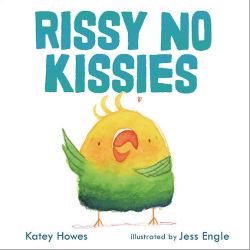
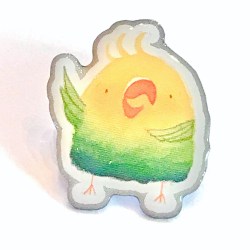

Katey’s latest book, Rissy No Kissies, illustrated by Jess Engle, releases March 2, 2021 with Carolrhoda Books, and has already received a starred Kirkus review and glowing recommendations from teachers, psychologists, and consent educators for its messages of autonomy, consent, and acceptance.

Katey lives in Bucks County, Pennsylvania with her husband, three ravenous readers, and a pup named Samwise Gamgee. You can find her on the screened porch with a notebook and a bowl of Moose Munch—or find her online at kateyhowes.com, tweeting @kateywrites, and on Instagram @kidlitlove.

Katey is giving away a signed copy of RISSY NO KISSIES and a custom enamel Rissy the lovebird pin.

Leave one comment below to enter.

You’re eligible to win if you’re a registered Storystorm participant and you have commented once below.

by Diana Murray

It seems only natural to start writing a story as soon as you know the beginning. But since the beginning and the ending need to be connected, doesn’t it make sense to figure out the ending first? That way you’ll know what you’re moving toward. But you often can’t work out the ending till you know the middle! I don’t mean every single thing that happens in between. But just that exact middle point. The middle can consist of a “black moment” before a final solution, or it can be some other big turn of events. Even in plotless, lyrical concept books, there is almost always an arc of some kind, and the middle needs to pop.

I know, I know. This challenge is all about creating ideas. Aren’t I putting the cart before the horse? Well, the thing is, once you catch an idea and write it down, it kind of takes on a life of its own. It will start sparking other similar ideas. It might branch off into something new or it might rustle up a distant memory. Your mind might ask questions about your idea, or posit possible story directions. Write everything down! I like to collect ALL those musings and nestle them right under the ideas in my file. Ideas always generate more ideas and questions generate more questions! Use that to your advantage.

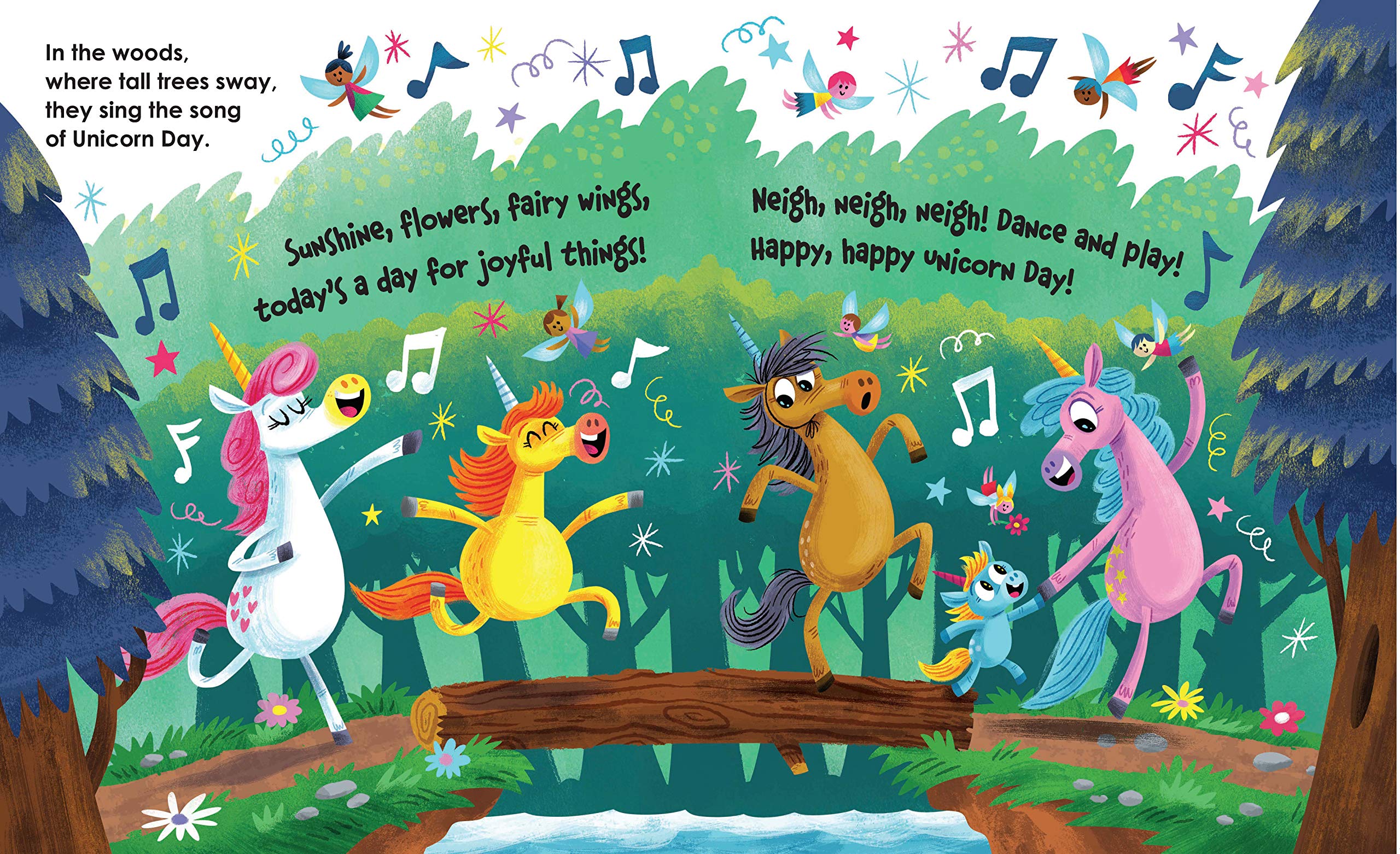
Anyway, lots of people out there are successful “pantsers”, but I personally find that having a plan is the most efficient way for me to work. Here are the first few stages I typically go through, from idea to first draft. I’ll use “Unicorn Day” as an example (with actual snippets from my original idea file). As you can see, my ideas often begin with a title.

I have an idea. I write it down, but I don’t dive in yet.

Dolphin Party?

This idea came to me after watching dolphins swim around in Orlando. I was thinking about how majestic and almost magical they seem.

I have lots of other ideas throughout the weeks, both related and random. I write them down, but don’t go further than that yet. (Some of them suck. Some are OK. Some are fun, but not marketable. Some feel too common. I don’t assess that until later. For now, at the early idea stage, I enjoy being wild and free! No idea is shunned at this phase.)

Dolphin Daze, Dolphin Day, Five Diving Dolphins, Dolphin Princess, Unicorns of the Sea
Under where? Underwear! – wordplay? make refrain?

Loose Tooth Blues (song)

Worm Race

Monkey Party? They go “bananas”.

Unicorn Party? Unicorn Day?

etc…

If I find that thoughts keep popping up regarding one of the ideas in particular, I go back to it, and jot down some notes. Perhaps a turn of phrase or a plot point will keep bubbling up. When the same idea keeps nagging at me day after day, I know it’s time to go deeper.

Unicorn Party? Unicorn Day? Describe magical party. “Only three rules”. “Must have fabulous ‘do”?

But what happens??? Maybe a horse comes by and he’s sad. They give him a horn? “Unicorn party! Unicorn party! Everyone’s invited!” Chant of some kind?

Maybe they need someone sensible and horse is the sensible one?
Maybe ALL the unicorns are actually horses? Or the main one? That’s the surprise–fake horn all along?

…(my ramblings continue for several pages)

Once the story starts coming out, I write notes in this sort of crazy, conversational stream of consciousness. Usually, a week or two goes by. Then the answer finally pops out:

The horse sneaks in with a fake horn. Paper horn tied on with string. Nobody knows…until it falls off during celebration.

And that’s my middle. How do I know? It just feels right. And a different person might find a different “middle” even if they start with the exact same title. But anyway, now that I’ve found it, I know where I’m going with the story and I can start fleshing things out more. I often do a rough outline with page numbers before switching to verse. By this time, I’m usually chomping at the bit! I start writing at a galloping pace till I get my first draft down.

When I plan things like this, my initial draft comes out more polished and I tend to have fewer revisions after I’m done. And since I write in rhyme, that’s especially beneficial! Until I figure out that “middle” or that “twist” (and by extension, the ending) I don’t have much to go on, and I risk writing something that meanders or feels slight.

Here are a few other examples of “middles” in my books:

  • ONE SNOWY DAY (Sourcebooks): Two kids and a dog go on a snowy day adventure in this counting concept book. In the middle, the dog steals the snowman’s carrot nose.
  • GRIMELDA THE VERY MESSY WITCH (Tegen/HarperCollins): A messy witch loses an ingredient she needs to make pickle pie. In the middle, she’s forced to use her broom to sweep instead of fly.
  • SUMMER COLOR (Little/Brown): In this color concept book, two kids go on a nature walk on a very hot summer day. In the middle, there is a sudden rainstorm, and a mad rush home.
  • PIZZA PIG (Step-into-Reading/RandomHouse): A pig serves all his customers the perfect animal-specific pizzas in his shop. In the middle, a shy turtle refuses to eat, no matter what he tries.

Enjoy this early idea phase and write down EVERYTHING, without self-critiquing. Just let the ideas frolic in your mind. Soon, you will see which ideas keep nagging at you, and once you get that middle figured out, you’re off to the races! And with all that planning, you’ll have the reins firmly in hand.

For those who don’t know, it was during the very first Storystorm (PiBoIdMo 2009) that I came up with the manuscript that got me my agent. Since signing with her in 2012, I have sold 15 picture books and 2 early readers.

Diana Murray is the author of over a dozen books for children, including GOODNIGHT VEGGIES (HMH, March 2020), a Jr. Library Guild Selection; and UNICORN DAY (Sourcebooks, 2019), a National Indiebound Bestseller. Both of these books will be coming out in board book editions this April. Diana grew up in NYC and still lives nearby with her firefighter husband, two children, and a smarty-pants cockatiel named Bean. Visit her at dianamurray.com.
Diana is giving away one of her signed books (of your choice).

Leave one comment below to enter.

You’re eligible to win if you’re a registered Storystorm participant and you have commented once below.

by Mike Ciccotello

We’ve all heard that critique from an editor, “It’s too predictable.” And then, we pull out the rejection Bingo Card and fill in a spot.

Coming up with an unexpected concept is challenging. There are plenty of ways we can apply this “unexpected” element to a story. It could be the overall concept, a plot point, or even a character. For this post, let’s focus on the concept of your story. For me, it’s typically paired with a bunch of planning and work. What? But, Mike, shouldn’t these unexpected concepts just come to us when we least expect them? Well, just because we used the word “Unexpected” does not mean the idea will unexpectedly come to us. I wish it were that simple. Maybe some magical authors have unexpected ideas suddenly popping in their heads all the time. Good for them. I wish them well. I’m so very, very happy for them. Sigh. Still, the rest of us need to spend a lot of time working toward the unexpected. We need to dig deep to find that special something that makes our story sing.

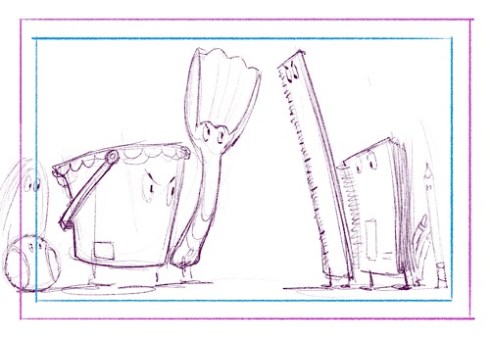
A couple of years ago, my agent asked me to develop a promotional illustration for back-to-school. I immediately started working but knew I needed to get all of my expected ideas out of the way to get to the unexpected. I started drawing a typical back-to-school scene with kids in line at the bus. Which led to adding a dog in place of a child, then an anthropomorphic bus, then an anthropomorphic book with the bus. This process went on for a few days. (Sometimes, this process takes much longer.) Then, one day, I was outside with my kids in their sandbox, playing sandcastle ice cream shop, of course, and the idea appeared in front of me. Well, part of it, anyway. I was staring at a shovel, and it was staring back at me.

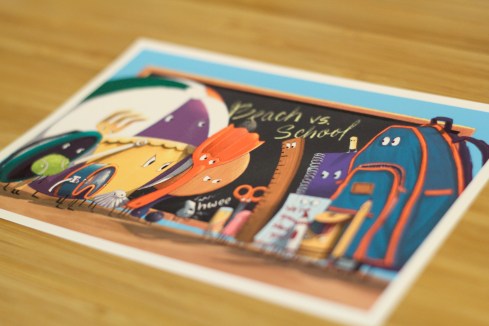
But, Mike, what does a shovel have to do with back-to-school? Absolutely nothing, but it has a lot to do with right before you go back-to-school. I started imagining a shovel and a ruler sizing each other up on the beach. Why not, right? So, I played around with the sketch and added a few more items.

That was the first iteration of BEACH TOYS vs. SCHOOL SUPPLIES. It was a fun concept, and I couldn’t wait to develop it. I did more work on the illustration and ended up with this.

My next author-illustrated book, BEACH TOYS vs. SCHOOL SUPPLIES (FSG/Macmillan), will be washing up on shore near you this June.

And here’s the cover. Did you expect a cover reveal in this blog post?

Now, how do you find YOUR unexpected ideas? Take your time. Work through the expected and then keep going. Turn the expected upside down and shake the change out of its pockets. You may find something unexpected there.

Once you find that surprising concept, you can sprinkle in some compelling characters, build a strong narrative, and add a bit more “unexpected” to the plot. You know, all the easy stuff. 😉

Before I go, let’s try something fun—list five random objects around you. Pick the one with the most personality. Now come up with today’s Storystorm idea based on that character.

Happy writing, and don’t forget to talk to your silverware!

Mike Ciccotello received a BFA with a concentration in painting from Mason Gross School of the Arts at Rutgers University. He is the author-illustrator of the picture book TWINS and the forthcoming BEACH TOYS VS. SCHOOL SUPPLIES (both from FSG/Macmillan). Mike will also illustrate Bridget Heos’s TREEMENDOUS (forthcoming from Crown/Penguin Random House) and CHEESE AND QUACKERS, a two-book early graphic chapter-book series written by Sudipta Bardhan-Quallen (forthcoming from Aladdin/S&S). He is an active member of SCBWI, CBIG, and was a contributing member of AllTheWonders.com. Find him online on Twitter @ciccotello, Instagram @ciccotello and ciccotello.com. Mike is represented by Rachel Orr. Please contact Rachel at rko(a)prospectagency.com.

Mike is giving away an an original inked piece of some of the BEACH TOYS VS. SCHOOL SUPPLIES characters.

Leave one comment below to enter.

You’re eligible to win if you’re a registered Storystorm participant and you have commented once below.

Like this site? Please order one of my books! It supports me & my work.

FLAT CAT is the winner of multiple state book awards, selected by kids!

Enter your address to receive this blog via email.

Join 14.6K other subscribers

My Books

Blog Topics

Archives