by Shirin Shamsi

It may at times appear to writers that their journey is one endless tunnel that leads to nowhere. And it is disheartening, to say the least. Sometimes you wonder if you will ever be published. I know. I have been there. I have keenly felt the disappointments of rejection after rejection. I have felt the downward pull of imposter syndrome. They say that the only writers who succeed are the ones who do not give up. I am living proof.

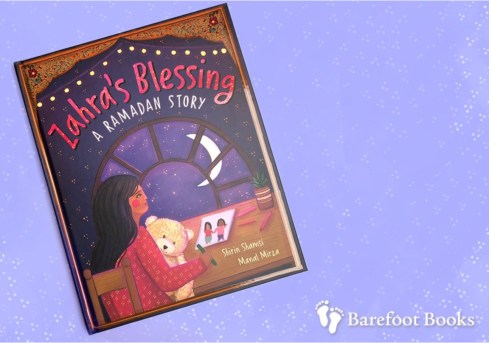
My picture book, ZAHRA’S BLESSING: A Ramadan Story (Barefoot Books, March 2022) is really a testament to perseverance. It was rejected in 2002. Yes, twenty years later this book is ready for the world. The idea for this story first came to me when my children were in elementary school. They are now in their thirties. This publishing story may well be one for the records! And yet I would not change any part of the journey. However unbelievable this may sounds, I feel my story needed those long years for me to grow, and for it to bloom.

Zahra's Blessing cover,

It all began with a teddy bear. Looking back, he was a little like the bear Corduroy. There still is a teddy bear in ZAHRA’S BLESSING. But the bear in ZAHRA’S BLESSING does not speak. He is just a cute toy. In the original story, the teddy bear was the anthropomorphic protagonist and Zahra was the minor character. The story has changed completely from its original form. I still have my rejection letter from 2002, which states that a story with a bear who can speak is really not what the publisher is looking for.

I write very slowly. My stories form over months and years, like layers of rock over eons. That is my writing style. I can’t force myself to write any other way. And I am so grateful to be on this journey. I do love it when STORYSTORM comes around. A new year, with new ideas, and the community of writers gathering in the process of layering, marinating, simmering their ideas in this month of communal creativity.

My writing tip comes from the deepest recesses of my childhood memories. As the middle of seven siblings, we entertained ourselves. My eldest sister often created games for us. I recall one game which originated in the “Katy Did” series, so I call it “What Katy Did”. You will need at least a group of three or four people:

1: Take a blank piece of paper and write a question. Fold the paper over to hide the question and pass it onto a writing partner on your right.

2: Write a word and fold the paper over the word. Again, pass it to the person on your right.

3: You will receive a paper from the person on your left. Now open the paper and write a poem to answer the question, using the word.

I think it’s a simple exercise that frees creativity. Have fun with it. Creativity happens most when we are at play, or relaxed. Take time and embrace your creativity. Whatever your writing style is,  know that it is uniquely yours —and that the world is waiting for your story, for no one else can write it but you.

Shirin was born and raised in the UK. Having lived on three continents, she views herself as a global citizen and now spends her time sharing stories with children of the world. Shirin and her husband have raised six children —three human and three feline—and reside in the suburbs of Chicago. Her debut middle grade novel, Laila and the Sands of Time was published in 2019. She has co-written PLANTING FRIENDSHIP: Peace, Salaam, Shalom (Clear Fork Publishing, 2021) and has two upcoming picture books: ZAHRA’S BLESSING: A Ramadan Story (Barefoot Books, March 2022) and THE MOON FROM DEHRADUN: A Story of Partition (Atheneum, Fall 2022). Visit her at ShirinShamsi.comShirinsBooks.com and follow her on Twitter @ShirinsBooks.

Shirin is giving away a copy of PLANTING FRIENDSHIP.

You’re eligible to win if you’re a registered Storystorm participant and you have commented once below.

Prizes will be distributed at the conclusion of Storystorm.

by Danielle Joseph

I Want to Ride the Tap Tap Cover, colorful Haitian bus, harbor in background

When I started thinking about writing this blog post, I realized that I’ve been gathering ideas for most of my life. Thoughts took me back to my bedroom with the blue carpet outside of Boston, where I’d sit with my sister or a friend and try to figure out what to play. We’d individually come up with a bunch of ideas, write them on little scraps of paper, ball them up, and then stick them in a clay bowl that I’d made in art class. Some top ideas: play house, camping, act out tv commercials and school. Sometimes, when we’d finally decided what to play, a friend’s mom would arrive to pick her up or my mom would yell, “Come set the table!” That was the worst!

pinchpot ceramic bowl, white and yellow

The actual bowl I used to generate ideas as a kid.

When I got older, I continued to collect ideas. In sixth grade, a friend and I threw all sorts of ideas into the bowl on where we should sleep that night for our sleepover because beds would be too boring. The bathtub was the winning idea, but my mom quickly vetoed that, and we ended up with choice number two, my closet. It was cramped, so eventually the beds won out. But it was a lot of fun imagining what it would be like to sleep in some of the odd places that had made the list.

It took me a long time to realize that the gathering of ideas was a game in itself! Then fast-forward to when I taught middle school for a few years after college. I’d come up with a whole bunch of story ideas, throw them into a bowl and tell the students to pick out two ideas and incorporate them into their stories. We always had a blast with this, and the students were so creative.

For my own work writing novels, I keep different files of ideas on my computer, but when I began writing picture books, I found that lists were really helpful too. Since I love to procrastinate, I start with a pre-brainstorm list. It helps to get the ideas flowing and bonus, you don’t have to commit to anything just yet. You can answer any types of questions when you create your pre-brainstorm lists, but here are some suggestions. And you should keep it as a running list, so you can always refer back to it.

Pre-Brainstorm (Create an idea list), jot down:

  • Things you like
  • Specifics that relate to you
  • Hobbies
  • Your culture
  • Upbringing
  • Family life
  • Character traits
  • Major life events
  • Minor events that stick with you

Once you’re done with the list, you are ready to start brainstorming! I call this the hook-up phase and from here you pick two topic ideas from your pre-brainstorm list that you want to further explore, hook-up. When I wrote my picture book, I WANT TO RIDE THE TAP TAP about a boy in Haiti who dreams of riding the Tap Tap bus, I chose location (I love to travel and have lived in a few different cities) and transportation (I’ve collected a few types of toy cars over the years, starting with a handmade wooden one that was given to me as a baby by my dad’s friend).

The Hook-Up (Unification of Ideas)

LOCATION…TRANSPORTATION

Cape Town…Cable Car
Florida…Bicycle
Haiti…Tap Tap bus
London…Double-decker bus
Boston…Subway

Once you pick an item from column one that corresponds with column two, you are ready to brainstorm!

Brainstorm

Again, this can be done in a list format. Just write down anything you think could possibly happen in your story from the mundane to the wacky! And if some of the items don’t make it to this story, add them back to your main idea list and you may use them another time.

Story Grab Bag

Keep all these ideas as a running list. They will go into your story grab bag. You just never know when you might need a new story idea or an idea for a plot thread and when you do, you can look through your lists or your bag or bowl and see where your next match comes form. Sometimes you have a good idea going, but your plot is too thin, so you can pull an idea from your Pre-Brainstorm List.

I hope this gets you generating even more ideas this month and beyond! Happy Brainstorming!

Danielle Joseph is the author of the newly released middle-grade novel Sydney A. Frankel’s Summer Mix-Up and the 2021 CBC Notable Social Studies picture book; I WANT TO RIDE THE TAP TAP. She also has written three young adult novels Shrinking Violet, Indigo Blues, and Pure Red. Shrinking Violet was adapted into the 2012 Disney Channel movie, Radio Rebel. Danielle has a BFA in Creative Writing and an MA in Marketing Communications and Advertising, both from Emerson College. She’s a former middle school creative writing teacher and has been teaching writing workshops for over fifteen years. Danielle was born in Cape Town, South Africa and currently lives in Maryland. Her picture book biography, RUTH FIRST NEVER BACK DOWN debuts Fall 2023 from Lerner. Visit her at daniellejoseph.com and follow her on Twitter and Instagram @daniellejoseph1.

Danielle giving away one signed copy of I WANT TO RIDE THE TAP TAP and a second prize of a 30-minute consultation where I can answer any writing or industry questions or talk about story ideas. These are two separate prizes!

You’re eligible to win if you’re a registered Storystorm participant and you have commented once below.

Prizes will be distributed at the conclusion of Storystorm.
by Laura Lavoie

It’s the halfway point! If you haven’t come up with 14 ideas yet, don’t despair. My goal is for you to leave this post with not one, not two, but three new story ideas.

When I’m brainstorming, I almost always come up with a title first and see if I can spin a solid story from there. There are many methods I use to brainstorm catchy titles, but today I’m going to share three—with an exercise to try for each. Ready?

Title Trick #1: Add a Twist!

I like to make lists of classic titles and/or common phrases and see if I can spin a fun new story by swapping out a word or two. Our fearless Storystorm founder, Tara Lazar, did this with her picture book LITTLE RED GLIDING HOOD (illustrated by Troy Cummings). Switch up the word riding for the rhyming gliding and voila! Little Red is now the star of her own figure skating story.

Here are a few more ways you can create a twisted title:

Instead of substituting a rhyming word into a classic title, try a totally wacky, unexpected word like Corey Rosen Schwartz did with THE THREE NINJA PIGS (illustrtated by Dan Santat).

You can also put a twist on a common phrase. See: Tammi Sauer’s BAWK AND ROLL (also illustrated by Dan Santat) or Kelly DiPucchio’s NOT YETI (illustrated by Claire Keane).

Alternatively, put a spin on a popular movie title, like author-illustrator Ethan Long did with FRIGHT CLUB.

Brainstorming Exercise: Grab your notebook. Write down a few classic fairytales, well-known movie titles, and familiar phrases that come to mind. What fun new words could you use to come up with a twisted title?

Title Trick #2: Make it Roll Off the Tongue

Another favorite trick is to utilize rhyme, alliteration, consonance, or assonance… or a combination of two or three of these for bonus points. For my debut picture book, VAMPIRE VACATION, illustrated by Micah Player (coming in May from Viking), I went with an alliterative title.

In this case, I actually didn’t brainstorm the title before I drafted the manuscript. (If you want to know how I came up with the idea for this story, you’ll have to read the PBCrew22 Storystorm post later this month!)

Once I had written a story about a little vampire who dreams of sandcastles, snorkeling, and surfing, I brainstormed a few working titles, including “Vampire Loves the Beach”… but the alliteration in VAMPIRE VACATION sounded so much better, so that one stuck.

Other alliterative titles I love? MEENA’S MINDFUL MOMENT, written by Tina Athaide and illustrated by Asa Gilland, and HARDLY HAUNTED by author-illustrator Jessie Sima.

Here are more examples of ways you can create a title that rolls right off the tongue:

Go for a title that rhymes, like THANK YOU, OMU, written and illustrated by Oge Mora, or NOT QUITE SNOW WHITE, written by Ashley Franklin and illustrated by Ebony Glenn.

Think up a title that goes heavy on assonance and consonance, like Ashley and Ebony’s sequel story, BETTER TOGETHER, CINDERELLA, which features the repetition of the soft ‘e’ (assonance) and the ‘r’ sound (consonance).

Create a fun wordplay mashup like author-illustrator Lucy Ruth Cummins did with VAMPENGUIN.

Brainstorming Exercise: Write some lists of alliterative words, rhyming words, or words that share similar sounds. Any fun title ideas jumping out at you? Any words you can smoosh together to create a clever concept?

Title Trick #3: Get Readers Curious

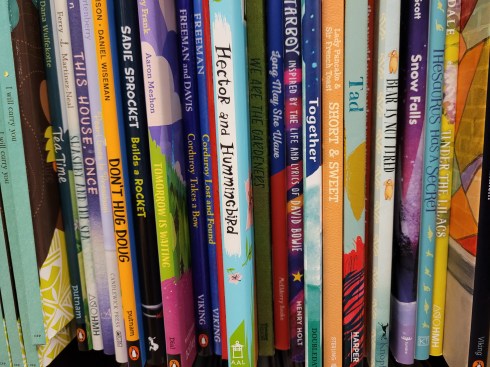
I love titles that make me wonder, what’s that about? Think about it: you’re browsing shelves in a bookstore and catch a spine out of the corner of your eye. If the title automatically elicits curiosity, you’re likely to take a look, right?

DON’T HUG DOUG, written by Carrie Finison and illustrated by Daniel Wiseman, gets bonus points. Not only does it rhyme, but it makes me wonder, WHY shouldn’t I hug Doug? Of course, we know this is a story about consent, but it *could* be a story about an irritable porcupine or a kid who burps when you squeeze him.

Here are some other recent titles that have made me go Hmm…

  • TOO MUCH SLIME! written by Frances Gilbert and illustrated by Vin Vogel
  • THE NEW KID HAS FLEAS, written by Ame Dyckman and illustrated by Eda Kaban
  • I DO NOT LIKE YOLANDA, written and illustrated by Zoey Abbott
  • ON ACCOUNT OF THE GUM, written and illustrated by Adam Rex

Brainstorming Exercise: Create a list of problems a character could have. How could you spin that problem into a curious title like the ones above?

My challenge to you today: come up with at least one idea for each of these title tricks. Even if it’s just the title, that counts. Come back to it later and see what kind of magic you can make!

Laura Lavoie writes humorous, pun-filled picture books. She can also tap dance, tell terribly cheesy jokes, and bake a mean chocolate chip cookie. Laura’s debut, VAMPIRE VACATION, (illustrated by Micah Player) will be out from Viking in May 2022. She has more books on the way in 2023 and 2024! You can find Laura on Twitter and Instagram @llavoieauthor.

Laura is donating a picture book critique + a follow-up 30-minute Zoom chat to one participant! Humor and puns are her specialties, but she’s happy to talk about anything writing- or publishing-related during the call.

You’re eligible to win if you’re a registered Storystorm participant and you have commented once below.

Prizes will be distributed at the conclusion of Storystorm.

by Julia Mills


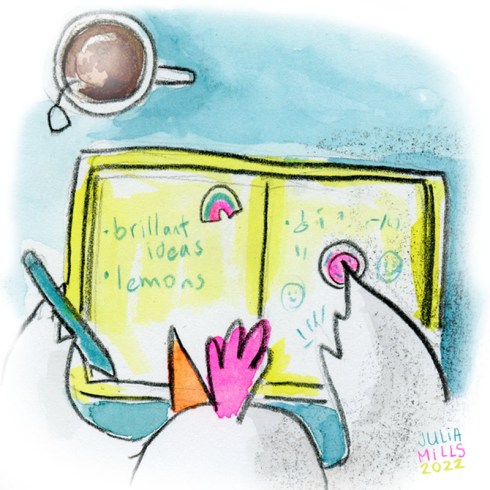
1. I like to start with a list. Lists are much less intimidating than paragraphs. You can use numbers, letters, bullet points, stickers. I sometimes change midstream.

2. I like to make lists of very random words, whatever comes to mind. It’s ok if some of them are repeats. You may find that the same word creeps in again and again. Be suspicious of this word. It may be telling you something.

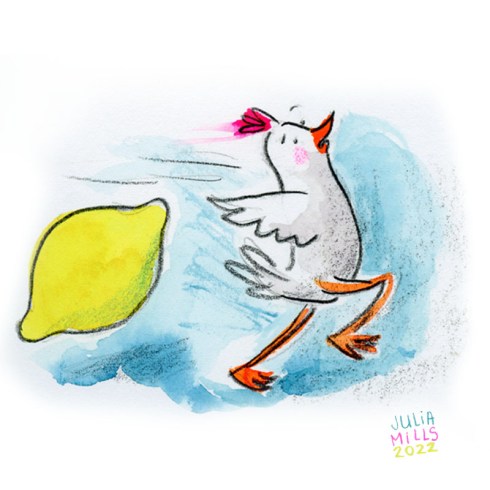
3. Lemons…

4. When you are brainstorming, no idea is bad. Write it down. Sometimes I try to make a bad idea worse. Take it to the limit. You can always go backwards.

5. If you can’t think of anything to write, write how you feel.

6. I’m feeling hopeful today. I’m hopeful that some great picture book idea will land in my brain.

7. Look at your words. I mean really look at them. What shapes do they make? The “aha!” moment for my story occurred when I saw a turtle in the letter “u” of “stuck”.  I like to make very rough doodles. It’s OK if you don’t draw, doodling is for everyone. Doodle like a Kindergartner with a sparkly crayon.

7.5 Say your words. How do they feel? Are they crunchy or smooth? Are they funny or serious?

8. Take your words to a different place. Sit on the floor. Do they look different here? Take them to the shower but only if your paper is waterproof.

9. Add things to your process that make you happy. For me that means colorful pens, stickers and tea. Tea is very important.

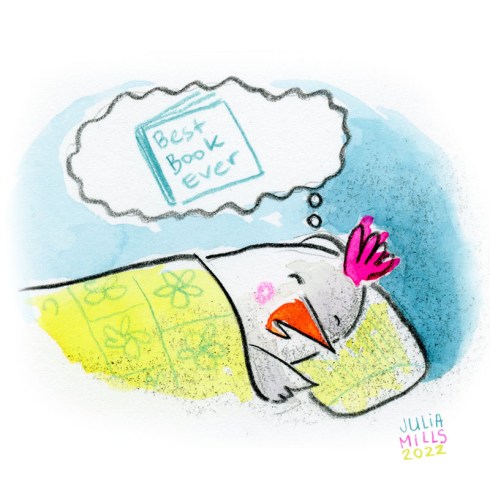
10.  If you are really frustrated, take a nap. When you are half asleep, think about your words. Imagine them in a book. Don’t stress over this. Just read the book to yourself in your half sleep. Read them like you would read them to a child. You are the child. You are putting yourself to sleep. It’s ok, you are tired.

11. Ignore your words for a while. If you have terrible handwriting like I do, deciphering your words months later is half the fun.

12. Come back to your words after you forget them. What do they make you think about now? What questions pop up when you look at them?

13. Even if you write ONE word, you have written something. You deserve a nap, a sticker, a cup of tea, or whatever makes you happy.

Julia Mills is a writer, illustrator and kindergarten art teacher. Her debut picture book I AM STUCK (Clarion, Fall 2023) was dreamt up on the very last day of Storystorm in 2020. She has yet to write a book about lemons. You can find her at jamills.com and as JMillsPaints on Instagram and Twitter.

Julia is donating a 30-minute Zoom idea chat or art critique.

You’re eligible to win if you’re a registered Storystorm participant and you have commented once below.

Prizes will be distributed at the conclusion of Storystorm.
by Melissa Roske

Inspiration is weird. It comes at the strangest times, in the strangest places. The inspiration for my middle-grade novel, KAT GREENE COMES CLEAN, came stuffed inside a fortune cookie. Here’s what it said:

A winsome smile is your sure protection.

I hadn’t a clue what this meant—or how it applied to me—but the fortune had a nice ring to it, so I decided to keep it. Several years later, I was going through my desk drawer when I found the fortune. For reasons I can’t begin to understand or explain, an image of a sassy 11-year-old New Yorker leapfrogged into my brain and I knew I had to write about her.

I wrote and wrote (and wrote), until I had a clearer picture of who this character was, and what mattered to her. I slowly added parents, a best friend, a quirky school in Greenwich Village, a stepmom, a little brother, a crush. Before I knew it, I had created Kat Greene’s world—and a first draft of the novel. I found an agent (not easy), landed a book deal (harder still), and, on August 22, 2017, was finally able to call myself a published author. It was a dream come true!

Unfortunately, the idea for my second middle-grade novel didn’t come as easily. Images of sassy protagonists didn’t leapfrog into my brain, and all the fortune cookies in the world couldn’t help me this time. Clearly, I’d used up all my good ideas in the first book. I was a one-hit wonder, I decided. The kidlit equivalent of Milli Vanilli.

Immobilized by fear and self-loathing, I went into a very dark place. Then the pandemic hit, and the place grew even darker. The more despondent I felt, the more immobilized I became. Was this writer’s block, I wondered—or something more sinister?

As most writers eventually do, I turned to Anne Lamott’s iconic craft book, BIRD BY BIRD, for guidance. I had resisted this book for years because—let’s be honest here—it seemed way too touchy-feely for my cynical New York taste. Too New Age-y. Too Californian. But I was wrong. Sure, Lamott uses words like “abundance” and “self-compassion,” but her book turned out to be hysterically funny and, more important, offered me more than humor. It gave me hope. Hope that I wasn’t a one-hit wonder; that I had the ability to write but had lost my confidence, somewhere between “fear” and “self-loathing.” I’d also forgotten how joyful writing can be, especially when you learn to tune out the judgy-wudgy voice inside your head that says, “You suck!” and “You have no business calling yourself a writer.”

It didn’t happen overnight, but after a while “you suck” gave way to “I can”. I revised two novels and wrote a short story—“Grandma Merle’s Last Wish,” which will appear in COMING OF AGE: 13 B’NAI MITZVAH STORIES, a Jewish MG anthology released on April 18 from Albert Whitman & Co.

I also realized that fear and self-loathing can be kicked to the curb, but only you’re ready and willing to do the work. And if you’re not…?

Crack open a fortune cookie. You never know what’s inside.

Melissa Roske is the author of KAT GREENE COMES CLEAN (Charlesbridge, 2017) and the short story “Grandma Merle’s Last Wish,” which will appear in the forthcoming Jewish middle-grade anthology, COMING OF AGE: 13 B’Nai Mitzvah Stories (Albert Whitman & Company, 4/19/22). A native New Yorker, Melissa is a contributor to the popular MG blog From the Mixed-Up Files of Middle Grade Authors, including this post she wrote about #Storystorm2021. Learn more about Melissa on her website and follow her on Twitter, Facebook, and Instagram.

Melissa is giving away three prizes to three separate random winners—a signed copy of KAT GREENE COMES CLEAN, a copy of COMING OF AGE: 13 B’NAI MITZVAH STORIES (when it becomes available on 4/18/22), and a middle-grade query critique!

You’re eligible to win if you’re a registered Storystorm participant and you have commented once below.

Prizes will be distributed at the conclusion of Storystorm.

by Heidi Tyline King

I hesitate to give away my treasure trove of ideas, but let’s be honest: There are more people dead than alive, meaning that there are plenty of obituaries—and people who led insanely interesting lives—for all of us writers to mine for stories. Obituaries are mini biographies readymade for children’s nonfiction picture book writers. I began reading obituaries for fun but they have become integral to my writing process.

First, they’re great sources of inspiration for good writing. When I get stuck on how to mark time quickly or what phrase to use as a transition between unrelated life events in a story, I spend time reading obits for examples. They’re also ideal for helping writers identify a singular event to chronicle in a life. You don’t always have to write a birth-to-grave story; consider the life of Katherine Johnson, the mathematician whose work for NASA became the central narrative for the popular book, Hidden Figures. Papers like The Guardian or The New York Times are filled with obituaries exuding strong writing and examples of how to distill a life down to its essence in a few hundred words or less.

I also turn to obituaries for motivation. I am full of self-doubt and “poor me”s, especially when my writing gets stuck. In the name of “research,” I’ll pull up my file of obituaries and begin reading about the ordinary people in the world who did extraordinary things—despite advanced age, disabilities, or a lack of education and resources. Their stories and ability to overcome keep me going.

And then there’s the most obvious reason for reading obituaries: subject matter. I am currently finishing my second children’s book on John Bonner Buck, an expert on firefly research and bioluminescence, whose obituary I clipped way back in 2005. Buck’s life’s work centered around a question that I believe all children ask: Why do fireflies flash? My book explains how Buck found the answer and went on to become a preeminent scientist in the field of bioluminescence.

To make the most of obituaries in your work, I suggest the following:

1.     Scan obituaries for compelling characters.
I skip the celebrities and look for people that I haven’t heard about, people who made notable achievements in a particular field of study, worked behind the scenes on a well-known event, or devised a new way of doing things. Don’t forget to delve into the archives for the forgotten stories of people who deserve to be known.

2.     Set Google Alerts to narrow interests.
Sifting through obituaries is one way to find interesting subject matter. Another is to set a Google Alert and have the search engine curate content for you. You’ll get obituaries delivered to your inbox about people working in fields that are of most interest to you. Every now and then, you’ll get a gem that you would have never sniffed out on your own.

3.     Branch out and look for other sources.
Once you’ve identified a person to consider writing about, do a quick search for other sources to learn more about their contributions. Obituaries in other publications and articles about their work help you compile research to consult when you’re ready to write and help you build a stronger story. For example, I ran across an article about Buck describing him as a “scientist’s scientist.” The idea that he loved process and the practice of science became an underlying subtheme in my book.

4.     Discover secondary themes.
Speaking of subthemes, a good biography has several running through throughout. In my latest picture book, SAVING AMERICAN BEACH: The Biography of African American Environmentalist MaVynee Betsch, the story centers on her activism to save a beach, but it’s the subthemes of music, environmentalism, discrimination and racism, and resilience that carry the story.

5.     Write in the genre that’s most comfortable to you.
Above all, obituaries are simply sources of inspiration. I have a degree in journalism so writing nonfiction is what I’m best at doing. But obituaries can inspire writing in genres from poetry to science fiction.

The next time you’re struggling with characters, plot, motivation, and writing succinctly, take a break and scan the day’s fresh batch of obituaries or leaf back through your file for ideas. There are people whose stories are waiting to—and worthy of—being told.

Heidi Tyline King writes nonfiction picture books from her home in Tallahassee, Florida. Follow her on Instagram @heiditylineking and visit her at heiditking.com.

Heidi is giving away a copy of her book, SAVING AMERICAN BEACH.

Leave one comment below to enter.

You’re eligible to win if you’re a registered Storystorm participant and you have commented once below.

Prizes will be distributed at the conclusion of Storystorm.
by Kelly Mangan & Adrea Theodore

‘Write what you know’ is a popular refrain we’re used to hearing as writers. And for good reason! When you write from your own, lived experience, there’s an honesty and authenticity to your words that’s hard to duplicate.

But what do you do when a lived experience is rooted in a difficult or uncomfortable reality? How do you translate those sorts of experiences into a story for kids? And…should you?

There are no easy, universal answers to these questions. But hopefully OUR answers will help as you dig into your own life experiences for story inspiration.

Why write about reality?

ADREA: For me, it starts with the story. If there’s a particular story that I want to tell, I have to consider if using the framework of a real-life experiences is the best way to do it. With my debut picture book, A HISTORY OF ME, I had a story to tell about a young girl being the only person of color in class during lessons on slavery and segregation. I had a story to tell about that same girl growing in her understanding of and appreciation for her heritage, one that includes an ancestor who was enslaved in this country. It might be difficult to write about, but not nearly as difficult as actually having the experience. This story is also worth sharing, since I know there are other kids out there experiencing the same or similar things right now.

KELLY: I write about challenging realities to comfort and validate kids going through similar situations. But also…? Because I want encourage kids to think about why things are the way they are, and to question if they could be different. For example, I was the fat girl growing up. I never once saw a fat character in a picture book who wasn’t either a bully or a buffoon. Sadly, that remains largely unchanged in children’s media (fat is often used as a visual shorthand for a whole slew of negative character traits). So I often seek out story ideas which confront this paradigm.

How do I know if a topic is appropriate for kids or not? 

KELLY: I think virtually any topic can be broached with kids if done in a thoughtful, developmentally-appropriate way. I have two children who are picture-book-age, so I often think about how I’d explain a difficult topic to them. What questions or concerns do I anticipate them having? How could I answer those in a way that is honest and honors their intelligence, but which isn’t overly upsetting? And perhaps most importantly: What’s the overarching message or feeling I want kids to take away from this story?

ADREA:  I definitely agree. The pages of a book can be viewed as a safe space to hear about or see things that can be scary, difficult to handle, or hard to explain.

How do you address serious topics in children’s books in an age-appropriate way?

ADREA:  My approach?  First, try to see it—whatever “it” is—from a kid’s perspective. Remember what it was like to be that age; and if it’s from your own experience, remember what or how you felt.  What was most important to you?

Second, simplify “it” in terms that would make sense to a young person. Consider your words, phrases, sentence structure, and metaphors. Keep in mind that the illustrations will likely carry as much weight as the words, especially for those who aren’t yet reading on their own. As an example, in A HISTORY OF ME, there is a scene that takes place on a playground because these spaces are familiar to young children. The playground is known as a place for fun, but it becomes a place of racial insensitivity; and this juxtaposition is unsettling, but necessary.

KELLY: I always start from a personal experience, like being the only fat girl in my ballet class. Then I dig into the little, concrete details of that experience: the disdainful way other students looked at me; the snickers of the parents; my own mother’s fear of me performing and embarrassing myself. I needn’t ever say “people didn’t think she could be a dancer because she was fat”– for one, because it’s unnecessary: children are smarter, more nuanced readers/listeners than adults often give them credit for. And for two, because focusing too much on the pain can actually be damaging to kids rather than empowering. It’s a tough balance.

Does writing about reality always have to be sad? 

KELLY: Absolutely not! I don’t write about serious topics to make kids sad. I write about them to instill hope, foster compassion, and to make kids feel seen. There has to be light at the end of the tunnel. Ultimately, I’m trying to distill my experiences down into something useful for kids.

ADREA:  When we write about a serious topic, one that is uncomfortable or difficult in real life, we should consider how to present it in such a way that it’s beneficial to our audience.  Is this something that can be used as a mirror for some kids or a window for others?  Can it enhance empathy or cultivate kindness? And is there a way to leave the child reader with hope, regardless of the situation?  The onus is on the writer to find that hope first and then bring it out in the text so the reader can see it and grab hold of it.

ADREA THEODORE is a mom, a pediatrician and a children’s book author from North Carolina.  Her debut picture book, A HISTORY OF ME (Neal Porter Books/Holiday House) is available for pre-order now and in stores soon (January 18, 2022)! When not writing, Dr. Theodore works in a local child advocacy center (CAC) with children being evaluated for abuse or neglect. Every child she sees there also has a story to tell. Follow her on Twitter @adrea_theodore or check her website for upcoming event info: adreatheodore.com.

KELLY MANGAN an author and illustrator of picture books, middle grade, and young adult stories. She was a 2021 #PBChat mentee, and recently won an honorable mention in the KidLit411 annual banner contest. Though originally from the south, she now resides in snowy Vermont with her partner and two kids. When she’s not writing or drawing, you’ll likely find her weaving on a rigid heddle loom, reading anything with Squirrel Girl, or watching Star Trek with a cup of Earl Grey, hot. Follow her on Twitter @KellyAMangan or visit authorkellymangan.com for more info.

:

We are giving away not one, but TWO fabulous prizes!

One picture book critique from Kelly and one copy of A HISTORY OF ME to two random winners.

Leave one comment below to enter.

You’re eligible to win if you’re a registered Storystorm participant and you have commented once below.

Prizes will be distributed at the conclusion of Storystorm.

by Katey Howes

I’m going to be honest with you all. In the past twenty months, I have had tons of ideas. But I have not written all that much.

And I was really upset about this for quite some time. Frustrated with myself. Disappointed in myself. Worried I’d never get back in the swing of moving from inspiration to actualization.

Then I reflected on a conversation I’ve had with countless students during school visits. We talk about my book BE A MAKER. We discuss how there are many kinds of makers in the world: writers, artists, robotic engineers. Chefs, directors, architects. Minecrafters and perfumiers and lawmakers.

I tell the kids that the very best, among all kinds of makers, have one simple thing in common.

A notebook.

Because making anything requires resources. Time. Money. Materials. The right team. The right supports. The right equipment. The right level of skill, focus, or knowledge. The right level of faith in yourself. You may not have the resources you need right now. But you can get them later. Days later. Years later. Half a lifetime later. And when you do, you’re going to want that idea close at hand.

So you put it in your notebook.

Like DaVinci. Like Einstein. Like a Storystormer.

The kids often worry that the ideas will have gone bad, have worn out, by the time they have the resources to bring them to fruition. They aren’t alone in thinking this. I reassure them (and myself) that that isn’t the case. That it is natural for ideas to lay dormant, like seeds, until the right conditions surround them.

Seeds can wait for water, I tell them. They can wait for spring. They can wait for decades—centuries!—if stored properly. So can your ideas.

After having this conversation many times, I wrote “Seed/Idea” in my notebook.

After many more months listening to kids, taking poetry courses, learning to believe that my words and experiences matter, I realized I had acquired the right resources to turn this idea into a book.

And so I wrote A POEM GROWS INSIDE YOU. It’s the tale of a child who holds a seed of a poem close to their heart, not sure how to put it into words…until the rhythm of raindrops patters onto their skin, seeping through, bringing that long-quiet idea to life. It wraps roots and vines through the character’s body, and then, like a seedling questing for the sky, it reaches for the light.

That part is hard for me. When my stories want out, I want to keep them to myself. No one can dislike them, criticize them, judge them, if I keep them inside, in the dark.

But I remind myself (with this book, among other methods) that other people are some of the greatest resources for shaping and supporting my creations, for pruning and trimming and encouraging my seeds to grow.

I am so blessed to have had the courage to let A POEM GROWS INSIDE YOU out into the light, to be seen and pruned and fertilized first by my critique partners, then by my agent, Essie White, and at last by the incredible team of book gardeners at The Innovation Press. I am astounded at the ways illustrator Heather Brockman Lee has brought it to verdant, blooming, bursting-ripe life. (Take a sneak peek here! You’ll be glad you did.)

And now I want to use this book, the process of its dormancy and its growth, to reassure and advise all of you. Especially now, at a time when, I suspect, bringing ideas to life is tough for many of us.

Do not despair or give up.

Do not judge or become frustrated with yourself.

Instead:

  • Store the seeds of your ideas.
  • Trust that they are safe in dormancy. That it is natural.
  • Check on them once in a while. Remember you have them.
  • Assess the resources you need to grow them. Time to yourself? A class on meter? A brainstorming session with trusted friends? Research? Chocolate? Mentor texts?
  • When they begin to take root, to sprout and to reach—be brave. Let them into the light.

I look forward to seeing how they bloom.

Katey Howes is a haphazard gardener, a good rhymer, and a fun mother. She’s also the award-winning author of RISSY NO KISSIES, BE A MAKER, and a growing assortment of other books. In 2022, Katey is looking forward to the release of A POEM GROWS INSIDE YOU, illustrated by Heather Brockman Lee (The Innovation Press, Fall 2022) and WOVEN OF THE WORLD, illustrated by Dinara Mirtalipova (Chronicle, Fall 2022). You can find Katey on Twitter @kateywrites or on IG @kidlitlove, or check out her author page kateyhowes.com.

Katey is giving away a signed copy of one of her books…or a picture book critique. Whichever the random winner prefers.

Leave one comment below to enter.

You’re eligible to win if you’re a registered Storystorm participant and you have commented once below.

Prizes will be distributed at the conclusion of Storystorm.

by Kirsten W. Larson

Today we will not be talking about generating ideas.

Nope. Not even for a minute.

You think I’ve forgotten the whole point of Storystorm.

I assure you, I haven’t.

You see, I don’t think ideas have to be generated. They’re already out there just waiting for you to catch them. Your job is to pay attention, to put up your story antennas and jostle them around until the static gives way to a steady stream of inspiration.

That’s what I want to focus on today—fine-tuning your antennas. Because here’s the thing, if you train your antennas just right, you’ll pick up the story ideas only you can write. The ones that resonate with your soul and speak to the deepest part of who you are. The ones that capture your heart and energize you, carrying you from crappy first draft through countless revisions.

Those story ideas are gold. And they are begging for you to notice them.

Take the idea for my debut picture book WOOD, WIRE, WINGS, illustrated by Tracy Subisak, the true story of engineer Emma Lilian Todd. Lilian Todd was the first woman to design a working airplane, which flew in 1910. That idea for that book came straight out of the pages of ROSIE REVERE, ENGINEER by Andrea Beaty, illustrated by David Roberts.

Thousands, perhaps millions of people have read ROSIE REVERE. Why did I pick up on the idea of Lilian Todd when so many others hadn’t?

My antennas were up.

I used to work for NASA, and I’ve lived and worked around airplanes my whole adult life. I was interested in aviation. I was fascinated by underdogs. And I was curious enough to think, “Who is this Lilian Todd, and why haven’t I heard of her?”

Step 1: Embrace curiosity

Your first task today is to make a list of topics that interest you and new things you want to learn about. Consider past jobs, your hobbies, your childhood favorites. (If you’ve read my latest picture book, A TRUE WONDER, illustrated by Katy Wu, you know I was a huge Wonder Woman fan as a kid. I had the Underoos to prove it.) Think about the types of movies, TV shows, and books you like. What are your cherished family and cultural traditions? What have you been dying to learn more about?

Now keep pursuing those interests and see what ideas crystalize out of thin air.

Step 2: Consider your values and truths you know

Now let’s make a list of your values and truths you know. These speak more to theme than subject matter, but every good picture book needs both.

I believe underdogs can change the world, and I love writing about them. All my protagonists are underdogs, including Wonder Woman, who was poo-pooed by male comics creators and then parents and teachers.

The label also fits Cecilia Payne, the real-life subject of my next picture book, THE FIRE OF STARS, illustrated by Katherine Roy. When Payne discovered what stars were made of, a well-known male astrophysicist flat-out told her she was wrong. French art curator Rose Valland, who secretly spied on the Nazis for years, is an underdog too. She’s the subject of my first middle grade graphic novel, THE LIGHT OF RESISTANCE, illustrated by Barbara McClintock.

My antennas are always scanning they sky for stories about people who defy odds and expectations.

There are other ideas that fascinate me too, like being a scientist or inventor is about passion and persistence not genius. I also gravitate to the idea of subverting notions about what heroes look like.

Getting in touch with your values and truths helps train your antennas in the right direction.

Step 3: Mash it up

What if you combine one of your truths/values with one of the topics from your first list? Maybe you mash up “pirates” with “family is who you choose.” Does an idea start to form?

I’ll be honest, every time I finish a project, I worry I’ll never find another just-right idea. But I know if I indulge my interests and curiosity and reflect on my values, the ideas come in crystal clear.

Now get out there and pick up some golden ideas.

Kirsten used to work with rocket scientists at NASA. Now she writes books for curious kids. She is the author of the picture books WOOD, WIRE, WINGS: EMMA LILIAN TODD INVENTS AN AIRPLANE, illustrated by Tracy Subisak (Calkins Creek), A TRUE WONDER: The Comic Book Hero Who Changed Everything, illustrated by Katy Wu (Clarion), and THE FIRE OF STARS: The Life and Brilliance of the Woman Who Discovered What Stars Are Made Of, illustrated by Katherine Roy (Chronicle, 2023), and the middle grade, graphic nonfiction, THE LIGHT OF RESISTANCE, illustrated by Barbara McClintock, (Roaring Brook, 2023), as well as 25 nonfiction books for the school and library market. Find her online at Kirsten-w-larson.com or on social media @kirstenwlarson.

Kirsten giving away an hour Zoom call you can use any way you like. You could use it for career coaching, a critique, or just an “ask me anything” session.

Leave one comment below to enter.

You’re eligible to win if you’re a registered Storystorm participant and you have commented once below.

Prizes will be distributed at the conclusion of Storystorm.

by Josh Funk

So here’s the thing: I’m kind of a fraud. This is the fifth time I’ve written a guest post for Storystorm and it’s time to come clean.

Storystormers, I lied to you.

I never took my own advice before sharing it with you.

Let me explain.

Back in my first ever Storystorm post, I suggested you should think of something you want to see illustrated. I strongly implied that I got the idea for the Lady Pancake & Sir French Toast series by thinking how fun it would be to see a Pancake running through Broccoli Forest or a piece of French Toast skiing.

But that’s not how I got the idea for the book. I didn’t start brainstorming ideas by thinking of things I wanted to see illustrated until after I wrote that post.

During another Storystorm, I suggested spying on people in coffee shops…or better yet…spying on artists on Instagram. And while I do love to snoop on the #kidlitart IG hashtag, I didn’t truly start doing that until after I made that suggestion.

Another time, I suggested that you should think of the worst idea for a book and go write that. I somehow managed to convince you that I got the idea for Lady Pancake & Sir French Toast by using that approach (I really milked that book for Storystorm posts, didn’t I?).

But as you now know, that’s not how I got the idea. I didn’t start trying to think of bad book ideas as a source for new stories until after that post.

And in perhaps my most ludicrous Storystorm post, I suggested using autocorrects and typos to generate ideas. As you probably suspect, I never did this before writing that post. It was absolutely not a tried-and-true method of idea generation.

So as you can see, I lied to you. I was a genuine fraud.

But here’s the thing. After I wrote those posts…after I made those Storystorm suggestions…I did start to heed my own advice.

I got the idea for the IT’S NOT A FAIRY TALE series (illustrated by Edwardian Taylor) by thinking that it would be really fun to see the characters in a book arguing with the person reading the book.

I got the idea for DEAR UNICORN (2023, illustrated by Charles Santoso) from artists posting on social media on Unicorn Day (which also happens to be my birthday).

I got the idea for my poem The Ballad of Mr. Zibb (about my cat that poops all over the house) by thinking of an idea that should never get published (and frankly, I don’t really want to see that one illustrated)—although it is available as part of a Writers’ Loft anthology.

But maybe best of all was when I made the typo writing ‘my best fiend’ when I meant to write ‘my best friend.’ I began to wonder what a book called My Best Fiend would be about. I began wondering what happened to the R in friend to make it fiend. If something happened to that R, what happened to the rest of the R’s? Eventually, that led to an entire book written without the letter R, called MY PET FEET which comes out later this year (illustrated by Billy Yong) in which a little girl’s pet ferret turns into pet feet as she frantically searches for missing R’s throughout her mixed-up town.

So now you’re probably thinking, “Great, Josh. You told me how you lied and didn’t take your own advice until after you gave it to us. How does that help me now?”

Here’s how: I want you to think of the advice you give to other people that you often forget to take yourself. We all do this. What is the inspiring advice you tell others to follow…but need to do a better job of following? Today, I want you to utilize that advice.

Better yet, I want you to share that advice in the comments for ALL of us to learn from. What is your one piece of writing advice that you yourself wish you followed more?

You might be thinking, “But, Josh, doesn’t this just mean we, the Storystorm community, will essentially be writing this Storystorm post for you?”

And to that I answer, “Maybe. But maybe this will turn out to be the greatest Storystorm post TO RULE THEM ALL!!! Bwahahahaha!”

(Or maybe this post is another lie in an excruciatingly long series of despicable deceptions…)

Josh Funk is a software engineer and the author of books like the Lady Pancake & Sir French Toast series, My Pet Feet, the ​It’s Not a Fairy Tale series, the How to Code with Pearl and Pascal series, the A Story of Patience & Fortitude series, Dear Dragon, and more.

Josh has written a comprehensive “Guide to Writing Picture Books” that’s available for free on his website’s Resources for Writers section.

For more information about Josh Funk, visit him at joshfunkbooks.com and on Twitter, Instagram, and Facebook at @joshfunkbooks. (Photo credit: Carter Hasegawa.)

Josh is offering one of either a picture book critique or a signed copy of any of his books to THREE lucky winners.

Leave one comment below to enter.

You’re eligible to win if you’re a registered Storystorm participant and you have commented once below.

Good luck!

Like this site? Please order one of my books! It supports me & my work.

FLAT CAT is the winner of multiple state book awards, selected by kids!

Enter your address to receive this blog via email.

Join 14.6K other subscribers

My Books

Blog Topics

Archives