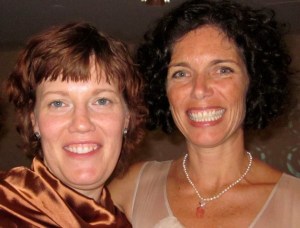
Erin Murphy (l.) and Liz Garton Scanlon at the 2010 Newbery-Caldecott Award Banquet, where Marla Frazee, illustrator of Liz's All the World (Beach Lane/S&S), was awarded a Caldecott Honor.
by Erin Murphy
So, you’ve got 30 picture book ideas. Now what do you do?
FILE.
Keep them. All of them. Do you have an idea file of some kind? You should. It’s obvious that you might turn to the idea file when you’re casting about for something new to write, but it also can do wonders for unlocking writers block. You never know when some seemingly unrelated idea will be just the thing to add the missing layer to another piece. Sometimes it’s less direct than that; just reading through ideas is a way of getting you out of a stuck place, much like taking a walk or strolling through a gallery can knock you out of a creative rut.
CHOOSE.
Sort through them to find the most promising ideas to spend more time with. Laura Purdie Salas had some great suggestions about how to evaluate your ideas last week.
WORK.
Budget time to work on each of those most promising ideas. Not just once, but two or three times per idea before you decide if they’re worth pursuing further. Even if you schedule 20 minutes of writing time a day, you can spend 10 on a new idea, 10 on an idea you’ve already worked on some, and by the new year, you’ll most likely have a couple of solid ideas that are coming together into a real picture book manuscript.
GIVE SPACE.
Some ideas seem to have promise, but they resist any time and attention you give them. This is a sign that they need to sit in your subconscious for awhile. They will most likely kick and scream when they’re ready.
OBSERVE.
After a concentrated creative period like PiBoIdMo, you’ve got a great opportunity to take stock of where and when you do your most creative thinking. Did you get your best ideas in the car while waiting for your kid to come out of her piano lesson? Well then, perhaps a copy of your promising idea list needs to stay in the car so you can keep using that time for best results.
SORT AND EVALUATE.
I’m not talking about evaluating the idea; you’ve already done that. I’m talking about general trends. Try putting all 30 ideas into categories (character-driven, concept-driven, voice-driven, plot-driven; lyrical, funny, quiet; spontaneous-feeling or intellectual…). Are you heavily weighted towards one type of story? Is that your strength? (Or, conversely, are you limiting yourself unnecessarily?) What research can you do about that type of story to help you grow in your picture book writing craft?
REVISIT.
Don’t forget to go back to that full list of ideas now and then. Who knows what discarded idea ends up turning out to have legs! Kathy Duval’s I Think I See a UFO, forthcoming from Disney-Hyperion, to be illustrated by the wonderful Adam McCauley, was a nearly discarded idea that found a home at the first publisher we sent it to!
Erin Murphy was born and raised in Arizona, and founded EMLA in Flagstaff in 1999. She works with publishers of all sizes all over the U.S., and has placed clients’ books with every major children’s house in New York and Boston, but she cut her teeth in regional publishing. She began her career at Northland Publishing/Rising Moon Books for Young Readers (a beloved decades-old Flagstaff company that was bought out in 2007), eventually becoming editor-in-chief, and was a member of the board of directors of PubWest, a professional development organization for small and mid-sized publishers in the West.
Erin represents writers and writer-illustrators of picture books, novels for middle-graders and young adults, and select nonfiction. She is especially drawn to strong characters and heart-centered stories. In her spare time she loves walking, baking, kayaking, knitting, traveling, reading (often audiobooks), and powering through her Netflix queue. You can read more about Erin’s tastes and background in interviews here and here. She now blogs at http://emliterary.com/blog/ and tweets @AgentErinMurphy.
 Generating ideas comes easily for me. I am participating in my own private PiBoIdMo every day of the year. I jot down ideas on napkins; I write them on my hand; I email them to myself; I leave myself idea voice mails. I’ve got no problem with ideas.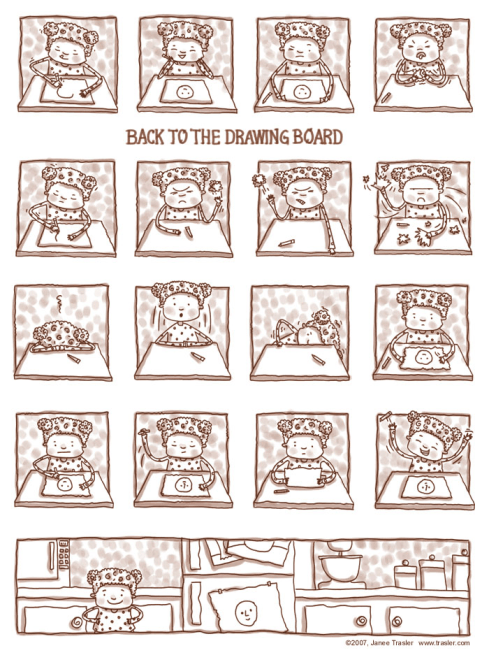
 Janee Trasler has illustrated 19 books and written/illustrated four of her own. Her latest book,
  I have just finished my second year of PiBoIdMo and I can’t stop thinking about how much I love what I do. I love the blank page that is suddenly no longer blank. I love that for a living, I get to be a picture book author. Because when you write picture books, you get to Make Things Up. You get to take something that never existed in real life and make it real. And if you’re lucky, one day it becomes a book you can hold in your hands.
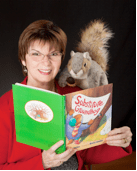
 by Tara Lazar
 Tara Lazar is the creator of PiBoIdMo, the picture book writer’s alternative to NaNoWriMo. Her first two picture books will be released by the Aladdin imprint of Simon & Schuster. THE MONSTORE, illustrated by
  When Tara asked me to contribute a post to PiBoIdMo 2009 I was honored. And, truth be told, scared. For me, getting a Really Good Idea is hard. Crazy hard. How could I possibly offer idea-getting strategies to others when I felt this was the toughest of all the writing challenges?
 Hi there! My name is Erik. I am nine years old (but this month I will be the big 10)! I have a blog (
 by
by 
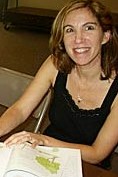
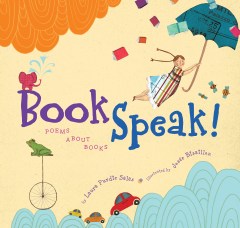 Laura Purdie Salas is the author of many nonfiction picture books, but her first love is poetry and verse. Her newest book is










 by
by  Pat Miller is the author of





 Writing for Kids (While Raising Them)