You are currently browsing the category archive for the ‘Writing’ category.
 Among those represented by the Erin Murphy Literary Agency, Luke Reynolds is known as the *real* Ryan Gosling (you had to be there). Although, I happen to think Luke is cuter, don’t you? Just look at that dimple! And I happen to know he’s a heckuva lot funnier.
He’s also smarter than my Ryan Gosling when it comes to publishing, writing and living.
Luke is the author of KEEP CALM AND QUERY ON: NOTES ON WRITING (AND LIVING) WITH HOPE. And he’s here today to give you that: HOPE. (Plus a copy of his book, plus a query critique, plus a personal “pep talk” phone call!)
Half of Luke’s book includes some reflections for writers on perseverance, hope, humor, gratitude, and work ethic, while the other half includes interviews with writers like Daniel Handler (a.k.a. Lemony Snicket), Katherine Erskine, Jane Smiley, and 11 other authors.
Without further Ryan Gosling references, take it away, Ryan! Erm…I mean Luke!
Making a Life
by Luke Reynolds
There are two places where fast, easy manoeuvres and accomplishments are both warranted and worthwhile: 1) In a snowball fight, when your opponents are slinging well-packed cold stuff at you faster than re-runs of Friends episodes appear on TBS; and 2) In getting the kids to bed when they’re already overtired after a long day of snowball fighting.
Most other pursuits in life don’t lend themselves to easy success. And at the top of a very, very long list of Stuff That Takes Forever comes the pursuit of writing. But that’s a good thing—a terribly hard, but fantastically good thing. Because deep down, none of us who love writing want it to be easy anyway. That’s not why we fall in love with something in the first place.
When we were children, people asked us, “What do you want to be when you grow up?” Very few of us, I’m guessing, responded, “I’d really love to find something easy—something that requires little skill, almost no perseverance, and happens fast.” Instead, most of us said we wanted to fly into outer space wearing massive white suits; or we said we wanted to sing on stage in front of a roaring audience; or we wanted to be pilots or race car drivers or scientists who found cures for every kind of disease or explorers who found distant lands.
Or we wanted to be writers.
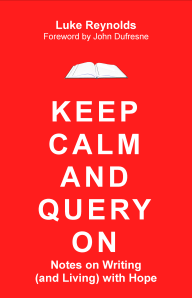 Novelist John Dufresne writes in his Foreword to KEEP CALM AND QUERY ON the following: “Writers want to write, not to have written.” Even though the manuscript of Keep Calm had been finished and proofed and was ready for publication, that line from John’s Foreword hit me hard and fast—much like a well-packed snowball or like a child screaming wildly that he isn’t ready for bed. The line speaks so loudly because it captures the essence of this pursuit we’ve chosen: a creative calling that is about making a life, not a living.
We write because we love the small giddy feeling that rises up like regurgitated food after we’ve eaten too much and then laughed too hard. We write because we like the problems (deep down) that our characters encounter, and we like the fact that there is no easy way out—either for our characters themselves or for us as we make plotting decisions. We write because we know that hearing no enough times and going back to our desks, reworking material, forging new work, and venturing back out into the wild, beautiful possibility of publishing makes our hearts beat fast.
So, deep down, we know it’s not easy. Nor do we want it to be. That’s not why we love it in the first place.
 Why do we love films and stories about underdogs? Why—for instance—does Atticus Finch inspire me to no end? It’s not because he took an easy case that guaranteed a sure-fire victory with no obstacles. I love Atticus because he took an impossible case that guaranteed a loss but his conscience demanded it and his soul echoed the call.
You love the books and characters and films you do, I believe, because you know that triumph is only beautiful when the journey is difficult, that getting the story right is profoundly moving only because you’ve known the story has been so stubbornly wrong—however slightly—in its previous lives.
The MG novel that my agent, the lovely Joan Paquette, signed me on was originally entitled ATTICUS AND ME. It was a story that came down my arteries and out through my fingertips. The first draft, though, would have guaranteed a speedy rejection from Joan. So she didn’t see Atticus until his fourth revision. And then Joan continued to revise Atticus into a character who was more authentic, more real—a character whose story meant more. Joan raised the stakes in the novel. And after quite a few rounds, Atticus is still growing, still changing.
And various picture book manuscripts are in their own worlds of revision, each entering a fifth, ninth, and eleventh or more incantation of their possible lives.
We write because we want to write, not because we want to have written. As writers, we start to accept the fact that—much like us—the characters that people our stories are going to need second-chances, harder obstacles, higher walls, deeper pain—and that all of this, eventually, leads to greater love. In the writing, for the writing, and through the writing.
So, then, the question remains: if we don’t want writing and publishing to be easy, what do we really want? I’d venture a humble guess: we want support. We want somebody—anybody, the mailman, Grandma, our children, our students, and maybe one day an agent and editor—to tell us that we have what it takes. We want support. We want to know that our work is worth it. That ninth draft of an MG novel or our twentieth time through a PB manuscript that has changed completely and become almost an entirely new book are both pursuits for which support is not only helpful, but essential.
 In short, we need someone in our corner, shouting in a voice of accountability, conviction, and faith to keep going. You have what it takes. Get through this draft. Try it from a different POV. Try it from a different character’s perspective. Try the story in present tense. Throw in a cow who believes he is Ryan Gosling. Throw in a turtle who eats books. Throw in a kid who thinks it’s over, until—
Until that voice. Listen it to it clanging inside the damn-near defeated walls of your heart. That voice confirms what you and I already know: we don’t want it to be easy. It’s hard. We know that. What we want is the pluck and the nerve and the faith to keep going—to make a life with our pursuit of writing and the way we embody it, rather than simply a living.
We want more than a contract and some cash. We want to craft the words that get us excited—that get readers excited. Or, as John Dufresne put it, we want to write, not to have written.
So: a toast. (I wish I had wine, but coffee feeds the writer in me more). To the very act of writing—in all its difficulty, stubbornness, painstakingly slow but remarkably beautiful worth. May we all, as writers and as people, keep calm and query on.
Thanks, Luke! Very inspiring. I need a tissue now. *sniff*
And you folks need to comment! Luke is giving away THREE PRIZES!
1. A signed copy of KEEP CALM AND QUERY ON.
2. A query critique.
3. A personal phone call and pep talk to discuss your writing career.
Your comment counts as one entry. You get an extra entry for each mention on social media: Twitter, Facebook, Pinterest, etc. Just mention it in your comment. Comments close the end of April 1 and winners will be randomly selected on April 2.
Now keep calm and comment on!
Luke Reynolds is editor of the forthcoming book for teens and tweens BREAK THESE RULES (Chicago Review Press, 2013). He has also co-edited BURNED IN: FUELING THE FIRE TO TEACH (Teachers College Press 2011) and DEDICATED TO THE PEOPLE OF DARFUR (Rutgers University Press, 2009). His newest books are KEEP CALM AND QUERY ON: NOTES ON WRITING (AND LIVING) WITH HOPE (Divertir Publishing, 2012) and A CALL TO CREATIVITY: WRITING, READING, AND INSPIRING STUDENTS IN AN AGE OF STANDARDIZATION (Teachers College Press, 2012). He loves garlic bread with passion, and loves children just about as much. He has taught grades 7-12 and he’s now a nightschool teacher and home-dad by day. His writing for children is represented by the formidably wise and oft-inspiring Ammi-Joan Paquette of the Erin Murphy Literary Agency. Keep calm and visit on at www.lukewreynolds.com.
 Contests for kidlit writers are big draws because they’re an opportunity to break into the business, but I must say to publishers—please stop with the public vote-to-win process.
Publishers may think that open voting ensures that the public’s favorite—and thus, the best book for their audience—will win, but how is that going to happen when the writers are campaigning for votes via social media?
Sure, votes demonstrate the author’s reach and may indicate how well they’ll market a published book, plus it gets more eyeballs on a publisher’s site. But the thing that will really sell a book? A GOOD story.
Writing contests should be chosen by an experienced editorial team, not by Aunt Sue in Schenectady. Because it’s one thing to ask for a writer’s friends and family to click a button and yet another to ask them for cash once the title is released. Just because someone spends two seconds to vote does not mean they’ll spend hard-earned money on the completed book.
Contests that require people to vote once a day for a prolonged period are even more exhausting to the writer and the people who are repeatedly asked to vote. And vote again. Just one more click. Another? Pretty please? It may even cause that writer’s social network to shrink.
And think of the disappointment when the diligent voters learn their time was for naught. Think of the writer’s disappointment having to tell their audience that it was for naught. Will people spend the time voting for that person again? Maybe. But maybe not.
Yep, social media isn’t always so social. And it shouldn’t be exploited.
As a kidlit enthusiast, I want to see good stories published for children to love. The public voting process does not ensure that. Like a Student Council election, it ensures that the most popular person wins. But the most popular isn’t always the most qualified or the most deserving.
In the end, these contests are more about marketing for the publisher than about discovering real talent. And if you have real talent, you should avoid them. Spend your time polishing your manuscript for submission, not campaigning for votes.
I’m sure this post will cause a stir. So please, debate away in the comments. I’m eager to hear your thoughts.
 Before I got my first publishing contract, I dreamed of the day I could call myself a bonafide “author”. I thought my life would be transformed. Transformed how, I wasn’t sure, but I’d walk down the street with a dignified air.
Of course, I got my first contract and I was like Samantha Baker on her 16th birthday. I looked in the mirror and nothing had changed. (And, I will note that the cream they say diminishes dark under-eye circles doesn’t work.) Sure, I was happy—thrilled—but the Tara remained the same. For instance, nowadays:
- I don’t wear tweed jackets with elbow patches.
- I don’t sit in Queen Anne chairs, sipping Darjeeling.
- My toilet doesn’t magically scrub under its rim.
- I haven’t taken up pipe smoking.
- I still don’t use words like “forthright” and “verisimilitude”.
- Joyce Carol Oates has not invited me to dinner. (But I’m only 45 minutes away, Ms. Oates!)
Nope. In fact, I still:
- Remain in my jammies for 2-3 days at a time.
- Drown my eggs in ketchup.
- Do a spot-on impression of Kermit, Miss Piggy, Elmo and Fozzie Bear—while I’m buying groceries.
- Have zero confidence in my writing at times.
- Fall into creative slumps.
- Wear my hair in pigtails.
- Question my significance after viewing Hubble images.
So, I’m here to say…if you haven’t gotten a publishing contract yet, don’t sweat it. You’re still an artist. You’re still a writer. Heck, you’re even an “author”. Life doesn’t really change when you sign on the dotted line. But…
…maybe it changes after the book is released?!
There are many things I wish I had known about writing picture books when I began pursuing my dream of becoming a published author. Word count. Page turns. Linear storytelling. Building tension. The “twist” ending. Instead, I had to learn these things through trial and error, attending industry conferences, reading books and blogs, and networking with professionals.
On November 6 in Madison, NJ, I’ll be sharing all I’ve learned to those who also have a dream of becoming a picture book author. Are you in the area? I’d love to see you!
So You Want To Be a Picture Book Author
November 6, 2011, 2-4pm
Sages Pages, Madison, NJ
Many people believe writing for the young is easy. After all, “they’re just kids!” But writing for children is one of the most difficult genres in publishing to break into.
Picture book author Tara Lazar (“The Monstore”, Aladdin/Simon & Schuster 2013) will teach you all the things she wished she knew when she began her career, from story length to page turns, how to leave room for illustrations and create irresistible, age-appropriate, relatable characters.
You’ll learn the little-known “rules” of kidlit (and that rules are made to be broken!), plus how to fine-tune your ideas into sellable manuscripts. Participants can even submit a first page of their children’s picture book or novel for an anonymous critique. Tara will answer your questions and help you form an action plan for breaking into the kidlit business armed with knowledge, inspiration and encouragement.
Visit The Writer’s Circle to sign up. Only $25 for 2 hours chock full of what took me years to learn!
 It’s summer, so let’s have some fun, shall we?
How about a contest?
Good. I thought you’d like that.
And this one is easy. You don’t have to send a manuscript. All you need to enter is a premise.
That’s right! A picture book premise.
Make it unique, make it funny, make it touching. In less than 100 words tell me your story’s premise. What’s the problem? What crazy situation has got your character all flummoxed? Imagine it’s your book’s jacket copy. What would you say to sell the audience on your book? You’ve only got a few seconds to capture someone’s attention, so make it snappy.
The best premise will win a free critique–and get this, you don’t even have to have the book written yet! Think of a great premise now, claim your critique later. I’ll honor the free critique for as long as you need (although it’s non-transferable and its cash value is 1/100th of a cent.)
There are three steps to enter:
- Subscribe to my blog via email if you haven’t already. (See handy button in the top left column of my blog.)
- Send your premise in the body of an email with the subject line “PB Premise Contest” to tarawrites at yahoo dot you-know-what. All entries must be received by Sunday, August 14th. (One entry per person, please. So make it your best.)
- Tell your friends. The person who refers the most people to my blog will also win a critique! (Just let me know in a comment below who you referred. I’m working on the honor system here.)
That’s all! So easy-peasy! I’ll announce the winners the week of August 15th.
One last thing–if your premise is anything like one of my current projects, I will notify you, just to let you know, I’m not taking anyone’s premise. I’ve got enough of my own begging me to write them!
 This list of literary agents on Twitter is mostly comprised of kidlit agents, and it isn’t comprehensive, and some are no longer agents…but all are worthy of a follow. They are in no particular order.
Know other literary agents on Twitter? Please post a comment and I’ll periodically add to the list.
You can also find this list here: http://twitter.com/#!/taralazar/literary-agents/
 LovethePippins
Pippin Properties
We are a boutique literary agency dedicated to the management and representation of the finest authors and artists working today.

KSonnack
Kelly Sonnack
Children’s agent for the Andrea Brown Literary Agency.

Jamie Weiss Chilton
Agent, Andrea Brown Literary Agency, shameless caffeine addict, farmer for Marbles, my gray and white rescue bunny.

Jen Rofe
Children’s lit agent with Andrea Brown who dreams about being a bakery-owning cowgirl. Nevermind that I don’t bake much or have a horse.

Steven Malk
Literary agent with Writers House musing on publishing, music, and sports–not necessarily in that order.

The McVeigh Agency (Mark McVeigh)
A boutique literary agency representing authors, illustrators, graphic novelists and photographers.

Donald Maass
President of Donald Maass Literary Agency in New York, author of Writing the Breakout Novel, The Fire in Fiction and other craft books for fiction writers.


Michelle Wolfson
I’m a literary agent. Check out my site and if you think we’re a fit, let me know. Otherwise just support my authors and buy their books!

The Knight Agency
Our talented agents include Deidre Knight, president, Pamela Harty, Lucienne Diver, Nephele Tempest, Elaine Spencer and Melissa Jeglinski.


DeidreKnight
Literary Agent and New York Times bestselling author of romance/women’s fiction who loves to travel to far away places, mentally and geographically.


TracyMarchini
Editorial Consultant, former Literary Agent Assistant, freelance copywriter.

Suzie Townsend
book lover, former HS teacher, literary agent, sci-fi/fantasy nerd, and owner of an unused $6000 wedding dress. love my life.


Nathan Bransford
Author of JACOB WONDERBAR AND THE COSMIC SPACE KAPOW (coming in May)

Colleen Lindsay
Publishing browncoat. Cat herder. Queer human. Professional nerd. TARDIS fan. Athlete’s foot survivor. Part of Penguin Group (USA) Business Development team.


Kim Lionetti
Literary Agent representing women’s fiction, romance, mystery, true crime, pop culture and pop science.

Ginger Clark
I am a literary agent. I work at Curtis Brown. I respond only to queries I’m interested in. This twitter account will be boring.


Lauren E. MacLeod
A literary agent @strothmanagency with an emphasis in YA and MG fiction and nonfiction. Opinions are my own.

jennifer laughran
literary agent at andrea brown lit, children’s bookseller, reader, raconteur, eccentric multi-millionaire and patron of the arts… and some of those are lies

Jill Corcoran
Literary Agent with Herman Agency representing primarily MG and YA authors.

Rachelle Gardner
Literary agent, firefighter’s wife, mom of two awesome girls, Starbucks freak.

ElanaRoth
Elana Roth
Brooklynite, children’s book agent, Squarespace support specialist, semi-pro Jew, bourbon drinker. I work for lots of people. None of these tweets are theirs.

MarieSuzetteYA
Marie Suzette
At work, I’m a literary agent focusing on the YA genre, and I have to bite my tongue. On Twitter, I’m the anonymous Marie Suzette, who says whatever she wants.

EpsteinLiterary
Kate Epstein
Literary agent representing nonfiction for adults and nonfiction and fiction for YA and MG readers I tweet mainly advice for writers and updates on my books.

AlannaLitAgent
Alanna Ramirez
Alanna Ramirez is a literary agent with Trident Media Group.

mikalroy
Michael Stearns
Michael Stearns
Literary agent. A bit obsessive compulsive about words and writing, books and pop culture.

edwardnecarsulm
Edward Necarsulmer
Director and Principal Agent, Children’s Department, McIntosh & Otis, Inc.

Janet_Reid
Janet Reid
Janet Reid
Writer wrangler. President of the Fabulosity Fan Club. Reader. Easily annoyed, often amused, devoted NYer. I love my job more than makes any kind of sense.

barrygoldblatt
Barry Goldblatt

JuliaChurchill
Julia Churchill
We’re the Greenhouse Literary Agency, a transatlantic agency specialising in children’s fiction.

adamsLiterary
Adams Literary
Adams Literary
A full-service, boutique literary agency exclusively representing children’s and young adult authors and artists.

SarahGreenhouse
Sarah Davies
Founder and agent of children’s/YA at Greenhouse Literary Agency, based in DC and London. Dachsund-slave, photographer, lover of history and wild places.

MandyHubbard
Mandy Hubbard
Agent with D4EO Lit and multi-pubbed author writing as Mandy Hubbard and Amanda Grace. I like words. And pasta. Not necessarily in that order.

sarahlapolla
Sarah LaPolla
Sarah LaPolla
Associate Literary Agent at Curtis Brown, Ltd., pop culture junkie, writing enthusiast, all around book nerd.

seekendall
Sara Kendall
Literary assistant and junior associate at Nancy Coffey Lit. Lover of books and food. And cupcakes.

RebeccAgent
Rebecca Sherman
Rebecca Sherman
Literary Agent at Writers House. Midwesterner transplanted to NYC. Musical theater loving, pop culture addict vegetarian.
 KatRushall
Kathleen Rushall
There’s more to life than books, you know, but not much more. Children’s Literary Agent at Waterside Productions, Inc.

Literary Agent with the Sandra Dijkstra Literary Agency Proudly representing YA, children’s picture books, and some adult projects!
 When one arrives at their summer rental home, the sandy carpets, wood paneling and fishnet curtains can be largely ignored. You’re there for the beach, not for the house.
But when a foodie arrives in their temporary accommodations, the heart sinks upon discovering a less-than-accommodating kitchen.
Preparing for our annual excursion to the Jersey shore, I packed the extra virgin olive oil, garlic, ginger and jars of spices. I collected basil, chives, parsley, cilantro and mint from my garden. Yet I didn’t bring my trusted chopping knife, so I’m forced to mince and julienne with a butter knife. What I wouldn’t give for a serrated edge.
The hutch stores silverware for 50 people and wine glasses for 75, but not a single can opener that works. I must remind myself to buy dried beans next year.
Paper-thin pans burn their sizzling contents even on the lowest heat, so I’ve adapted a cooking method of removing them from the stove every few seconds. On, off. On, off. The scrambled eggs cannot brown, or else the kids will deem them “dirty.”
The first few days were filled with frustration. I cursed the dull peelers, all seven of them. I laughed at the bevy of bottle openers. If two dozen people wanted to open their Coronas in unison, no problem. There’s an entire shelf of serving platters, but not a single baking dish.
But now I’ve settled into the groove of my poorly stocked summer kitchen. Forced into a culinary simplicity, I plan our meals accordingly. Grilled chicken with roasted tomatoes. Pasta with grated cheese and torn herbs. Sole with browned butter sauce (I knew those pans were good for something). Cutting shortening into flour for biscuits works just as well with two forks as a pastry blender.
When I’m forced to do without, doing with seems complicated. For instance, my cupboard at home features the fruits of a ridiculous Nordicware Bundt pan fixation. But the shape has nothing to do with taste. Baking on an island with inferior cookware feels like a greater accomplishment than serving a cake that resembles a castle. Those pans allow me to cheat. What epicurean expertise can I claim if I own every tool of convenience?
So I’m learning to love my summer kitchen and the skills of culinary compromise it’s teaching me. Now if I could just rip that fishnet off the window, this house might be perfect.
Yes, I’m on vacation and this blog is quiet. Can you guess today is rainy? I will return to kidlit upon returning home. I hope you’re having a fun and relaxing summer!
Agents and editors have told me they occasionally receive calls from writers who are brand new to children’s books. These aspiring authors ask, “How do I get my book published?”
Kindly folks that they are, these agents and editors don’t slam the phone down. They’ll sometimes spend a few moments providing basic details. But this information can be easily found online. That’s what makes being a new writer so exciting these days: there’s professional advice available via websites and blogs, you just have to search for it. It’s not all so mysterious anymore.
So if you’re looking to launch a kidlit career, please don’t call an agent or editor to learn the basics. Let them read manuscripts, sell books and do their jobs. Come here instead…
A New Children’s Writer’s To-Do List:
- Write.
I knew you’d like that one. - Read children’s books.
Become familiar with the genre in which you write. Understand appropriate length and content for specific age groups. See what’s being published. Don’t follow trends, but know the competition. When pitching editors and agents, it’s often helpful to compare your book to another title. You can’t compare if you aren’t well read. - Join SCBWI.
Take advantage of their resources—local chapter events, national conferences, online discussion boards and publications. - Join a critique group.
Find fellow writers who work in the same genre as you. They provide support, motivation, and helpful feedback. (And if you can, find a group with writers who are more experienced than you.) P.S. Your mother, daughter, spouse, and neighbor’s 2nd grade class are not a critique group. - Attend workshops, conferences and events.
Seek out opportunities to learn and network with authors, agents, editors and writing peers. - Read books on the craft.
Writer’s Guide to Crafting Stories for Children by Nancy Lamb
Writing Picture Books by Ann Whitford Paul
Writing for Children and Teens by Cynthea Liu
Writing with Pictures by Uri Shulevitz - Revise and rewrite.
It’s not going to be right the first time (or maybe even the second or the fifteenth). It’s just not. Resist the temptation to submit an early draft to a publisher. - Take time to develop your skill.
Your writing will improve with practice. Most professional authors need at least two years of serious writing to hone their craft, and it’s not unheard of to work for ten to fifteen years before becoming published. - Submit when you have more than one project polished.
Finished your first manuscript? Keep writing. If an editor or agent likes your manuscript, but not enough to make an offer, they may request other material. Have a few manuscripts at the ready. - Learn to have patience.
It can take many years to write publishable material, sell your first project, and develop a career. Even after you become published, the business is still full of waiting—waiting to hear from your agent and/or editor, waiting for a book to be released, waiting to earn out. You will never NOT be waiting. Patience and perseverance are key. - Call yourself a writer.
Because you are one!
If you have some newbie suggestions, let’s hear them. Please leave a comment.
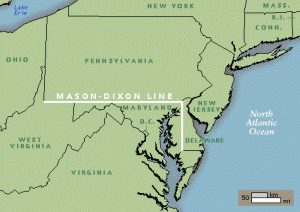 What separates the south from the north? Nope, it ain’t the Mason-Dixon. It’s the road signs.
New Jersey’s exit signs remind us that the road we’re on is not the road we want. Ads for dating websites wilt on the medians. The giant green gecko stares down at our cars, telling us to save on insurance. There’s not much personality there.
But South Carolina? There’s treasures along the roadside. And I’m not talking about boiled peanuts.
Reading the signs along a rural route, I was reminded of how small, specific details in your writing–like a street name or a slogan on a church billboard–can contribute loads to the mood and setting of your story.
Here’s the southern road signs that charmed me.
DAN
THE
MAN’S
Tractor Service
814-DIRT
Christians Like Pianos
Need Frequent Tuning
Minnows Crickets
Worms Sodas
Bee City
Honey Farm
Petting Zoo
Pumpkin Girl Road
Heavy Father Lane
There’s Only One Heaven
and Only One Way
to Get There
Groceries & Hunt’n Stuff
Welding
Organic Produce
Today’s Sons
are Tomorrow’s Fathers
Mars Oldfield Road
Vincent’s Venison
Processing Plant
There are stories buried in these signs.
Do you pet bees at Bee City?
Was Pumpkin Girl related to Heavy Father?
Is the welder married to the organic farmer? Or are they the same person?
Did aliens once land on Mars Oldfield Road?
What stories do your town’s signs tell?
Did you know that words on a page make a sound in your head? Reading expository stretches is like someone whispering in your ear. Too much and it makes you doze off. Page upon page of dialogue can be tiring as well, like listening to a loud, non-stop talker. Blah blah blah. And awkward arrangements will make a reader dizzy and confused. The ears hear what the eyes see.
Words on the page should have a pleasing rhythm or euphony. Words should mix and mingle in our minds to elicit rich imagery. Sure, you might want some words to clash for effect, but overall, clunky language is junky language.
I enjoy writing in first person because I can become my character. I sometimes speak a scene aloud before committing to paper, to test the sound of the words. (And I’ve even been known to speak with an accent, since my current manuscript is set in the south.)
Reading your manuscript aloud differs from scanning it on the page. Your ears will immediately find awkward passages and stilted dialogue. While reading aloud, you’ll be able to examine:
- Repetitive phrases. Many writers have crutch words or phrases that they use repeatedly without noticing. Reading aloud can make those redundancies obvious. Even a word used twice on the same page can sound faulty to the ear, especially if it’s an uncommon word.
- Authenticity of dialogue. While reading, ask yourself, do people talk like this? You might find yourself adding words or skipping some to fit a more natural speech pattern.
- Wordy descriptions and run-on sentences. Too many adjectives can bog a sentence down. And don’t even get me started on adverbs. That requires a separate post!
- Pacing. Do you have long passages of description or introspection? Too much dialogue? Is the piece too slow or too fast?
Your body will also give you cues. Do you need to catch your breath? Are you thirsty? That may sound funny, but it was true with one of my early stories. I stuffed my sentences so full of curlicue words that I needed a big glass of water afterwards.
But be forewarned, like any technique, reading aloud does have its cons. A writer may inject a tone or inflection while reading their own work that doesn’t come across on the page. I learned this recently at a first page session when someone else read my story. The humor and liveliness that I intended fell flat. Was the reader’s performance or my words at fault?
So you might want to consider having a critique partner read your manuscript aloud instead. Even if it’s read in monotone, the meaning should shine through. Are the words doing what you want them to do?
Have a listen; make a revision.





 Writing for Kids (While Raising Them)