You are currently browsing the category archive for the ‘Uncategorized’ category.
Shaping a poem
the body builder
pumps
flexes
tones and
tautens
as
snip
snap
snip –
the gardener
prunes and shapes
and
whoosh!
the very
clumsy clown
colours the sky
with brightly bobbing
balloons of
thought
© Kathryn Apel 2010
 Playing with words to inspire creativity
I write poetry. And I write picture books. And this is a good thing, because poetry and picture books go hand-in-hand… beautifully!
If I’m stuck for inspiration or enthusiasm in my picture books, or I’m at that point of doubting that I’ll ever find ‘the’ perfect word (or any words, for that matter)—I write poetry. Poetry prompts me to play with words again.
We all know the cliché that writers paint pictures with words, but when I’m writing poetry, I get three distinct visual images—and they’re all of me! Let me put you in the picture, too…
 The first is a bit of a joke, because in reality I can’t lift more than a bar of chocolate… BUT—I see myself as The Body Builder toning up by pumping poetry. Composing poetry flexes creativity. It hones vocabulary and encourages wordplay. It pinpoints weaknesses and forces me to focus on specific ‘muscles’. The more poetry I write, the greater my control of my writing muscles—of words. And that is vital when writing picture books!
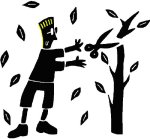 As The Gardener, I am a topiary artiste, intent on pruning and shaping; looking at the bigger picture and trimming it into a recognisable form. There is a certain ruthlessness in laying bare a thing of beauty. Poetry is a lot like a topiary tree—each word carefully placed to create a sharp, clear image. Excess words snipped away. There is no room for clutter. Each word must earn its place. A lot like … a picture book!
 And then I see myself as The Clumsy Clown clutching fistfuls of colourful helium balloons… but can she keep them all in her grasp? No way! Poetry has a way of releasing thoughts to, float, fly, drift and swirl like a bunch of brightly bobbing balloons. Thoughts that could become a poem… or even a picture book… For me, a tramp over paddocks (with notebook in hand) is the perfect time to release the balloons, where they can dip and sway and soar to greater heights in the vast, open sky.
When writing poetry, I am carried away by my imagination.
Come fly with me!
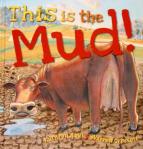 Kathryn Apel is the author of the rhyming picture book This is the Mud! published by Lothian/Hachette Australia in 2009 and read on ABC Play School in 2010. You can follow @KatApel on Twitter, or visit her website, katswhiskers.wordpress.com. Kat is also the co-founder of #pblitchat, the weekly chat for those who work in the picture book publishing industry. You don’t have to be on Twitter, Facebook or any other social media to join the chat. Read all about it at picturebooksonly.wordpress.com.
This doesn’t require commentary. Just watch.
(I know, aren’t you amazed that I can be quiet for once?)
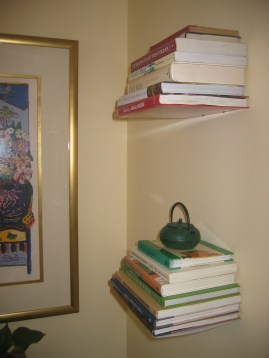 When my father got a Kindle, he was awestruck by its instant gratification: “The books come out of the air!”
And now, I have a similar cry of joy: “The books hover in the air!”
I’m not talking about a Kindle, which is still too steep for me to consider. No, I’m referring to the amazing Umbra conceal bookshelf. (Which, at less than $10 from The Container Store, is a whole lot cheaper than any e-reader.)
Magically, a stack of books sits upon the wall, seemingly suspended sans anchor. An artful arrangement, as minimal as minimalism gets, the Umbra conceal bookshelf creates a floating home for a flotilla of tomes.
How it works: the L-shaped bracket screws into the wall. Place the last page of a book on top of the shelf and slide it to the wall. Below the shelf, two tiny hooks hold the back cover up—ingenious! You can then stack 6-8 books on the first, concealing the bracket on the wall to create the levitation illusion.
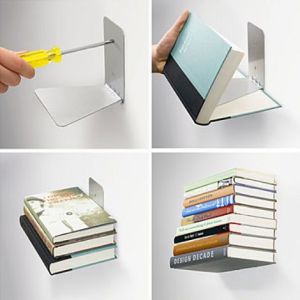 However, there are a few caveats. With the large shelf, the books should be no deeper than 10”, and the total weight of the books shouldn’t exceed 20 lbs. or they will sag. (Grab a stack of books and weigh it on your bathroom scale. I had what I thought was a heavy bunch, but it was only 13 lbs. No sweat for the Umbra.)
Next, the arrangement of books can be a little tricky. I bought two shelves for cookbooks. I have about 40, and it took some shuffling to create perfect pyramids of progressively smaller books. Some books were smaller in length, but not in width—and vice-versa. If you have a large collection of books, however, finding a pleasing aerial aesthetic shouldn’t be an issue. You can even display small objets d’art atop the books, as I did with a Japanese cast-iron teapot.
Finally, you need to install the shelf into a stud and use a hardcover for the bottom book. But paperbacks work well mid-stack, as you’ll see I put the meatless Moosewood between Jim Dodge and the Barefoot Contessa.
Books are works of art, and never before have they been so suitably displayed. I can’t imagine the Kindle being hung on the wall for artistic appreciation. But go ahead, get your e-reader. I’ll just keep buying more books…and more Umbra bookshelves.
A few weeks ago, the hot topic here was Five Rules for Picture Books. Follow those guidelines and you might just have a winning manuscript. Or you might just have Hop! Plop! by Corey Rosen Schwartz, Tali Klein and Olivier Dunrea.
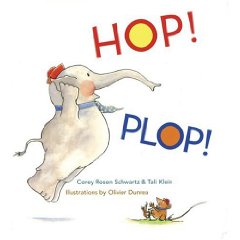 Let’s take a closer look at this story and how it fits beautifully with “the rules.”
Rule #1: Audience Age is 2-6 years old
A picture book should include situations and characters to which children this age can relate. Hop! Plop! is set at a playground. Familiar? Check. Adorable, friendly animals? Check.
Rule #2: 500 Words is the Magic Number
Hop! Plop! comes in at about 300. Check.
Rule #3: Make it Really Sweet or Really Funny
In this case, it’s really sweet and really funny. Elephant and Mouse navigate the playground together and hilarity ensues. Elephant is too heavy on the seesaw and he pushes Mouse a little too hard on the swing. In the end, the two friends discover that their favorite playground diversion is each other. Awwwww.
Rule #4: Use Playful, Unique Language
Elephant and Mouse’s foibles are expressed through onomatopoeia and rhyme. “Skip! Tip! Zoom! Zip! Mouse did a backward flip.” and “Plop! Drop! Crash! Whop! The swings were a total flop.” Totally fun to read aloud. And not too tongue-twisty.
Rule #5: Create Situations that Inspire Cool Illustrations
Picture an elephant and a mouse on a seesaw. And a mouse sliding down an elephant’s trunk. Funny situations, cute pictures. Final check.
Hop! Plop! is a delightful romp. While this book happens to follow “the rules,” that doesn’t mean other manuscripts which color outside the lines are doomed for the rejection pile. Not at all. Remember, “the rules” are merely guidelines for new writers, to help them understand what editors generally seek in a manuscript. (I should really add to the rules: there must be a story.) I can name plenty of picture books that break at least one of these guidelines, with length being the most common one. But Hop! Plop! fits all the criteria–and it’s darn cute to boot. Check it out.
Please share in the discussion by naming your favorite rule-followin’ title! Or maybe you want to point out a rule breaker, a rebel title that deserves praise!
This post is just one in a series about the 2008 Rutgers University Council on Children’s Literature One-on-One Mentoring Conference. Click the RUCCL tag above to read them all.
After lunch, RUCCL attendees separated into groups of five mentor/mentee pairs to discuss industry trends.
The first question was posed to the editors: “What are the biggest mistakes you’ve seen new writers make?”
Senior Editor Erin Molta from Scholastic Book Clubs said she dislikes when writers claim “their book is the next Harry Potter, especially when I read it and think, no, not at all!” Yes, writers are encouraged to compare their manuscript with a successful title, but she’s seen way too many Harry impersonations. On the other hand, she likes when a writer tells her why they have written this story. If the story comes from your heart, the genuine enthusiasm shines through.
Grace Kendall, Editorial Assistant at The Blue Sky Press/Scholastic, emphasized the need for a concise cover letter that tells her “how you see your book positioned in the bigger world.” You might have a great idea and a great character, but is it a good story? She receives great projects without story, and story trumps all. Tell her that “your book is like this [other] book, but it’s different because…” And you’d better have a good because!
Kendra Levin, Associate Editor at Viking and award-winning playwright, said her biggest pet peeve is when people call her on the telephone. One of the writers asked about sending a status query instead. “If it makes you feel better,” she said. “Honestly, if I have your manuscript, I will read it.” She also suggested, “Do your research before you send it out.” Target your manuscript to specific editors. Let her know why you are submitting to her. Information about editors is available online and she suggested looking in a comparable book’s acknowledgements. Authors often thank their editors.
Kiffin Steurer is an Assistant Editor at Philomel (and fellow Dahl fan). He wants writers to “get to the heart of the story as quickly as possible in the cover letter.” His pet peeve is “picture book authors who send [poor] illustrations with the story.” An editor will match your story with an illustrator. So if you’re not a professional artist, don’t send pictures. They can sour the entire manuscript. Let your words stand on their own.
Agent Alyssa Eisner Henkin said her pet peeve is “when someone sends a query to me…and everyone else in children’s publishing!” Agents want to know that you’ve researched their preferences and that you’re not just submitting blindly en masse. She’s impressed with a query when it mimics jacket flap copy, so do yourself a favor and read a lot of jacket flaps!
Kiffin Steurer added that he’s not looking for a message. “I’m looking for good stories. If you have a good story with a message, then it’s just icing on the cake. But if there’s no story, we don’t want it.”
This post is just one in a series about the 2008 Rutgers University Council on Children’s Literature One-on-One Mentoring Conference. Click the RUCCL tag above to read them all.
After we heard from the panelists, Alyssa Eisner Henkin opened the floor to questions.
One writer asked, “In the editor and agent bios, a lot of you say that you’re looking for two things: high concept and unique voice. Could you please tell us exactly what you mean by that?”
Chad Beckerman couldn’t resist: “Diary of a Wimpy Kid: high concept, unique voice.” Then one of the editors explained high concept as boiling the essence of a story down to one line.
Agent Stephen Barbara offered an example, shouting down from the audience, “Phonebooth!” The movie is about a man trapped in a phonebooth by a sniper. You can summarize the entire film with that single concept.
On the other hand, a literary novel or a coming-of-age story isn’t necessarily about a single concept. You may still be able to describe the story in a sentence, but it doesn’t offer the instant understanding of a high-concept pitch. The industry wants the next big thing, and high-concept often delivers it.
Next, the editors talked about unique voice. One editor told us about her friend’s personality. “She’s the most bubbly, interesting person I’ve ever met. But in an email, she comes through flat. Hi. How are you? I am fine.” That’s not what you want to do. Your writing should capture the essence of your character. Inject your writing with its own personality. The voice is what makes your story stand out among similar tales. It’s the way you tell your story that allows kids to connect and relate to your characters.
Another question from the audience had the editors a little tight-lipped. “What are the new themes coming in the next 1-2 years?” They looked around but no one spoke. The writer pressed, “Come on, what are you working on right now that you think is going to be big?”
Chad Beckerman said he hoped there would be “more books without words.” Just like an art director! Lisa Cheng talked about a new novel that’s told in text, IM and blog posts. Chad offered, “High concept!”
Then Molly O’Neill gave a fabulous answer to the next question regarding the border between YA novels and adult fiction. What distinguishes them from one another? “This is going to sound like a perfect, rehearsed answer,” she said, “but honestly I’ve been thinking a lot about this lately.”
YA novels have a sense of immediacy. When you’re a teen, every experience is new. Every hour of every day is heartbreak, tragedy, elation. There’s a heightened sense of reality and being in the moment. There’s no time for pondering, you’re too busy living. Adults have their entire lives on which to base decisions, but a young adult doesn’t have that experience to draw on. They’re making decisions in the here and now, raw and full of emotion.
Lisa Cheng agreed and added that in a YA novel, she doesn’t want to leave the reader feeling hopeless.
With their thoughtful answers and wealth of industry knowledge, the editors didn’t leave any of the writers feeling hopeless, either. (Yeah, corny ending, but gimme a break, I’ve written a lot of these posts!)
This is the third in a series of posts about the 2008 Rutgers University Council on Children’s Literature One-on-One Mentoring Conference. Click on the RUCCL tag above to read them all.
Author Kay Winters is a RUCCL success story. Who better to give the introductory speech? She attended the one-on-one conference three times before she was published, but now has 14 books in print with 5 more under contract. She came to inspire. And she did with this simple yet powerful statement: “I’m here to tell you: it can be done.”
 Ms. Winters spoke of her journey to becoming an author, which began in childhood with a love of books. She always wanted to be a teacher, however, and that is what she became. But she still wrote for pleasure, penning articles, short stories and poems that never made much money. Writing to make a living didn’t seem possible.
She eventually co-authored a book about teaching. But the long hours writing plus being a teacher created a tiring pace that she could not sustain. When a local author visited her school, he told her, “Give yourself five years to break into the business.” She thought, “I need to get going!” Shortly thereafter, her school offered an early retirement package. Her letter of resignation was on the Principal’s desk the next day. She wanted to write full time.
“When I quit teaching, I worried that I would miss the hugging,” Kay said, referring to her students. “But children’s writers are hugging.” We all laughed. We know. She was already hugging us.
After her retirement, Kay took classes at The New School and spent afternoons at the Children’s Book Council reading every single picture book that they received. Thousands of them. She joined two writers groups. She subbed her manuscripts. Wolf Watch was rejected 17 times.
But she came to RUCCL with hope and left inspired. The encouragement she received at the event kept her spirits up despite the rejections. “I think I can” became “I know I can!”
And on her third trip to Rutgers, Kay’s agent-mentor took a look at her picture book manuscript and said, “This is publishable.” And then another. “This is publishable.” She left fired up!
It was soon thereafter that the offers came pouring in. They say good things come in threes. This was true for Kay, who sold Teeny Tiny Ghost to HarperCollins, and the oft-rejected Wolf Watch was snatched up by Simon & Schuster just two weeks later. Viking then offered a contract for Did You See What I Saw? Poems About School.
Kay now spends her time writing, speaking at conferences and making school visits. She especially loves hearing from her student-fans:
Dear Ms. Winters, thanks for coming to our school. Your assembly was awesome. I wasn’t there.
and another charming young man asked:
How old are you? Were you on the Titanic?
OK, she doesn’t have as much experience as that child thought, but she has been in this business long enough to impart three very important tips for all aspiring writers.
- Word Hard.
- Let your manuscript breathe. Don’t send it right out. Give it some time and revise.
- Have persistence. Because there is a lot of talent out there, but persistence is in shorter supply.
Kay ended with something a mentor once told her: “I’ve never known anyone who wanted to do this, who worked really hard, and didn’t succeed.”
Thunderous applause for Kay Winters! She gave us her own magical story.
History Lessons
Juliet Dupree snuck into Mr. Forman’s classroom before the morning bell and wrote Mr. Snoreman on the blackboard. When Tristan sat next to her, she’d nudge his arm, nod toward the front of the room, and take credit.
Everyone knew that Mr. Forman’s monotone lectures came straight from the textbook, word for dreary word. He cradled the teacher’s guide with his left arm while he pointed to the ceiling with his right, appearing only slightly more animated than the Statue of Liberty.
The huddled masses of 1st period American History yearned to be free of boredom, so Tristan organized daily pranks. Yesterday the entire class dropped their textbooks on the floor at precisely 8:10am…and received empty detention threats at 8:11am.
When Juliet reached for her book, she had noticed it was published the year she was born. That was odd; she was pretty certain that something historically meaningful had happened in the past 13 years. After all, Tristan had kissed her. That might not make it into the next edition of An American Account Volume II, but it would launch an unpredictable new chapter in her own history, threatening full-out war as soon as Tristan’s girlfriend found out.
This flash fiction piece is in response to the Imagine Monday writing prompt posted last Friday. Join us every week for a new writing exercise.
When I came up with this week’s prompt, I immediately drifted back to my 9th grade American History class. The tale above isn’t far from what occurred in the classroom. My friend arranged pranks on a near-daily basis. One day a classmate discovered that he owned the same digital Casio watch as our teacher, so he set the alarm to go off in class. Our teacher fumbled at his wrist, wondering why he couldn’t get the beeping to stop. Such adolescent nonsense has a way of escalating into legend, and in the hyperbole of memory, I recall this little trick baffling our teacher for months.
The New Jersey Chapter of SCBWI was treated to an afternoon of professional first page critiques yesterday in Princeton. (Heck, we even felt smarter just being on the campus of Princeton University!)
Editors Connie Hsu and Kate Sullivan from Little, Brown shared their literary insights with 30 aspiring authors. Manuscripts ranged from a whimsical picture book about goldfish to a compelling young adult novel set in a foreign village under siege.
After each first page was read aloud, the editors provided their immediate impressions of the manuscript–what worked, what didn’t.
Some helpful advice included:
- Use first person point-of-view to your advantage. It helps the reader get into your character’s head, so if there’s too much dialogue on the first page and not enough introspection, you’re not using that device to its full potential.
- Make sure the voice fits the genre. This is a common critique I’ve heard repeated at every first-page session. Some picture books were wordy, with long sentences and adult sensibilities. If it takes the entire first manuscript page to set up the story, then you need to cut, cut, cut. Little kids beg their parents to turn the page, so you must get to the story quickly. The first manuscript page needs a clear story arc. Regarding books for ‘tweens and teens, a young adult novel should have longer sentences and be more gritty than middle-grade. In general, the editors said an MG voice can sometimes be classified as “whiney,” whereas a YA voice is angrier and angst-ridden. Yes, let that YA voice curse and swear.
- Make room for illustration in a picture book. You don’t have to describe every detail. Instead of saying, “the girl’s hair was red and wavy like her mother’s red, wavy hair,” try instead, “the girl’s hair was just like her mother’s.” This provides the double benefit of cutting words and leaving the family’s appearance to the illustrator’s interpretation. (Read Linda Urban’s interview with illustrator Marla Frazee regarding The Seven Silly Eaters by Mary Ann Hoberman. Great example of how an illustrator fleshes out the story.)
- Don’t try to surprise your reader on the first page. It can lead to confusion instead. Some stories left important details aside (who/what/why/where) and forced the reader to guess what was happening. You don’t want your reader to guess wrong! If they do, then when the correct information is revealed, they will be confused. You want the reader to move forward, not double-back to re-read.
- Set the scene. The setting provides a clear context for your character’s actions and emotions. Again, don’t make the reader guess where your character is. Show the reader. Immerse the reader in your world.
One of the funnier moments occured when the editors cautioned against using the word “puberty” in a middle-grade work. It guarantees giggles of embarassment among that age group. “It’s a word no ‘tween wants to admit exists,” said Kate Sullivan.
While the insights above were specific to the pages submitted, they can be applied to your own manuscript. Keep in mind that rules can be broken, but it typically takes an experienced, talented author to make the unconventional work.
Want to read more about first pages? Check out these previous posts:
 The Etsy addiction continues.
This witty “booklace” conversation piece by Etsy artisan JOYouz, otherwise known as The Quill Chick, features an inspiring Robin Williams quote.
Yep, we’re all mad here.





 Writing for Kids (While Raising Them)