You are currently browsing the category archive for the ‘Picture Books’ category.
by Danielle Joseph

When I started thinking about writing this blog post, I realized that I’ve been gathering ideas for most of my life. Thoughts took me back to my bedroom with the blue carpet outside of Boston, where I’d sit with my sister or a friend and try to figure out what to play. We’d individually come up with a bunch of ideas, write them on little scraps of paper, ball them up, and then stick them in a clay bowl that I’d made in art class. Some top ideas: play house, camping, act out tv commercials and school. Sometimes, when we’d finally decided what to play, a friend’s mom would arrive to pick her up or my mom would yell, “Come set the table!” That was the worst!

The actual bowl I used to generate ideas as a kid.
When I got older, I continued to collect ideas. In sixth grade, a friend and I threw all sorts of ideas into the bowl on where we should sleep that night for our sleepover because beds would be too boring. The bathtub was the winning idea, but my mom quickly vetoed that, and we ended up with choice number two, my closet. It was cramped, so eventually the beds won out. But it was a lot of fun imagining what it would be like to sleep in some of the odd places that had made the list.
It took me a long time to realize that the gathering of ideas was a game in itself! Then fast-forward to when I taught middle school for a few years after college. I’d come up with a whole bunch of story ideas, throw them into a bowl and tell the students to pick out two ideas and incorporate them into their stories. We always had a blast with this, and the students were so creative.
For my own work writing novels, I keep different files of ideas on my computer, but when I began writing picture books, I found that lists were really helpful too. Since I love to procrastinate, I start with a pre-brainstorm list. It helps to get the ideas flowing and bonus, you don’t have to commit to anything just yet. You can answer any types of questions when you create your pre-brainstorm lists, but here are some suggestions. And you should keep it as a running list, so you can always refer back to it.
Pre-Brainstorm (Create an idea list), jot down:
- Things you like
- Specifics that relate to you
- Hobbies
- Your culture
- Upbringing
- Family life
- Character traits
- Major life events
- Minor events that stick with you
Once you’re done with the list, you are ready to start brainstorming! I call this the hook-up phase and from here you pick two topic ideas from your pre-brainstorm list that you want to further explore, hook-up. When I wrote my picture book, I WANT TO RIDE THE TAP TAP about a boy in Haiti who dreams of riding the Tap Tap bus, I chose location (I love to travel and have lived in a few different cities) and transportation (I’ve collected a few types of toy cars over the years, starting with a handmade wooden one that was given to me as a baby by my dad’s friend).
The Hook-Up (Unification of Ideas)
LOCATION…TRANSPORTATION
Cape Town…Cable Car
Florida…Bicycle
Haiti…Tap Tap bus
London…Double-decker bus
Boston…Subway
Once you pick an item from column one that corresponds with column two, you are ready to brainstorm!
Brainstorm
Again, this can be done in a list format. Just write down anything you think could possibly happen in your story from the mundane to the wacky! And if some of the items don’t make it to this story, add them back to your main idea list and you may use them another time.
Story Grab Bag
Keep all these ideas as a running list. They will go into your story grab bag. You just never know when you might need a new story idea or an idea for a plot thread and when you do, you can look through your lists or your bag or bowl and see where your next match comes form. Sometimes you have a good idea going, but your plot is too thin, so you can pull an idea from your Pre-Brainstorm List.
I hope this gets you generating even more ideas this month and beyond! Happy Brainstorming!

 Danielle Joseph is the author of the newly released middle-grade novel Sydney A. Frankel’s Summer Mix-Up and the 2021 CBC Notable Social Studies picture book; I WANT TO RIDE THE TAP TAP. She also has written three young adult novels Shrinking Violet, Indigo Blues, and Pure Red. Shrinking Violet was adapted into the 2012 Disney Channel movie, Radio Rebel. Danielle has a BFA in Creative Writing and an MA in Marketing Communications and Advertising, both from Emerson College. She’s a former middle school creative writing teacher and has been teaching writing workshops for over fifteen years. Danielle was born in Cape Town, South Africa and currently lives in Maryland. Her picture book biography, RUTH FIRST NEVER BACK DOWN debuts Fall 2023 from Lerner. Visit her at daniellejoseph.com and follow her on Twitter and Instagram @daniellejoseph1.

Danielle giving away one signed copy of I WANT TO RIDE THE TAP TAP and a second prize of a 30-minute consultation where I can answer any writing or industry questions or talk about story ideas. These are two separate prizes!
You’re eligible to win if you’re a registered Storystorm participant and you have commented once below.
Prizes will be distributed at the conclusion of Storystorm.
by Laura Lavoie
It’s the halfway point! If you haven’t come up with 14 ideas yet, don’t despair. My goal is for you to leave this post with not one, not two, but three new story ideas.
When I’m brainstorming, I almost always come up with a title first and see if I can spin a solid story from there. There are many methods I use to brainstorm catchy titles, but today I’m going to share three—with an exercise to try for each. Ready?
Title Trick #1: Add a Twist!
I like to make lists of classic titles and/or common phrases and see if I can spin a fun new story by swapping out a word or two. Our fearless Storystorm founder, Tara Lazar, did this with her picture book LITTLE RED GLIDING HOOD (illustrated by Troy Cummings). Switch up the word riding for the rhyming gliding and voila! Little Red is now the star of her own figure skating story.

Here are a few more ways you can create a twisted title:
Instead of substituting a rhyming word into a classic title, try a totally wacky, unexpected word like Corey Rosen Schwartz did with THE THREE NINJA PIGS (illustrtated by Dan Santat).
You can also put a twist on a common phrase. See: Tammi Sauer’s BAWK AND ROLL (also illustrated by Dan Santat) or Kelly DiPucchio’s NOT YETI (illustrated by Claire Keane).
Alternatively, put a spin on a popular movie title, like author-illustrator Ethan Long did with FRIGHT CLUB.
Brainstorming Exercise: Grab your notebook. Write down a few classic fairytales, well-known movie titles, and familiar phrases that come to mind. What fun new words could you use to come up with a twisted title?
Title Trick #2: Make it Roll Off the Tongue
Another favorite trick is to utilize rhyme, alliteration, consonance, or assonance… or a combination of two or three of these for bonus points. For my debut picture book, VAMPIRE VACATION, illustrated by Micah Player (coming in May from Viking), I went with an alliterative title.

In this case, I actually didn’t brainstorm the title before I drafted the manuscript. (If you want to know how I came up with the idea for this story, you’ll have to read the PBCrew22 Storystorm post later this month!)
Once I had written a story about a little vampire who dreams of sandcastles, snorkeling, and surfing, I brainstormed a few working titles, including “Vampire Loves the Beach”… but the alliteration in VAMPIRE VACATION sounded so much better, so that one stuck.
Other alliterative titles I love? MEENA’S MINDFUL MOMENT, written by Tina Athaide and illustrated by Asa Gilland, and HARDLY HAUNTED by author-illustrator Jessie Sima.
Here are more examples of ways you can create a title that rolls right off the tongue:
Go for a title that rhymes, like THANK YOU, OMU, written and illustrated by Oge Mora, or NOT QUITE SNOW WHITE, written by Ashley Franklin and illustrated by Ebony Glenn.
Think up a title that goes heavy on assonance and consonance, like Ashley and Ebony’s sequel story, BETTER TOGETHER, CINDERELLA, which features the repetition of the soft ‘e’ (assonance) and the ‘r’ sound (consonance).
Create a fun wordplay mashup like author-illustrator Lucy Ruth Cummins did with VAMPENGUIN.
Brainstorming Exercise: Write some lists of alliterative words, rhyming words, or words that share similar sounds. Any fun title ideas jumping out at you? Any words you can smoosh together to create a clever concept?
Title Trick #3: Get Readers Curious
I love titles that make me wonder, what’s that about? Think about it: you’re browsing shelves in a bookstore and catch a spine out of the corner of your eye. If the title automatically elicits curiosity, you’re likely to take a look, right?
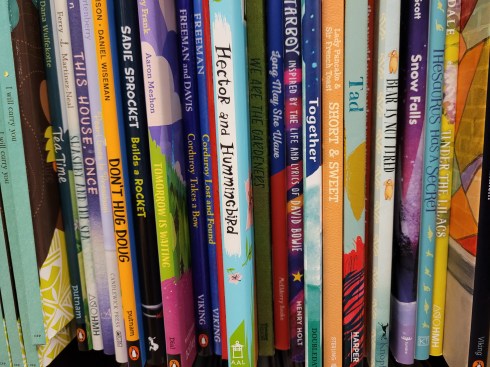
DON’T HUG DOUG, written by Carrie Finison and illustrated by Daniel Wiseman, gets bonus points. Not only does it rhyme, but it makes me wonder, WHY shouldn’t I hug Doug? Of course, we know this is a story about consent, but it *could* be a story about an irritable porcupine or a kid who burps when you squeeze him.
Here are some other recent titles that have made me go Hmm…
- TOO MUCH SLIME! written by Frances Gilbert and illustrated by Vin Vogel
- THE NEW KID HAS FLEAS, written by Ame Dyckman and illustrated by Eda Kaban
- I DO NOT LIKE YOLANDA, written and illustrated by Zoey Abbott
- ON ACCOUNT OF THE GUM, written and illustrated by Adam Rex
Brainstorming Exercise: Create a list of problems a character could have. How could you spin that problem into a curious title like the ones above?
My challenge to you today: come up with at least one idea for each of these title tricks. Even if it’s just the title, that counts. Come back to it later and see what kind of magic you can make!
 Laura Lavoie writes humorous, pun-filled picture books. She can also tap dance, tell terribly cheesy jokes, and bake a mean chocolate chip cookie. Laura’s debut, VAMPIRE VACATION, (illustrated by Micah Player) will be out from Viking in May 2022. She has more books on the way in 2023 and 2024! You can find Laura on Twitter and Instagram @llavoieauthor.
Laura is donating a picture book critique + a follow-up 30-minute Zoom chat to one participant! Humor and puns are her specialties, but she’s happy to talk about anything writing- or publishing-related during the call.
You’re eligible to win if you’re a registered Storystorm participant and you have commented once below.
Prizes will be distributed at the conclusion of Storystorm.
by Julia Mills
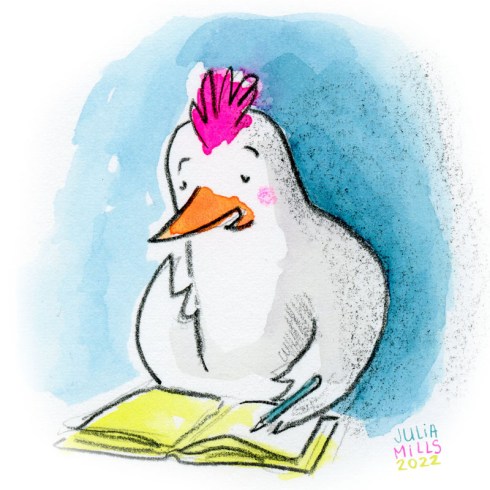
1. I like to start with a list. Lists are much less intimidating than paragraphs. You can use numbers, letters, bullet points, stickers. I sometimes change midstream.
2. I like to make lists of very random words, whatever comes to mind. It’s ok if some of them are repeats. You may find that the same word creeps in again and again. Be suspicious of this word. It may be telling you something.
3. Lemons…
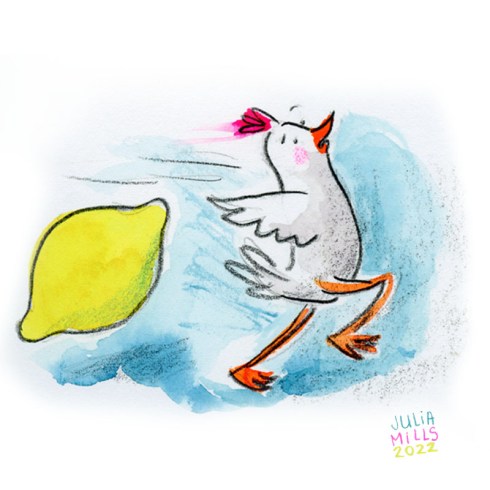
4. When you are brainstorming, no idea is bad. Write it down. Sometimes I try to make a bad idea worse. Take it to the limit. You can always go backwards.
5. If you can’t think of anything to write, write how you feel.
6. I’m feeling hopeful today. I’m hopeful that some great picture book idea will land in my brain.
7. Look at your words. I mean really look at them. What shapes do they make? The “aha!” moment for my story occurred when I saw a turtle in the letter “u” of “stuck”. I like to make very rough doodles. It’s OK if you don’t draw, doodling is for everyone. Doodle like a Kindergartner with a sparkly crayon.
7.5 Say your words. How do they feel? Are they crunchy or smooth? Are they funny or serious?
8. Take your words to a different place. Sit on the floor. Do they look different here? Take them to the shower but only if your paper is waterproof.
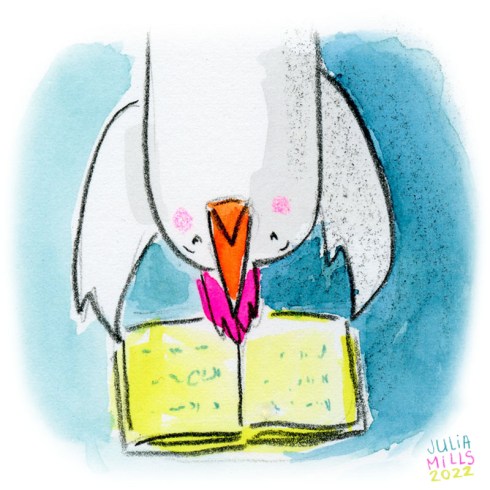
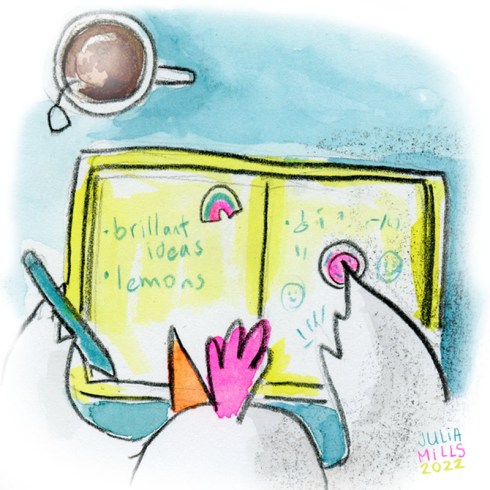
9. Add things to your process that make you happy. For me that means colorful pens, stickers and tea. Tea is very important.
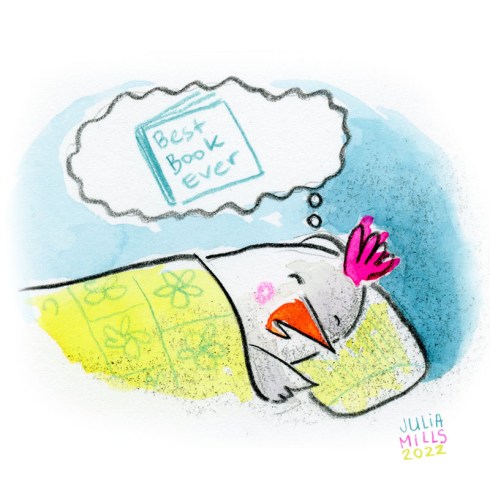
10. If you are really frustrated, take a nap. When you are half asleep, think about your words. Imagine them in a book. Don’t stress over this. Just read the book to yourself in your half sleep. Read them like you would read them to a child. You are the child. You are putting yourself to sleep. It’s ok, you are tired.
11. Ignore your words for a while. If you have terrible handwriting like I do, deciphering your words months later is half the fun.
12. Come back to your words after you forget them. What do they make you think about now? What questions pop up when you look at them?
13. Even if you write ONE word, you have written something. You deserve a nap, a sticker, a cup of tea, or whatever makes you happy.
 Julia Mills is a writer, illustrator and kindergarten art teacher. Her debut picture book I AM STUCK (Clarion, Fall 2023) was dreamt up on the very last day of Storystorm in 2020. She has yet to write a book about lemons. You can find her at jamills.com and as JMillsPaints on Instagram and Twitter.
Julia is donating a 30-minute Zoom idea chat or art critique.
You’re eligible to win if you’re a registered Storystorm participant and you have commented once below.
Prizes will be distributed at the conclusion of Storystorm.
by Heidi Tyline King
I hesitate to give away my treasure trove of ideas, but let’s be honest: There are more people dead than alive, meaning that there are plenty of obituaries—and people who led insanely interesting lives—for all of us writers to mine for stories. Obituaries are mini biographies readymade for children’s nonfiction picture book writers. I began reading obituaries for fun but they have become integral to my writing process.
First, they’re great sources of inspiration for good writing. When I get stuck on how to mark time quickly or what phrase to use as a transition between unrelated life events in a story, I spend time reading obits for examples. They’re also ideal for helping writers identify a singular event to chronicle in a life. You don’t always have to write a birth-to-grave story; consider the life of Katherine Johnson, the mathematician whose work for NASA became the central narrative for the popular book, Hidden Figures. Papers like The Guardian or The New York Times are filled with obituaries exuding strong writing and examples of how to distill a life down to its essence in a few hundred words or less.
I also turn to obituaries for motivation. I am full of self-doubt and “poor me”s, especially when my writing gets stuck. In the name of “research,” I’ll pull up my file of obituaries and begin reading about the ordinary people in the world who did extraordinary things—despite advanced age, disabilities, or a lack of education and resources. Their stories and ability to overcome keep me going.
And then there’s the most obvious reason for reading obituaries: subject matter. I am currently finishing my second children’s book on John Bonner Buck, an expert on firefly research and bioluminescence, whose obituary I clipped way back in 2005. Buck’s life’s work centered around a question that I believe all children ask: Why do fireflies flash? My book explains how Buck found the answer and went on to become a preeminent scientist in the field of bioluminescence.
To make the most of obituaries in your work, I suggest the following:
1. Scan obituaries for compelling characters.
I skip the celebrities and look for people that I haven’t heard about, people who made notable achievements in a particular field of study, worked behind the scenes on a well-known event, or devised a new way of doing things. Don’t forget to delve into the archives for the forgotten stories of people who deserve to be known.
2. Set Google Alerts to narrow interests.
Sifting through obituaries is one way to find interesting subject matter. Another is to set a Google Alert and have the search engine curate content for you. You’ll get obituaries delivered to your inbox about people working in fields that are of most interest to you. Every now and then, you’ll get a gem that you would have never sniffed out on your own.
3. Branch out and look for other sources.
Once you’ve identified a person to consider writing about, do a quick search for other sources to learn more about their contributions. Obituaries in other publications and articles about their work help you compile research to consult when you’re ready to write and help you build a stronger story. For example, I ran across an article about Buck describing him as a “scientist’s scientist.” The idea that he loved process and the practice of science became an underlying subtheme in my book.
4. Discover secondary themes.
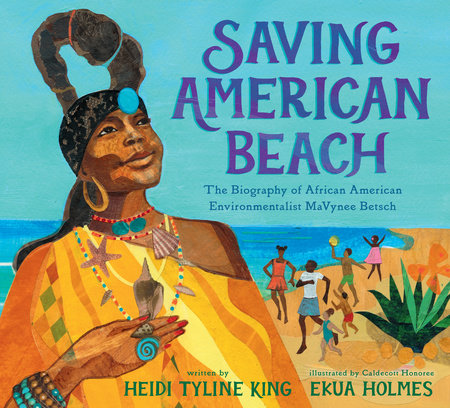
Speaking of subthemes, a good biography has several running through throughout. In my latest picture book, SAVING AMERICAN BEACH: The Biography of African American Environmentalist MaVynee Betsch, the story centers on her activism to save a beach, but it’s the subthemes of music, environmentalism, discrimination and racism, and resilience that carry the story.
5. Write in the genre that’s most comfortable to you.
Above all, obituaries are simply sources of inspiration. I have a degree in journalism so writing nonfiction is what I’m best at doing. But obituaries can inspire writing in genres from poetry to science fiction.
The next time you’re struggling with characters, plot, motivation, and writing succinctly, take a break and scan the day’s fresh batch of obituaries or leaf back through your file for ideas. There are people whose stories are waiting to—and worthy of—being told.
 Heidi Tyline King writes nonfiction picture books from her home in Tallahassee, Florida. Follow her on Instagram @heiditylineking and visit her at heiditking.com.
Heidi is giving away a copy of her book, SAVING AMERICAN BEACH.
Leave one comment below to enter.
You’re eligible to win if you’re a registered Storystorm participant and you have commented once below.
Prizes will be distributed at the conclusion of Storystorm.
by Kelly Mangan & Adrea Theodore

‘Write what you know’ is a popular refrain we’re used to hearing as writers. And for good reason! When you write from your own, lived experience, there’s an honesty and authenticity to your words that’s hard to duplicate.
But what do you do when a lived experience is rooted in a difficult or uncomfortable reality? How do you translate those sorts of experiences into a story for kids? And…should you?
There are no easy, universal answers to these questions. But hopefully OUR answers will help as you dig into your own life experiences for story inspiration.
Why write about reality?
ADREA: For me, it starts with the story. If there’s a particular story that I want to tell, I have to consider if using the framework of a real-life experiences is the best way to do it. With my debut picture book, A HISTORY OF ME, I had a story to tell about a young girl being the only person of color in class during lessons on slavery and segregation. I had a story to tell about that same girl growing in her understanding of and appreciation for her heritage, one that includes an ancestor who was enslaved in this country. It might be difficult to write about, but not nearly as difficult as actually having the experience. This story is also worth sharing, since I know there are other kids out there experiencing the same or similar things right now.
KELLY: I write about challenging realities to comfort and validate kids going through similar situations. But also…? Because I want encourage kids to think about why things are the way they are, and to question if they could be different. For example, I was the fat girl growing up. I never once saw a fat character in a picture book who wasn’t either a bully or a buffoon. Sadly, that remains largely unchanged in children’s media (fat is often used as a visual shorthand for a whole slew of negative character traits). So I often seek out story ideas which confront this paradigm.
How do I know if a topic is appropriate for kids or not?
KELLY: I think virtually any topic can be broached with kids if done in a thoughtful, developmentally-appropriate way. I have two children who are picture-book-age, so I often think about how I’d explain a difficult topic to them. What questions or concerns do I anticipate them having? How could I answer those in a way that is honest and honors their intelligence, but which isn’t overly upsetting? And perhaps most importantly: What’s the overarching message or feeling I want kids to take away from this story?
ADREA: I definitely agree. The pages of a book can be viewed as a safe space to hear about or see things that can be scary, difficult to handle, or hard to explain.
How do you address serious topics in children’s books in an age-appropriate way?
ADREA: My approach? First, try to see it—whatever “it” is—from a kid’s perspective. Remember what it was like to be that age; and if it’s from your own experience, remember what or how you felt. What was most important to you?
Second, simplify “it” in terms that would make sense to a young person. Consider your words, phrases, sentence structure, and metaphors. Keep in mind that the illustrations will likely carry as much weight as the words, especially for those who aren’t yet reading on their own. As an example, in A HISTORY OF ME, there is a scene that takes place on a playground because these spaces are familiar to young children. The playground is known as a place for fun, but it becomes a place of racial insensitivity; and this juxtaposition is unsettling, but necessary.
KELLY: I always start from a personal experience, like being the only fat girl in my ballet class. Then I dig into the little, concrete details of that experience: the disdainful way other students looked at me; the snickers of the parents; my own mother’s fear of me performing and embarrassing myself. I needn’t ever say “people didn’t think she could be a dancer because she was fat”– for one, because it’s unnecessary: children are smarter, more nuanced readers/listeners than adults often give them credit for. And for two, because focusing too much on the pain can actually be damaging to kids rather than empowering. It’s a tough balance.
Does writing about reality always have to be sad?
KELLY: Absolutely not! I don’t write about serious topics to make kids sad. I write about them to instill hope, foster compassion, and to make kids feel seen. There has to be light at the end of the tunnel. Ultimately, I’m trying to distill my experiences down into something useful for kids.
ADREA: When we write about a serious topic, one that is uncomfortable or difficult in real life, we should consider how to present it in such a way that it’s beneficial to our audience. Is this something that can be used as a mirror for some kids or a window for others? Can it enhance empathy or cultivate kindness? And is there a way to leave the child reader with hope, regardless of the situation? The onus is on the writer to find that hope first and then bring it out in the text so the reader can see it and grab hold of it.
 ADREA THEODORE is a mom, a pediatrician and a children’s book author from North Carolina. Her debut picture book, A HISTORY OF ME (Neal Porter Books/Holiday House) is available for pre-order now and in stores soon (January 18, 2022)! When not writing, Dr. Theodore works in a local child advocacy center (CAC) with children being evaluated for abuse or neglect. Every child she sees there also has a story to tell. Follow her on Twitter @adrea_theodore or check her website for upcoming event info: adreatheodore.com.
 KELLY MANGAN an author and illustrator of picture books, middle grade, and young adult stories. She was a 2021 #PBChat mentee, and recently won an honorable mention in the KidLit411 annual banner contest. Though originally from the south, she now resides in snowy Vermont with her partner and two kids. When she’s not writing or drawing, you’ll likely find her weaving on a rigid heddle loom, reading anything with Squirrel Girl, or watching Star Trek with a cup of Earl Grey, hot. Follow her on Twitter @KellyAMangan or visit authorkellymangan.com for more info.
:
We are giving away not one, but TWO fabulous prizes!
One picture book critique from Kelly and one copy of A HISTORY OF ME to two random winners.
Leave one comment below to enter.
You’re eligible to win if you’re a registered Storystorm participant and you have commented once below.
Prizes will be distributed at the conclusion of Storystorm.
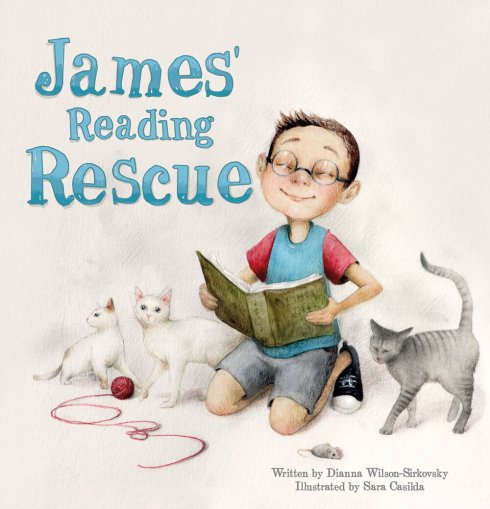
Dianna Wilson-Sirkovsky’s debut picture book just released! When she told me the premise, I knew she had to be on the blog…you’ll soon find out why…
Dianna, since I regularly discuss ideas on my blog, can you reveal where your concept for this book originated?
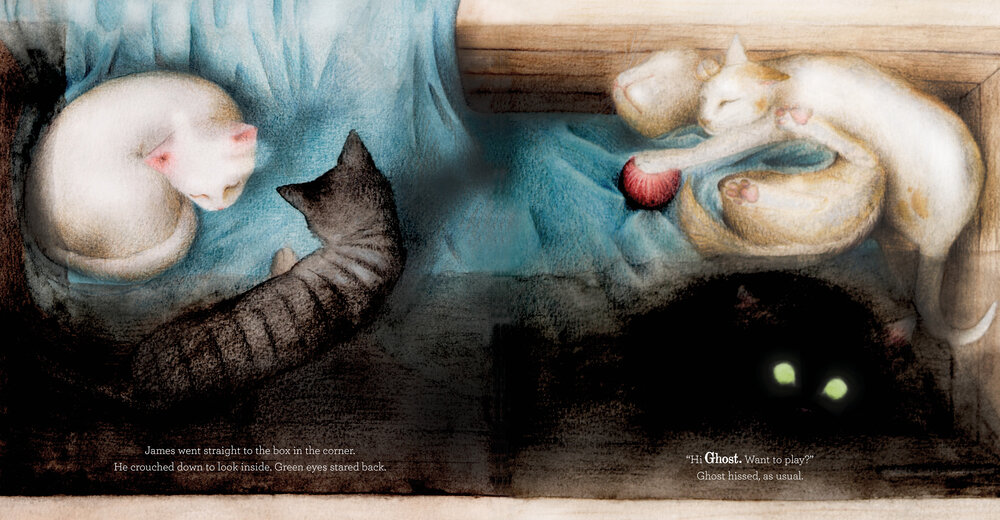
JAMES’ READING RESCUE is inspired by a true story that I read on the internet a number of years ago. The mom of a young son (who struggled with reading) suggested he read to the cats at the rescue shelter where she volunteered. He improved his reading while helping to socialize the cats for adoption. It was a win-win story that captured my heart!
My own son struggled with reading when he was younger and I’ve been involved in animal rescue for 40 years. This story jumped off the page at me and I just knew that one day it would be a wonderful picture book—no matter how long it took! The rescue began a program called Book Buddies, involving dozens of children reading to the cats and was so successful that other rescues contacted them to find out more about their program. How can you go wrong with a story about reading and cats? They just seem to naturally go together.
Wow! This story was meant for you!
My own kids have read to therapy dogs at the public library. In fact, I had only ever heard of dogs being the “read to” animal. What’s special about reading to cats instead?
Indeed, this story was meant for me! Cats often like the sound of a human voice and it is one of the best ways to help socialize them. So, reading to them is perfect. Some may seem to ignore you, but human presence, a gentle voice and stroking their fur, if they permit it, is a great way to help them become comfortable and “adoptable”. Some animals who have come from a home environment may have missed this human comfort and even seek it out with little readers!
I was not familiar with Clavis Publishing because they are based in Europe, although I understand they have a branch in New York. How did you connect with them?
You’re right, Clavis is based in Belgium but they also have a New York office. I researched all publishers who were accepting unsolicited work for children’s stories. Then I reviewed the types of stories they were publishing. I then submitted!
Clavis prints their books in both Dutch and English and market in Europe, the U.S. and Canada.
Good for you!
What do you hope readers will take away after reading your book?
A few things, actually! Everyone struggles with something. Kindness matters even if no one witnesses it. Hard work really does pay off. Reading opens the world and love of (and from) animals opens our hearts. Rescue animals make wonderful family members and black cats (and dogs) are the least adopted because of their color. Please think of these facts next time you’re looking for a new friend!
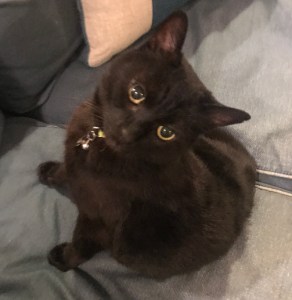
You know, my new pet Phoebe is a black cat! I should read to her!
So, what else is on the horizon for you?
I have a couple of stories on submission at the moment, so I’m anxiously waiting to hear about them! I’ve also been busy with revisions on a few other stories and I’m hoping to submit them within the next couple of months. I also have some stories patiently waiting their turn to be written, so I’m excited to get to those and see where they lead!
Did anything about the publishing process surprise you?
Almost everything! As a new writer I was completely untutored in all the “must knows”—story arc, the rule of three and the terrible SHOW not tell!! And then the dreaded query letter…! It has been such a learning experience and the help of more experienced writers along the way has been invaluable.
Dianna, thanks for sharing your debut here!
Blog readers, you can win a copy of the book by leaving a comment below. A random winner will be chosen soon.
Good luck…and happy reading! (I hope you have a cat!)
 Dianna Wilson-Sirkovsky has always been a passionate reader and animal lover. As a result, her children grew up in a house full of books and cats! She rediscovered her love of picture books reading to her children and it is the realization of a dream to now write for other children. She spent her childhood years on the Canadian prairies but she has lived in Montreal for many years, raising her family and working at McGill University. Writing for children is both a pleasure and privilege that she hopes to enjoy for as long as possible! Find out more about her debut picture book at Clavis Publishing.
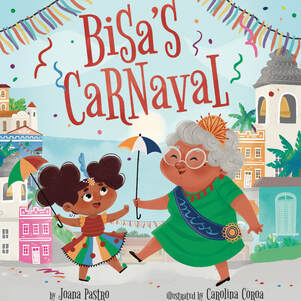
How lucky we all are to be in the midst of the most colorful time in picture books. Cultures from around the world feature prominently, like never before. You can truly visit the globe from the comfort of your living room couch.
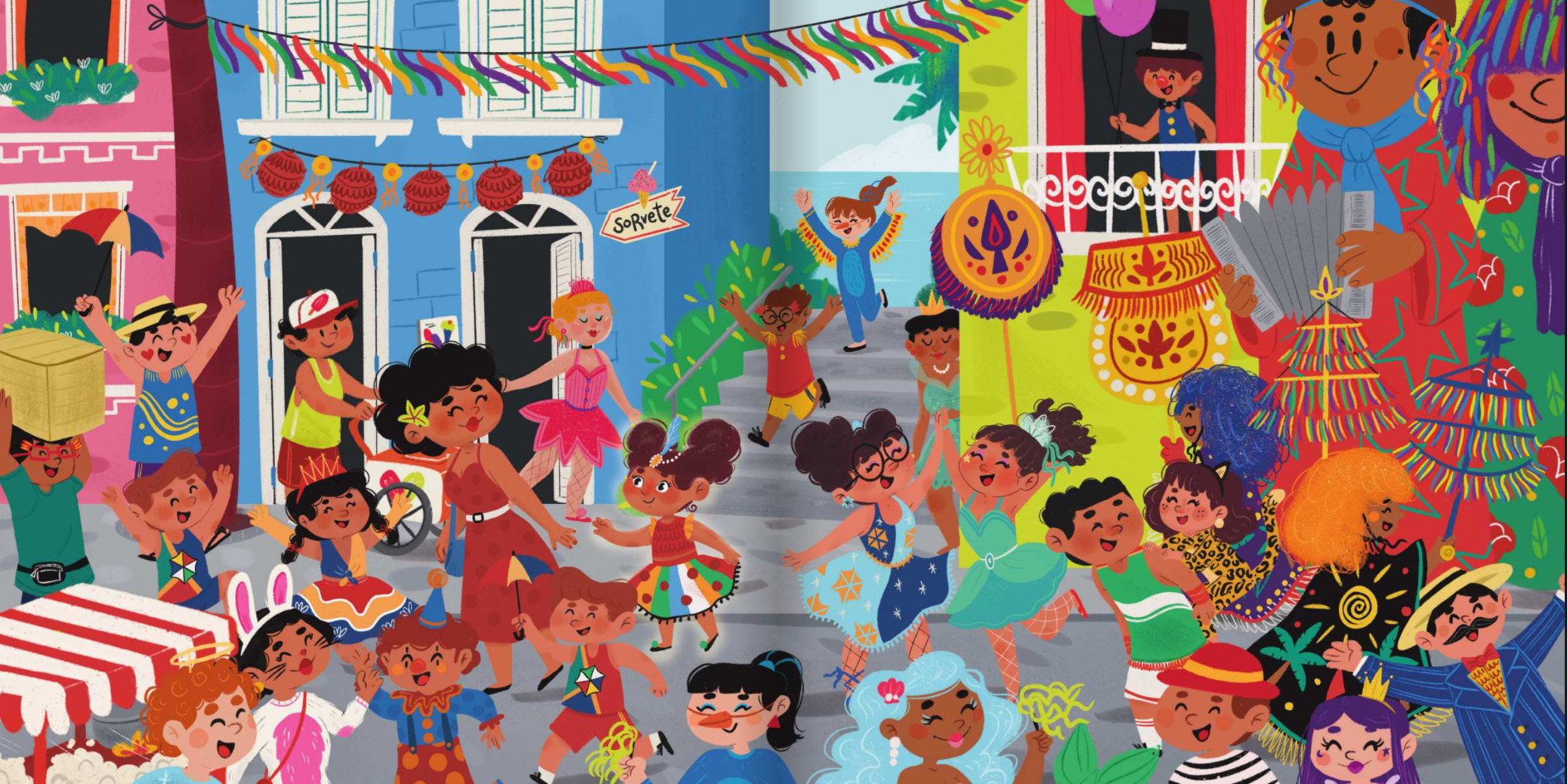
Author Joana Pastro grew up in Brazil and she brings the joyous festival of Carnaval alive in her newest book, BISA’S CARNAVAL, due from Orchard Books/Scholastic on December 7th.
Joana, this book is so lively and colorful! Did seeing the illustrations by Carolina Coroa bring you back to the Carnaval of your childhood?
Certainly! Carolina did such an amazing job capturing the energy, the excitement, the joy of Carnaval, and also the fact that in those five days, Brazil means Carnaval! Everything else in the country stops. It’s all a big celebration. I also want to add that because Brazil is a big country, each region has its own slightly different way to celebrate. The one featured in the book is the one that happens in the city of Olinda. Carolina portrayed Carnaval, and everything that’s unique to Olinda’s celebration, like the giant dolls, the geography and the buildings (by the way, a UNESCO World Heritage site), in the most beautiful way. I truly feel transported every time I read the book. I love it!
Sometimes the best stories are inspired from our own childhoods. The magic is that we can refine them to our liking! What from your childhood remains in the story and what did you change?
Joy, excitement, energy, craft-making, and especially love and family are the big elements that remained from my childhood.
As for changes, the first change is the location. Carnaval in my city was joyful, exciting and fun, but it pales in comparison to the festivity in other cities. I changed to Olinda, because of its unique cultural aspects, especially the giant dolls parading along the street side-by-side with the revelers. I was always fascinated by those. They’re very poetic to me. Another change was that, in my childhood, it was my mom, not my great-grandmother, whom I watched zig-zagging at the sewing machine. She made and fixed our clothes, and she’d do all sorts of crafts with us. That taught us to be mindful of our resources, recycle, and not discard things so easily, and also a great way to spend time together as a family.
How does your family celebrate Carnaval now that you’re in America?
Unfortunately, I can’t say we celebrate it. We always know it’s happening, we follow it online and on TV, but that’s it. My children have always heard us talking about it, but it was only after I started writing BISA’S CARNAVAL that they became curious about it. In my interviews I always say that one of the reasons I wrote this book was because I wanted Brazilian-American children to feel proud of their heritage. I just realized that this is already happening with my own children. Who knew your interview would be so therapeutic?
What traditions do you follow and have you created any new ones?
Festa Junina is a religious festivity with dance, music, games, and lots of delicious food. We have our own version of that every year. It’s fun and there’s a lot of eating going on!
I love Christmas. It’s always been my favorite holiday. I decorate my whole house, we always have a baking and craft making session as a family, before actual decorating starts.
As Brazilian-Americans we’ve incorporated Halloween and Thanksgiving as a tradition. Halloween is about dressing up and candy. What’s not to like? When I first moved here, I loved the idea of Thanksgiving, a holiday that celebrates being being thankful. It took me a few years to realize its historical inaccuracies. Today I’m careful not to perpetuate them, and I focus on being grateful for our blessings.
Joana, thank you for sharing your beautiful version of Carnaval with us!
Blog readers, you can win a signed copy of BISA’S CARNAVAL. Just leave one comment below to enter. A random winner will be chosen at the end of the month.
Good luck!
 Joana Pastro always wanted to be an artist of some sort. So, she became an architect. But once her first child was born, all the visits to the library, and the countless story times made Joana start dreaming of becoming a children’s book author. After a lot of reading, writing and revising, her dream came true. Her debut picture book, LILLYBELLE, A DAMSEL NOT IN DISTRESS, illustrated by Jhon Ortiz, was published by Boyds Mills Press in 2020. Her second book, BISA’S CARNAVAL, illustrated by Carolina Coroa will be published by Scholastic on December 7, 2021. Originally from Brazil, Joana now lives in Florida with her husband, her three extremely creative children, a rambunctious Morkie, and a needy Maltipoo. Visit her on Twitter @jopastro, Instagram @jopastro, or at joanapastro.com.
by Rosie J. Pova
I remember vividly the exact moment the title for the book popped into my head.
It was Thanksgiving Day and my family and I, along with some friends, had rented a cabin in the mountains in Colorado.
The turkey was in the oven, the salads and the sides were made, and I was bored. Everyone else had left to go to some hot springs and soak up, but I had stayed at the cabin to cook. On top of that, I had a cold and was quite miserable to go anywhere, anyway.
Luckily, Jack Canfield had a 2-hour pre-recorded webinar coming up for which I had registered. He was being interviewed, talking about his journey, his ups and downs, marketing and other interesting topics for authors.
I had watched that webinar a few times already and was pretty familiar with the content, but never tired of listening to Jack’s amazing journey to such tremendous success with his CHICKEN SOUP FOR THE SOUL series.
So, I was ready to soak up his wisdom once again.
As usual, his talk left me feeling inspired and motivated. I was in the mood to write.
I started brainstorming catchy titles for a story that would be fun to write. I asked myself, what would be a title that stands out, is intriguing, memorable, and fun to say all at the same time?
Suddenly, it came: THE SCHOOL OF FAILURE. I liked it! Then I thought of an interesting opening sentence. I was trying to amuse myself… hoping that I’d create one of those classic, memorable opening lines.
What followed was, The school of failure was located in the middle of nowhere, but it was the center of everything! I was delighted with my progress and continued to write the first draft that day.
That was a great feeling, it cheered me up, making me forget I was under the weather. And even though the starting of my day seemed like a bit of a fail, it was well worth it to have this time to myself and end up with a completely new story. I was grateful—maybe this was a divine plan after all.
Fast forward a few years, many, many revisions later, and the story sold!
Many more revisions after that, my precious little opening sentence ended up being cut, but the title stayed with the addition of a subtitle: A STORY ABOUT SUCCESS.
Now finally, I am pleased to share it with the world, and hoping it finds its own success in the homes and hearts of many readers.
Thank you all for celebrating this book with me.
And now, the reveal…the cover by Monika Filipina…

P.S. I did find a way to sneak that opening sentence in to the book—it’s now included in my Author’s note!
Thank you, Rosie, for sharing this cover with us! And some adorable story characters…
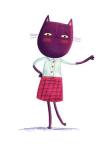
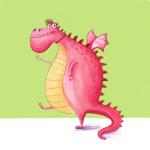

Rosie is also giving away a 30-minute consulting phone call (or Zoom, depending on your location) to chat about any writing or publishing questions you have for her.
Leave one comment below to enter.
A random winner will be selected soon!
Good luck!
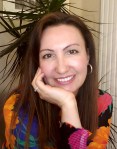 Rosie J. Pova is a marginalized, multi-published, and award-winning children’s author, poet, speaker, and school presenter. She is also a Writing Instructor for the Dallas Independent School District, an instructor with Writing Workshops Dallas, teaching online picture book courses to children’s writers, and Rate Your Story judge.
Her latest picture book, SUNDAY RAIN (Lantana/Lerner, March 2021), was featured in The New York Times and Parents magazine. Her upcoming picture book, THE SCHOOL OF FAILURE: A Story About Success will be released in 2021 in China and in spring of 2022 in the USA from Yeehoo Press. She has three other children’s books in print as well.
Rosie has been featured on TV, radio, podcasts, and print media, and also speaks on women’s and mom’s topics.
Originally from Bulgaria, she now lives in Dallas, TX with her family.
Visit her at RosieJPova.com and follow her on Twitter @RosiePOV.
by Heidi E.Y. Stemple
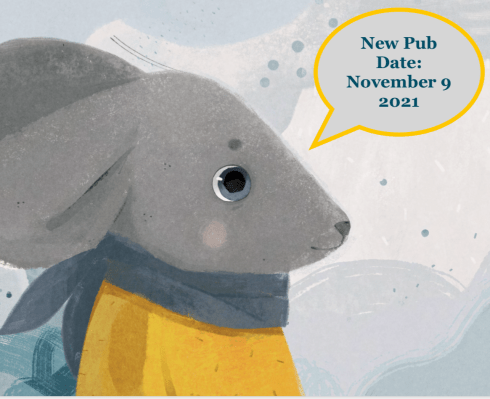
This is the dedication from my new book ADRIFT, available September 7, 2021 Oct. 26, 2021 November 9, 2021*:
For my mother Jane and my daughter Maddison—in their own boats in this same storm. And the two beautiful friends who helped make this a book: Nina before the story and Hannah after.
OK, I know that’s a weird way to begin a blog post. And, frankly, this might be a totally different (weird?) way to introduce a book. But, stick with me.
In the early days of 2020, just as I was about to get on a plane and teach writing in Alabama with my mother (author Jane Yolen) then visit my daughter Maddison in Georgia on the way home, the world ground to a halt. We were locked down. I was alone and scared. I am not ashamed to admit, I spent many days pacing and crying. I know my experience isn’t unique. We were all, in our own ways, struggling. Families were stuck inside together or kept apart from each other. Educators were scrambling. Creatives were trying to figure out how to create through the stress and uncertainty.
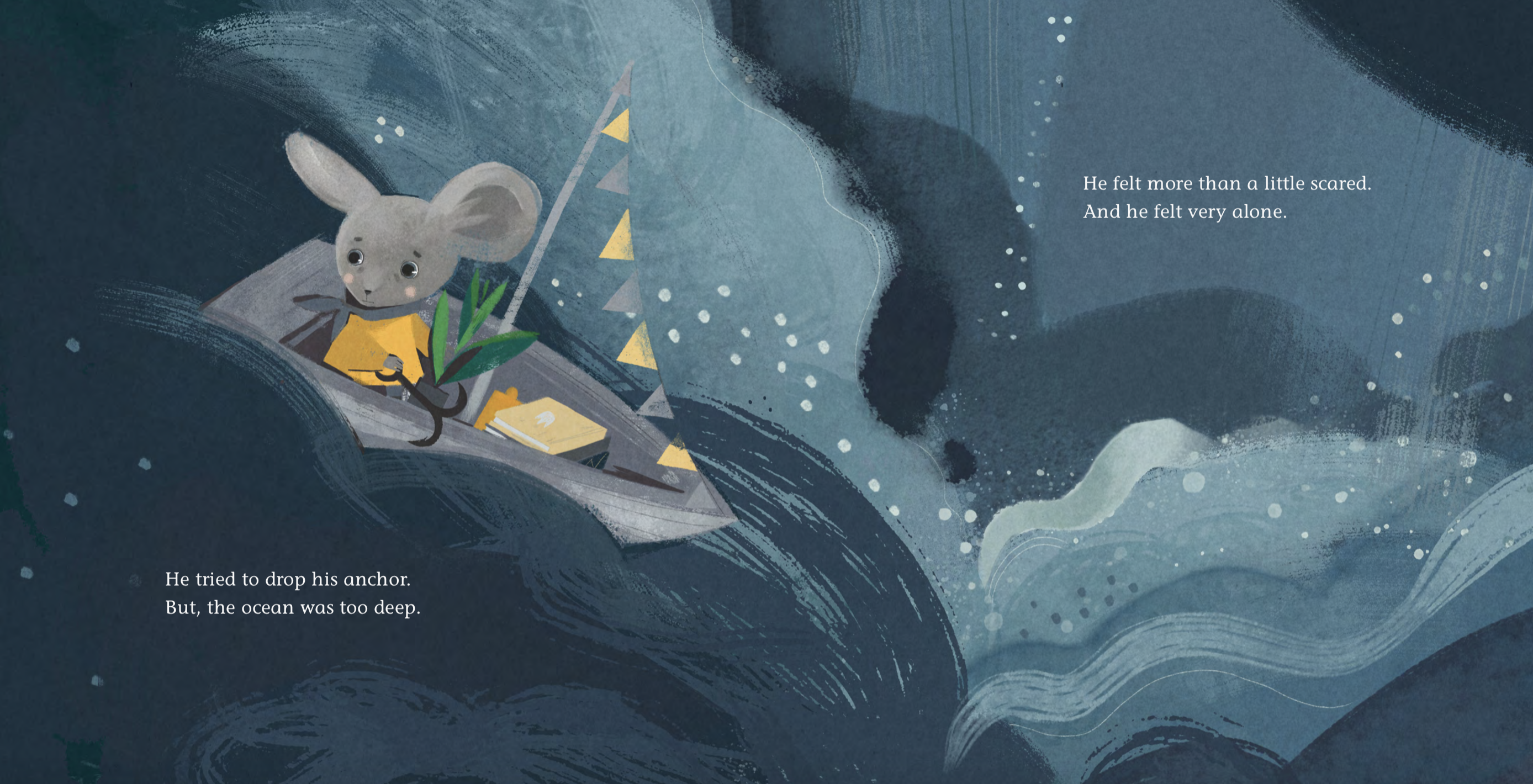
In a conversation one evening, my friend Nina—the one from the dedication (Nina Victor Crittenden, a talented author/illustrator) said to me “we may be in our own boats, but we are all in the same storm.” I know she didn’t make it up, but the metaphor stuck with me. I went to bed thinking about that storm. And, I woke thinking about it. After being an author for 26 years, I knew that was my brain telling me to write that story. I opened my computer and typed, “One tiny mouse on one tiny boat pitched back and forth, adrift on the churning seas…”
I often write just for the sake of writing. Clearing out what is in my head. I wrote a lot of poems about my fears during the pandemic. They were never meant to be published—a deep cleansing breath of words onto the page. When I couldn’t stand the sadness of being so far away from my daughter, I wrote about doing yoga with her over Zoom. I still can’t read this without crying.
Gratitude
The best part
of my day,
is filled with
pain.
One thousand miles away,
my daughter opens a room
on the internet
and I enter.
She instructs me to breathe,
in and out.
In and out.
And I do.
But, my breathing
is not for centering myself.
Oceanic breath
means nothing to me.
My pranayama
is a long sigh
of relief.
One more day she is healthy,
even if too far away
from me.
I do all the poses
and stretches
and impossible bends.
In truth,
they are getting easier
for these old bones.
But, I would walk across
hot coals
if that’s what it took
to see her face,
hear her voice,
know she is safe.
Close your eyes,
she instructs. Think
of something you are
grateful for.
I should be thinking
inward.
I should be one with
the intention.
But, I am bad
at yoga rules.
I look across those
one thousand miles
into those
oceanic blue eyes
and I know exactly what
I am grateful for.
©2020 Heidi E.Y. Stemple
That first morning, writing ADRIFT was like that. The purging of anxiety onto the page. In that white hot writing—the first draft when you are madly chasing along after the plot without having any idea where your character is taking you—there is just story, not yet book. I think I read it to friends over Zoom that night. I remember tears. Mine. Maybe theirs, too. Who knows. There were so many tears in those early days. We all needed that deep cleansing breath. It probably wasn’t particularly good, yet. But, it resonated. Like Little Mouse in my story, the contact with my own community was so necessary. So healing. My friends encouraged me to try to sell it. First, of course—revision.
Revision, my mother will tell you, is the opportunity to re-imagine, re-envision your work. When I am grumpy about revising—and I am always grumpy about revising—I remember that.
Then a funny thing happened—one of those things that, if you wrote it in a novel, your editor would tell you it’s not believable. But, it happened nonetheless. Michel Moushabek, the publisher of Interlink/Crocodile Books either posted on social media or emailed my mother (these stories get murky as they get further in the past) and mentioned the quote that Nina had said to me. He asked if she would consider writing a picture book based on it. She said, funny you should ask, I have just read that manuscript! My agent sent it right away.
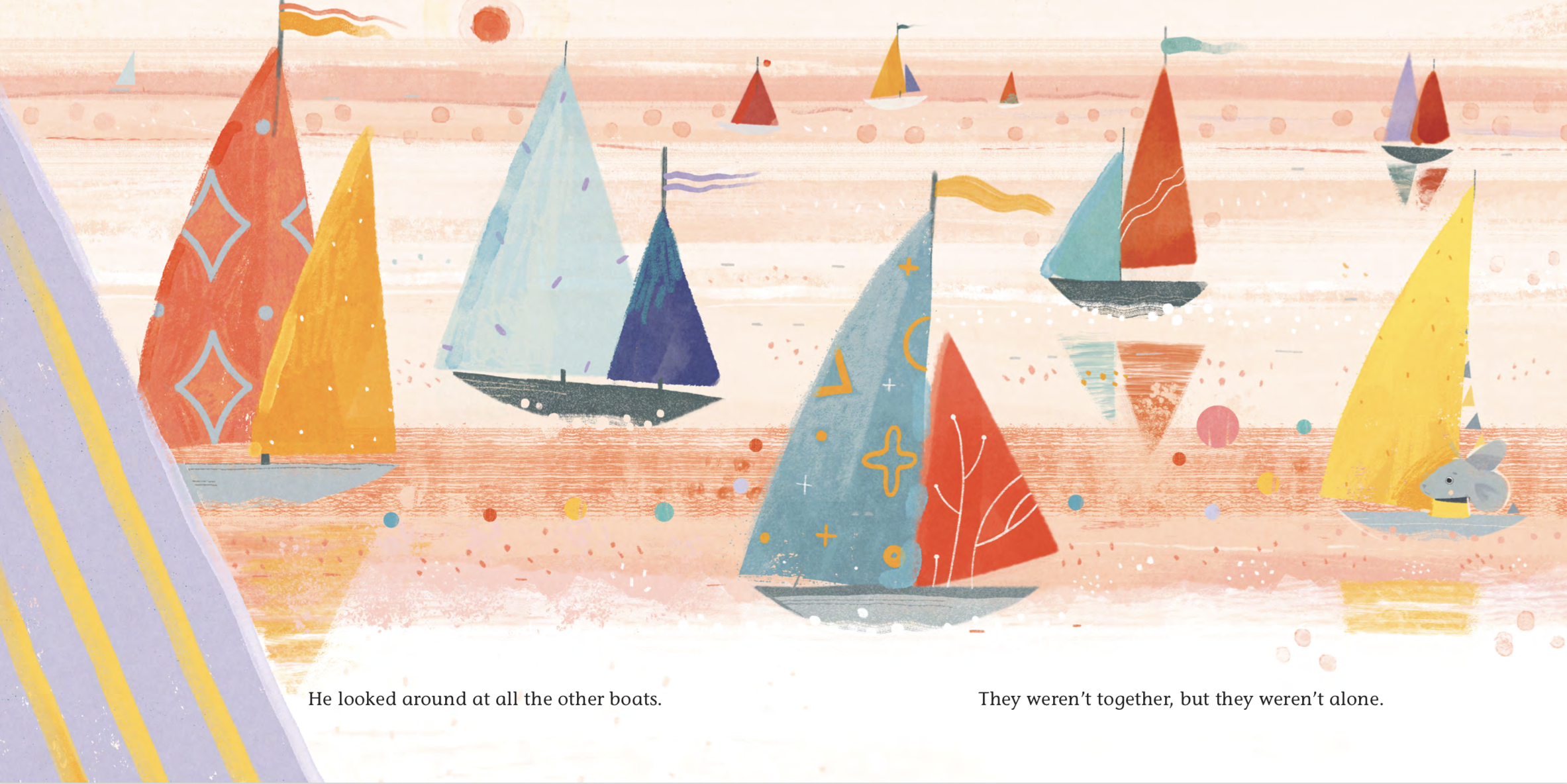
Hannah Moushabek is a marketing genius. This isn’t my opinion. Look her up. She is presently working for Simon & Schuster (who did not publish ADRIFT but did publish my other 2 books that came out this year, TOUCAN WITH TWO CANS and PEOPLE SHAPES). In her (very) spare time, she acquires and edits picture books for Interlink/Crocodile. She is the Hannah in my dedication—who helped me after the story. Hannah found Anastasia Suvorova who created evocative, deeply moody, hope-filled illustrations. Anastasia created a color arc to the story that made visual what I had written. Blue-gray to peachy pink—fear to hope. Hannah took my words and Anastasia’s illustrations and created a book.
That should be the end of the story, right? Today my book comes out and people get to read it! Yeah!
Ha!
Nope.
* As we know now, 2021 had its own ideas of how it would unfold. Enter a new storm—global supply chain issues. ADRIFT was supposed to come out September 7 when the pandemic was over and we were hip-deep in our long-awaited joyous celebrations of togetherness! None of that happened. We are still in the middle of the pandemic and we are not fully back together. Also, you may have noticed, September 7 has come and gone. And, if you check Amazon today, you will notice that the pub date is now November 9, 2021. This change happened just one week ago. I am lucky—we saw this coming and moved the pub date, the first time, back in July. And, I am a patient sort (who has been in the book business a LONG time), so while this last-minute change is inconvenient, I have decided it just means I will celebrate ADRIFT’s book birthday for the full two weeks between today and November 9th. Others, friends with books tied to anniversaries and holidays, specific days meaningful to their stories, have not been so lucky—in their case, ‘late books’ translates to substantial loss of sales. I mention this because I want to honor how hard it has been for everyone launching a book. And, I want to encourage you to not overlook books that are on backorder. We can all wait a little, right We book creators are trying to all keep our heads and spirits up and keep bringing you beautiful, hopeful, empowering, funny, gorgeous, silly, and thoughtful books. Sometimes it is hard. On days like today, or maybe November 9th, when my book is finally out in the world, on shelves, and in small hands, it’s much nicer.
This past year and a half has been so difficult on so many levels. But it also helped me slow down and reprioritize my life. It made me look at community, including the 4 amazing women in the dedication of ADRIFT, in new and important ways—those moments where I, like Little Mouse, have held my loved ones “close enough to feel them near, but not close enough to crash.” Honestly, ADRIFT is my hope for our future—for every kid to know that alone and afraid may be part of life, but there is always something wonderful to look forward to after the storm—metaphoric or real.
Have I not told you enough about the book itself? Probably not. Sorry. Here’s the elevator pitch:
Finding himself alone and scared in the middle of a storm, a small mouse finds comfort and strength when he sees another boat and is joined by others. They ride out the storm together―close enough to see each other, but not close enough to crash. In a gentle metaphor for the global pandemic, ADRIFT is a way to start conversations with young readers about fear, hope and being together even from afar.
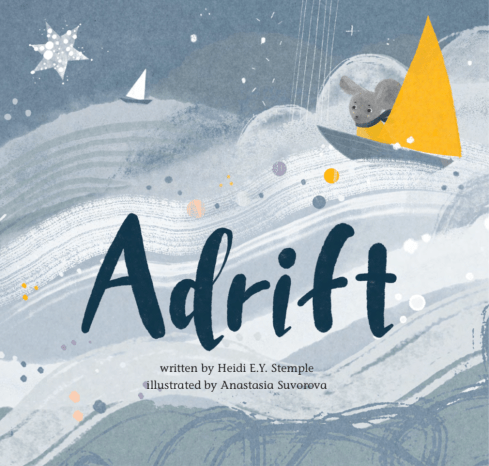
I hope you love ADRIFT. I hope you share it with the children in your life. And, I hope my words and the magnificent art by Anastasia Suvorova give you hope and joy even when times are stormy.
Thanks for reading!
Thank you for sharing, Heidi!
Blog readers, don’t go drifting off! You can win a signed copy of ADRIFT!
Leave one comment below to enter.
A random winner will be selected soon.
Good luck!
 Heidi didn’t want to be a writer when she grew up. In fact, after she graduated from college, she became a probation officer in Florida. It wasn’t until she was 28 years old that she gave in and joined the family business, publishing her first short story in a book called Famous Writers and Their Kids Write Spooky Stories. The famous writer was her mom, author Jane Yolen. Since then, she has published more than thirty-five books and numerous short stories and poems, mostly for children.
Heidi lives and writes on a big old farm in Massachusetts that she shares with one very large cat who lives inside, and a dozen deer, a family of bears, three coyotes, two bobcats, a gray fox, tons of birds, and some very fat groundhogs who live outside. Once a year she calls owls for the Audubon Christmas Bird Count.
Follow her online at heidieystemple.com, on Twitter @heidieys and Instagram @heidieys.
Thinking Outside the Box:
You know what else has been SO HARD this year? Promoting your book. We have all had to not only pivot from in-person to online book events, but we have had to figure out how to promote our books without the stuff we all count on—book festivals, school visits, books store signings…
How do you get a signed copy of ADRIFT?
You can purchase autographed and personalized copies of ADRIFT through my local bookstores:
Odyssey Bookshop, Hadley MA
High Five, Florence, MA
The Carle Museum, Amherst, MA (413) 559-6333
BookLinks, Northampton, MA (413) 585-9955 or through bookshop.org
What do you do once you have a copy of ADRIFT:
If you purchase a book from your own bookseller, I will send you a signed bookplate: email your address to adrift@interlinkbooks.com
If you are an educator and have purchased or preordered ADRIFT, send a copy of your receipt to: adrift@interlinkbooks.com and they will send you a link to a recording of me reading ADRIFT for your classroom.
I will be doing an online event with Odyssey Books on Wednesday, Nov 3 at 6:30pm EST, with or without books!
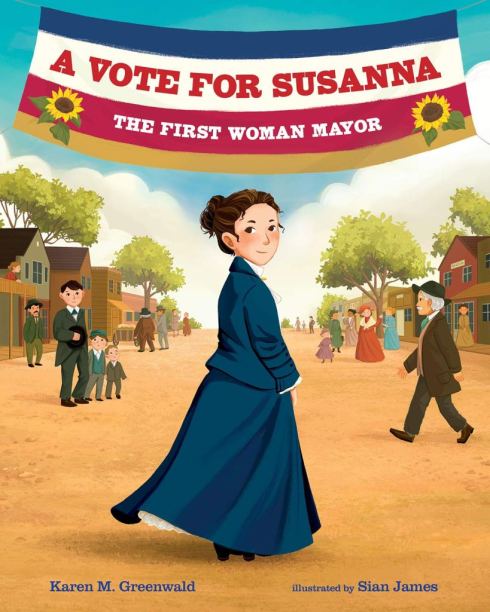
by Karen M. Greenwald
I’m often asked why I wrote A VOTE FOR SUSANNA, THE FIRST WOMAN MAYOR (illustrated by Sian James)? The funny thing is that I didn’t really feel like it was a choice. It needed to be told. Sometimes, you just know. But when I think about the three and half years it took to create this book, the question could easily be rephrased.
What made you go spelunking through gazillions of documents, newspapers, and articles and scale enormous barriers (there were many!) in search of the one thing that would allow this piece of history to fit the picture book format?
Whew! Yes, finding the key to unlocking her story took a lot of work. But Susanna’s election in 1887 offers so many lessons for children (and adults). While many of the challenges she faced are still relevant today, most people have never heard of her. Thrust into the center of a public prank, Susanna had to make a difficult choice that would impact her life and her family’s future. Clearly, bullying is a problem many children sadly deal with daily. I knew that learning about how this woman was bullied would make her story come to life and feel relatable to kids today.
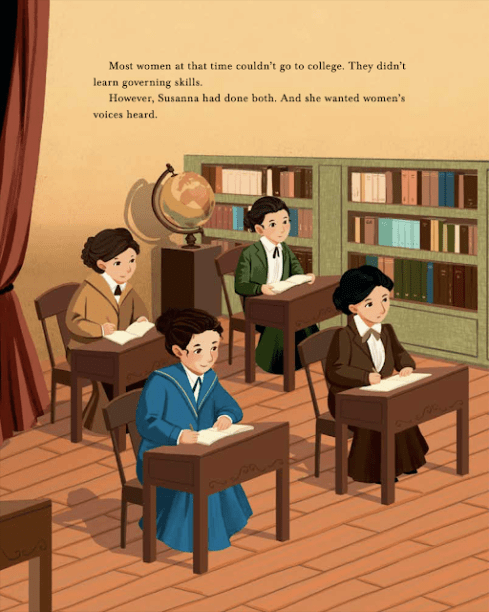
Even winning didn’t change her treatment. Papers worldwide focused attention on her weight, dishwashing, and clothing—not on her education or other qualifications. Notice any parallels between coverage of her and women today? Despite the press, women and men around the world wrote to Susanna. They said she gave them hope that equity was possible. Wouldn’t it be amazing if her bravery and victory could inspire children to treat each other with more respect today?
Finally, Susanna’s win didn’t happen in a vacuum. Argonia was part of her journey and triumph. Yet, history has long brushed them and this important election aside. I wrote my book to continue the conversation Mayor Salter and her community began—one that touches on ending bullying, finding compromise, and building unity. I know these topics will spark important discussions in school and at home, showing children the power a vote and belief in oneself can yield.

Two weeks ago, the National Women’s History Museum held my book’s launch. I couldn’t catch most of the chat—it streamed so fast. But one post while I spoke caught my eye. It was from Susanna’s great grandson (I knew he was coming), “Susanna’s great-great granddaughter is also listening and is loving hearing more about her. She’s bringing this book to her 5th grade class next week where they are talking about gender stereotypes in class—this book will be a perfect addition to the conversation. Thank you for a new family treasure!”
So why did I write this book? What better answer could I give?
Thank you, Karen! I didn’t know about Susannah until your book! Thank you for writing it!
And as a thank you to you for reading about A VOTE FOR SUSANNA, Karen is giving away a half-hour Zoom consult to talk about writing picture books. I often chat with Karen via Zoom, so I can confirm what a delight she is!
Leave one comment below to enter.
A winner will be chosen at the end of the month.
Good luck!
 Karen M. Greenwald has a wide range of government, campaign, and branding experience. She’s won international awards for STEM creative, writing, video, rebranding, and self-promotion. Bylined credits include online, print magazines, and The Washington Post. Karen belongs to SCBWI, 12×12, and co-founded #SunWriteFun—a NF/Informational fiction summer contest that raises money for kidlit charities. Her picture book, A VOTE FOR SUSANNA, THE FIRST WOMAN MAYOR, debuted in October (Albert Whitman). It has held steady since February on two of Amazon’s Hot New Releases lists for kids. A Phi Beta Kappa, she earned undergraduate and JD degrees from Georgetown University. Before turning to branding, Karen worked as an attorney and focused on international environmental compliance issues. Follow her on Twitter @karenmgreenwald.


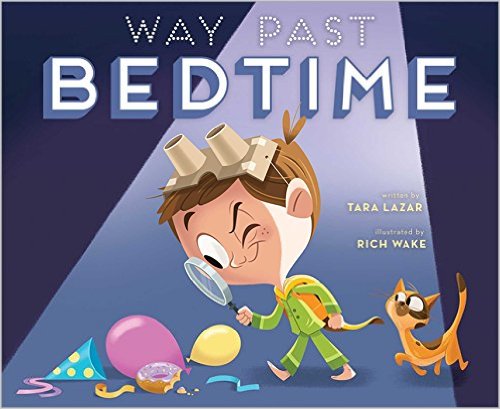



 Writing for Kids (While Raising Them)