You are currently browsing the category archive for the ‘Picture Books’ category.
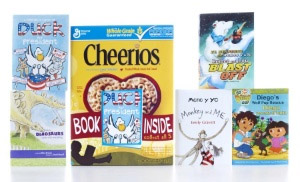
Who doesn’t love Cheerios? Little circles of oat goodness! The TV show “Glee” pays homage to Cheerios by naming their cheerleading squad after the superior cereal. And since we’re already cheering, let’s whoop it up for the Spoonfuls of Stories program! Cheerios distributes 6 million children’s stories in its specially-marked bookish boxes. Bravo!
Well, I do love Cheerios.
When I’m not hating them.
You see, my love/hate relationship with the ubiquitous toddler treat runs deep—deep in my carpeting, that is.
So for the new parents out there, take heed. Sure, run out and buy What to Expect When You’re Expecting. But then, expect Cheerios to be on your grocery list for a lifetime, so pay attention to these lessons:
- Do not purchase carpeting that is the same color as Cheerios. My sand-colored shag disguises stray O’s. We’re endlessly grounding whole grain cereal into the fibers and getting little circles stuck to the bottom of our feet.
- Do not enter the ceramic tile of your kitchen with said Cheerios attached to your heels. You will go flying. It won’t be pretty. (Hey Mom, is that a new dance?)
- Do not buy Cheerios at Costco. The enormous box won’t fit into any cabinet. You will be forced to let it live on the kitchen floor, within easy reach of a newly-walking toddler. You will soon have 5,392 Cheerios dumped onto your floor…with 5,391 rolling under the refrigerator. All the money saved by buying in bulk will be beneath your icebox.
- Do not buy fruity Cheerios in rainbow colors to solve the carpeting dilemma. They will not be eaten, these strange, colorful cereal mutations. Instead, necklaces will be made. Bracelets. They look so beautiful glued to construction paper. If you lick them and press them against the wall, look—they stick!
- Murphy’s Law of Cheerio Consumption: if you place one Cheerio at a time on the baby’s tray to avoid cereal being thrown on the floor, she will eat each quickly and cry for more. If you put more than one on the tray, they will be immediately swiped onto the ground. (Corollary: number of Cheerios provided to your child is inversely proportionate to their hunger.)
I’m sure you other parents have your own Cheerio life lessons. Please share them! (The lessons, not the Cheerios. I have enough all over my floor to make a meal, thankyouverymuch.)
P.S. While I have your attention, please vote for the books to be included in the 2010 Spoonfuls of Stories program. Me, I like Bear’s New Friend by Karma Wilson and The Hair of Zoe Fleefenbacher Goes to School by Laurie Halse Anderson.
Corollary
 What makes you pluck a picture book off the shelf? A clever title? The author’s name? What about a charming little girl on the cover, stirring a delicious pot of noodles? That’s what got to me with Cora Cooks Pancit by Dorina K. Lazo Gilmore.
Maybe it’s because I love to cook. Maybe the bright little dot that said “Recipe Included!” spoke to me. (And, by the way, the recipe is delicious!)
But more than anything, vibrant primary colors and Cora’s smiling eyes drew me in. Illustrator Kristi Valiant’s paintings evoke a warm feeling as Cora cooks a traditional Filipino dish with her mama for the first time.
Cora is the youngest of many children and always gets the kiddie kitchen tasks, like licking the spoon clean. Valiant’s opening scene shows the family from Cora’s point of view, as she sits on the floor with the family dog. We see her family from the waist down, spread along the kitchen counter, performing their duties. It’s amazing how Valiant can make the poses so varied and expressive, only working with half a body. Some of the pencil lines remain, creating an illusion of movement—the bustle of the family kitchen.
Valiant’s image presents the conflict immediately: little Cora is not involved with family meal preparation. We feel Cora’s longing to be a “real cook.”
One day when her siblings leave the house, Cora asks to cook with Mama. Mama lets Cora choose the dish. Cora wants pancit.
Mama tells the story of how her own father taught her to make pancit, and Cora feels proud when she gets to wear her Lolo’s red apron.
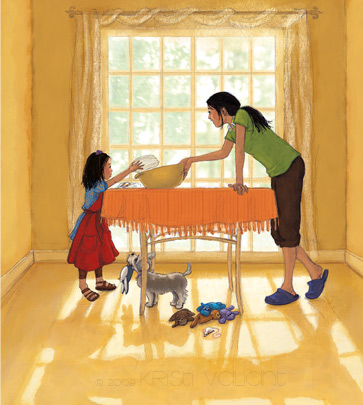
What follows is a delightful, heart-warming exchange between mother/teacher and daughter/student. Valiant’s illustrations are spot-on, from facial expressions to body language. She gets every detail just right. Even Cora’s feet, slightly off-balance, reveal her trepidation as she prepares the noodles. Sunlight streams in through the kitchen window, framing Cora and Mama in a scene that highlights the special bond created with family tradition.
As usual, I won’t reveal the story’s ending. There’s an oopsie along the way, but there’s also a beaming Cora.
I was so impressed with this book’s illustrations, I asked Kristi Valiant for an interview. Luckily, she agreed to talk to me about the making of Cora and other fun illustration stuff. Watch for it soon!
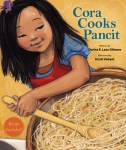 Cora Cooks Pancit
Text by Dorina K. Lazo Gilmore
Illustrations by Kristi Valiant
Shen’s Books, Spring 2009
Want it? Sure you do!

[10/19/10: UPDATE! PiBoIdMo 2010 is almost underway. See announcement.]
[11/1/09: UPDATE! PiBoIdMo 2009 has launched! Click here for details!]
November is only a few weeks away, so while novel-writing friends gather up their character notebooks and plot outlines, I’m preparing to do exactly what I did in November 2008: generate one new picture book idea a day.
This is different from Paula Yoo’s NaPiBoWriWee last May, when writers wrote one new picture book a day for seven days. (Phew! I couldn’t keep up with that.)
And it’s different from YA author Jo Knowles’ JoNoWriMo, where children’s writers take a month and a half more (from mid-September to November 30) to complete a kidlit project.
This November’s writing challenge is all about ideas.
They say it takes 10 to 30 days to form a habit, so I’m encouraging picture book writers to get in the daily habit of idea generation. Do it for November, let it continue into December, and start off the new year still collecting tiny seeds that may some day sprout into a story.
An idea for a picture book could be as simple as a title, like Misfit Museum. Or you could take a fall stroll one afternoon and be inspired by foliage floating on a lake. (You might jot down “watercolor pond.”) It doesn’t have to be a full concept, or even a good one. Heck, I’m sure we’ll all have some stinkers in there. But by creating an idea file, you’ll have a document to turn to when you’re low on inspiration.
Why is this a good idea? During an online chat with literary agent Sean McCarthy last year, he was asked about the qualities his ideal client might possess. “Prolific-ness” was his answer. Agents like when their picture book authors are constantly creating. That means there’s more potential books to sell.
At the end of November, you should have 30 new story starters (or close to 30…we do have Thanksgiving festivities to think about). Last year I walked away with 22 ideas, four of which turned into picture books. And I refer to that idea file at least once a week.
Now all we need is a flashy name. NaNoWriMo-lite? (Way, way lite. With extra cream and sugar.) Nah. Something snazzier. Give it a try! It needs a name!
If you’d like to participate, please comment below. I promise to post ideas for idea generation all November long and check in with progress reports.
 Picture book brilliance isn’t easy to achieve, as many children’s writers know. Telling a story in 500 words–with page turns that work within a 32-page format–challenges the most talented of writers.
Let’s not forget that a picture book should appeal to both parent and child. Silliness keeps the kids begging “again!” But if a parent thinks the language is too repetitive or annoying, you’ll lose the gatekeeper. (You know, the one with the wallet.)
Sappy stories can attract Mom and Dad, but kids might declare them snoozers. I recall tearing up at a lovely, sentimental picture book while my daughter rolled her eyes. “Mom, what is wrong with you?”
So what makes a great picture book that both parent and child can call a favorite?
A balance between humor and heart, imagination and reality.
That Rabbit Belongs to Emily Brown by Cressida Cowell and Neal Layton has it all.
Emily and her stuffed pal Stanley explore the world together–they scuba-dive, swing through the rain forest, and launch into outer space. But they are constantly interrupted by a rat-a-tat-tat on their garden door. Her Royal Highness Queen Gloriana’s guardsmen keep insisting that Emily give her Bunny-Wunny to the matriarch. It is the Queen’s decree!
Now, the Queen tries to be fair about it. She offers all these new-fangled toys in exchange, upping the ante each time Emily refuses. But the Queen’s toys are “stiff and new and gold and horrible…with staring eyes and no smile at all.” Once it’s clear that Emily will not trade Stanley, the Queen resorts to extreme measures.
Emily awakens the next morning without Stanley! She knows who’s behind his disappearance and marches straight to the palace. But the Queen is not happily playing with her Bunny-Wunny. She’s crying over him.
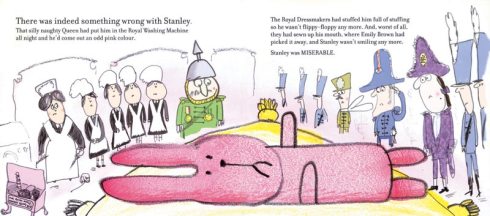
That silly, naughty Queen had Stanley re-stuffed and washed, turning him an odd pink color. They were both miserable.
As usual, I won’t tell you how it ends. You’ll just have to pick it up for yourself. And cuddle with it. And go on adventures together. Wear out the pages a bit.
That Rabbit Belongs to Emily Brown celebrates the special bond between child and toy. Almost everyone had a lovey, that one thing we couldn’t live without, dragged by a leg to grocery stores and Grandma’s. This story reminds adults that there’s still a kid inside us, longing to curl up with our own flip-floppy stuffed rabbit.
Luckily we can snuggle with a cute kid instead, reading Emily Brown over and over and over again.
 That Rabbit Belongs to Emily Brown
Written by Cressida Cowell
Illustrated by Neal Layton
Hyperion Books for Children
Want it? Sure you do!
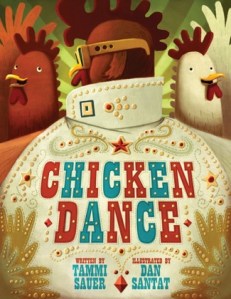 Remember those embarrassing dance moves your Aunt Myrna unveiled at Cousin Frannie’s wedding? She flapped her arms, wiggled her tush and tumbled onto the parquet floor?
Well, that’s not this chicken dance.
No siree, this Chicken Dance is a brilliant barnyard romp featuring two hilarious hens and their idol Elvis Poultry, thank you. (Thankyouverymuch.)
Author Tammi Sauer grew up on a Kansas farm, tending cows at dawn. Those daybreak chores paid off, ’cause this little lady sure knows how to milk the humor.
According to henhouse pals Marge and Lola, Elvis Poultry is a hunk of bawking love. When the barnyard talent show is announced, the pair discover the grand prize is two tickets to Elvis’ Final Doodle Doo concert tour. They must win!
But the ducks waddle by and wave a wing at the hopeful hens. “Don’t bother, drumsticks.” Seems ducks are top dog at this farm.
Marge and Lola test out their talents but the ducks quack at every failed attempt. When Marge and Lola finally hit the stage–following solid goat, pig and cow acts–they stammer and gulp. A duck heckles, “What’s the matter? Are you chicken?” so they begin to flap, shake and bawk. Just regular chicken stuff, nothin’ fancy. But the crowd loves it and crows for more.
The next spread features Marge and Lola performing dance moves that would make Aunt Myrna shake in her boots. They vogue, point like John Travolta, domo arigato misuta robotto, and walk like an Egyptian. Illustrator Dan Santat makes chickens boogie better than So You Think You Can Dance finalists.
I can’t reveal the contest results, as that would spoil all the feathery fun. But I will tell you that Elvis is in the building. Err, I mean barn.
 The jokes even extend beyond the story, with end pages that demo step-by-step “Disco Chicken” and “Chattanooga Choo Choo” dance moves. Funky album covers replace the typical staid author and illustrator photos.
Yes, just one look at the blinged-out, white-caped Elvis Poultry on the front cover, and you know this ain’t your Aunt Myrna’s paltry poultry impersonation.
Can’t get enough of the silliness?
Publisher Sterling Kids is holding a video contest now through October 31. Just shake your tail feathers along to the official music and post your hoe-down on YouTube.
And tell them Elvis Poultry sent ya.
 Chicken Dance
Written by Tammi Sauer
Illustrated by Dan Santat
Sterling Kids, August 2009
Want it? Sure you do!
Agents and editors have told me they occasionally receive calls from writers who are brand new to children’s books. These aspiring authors ask, “How do I get my book published?”
Kindly folks that they are, these agents and editors don’t slam the phone down. They’ll sometimes spend a few moments providing basic details. But this information can be easily found online. That’s what makes being a new writer so exciting these days: there’s professional advice available via websites and blogs, you just have to search for it. It’s not all so mysterious anymore.
So if you’re looking to launch a kidlit career, please don’t call an agent or editor to learn the basics. Let them read manuscripts, sell books and do their jobs. Come here instead…
A New Children’s Writer’s To-Do List:
- Write.
I knew you’d like that one. - Read children’s books.
Become familiar with the genre in which you write. Understand appropriate length and content for specific age groups. See what’s being published. Don’t follow trends, but know the competition. When pitching editors and agents, it’s often helpful to compare your book to another title. You can’t compare if you aren’t well read. - Join SCBWI.
Take advantage of their resources—local chapter events, national conferences, online discussion boards and publications. - Join a critique group.
Find fellow writers who work in the same genre as you. They provide support, motivation, and helpful feedback. (And if you can, find a group with writers who are more experienced than you.) P.S. Your mother, daughter, spouse, and neighbor’s 2nd grade class are not a critique group. - Attend workshops, conferences and events.
Seek out opportunities to learn and network with authors, agents, editors and writing peers. - Read books on the craft.
Writer’s Guide to Crafting Stories for Children by Nancy Lamb
Writing Picture Books by Ann Whitford Paul
Writing for Children and Teens by Cynthea Liu
Writing with Pictures by Uri Shulevitz - Revise and rewrite.
It’s not going to be right the first time (or maybe even the second or the fifteenth). It’s just not. Resist the temptation to submit an early draft to a publisher. - Take time to develop your skill.
Your writing will improve with practice. Most professional authors need at least two years of serious writing to hone their craft, and it’s not unheard of to work for ten to fifteen years before becoming published. - Submit when you have more than one project polished.
Finished your first manuscript? Keep writing. If an editor or agent likes your manuscript, but not enough to make an offer, they may request other material. Have a few manuscripts at the ready. - Learn to have patience.
It can take many years to write publishable material, sell your first project, and develop a career. Even after you become published, the business is still full of waiting—waiting to hear from your agent and/or editor, waiting for a book to be released, waiting to earn out. You will never NOT be waiting. Patience and perseverance are key. - Call yourself a writer.
Because you are one!
If you have some newbie suggestions, let’s hear them. Please leave a comment.
 Ever have one of those light-bulb moments when your manuscript finally gels? Your plot falls into place and you wonder why you didn’t think of something so simple and perfect before.
Sitting in on Sudipta Bardhan Quallen’s picture book workshop last month, I had a dozen lightbulb moments. She dissected picture book structure like a biology teacher dissecting a frog–she split it wide open and showed us its heart. (OK, maybe that analogy wasn’t good for the squeamish, but she has a science background, so I think it works.)
For example, she suggested inserting a “ticking clock” into our manuscript. A deadline makes the story urgent and exciting. (Eureka!) If you’ve never heard her speak, you’re missing out on one of the finest picture book tutorials anywhere.
Besides being wicked sharp, Sudipta has a nervous energy that’s endearing. Get her engaged in conversation, and she’ll talk non-stop about her love of children’s literature. (And high heels and shopping on Bluefly. Yes, she’s a girly-girl like me.)
Surprisingly, she never dreamed of becoming a kidlit writer. She’d thought of being a doctor (but she’s afraid of blood), a model (but she likes to eat), and the President (but she had a dissolute youth). So much for childhood dreams.
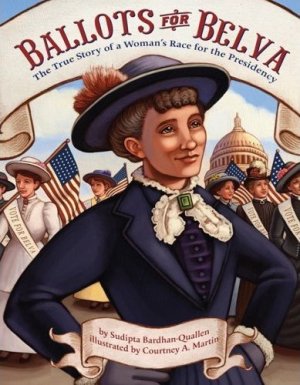 But now she’s the author of 11 picture books and 16 non-fiction books for children including The Hog Prince (Dutton), Ballots for Belva (Abrams) and Tightrope Poppy the High-Wire Pig (Sterling).
So Sudipta, if you didn’t want to be a writer, how did you get into the kidlit business?
I got pregnant twice in the span of 15 months and had to move from California (where I’d been going to grad school) to New Jersey (where a little piece of me dies every day). Like every other new mom in the world, I decided I had stories that I just had to tell my kids and so I started writing. I also had this idea that writing was totally a job I could do with two babies in the house, which was just stupid because you can’t do anything with two babies in the house.
Amen to that! I can’t do anything with two babies out of the house, either. (And by the way, I’ll let that NJ crack slide.)
When I started writing, everything was really bad. Some day, when I am super-famous, I will pull out my Alphabet book, and my going-to-the-zoo book, and all the other requisite bad stories we all write when we start. But eventually, I figured out to go to conferences and read up on the craft of writing, and I started to get things published.
How did you get your first big break?
About two months after I started writing, I wrote up a short story for Highlights. It was something that had actually happened to a friend of mine, with a bit of fictional dramatization. Highlights bought it and it was the first $200 I made writing.
 I also randomly got a foot in the door of children’s publishing by mentioning my science background in a cover letter. I’d sent a picture book manuscript to Sterling, which they rejected, but in the rejection the editor asked if I’d consider writing a science experiment book for them. That became Championship Science Fair Projects, which still sells really well for me, and a few years later, my first picture book, Tightrope Poppy, was published by the same editor.
New writers are often told not to mention irrelevant information in queries, but your science background landed you a contract. What exactly is your science background?
I graduated Caltech in 1998 with a BS in Biology (by the way, with the passage of years and my gradual failure to remember even the most basic biology concepts, BS is becoming more and more appropriate). I spent a year at Harvard, but it really wasn’t for me, and then headed back to Caltech as a PhD candidate in developmental neurobiology. But those plans went off the rails when I had two babies. I had this crazy idea that I could write with two kids in the house—which you totally cannot do—but that’s how I got into the writing-for-kids business.
Normally, I recommend that you don’t mention anything other than kidlit in your cover/query letters, but if you keep it short and sweet, you can throw some things in there. I think the line I wrote was something like: “I have a Master’s degree in Biology from the California Institute of Technology and have published several scientific articles.” That doesn’t take up so much space that it is annoying.
What has surprised you most about being a published author?
So many things have surprised me about being a published author. Hard to pick just one. So I wrote a Top Ten list. I love Top Ten Lists. Except after I start writing and realize that I only have six interesting things to say. But who’s ever heard of a Top Six list?
Top Ten surprising things about being a published author:
- That the advances are so small that after everyone has had their cut and you’ve paid all your expenses (whether it’s permissions, or research costs, or just the cost of babysitting that allowed you to write the book) you have just enough money left over to take your family out to dinner. But only if they agree to go Dutch.
- That you can’t just show up at a book store and expect them to have your book. Or believe that you are a real author.
- That there’s a 50-50 chance that the number of kids that are biologically related to you who show up for a book signing will outnumber the number of kids that are NOT biologically related to you.
- That no matter how much market research you’ve done, there’s a good possibility that there is a really similar book out there that no one has ever heard of – except the person writing the review.
- That even though the publisher picks up the tab for producing the book, all of the marketing responsibility is on you. So if you want anyone beyond your mother and your best friend to know about it, you need to get your butt in gear.
- That you know no more about writing or publishing after the contract than you did before. Even though everyone expects that you do.
- That the more successful you get and the more books you publish, the less of your writing time will actually be devoted to writing.
- That when you and a group of writing colleagues meet certain editors (who may now be agents…), no matter how many books you’ve done, the first comment he will make is, “So… you all are *moms*, huh?”
- That it is a long time before you move “real author” into the list of things you consider yourself. I still haven’t really gotten there.
- That going to a school for an author visit is as close to being Angelina Jolie as you will ever get. And it’s a pretty cool feeling.
How did you begin to bill yourself as a speaker?
I started to volunteer to speak at conferences because I wanted to teach what I had learned about the craft of writing picture books to other aspiring writers. I got a lot out of SCBWI events in New Jersey, and I wanted to give back. Also, teaching helps you learn in ways that doing does not. For example, at this year’s NJ-SCBWI annual conference, I gave a workshop about rhythm, rhyme, and repetition. I talked about using a refrain in your picture book manuscript to give it narrative structure—and it was the first time I had consciously realized that that was something I do a lot in my own writing. Having to teach it, however, was what made me conscious of it.
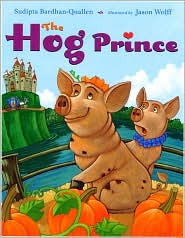 Some authors say they learn something about themselves with each new book. What did writing The Hog Prince teach you?
In my workshops, I emphasize the importance of the market over and over again. I’m constantly saying that I only write what I know I can sell. But as I review my own body of work, which has finally grown large enough that I feel comfortable calling it a body of work, I notice that, within the confines of what I feel the market can bear, there are themes that I subconsciously explore time and again. And these are the themes that resonate most strongly for me.
In The Hog Prince, Eldon dreams of being something he is not. He believes that if he were to change by magic, his life would be better, that everything would be shiny and pretty and luxurious and grand. And while I run the risk of coming off as having no self-esteem at all (which is not true, I have an itty-bitty bit), I can say that there have been plenty of times in my life that I have felt this way. In fact, I don’t think it is just a childhood thing–I’m not sure that we ever completely grow out of feeling like everything about our lives would be improved if only we could change ONE little thing. Except that it is never a little thing, nor is it one thing, nor will your life actually get better.
What’s nice about the story is that Eldon figures out that he is worthy and precious just the way he is, and that the folks who really matter (in his case, Petunia) don’t want him to change one muddy little thing. I struggle with this lesson, and I think a lot of kids do, too. Hopefully, that’s what makes the story timeless.
So, here is what I learned about myself:
- I sometimes wish I could change into royalty;
- I use my books to sort out emotional issues;
- I think that every story is better is you replace the main character with a pig.
You may be right there. Who doesn’t love pigs? I mean pigs in literature. Real pigs, not so much.
Thanks for the interview, Sudipta! I think I know what the blog market can bear, and although I’d love to talk to you for another thousand words, something’s telling me to wrap it up here.
More of Sudipta’s serious-yet-sassy picture book philosophies can be found on her new blog, including a picture book writer’s Ten Commandments. Thou shalt not submit a manuscript before its time…
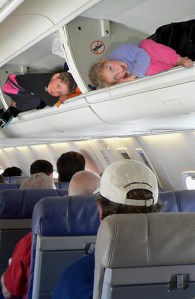
Image courtesy of Ma1974
I hate air travel with children. I mean with my own children. My goal for the flight is to ensure that my toddler and Kindergartener don’t disturb the other passengers. I don’t want them whining, crying, screaming, running through the aisles or otherwise causing mayhem. I remember being a stressed-out businesswoman and being seated near a miserable child. I have empathy for the childless travelers, honestly I do.
I spend a ridiculous amount of time preparing for the trip and devising solutions for worst-case scenarios. Flight delays. Missed naps. Sudden fever. Soiled clothes. Motion sickness. I’ve got it all covered, people.
My foolproof plan involves a bag of books. I read to my children on the flight. (Oh yeah, I can’t forget the lollipops…great for easing the pressure on take-off and landing.)
However, I found out that my efforts to entertain and enlighten my children aren’t necessarily appreciated.
The older woman in front of me turned around in the middle of a story and asked, “How long do you plan on reading aloud?”
So continued a rudeness I’ve never experienced before, someone complaining about a happy, content family. She mistakenly said I had been reading for an hour when the flight had been in the air only 25 minutes, and she told me that if I was going to “read for another hour” she “wouldn’t be able to take it.”
Did you ever have one of those conversations where you wish you could say something different than what leaves your mouth?
I could let my children play bongos on the tray tables if you prefer.
A crying jag can be arranged.
We’re going to peek over the seats and force you into an endless game of peek-a-boo later.
Instead, I apologized like the polite person I am. I was sitting in the last row with a terrible jet engine din and could barely hear what I was reading. Was I a little loud? Maybe. Could she have approached the subject differently? Sure. So could the cowardly husband who decided to give a rude stare and play with his seat, knowing that we in the last row had nowhere to recline ourselves.
She finished by not making eye contact. “Well, just lower your voice.”
Hmmm. I didn’t hear “please.”

Check ya later, kidlit fans. There’s sand castles, seafood and South Carolina in my forecast.
I’ll be posting again in July. Y’all come back now, ya hear? ‘Cause you won’t want to miss an interview with the stupendous Sudipta Bardhan-Quallen. Or the artistic antics of up-and-coming author/illustrator Ryan Hipp (who contributed the robot fish above). Or the courageous story of YA debut author Albert Borris. Illustrator Kristi Valiant will talk about her latest book, Cora Cooks Pancit. I’ll also share some tips for making your own book trailer before you sell the book. And perhaps my talented friend Michael Sussman will make an appearance…
It’s all coming next month. And August. It may be summer, but I don’t plan on slowing down.
Well, maybe just a little bit, for now.
 Before I take off, let me remind you to Take the Dare at Cynthea Liu’s website. There’s fabulous critiques up for auction from kidlit agents, editors and authors. All proceeds benefit Tulakes Elementary, a Title I school in Cynthea’s home state of Oklahoma. So show you care, take the dare!
This week also marks the YA Book Carnival, hosted by Shooting Stars Mag. Nearly 100 giveaways are listed, so go enter and grab a great read!
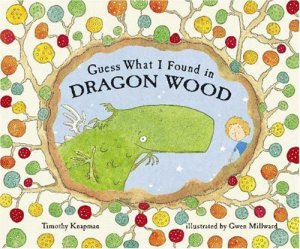 Benjamin wanders too far from home one day and stumbles into Dragon Wood. In this tale of boy meets dragon, the unexpected happens–dragon meets boy.
The cover art by Gwen Millward drew me into Timothy Knapman’s quirky little tale. Her forest reminded me of the Truffula Trees in The Lorax, albeit on a smaller scale (and perhaps not as poofy). They frame Benjamin and the Dragon on a clever, die-cut cover.
I admit that I goofed while reading the story for the first time. I got confused. I had to flip back to the beginning to understand Knapman’s brilliant twist on a familiar theme. When editors tell aspiring authors they want to see fresh ideas in picture books, Guess What I Found serves as a perfect example.
“What kind of review is this?” I hear you asking. “She’s not telling me anything about the book!” Oh yeah, sorry ’bout that. If I tell you too much about the Benjamin’s quest, I’ll ruin the surprise.
“Wait a second, did she just call him ‘the Benjamin?’ Must be a typo. What a sorry excuse for a blogger.” Um, I must inform you, that was no typo.
So okay, calm down. I’ll tell you that I loved the striped boots, the whirly wee-woo boxes and the soccer goalposts. And I can’t forget the volcano-sitting lessons! If you want to know more than that, you’ll have to stumble into Dragon Wood yourself.
Don’t get lost!
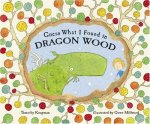 Guess What I Found in Dragon Wood
Story by Timothy Knapman
Illustrations by Gwen Millward
Bloomsbury USA Children’s Books, December 2007
Got a favorite children’s book? Write a review! Today is “Write a Review Wednesday.” Help support kidlit!





 Writing for Kids (While Raising Them)