You are currently browsing the category archive for the ‘Picture Books’ category.
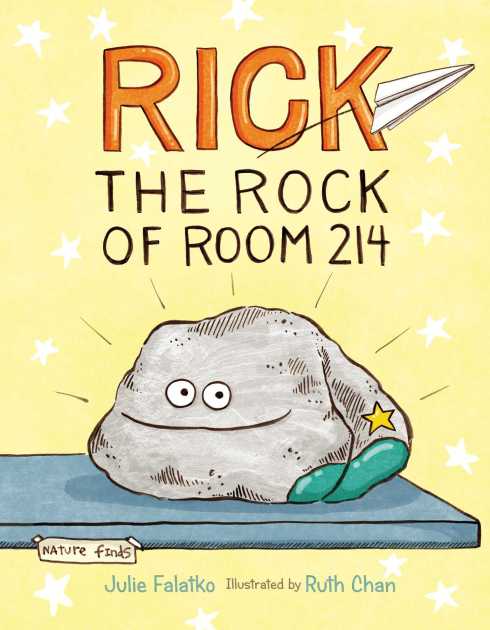
Just look at that rock face! Cuter than Mount Rushmore!
When I saw that funny lady Julie Falatko had a new picture book, you can bet I sent her an email right away booking her on the blog! We then had some banter before beginning…
“Hi Tara, in the interest of neither of us having any sense of time, I’m checking in to see if you have questions for me for the RICK THE ROCK blog post.”
“Oh no, I have about six blog posts before yours! I am slow and full of procrastination mojo. If that can be called mojo.”
“Procrastination mojo is its own special brand of mojo, but it’s definitely something that gathers steam and pushes me right straight into the giant room of procrastination, where all sorts of interesting things that are not on my to-do list live.”
I told Julie to write that book! It’s like the complete opposite of an Escape Room.
Then we finally got down to the rock of the matter.
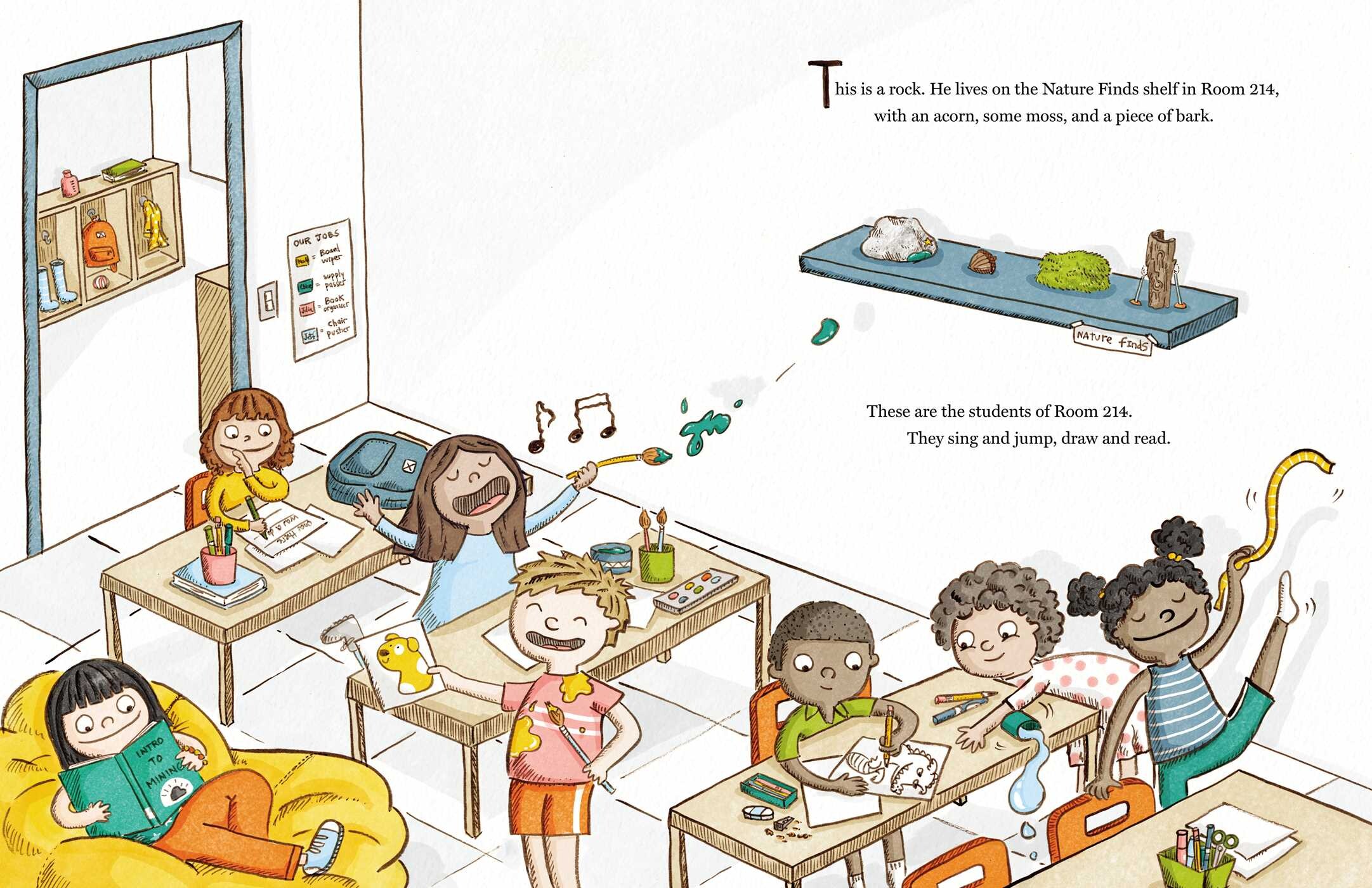
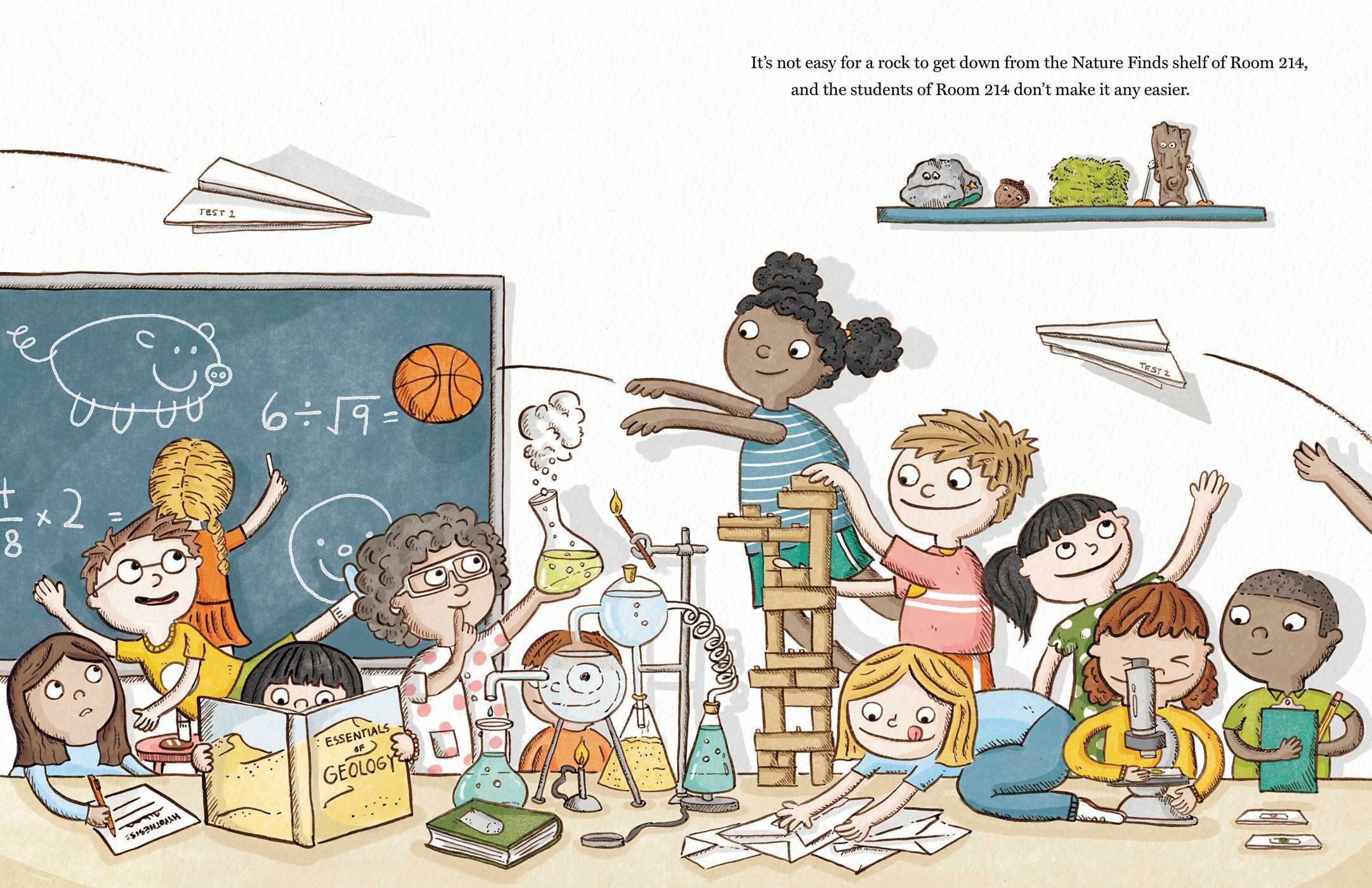
Julie, those of us working in picture books know that a story set at school is almost always welcomed by editors. Of all the things school is known for—why did you choose a ROCK who lives on the “Nature Finds” shelf in Room 214?
That’s a good question. It was the other way around, though: the rock came first, and he was outside, and in a house, and in a shed, until finally the story made its way to school.
So he was a rolling stone? *ba-dum-tsss*
HA. A rolling stone and a rock star.
If the rock came first, what is it about an anthropomorphic rock (different than a metamorphic rock) that you were excited to share?
OK, so the interesting thing to me about an anthropomorphic rock is that it’s still a rock. I like the idea of a character who is weighty and immobile. What would a character like that think? What would a rock think that a human could relate to? That’s where a lot of my stories start, by thinking, ok, here’s this fragment from my day that interests me—is there depth to this rock, this paper clip, this tiny bird?
My older son got frustrated with me once when I was thinking out loud about what some wild animal might be thinking. “Do you have to anthropomorphize everything?” he said to me, annoyed. And I told him yes, I do. It’s my job.
Of course it’s your job! We can’t leave anthropomorphizing to the amateurs! What kind of world would that be?! (One I wouldn’t want to live in!)
I don’t even want to think of what would happen during an amateur anthropomorphication. Someone could get hurt. You can’t just initiate a tea party with a chipmunk out of the blue, you know. (You have to send a formal invitation first.)
How did Rick become so lively and interesting? Let me guess…are you saying that school makes him so?
It was school that made Rick lively! He was a real grump in earlier drafts. He spent a lot of time complaining about the indignities of the Nature Finds shelf. I still wish I could have kept the sentence “I’m young for a rock, but I’m too old for this” when Rick was getting smeared with glitter glue, but it was too much the old, grumpy Rick. Being in Room 214 with all the fun students made him (through many drafts) appreciate things a bit more.
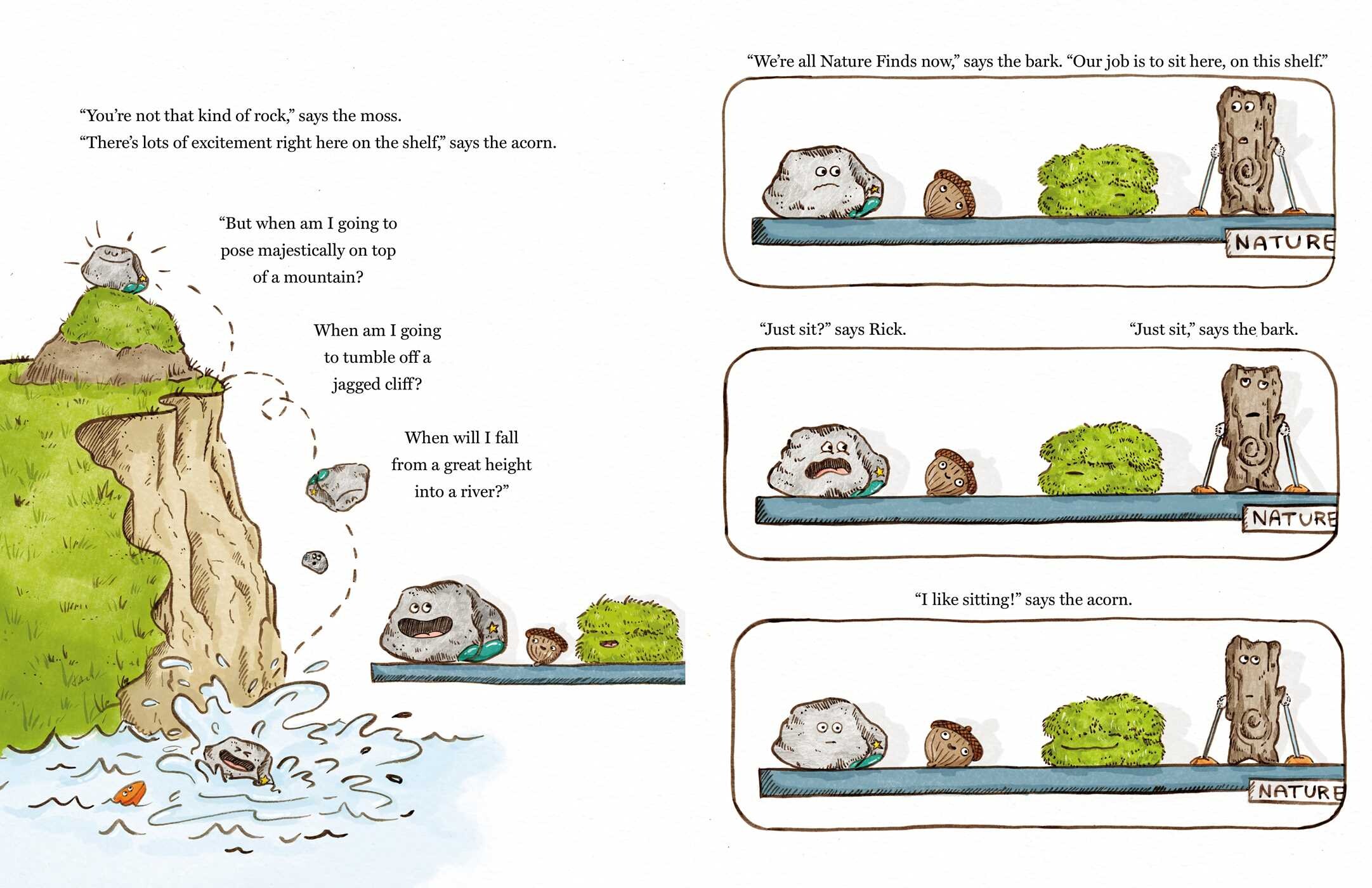
So does Rick—the non-grumpy, delightful version—have a part of school that he likes best?
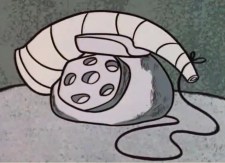 What he likes, and likes best, about school is the arc of the story! In the beginning, he’s OK on the “Nature Finds” shelf, but he’s a little bored. He’s phoning it in, as much as a rock can phone something in (he’d have to use that Flinstones phone) (or he’d have to BE that Flinstones phone??). But by the end, he’s so happy to be in the classroom. The lessons are cool. The students are fun. And his favorite part is his friends on the shelf with him.
Aww, that’s so sweet.
So Julie, what’s next for you? A sequel about Moss?
Wouldn’t that be AMAZING? (Amossing?) I love the way Ruth drew all of the Nature Finds. Acorn’s eyes! Bark’s concerned face! Moss’s shaggy demeanor! She is so top-notch at creating personalities for everything in her illustrations.
She captured ROCK and friends in all their anthropomorphic friendliness! And you can tell each child in Room 214 has their own quirky personality as well.
What advice do you have for picture book writers who want to anthropomorphize something not usually anthropomorphized?
Well, first (to draw on acting class), try to be the thing. Be the sneaker. Be the grain of sand. Be the rock. How does the world look from where you are? How does it feel to have a foot shoved into you, to be tiny and blown by the wind, to be heavy and immobile? Then I think: if this thing is the weird kid at school, what’s that kid like? (A story is more interesting to me if it’s about the weird kid.)
So if it’s a grain of sand, maybe that kid is pretty small and gets unwittingly pushed around in crowds, but also can make something huge and beautiful, like a sand castle. The story might be in the surprise that something so small can be part of something so big. Or it might be the grain of sand’s surprise at that. Or maybe it’s something else entirely, and the sand gets blown off the beach and down to the ice cream stand, and tries soft serve vanilla for the first time, and it’s everything that grain of sand thought it would be.
Julie, this interview was everything I thought it would be…and more! You have something more for the blog audience!
Yes, a picture book critique!
WOW! Thanks, Julie! I’m sure everyone is going to go crazy over that!
RICK THE ROCK OF ROOM 214 is available now from Simon & Schuster.
Blog readers, please leave one comment below and you’ll be entered to win a PB critique from the hilariously talented Julie Falatko!
A random winner will be selected at the end of this month.
Good luck!
 Julie Falatko writes books for children. She is the author of many books, including Snappsy the Alligator (Did Not Ask to Be in This Book), which was named one of the ABA’s best books for young readers for 2016, was featured in People magazine, and was read online by David Harbour of “Stranger Things,” and the Two Dogs in a Trench Coat chapter book series, illustrated by Colin Jack (Scholastic), for which she received the Denise McCoy Literacy Award. Julie lives with her family in Maine, where she maintains the Little Free Library in front of their house. Visit her at JulieFalatko.com.
Today is a treat for rhyming writers! We’re flies on the wall as author Anne Marie Pace talks about her newest book MOUSE CALLS with Cassandra Whetstone, an educational consultant and writing mentor. Anne Marie reveals her process, her picture book philosophy, and some special devices, like the visual refrain.
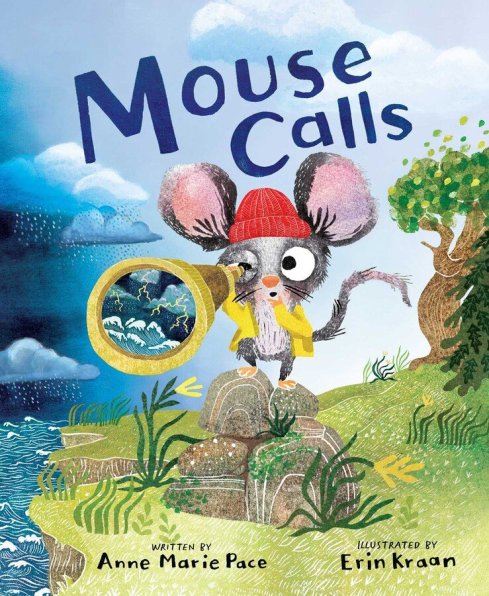
 Anne Marie Pace is an author whose eleven published picture books include three rhymers. With Sudipta Bardhan-Quallen, she has co-taught workshops in rhyming picture books for the Highlights Foundation. Her newest rhyming picture book is MOUSE CALLS, illustrated by Erin Kraan, from Beach Lane Books/Simon & Schuster.
Cassandra Whetstone is a former classroom teacher and is the co-founder of Sequoia Gifted & Creative, where she is an educational consultant and writing mentor. She has published poetry in Cricket, Ladybug, and other children’s magazines.
Cassandra: Thanks for taking the time to talk to me today, Anne Marie. You know I’m a huge fan of your writing, and I’m excited to have this time to explore your expertise with rhyme. Are you ready to dive in?
Anne Marie: Let’s do it!
Tell me about how you got into writing in rhyme? What were your early influences?
As a child, some of my favorites included Mother Goose, MADELINE, and Dr. Seuss books, so I suppose my immersion into rhythm and rhyme began early. However, writing rhyming picture books isn’t something I set out to do. It just happened as I experimented in my writing. Like many writers, I composed my share of angsty free verse as a teenager, but I don’t consider myself a poet. However, I do love the sounds of words, playing with words, reorganizing words, and the rhythm of language, so writing in verse has become something I really enjoy.
I am a long-time choral singer and I think my musical skills have definitely helped me understand rhythm and meter in a way that can escape some new writers with less musical training. Of course, I always try to make it clear that you can’t write picture books in verse the same way you’d write a song. In music, the songwriter uses time signatures and rests and note values to help the singer know exactly how to create the desired meter. In picture books, we really have only words (with their various lengths and stresses), punctuation, and page breaks. Also, a lot of songwriters use near rhyme at least some of the time, and it doesn’t matter as much because the singer sustains the tone on the vowel; the ending consonant is enunciated, but less obvious, far briefer in length. In a picture book, near rhyme is much more jarring.
You seem like such a natural at it. When you start with a new idea, do you hear the rhyme right away? How do you decide if this idea is going to be in rhyme or not?
I’ve published three rhyming books, BUSY-EYED DAY (which was originally titled BIG-EYED BUG), SUNNY’S TOW TRUCK SAVES THE DAY, and my brand-new title, MOUSE CALLS. For two of the three, the title came first in conjunction with a rhyming couplet, so the story developed from the rhyme.
For example, in BUSY-EYED DAY, the couplet “Big-eyed bug/Stalk-eyed slug” came to me first. What did that give me to work with? It’s a rhyming couplet, with alliteration of the first and third words. That said Verse to me, so I began creating similar couplets. The story of kids spending the day at the park came later, as I looked at the couplets I’d written and figured out what they had in common (things kids could see at a big city park).

With MOUSE CALLS, I had the title for several years before I knew what to do with it. I liked the play on “house calls” but a doctor mouse didn’t spark anything for me. When I remembered the classic game of Telephone, I started playing with rhyming animals, and developed the structure, which has plenty of alliteration and both end rhyme and internal rhyme: “Mouse calls Moose/Moose calls Goose/Goose calls Dog and Hog and Hare. Hare calls Bat/Bat calls Cat/Cat calls Frog and then calls Mare.” Even after I was satisfied with the text, which I believe is a great read-aloud, we were still missing a story. My Beach Lane editor Andrea Welch and I hashed out a few ideas and settled on the premise of Mouse helping his friends take shelter from a storm. That story is completely in the illustrations, not the text.

What do you love about writing in rhyme? What are the unique challenges of the form?
I love it because it is both easy and hard–sort of a perfect balance of fun and challenge. As I said before, I love the sounds of words. I love the rhythm of a well-constructed sentence. Sometimes, even when writing prose, I hear the rhythm of a sentence before I find the words that fit that rhythm. So using sounds and beats to create something that children will enjoy is simply a good time. But rhyme and meter really need to be close to perfect. If you set your reader up to expect a rhyme or a particular beat, you need to keep that promise. Perfect may not be possible, but you can aim for it. For most writers, that means the easy way should not be the final way.
In writing longer forms, like novels, it can be a huge overhaul to change the point of view of the writing, but the outcome is often a fresh look at the story. Picture books are, of course, a shorter work to craft, but have you ever done a total overhaul of the meter or rhyme scheme and what was that like?
I have done a total overhaul of the story, but once I’ve developed the structure, I stick with it–or at least, I can’t think of any examples where I’ve really changed the structure. SUNNY’S TOW TRUCK SAVES THE DAY began as a story about a family running late for school, but it didn’t seem fresh. It ended up as a story about a family on their way to a picnic. They get a flat tire and have to wait for a tow truck. Because they are waiting, the concept of the passage of time (9:00, 10:00, etc.) found its way in, along with lots of food and trucks. But it was always a story in rhyming couplets.
Can you talk a bit about how you turn a story in rhyme into an actual picture book with line breaks and page turns?
My published rhymers are for the youngest listeners, so usually the complete couplets or stanzas stay on the same spread. However, in BUSY-EYED DAY, the climax of the story occurs when a spider startles a little girl, who runs to her mother for a hug. That couplet takes place over three pages, which shines a spotlight on the importance of the moment and gives it some oomph. My friend Sudipta Bardhan-Quallen has a new book coming out this fall called ROXIE LOVES ADVENTURE. There’s a spot where the rhyme scheme leads you to believe a certain word is next and there’s a page break before the word–and then the actual word is something completely unexpected. It’s brilliant.
Something I’ve included in two of my books (BUSY-EYED DAY and MOUSE CALLS) is a refrain. My editor Andrea Welch encouraged me to add a refrain to each book as sort of a pause, or grounding. A refrain becomes familiar to the reader, and it relieves what might be an otherwise monotonous structure. In BUSY-EYED DAY, the refrain is text which appears after each three couplets: “Busy-eyed day at the park.” But in MOUSE CALLS, I never found a refrain I was happy with, but Andrea still asked for a pause. So we ended up with a sort of visual refrain. The illustrator Erin Kraan included several wordless double-paged spreads, all set in a cave, with a growing number of animals as the book progresses. It works well, and with no words on the page, it forces the reader to stop and examine the wonderful details Erin included in the illustrations.
This is so interesting. Your writing is so lovely to read and to listen to. When I share your books with my students, I appreciate that you are meeting them at the page in such a gentle and respectful way. What is your advice to new writers?
I try not to talk down to readers. Just because they are young and have less experience with life and a smaller vocabulary doesn’t mean they shouldn’t be respected. New writers who are just learning to write picture books are still finding their voices, and that includes their willingness and their ability to meet kids where they are. Hopefully, they’re studying mentor texts, especially new and outstanding books that manage to feel comfortable, yet fresh. The more they write, the more they’ll develop their craft.
How have rhyming picture books evolved over the years and why is it important for writers to study new works as well as old classics?
Of course, it’s most important to write from the heart and our heart is often full of the books we loved as children, or the books we read to our children.. But some people embark on writing picture books without knowing the wonderful creators of today.
I mentioned before that as a child I loved Dr. Seuss. He certainly earned his place in the canon. His books were published as many as eighty-five years ago, with his best-known books coming in the 1950s and 1960s. Honestly, we don’t need another Dr. Seuss because most of his books are still in print.
When writers try to emulate his style now, their work tends to seem dated. As a technical point related to writing rhyming picture books, Dr. Seuss had a unique, clever voice, but one of the reasons he was able to write so seamlessly in anapestic tetrameter (aside from sheer talent!) is that he invented words. If he needed a three-syllable noun that rhymed with some other word, and an English word didn’t exist, he would just create one. In his time, that was exciting and fun; today, it just isn’t often done.
But we can still learn lessons from his work. The mastery of anapestic tetrameter and creation of crazy vocabulary aren’t what’s necessary. Meeting kids where they are intellectually and emotionally, making them laugh, making them think–those are the things a modern writer can take away from Dr. Seuss.
My younger students are usually quite willing to jump in with their creativity, but often those inner critics start to get really invasive by the time they are in upper elementary grades. What’s your advice to kids and adults who want to tap into their creative ideas but the editors on their shoulders get in the way?
All of us have editors on our shoulders. The only real advice I have, and something I should take to heart more than I do, is to keep writing. Write through the block, even if it’s painful. The more words you produce, the more likely you’ll be able to pull gems from your output.
I sometimes work with learners in grades 3-5 who are still developing their phonemic awareness and need to play with rhyme and manipulating sounds, but often when I pull out a rhyming picture book they are resistant because it looks like it’s for younger kids. Once I crack the book open and begin reading, they relax and enjoy the rhythmic ride, but what are the rhyming books that you might recommend for older readers?
Some of my favorite authors are Julia Donaldson and Mary Ann Hoberman. They’re just so skilled in telling lengthier stories with rhyme. I can see why a student of that age might feel that way. Verse allows for a lot of white space on the page and kids alternately embrace it, fear it, or hate it, depending on their mood.
To prepare for this interview I reviewed your booklist on your gorgeous website and wow! You’ve written some wonderful books and the adorable MOUSE CALLS was just released. I’ve ordered my copy of MOUSE CALLS and can’t wait until I get to share it with the kids in my life! One last question, what’s on the horizon for you? What are you working on next?
Right now, I’m doing weekly MOUSE CALLS events, including some book signings and school visits. I wrote a biography of Anne Hutchinson for the Core Knowledge Foundation and I’m excited to see that when it comes out. As far as new writing goes, I am mostly revising some manuscripts I wrote in the spring. Hopefully, I’ll take some big steps forward in the next few months with those.
That sounds busy. Thanks so much for taking the time to talk with me today. I’ve learned so much from you and I’m looking forward to reading what you do next!
Thank you Cassandra and Anne Marie for this inspiring and informative talk!
Blog readers, you can win a copy of MOUSE CALLS by Anne Marie and Erin Kraan, released by Beach Lane/Simon & Schuster just a couple weeks ago!
Leave one comment below answering this question: do you write in rhyme? Why or why not?
A random winner will be selected next month.
Good luck!
When I began writing for children, I joined SCBWI and found a welcoming group in the NJ chapter. That’s where I met author Rosanne L. Kurstedt, who joins me today to talk about revision techniques for her newest [adorable] picture book with illustrator Ya-Ling Huang, AND I THINK ABOUT YOU.

Rosanne, what are some things you do when revising and how did that change (or not change) AND I THINK ABOUT YOU?
That’s a great question, Tara. I do a lot of things when I’m revising—but I’d like to talk about two today—playing with verb tense and using onomatopoeia.
I find that changing the tense of my manuscripts helps me see holes and helps me to craft more layered stories. I’m always amazed at how the tense changes the mood. Here’s the journey of AND I THINK ABOUT YOU.
The original drafts of AND I THINK ABOUT YOU were written in past tense—and the title was AND I THOUGHT ABOUT YOU. The premise of course was the same. In both, mother and child think about each other throughout the day.
But when the publisher, Kids Can Press, purchased the book, they wanted me to try it in the present tense. So, of course, I did. Instead of a welcome home routine and a recounting of the mother’s day, where she told the child what she had done throughout her day and then said “I thought about you,” the present tense brought immediacy to the story and provided space to add another layer.
In the present tense we see the mother throughout her day reminded of the child, thinking about something they had done together in the past or imagining what the child might doing in school. And then, at the page turn, the reader gets to see what the child is actually doing.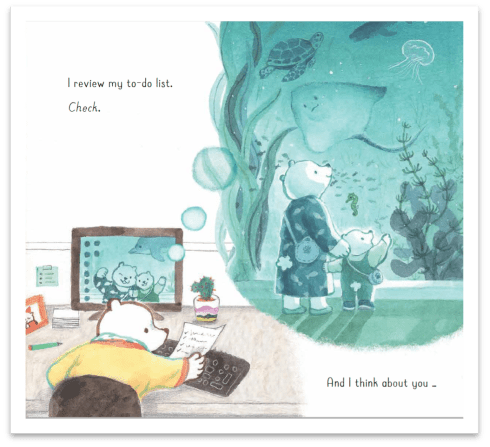
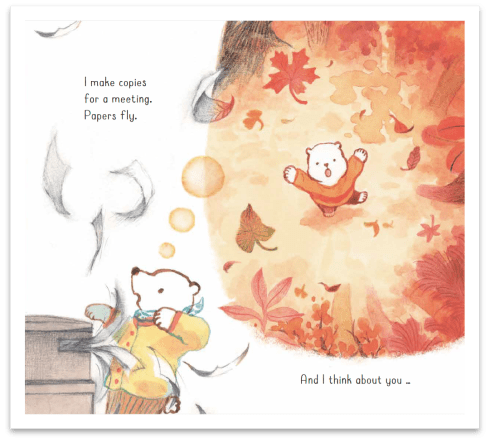
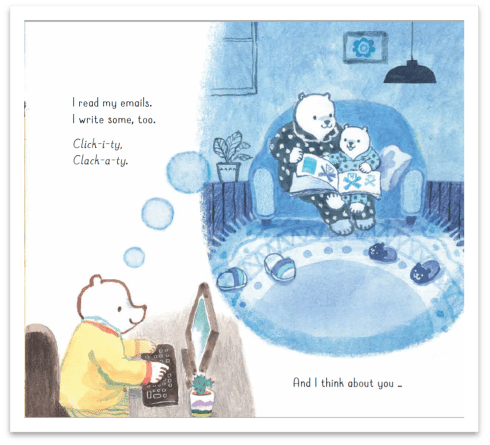
This allows little ones to engage with the text by guessing what the child might be doing. It also enriches the depiction of the mother and child’s relationship because of the different activities the mother remembered doing with the child.
Another thing I like to do is add onomatopoeia. Besides being so much fun to say, adding sound words fosters children’s engagement. Kids love repeating and shouting out the sound words. In And I Think About You sound words are used on each of the pages that show what the child is doing in school. I also peppered some sound words on the pages that show what the mother is doing.
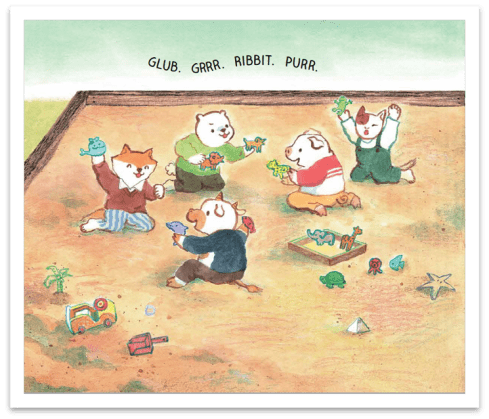
Both of these revision strategies don’t always work. Sometimes I change the tense and the manuscript works better in the original tense. I find though, that even when that is the case, I’ve learned something about the story that requires me to rethink something in the manuscript.
I’ve also tried adding onomatopoeia to stories and it just didn’t fit. It sounded forced or broke the rhythm of the story.
In other words, try these revision strategies to learn as much as you can about the best way to tell your story. I can’t guarantee that you’ll wind up using the tense you revised to or the sound words, but I can guarantee you’ll be closer the story and what you want to say.
Did you imagine specific actions when you added onomatopoeia or did you leave the action up to the illustrator?
I imagined specific actions and put those ideas in for the illustrator—it was the editor who actually told me to do that. Ya-ling followed my suggestions and embellished. Like I didn’t have the pinwheel in the manuscript but Ya-ling put it in and I just love that detail. Young readers can look for the pinwheel on different pages. The pinwheel is what the bear cub shares with the class. I know we’re often told not “direct” the illustrator. But in this case, the editor wanted me too. Maybe because it was supposed to be connected to what the mother was doing at work.
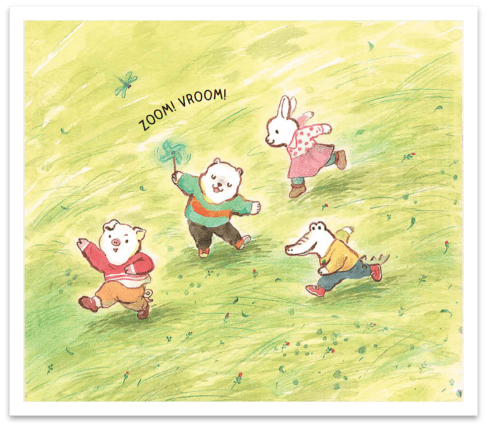
I love that pinwheel detail!
Do you read your manuscripts aloud to hear what they sound like?
I always read my manuscripts aloud and have other people read them too. I even read only the onomatopoeia to see how they sound. Trying to find the right sound word or words can be difficult. I wanted them to be fun to say—so sometimes I used rhyme, sometimes alliteration and sometimes I used both. Glub. Grrr. Ribbit. Purrr. and Chit. Chat. Splat.
Thanks for sharing your tips, Rosanne!
I hope this is helpful. I would love to hear about everyone’s experiences with changing tenses or working with onomatopoeia.
Blog readers, let her know! Leave one comment below!
Rosanne is giving away TWO prizes:
- a copy of AND I THINK ABOUT YOU and
- a picture book critique!
Two separate winners will be randomly chosen next month.
Good luck!
 Rosanne L. Kurstedt, Ph.D., has been an educator for over 20 years, supporting learners of all ages. She is the author of several books for teachers, including Teaching Writing with Picture Books as Models and a series entitled 100+ Growth Mindset Comments. Rosanne loves picture books and anything kid-lit so she volunteers as the Assistant Regional Advisor for the New Jersey chapter of the Society of Children’s Books Writers and Illustrators. Her first book Karate Kid (Running Press Kids) was released in 2019 and her second book And I Think About You (Kids Can Press) was released in 2022. She loves sharing her books and expertise with readers of all ages at various author events.
Rosanne is the founder of The Author Experience, a 501(c)(3) organization committed to the transformative power of sharing stories. In collaboration with students, families, and educators, TAE provides sustainable literacy-based experiences that build a culture of literacy—one that elevates connections and delivers lasting impact.
Rosanne lives in New Jersey with her family. Visit her onliine at RLKurstedt.com, Twitter @rlkurstedt, Instagram @rlkurstedt, and Facebook RLKurstedtAuthor.
Behold a summer escape in a picture book!
Releasing on August 1st from Flashlight Press, GIANT ISLAND reveals an astonishing secret as a grandfather and his two grandchildren embark upon a common, everyday fishing trip…or so they think…
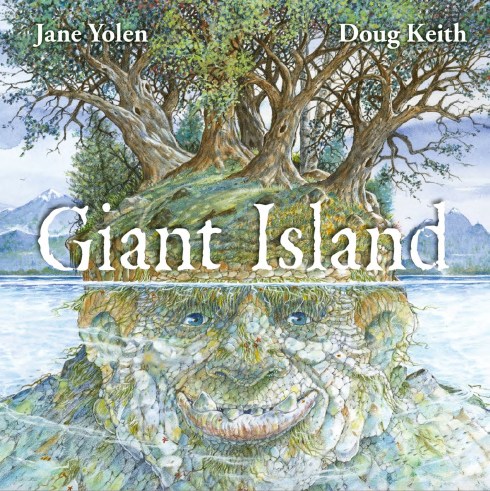
Jane, this blog emphasizes the importance of brainstorming story ideas often to get to the book-worthy ones. Where did you get the idea for GIANT ISLAND?
Not in the usual way.
I was contacted by an editor I didn’t know, Shari Dash Greenspan, at a publishing company I hadn’t yet worked with, to help rewrite/edit the text of a book by an amazing illustrator, Doug Keith. Doug had the idea for a book about an island that is actually a giant, and what happens when a family visits it. The publisher already had the book dummy and about half of the paintings were done, but there wasn’t a working text because the story was all told visually by the illustrator. The pictures were fantastic, but they needed some assist with an actual story.
In other words, they needed a writer. And that’s where I came in.
I studied the pictures until I knew them by heart. I knew I had to give the book a text/story that matched its lyrical and yet humorous visual telling. The characters were a given—a grandfather, a grandson and granddaughter, a dog…and a giant… I couldn’t change them, I had to make them live.
I wrote, rewrote, invented, re-invented. Editor Shari edited and illustrator Doug occasionally re-drew, and the book became what you see now. So, NOT your usual way of creating a picture book.
Shari has become a dear friend and I am still trying to sell her something else!!! Or maybe I can convince her to do a RETURN TO GIANT ISLAND where the kids help save the island from becoming someone’s home. Doug could have a grand time with that.
Aha! It was the illustrator’s idea! There are many wordless PBs, though. Why did Shari want to add words?
The book had been meant to be a wordless book, but while the pictures were beautiful, the story’s subtleties were not clear enough without words. And the marvelous Doug was more artist than wordsmith. So we each brought our A games to make the book—artist, editor/art director, and author in that order. Not the usual order, but this time it worked. Whew!!!
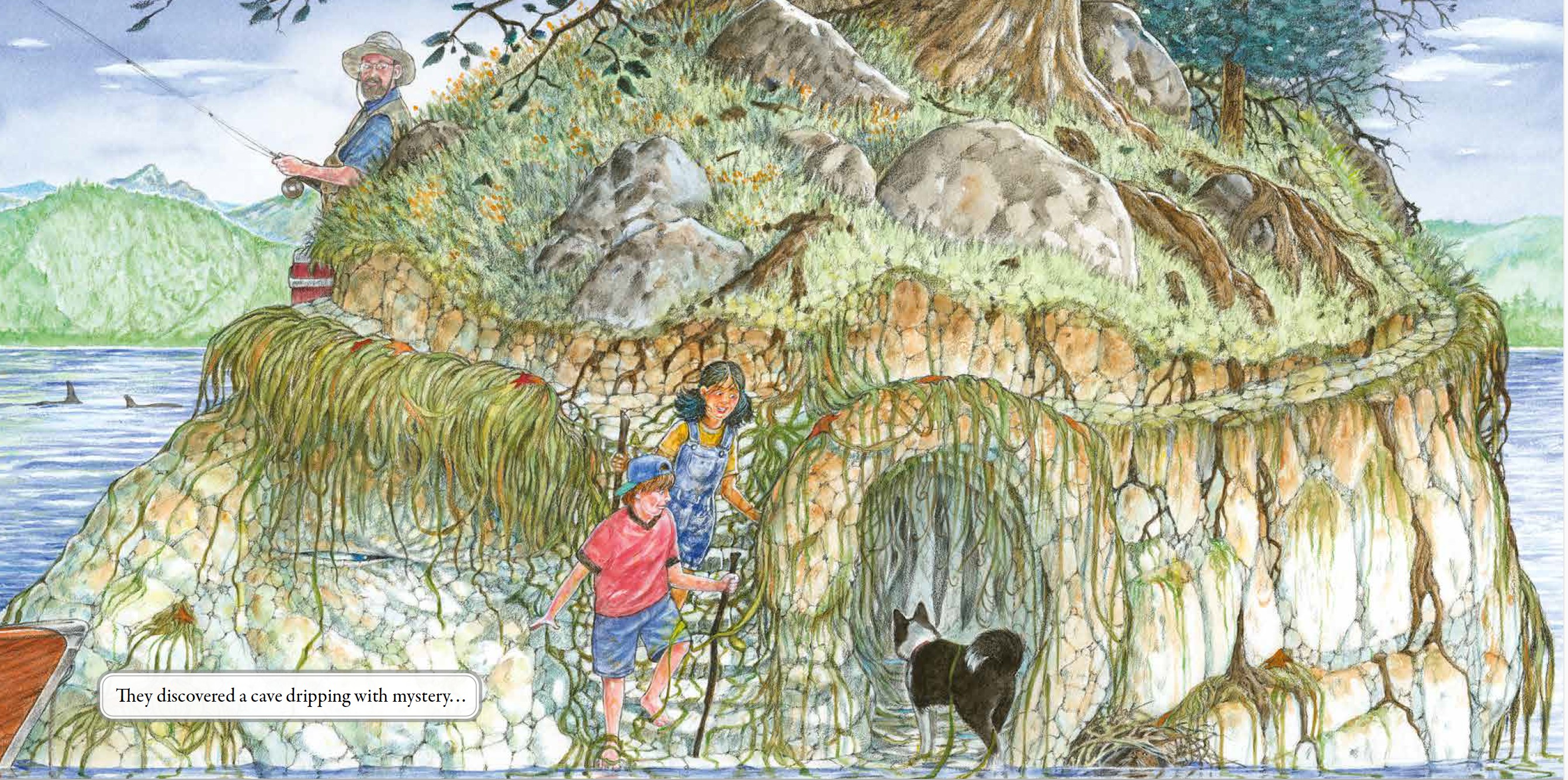
Click on spreads to enlarge
What were your concerns as you were writing and wanting to stay true to Doug’s story? Did you communicate with him during the process?
I tried to stay close to what Doug had already done, at least as close as possible. I had my fierce (and funny) editor to keep me on track. We all wanted it to seem seamless. And I think (hope) that is true.
Was it harder than just writing the piece from the start and letting an illustrator go at it?
A bit.
But isn’t that just a reversal of roles? Because that is what artists do all the time—take the words and turn them into pictures!
Also, I have done this before, once with a picture book retelling of Sleeping Beauty with artist Ruth Sanderson. And in about twelve books of poetry in which I wrote poems to go with my son Jason’s photographs of animals on sea, land, and in the sky.

What do you hope readers will take away after reading GIANT ISLAND?
GIANT ISLAND is a book about magic and imagination that spans a family’s generations and ages, from children to grandfather. And it is also about storytelling, though that is subtext. And for me, it had another meaning because I got to meet and befriend both editor Shari and illustrator Doug.
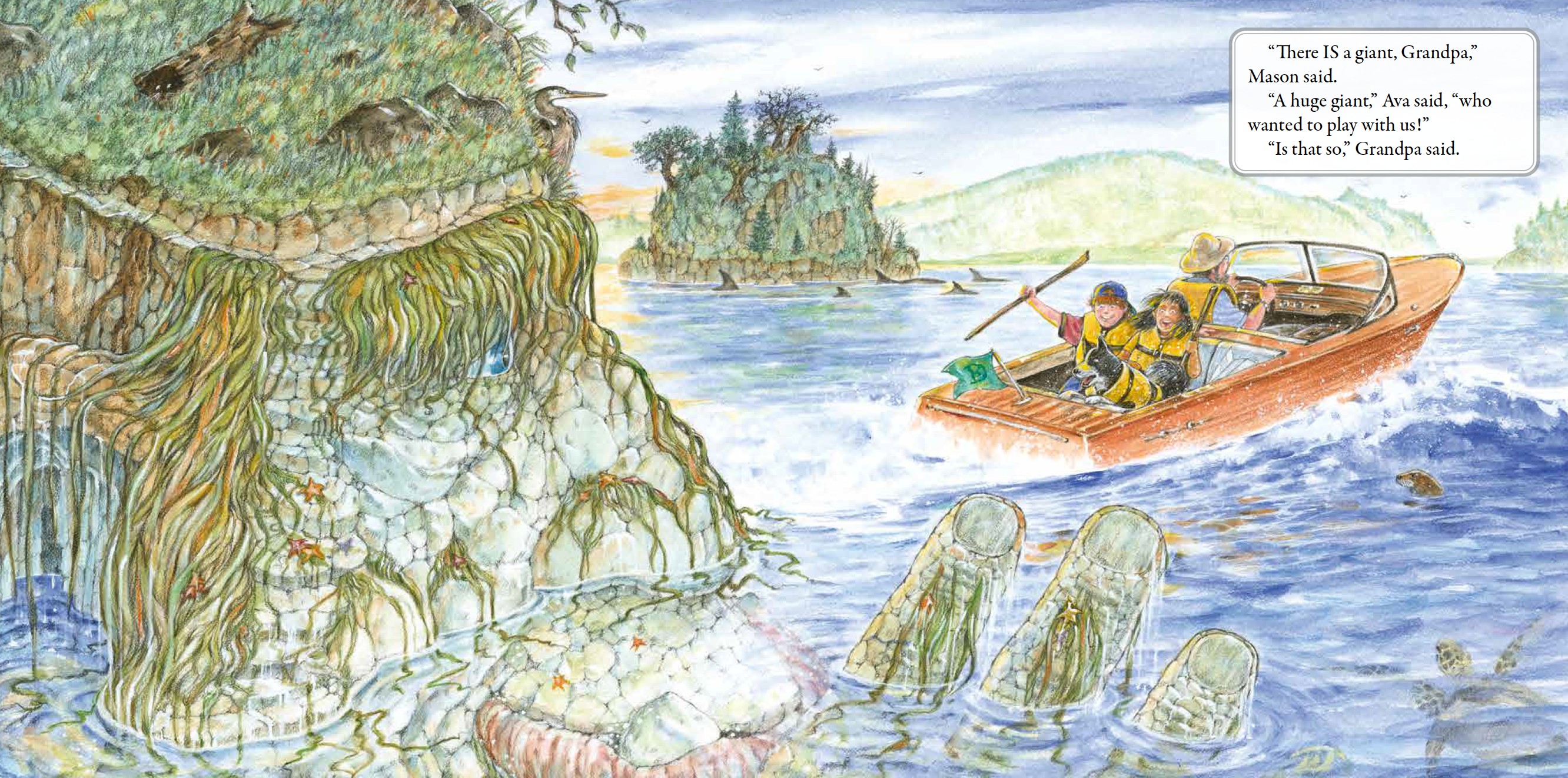
What is it about magic and secrets that children love so much?
I am not sure. I know that from childhood, magic stories sustained me.
But I also remember a young Scottish boy, son of a friend, to whom I gave a witch book I had written, and he handed it back solemnly saying, “Boys like books about real things.” (Of course I know a computer scientist who creates fantasy board games. Go figure!)
This story involves a grandfather and his grandchildren—do you have any secret family stories?
As a grandmother, I often tell the story of MY grandmother and grandfather their eight children living in “the old country” (Ukraine). When the Russian Cossacks came to raid Jewish villages and set houses on fire, my five-foot-nothing, red-headed grandmother would gather her children and her neighbors’ children, put them into a large horse-drawn cart, and cover them with hey and grains. She would drive them out of the village and into the safety of the forest, waving at the Cossacks who thought, with her red hair, that she was probably Polish (and not Jewish). So they left her alone.
I hope I have inherited some of her tough magic, her courage. The family left their big house in the early 1900s and migrated to America. Last month the Russians bombed the house, but we lucky Yolens are safe here. It’s a story that my children and their children will be able to tell forever.
What a beautiful story, Jane! Or I should say, two beautiful stories!
GIANT ISLAND is a gorgeous book, and Jane brings GIANT ISLAND to life with subtlety, to let the majestic illustrations by Doug Keith speak with their wonder. Jane tells the reader only what they need to know—and the rest can be left up to the imagination. Who is this giant? How did he get here? What other adventures await the children?
GIANT ISLAND releases next week from Flashlight Press!
Blog readers, I am giving away a copy of GIANT ISLAND.
Just leave one comment below.
A random winner will be selected in two weeks.
Good luck!
Ahh, don’t you just love cover reveals? There’s nothing better as an author, to finally see your creation in all its beautiful bookshelf glory. The story that began as a little seed and grew into a manuscript has finally taken root and it’s ready to soar.
Speaking of soar, I’ve got Annie Silvestro here today to welcome her newest picture book to the world.
BRAVO, LITTLE BIRD!
(That’s the title of the book, not my nickname for Annie.)
Since I’m fascinated by ideas and how they leap into our minds, I asked Annie to share a backstory of the story.
For years my son took piano lessons at his teacher’s home. She had a beautiful front lawn and the piano sat in her living room with windows facing out to the yard. As I would listen to the lesson, occasionally a deer or a rabbit would pop up in the grass and I imagined they were listening to and enjoying the music, too.
Sitting there, I also had plenty of time to think! Of course birds also came to the piano teacher’s window, and being that many birds are musical creatures, a bird seemed like a good match for the story I wanted to tell.
At some point as the idea percolated, I scribbled down the first line into my nightstand notebook and the story began to take shape in my mind.
At heart, BRAVO, LITTLE BIRD!, illustrated by Ramona Kaulitzki, is a friendship story between an old man and a bird, and about how the power of music affects us and unites us in ways we don’t even realize. I look forward to sharing it with you!
For now, I am grateful to Tara for revealing the truly beautiful cover illustrated by Ramona Kaulitzki. Thank you, Tara!
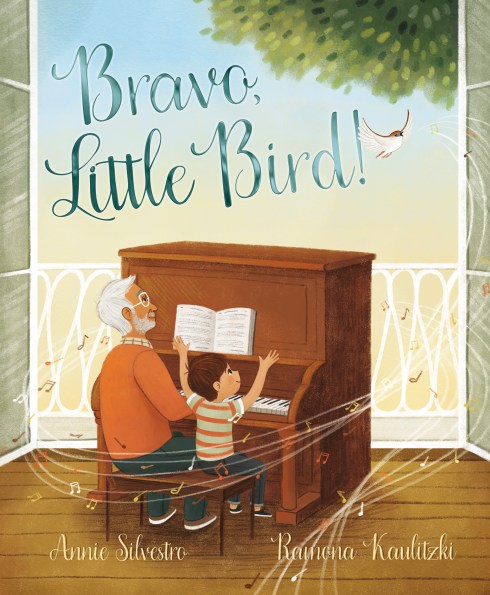
It’s gorgeous, Annie! I can feel both the music and the bird taking flight!
BRAVO, LITTLE BIRD! will be published by Simon & Schuster/Paula Wiseman Books on February 21, 2023. Watch for it to flutter into your bookstore window!
 Annie Silvestro is a lover of books who can often be found shuffling piles of them around so she has a place to sit or someplace to put her teacup. She is the author of the forthcoming BRAVO, LITTLE BIRD as well as DYLAN’S DRAGON, SUGAR AND SPICE AND EVERYTHING MICE, BUNNY’S BOOK CLUB GOES TO SCHOOL, BUTTERFLIES ON THE FIRST DAY OF SCHOOL, THE CHRISTMAS TREE WHO LOVED TRAINS, MICE SKATING, and BUNNY’S BOOK CLUB, named a Kids’ Indie Next List Pick, an Amazon best book of the year for 2017, and a 2018 pick for Dolly Parton’s Imagination Library. Annie lives with her sons by the beach in New Jersey where she laughs loudly and often. Visit her at AnnieSilvestro.com and follow her on Twitter @AnnieSilvestro.
Some of you may already be familiar with my crazy cat, Phoebe.

She meowed at my back door one night, I opened the sliders, and she sashayed in, looked around and said, “Isn’t this great?”, just like Damone from Fast Times at Ridgemont High—anywhere you are, that’s the place to be! (Especially if it has a fireplace and tuna.)
So when Maria Gianferarri asked if I’d do a cover reveal for her companion book to BEING A DOG, Phoebe stepped up to ask the questions about BEING A CAT: A TAIL OF CURIOSITY.
(For ease of reading, I’ve translated from Phoebe’s native Feline tongue.)

Maria, I’m curious, where is Cat’s favorite place to nap?
Cat’s favorite place to nap is dog’s bed.

Surely that can’t be the ONLY place to take a snooze?
Atop a radiator, or in a slice of sun.

Ahh, I know all about sun slices.
Anything else Cat wants to impart to the readers?
Yes. Curiosity did NOT kill the cat.
Thanks, Maria! Now without further meow, the BEING A CAT cover by illustrator Pete Oswald!

Sittin’ pretty!
Blog readers, the prolific Maria is giving away a PB critique with this reveal.
Just leave one comment below.
A random winner will be selected at the end of the month.
Good luck!
 Maria Gianferrari wonders and is in awe of the natural world and its inhabitants, domestic and wild cats included. She lives in Massachusetts with her inquisitive scientist husband and Maple the dog, a watcher who’s curious about anything that moves, especially if she can chase it! Curiously, though an unabashed dog lover, this is Maria’s third book featuring cats as main characters, most recently Bobcat Prowling, as well as Officer Katz and Houndini. You can learn more about Maria at her website, MariaGianferrari.com.
 Pete Oswald is a #1 New York Times bestselling illustrator and an Annie Award-nominated animation production designer best known for The Angry Birds Movie film franchise and Oscar® Nominated ParaNorman, in addition to multiple animated studio films. He is also known for his work as a children’s book author and illustrator, and painter. Pete lives in Los Angeles, California with his wife and three sons.
It’s almost summer! Get ready to take a dip!
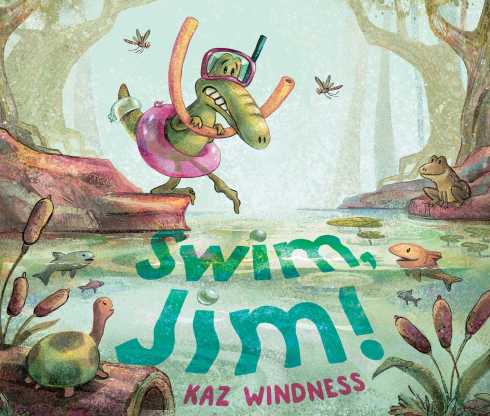
A dip in the debut waters, that is! I’ve been following Kaz Windness for years now and I have long admired her quirky artwork. So when she emailed me about her first picture book, you know I had to jump right in!
Kaz, you know I love to talk about picture book ideas—where did this one come from?
The idea for SWIM, JIM! came from the news.
A man in Key Largo, Florida saw a crocodile crossing a canal floating on top of a pool noodle and snapped a picture.
I saw the photo and drew a picture of my version of that crocodile. When I showed the drawing to my agent, he said there was a story there and encouraged me to write the book.
I failed swimming lessons as a child and know what it’s like to be afraid of the water. In fact, I still need floaties in the pool, so Jim and I have a lot in common. It took me a couple of weeks to work out the story and a few more to draw the dummy book, and then we were out on submission!


OMG! I love getting ideas from “weird news”!
Since I’m just an author, I’ve always been curious if when an author-illustrator comes up with ideas for stories, do you limit yourself by what you think you can illustrate?
I limit myself by what I want to illustrate, not by what I think I can illustrate. I don’t mind a challenge and will figure out a way to draw something if it’s part of my brief. I am definitely a character-driven artist and storyteller, so if you give me a good character, I am happy to provide that character with whatever they need. Usually, my environments are more implied more than highly rendered, but I have a lot of tools in my toolbox to get around complicated illustrations.
And those tools include pool tubes! (Say that 10 times fast!)
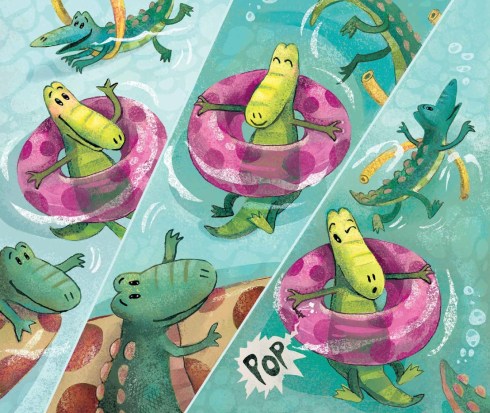
Now Kaz, a little croc told me you had a traumatic swimming experience as a child…?
 My swimming teachers threw me off the high dive when I was 4. My mom pulled me from swim lessons that same day. On reflection, those swimming teachers were probably mid-teens, but it did wreck me for swimming. I like the water, but I don’t swim.
I have a traumatic swim story, too! I took lessons at the local YMCA and at the end of the class, we had to paddle across the length of the pool with a kick board. For some reason, 3-year-old me thought I didn’t need no stinkin’ kick board, so I pushed it away. I can still see it skipping across the water. Then I don’t remember anything until I was grabbing my mother’s leg by the side of the pool.
OK, so are you therefore Jim in this book?
 Yes! SWIM JIM is autobiographical! As are all my books in some way. Even “If UR Stabby” is all about my edgy introvert side that just wants to be left alone with my dog and listen to podcasts and write children’s books. Not all unicorns are rainbows and kittens, you know!
Next year, I have a new book called BITSY BAT, SCHOOL STAR, created by the same team and imprint that brought you SWIM JIM! Bitsy talks about my experiences of trying to fit in as an autistic kid. Bitsy Bat finds herself at a school for nocturnal animals and as hard as she tries to do things like everyone else, she can’t be anyone except her true self.
You have quite a few books coming out in the next few years! What advice do you have for PB creators hoping to do the same?
Be ready! My picture book break was a long time coming (20 years!), but once you have a relationship with an editor, they’ll ask you what else you’re working on and even recommend you to other editors. Having some WIPs on hand is a big plus. I keep a Google document called “Random Book Ideas” and sometimes the random ideas become books. I also strongly recommend having a critique group. My work is a million times better because I receive regular feedback. My critique mates are also friends that understand the bumpy journey that is publishing. We lift each other up through the lows, celebrate the highs, and buy each other tacos and art supplies just because.
SWIM, JIM! was on submission for a year and received 50 rejections before going into the auction, so the whole “don’t give up” advice is something I stand by. Being tenacious pays off in publishing, and if you can enjoy the journey in the meantime, all the better.
We had our SWIM, JIM! launch party at The Wandering Jellyfish on Saturday, and seeing the way kids responded with laughter, sympathy, and curiosity—and even dressed up like the character? It made all those years of hard work worth it!
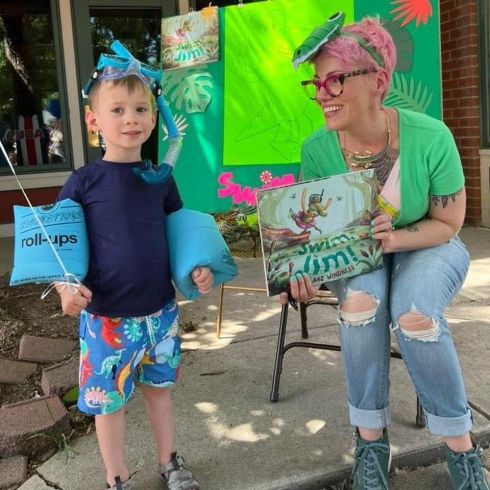
Kaz, so your debut picture book IS autobiographical! It’s all about your publishing journey! You just kept getting back in that water!
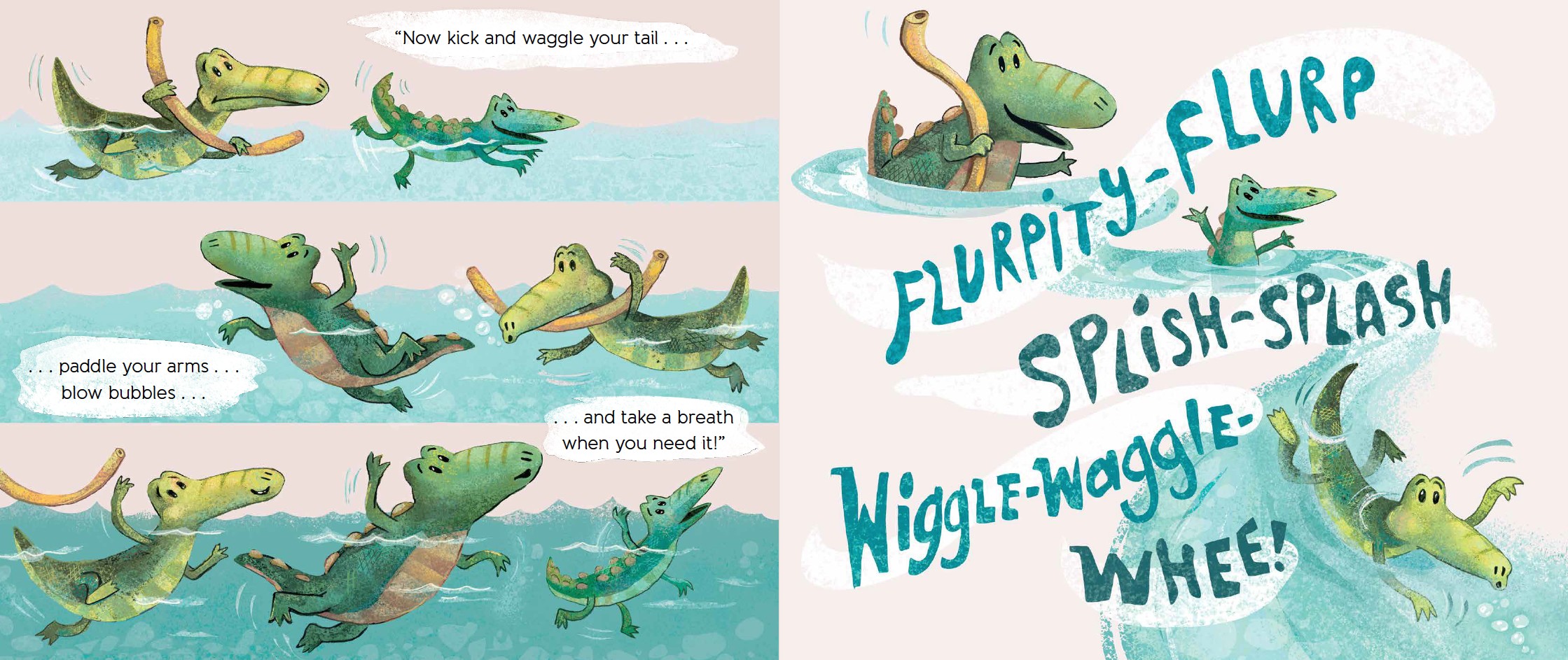
Thank you so much for sharing SWIM, JIM! with us!
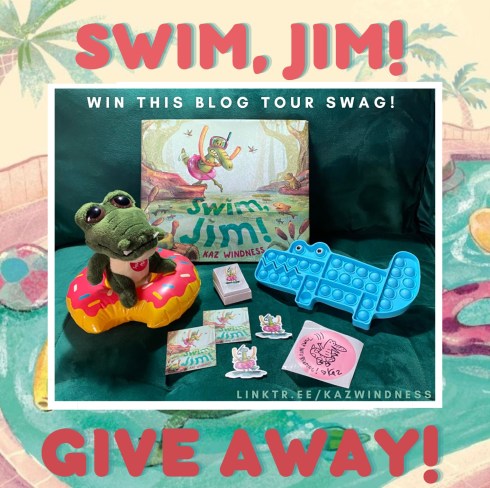
Blog readers, Kaz is giving away a whole kit and caboodle of swim noodle swag! Just enter via this Rafflecopter!
Kazgratulations, again Kaz! (I know, I’m corny.)
 Kaz Windness is an autistic author-illustrator specializing in inclusive stories featuring cute and quirky animals for younger children and spooky and edgy humor for older kids and teens.
Kaz studied children’s book illustration at the Rocky Mountain College of Art and Design (RMCAD) where she was a valedictorian graduate in 2002. Kaz volunteered as the SCBWI Rocky Mountain Chapter Illustrator Coordinator from 2009-2021 and continues to mentor and advocate for illustrators. She is passionate about helping artists succeed and believes education is key. She is a professor of illustration and curriculum author at RMCAD (2013-present).
Kaz is obsessed with squishy-faced dogs, waffles, thrifting, and all things spooky and witchy-woo-woo. She loves working in watercolor, gouache, acrylic, collage, and pencil, but mostly Photoshop. There’s not much she won’t turn into an art supply.
Kaz lives in Colorado with her English teacher husband, two children, and a bunny-obsessed Boston Terrier named Remy. Visit her at linktr.ee/kazwindness.
The world is a complicated place, even on this blog where I’m struggling to find the right words to introduce debut author Ty Chapman and his groundbreaking new book, SARAH RISING. Thankfully, Ty explains his thought process behind the book and its focus on social justice, told in a way a young person can appreciate and comprehend.

Ty, this blog talks a lot about story ideas. How did this one arise?
The idea for SARAH RISING came about in the midst of the racial uprising here in Minneapolis. At the time, there was so much misinformation around what was going on, and what the protests actually looked like. As I saw inaccuracy after inaccuracy being shared widely by “reputable” news sources, I began thinking a lot about access to information and who gets to write history. I also thought a lot about what historical events I had experienced as a child, and what my relationship to them was.
Arguably, the biggest historical event of my childhood was 9/11. I was in kindergarten at the time, and my primary memories from that day were my teacher inexplicably crying, and all of the children gathering in a circle to watch the news shortly thereafter. I knew I wanted to write a book about the uprising because I didn’t want it to be some foggy memory in the minds of our young people with very little context as to what actually happened and why. I also knew that if I was going to speak to such a heavy topic, I needed to do so with care and in a way that inspired hope and future activism. I threw a few ideas at the wall before finally stumbling upon the concept for SARAH RISING.
It’s wonderful that you seek to give children the context and understanding you did not have. How did you distill such a heavy topic in a way that’s accessible to a child?
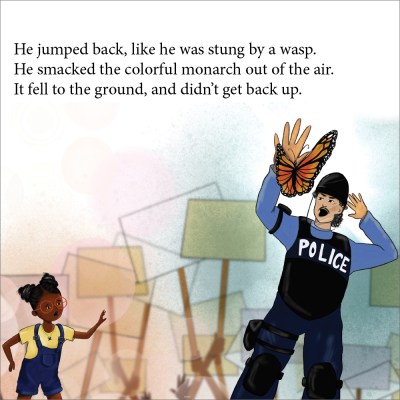
My approach truly begins with the belief that children are capable of understanding much more than we give them credit for. While I certainly don’t show the full details of police brutality in this picture book, the language in the book is pretty direct throughout. I think it’s impossible to speak on these issues in a meaningful way without being very honest and direct. That said, the use of metaphor is very helpful in striking that balance. Using Sarah’s monarch butterfly as the climax of the story allowed me to show the nature of police brutality without traumatizing the youth. It’s also helpful with these heavier topics to ultimately end on themes of hope—to remind the young reader that they can be a big part of making a better future by standing up for what they believe in.
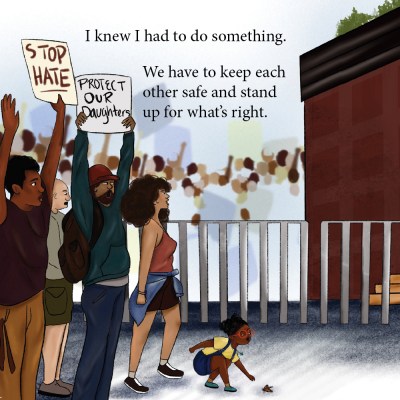
What kind of edits did you make after the book was acquired?
Once the work was acquired, much of the edits were focused on illustrator notes. We focused in particular on representing the wide array of racial/ethnic groups present in the Twin Cities. We wanted to be sure that the Twin Cities’ diversity was represented in the pages. There was also some nitty gritty editing of word choice, but honestly not very much. Because my agent, Savannah Brooks, and I had already gone through a couple rounds of edits, there wasn’t too much that needed to be tweaked once the work was acquired.
Did anything about the process of bringing the story to print surprise you?
The biggest surprise for me was probably the illustrations. I knew the illustrator, DeAnn Wiley, was incredibly talented, but nothing could have prepared me for some of the gorgeous spreads in the book. She did a terrific job capturing the essence of the Twin Cities, and crafting stunning spreads that took my breath away. It’s one thing to loosely imagine a couple of visuals—it’s another thing entirely to have a talented illustrator take your concepts and breathe greater life into them.

Ty, thank you for sharing SARAH RISING with us and congratulations on its publication.
Blog readers, you can win a copy of SARAH RISING just by leaving a comment below.
A winner will be randomly selected later this month.
Good luck!
 Ty Chapman is the author of SARAH RISING (Beaming 2022); LOOKING FOR HAPPY (Beaming 2023); A DOOR MADE FOR ME, written with Tyler Merritt (WorthyKids 2022); TARTARUS (Button Poetry 2024); as well as multiple forthcoming children’s books through various publishers. Ty was a finalist for Tin House’s 2022 Fall Residency, Button Poetry’s 2020 Chapbook Contest, and Frontier Magazine’s New Voices Contest. He is currently an MFA candidate in creative writing for children and young adults at Vermont College of Fine Arts and was recently named a Loft Literary Center Mirrors & Windows fellow and Mentor Series fellow. Visit him at TyChapman.org.
by Salina Yoon
 In the spring of 2021, my editor reached out to see if I’d be interested in writing and illustrating another Penguin book to celebrate the tenth anniversary of Penguin’s first book, PENGUIN AND PINECONE, a friendship story. It was an incredible opportunity to bring the series back to the forefront with a new book!
BUT, it was also a daunting task because in my mind, the series was complete with the 6 published books. The last Penguin book I wrote was in 2016, with PENGUIN’S CHRISTMAS WISH (Bloomsbury/2017). I had written one book after the next at the time, so I wondered if I could go back to the place of Penguin’s world and create a new story that was not only authentic to Penguin, but also something new and fresh, and deserving to be published.

Penguin’s 7th book began with thinking of a new character for Penguin to meet. I wanted this character to be different from all his previous friends—like Crab, Polar Bear, and Pinecone—while also being very different from Penguin. He has an eclectic taste in friends, and they often take him on new and surprising adventures.
I chose an elephant, and named her Penelope.
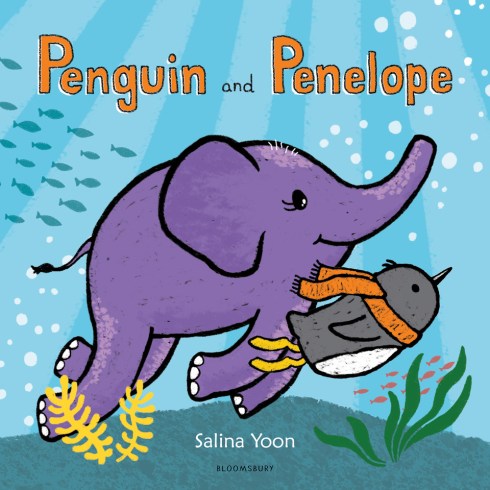
The elephant was different from a penguin in many ways; large body vs. small body, 4 feet vs. 2 feet, trunk vs. beak, rough skin vs. smooth feathers, large ears vs. no ears, tropical habitat vs. cold habitat, just to name a few contrasting elements. The goal I had was to find something unique that connects them despite their obvious differences. Once I found that piece in the story, I knew I had something to work with! The cover gives you a clue to what they share in common—they can both swim!
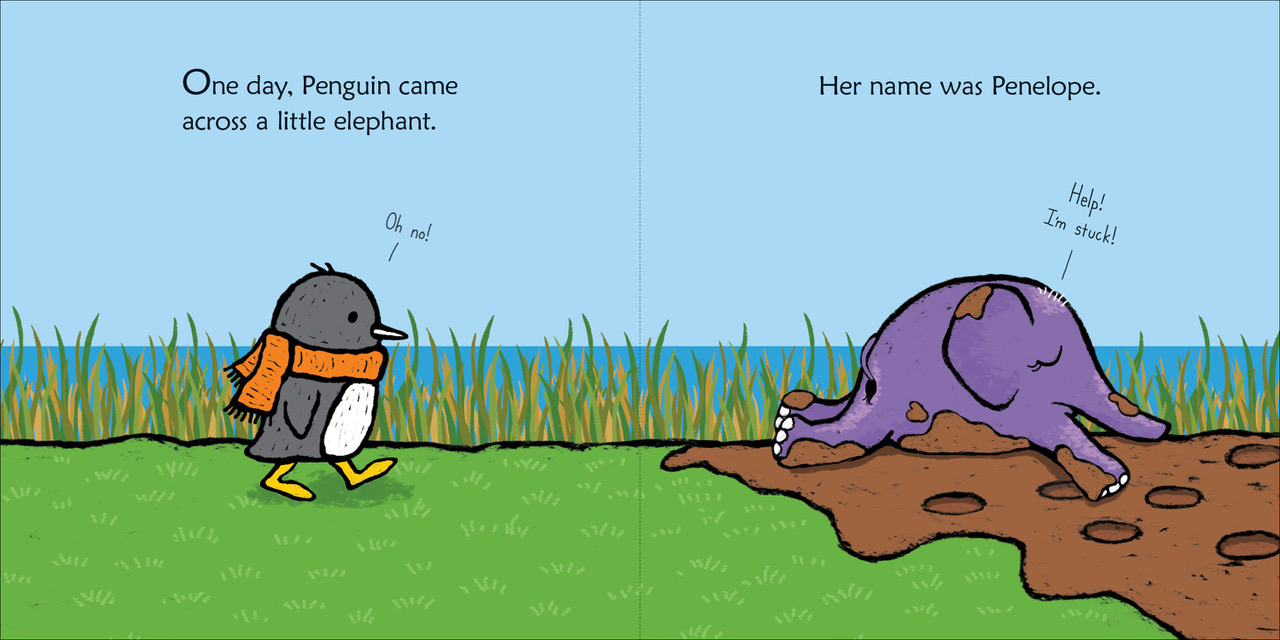
Penguin’s books show the importance of friendship and the value of kindness through a heartwarming journey like no other. In Penguin and Penelope, Penguin finds Penelope stuck in mud, and he helps her find her way back home through a journey of friendship, growth, and self-discovery.


Salina, what a delightful problem to have—envisioning a 7th book in an established series!
Congratulations on PENGUIN AND PENELOPE, which releases on September 6, 2022. The special anniversary edition of PENGUIN AND PINECONE will come out on November 1.
Blog readers, Salina is giving away one set of the first 6 PENGUIN BOOKS!
Leave one comment to enter.
A random winner will be selected in June.
Good luck!
 Salina Yoon is a Geisel Honor-winning author/illustrator of a dozen picture books and early readers and nearly 200 innovative novelty books, with over 5 million books sold worldwide, including KIKI AND JAX, the life-changing magic of friendship, a picture book she co-authored and illustrated with international tidying superstar and bestselling author, Marie Kondo. Visit her online at SalinaYoon.com.
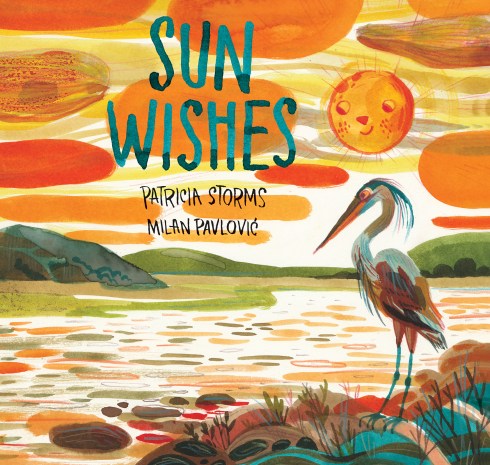
Today it’s my pleasure to welcome Patricia Storms with her newest book, SUN WISHES. I caught a glimpse of the cover online and I was immediately captivated by the bold colors. I was so drawn to the book, I had to ask her about it!
Patricia, this blog focuses on story ideas, so please tell us how you got the concept for SUN WISHES?
It’s interesting how SUN WISHES came to be.
SUN WISHES would not have happened without MOON WISHES, which came into the world in 2019.
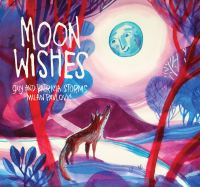 MOON WISHES came about as a conversation with my husband Guy. The response from MOON WISHES was so kind and positive. I wasn’t sure what the response would be, because it was a different kind of picture book—soft, dreamy, poetic. I was pleased that people enjoyed MOON WISHES, but it really did not occur to me to write a sequel, or follow-up. But I was at a Christmas party in 2019 (a party full of children’s authors & illustrators, by the way), and I had brought a copy of Moon Wishes with me. One of the guests turned to me after reading Moon Wishes and said, “Well, when are you going to write SUN WISHES?” My jaw dropped. I had never considered that! So then I could not get that title out of my head, and within the next few days, the words poured out of me so easily, like a gift from the heavens.
You are an illustrator yourself, but Milan Pavlović is the illustrator for both books. How did that come about?
Yes, I did receive a lot of questions/confusion when MOON WISHES came out—why was I letting someone else illustrate my text, if I can illustrate my own books? Well, it’s like this: before MOON WISHES came out, I had illustrated a couple of books under a very tight deadline, and I was mentally exhausted. Illustrating a picture book is a lot of hard work. But the main reason why Milan illustrated MOON WISHES and SUN WISHES is that he was the perfect person to illustrate my words.
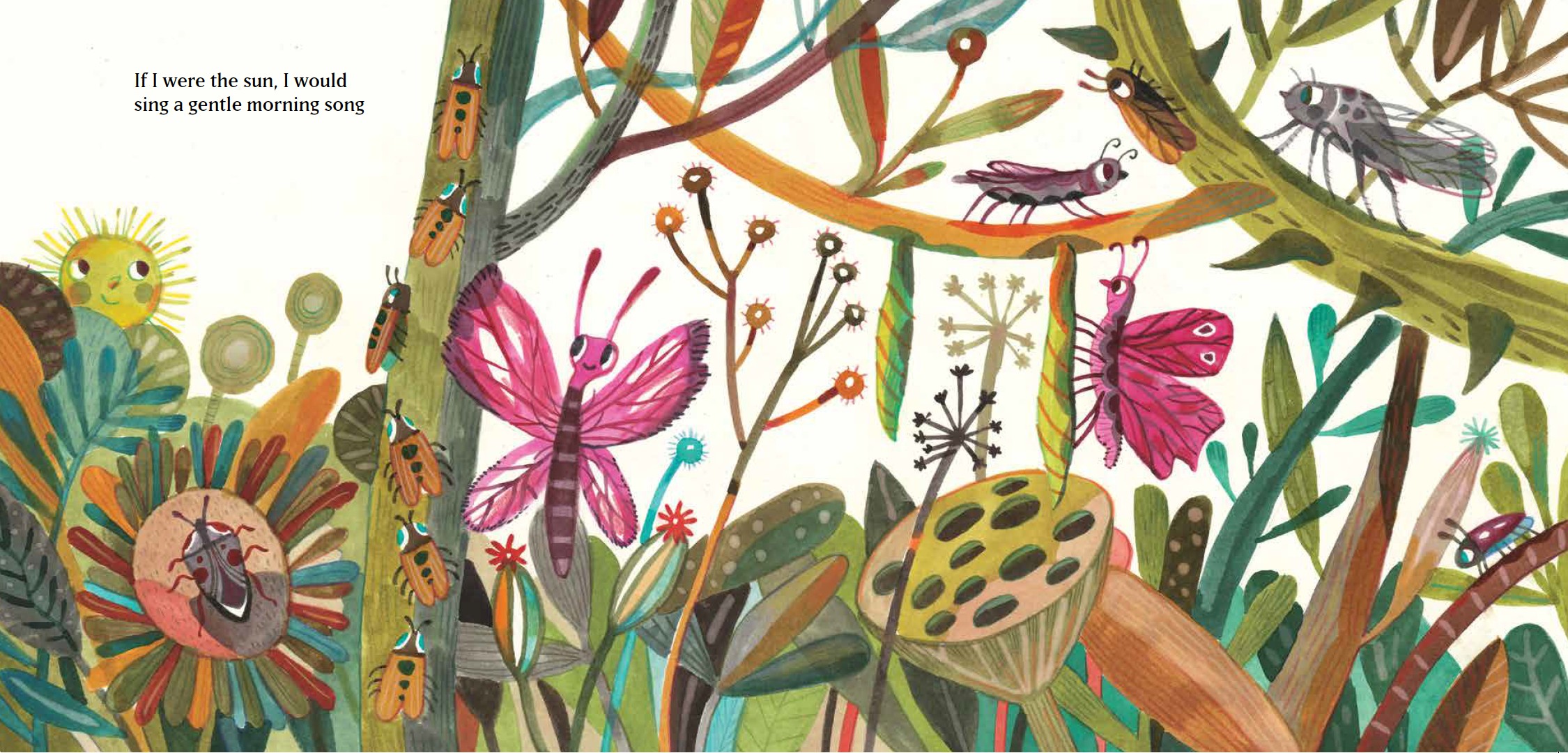
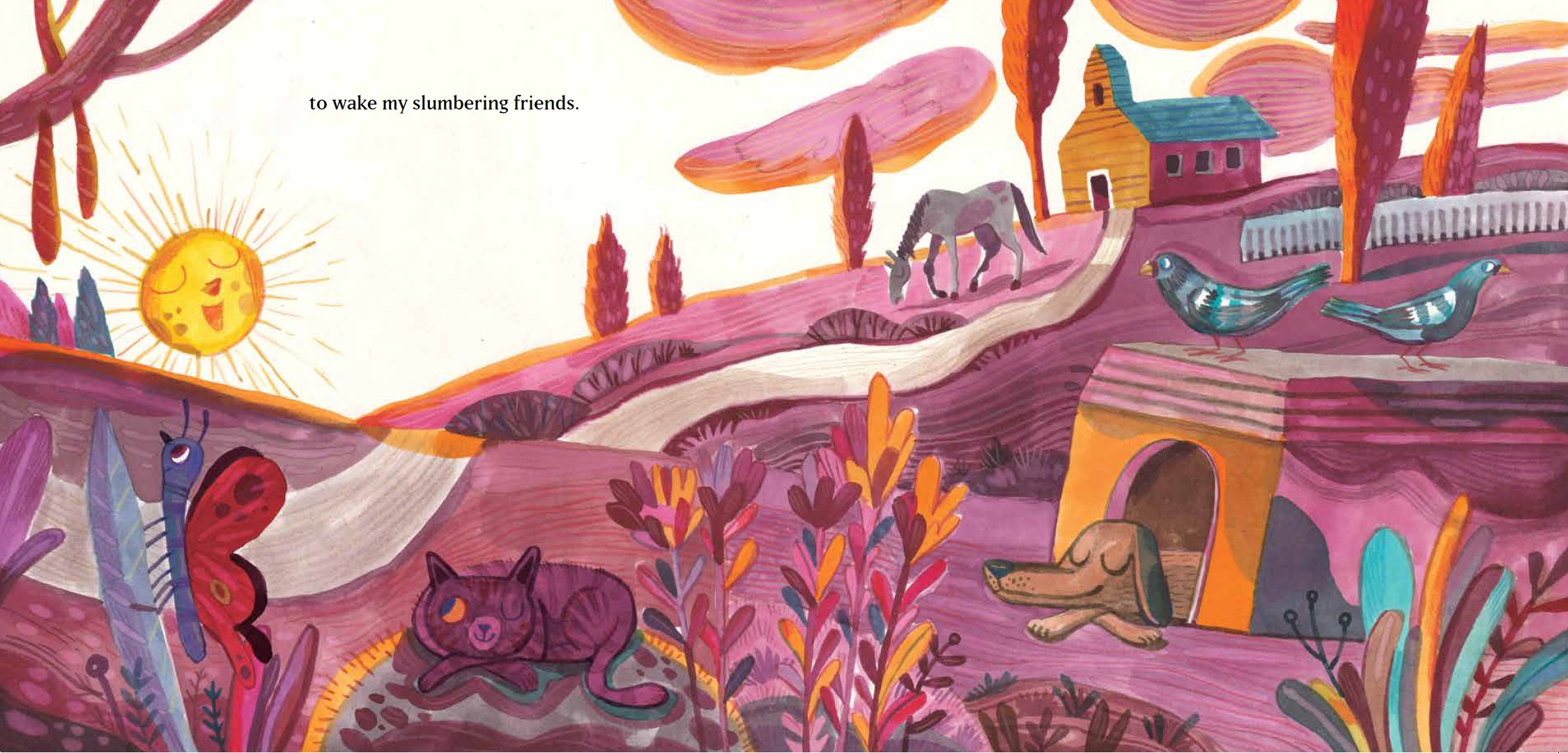
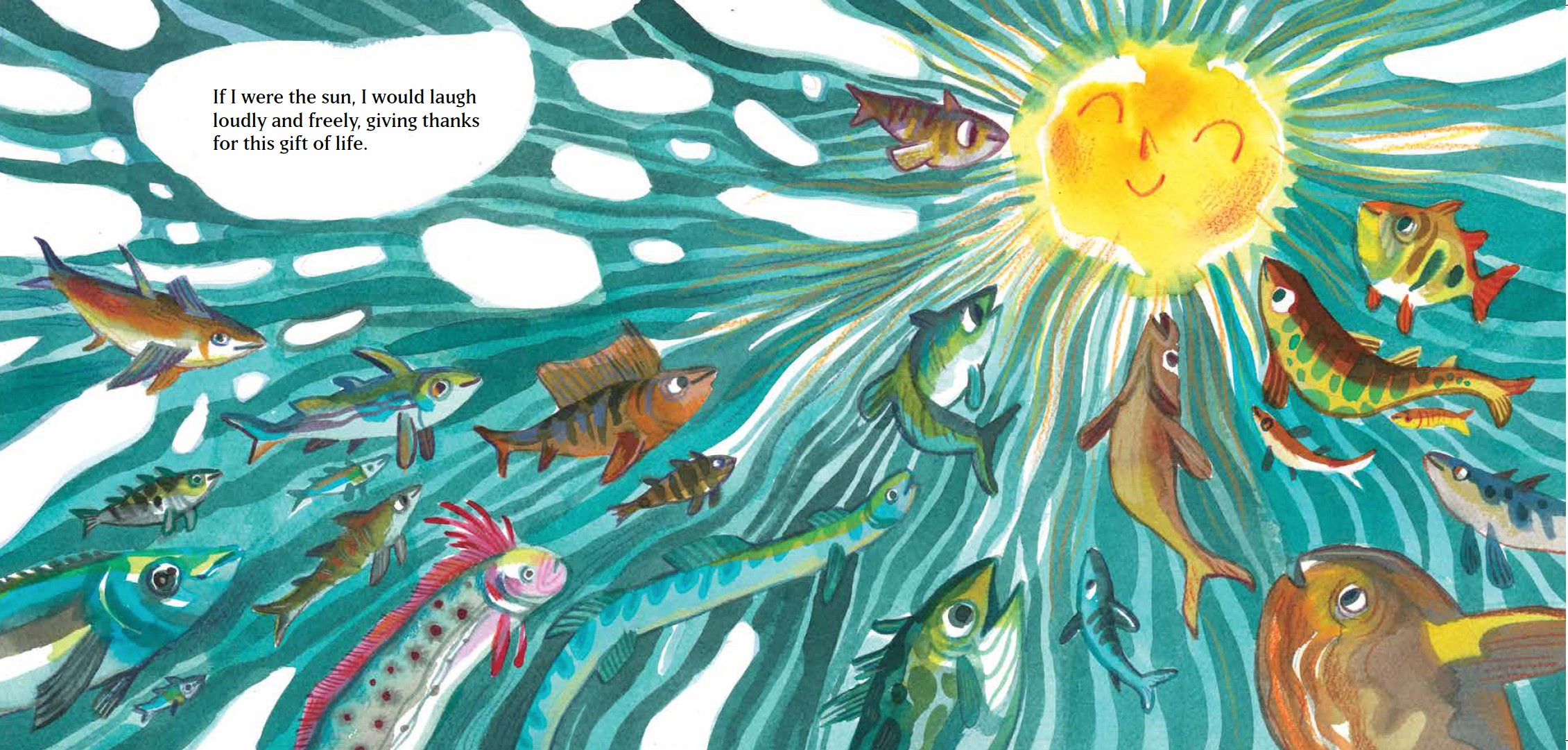
I agree! His style is perfect for this book. The colors are so rich and vivid, and I love the way certain pages have an overall color theme based on the time of day or location. You can’t stop marveling at it.
For most of my creative career I have focused on cartooning, so all the books I have illustrated have been cute and funny. But all of a sudden I was getting all these soft and gentle words coming out of me. I can draw/paint in a soft manner, but I wasn’t sure I could suddenly change styles and create gentle art under a tight deadline. Plus I was really excited at the thought of having someone else illustrate my words. I’d never had that experience, professionally.
It’s scary to try new things when you are not sure of the end result, and trust me, I was a tad nervous (giving creative control over to another artist) but the end results were way beyond my expectations (this also includes my other book, THE DOG’S GARDENER, which was illustrated by the amazing Nathalie Dion). I do want to grow as an artist, so since the beginning of the pandemic I started painting using gouache, trying to stretch my skills. My dream is to illustrate a picture book using gouache instead of coloring digitally. We will see what transpires…
The last three books you have written have a very low word count, and even your earlier picture book, NEVER LET YOU GO has just over 100 words. Is there a reason behind that?
Yes, I do seem to have a penchant for short, short fiction. I’m not exactly sure what to say other than I think that’s how my creative brain works when it comes to writing. Even when I was very young, I wrote short works. I still have my kindergarten report card and my teacher wrote, “Patricia’s stories, though brief, are very imaginative.” I loved reading all the clever one-panel gag cartoons I found within New Yorker cartoon collection—short, clever jokes really rocked my world. I wrote lots of short poems back then, and then I eventually graduated to magazine gag cartoons and greeting cards. The next logical step seemed to be picture books. It’s not easy to write a story with a limited amount of text, but I really enjoy the challenge. I have read the criticisms of my works—some folks don’t quite get my approach to writing picture books; they think there is no ‘story’ within my words. I’ve read comments like “nothing happens” in some of the book reviews (I know, I shouldn’t read the negative reviews!). Well I would argue that lots happens—it’s just beneath the surface, and the approach is very quiet. I like picture books with lots of energy and highs and lows, but there is a place for quiet stories that make you think, and get to the heart of the matter.
Thank you for sharing SUN WISHES with us, Patricia! It’s a gorgeous, captivating book!
Blog readers, you can win a copy of SUN WISHES. Just leave one comment below.
A random commenter will be selected at the end of this month.
Good luck!
 Ever since Patricia Storms can remember, she has loved to draw, paint, write, read, and sing. She was 12 years old when my first cartoon was published in a Toronto newspaper. She got paid five dollars for that cartoon, so she figured that maybe she should keep drawing. She’s been writing, drawing and painting ever since, publishing dozens of books which you can find here.
Visit her online at patriciastorms.com and follow her on Twitter @stormsy.





 Writing for Kids (While Raising Them)