You are currently browsing the category archive for the ‘Picture Books’ category.
 by
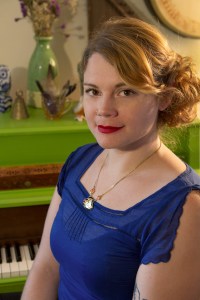
by When I was growing up as a latch key kid in New York, two things formed my sense of place and identity in the world: my grandfather’s freckled arms and my picture books. There is something about visualizing a chosen reality that is so vital for kids as they transition from the Waldorf educational concept of the childhood dream-world to the brass-tacks world of adults. In a picture book, the world is presented as navigable, even through challenge. Whether the challenge is fear of closing one’s eyes to sleep, or losing a favorite bunny, or getting through the classic Grimms’ three-challenge arc, kids need to know that on the other side of something insurmountable is a green valley brimming with potential.
I am currently in the MFA program in Illustration as Visual Essay at School of Visual Arts, and most of the work I’m doing is a departure from my usual picture book work that you see here. I’m exploring my grandmother’s aging in one book project, and writing a love story set in post-Holocaust Germany which I will be illustrating this spring. I had a bit of a crisis about this, especially since I just signed with Rodeen Literary Management this summer and we’re just about to send one of my picture books out. But I realized that much of my work, even for kids, has to do with thriving after trauma, and that by exploring these more “adult” themes in my MFA, my picture book work will become more nuanced.
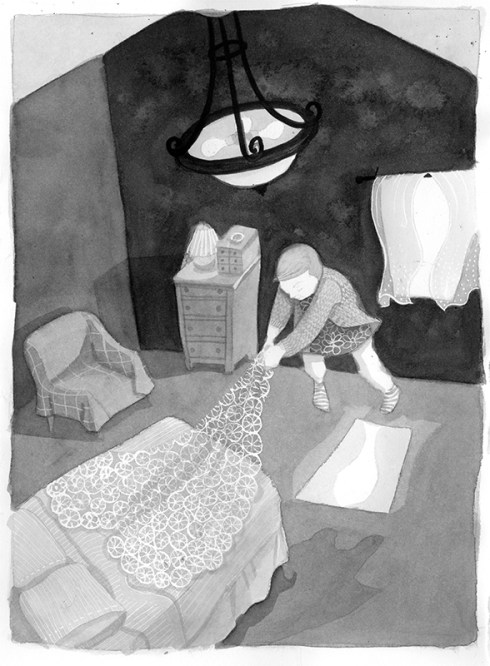
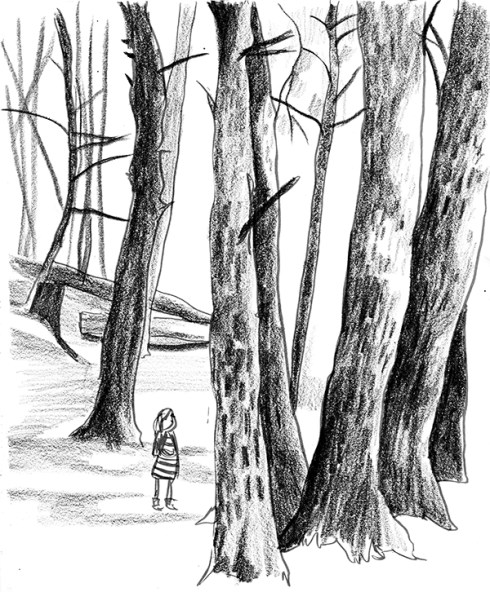
Far from being just about cute stories, picture books are the vehicle for survival for many kids as they were for me. That is why they are so, so
important. And…they’re gorgeous to look at!

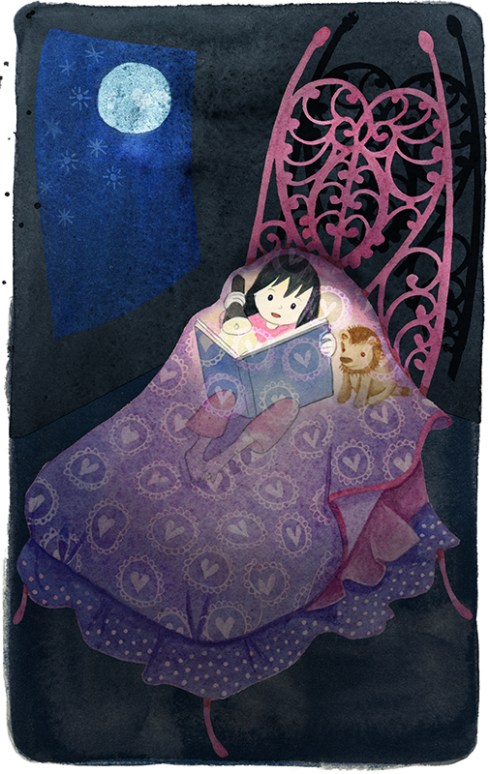
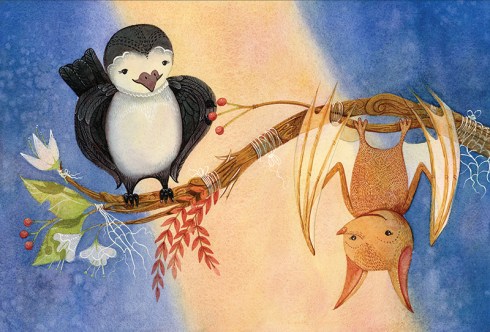
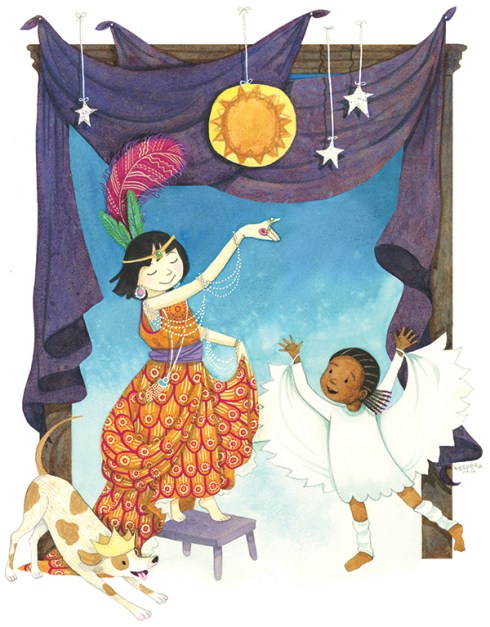
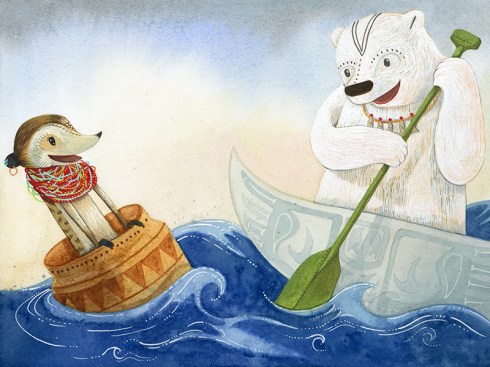
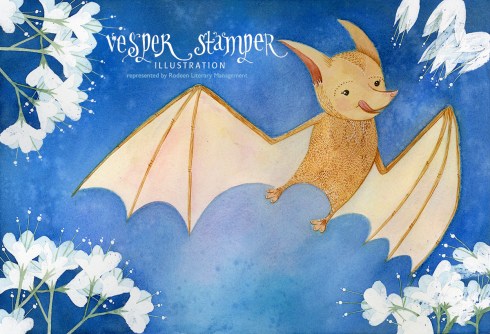
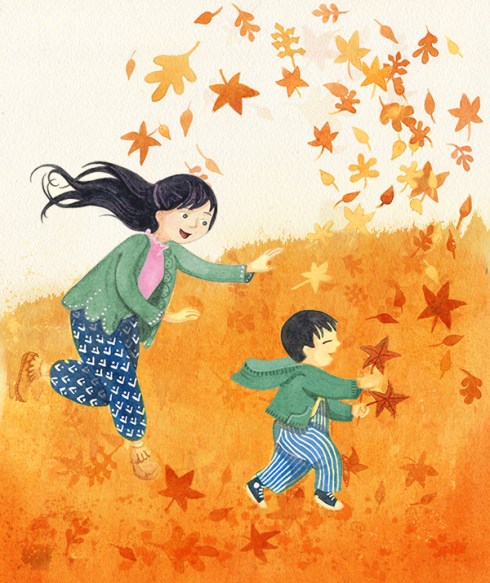
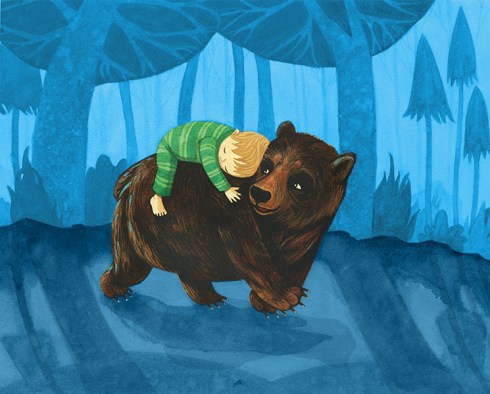


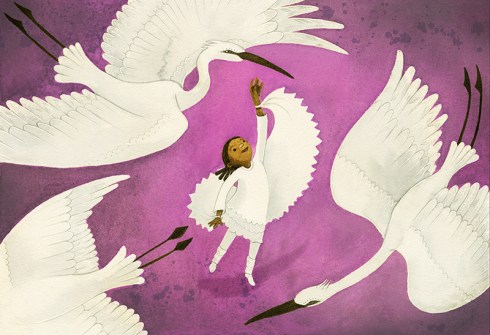
Hopelessly lost among the wintry wardrobes of Pauline Baynes’ Narnia, Shaun Tan’s mysterious foreign lands, and the watery open spaces in Lisbeth Zwerger’s illustrations, Vesper Stamper’s calling as an illustrator began when she cracked open Hilary Knight’s Cinderella and spent the rest of her childhood meticulously copying each graceful page.
Vesper has a BFA degree in Illustration with Honors from Parsons School of Design. Her career has spanned fifteen years, dozens of album covers, four picture books and countless other exciting projects. Vesper brings a refined style and emotional depth to her work that pays homage to the rich illustrative tradition from which she comes.
Vesper was named the 2013 People’s Choice Finalist in the Lilla Rogers Global Talent Search and is the recipient of the 2012 Lincoln City Fellowship for her graphic novel, The Sea-King’s Children. She lives in Jersey City, NJ with her husband, filmmaker Ben Stamper, and their two children. She is the winner of both the 2014 NJ SCBWI Juried Show and People’s Choice awards, and is an MFA candidate in the Illustration as Visual Essay at School of Visual Arts, NYC.
Vesper is represented by Lori Kilkelly at Rodeen Literary Management, Inc.
I asked the kidlit agents participating in PiBoIdMo as your “grand prizes” to tell us why they love picture books. Their answers are sure to inspire!
Heather Alexander, Pippin Properties
 Picture books are easy to love because they are tiny little windows that offer beautiful glimpses out into the whole, wide, wonderful world, and into hearts like and unlike our own.
Stephen Fraser, Jennifer De Chiara Literary Agency
 I do love picture books! There is nothing more satisfying than to find a picture book manuscript which has been carefully crafted to share a story with the youngest readers. The Impressionist painter Pierre Auguste Renoir said that painting is “making love visible” and I can’t help thinking that is why some picture books are so endearing and everlasting. They make the love we feel for our children, our grandchildren, and the children within us very visible. It is a true craft which needs to be learned and practiced. And I honor those who learn this craft and honor children.
Kirsten Hall, Catbird Agency
 Picture books pretty much have me wrapped around their finger. I’m obsessed by the story-telling opportunities offered by this highly-visual genre! Picture books (as a format) seem simple at first blush, but they are often in fact quite layered and even poetic, displaying an elegant interplay between text and art. Best of all, picture books are accessible to everyone. You don’t have to be able to read in order to love them. They can be savored for what they offer visually, and when read aloud, until a reader has command over the written word. Simply, what format is better than the first one that takes children by the hand and turns them into book-lovers?
Susan Hawk, The Bent Agency
 The best part of picture books, for me, is way words and illustration marry together to create a sum greater than its parts. I love the way art builds meaning in the story, and how the simplest of texts can be full of emotion and heart. I remember so well the picture books that I poured over as a child — mystified and delighted to be invited into the world of reading and books. For me, it’s an honor to represent picture books!
Tricia Lawrence, Erin Murphy Literary Agency
 I love picture books because they celebrate a time in our life we all look back on so fondly. I love being a part of helping to create them because we’re creating books for kids who will look back on them for the rest of their lives.
Erin Murphy, Erin Murphy Literary Agency
 I became a reader because of picture books, and I became an agent because of picture books. They are one of the richest and most influential forms of literature. So much feeling, so many laughs, in so few pages, meant to be read over and over again!
Ammi-Joan Paquette, Erin Murphy Literary Agency
 I love picture books because they speak to the quintessential child in each of us. They reach across the gaps of age and culture and language and bring us under their spell. A perfectly-crafted picture book is a full-senses experience that can last a lifetime.
Rachel Orr, Prospect Agency
 I love the breadth of story and emotion—from clever and comical, to poetic and pondering—that can be found within the framework of a 32-page picture book. I love the right prose, the visual subplots, the rhythm and rhyme and repetition (and repetition, and repetition). But, most of all, I love them because they’re short.
Kathleen Rushall, Marsal Lyon Literary Agency
 I love working with picture books because they remind me that the earliest literature we read in life can be some of the most memorable (and the most fun!).
Joanna Volpe, New Leaf Literary & Media, Inc.
 I love picture books because they’re fun to read aloud, and they’re meant to be read with someone else.They can’t not be shared! Even now, I don’t have kids, but when I read a good picturebook, my husband gets to be the audience. He’s very understanding. 🙂
Let me say one thing straight out: My picture book, GHOST IN THE HOUSE, is very close to my heart. Of my published picture books, it’s the one that’s gotten the most visibility so far, including a fabulous review in the New York Times, several “Best of the Year” roundups, and a pickup by the Scholastic Clubs and Fairs. Needless to say, these small joys absolutely thrilled me.
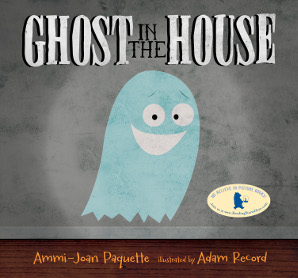
But also? I have to be honest: They surprised me a little. Those of you who have heard me speak about GHOST IN THE HOUSE will have heard how it came about: Following the rejection of another Halloween manuscript, an editor asked if I “had any other spooky rhyming picture books.” At that moment, I did not. Several weeks, much brainstorming, and a torrent of writing later, I did.
Don’t get me wrong. I worked hard on GHOST IN THE HOUSE. But compared to many of my picture book texts, over which I toiled ad infinitum, this text came relatively easy. The end result also felt, well, simple. It was a sweet, zippy rhyming story. Short and to the point. Fun characters, neat twist. But when lined up against my other laboriously crafted stories—and, in particular, the one it had originally supplanted—it felt uncomfortably ordinary.
Still, someone wanted to publish my picture book! Joy!
In the months following publication, I gained more respect for my modest little manuscript. But it took one final thing to bring me fully around. And that was this: One day I received an email from my editor at Candlewick, asking what I would think about writing a companion book. It might, she suggested, be called ELF IN THE HOUSE.
Well! Ask no further—I was on it. GHOST was just a simple, puny little story, right? I could crank out another one of those in a flash. No worries!
Instead? I hit the blank page. Hard.
Frustrated at my false starts, I sat down and listed the elements that made up GHOST IN THE HOUSE, so I could attempt to replicate them (in a perfectly organic, all-new-and-fresh way, with a Christmas spin) in the sequel. Here’s what I needed:
- recognizable creatures
- a reason for the creatures to accumulate
- tension—what’s keeping the reader turning the pages?
- perfect fit to the rhyming scheme
- surprising twist
- satisfying, feel-good ending
Let’s just say (if that list wasn’t clear enough), that this exercise made me look at GHOST in a whole new light. Short? Yes. Simple-easy-basic-ordinary? Not so much.
Astute readers will likely have seen this coming, but ELF IN THE HOUSE did not come in a flash. More than once I doubted if I could pull it off at all. It took writing, and rewriting, and re-rewriting. Forget inspiration: This was deliberate, backbreaking effort: Lists and brainstorming and trial-and-error and throw-it-all-out-and-start-over. Time after time after time. I’d almost have it… but not quite. This angle might work… only not.
It did not come easy. Not even close.
But finally, in the end, it did come. And great was my delight when my editor received my final manuscript, and made a publication offer. (Woohoo!)
Once ELF IN THE HOUSE is published, I imagine most readers won’t see much difference in tone between the two stories. From the outside, it’s likely that they’ll both appear effortless and breezy. But what this experience crystalized for me was that stories can be born in all sorts of ways. Some arrive on the magical wings of inspiration, landing lightly on your shoulder and seeping onto the screen with the greatest of ease. Others bare their bloody fangs and force you to wrestle them into submission.
One method, one origin, one final story is not necessarily greater than any other. We are authors: we take what we can get, and we make it our own. It’s the making—however long or short, easy or gut-hard—that brings the magic.
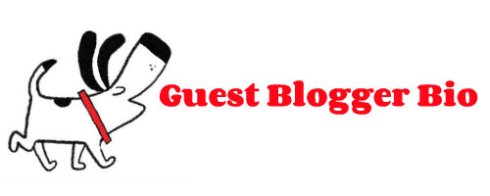

Ammi-Joan Paquette is an author and a literary agent with Erin Murphy Literary Agency. She’s a mother, friend, reader, traveler, food-lover, chocolate connoisseur. She is not especially tidy, a fan of mushy vegetables, or good at coming up with spur-of-the-moment self-portraits.
Learn more about Joan and her books at ajpaquette.com and follow her on Twitter @JoanPaq.
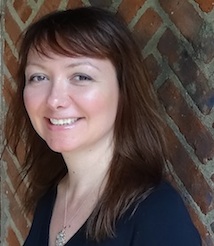 by Diana Murray
Picture books are as varied as the potions in a witch’s cupboard. Some are spicy and bubbly, while others are mellow and sweet. So which kinds of stories are editors and agents clamoring for? Well, their tastes are just as varied. But one thing that seems to be on everyone’s wish list is this: character-driven stories. A few examples include FANCY NANCY by Jane O’Connor, LLAMA LLAMA RED PAJAMA by Anna Dewdney, PINKALICIOUS by Elizabeth Kann, RUSSELL THE SHEEP by Rob Scotton, SKIPPYJON JONES by Judy Schachner, PETE THE CAT by Eric Litwin, LADYBUG GIRL by David Soman and Jacky Davis, MAX AND RUBY by Rosemary Wells, and SCAREDY SQUIRREL by Mélanie Watt. As you can see, character-driven books have great series potential and overall marketing potential. When readers fall in love with a character, they want to read more about him/her, and it’s fun to visualize what other sorts of situations the character may get into.
This doesn’t mean that character-driven stories are the only kinds that sell or do well in the marketplace. Nor does it mean that writers should focus primarily on pleasing editors or following trends. The best writing comes from the heart! But with that in mind, if you want to explore the possibilities of a character-driven story, here is one quick and easy recipe for brewing up a strong concept. Two ingredients are all you need!
- Personality Trait
- Conflicting Goal
I recommend you start off with a list of your own personality traits. This will make it easy for you to feel an emotional connection with (and understanding of) the trait.
My list might look something like this:
- introverted
- joker
- nerdy
- perfectionist
- quiet
- creative
- analytical
- messy
- quirky
- worrier

Pick one trait (or several, if you’re feeling bold!). Next, choose a goal. Not just any goal, but specifically a goal that is in opposition to the trait you selected. When I wrote GRIMELDA, THE VERY MESSY WITCH, I chose the trait of being “messy” and made the goal “to find an item the character desperately wants/needs.” Or let’s say, for example, I choose “quiet”, then perhaps the goal would be to sing on stage, or speak out against something, or win an international yodeling contest. Sprinkle the goal in with your trait and–POOF! Instant conflict. And the conflict is intrinsically related to the essence of the main character. Adding conflict to a story is one way of encouraging readers to keep turning the pages. They’ll want to find out what happens next! Now, how will your character attempt to reach that goal or face that problem in his/her own unique way?
Feel that story bubbling to life? Now all you have to do is write (and revise, and revise) the rest. Of course, that’s the hard part. But a little inspiration magic can go a long way!
Diana Murray is the author of several forthcoming picture books including, CITY SHAPES (Little, Brown, Spring 2016), NED THE KNITTING PIRATE: A SALTY YARN (Roaring Brook Press, Winter 2016), and GRIMELDA, THE VERY MESSY WITCH, plus a sequel (Katherine Tegen Books/HarperCollins, Summer 2016, 2017). Diana is the recipient of two SCBWI Magazine Merit Awards (2013 and 2014) and an Honor (2013) for poetry. She also won the 2010 SCBWI Barbara Karlin Work-In-Progress Grant for a picture book text. Diana is represented by Brianne Johnson at Writers House. She was raised in New York City and currently lives in a nearby suburb with her husband, two very messy children, and a goldfish named Pickle. Diana’s character GRIMELDA was brewed up during the first official PiBoIdMo, back in 2009! You can read more about that experience here.
For more information and news, you can visit DianaMurray.com or follow Diana on twitter: @DianaMWrites.
Diana is giving away a picture book critique!
This prize will be given away at the conclusion of PiBoIdMo. You are eligible for this prize if:
- You have registered for PiBoIdMo.
- You have commented ONCE ONLY on today’s post.
- You have completed the PiBoIdMo challenge. (You will have to sign the PiBoIdMo Pledge at the end of the event.)
Good luck, everyone!
Today I invited The Girllustrators, Austin-based kidlit artists, to guest blog for PiBoIdMo, so you’re getting THREE inspirational essays—by Emma Virján, Caitlin B. Alexander and Marsha Riti—for the price of one. (And they’re all FREE, LOL.) I recommend following these talented ladies on Twitter @Girllustrators.
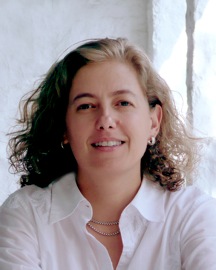
Up first: Emma Virján!
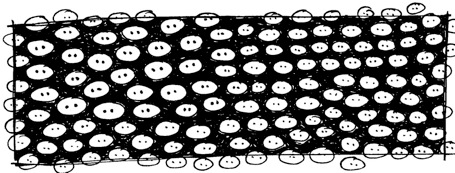
WHAT THIS STORY NEEDS IS A PIG IN A WIG started with this doodle of pig snouts.
Sketches of pigs started to fill my notebooks.
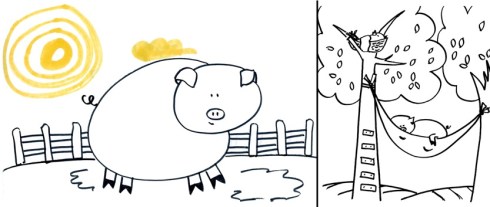
After many drawings, I determined pig needed a name. I named her Pig.
It was also determined that she needed a wig.
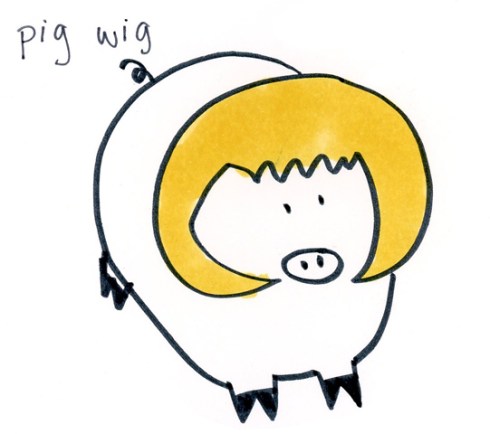
I drew Pig wearing many different wigs.
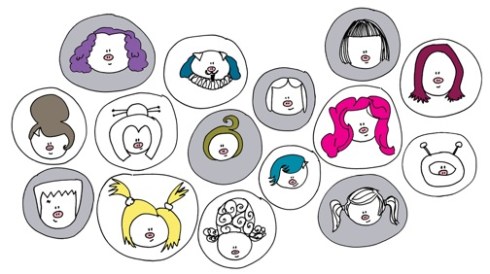
I loved Pig in all of her wigs (still do) but this one became my favorite.
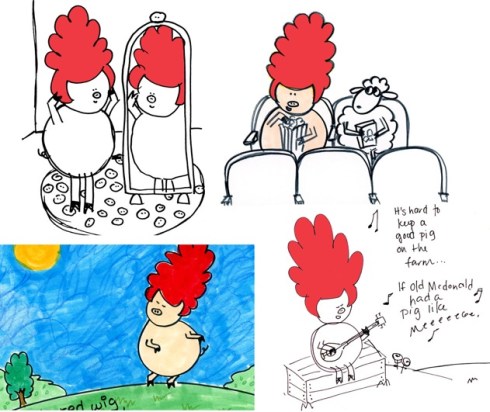
The story of Pig and her wig started to take shape. Work began on a manuscript.
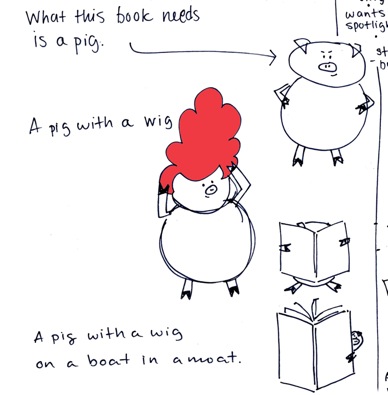
The words “on a boat” kept cropping up and I started drawing images of Pig near a boat.
Sometimes I only drew the boat. The boat always had a pig snout on the bow.
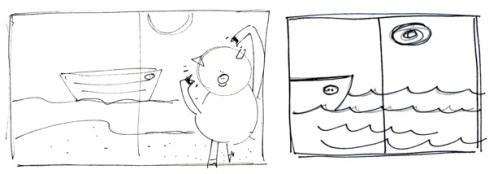
The first of many thumbnails were created.
So began the real work of the images and words becoming a picture book.

Revisions happened. Drawings were scrapped and new ones were drawn. More revisions happened and eventually What This Story Needs Is A Pig In A Wig was finalized.
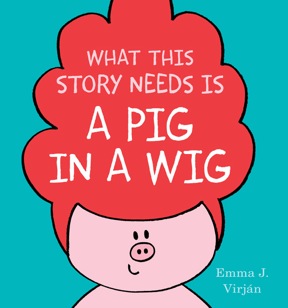

It’s amazing to think that a black and white doodle of pig snouts, drawn while on the phone with a client, became the inspiration for a character and a story.
And the endpapers.

Emma J Virján was born under an Aries moon on a Wednesday, her dad’s bowling night. This explains her attraction to hardwood floors. She likes to draw, work in her garden and often lets her dog sleep on the couch. She makes her home in Austin, Texas where she spends her days as an illustrator and graphic designer.
She is the author-illustrator of Nacho the Party Puppy, Random House, 2008, and the forthcoming What This Story Needs Is A Pig In a Wig, HarperCollins, May 12, 2015.
You can visit Emma Virján at Emmavirjan.com and follow her illustrative moods on Twitter @EmmaVirjan.
____________________________________________________________________________

Next is Caitlin B. Alexander!
Being an illustrator, my concept for a story grows in tandem with my visual ideas. I look at children’s books that I admire, both old and new, and take note of what draws me to them. Is it the overarching message? The color palette? The scenery? What medium did they use for the art, and what kind of characters did they use? The art or writing may not resemble my work, but something about it can still inspire me. I have a massive collection of books that I turn to frequently.

I am somewhat of an overly-organized person, so I make all sorts of bubble charts and graphs, with ideas sprouting into other ideas. Some of these are just images I would love to incorporate into a story, like a sailboat, and others are larger concepts. Eventually, with a lot of scribbling, listing, doodling, highlighting, and sample-writing, I come up with a rough idea or two that can be explored further. It reminds me of a slab of clay that has barely taken shape, but has a lot of potential.

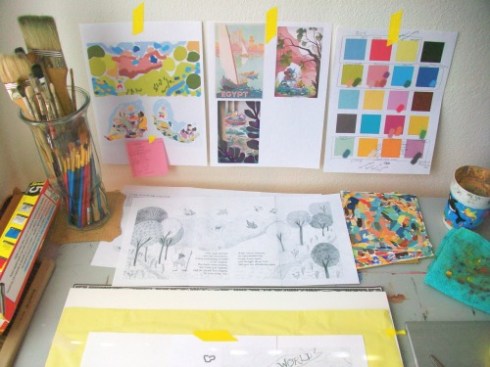
I wish I could say that I know what perfect and repeating formula works for getting a book published, but there are probably few people who do. The rest of us just create things that we love, and keep learning, making mistakes and trying new things. If we’re lucky, we’ve hit the right combination, and someone else has fallen in love with the idea as much as we have.
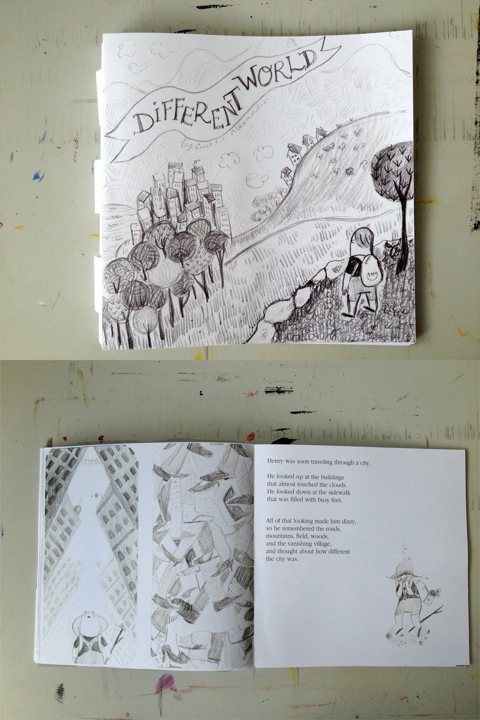


Caitlin B. Alexander is an illustrator based in Austin, Texas with a particular love for dry-brush gouache painting. Both her life and work are heavily influenced by the aesthetics of the 1940’s, ’50s and ’60s. She fancies herself a collector of memories as much as a collector of things, andenjoys bringing this sense of nostalgia to her audience.
Clients include: Spider Magazine, Ladybug Magazine (Cricket Media), Geneologie, Texas Board of Tourism, Dallas Child Magazine, Bearded Lady Screen Prints, Austin Society of Children’s Book Writers and Illustrators, PERC Coffee, The Kloud Agency, What’s Up Annapolis? Magazine
Visit Caitlin’s website at cbaillustration.com, follow her Tumblr at cbaillustration.tumblr.com and Tweet with her @cbaillustration.
____________________________________________________________________________

And now…Marsha Riti!
Because I consider myself an illustrator first and foremost, the way I approach storytelling is a bit different than a writer. My inspiration comes from sketching and playing around with materials.
I’m currently working on a dreamy story about a girl, a rabbit, and the moon. This story came about from playing around with loose watercolor techniques and other materials.

Then I started playing with character sketches.
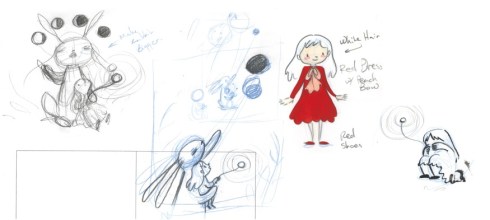
I love to thumbnail out ideas. Tara Lazar has a great thumbnail guide on her website and so does Debbie Ohi.

Here’s a small sample of a double-page layout.
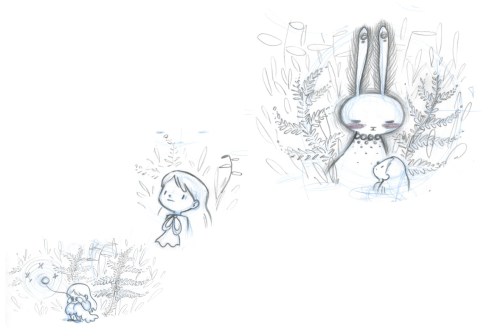
And here’s a finished spread.

This process naturally lends itself to wordless storytelling, but I don’t want to limit myself. If the story needs words, then I’ll supply them. If it does not, then so be it.
One other place I find inspiration is this quote below from a Blake poem titled “Night.”
“The moon like a flower,
In heaven’s high bower,
With silent delight!
Sits and smiles on the night.” ~ William Blake
My husband and best friend Adam happened across it while reading “Songs of Innocence.” Adam is another source of inspiration. We have wonderful conversations about life and philosophy that are always giving me new ideas.
Marsha Riti is a children’s book illustrator from Austin, Texas. She has been a member of SCBWI for a number of years, and is also a co-founder and member of a female illustrator collective called the Girllustrators. She is currently illustrating a chapter book series for Simon & Schuster, The Critter Club, and is represented by Teresa Kietlinksi of Prospect Agency. And she’s got a wicked sense of humor.
Tara featured Marsha in a “Portrait of an Aspiring Illustrator” in March 2009.
View Marsha’s artwork and latest projects at marshariti.com and follow along on Twitter @marshariti.
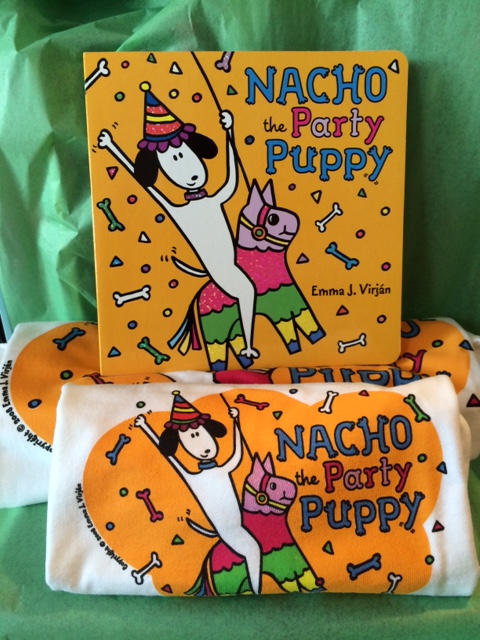
Emma is giving away a NACHO THE PARTY PUPPY book and tee!
And Marsha is donating two books from THE CRITTER CLUB!
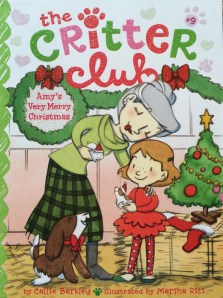
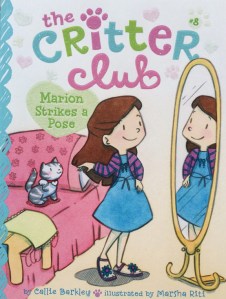
These prizes will be given away at the conclusion of PiBoIdMo. You are eligible for these prizes if:
- You have registered for PiBoIdMo.
- You have commented ONCE ONLY on today’s post.
- You have completed the PiBoIdMo challenge. (You will have to sign the PiBoIdMo Pledge at the end of the event.)
Good luck, everyone!
by Henry Herz
Everything I know about writing picture books, I learned from animals.
Animals make great picture book characters. Just ask the Very Hungry Caterpillar. And animals offer authors and illustrators nine B’s of inspiration for creating PBs:
Be a sponge.
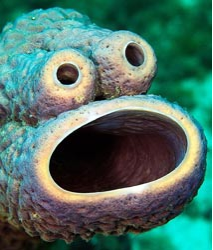
Soak up everything around you. View, listen, sniff, taste, and feel. Watch people (in public, not with a telescope from your house), read books (especially picture books), and watch TV and movies. Take notes. Even the most mundane situations can unexpectedly feed your muse.
Be a sharktopus.

OK, that’s not a real animal, but I’m making a point here, people. Combine elements into unlikely (and therefore hilarious) pairs, as in Doreen Cronin’s Click Clack Moo: Cows That Type. Practice riffing on the things you soak up. I did a classroom reading where this boy had a torn-up sneaker. I thought, picture book title: The Boy With Exploding Sneakers. Let your creativity run free.
Be a honey badger.

Have no fear. Don’t be scared to put words to paper. Don’t flee from constructive criticism. Don’t be afraid of rejection. They all line the path to traditional publication. Honey badger don’t care, and neither should you! Get outside your comfort zone.
Be a dung beetle.
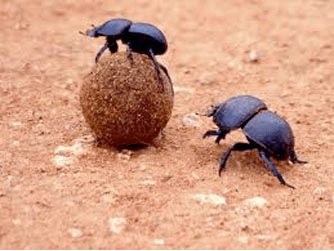
Be tenacious, even on crappy days. Becoming published isn’t easy. But it won’t happen if you stop trying. The journey of a thousand miles begins with a one step. Revise, revise, revise. But remember that perfect can be the enemy of good enough. At some point, you need to submit!
Be an armadillo.
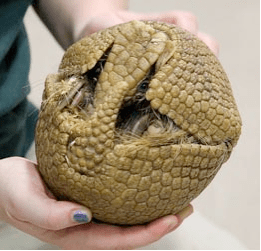
You need to be thick-skinned and learn to roll with the punches. Understand that a publisher’s or agent’s rejection isn’t personal, but it is highly subjective. Many great works of literature were rejected repeatedly before being published, so you’re in good company.
Be an ant.

No man is an island, and no ant is a bridge. Teamwork is your best friend. Take advantage of critique groups to hone your craft. Join the Society of Children’s Book Writers and Illustrators (SCBWI) to develop a support network. Leverage social media to connect with fellow writers. You’re not alone.
Be a hagfish.
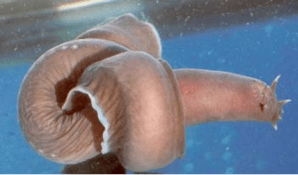
Be flexible enough to incorporate helpful feedback. But feel free to ignore feedback that doesn’t resonate with your gut. Follow the rules, but recognize that they can be broken when the result is a success. Drew Daywalt’s The Day the Crayons Quit is a picture book with over 1,000 words and inanimate characters. But it’s also a New York Times bestseller.
Be a peacock spider.
Male peacock spiders don’t just have stunning colors. They have a delightfully entertaining mating dance (think MC Hammer’s “Can’t Touch This”). They show the ladies some enthusiasm! They wear their passion on their, er, sleeves. Writing is also an act of passion. Write about what you love. Have fun writing. Write the story that is inside you, trying to get out. But hopefully not like a chestburster from Alien, or Ian Ziering in the final scene of Sharknado.
Be a cat.
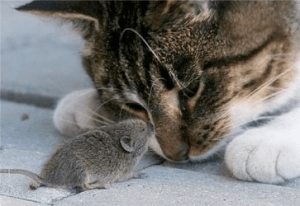
Cats are lucky. They always land on their feet, and have nine lives.
There’s an expression, “luck favors the prepared.” Working at the other eight B’s is the best way to earn some luck. Good luck to you!
 Henry Herz has masters degrees in engineering and political science, neither of which help him write children’s books. He enjoys moderating sci-fi/fantasy literature panels at conventions, eating Boston Creme Pie, and writing children’s books with his sons Josh and Harrison. Their indie-published Nimpentoad was featured in Young Entrepreneur, Wired GeekDad, and CNN. Their picture book, Monster Goose Nursery Rhymes, will be published by Pelican in January 2015. Henry edited the YA dark fantasy anthology, Beyond the Pale, with stories from Peter S. Beagle, Heather Brewer, Jim Butcher, Rachel Caine, Kami Garcia, Nancy Holder, Jane Yolen and others. He interviews KidLit authors and illustrators at www.henryherz.com.
Henry is offering two picture book critiques to two PiBoIdMo winners!
These prizes will be given away at the conclusion of PiBoIdMo. You are eligible for these prizes if:
- You have registered for PiBoIdMo.
- You have commented ONCE ONLY on today’s post.
- You have completed the PiBoIdMo challenge. (You will have to sign the PiBoIdMo Pledge at the end of the event.)
Good luck, everyone!
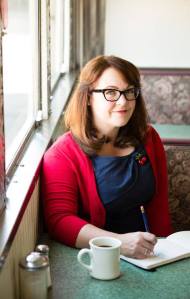 by Kelly Light
“I want to be The Hardest Working WO-Man in Show Business”
But I’m tired. Are you?
It’s been an insane few months in my life. My book, Louise Loves Art, came out September 9th! Then I went on a 27-day book tour.
When I sit down to work and I have A LOT of work…sometimes, I got ‘nuthin.
Sometimes we feel like we just can’t go on.
We can’t do no more.
But you can. You can get back up. Like James.
You can find it in yourself. You have come this far.
You can still dance and spin.
You’ve got more ideas inside of you, dig. Dig deep.
Throw off that cape! Pull yourself up.
Let’s channel a little James this year.
Watch this:
James Brown.
The hardest working Man in show business.
Even he just has to fall on his knees and ask… Please.!?!?
Please, please, please, please.
Let’s grab the mic, Wacom pen, pencil or hairbrush … and sing with……PAIN.
(back up singers in parenthesis) (PiBoIdMo peeps – that’s you)
Spoken like James:
This year I gotta dig a little deeper.
Ya see ‘cause I am tired.
I’ve been working so hard.
(So hard. )
So hard.
(So hard.)
Start singing:
30 ideas in 30 days.
(Who came up with this idea?)
11 more to go, you’re in a daze
(I need a shot of tequila)
Pencil in hand, butt in chair.
(I gotta find a new idea)
Ideas, I can’t find you anywhere
(need to get my head in gear)
Yeah, oh yeah, ideas, I need you so..
(Please, please ideas don’t go)
Please, please, please, please….
(Please, please don’t go)
Please, please, please….
(Please, please ideas don’t go)
Can you hep me?
Somebody hep me!
Please, please, please, please….
(Please, please don’t go)
Please, please, please….
(Please, please ideas don’t go)
Imagination is all gone
(all dried up, ideas are gone)
Why did you leave and do me wrong?
(you are fried, you can’t hold on)
Please, please, please, please….
(Please, please don’t go)
Please, please, please….
(Please, please ideas don’t go)
I wrote so many ideas down
(So you wrote some good ideas)
I used some adjectives and some nouns
(these sound like bad ideas)
Doesn’t matter, I got 30 ideas out
(ideas on the page it’s a start)
Makes me wanna scream and shout!
(Keep on going, you’ve got heart!)
I’ll come back to these ideas one day
(Don’t leave them up on a shelf)
Soon You’ll see me signing at BEA!
(don’t get ahead of yourself, do 12 X 12)
Please, please, please, please….
(Please, please don’t go)
Please, please, please….
(Please, please ideas don’t go)
Danny! I can’t do no more…
WAIT! C’mon….
Now JUMP BACK! You’re super bad! You gotta kiss yourself!
Listen to this:
Kelly Light is working hard out on the road with LOUISE LOVES ART while working on the second Louise book and the first Louise reader. Look for those next year from Balzer and Bray. Also out next year is JUST ADD GLITTER by Angela DiTerlizzi from Beach Lane Books. She’s got soul. She’s tired and she’s super bad.
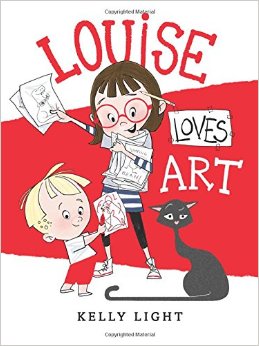
You can win a signed LOUISE LOVES ART book and a “Holiday Louise” print by Kelly!
These prizes will be given away at the conclusion of PiBoIdMo. You are eligible for these prizes if:
- You have registered for PiBoIdMo.
- You have commented ONCE ONLY on today’s post.
- You have completed the PiBoIdMo challenge. (You will have to sign the PiBoIdMo Pledge at the end of the event.)
Good luck, everyone!
 by Dev Petty
I know, I know…You’ve probably read or been told you should write every day. Twenty minutes? Thirty minutes? Some number of minutes that gets you off your behind and typing away.
But I’m here to suggest a different approach, something especially useful for picture book writers.
STOP Writing.

Yes, you heard it here first. Stop. At least for a while.
Work with me here…
When I was first writing picture books and I found a story idea, I’d race home and get to writing it. Words streamed off my finger tips into my story, clickety-clack, clickety-clack and BOOM! I’d be done and I’d congratulate myself for finishing. Then I’d edit and revise and tinker and make little changes. I wrote a lot of stories this way, but they were often a bit one note. They were linear, a super straight shot at my story idea. Moving so fast from an idea to writing, I got mired in language and word choices, small stuff, instead of thinking about the idea itself. It’s one of those forest for the trees kinda things.
Somewhere along the way, I put the brakes on that process. What did I do? I started thinking.
Here’s what I’ve found. When I take some time, in some cases LOTS of time, to think about my idea and how to get that idea onto the page, I come up with a richer, more original story. I lie on my deck, I think in the shower, I think on a walk, I think on a rock, I think as I’m going to and coming out of sleep. Sometimes, if it’s a really juicy idea, I think for MONTHS about how that idea could turn into a story. Fair warning, thinking is hard. Our brains are filled with lunch making and appointments and things to do- it takes time to learn to think.

So, while I’m lying on the deck “writing” (Imagine my husband making an air quote gesture here), what am I thinking about? Well, I think about structure and about voice. I try my story in my head in different ways: Traditional, present tense, past tense, third person, sparse, only in dialogue, repetitive, wordless. When I’ve done this long enough something really strange happens. I start to hear it, I start to hear my story. Then, and only then, do I write down the words.
I also try to think about my story from many angles, to turn it around in my head. Can my idea be expressed as a metaphor or in a way that’s deeper? Is a story about a kid with head lice more interesting if it’s about a monkey with fleas? These are the deep questions I ask…”Monkey or no monkey?” Monkeys aside, a wonderful bi-product of thinking instead of writing is that you find new ideas. Ideas breed ideas, so it’s like you’re making tiny little baby stories while you’re bringing the first one into the world.
Finally, before I ever write a word, I force myself to ask myself this most basic question. WHAT IS THIS STORY ABOUT? (Hint: the answer does not have your main character’s name in it) If I can’t answer that, I’m not ready to write the story. Period.
When I finally do write words, it goes pretty fast and requires less tinkering, it comes out of the oven a little more baked. Still, in those first few moments of writing the story I’ve formed in my head, I will try the opening in a bunch of different ways to see what sticks. That opening forms the framework for the whole book and I’m always prepared to write the opening, read it back, throw it away and try again if it isn’t right before continuing.
It’s a good bet this method isn’t for everyone, but for me it has fundamentally changed my experience of writing picture books. My stories are now more ME. They have MY voice. They come out as I imagined. Also, I get to spend a lot of time in the sun just thinking. About monkeys.
Dev Petty’s debut picture book, I Don’t Want to be a Frog (Random House/Doubleday) will be released on February 24th. Told in hilarious dialogue, this book is about a frog who wants to be anything but a slimy, wet frog. Before writing children’s books, Dev worked as a senior visual effects artist in film on The Matrix films and dozens of others. She lives in Albany with her husband, two daughters and critters. Connect with her at www.devpetty.com.
Dev is giving away a picture book critique!
This prize will be given away at the conclusion of PiBoIdMo. You are eligible for this prize if:
- You have registered for PiBoIdMo.
- You have commented ONCE ONLY on today’s post.
- You have completed the PiBoIdMo challenge. (You will have to sign the PiBoIdMo Pledge at the end of the event.)
Good luck, everyone!
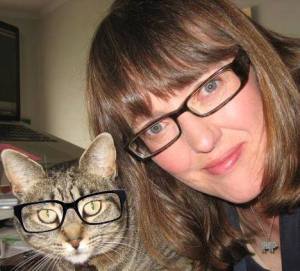 by
by Congratulations, PiBoIdMo-ers! You’re more than halfway home! (56.6666% home, but who’s counting?)
At this point in the game, you may be a little stuck. Believe me, I know the feeling. When I’m devoid of ideas, sometimes remembering the origins of an existing manuscript yields clues about how I might forge ahead.
So, in hopes that it might help you, let me share the genesis of Here Comes the Easter Cat, illustrated by Claudia Rueda. The book resulted from three things that happened in June of 2011:
1) I was floundering around looking for inspiration, so I wrote to a friend, the founder of an animal museum. I asked if there was a kids’ book she saw a need for, something that might be helpful to her in her work. She mentioned that a woman she knew had trouble finding suitable Easter books for her vegan book review site. I didn’t find the idea of writing an Easter book particularly compelling, so I thanked her and promptly forgot about her suggestion. (Or so I thought!)
2) A few weeks later, I had a weirdly illustrator-centric week. I had coffee with one visiting illustrator, coffee another day with two others, and lunch with a local illustrator friend.
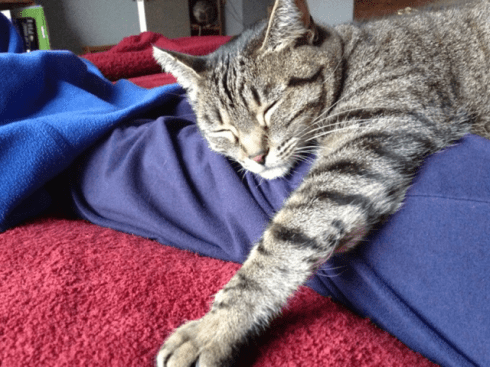
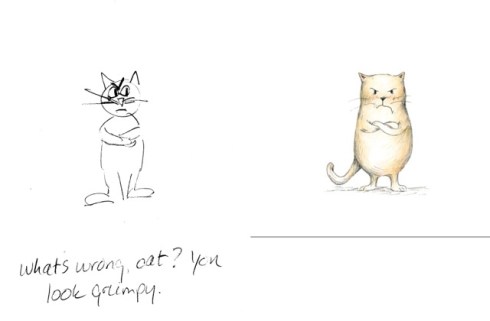
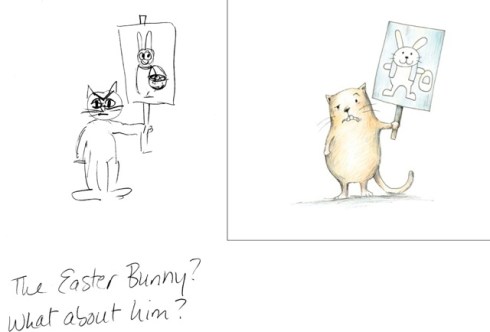
3) Several days after that, I was sitting on my bed, still trying to come up with a viable idea. My cat Bella was sprawled in front of me, so I idly doodled a cat. The cat looked grumpy. I asked why, and, to my surprise, the cat held up a sign with the Easter Bunny on it. Intrigued, I continued to ask the cat questions, and Here Comes the Easter Cat took shape.

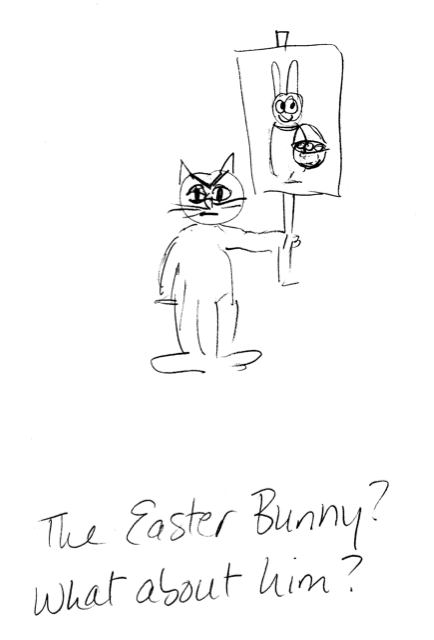

Why did I decide to draw? I’m not sure, but I’ll bet it was because I’d just talked with all those illustrators.
And why did the Easter Bunny show up on Cat’s sign? Undoubtedly because my friend had mentioned that Easter book a few weeks earlier.
So the book idea came about because:
- I actively sought input from someone outside my usual circle.
- I took off my pajamas—horrors!—and got out into the world, and in doing so, learned more about how illustrators work.
- I gave myself the space to think (sitting on my bed, trying to be receptive) and to play (doodling).
So I was active, and I was passive. I soaked up information from others, and I experimented with something outside my area of expertise. If any of those elements hadn’t been present, I suspect there would be no Cat.
Here are my original sketches alongside Claudia Rueda’s terrific finished art:
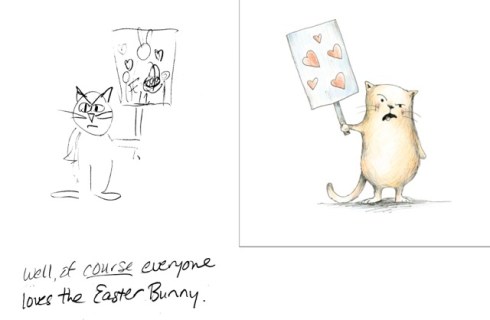
In particular, the drawing component was critical. So I encourage you to play around with doodling or sketching, even if you think you’re not an artist. Here Comes Easter Cat came out earlier this year, Here Comes Santa Cat was just released, and two more Cat books are in the queue. I’m very, very glad I did that first Cat sketch.
One more thing: when I began Easter Cat, I was not thinking of the market. I was definitely not saying, “What the world really needs is an 80-page picture book!” or “I’ll bet my editor is dying to see a stack of sketches by someone who can’t draw!”
Rather, I was having a conversation with Cat for the best of reasons: it amused me. It made me laugh. And what I loved turned out to be what my agent and my editor loved, too.
I am embarrassed to say that I need to remind myself of this over and over. It’s so easy to get caught up in questions like “What do editors want?” and “What can I sell?”
When really, the critical question is, “What do I love?”
So write with your heart. And draw! And if one of your sketches starts talking to you? You should probably pay attention. Best of luck!
Deborah Underwood grew up in Walla Walla, Washington. When she was little, she wanted to be an astronomer. Then she wanted to be a singer. Then she wanted to be a writer. Today her jobs are writing and singing. Two out of three’s not bad! (Okay, she also wanted to work in a piano factory and paste the labels on new pianos, but let’s just ignore that one.)
She’s the author of THE QUIET BOOK, THE LOUD BOOK, PART-TIME PRINCESS, the SUGAR PLUM BALLERINAS series (with Whoopi Goldberg), and, of course THE CAT books, among others.
When she’s not writing, you might find her singing in a chamber choir, playing a ukulele (very badly), walking around in Golden Gate Park, baking vegan cookies, or petting any dogs, cats, pigs, or turkeys that happen to be nearby.
You can connect with her at DeborahUnderwoodBooks.com or on Twitter @underwoodwriter.
Deborah is giving away one copy of EASTER CAT and one copy of SANTA CAT!


These prizes will be given away at the conclusion of PiBoIdMo. You are eligible for these prizes if:
- You have registered for PiBoIdMo.
- You have commented ONCE ONLY on today’s post.
- You have completed the PiBoIdMo challenge. (You will have to sign the PiBoIdMo Pledge at the end of the event.)
Good luck, everyone!
 by
by Okay, so last year I did PiBoIdMo. At the same time, I was also trying to get 1,000 words a day finished on a middle grade novel. If you do the math, you can see that I’d have had 30,000 words on a novel and 30 ideas finished by the end of the month, were I to have been successful.
That would have been an AMAZING amount of writing.
But I was not successful. Not completely, anyway.
I logged about half of that amount of words on my novel—but that is still 15,000 more words than I would have had otherwise. So I felt pretty good about that.
But my picture book ideas. Ugh. I ended the month with 22 of them. Most were pretty crummy. I mean, I was trying to do the best that I could, but man, some of my ideas were really dumb/hideous/terrible/lame. What? You want an example? Okay, I’ll cut and paste some entries from my PiBoIdMo Journal, 2013:
November 3: (Came up with this one in my sleep) Baby Kangaroo Won’t Get Out of the Pouch I kind of see lots and lots of animals getting invited over to Joey’s pouch, but he is too scared to come out. Not sure what is going to get him to come out.

Really? I read that idea now and all I can think is POOR MAMA KANGAROO!! And also yuck. I think yuck.
Hungry for another?
November 13: Dream Dinos (Little dinos that live in your head and help you sleep….hahaha)
This whole idea just gives me the heebie-jeebies. And nightmares. Ick.
The list continues on in a similarly awful manner. 18 completely un-writable ideas.
Notice I said 18, not 22. That is because 4 of the ideas I recorded last November were pretty darn good. Actually, they were incredible. I am working on two of them right now, and will tackle the other two a time permits. (I wish I could tell you about them, but I can’t talk about picture book ideas when they are in progress. Ruins the magic of it.)
The truth of it is that I never would have come up with the 4 ideas that I really like if I hadn’t been willing to take a chance and just try and come up with one idea each day. (And each day, I did feel pretty satisfied with what my muse had given me. It was only upon later reading that I thought BLECH. But that is okay. From mounds of fertilizer sprout beautiful blossoms, right?)
So make your PiBoIdMo list. Let it sleep (or ferment, as the case may be) for a month, then see which ideas still smell sweet.
Shelley Moore Thomas is the author of the nine picture books (including the much heralded GOOD KNIGHT series) and one middle grade novel, THE SEVEN TALES OF TRINKET. Her upcoming tenth picture book, NO, NO, KITTEN! (Boyds Mills Press) hits shelves on March 3, 2015. In addition to being a writer, Shelley is also an elementary school teacher. So, no, she doesn’t really ever get to sleep.
www.ShelleyMooreThomas.blogspot.com
blog: www.storyqueenscastle.blogspot.com
twitter: @story_queen
Shelley is giving away a pre-order of her upcoming picture book with Lori Nichols, NO, NO, KITTEN!

This prize will be given away at the conclusion of PiBoIdMo. You are eligible for this prize if:
- You have registered for PiBoIdMo.
- You have commented ONCE ONLY on today’s post.
- You have completed the PiBoIdMo challenge. (You will have to sign the PiBoIdMo Pledge at the end of the event.)
Good luck, everyone!





 Writing for Kids (While Raising Them)