You are currently browsing the category archive for the ‘Picture Books’ category.
We have been showered with gorgeous picture book covers lately and the latest one is truly a gift! It’s RIVKA’S PRESENTS, written by Laurie Wallmark and illustrated by Adelina Lirius.
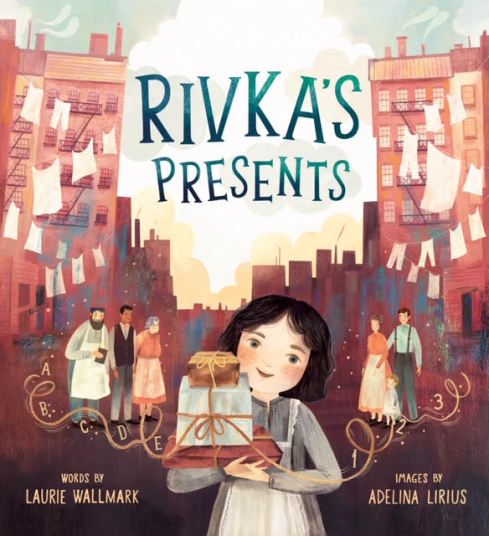
It’s 1918 on the Lower East Side of New York City, and Rivka is excited to start school. But when her father gets sick with the flu, her mama has to go to work at the shirtwaist factory and Rivka needs to stay home and take care of her little sister. But Rivka figures out a way to learn anyway: she trades chores with the grocer, the tailor, and an elderly neighbor for lessons. As the seasons change, Rivka finds she can count pennies for the iceman and read the labels on jars of preserve. And one day, papa is no longer sick, and Rivka can finally start school! Full kindness and love for your neighbors, here is a story that introduces life on the Lower East side for a Jewish family during the flu pandemic of 1918.
RIVKA’S PRESENTS releases July 11, 2023 from Random House Studio.
 Award-winning author Laurie Wallmark writes picture book biographies of women in STEM (science, technology, engineering, and math) as well as fiction. Her books have earned multiple starred trade reviews, been chosen as Junior Library Guild Selections, and received awards such as Outstanding Science Trade Book, Best STEM Book, Crystal Kite Award, Cook Prize Honor, and Parents’ Choice Gold Medal. Her titles include ADA BYRON LOVELACE AND THE THINKING MACHINE, GRACE HOPPER: QUEEN OF COMPUTER CODE, HEDY LAMARR’S DOUBLE LIFE, NUMBERS IN MOTION, and CODE BREAKER, SPY HUNTER. Laurie has an MFA in Writing from VCFA and frequently presents at schools as well as national professional conferences (NSTA, NCTE, ALA, TLA, etc.). She is a former software engineer and computer science professor. You can find Laurie at lauriewallmark.com and Twitter @lauriewallmark.
by Chana Stiefel
Back in February 2020, I was sick in bed with a bad cough. In retrospect, the timing was right for a mysterious early case of Covid, but we’ll never know. In the meantime, I received an email from my awesome agent, Miranda Paul at Erin Murphy Literary, asking if I had a manuscript about an avocado.
In my feverish state, I grabbed a notebook and started brainstorming avocado puns: Holy guacamole. Guac and roll. Avocado had a pit in her stomach.
That last one got me thinking: Was Avocado anxious? And if so, why?
I wrote several drafts about an avocado who wants to make friends with other fruits and veggies. But they all seem to have plans. No wonder Avocado had a pit in her stomach! Garlic, who never minces words, suggests that Avocado is bland. Avocado sheds lots of tears (well, Onion is nearby). But then Avocado pulls herself together and decides to meet up with other bland friends.
“Wanna play?” she asks.
“Sounds nice!” says Rice.
“Yes, please!” say Black-eyed Peas.
“Let’s go!” says Potato.
When the veggies who rejected her want to join the fun, Avocado says, “We might seem bland, but…WE CAN BLEND!”
To top off this work of genius, I included a recipe for guacamole in the backmatter.
THE END?
Nope.
Editor Tamar Mays at HarperCollins liked my writing, but the story? Not so much. Would kids connect to the bland/blend theme? And the marketing team was dead set against eating the protagonist at the end. (I sometimes like to go dark.) Luckily, Tamar was willing to give me another shot!
By then spring had sprung. I brainstormed new settings and situations for my little green character. I thought about my favorite trips to the Farmers’ Market with my critique partner Donna Cangelosi And voila! BRAVO, AVOCADO was born.
This new story is about an avocado at the Farmers’ Market who wants to be Today’s Special. Strolling through the aisles, Avocado asks her veggie friends what makes her stand out. Tomato offers to teach her salsa. Pumpkin proposes funny faces. Garlic suggests she add some zing! Nothing seems to work until—Ding ding!—the bright and shiny Toaster inspires Avocado to “reflect” more deeply. Avocado discovers that she was special all along.
Many of the funny puns remain from the earlier version, but only the ones that serve the story. And the social-emotional themes of developing self-awareness, discovering what’s inside us that makes us special, and uplifting our friends struck a chord. Tamar loved it! And illustrator Anna Sussbauer’s eye-popping colors and vibrant textures bring the story to life. Best of all, no fruits or veggies were harmed in the making of this book.
Presenting the cover of BRAVO, AVOCADO, illustrated by Anna Sussbauer! Coming March 28, 2023 from HarperCollins!
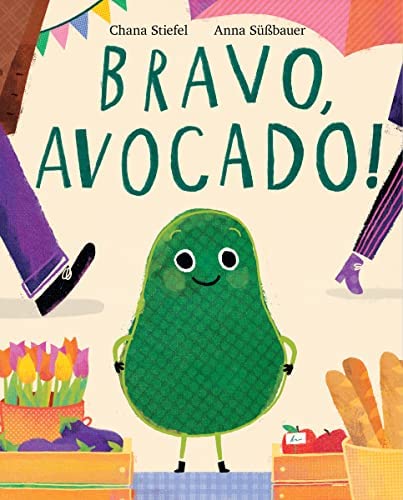
Hungry for a copy? You can win one upon release. Just leave a comment below (avocado recipes welcomed).
A random winner (US only) will be selected when the book becomes available.
Good luck!
 Chana Stiefel is the award-winning author of more than 30 punny and poignant books for children. Her nonfiction books include THE TOWER OF LIFE, the true story of Holocaust survivor and historian Yaffa Eliach (a Junior Libary Guild Gold Medal Selection, Scholastic); LET LIBERTY RISE: How America’s Schoolchildren Helped Save the Statue of Liberty (a Bank Street Best Book of the Year, Scholastic, 2021), and ANIMAL ZOMBIES & OTHER REAL-LIFE MONSTERS (a Top 10 YALSA Quick Pick, NatGeoKids). Chana’s funny fictional picture books include MENDEL’S HANUKKAH MESS UP (Kalaniot), MY NAME IS WAKAWAKALOCH (HMH), and DADDY DEPOT (Feiwel & Friends). Follow her @chanastiefel on FB, Twitter, and Instagram. To hear Chana pronounce her name, click here.
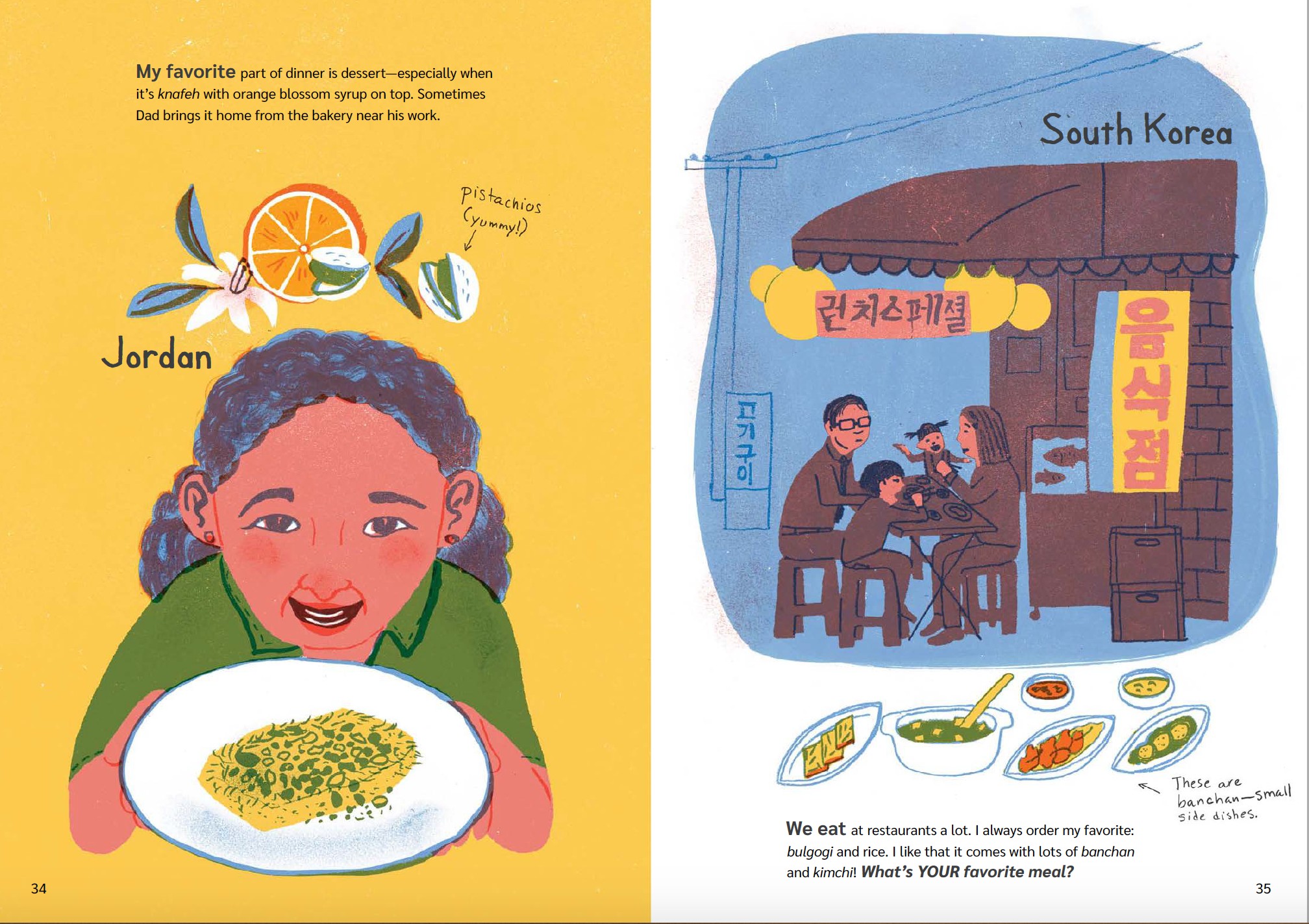
One of my favorite things to do is watch food shows, especially those that travel the world in search of good eats. Have you ever noticed that every country has its own special bread? And a signature dessert? Or a hand-held goodie, wrapped up and portable? Yes? Well, this is the concept behind Susan Hughes’ delightful SAME HERE! THE DIFFERENCES WE SHARE, illustrated by Sophie Casson.
We may be different, but we share the same values. We all need to feel loved, we all need to learn, and we all need to dream. Susan uses these categories to travel the world in search of the specific things that are special to one culture, but are really things we have in common.

Susan, this is a gorgeous book. Where did you get the idea for SAME HERE!?
I first began this project 15 or more years ago (yes, soooo long ago!), so my memory of how it all began is actually a bit vague!
But I do remember researching online for another children’s book project I was working on—and coming across a fascinating brief mention of a specific type of fried dough treat loved by kids in a specific country. (I can’t remember which one!) I hadn’t heard of the food before but it definitely made me think of a doughnut.
On a whim, I began hunting around to find other mentions of “doughnut-like” treats eaten by kids in other countries. There were many! I loved the idea that kids in disparate countries all around the world all shared a love for a similar treat.
I filed the idea away and over time kept coming back to the powerful notion that, although kids around the world are significantly different in various ways, experiencing different geographies, educational opportunities and teachings, economic situations, and so on, there are fundamental things they share, including the need for love, safety, food, and so on. They might share the same basic needs which might be expressed in different ways and yet still share an enjoyment of these fried batter treats!
I decided to try to somehow find a way to write a book to share this idea with young kids!
Did you initially have the idea to separate the book into sections? Or did that come about as you collected various items?
I always knew the book would be split into sections simply because I knew I had a big topic to cover and it would be easier for young readers if it were in “bite-size” chapters.
But initially, I wasn’t sure what would be in each section! It wasn’t until after the book was contracted that, with the editor’s help, we arrived at the idea to divide the book into sections representing the different “needs.”
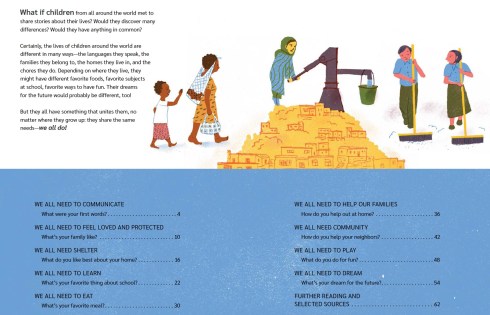
Do you have a favorite section?
Ah, that’s a tough question! Must I choose?
If so, I’d say my favorite section is the last one: We all need to dream. The other sections describe more straightforward needs: the need to communicate, the need to feel loved and protected, the need to learn, to help our families, to play, and so on. But this one—the need to dream—seems such a beautiful concept and so perfect with which to end this book.

Thank you for sharing SAME HERE! with us, Susan.
Blog readers, Susan is also sharing a picture book critique or Zoom session with a blog reader. Just leave one comment below about your favorite food specific to your heritage. (And I may ask you for the recipe!)
A random winner will be selected next month. Good luck!
SAME HERE! THE DIFFERENCES WE SHARE is available now from Owlkids.
 Susan Hughes is an award-winning writer of many books for children, both fiction and non-fiction, including HOORAY FOR TRUCKS!, WALKING FOR WATER: How One Boy Stood Up for Gender Equality, and Off to Class. Also a freelance writer, editor, and story coach, Susan lives in Toronto, Canada. Find out more about her at www.susanhughes.ca.
by Jessica Whipple
Wow, it’s such a *gift* to be doing a cover reveal here on Tara Lazar’s blog. Thank you, Tara, and thanks for asking me to share a bit about how my debut picture book ENOUGH IS… came to be.
This was the first picture book idea I had, which came to me verbatim as a line of text, before I had ever considered writing picture books. It later became the last line of the book. (I won’t spoil it here, but you’ll remember if you *hopefully* read it.)
I wanted to find a way to help kids sense that fuzzy boundary between a little and a lot, between wants and needs… to discover Enough. As a parent I was struggling to explain this concept to my kiddos, then ages nearly 5 and nearly 2.
I see a movement to understand the concept of Enough, even in the grown-up world. It’s what’s behind capsule wardrobes and tiny houses, right? It’s why we feel so much freedom when we simplify. And if we all strived not for more but for Enough, think of how things could be different! I wanted to ask kids, “Do you know Enough when you see it?”
I pressed into my initial idea and kept jotting down thoughts. I wondered what Enough could be if it were something in a kiddo’s world. I wondered what it *wouldn’t* be. And I wondered what would happen if I tried to write all of this into a picture book so kids might understand.
That’s how I work, sometimes—I like to try a thing to “see what happens.” So I researched and took in everything I could about the kidlit industry—agents, submissions, critique groups, writing, illustrators, etc. With two daughters and an overflowing library bag, I already had the requisite exposure to picture books.
I kept working on the idea and pushed it to the first draft stage, and on and on from there. To make a long publishing story short, here we are! I’m grateful to Jonathan Eaton at Tilbury House, to Nicole Wong who so beautifully illustrated the book, to my critique partners and readers along the way, and to my agent Emily Keyes.
Of course I’m still learning to understand all of this in my own adult life. I likely will be forever! But perhaps this book can help get kids thinking about it now, before that fuzzy boundary disappears altogether.
And now for the cover…
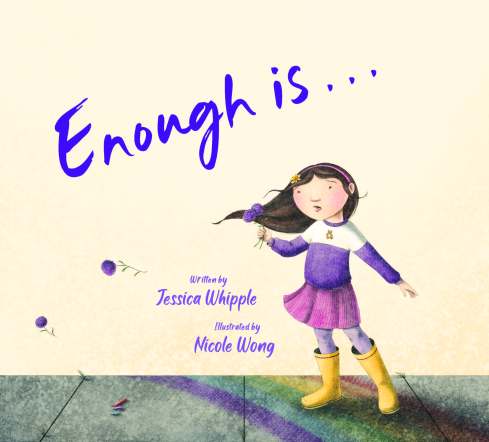
Thanks for sharing your debut cover with us, Jessica!
Jessica is also giving away two prizes—a picture book critique or a 30-minute brain-picking session via Zoom. Two random winners will be selected and they can choose either prize.
Leave one comment below to enter.
Two random winners will be chosen next month.
Good luck!
ENOUGH IS… will be released from Tilbury House on March 7, 2023 and is available for pre-order (and then signed/personalized) from Jessica’s local indie.

Credit: Nick Gould
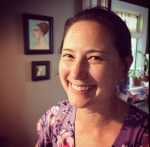
Jessica Whipple has a background in marketing and communications. She has worked as a copywriter and in communications for a Pennsylvania nonprofit. She also writes poetry for adults and children. She and her husband and two daughters recently moved from Pittsburgh to Lancaster, PA. This is Jessica’s first children’s book. To learn more, visit AuthorJessicaWhipple.com or follow her @JessicaWhippl17 on Twitter.
Credit: Dan Medeiros
Nicole Wong was raised by a designer/painter dad and a fashion illustrator mom and never thought of becoming anything except an illustrator. She has illustrated over twenty-five children’s books including THREE LOST SEEDS (Tilbury House, 2019) and I’LL BE THE WATER (Tilbury House, 2020). Her illustrations for KIYOSHI’S WALK (Lee and Low, 2021) earned starred reviews from Kirkus (“captivating”) and SLJ (“wonderful”).
Remember when you were a kid and your parents didn’t have to force you to play outside? You just went, because that was where the fun and friends were waiting! That [fantastic] feeling is captured in Valerie Bolling and Sabrena Khadija’s new picture book:
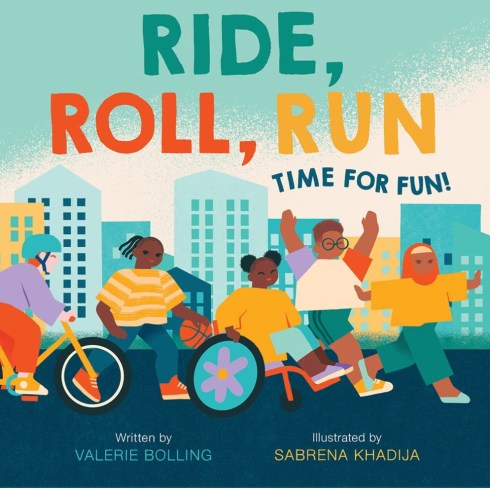
Valerie, everyone who reads this blog loves to hear origination stories. Where did your idea for RIDE, ROLL, RUN: TIME FOR FUN! come from?
The idea for RIDE, ROLL, RUN: TIME FOR FUN! came from a similar place as that of my previous books, LET’S DANCE! and TOGETHER WE RIDE. I notice what children enjoy doing and write about those things. Children love to move, play, and have fun. They enjoy being with other children.
The first version of the story took place on a playground, the next was set at an amusement park; and then—at the suggestion of a friend—I decided to make it about children being able to play right in their neighborhood. They can walk outside—grabbing a ball, jump rope, or chalk—and start to have fun with their friends!
I love that—immediate fun!
Why is it important to show kids in their own neighborhood?
It’s important to show kids in their own neighborhood because that’s where play often happens and where community is built. It can be fun to travel outside of one’s neighborhood, too, but it’s not necessary to have fun. Children can enjoy themselves right outside their home.
Yes! That’s how we did it back in the day…outside until the sun went down!
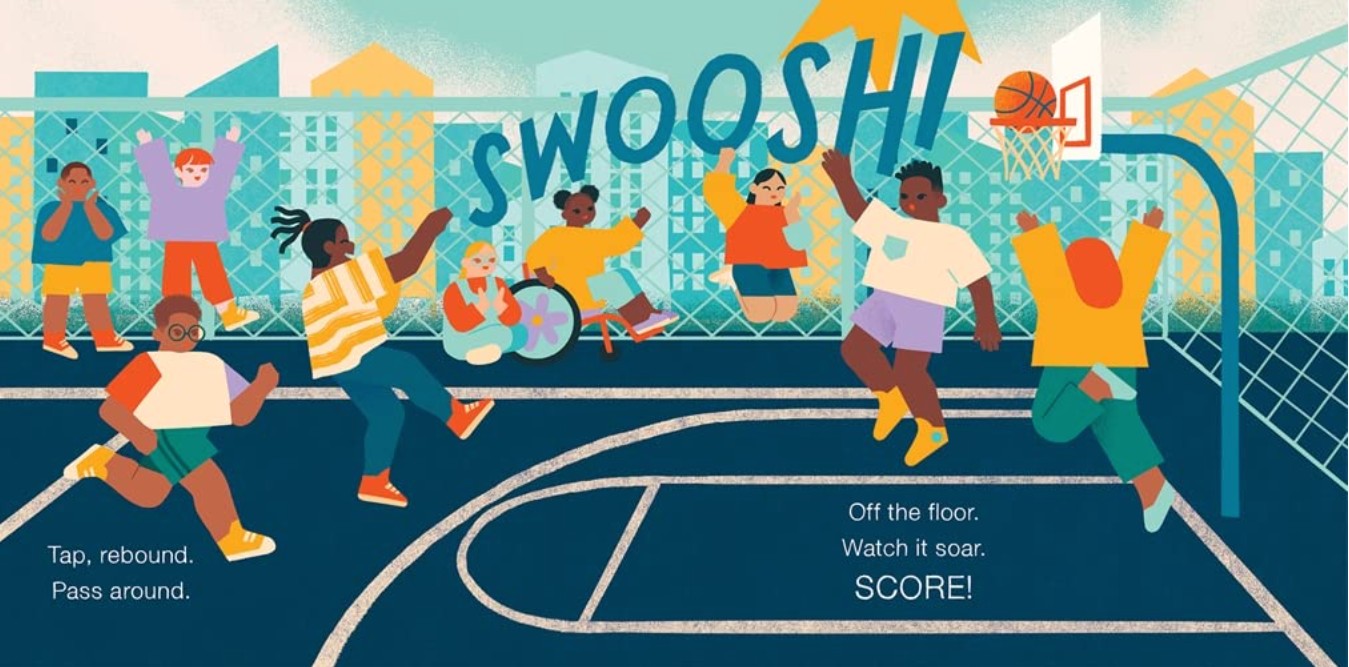
Besides “play-is-where-you-are,” what other messages do you hope to impart with this story?
I would add “play-is-who-you’re-with,” and “play-is-whatever-your-mind-can-imagine.” I want children to understand from an early age that they can play with anyone in their wonderful community. (Be inclusive.) I also want them to know that there are no limits to what they can play. They can make up games and the rules. (Be imaginative.) Exercising our creative minds is as important as exercising our bodies when we play.
You touched on a little of why play is so important to developing minds; care to delve further?
I’m sure a doctor could provide a much more in-depth and research-based response, but I’ll share my thoughts. When children play with others, they have to communicate, collaborate, and cooperate. This requires children to exercise their minds and use negotiation and problem-solving skills. When students use their imaginations to play games, they expand their mind muscles. In addition, physical play develops healthy bodies, which, in turn, leads to healthy minds.
As someone who is disabled, I was interested to see you had a character in a wheelchair on the cover of your book. Is that something you had planned or was that an editorial or illustrator choice?
It was my goal to have the children in this book represent a variety of backgrounds, but I’m not sure I explicitly mentioned creating a character in a wheelchair. I’m so glad that character is in the book though and am not sure if the credit goes to the illustrator or editor. I can tell you that when I submitted the manuscript, I included a note that said, “The illustrator should utilize her/his/their creativity, but my goal for this book is to convey a sense of community with children from diverse backgrounds,” so perhaps that provided the inspiration. In my book, LET’S DANCE!, I made a specific request that there be a child in a wheelchair because I’d been at a wedding where a young man in a wheelchair was “getting down” on the dance floor. Out of my three currently published books, two have characters who are in wheelchairs, and they are just as active and having as much fun as their peers.

What’s next for you, Valerie?
In 2023 readers can look forward to the sequel to RIDE, ROLL, RUN: TIME FOR FUN!, the second book in this “Fun in the City” series, which is about a musical block party, titled BING, BOP, BAM: TIME TO JAM!. In addition, 2023 will welcome TOGETHER WE SWIM (check out 2022’s TOGETHER WE RIDE, if you haven’t done so yet), and my Scholastic Acorn early reader series, RAINBOW DAYS, about a girl and her dog who love to create art. So far, I have one title to share for 2024, I SEE COLOR, which I co-authored with Kailei Pew.
Congratulations, Valerie! Thanks for sharing your newest title with us.
Blog readers, we are giving away a copy of RIDE, ROLL, RUN: TIME FOR FUN!
Leave one comment below about what you loved to play outside as a kid. (Me? Kick the can, frisbee golf and Chinese jumprope.)
A random winner will be selected at the end of the month.
Good luck!
 Valerie Bolling is the author of the 2021 SCBWI Crystal Kite award-winning and CT Book Award finalist LET’S DANCE! Valerie has been an educator for almost 30 years. Immersed in the writing community, Valerie is on the faculty at Westport Writers’ Workshop and a member of SCBWI, the Authors Guild, NCTE, and ILA. She is also a 2020 WNDB Mentee and a 2022 WNDB Mentor as well as a member of Black Creators HeadQuarters, The Brown Bookshelf and Highlights Foundation’s Amplify Black Stories, and 12X12 Picture Book Challenge. In addition, Valerie is a member of three co-marketing groups—Kid Lit in Color, Soaring 20s PBs, and PB Crew 22—and three picture book critique groups. Valerie and her husband live in Connecticut. Get all her links and connect with her here: linktr.ee/ValerieBolling.
Today I bring to you a woman I admire—author Rachelle Burk. Among her many talents, she’s a former EMT, a professional clown, an RUCCL council member, an animal-lover, tea drinker, and all-around fantastic critique partner. Her newest book, WOMEN WHO CHANGED THE WORLD, was just released!
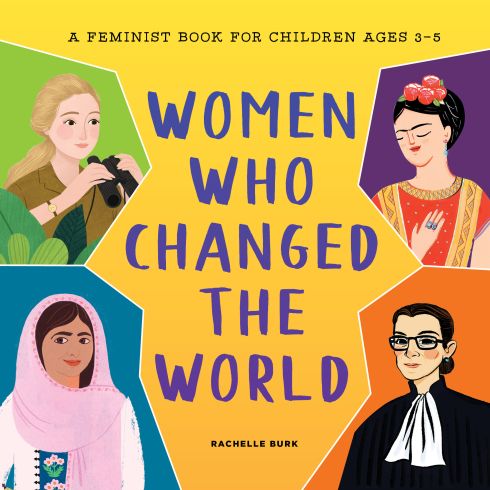
Rachelle, there are so many women who changed the world! How did you narrow down the list of women to be featured?
The educational publisher, Rockridge Press (Callisto Media), provided me with a list of the women to be included in the book. It was important to present a group of women from around the world not only with diverse backgrounds, but also diverse accomplishments. The list of 14 women includes scientists, activists, artists, an Olympic athlete, a mathematician, a politician, and others. Rockridge Press has a chapter book biography series called THE STORY OF, which includes extraordinary men and women past and present. The women in this book were all featured in that series, but selected for what they accomplished specifically for women’s rights.
What sets this book apart from other PB biography collections of great women?
This book focuses on what these women did to further women’s rights and other feminist causes. For instance, people know that Harriet Tubman helped many enslaved people escape. But after the Emancipation, she became active in the fight for a woman’s right to vote! Amelia Earhart was not only the first woman to fly solo across the ocean, she also helped start a flying club just for women to encourage more of them to become pilots in this male-dominated pastime.
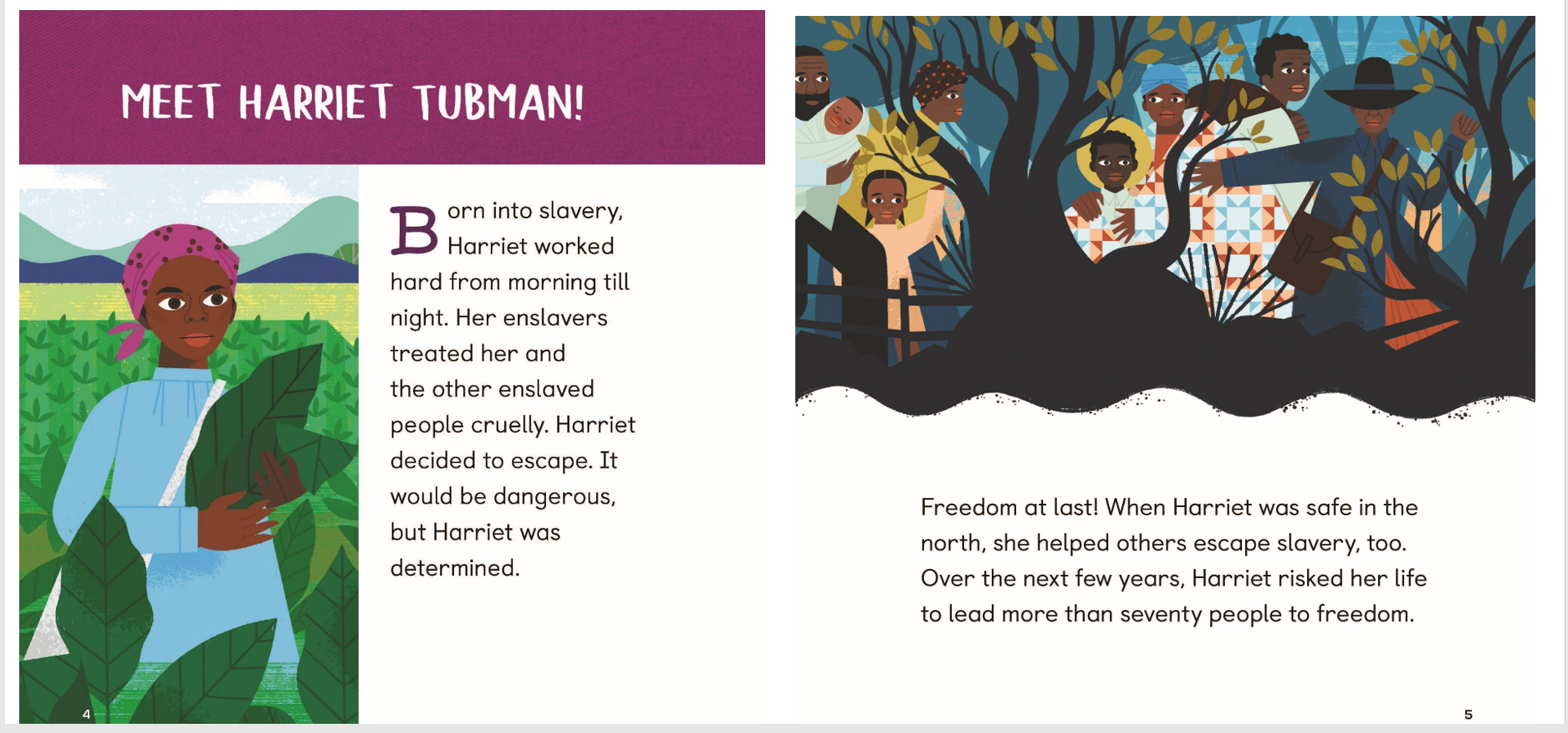
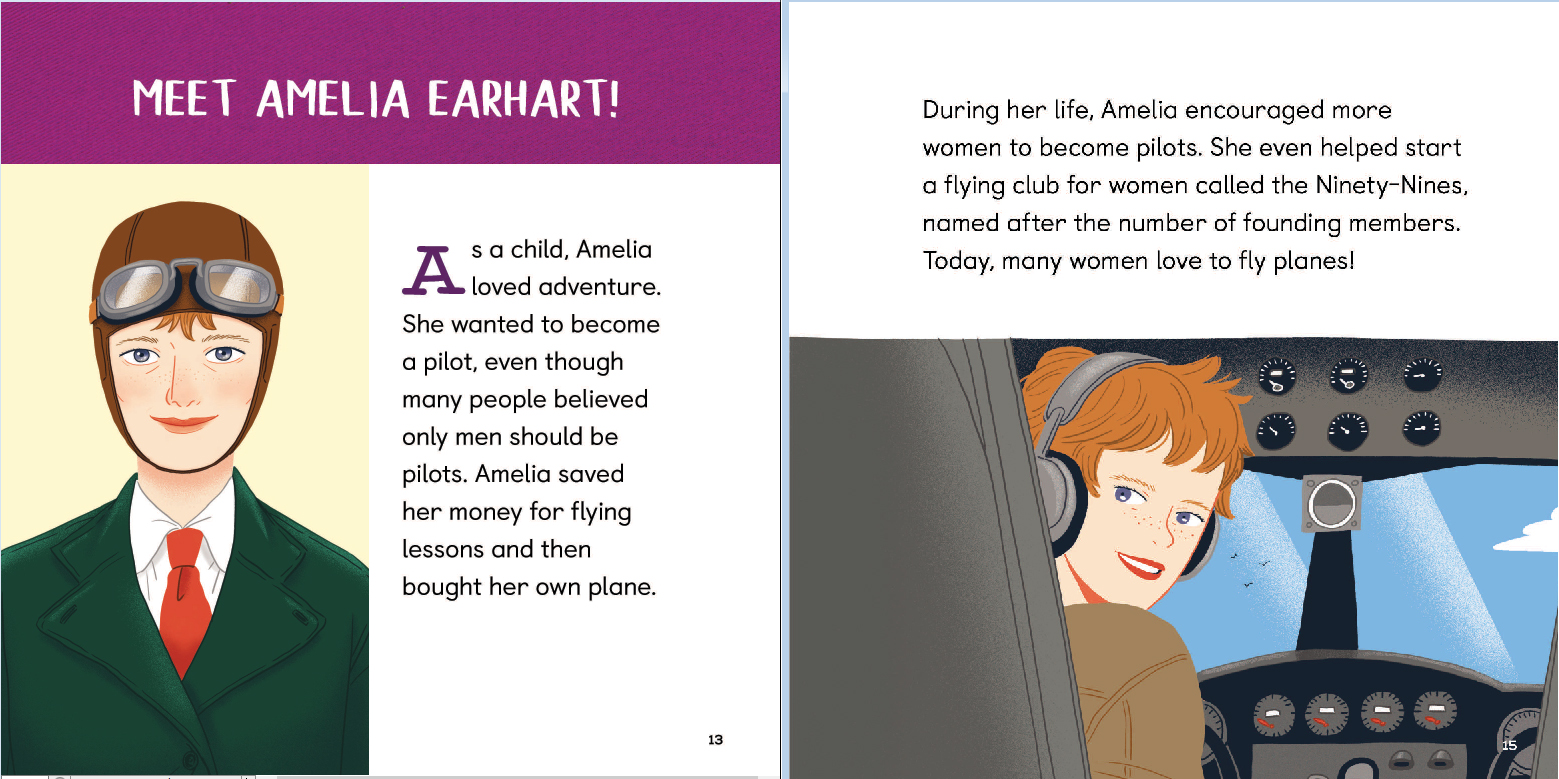
Which incredible woman in the book inspires you the most?
That’s such a tough question. I admire them all. I suppose Malala stands out as someone who so valued education that, even as a child, she was willing to put her life on the line for her right to go to school, and paid the price. It really saddens me when I hear kids say that they hate school, not understanding what a privilege it is. They should all know about Malala.
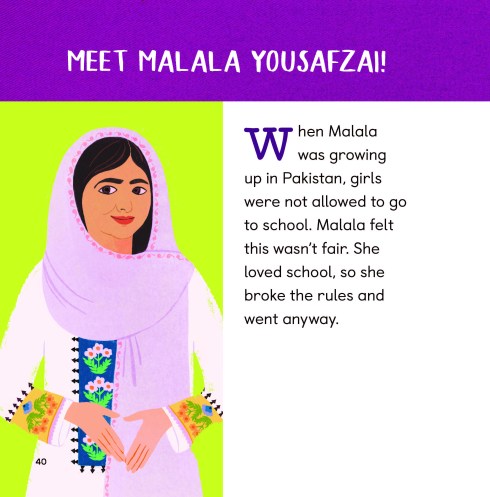
Which incredible woman not in the book inspires you the most?
Even though my mother died when I was 10, she has never stopped inspiring me. She was a nurse, an active member of so many health and charitable organizations, and a volunteer in my elementary school (PTA president and Great Books leader). She loved animals and allowed me to collect a menagerie of pets. Even in the 60s she was advocating for (age appropriate) sex education in school. My mother, who loved to write and had a great sense of humor, was beloved by all.
A touching tribute—what a lovely woman she must have been, Rachelle.
What do you hope young readers will take away after reading WOMEN WHO CHANGED THE WORLD?
Women have always accomplished big things, and this feminist book for little girls and boys is filled with the stories of strong women who used their unique gifts to make the world a better place.
Thank you for sharing your new book with us, Rachelle! WOMEN WHO CHANGED THE WORLD is available now from Rockridge Press!
Blog readers, post a comment telling us about a woman you admire and you’ll be entered to win a copy of WOMEN WHO CHANGED THE WORLD.
A random winner will be selected at the end of the month.
Good luck!
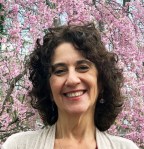 Rachelle Burk writes fiction and nonfiction for ages 2-12, including three other Rockridge Press titles. Her works include picture books, chapter books, and an award-winning science-adventure novel. She visits schools around the country with her dynamic Author Visit programs. New Orleans born and bred, she now lives in New Jersey. When she’s not writing, Rachelle loves adventure travel and scuba diving with her husband and daughters. Visit her at Rachelleburk.com or follow her on Twitter @Rachelleburk.
by Maria Gianferrari
Happy Book Birthday to ICE CYCLE: POEMS ABOUT THE LIFE OF ICE, with gorgeously rendered illustrations by illustrator, animator and designer, Jieting Chen!

 Did you know that our own Tara Lazar used to be a competitive ice skater? You can read about how her skating journey helped with her publishing journey here.
Or perhaps you’ve read her funny, punny fractured fairy tale, LITTLE RED GLIDING HOOD?
Let’s celebrate all kinds of ice! Here’s a glimpse of the visual and aural poetry that is ice!
Check out this gorgeous frost photo taken by Associate Publisher at Lerner Books, Carol Hinz.

Look at these “frost drops.”

Carol’s photo inspired this book. I was intrigued by these intricate and lacy patterns that looked like feathery ferns, and began researching ice and discovered so many cool things that I wanted to share with readers and our book was born.
You know icicles. Look at these beauties that formed on our roof last winter.
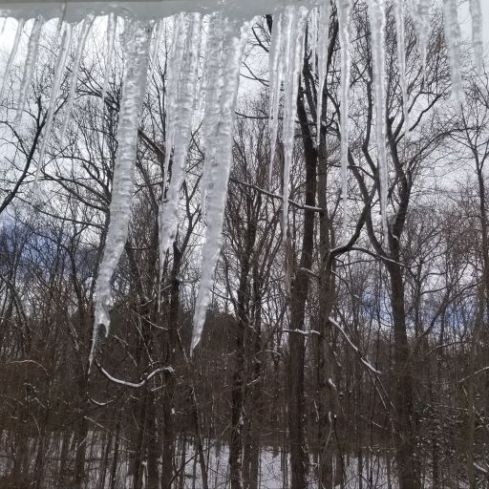
But have you heard of brinicles? I hadn’t, until I began researching this book. Brinicles form when freezing seawater releases its salt, forming brine. Brine is heavier than the surrounding sea water, so it sinks, and as it sinks, water around it freezes and forms a sinking brinicle spear. When the brinicle makes contact with the sea floor, it freezes everything in its path. You can watch a brinicle forming here.
Ice also has some evocative and whimsical names.
Pancake ice, anyone?

Credit: Kenneth Manoff
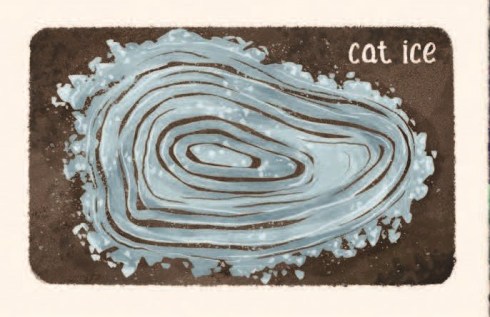
And Jieting’s rendering:

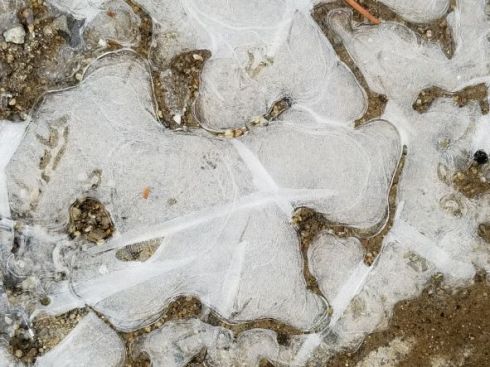
Or perhaps cat ice, so named for its delicate swirls and the idea that a light footed cat might be able to walk across it?
Perhaps Phoebe is as paw-dept as her mom on the ice?

Check out these fine filaments of hair ice!

Credit: Christian Mätzler
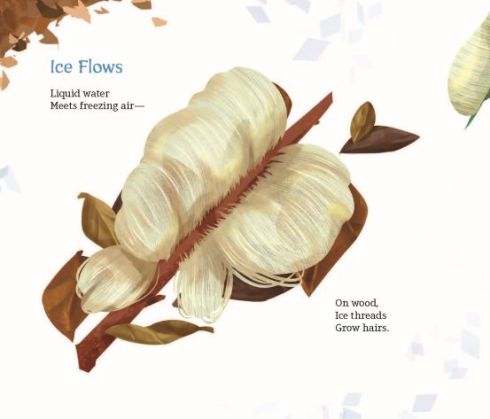
You can watch a time lapse photo of hair ice growing here.
Ice talks too!
It mumbles, grumbles and growls; squeaks and creaks.
Listen to some sea ice sounds here.
Who knew that frozen lakes have a Star Wars like blaster sound effect?!
Ice is so very nice, and so is Jieting’s lovely art! You can read our book to learn more about cool ice stuff.
To celebrate our book birthday, Lerner Publishing is kindly donating a giveaway copy of the book to one lucky person who leaves a comment below (US continental addresses only—sorry)!
What’s your favorite kind of ice? Leave a comment to let us know.
Thanks for letting us feature ICE CYCLE on our book birthday today, Tara!
Maria Gianferrari is a prolific children’s book author. Visit her at MariaGianferrari.com.
Tonight is the 16th annual Carle Honor Awards, celebrating individuals and organizations whose creative vision and long-term dedication have had a profound effect on picture books and the vital role they play in arts appreciation and early literacy.
This year they are hosting a hybrid event, both in-person in NYC and online.
You can view the event here beginning at 6:00pm Eastern.
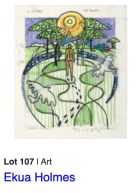

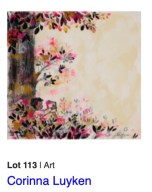
You can bid on original art by talented kidlit illustrators here.
The Carle Honors is a key fundraiser for The Eric Carle Museum of Picture Book Art, and all proceeds support the Museum’s mission to inspire a love of art and reading through picture books.
The 2022 Carle Honors honorees are:

Artist
Faith Ringgold
Faith Ringgold is a painter, mixed media sculptor, teacher, lecturer, and author of numerous award-winning children’s books. Known for her oil paintings and her narrative painted storquilts, her first children’s book, the renowned TAR BEACH, won over 20 awards including the1991 Caldecott Honor and Coretta Scott King award. A creative and cultural force whose work is in the permanent collections of numerous museums in the US and abroad, Ms. Ringgold is a role model for artists and scholars and continues to influence and inspire others.
 Angel
Angel
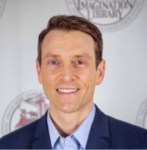
Dolly Parton’s Imagination Library, represented by President Jeff Conyers
Dolly Parton’s Imagination Library inspires a lifelong love of books and learning by mailing specially selected books to the homes of registered children, from birth to age 5, each month. Inspired by her father, who could not read or write, Dolly Parton founded and launched the program in East Tennessee in 1995. The Imagination Library now gifts over1.8 million books each month internationally and has gifted over 180 million books since inception.
 Bridge
Aija (阿甲)
Ajia is one of China’s foremost translators of Western children’s books and an influential storyteller, author, and educator. In addition to authoring his own picture books and books about children’s literature, he has translated several reference books and more than 200 picture books from English to Chinese, including such classics as GOODNIGHT MOON, the PETER RABBIT series, and WHERE THE WILD THINGS ARE. Ajia brings the joys and scholarship of picture books to a broad and eager audience.
 Mentor
Wade and Cheryl Hudson
Wade and Cheryl Hudson are authors, publishers, and leading advocates for equity, diversity, and inclusion in the children’s book industry. In 1988, they founded Just Us Books to publish children’s literature that centers and celebrates Black people, history, and culture. They have dedicated their careers to creating good books and more opportunities for talented creators—mentoring and giving numerous authors, illustrators, and other professionals their start in publishing.
Congratulations to the Honorees and best wishes to the Carle Museum on a successful art auction!
by Jill Esbaum
Thanks, Tara, for hosting my cover reveal for STINKBIRD HAS A SUPERPOWER!
 This book idea was sparked by a work-for-hire project for National Geographic Kids, Angry Birds Playground: Rain Forest. There I was, cramming my days with Amazon animal research, and … yeesh. Life in the Amazon is a big-time, bloody example of eat-or-be-eaten. And it was starting to get me down. (Maybe watching all those gobbledy-grisly videos wasn’t such a hot idea.)
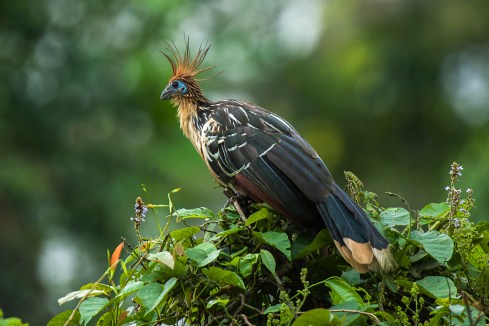
But then a breath of fresh air blew in. The hoatzin. A leaf eater. A bird that bothers nobody, and nobody bothers it. Why? Because it smells to high heaven—like cow poop, thanks to its four-chambered, slow-mo digestive system. Golly, that cheered me up. Further research showed it to be a great singer (not), a great flyer (not), and a great nest-builder (um…). Best of all, their chicks have what might be called (if you’re me) a SUPERPOWER unlike any other bird in the whole entire world!
Well, how could I not play around with THAT idea? So I wrote an informational fiction manuscript from Papa Hoatzin’s POV.
And no editor got it.
In my 25 years of submitting, this manuscript actually holds the record for most rejections (so far *knock wood*). Hmm, maybe it was a little long. And, okay, a little over-written. But I’m stubborn, so, all along the way, I kept going back and tweaking. More rejections. Finally, I hit upon the idea of adding one of Papa’s chicks to the mix, making it funny, and WHEW, everything clicked.
A dream editor at Putnam snapped up my manuscript, had me tweak again, got the hilarious BOB SHEA to illustrate (I KNOW!), and ba-da-bing, ba-da-boom, here’s the cover:
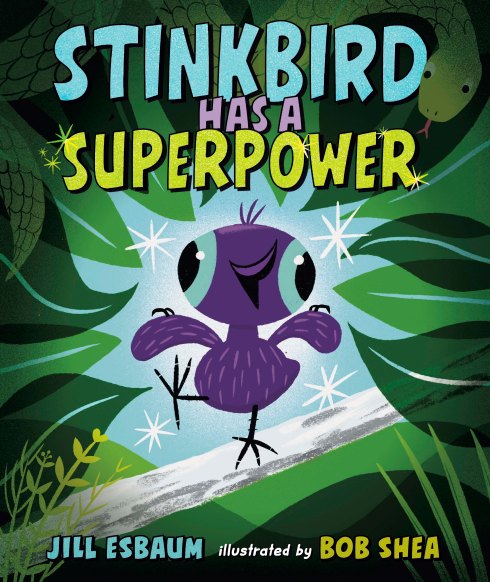
STINKBIRD HAS A SUPERPOWER will release May 16th, 2023, to be followed in 2024 by the second book in the series, the equally amazing PARROTFISH HAS A SUPERPOWER. I am so proud of these books. Kiddos will love ’em and boy, will adults have fun reading them aloud.
Get your dibs in now, because this baby is available for PRE-ORDER!
Thanks, Jill! It looks SUPER!
And blog readers, the amazing Jill Esbaum is giving away a picture book critique!
Leave one comment below to enter.
A random winner will be selected in October.
Good luck!
 Jill Esbaum is a widely published author of books for young readers. She is a frequent school visitor and conference speaker. She teaches writing for children at the University of Iowa Summer Writing Festival. Visit her at JillEsbaum.com and follow her on Twitter at @JEsbaum.
by Jennifer Raudenbush
Thanks to Tara for allowing me to share the cover reveal for my debut picture book!
In 2017, Tara drove two hours to my critique group’s very first writing retreat to give a craft talk and critique picture book manuscripts. She took a chance on us, shared her knowledge with us, and helped us believe in our writer-selves. We are forever grateful!
IN THE PALM OF MY HAND (Running Press Kids, Hachette) is a lyrical concept book about a child who takes a walk in nature and discovers great possibilities are contained in tiny treasures—an acorn, a wild flower—and even himself.
 Although I’m a big Storystorm fan, this book’s inspiration was sparked by a humorous picture book called FEAR THE BUNNY, written by Richard T. Morris and illustrated by Priscilla Burris (Atheneum, Simon & Schuster, 2019). I’m a poet at heart and was smitten at how Morris used William Blake’s famous poem “The Tyger” in his picture book. I told my Writing with the Stars (shout-out to Tara Luebbe) mentor—the amazing, incomparable Cate Berry—how genius I thought this book was. How I wish I’d thought of the idea. How I’d love to do something somewhat similar. And she encouraged me to pick up my pencil and go for it.
So I did.
I challenged myself to start with a snippet of poetry and somehow turn it into a picture book. As a springboard, I used the famous opening lines of Blake’s “Auguries of Innocence”:
To see a World in a Grain of Sand
And a Heaven in a Wild Flower
Hold Infinity in the palm of your hand
And Eternity in an hour.
I wrote Blake’s lines at the top of my notebook as an epigraph, then played around on the page and allowed my creativity to take over. The first iteration was similar to the published version, but focused more on the water cycle. An editor’s critique at the NJSCBWI conference encouraged me to revise & resubmit (R&R) by removing both the focus on the water cycle and the epigraph. That editor ultimately passed on the manuscript, but it found a home at Running Press Kids! Now, the book’s focus leans more into the connectivity of nature.
Illustrator Isabella Conti made the story come alive with her exquisite art. I love her details, such as a repeating sea gull and butterfly that little ones can hunt for. And I’m thrilled with the finished product.
My goal with this book was to make people fall in love with both the beauty of words and the beauty of nature. I hope its readers will do just that!
IN THE PALM OF MY HAND is now available for preorder where most books are sold, for a March 14, 2023 release.
And now, the cover reveal!
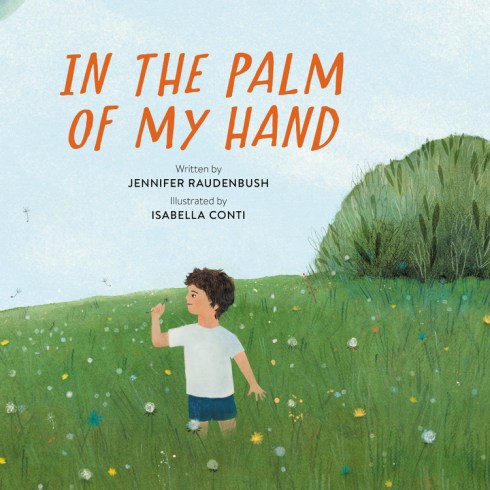
To celebrate her debut cover reveal, Jen is offering a giveaway of one fiction (non-rhyming) picture book critique.
Leave one comment below to enter.
A random winner will be selected next month!
Good luck!
 Jennifer Raudenbush feels most alive when she’s creating stories, especially picture books and middle grade novels. Jen lives with her husband and teenage son in eastern Pennsylvania, where its natural beauty provides endless inspiration. She also loves to cuddle with her pup, adventure with family, and escape with books. Connect with her at JenRaudenbush.com or on Twitter @jenraudenbush.





 Writing for Kids (While Raising Them)