You are currently browsing the category archive for the ‘Picture Book Review’ category.
 You’ve probably heard this advice: never write a children’s story with the intent of teaching a lesson. They typically come out preachy. Kids are clever; you can’t fool them into reading a lecture.
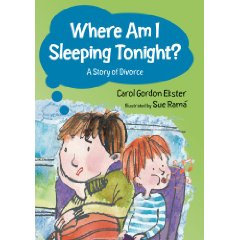
But what about writing a story with the intent of easing a child’s pain? Letting them know they’re not alone in their troubles? Carol Ekster does this beautifully in Where Am I Sleeping Tonight?, a humorous and realistic look at life as a child of divorce.
I was a child of divorce. The only books available to me in the early 1980’s were ones written by shrinks, telling kids that we weren’t responsible for the split. Well, DUH! I knew it wasn’t my fault! Whenever I got upset, people told me I wasn’t to blame, something I knew from day one. Nobody understood how I felt, knowing that the two people I loved the most no longer loved each other.
My life changed immediately and dramatically. My stay-at-home mother got a job and I became a latch-key kid, responsible for taking care of my younger brother every day after school. My father moved in with my Nana and we spent every weekend at her house, sleeping in the same room in which our Great Uncle had died. (Creepy!)
Life got frustrating. My belongings were strewn between two houses more than 30 minutes from one another. My dad didn’t know how to cook. My mom didn’t have time for us, between work, the house, and dating. (Creepier!)
Debut author Carol Ekster has filled a need in children’s books: a story for kids adjusting to divorced life, showing real situations and emotions. I wish Where Am I Sleeping Tonight? was around back then to let me know I wasn’t alone in my back-and-forth shuffle.
A niche title like this can be a great way to break into the publishing business. I talked to Carol about her journey to publication…
How long have you been writing?
About 6 years. It just came over me like an outer body experience on a July day at the beach. I went to get a pen and post-its (the only writing material I had) from my car, and started to write my first picture book.
[Lesson learned: always carry a notebook with you!]
Is this the first book you wrote?
This was actually the 20th book I wrote, but the first to sell.
[Lesson learned: you get better with every story. Don’t expect the first thing you write to sell.]
Where did you get the idea for the story?
It is loosely based on a former student who had the same schedule as the boys in the story. He touched my heart. I’ve been teaching 35 years and always had compassion for the children whose parents were divorced. I could feel their pain.
[Lesson learned: look for stories in everyday life. They’re all around.]
How many revisions did it go through?
Too many to count!
[Lesson learned: revision is your friend.]
How did you research where to submit it?
I use the “Children’s Writer’s & Illustrator’s Market,” but for this story, there was a call for submissions in the SCBWI Bulletin. Boulden Publishing was looking for books on divorce and a few other topics. I sent it out and heard back six weeks later that they were interested in it.
[Lesson learned: wow, that was quick! But Carol had exactly what they wanted! It’s all about finding a perfect match.]
How has your life changed since becoming published?
I’ve had to do book signings and promotion…none of which I ever thought about when I began writing. I was surprised how nervous I was for my first book signing. It takes a lot of time and effort, so I’m not getting as much writing done.
[Lesson learned: marketing and promotion is just as important as writing. Yes, it takes time, but it pays rewards in book sales and a solid platform from which to launch your next title. Check out agent Nadia Cornier’s recent post about her floundering novel and how she’s reinvesting herself in book promotion.]
Thanks to Carol for answering my questions and best wishes with the book. If you have questions for debut author Carol Ekster, please leave a comment!
A few weeks ago, the hot topic here was Five Rules for Picture Books. Follow those guidelines and you might just have a winning manuscript. Or you might just have Hop! Plop! by Corey Rosen Schwartz, Tali Klein and Olivier Dunrea.
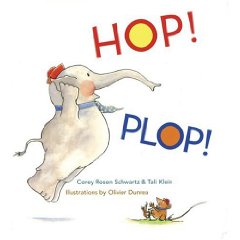 Let’s take a closer look at this story and how it fits beautifully with “the rules.”
Rule #1: Audience Age is 2-6 years old
A picture book should include situations and characters to which children this age can relate. Hop! Plop! is set at a playground. Familiar? Check. Adorable, friendly animals? Check.
Rule #2: 500 Words is the Magic Number
Hop! Plop! comes in at about 300. Check.
Rule #3: Make it Really Sweet or Really Funny
In this case, it’s really sweet and really funny. Elephant and Mouse navigate the playground together and hilarity ensues. Elephant is too heavy on the seesaw and he pushes Mouse a little too hard on the swing. In the end, the two friends discover that their favorite playground diversion is each other. Awwwww.
Rule #4: Use Playful, Unique Language
Elephant and Mouse’s foibles are expressed through onomatopoeia and rhyme. “Skip! Tip! Zoom! Zip! Mouse did a backward flip.” and “Plop! Drop! Crash! Whop! The swings were a total flop.” Totally fun to read aloud. And not too tongue-twisty.
Rule #5: Create Situations that Inspire Cool Illustrations
Picture an elephant and a mouse on a seesaw. And a mouse sliding down an elephant’s trunk. Funny situations, cute pictures. Final check.
Hop! Plop! is a delightful romp. While this book happens to follow “the rules,” that doesn’t mean other manuscripts which color outside the lines are doomed for the rejection pile. Not at all. Remember, “the rules” are merely guidelines for new writers, to help them understand what editors generally seek in a manuscript. (I should really add to the rules: there must be a story.) I can name plenty of picture books that break at least one of these guidelines, with length being the most common one. But Hop! Plop! fits all the criteria–and it’s darn cute to boot. Check it out.
Please share in the discussion by naming your favorite rule-followin’ title! Or maybe you want to point out a rule breaker, a rebel title that deserves praise!
The KidLit Comment Challenge helped me discover some boss new blogs and websites this weekend.
Everyone is talking about Wordle by Jonathan Feinberg. Input text and Wordle creates a word cloud, your very own piece of literary art, which I’m calling “literarti.” The more frequently a word appears in the text, the larger its relative size.
I had fun pasting my picture books into Wordle. Here is The Prince of Pizza:

You can change the font, color palate, direction of the words, and maximum word count. You can even link phrases with the tilde symbol (~) so they appear together. Keep in mind that Wordle’s gallery is uncensored, so it might not be appropriate for lil’ ones.
A site you will want to share with your young readers is author/illustrator Aaron Zenz’s Bookie Woogie: book reviews by kids, for kids (and their parents). Aaron and his three children, Isaac (10), Gracie (8), and Lily (5), review their favorite books from their impressive 2800-book home library. And when the discussion is finished, they share artwork inspired by the story. Aaron’s artistic talent has definitely rubbed off on his brood! Join them every Monday for a new book.
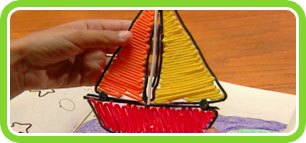 And then there’s Bendaroos. If you have a child with an insatiable artistic soul, then these colorful, bendable wax sticks promise to keep them busy for hours. You can even make your favorite picture book characters come to life by using the illustrations as a template. Your Bendaroo sculpture will lift right off the page when you’re done. As soon as ours arrive, I’ll post our creations.
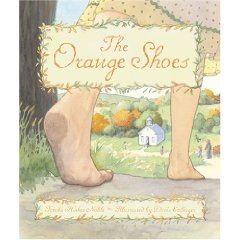 Trinka Hakes Noble once described the joy of being a children’s writer: she can relive her childhood. And not just the fun times, but the difficult ones, too. And why would that be a good thing? As an author, she has the opportunity to rewrite her own history—to take an unfortunate situation from her past and finally make it right.
She does just that in the poignant story The Orange Shoes.
Ms. Noble grew up in rural Michigan as the fifth of seven children. The hand-me-downs that defined her childhood became the inspiration for this tale.
Each child in her family received just one sturdy pair of shoes per year, and since they were to be passed down between boys and girls, they were plain loafers. At school she was teased for her boyish Buster Browns. One afternoon while browsing the sole department store in town, she set her eyes upon a pair of lovely orange Mary Janes and instantly fell in love. She does not know how they afforded it, but the next day her parents presented her with that special pair of shoes.
As a young innocent, she showed them off to the children at school so they would finally admire and compliment her shoes. Instead, the children kicked dirt on her shoes, stomped on her feet and destroyed them, leaving her heartbroken.
In The Orange Shoes, marvelously illustrated by Doris Ettlinger, the main character Delly comes from a poor, rural family who cannot afford shoes until October, when the weather demands them. And yet, Delly’s character does not feel sorry for herself without shoes. Instead, she relishes the feel of the cool earth beneath her bare feet.
Like Ms. Noble, Delly is a talented artist. The inside of unfolded, used envelopes are her canvases. Her teacher, Miss Violet, encourages her students to decorate boxes for a “Shoebox Social” which will raise money for art supplies. When Delly sees a pair of orange Mary Janes in town, she immediately wants them to wear to her school’s social, but she knows they will never be hers.
To Delly’s surprise, her father buys the shoes she so admires. The delighted young girl wears her shoes to school and her jealous classmates ruin them.
This is where Ms. Noble fixes the situation from her childhood. Delly becomes a resourceful artist, painting each crack and crease with vines, transforming bigger scuffs into flowers. She decorates her Shoebox Social box to match perfectly. At the event, her box draws the highest bid, but it comes from an unexpected source.
The Orange Shoes was easily my favorite picture book of 2007 and it deserves a place on your shelf. The illustrations and story marry beautifully, and the message is uplifting and powerful. This being said, it is a more complex tale meant for older children, making it a great snuggle-up-together tale which elicits discussion between parent and child. And those are some of my favorite moments with my kids, when we can talk about books that we love.
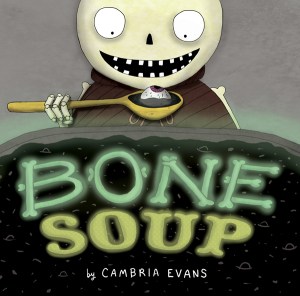 Succulent eyeballs float among tender bat wings, seasoning Cambria Evans’ Bone Soup with gross Halloween humor no five year-old can resist.
The main character Finnigin has a reputation for being a greedy eater. So when the witch finds out he’s coming to town, she warns her beastly neighbors. Everyone stashes their groceries away, hiding toenail clippings, frogs legs, and other ghoulish gourmet ingredients. No one offers him a bite to eat, not even a nibble of wormy cheese.
So the hungry, resourceful Finnigin boils a cauldron in town square. Into the bubbling pot he drops one dry bone, claiming it will create a magical delicacy. Of course, the curious creatures can’t help but add to the brew, and soon everyone is feasting on slimy gruel thickened with dried mouse droppings. Yum!

Evans’ pen-and-watercolor illustrations strike just the right balance between spooky and funny. The mummy wears a pretty pink bow and the werewolf looks more like a harmless hedgehog. The green and brown color palate makes every page feel like it’s glowing in the dark, adding to the fun Halloween spirit.
Stone Soup has been retold many times, but never with so much disgusting deliciousness.
You’ve got less than fifteen seconds to grab a bookstore customer. That’s it. Your cover must lure them to the shelf. The title and design must call to them. Fail this instant judgment test and lose a sale. Yep, they really do judge a book by its cover.
So do kids. My Kindergartener cannot read, but she knows what books she wants. Last week she came home with a list of book fair titles she had selected on her own, solely by the covers. I decided to research the books before deciding whether to buy.
Without exception, every book cover featured a pony or a dog. Yes, she loves both animals. But the one book that she begged for the most? My Chincoteague Pony by Susan Jeffers.
 How could a horse-crazed little girl resist? A black-and-white filly seems to be smiling as waves splash around her. The two-toned pink background and glitter on both the letters and the water seal the deal.
The story inside proves to be just as charming as the cover. Julie works hard on the family farm all year, earning money to buy her own pony at the annual Chincoteague auctions. The cover exudes a certain promise to the reader, and it delivers.
In contrast, another horse-themed picture book attracted my attention, but my daughter passed it by. The brown, muted tones of Twenty Heartbeats by Dennis Haseley reflects this story’s more mature vibe.
 A wealthy man commissions a master artist to paint a portrait of his favorite horse. Years pass without word from the artist and the man grows angry. Yet the artist does not deliver until he feels the painting is the best he can produce. The book’s message is one of hard work, patience and perseverance, but the lesson needed to be explained to my child whereas she immediately grasped Julie’s work ethic in My Chincoteague Pony.
There could be several reasons for this, none having to do with the cover. For instance, the main character in Jeffers’ tale is a young girl from present time, easily relatable. The main characters in Twenty Heartbeats are adult men from ancient China.
In the end, I purchased both books, although I admit, Twenty Heartbeats was more for me than it was for her.
I wonder if publishers design some book covers to appeal more to the adult-gatekeepers than to the direct audience. This would make sense if a book contains mature themes and universal lessons that parents wish to teach their children.
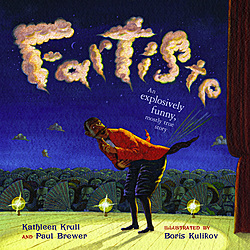
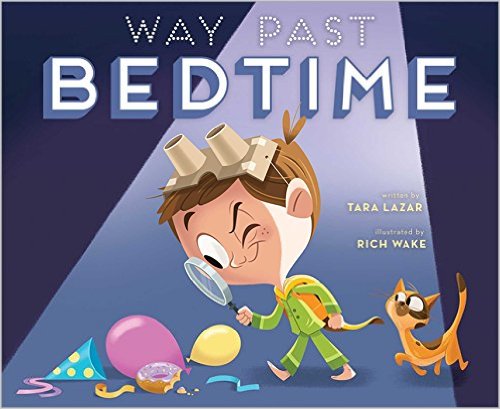
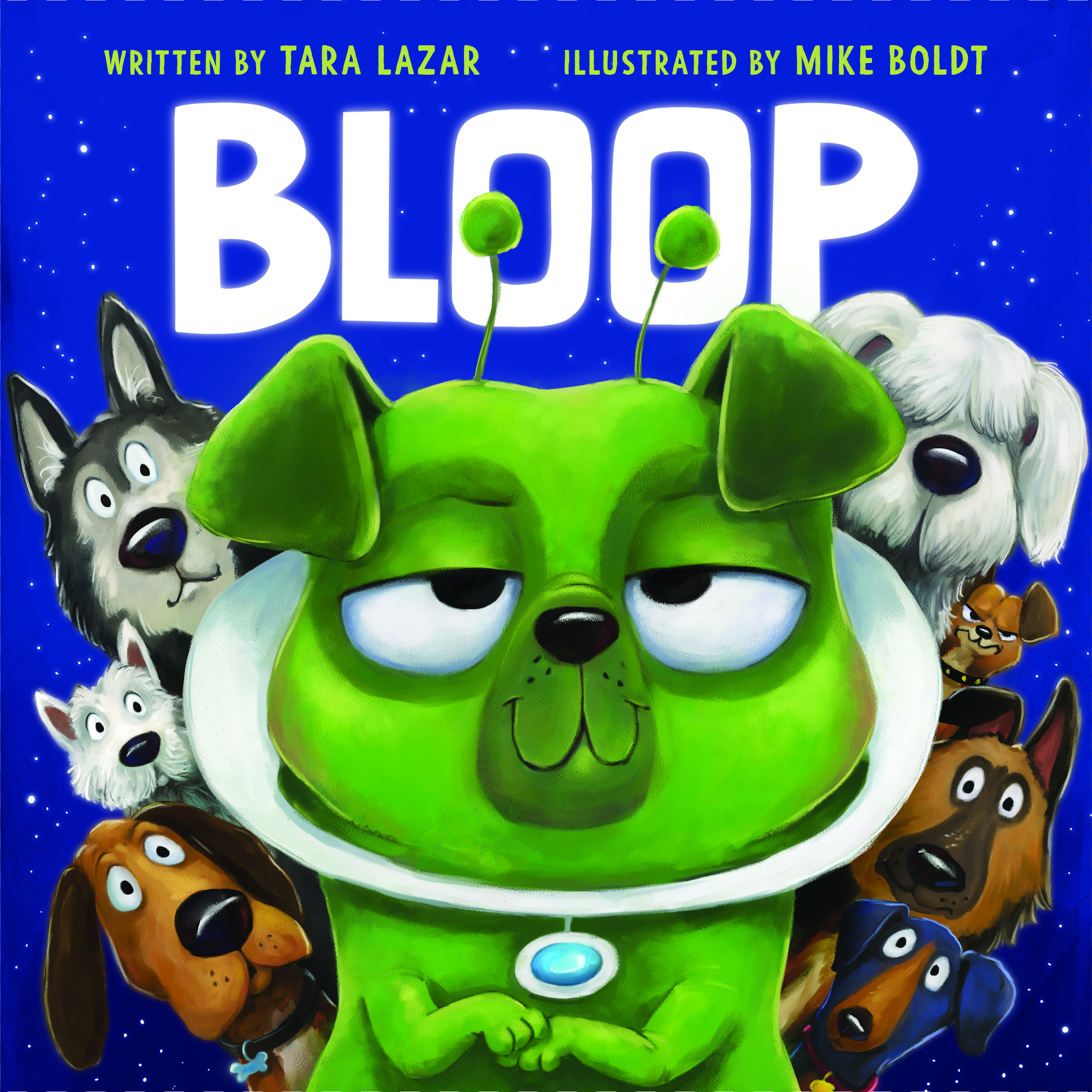
There are some book covers that both my daughter and I agree upon. Here are just a few that we would like to read together. (Please note that Savvy is a middle-grade novel. But what a gorgeous, eye-catching cover.)







 Writing for Kids (While Raising Them)