You are currently browsing the category archive for the ‘Picture Book Review’ category.
 Remember those embarrassing dance moves your Aunt Myrna unveiled at Cousin Frannie’s wedding? She flapped her arms, wiggled her tush and tumbled onto the parquet floor?
Well, that’s not this chicken dance.
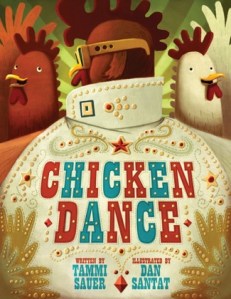
No siree, this Chicken Dance is a brilliant barnyard romp featuring two hilarious hens and their idol Elvis Poultry, thank you. (Thankyouverymuch.)
Author Tammi Sauer grew up on a Kansas farm, tending cows at dawn. Those daybreak chores paid off, ’cause this little lady sure knows how to milk the humor.
According to henhouse pals Marge and Lola, Elvis Poultry is a hunk of bawking love. When the barnyard talent show is announced, the pair discover the grand prize is two tickets to Elvis’ Final Doodle Doo concert tour. They must win!
But the ducks waddle by and wave a wing at the hopeful hens. “Don’t bother, drumsticks.” Seems ducks are top dog at this farm.
Marge and Lola test out their talents but the ducks quack at every failed attempt. When Marge and Lola finally hit the stage–following solid goat, pig and cow acts–they stammer and gulp. A duck heckles, “What’s the matter? Are you chicken?” so they begin to flap, shake and bawk. Just regular chicken stuff, nothin’ fancy. But the crowd loves it and crows for more.
The next spread features Marge and Lola performing dance moves that would make Aunt Myrna shake in her boots. They vogue, point like John Travolta, domo arigato misuta robotto, and walk like an Egyptian. Illustrator Dan Santat makes chickens boogie better than So You Think You Can Dance finalists.
I can’t reveal the contest results, as that would spoil all the feathery fun. But I will tell you that Elvis is in the building. Err, I mean barn.
 The jokes even extend beyond the story, with end pages that demo step-by-step “Disco Chicken” and “Chattanooga Choo Choo” dance moves. Funky album covers replace the typical staid author and illustrator photos.
Yes, just one look at the blinged-out, white-caped Elvis Poultry on the front cover, and you know this ain’t your Aunt Myrna’s paltry poultry impersonation.
Can’t get enough of the silliness?
Publisher Sterling Kids is holding a video contest now through October 31. Just shake your tail feathers along to the official music and post your hoe-down on YouTube.
And tell them Elvis Poultry sent ya.
 Chicken Dance
Written by Tammi Sauer
Illustrated by Dan Santat
Sterling Kids, August 2009
Want it? Sure you do!
 Benjamin wanders too far from home one day and stumbles into Dragon Wood. In this tale of boy meets dragon, the unexpected happens–dragon meets boy.
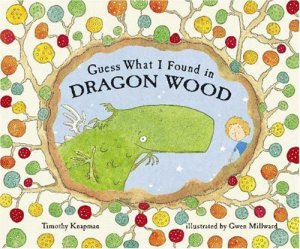
The cover art by Gwen Millward drew me into Timothy Knapman’s quirky little tale. Her forest reminded me of the Truffula Trees in The Lorax, albeit on a smaller scale (and perhaps not as poofy). They frame Benjamin and the Dragon on a clever, die-cut cover.
I admit that I goofed while reading the story for the first time. I got confused. I had to flip back to the beginning to understand Knapman’s brilliant twist on a familiar theme. When editors tell aspiring authors they want to see fresh ideas in picture books, Guess What I Found serves as a perfect example.
“What kind of review is this?” I hear you asking. “She’s not telling me anything about the book!” Oh yeah, sorry ’bout that. If I tell you too much about the Benjamin’s quest, I’ll ruin the surprise.
“Wait a second, did she just call him ‘the Benjamin?’ Must be a typo. What a sorry excuse for a blogger.” Um, I must inform you, that was no typo.
So okay, calm down. I’ll tell you that I loved the striped boots, the whirly wee-woo boxes and the soccer goalposts. And I can’t forget the volcano-sitting lessons! If you want to know more than that, you’ll have to stumble into Dragon Wood yourself.
Don’t get lost!
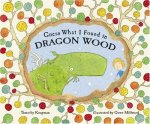 Guess What I Found in Dragon Wood
Story by Timothy Knapman
Illustrations by Gwen Millward
Bloomsbury USA Children’s Books, December 2007
Got a favorite children’s book? Write a review! Today is “Write a Review Wednesday.” Help support kidlit!
 Ruth Spiro is my hero. She’s the only children’s book author I know who invented her own holiday. And what could be more fun than Bubble Gum Day? Celebrations are “popping up” all over the place!
Bubble Gum Day participants raise money to support schools by blowing bubbles. And, of course, they read Ruth’s hilarious picture book Lester Fizz, Bubble-Gum Artist.
Never heard of a bubble gum artist? Lester comes from a long line of artsy ancestors, but he hasn’t inherited traditional talent. One day Lester visits his Uncle Edgar, whose inspiration has waned. When Lester’s bubble bursts, Edgar’s statue gets covered in pink, donning her with a lovely tutu. Hmmm, where have I seen that ballerina before? Sure, Lester helps his uncle out, but he still hasn’t found his fine art calling.
Lester might create drab doodles and pitiful paintings, but he soon discovers his unique talent for blowing beautiful bubble art. Spiro’s clever tale offers tons of fun for kids, but it also winks at parents with spoofs of Picasso, Seurat and other masters sprinkled on its pages. Lester‘s theme is about finding your place in the world, despite what others think. In fact, it serves as a wonderful lesson for aspiring authors.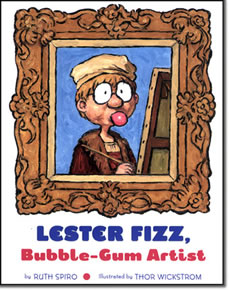 Write from the heart. Find your voice. Keep writing no matter what anyone else says.
Ruth Spiro’s journey to publication was a pretty sweet ride. Lester was her first picture book manuscript and her first sale. The story was also a winner in the 72nd Annual Writer’s Digest competition. But how did she start writing?
Ahh, glad you asked. I knew I liked Ruth’s work for a reason. In 2000, she took a class from one of my favorite picture book authors, Carolyn Crimi (The Louds Move In, Henry and the Buccaneer Bunnies). She gained a firm writing foundation and then found inspiration from her family.
One day her daughter said, “What if I could blow bubbles like that guy at the birthday party who made animals out of balloons? Wouldn’t it be cool if I could blow a bubble shaped like a dog?” With that, Lester’s story was born. And Ruth’s career took another turn.
“Once I sold my book and started selling articles to magazines, I also started receiving calls and emails from ‘friends of friends’ who were looking for advice on breaking into print. It seemed everyone had a drawer full of poems or a children’s book manuscript, but they didn’t know what steps to take next.
“I realized I was spending a lot of time putting together resources and reading other peoples’ work, so why not make it official and get paid for it?”
Ruth created the Writing for Moms program to help other women develop their craft and sell their work. Several of her students are now published authors, too.
And now the burning question: what kind of bubble gum does Ruth prefer?
“I was actually a Bazooka gal until Bubble Yum came out–so soft and sweet! While I don’t like to state a preference for a particular brand, I find Dubble Bubble is a good all-around bubblegum, and I usually have a big pink bowl filled with it at my events and signings!”
As if I needed another reason to attend her signing! Oh Ruth, you had me at “Bazooka.”
 Lester Fizz, Bubble-gum Artist
Story by Ruth Spiro
Illustrations by Thor Wickstrom
Dutton Juvenile, August 2008
 If you love children’s books, please participate in a new weekly blog meme:
Write a Review Wednesday!
Parents, teachers and librarians are relying on online reviews more than ever to help them decide upon book purchases. Your opinion counts! Praise a picture book. Marvel over a middle grade novel. Tell everyone that young adult isn’t just for young adults!
On Wednesdays, write an online book review for a book that you love. The review could be posted on your blog, Amazon, B&N, GoodReads, or you could tweet your book bravos on Twitter. It doesn’t matter WHERE you do it. The goal is to get more people who are passionate about kidlit talking about their recent, fabulous reads.
(The extraordinary podcast Just One More Book encourages you to phone your book review into their hotline. They will include your review in one of their shows!)
Don’t forget to link to information on where the book can be purchased–the publisher’s site, the author/illustrator’s site, Indiebound.org or a retailer.
If you’re participating via Twitter, link to your online review and use the hashtag #warw, which I’ve defined on Tagalus.
And if you don’t have the time to write a review, simply link to a review that you appreciated. There are many prolific book bloggers (like Maw Books and Write for a Reader), so let’s give them our thanks.
Ideas for “Write a Review Wednesday”? Please leave a comment!
Now let the reviewing begin!
It’s Children’s Book Week! So what does that mean? It’s time to celebrate children’s books across all genres.
Read to children. Inspire their creativity. Write a story together. Draw pictures. Enter Carin Berger’s Contest. Do whatever you want to make reading a priority in your family’s life! (Although I’m sure it’s already a priority.)
To help you along on this salute to Silverstein, this festival of Fox, this jubilee of Jeffers, here are some links:
- Read story starters by children’s authors and finish what they started.
- Visit the Write For a Reader blog. Shelly will have author interviews and give-aways all week.
- Check out IlluStory and Create Your Own Pop-up Book, fun ways for your child to publish their own book.
- Review the Top 10 Summer Reading Lists from various organizations and the children’s choice reading list from the Children’s Book Council.
- Share your favorite children’s book with us. Comment below so others can discover great books.
And here are some marvelous picture books being released this week! Enjoy!




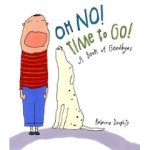
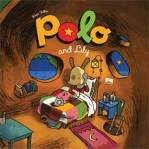
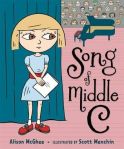

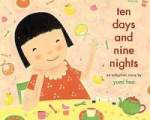
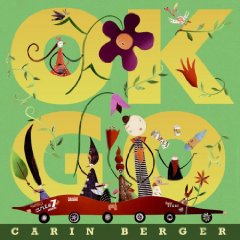 Carin Berger never deliberately set out to become an author/illustrator, but she found her true calling in picture books. She was awarded the Society of Illustrators Founder’s Award in 2006, the NY Times named The Little Yellow Leaf one of the top ten picture books of 2008, and Publishers Weekly called her “one to watch.”
And now’s a great time to watch.
Her latest title OK Go, a playful book about making greener choices, releases in bookstores today.
I had the opportunity to talk with Carin about her journey to publication (somewhat serendipitous) and her plans for the future (deliberately delightful). I shall follow PW’s lead and not only watch her, but predict the Caldecott will soon be calling.
Carin, how did you start on the path to becoming a children’s book illustrator?
I’ve always loved reading, writing, old paper stuff, children’s books, type and making things. I studied graphic design and spent almost 20 years working in the field. I worked my way down the (pay) food chain towards what I really loved: from very high-end annual reports and brochures to eventually designing book jackets for all the major publishers. I did jackets for poetry, fiction and non-fiction. I still do this and love it. I get to read manuscripts and can often use my own illustration or photography.
Anyhow, I had a daughter, and it turned out she was a sleepless wonder. (When she was little. Now she sleeps like a baby!) I spent much of most evenings hanging with her, waiting for her to fall asleep. I wrote the poems for Not So True Stories and Unreasonable Rhymes in those long hours, mostly to amuse myself.
 How did you first get involved in collage?
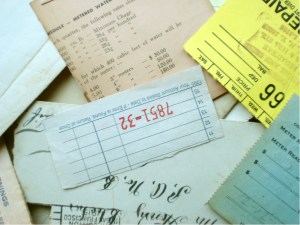
As for collage, that was kind of serendipity. I thought I would do paintings and was experimenting with different painting styles, some which included collage, and then my friend gave me a magic box full of old letters and documents and ephemera that she picked up at a flea market, knowing I had a thing for that kind of stuff. And that was the beginning.
Once I had pulled together some sample illustrations and manuscript, a friend-of-a-friend agreed to rep it; and she, amazingly, ushered it into the world.
And was Not So True Stories and Unreasonable Rhymes your first manuscript?
Yes, it was my first manuscript, though I’d written a bit, for myself, before.
 Wow. That’s a rare accomplishment and speaks volumes about your talent. Where did you go from that first success?
Not So True Stories was a quirky little book that got good reviews but sold…well, like a quirky little book. Chronicle Books graciously published my second book, All Mixed Up, another quirky and very little book. (It can fit in your pocket.)
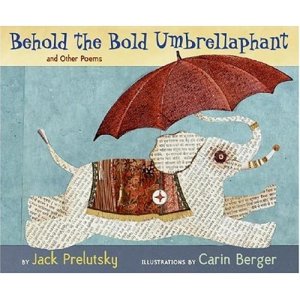
I was then called by Greenwillow Books and asked to illustrate Jack Prelutsky’s book. A real honor. And, because it was the amazing Master Jack’s book, it received lots of nice attention. He was named the first ever Children’s Poet Laureate right when the book came out which meant that there was a shiny golden sticker that went on the front of the book, too. I’ve been working with Greenwillow Books for the last couple of projects.
How has your illustration style evolved from one book to the next?
As for the collage style, it has sort of evolved in a few directions.
 All Mixed Up, a mix and match book where the heads, middles and legs (as well as the alliterative poems) combine in various ways to make new characters, was born out of the idea of collaging the collaged illustration. I had originally conceived it as a game, but Chronicle preferred to do it as a book. The illustrations are similar, yet somewhat simpler than Not so True Stories, so that the mixing worked.
For Behold the Bold Umbrellaphant, I wanted to do a slightly different style than the books that I had authored, and also, because the poems are about a conglomeration of animals and objects (such as Ballpoint Penguins), I thought it would be fun to play that up and make it really obvious.
I collect old dictionaries and army/navy catalogues that have engraved images, and so I used those images and integrated them into the collage. To do this I actually scanned engravings from the book, played with them in Photoshop, printed out pieces and used them to cut and paste with.
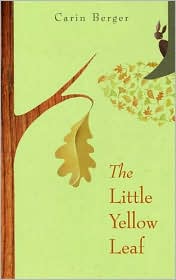 The Little Yellow Leaf felt like a really simple, nostalgic story and I ended up introducing a bit of paint (stenciling) to the collage to add another layer and also, at times, to age the paper.
Ok Go has a zillion funny little characters carousing throughout the book and feels much more like the art in the end papers of Not so True Stories and also in All Mixed Up. It was fun to change things up a bit and to do such playful art.
My next book, due out late next winter, is called Forever Friends and the art is much more similar to the art in The Little Yellow Leaf. I see it as a companion book to The Little Yellow Leaf because the bunny on the front cover and the bird on the back cover of Leaf are the characters in Forever Friends.
Your newest picture book OK Go is a playful book for the wee set, all about making greener choices. How did the concept for this book come together?
As best I can recall, it all sort of came as a whole piece. I liked the idea of introducing taking care of the environment to really young kids. I remember growing up in the 70s when “Give a Hoot, Don’t Pollute” was around and feeling very empowered to help make the world a better place. Here are some early sketches:
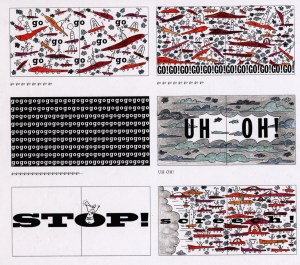
One of the biggest things I needed to figure out was how to emphasize the message in a powerful yet playful way. The gatefold came about because I wanted it to feel like a huge gathering or movement.
How do you choose which paper to cut for certain images? Does the paper speak to you?
 I have files of papers sorted by color—yellows/oranges, reds/pinks, blues/purples—and I also have files for some of my passions: polka dots, plaids, wood grain, buttons…
 I actually cut a vellum stencil of the shape I need and hold it over the paper to find a good section. Something with good gradations for example, that help the piece, say a car, look more dimensional. Clothing catalogs are great for plaids and buttons. And then I use a variety of old stuff, both really old ephemera like letters and receipts with great calligraphy on them and also bits and pieces that I find around: ticket stubs, laundry tags, etc.
Do the words on the paper hold any significance?
I do think about the paper I use, where it comes from and what it says. Not in a huge way, but in a quiet, just-to-amuse-myself sort of way. And in almost every book I make sure to include, somewhere, my daughter’s name, Thea. In The Little Yellow Leaf it appears on the page with the giant sun, and in OK Go I use her name and the names and initials of lots of friends to decorate the cars.
Speaking of the glorious sun in The Little Yellow Leaf, do you have any idea how many pieces of paper you used? Or how long it took to create that page?

I always knew what I wanted to do with that illustration, but it took a little longer (well, w-a-y longer) than I thought it would. I spent probably close to a week on it. Actually, part of the reason it took so long is that I started from the outside and was working my way towards the center and I got pretty far before I realized that, because the sun is asymmetrical, it wasn’t going to work. I had to add another layer working from the center out. Ugh!
I have absolutely no idea how many pieces there are, and I can’t imagine anyone who would be nuts enough to count (though I’d be curious to know that)!
Circling back to your newest book, what kind of impact do you hope OK Go will have on green thinking among parents and young children?
There are some very simple things that kids can do to be more green and they are listed in the back of the book.
I think if you plant the idea early, children will live more careful, aware lives, and remind their parents to do so as well. Plus, what is more motivating than our kids to get us to take care of this planet and the environment?
But mostly I want kids to have fun with the book, and to be introduced these ideas in a playful, engaging way.
One last thought: all of my art is made with found and recycled materials, so maybe this will prove inspiring and enabling, too.
Indeed it is, Carin! So let’s use that inspiration for a contest!
Kids age 10 and under, create a collage with a green theme–reduce, reuse, recycle or whatever you can dream up! Email your illustration to tarawrites at yahoo (you know the rest, dot com) and include child’s first name and age.
With the help of Random.org, we’ll randomly select three winners.
The grand prize winner gets an autographed copy of OK Go. The second and third winners will receive an All Mixed Up promotional mini-book. And all three illustrations will be featured on Carin Berger’s website and/or blog.
In your email, be sure to grant your permission for sharing the illustration and the child’s first name/age online.
One illustration per child. Enter now through midnight E.S.T., Tuesday, May 12.
Carin, thank you for giving us a glimpse into your beautiful world! I bet everyone is going to GO! GO! GO! get your book today!

Take a peek inside OK Go or
Find OK Go at your local bookstore!
OK Go by Carin Berger
April 2009
Greenwillow Books
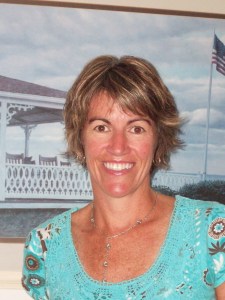
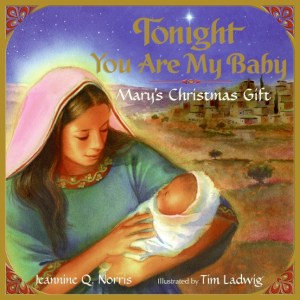 I had the pleasure of meeting author Jeannine Norris at a recent NJ-SCBWI mentoring workshop. One of the organizers, Kathy Temean, held up a copy of Tonight You Are My Baby and pointed to Jeannine, the author, sitting right behind me. Kathy told us that Jeannine had met her editor at a previous NJ-SCBWI event. Amazing! I immediately knew I had to talk to Jeannine about her path to publication.
Jeannine, how long have you been writing?
I have been writing for about four years. I dabbled in writing when our children were babies, as I missed the creative stimulation of my former job. I really started to write when our youngest went to pre-K.
Where did the inspiration for Tonight You Are My Baby come from?
The inspiration came when our daughter, Quinn, who was four years old at the time, was diagnosed with a brain tumor. As a mother, I needed the strength to help our daughter get through this difficult journey. I started to think about Mary, as the mother of Jesus, and her incredible strength. I decided to write about the Nativity, from a mother’s perspective, and, if the book was published, donate part of the proceeds to helping kids with brain tumors. Quinn’s tumor was benign, and next year will be her five-year celebration! We started a foundation, At Least Kids, that contributes to pediatric brain tumor research at Children’s Hospital of Philadelphia and supports families struggling financially. A portion of each book sold is donated directly to At Least Kids.
What a scary time for you as a parent, but what a blessed outcome—a healthy child, a beautiful book and a charitable foundation.
You met your editor at a writer’s event here in New Jersey. Can you tell us how the deal transpired?
I met my lovely editor, Catherine Onder, at a NJ-SCBWI mentoring workshop. Catherine heard Tonight You Are My Baby during the first page session. Another editor asked to see the rest of the manuscript, but it was eventually declined. Several months later, I met Catherine at another NJ-SCBWI workshop (with another manuscript) and she remembered the first page of Tonight You Are My Baby. She asked to see the rest of the manuscript and several months later it was acquired. I couldn’t have been happier! The right time, the right place, a great editor. I’m a huge cheerleader for SCBWI events. Opportunities abound!
I love NJ-SCBWI, too!
After your book was acquired, what was the editing process like?
The editing process was fascinating! I needed to add a few stanzas, when Tim Ladwig, the illustrator, started working on the book. Catherine helped me with the revisions as well. I have to say, I love revising, as my book became so much better! Revisions and rhyme are always a challenge—often it means changing the entire line, instead of just a word. Catherine pointed out that I had used the word “quiet” several times in my manuscript. Not a good idea when you are only dealing with 400-500 words! I hadn’t even noticed. When I do my school visits, I always tell the students about my revisions. A good editor is like a good teacher—encouraging, has a vision, and wants your work to be its best. Kids are always surprised that even authors make many revisions.
Interesting–how many times had you repeated “quiet”?
I think I had repeated “quiet” three times!
I suspect that many writers have a “crutch” word or phrase in a manuscript that we just don’t notice. Yours was “quiet.” Mine is “just.” (See?) It takes a good editor to point that out!
Why the need to add the stanzas? Was it because of the illustration spread count? Or did Tim add a drawing you hadn’t envisioned?
We added three stanzas because when Tim started to draw the story arc, we wanted Mary first traveling to Bethlehem and meeting Jesus several pages in. Naturally, the book is about a mother and her baby, but we needed additional stanzas to add other images: the angels trumpeting, the sheep/cows/donkey in the stable, the wise men bringing gifts. All those stanzas were added during revisions. As it happens, the angels trumpeting is my favorite illustration! It’s not what I imagined, and I love it! Tim was so creative. The rest of the illustrations are what I saw in my mind’s eye when I was writing. Tim really “got it”—Mary is very young, completely accessible and a joyous mother.
What has surprised you most about being a published author?
 My big surprise was—I didn’t really have any big suprises! The tremendous benefit of using the SCBWI and Verla Kay discussion boards is using the experiences of other authors to make the path easier. I am hugely indebted to those who have traveled this literary path before me! Through the discussion boards and workshops, I felt really well-prepared. Any of my questions were answered: simple questions such as “How do I make postcards?” to more complicated questions dealing with contracts. One pleasant surprise was that all of my school visits were wonderful. Each one was gracious, organized, prepared AND I sold a lot of books! Again, I learned how to prepare pre-order forms, write school contracts and even develop a PowerPoint presentation through the experiences of others. There is much to be learned, but a wealth of information is readily available.
What other advice do you have for aspiring children’s authors?
I would urge writers to join a critique group—or start one of their own! I belong to an online group and a local group. I met both of these groups through SCBWI conferences. Critique groups have so much to add! My groups provide me with valuable, honest comments and help prepare my manuscript for an editor’s eyes. I would also suggest aspiring authors gain writing credits through magazine articles, local publications and online sites. The extra income is nice, too! Attend every SCBWI workshop/conference you can afford. I’ve had an SCBWI workshop on my birthday list for the past several years! If your manuscript is acquired, be prepared to market yourself–heavily. The debut author MUST knock on doors, visit schools, call the bookstores, have a website, ask for interviews. This is your opportunity! Finally, have fun. Write what will bring you to your desk each day with a smile on your face.
That’s excellent advice, thank you, Jeannine.
Although Tonight You Are My Baby is about the birth of baby Jesus, a celebration of Christmas, what makes it a relevant read throughout the entire year?
Tonight You Are My Baby is really a celebration of a mother’s love. It’s about the boundless joy that every new mom experiences. The knowledge that a baby’s birth is truly a miracle—a gift unto itself. Tonight You Are My Baby is a celebration of Christmas, but it’s also a celebration of a mother’s heart. The book is certainly most popular at Christmas, but I find many people buying it for other occasions: new baby presents, baby showers, birthdays, etc. Mothers and little ones snuggle as they read of the love story that took place long ago.
Extra cuddle time: a wonderful reason for everyone to pick up this glorious book. Congratulations and thank you for sharing your journey to publication with us!
 Tonight You Are My Baby
Story by Jeannine Norris
Illustrations by Tim Ladwig
HarperCollins, September 2008
Check it out!
Every SCBWI first-page session I’ve attended has had one thing in common: picture book manuscripts about new babies in the family. At least two or three are submitted each time. Editors and agents respond by warning new writers: “The market is saturated with mom-is-having-a-baby books. If you’re going to write about a new sibling, the idea must be unique to stand out.”
I remember a harsh moment. After reading the first page of a new baby tale, an editor said, “This isn’t special enough to continue.”
Daunting, isn’t it? Makes you want to toss your baby—erm, your manuscript—out the window!
So when they say the idea has to be unique, what do they mean?
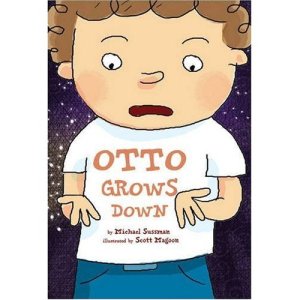 In a perfect world, they’d whip out Michael Sussman’s Otto Grows Down. Illustrated by Scott Magoon, it’s a tale of a boy who wishes his baby sister Anna was never born. “Be careful what you wish for” might be a cliché, but trust me, Otto Grows Down is an uncommon cautionary tale.
Otto makes his Anna-be-gone wish on his 6th birthday as he blows out the candles. Immediately, life begins to travel in reverse. Otto wraps up his gifts and hands them back to his friends. The second hand on his new watch ticks backward.
The next day at school, they start with mess-up time. Otto can’t get used to sliding UP the slide, and he’s so tired at the end of the day, he just wants to eat breakfast and get to bed. And going to the bathroom? Nasty business. (Nasty, hysterical business to my kids.)
Otto’s parents soon return Anna to the hospital and she disappears. Otto rejoices. But strangely, time doesn’t move forward again, it just keeps unraveling. Otto celebrates his fifth birthday, his fourth, his third…and he realizes that he may disappear, too! He’s slowly losing the words he needs to make his new wish come true: OTTO BIG!
Call it a dark comedy for kids. Scott Magoon’s film noir feel strikes the right balance between humor and horror. Dark shadows and warm colors mimic Otto’s flip-flopping emotions. (And hey, did you notice all the character names are palindromes? Another cool touch, huh?)
I won’t tell you where it ends—or where it begins—but let me just say: every editor who sent Mr. Sussman a rejection probably wishes they could make time go in reverse, too.
 Otto Grows Down
Story by Michael Sussman
Illustrated by Scott Magoon
Sterling, February 2009
Want it? Get it!
P.S. Author Heather Ayris Burnell interviewed Michael Sussman on her blog–plus she’s giving away a copy of the book!
 I love picture books with a touch of magic, so I was thrilled to speak with Patricia Storms, illustrator of the whimsical Edward and the Eureka Lucky Wish Company by Barbara Todd. Edward wishes he could fly, and by chance he gets three wishes–but he doesn’t use them wisely.
What a fun challenge to illustrate the Skyhopper 2000, a flying bike! Patricia, how did you land the contract to work on this book?
I’ve been very fortunate when it comes to getting book illustration jobs. Most of the time, publishers have approached me. If memory serves me correctly with the Eureka book, I had sent off a pamphlet of my recent work to various publishers in North America, and as luck would have it, Kids Can Press just happened to be looking for a humorous illustrator for this project. I believe they had been considering my work, since they were already familiar with my art (it’s a small world in Canadian publishing). My portfolio pamphlet just helped to seal the deal.
How did you get started illustrating children’s books?
Well, it was a very slow process for me. I always enjoyed drawing (especially cartoons) and took art all through high school, but for various reason (fear of failure being the big one) I initially took a different path, and studied to work in libraries instead (being a bibliophile and all, and settling for more ‘secure’ work).
But I continued to draw when I could, and slowly started selling art on the side, while working full-time in libraries. I ended up working for the Toronto Public Library cataloguing of all things–children’s books! That’s when I started dreaming about how it would be so much more enjoyable to illustrate the books, rather than catalogue them. Eventually in my mid-30s I went back to school and became a graphic designer, still selling the cartoon/humor work on the side.
About 6 years ago my freelance work really started to increase, mainly because I began putting my work online. My first few picture book illustration jobs were work-for-hire jobs, doing illustrations for the educational kid’s book market. In all those cases, I was approached by the publishers. I enjoyed doing the educational illustration but I really wanted to get into trade book illustration, because I knew I would have a much wider audience.
My first trade illustrated book was 13 Ghosts of Halloween, published by Scholastic Canada. Once again, they approached me. My upcoming illustrated picture book, The Pirate and the Penguin, which is completely my creation, will be my third trade picture book, and I hope I can do more in the future.
This job, more than anything else I have ever done, feels so right for me. Because for me, it’s not just a job. It is who I am. I view myself as a bit of a ‘late bloomer’ in this field. I still feel like a newbie in the kid’s book industry – there are many people my age (45) who have been doing it for 20 years or more. I have so much to learn. I hope I can continue to learn and grow in this industry, if the gods will allow it.
 What is the biggest challenge when translating someone else’s words into pictures? How much input does the editor have? Do you ever speak directly with the author?
I guess finding that perfect balance in which the editor and author are happy, but also where I get to add my own personal flavor without completely taking over the story…yet at the same time, where I’m not just being a “hired hand” doing grunt work.
How much input the editor has in developing the art for the story really depends upon the publisher and editor with whom you are working. Some editors will give some basic guidelines and then just let you fly, while others are much more hands-on, giving lots of direction and feedback. It’s never been the exact same experience for me.
The only time I’ve spoken directly with the author is when I have been illustrating the story written by me. It’s actually kind of hard to get away from myself. 😉
Generally, editors prefer to keep the author and the illustrator apart until the project is done. I’m not entirely sure of the reasons for doing this, but I suspect it is because they fear a) the author and illustrator will conspire together to give the editor and publisher grief or b) the author and illustrator will hate each other with a passion and disagree on everything and kill each other thus giving the editor and publisher grief.
It’s a tough, time-consuming (and expensive!) job creating a picture book so the last thing anyone working on the project needs is any added emotional stress.
The way I understand the process is that once the story has been accepted, the editor will work with the author to fine-tune the words, and then when the story is pretty much polished, that’s when the artist comes in to illustrate said words. By this point, the editor and art director work together to communicate with the illustrator concepts for the vision of the story, and of course the illustrator provides feedback, too. The script may still get edited a bit at this point, because once the pictures come into the equation, one discovers that very often the images can take the place of any extraneous words.
Once rough sketches are satisfactory for the editor and art director, they are shown to the author, just to make sure that the author doesn’t totally hate the artist’s vision. I’m pretty sure that if the author really were upset with the art, that something would have to be done, but once again, it all depends upon the publisher working on the project.
I only met the authors of my first two trade picture books AFTER the books were complete. Thankfully, both authors were happy with the final product. I do find it a stressful, worrisome experience, wondering whether or not the author is happy with my art. But I am a bit of a neurotic worry-wart, so I tend to let these things eat away at me.
 How and when did you make the decision to morph from illustrator to author-illustrator? Can you tell us about The Pirate and the Penguin, your first book as both author and artist?
Well, I’ve always enjoyed writing as well as drawing. As a kid I wrote and illustrated many comic strips, some of which were quite detailed, chock full of numerous characters. English and Art were my two favorite subjects all through school, and well, they still are! I think as soon as I realized that it was possible for me to get work in children’s book illustration, I knew in the back of my mind that I would eventually want to write my own stories. A lot of this stuff has been bouncing around in my head for a long time, and I really needed to let it out! That’s one of the reasons I started a blog a little over 4 years ago.
I became more determined about becoming an author/illustrator about two years ago. I began reading a lot online and in books about writing picture books, and of course, I read lots and lots of picture books that I brought home from the library. Around this time I joined an online critique group which was very helpful. Then about a year ago I took a “writing for children” course, which was also very helpful in teaching me about what worked in my writing, and what didn’t. During this time I would meet up with a wonderful writer friend of mine, Liam O’Donnell, from time to time. He writes pictures books and graphic novels and he’s just a really cool guy.
I was in one of my crabby moods, and I was kvetching to Liam about how tough it is to get published in the kid’s book biz. I made a flippant comment to him, something to the effect of, “If someone really wanted to cash in on two popular icons in kid’s books, they would write a story about a pirate and a penguin!”
Liam, being much smarter than me, actually thought it was a cool idea for a story, and urged me to write this crazy idea. I didn’t follow up on his suggestion right away, but every now and then he’d ask me “how’s that Pirate and Penguin story going?” So I figured I’d better do something.
When I finally thought of the story idea, I thought it was just too silly, but I mentioned it to Liam, and he loved it, and encouraged me to pursue it. So I did. And that’s how my upcoming picture book The Pirate and the Penguin came to be.
Of course it’s a fun story, because pretty much everything I write and draw is somehow touched by my wacky sense of humor. It’s a silly version of the classic The Prince and the Pauper, except that it involved a Penguin who hates the South Pole and a Pirate who can’t stand life on a pirate ship in the Caribbean. When they meet, lots of interesting stuff happens! And that’s all I’m going to say about the story for now, other than to say that I owe so much to Liam O’Donnell, and I’m eternally grateful to him for his guidance and encouragement.
There are many factors that come to play in getting published–knowledge, talent, perseverance, luck and patience. But it sure doesn’t hurt to have friends who are right there behind you, pushing you, rooting for you, and guiding you towards your dream.
That’s terrific advice! Thanks, Stormsy! (You don’t mind if I call you Stormsy, do you? No? Thanks.)
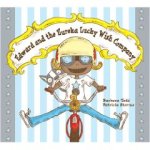 Patricia is generously giving away an autographed copy of Edward and the Eureka Lucky Wish Company!
Please leave a comment to be entered into the drawing.
Blog or Tweet about the interview and get another two entries–just let me know here or on Twitter. Winner will be picked by Random.org one week from today! Good luck!
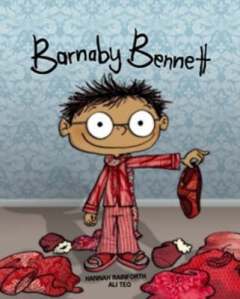 “Pooh-pooh on the blue,” Barnaby said.
“I’m Barnaby Bennett and I only wear red.”
Young children declare their emerging independence in many ways. They don’t cling to Mom and Dad so tightly. They insist on doing simple tasks by themselves. And they choose their favorite things—a huggable stuffed toy, a cherished blanket, or a bright, cheery color.
Come on, what kid doesn’t have a favorite color? Every morning my toddler asks to wear “pretty purple.” My Kindergartener’s closet is filled with “Shrek green.” So when we read Barnaby Bennett for the first time, we instantly understood Barnaby’s passion for pigment.
With a jaunty rhyme, author Hannah Rainforth dresses Barnaby Bennett in toe-to-head red. But there’s a problem: Barnaby wears the same red clothes every day. He loves them so much he won’t take them off. His shirt, shorts and socks get stinky. (Let’s just say we’re happy this isn’t a scratch-n-sniff book!)
Barnaby’s family tries to convince him to change colors. Dad thinks navy is nice. Sissy’s keen on green. And Bro? He’s mellow for yellow. But Barnaby is no chameleon!
Then Barnaby’s clever Aunt finds a creative way to break Barnaby of his crimson obsession. Does he become partial to pink? Go ga-ga over gold? Get smitten with silver? You’ll just have to read it to find out!
Ali Teo’s mixed-media illustrations combine quirky cartoon characters and photographed elements—blue jeans, fabric patterns, toys—resulting in something “real” to discover on every spread. The pages seem textured; alive. Even the words jump out with clever use of funky fonts. “Yanked” stretches across the page and “sludge” squirms.
Originally published in New Zealand, Star Bright Books recently brought this colorful Kiwi to the US. (Thanks, Star Bright!) This vibrant tale will knock your socks off, even if they aren’t red. Now if you’ll excuse me, I have to jump into my cherry jammies and read Barnaby with the kids.
 Barnaby Bennett
Story by Hannah Rainforth
Illustrated by Ali Teo
Star Bright Books, November 2008
Want it? Get it!





 Writing for Kids (While Raising Them)