You are currently browsing the category archive for the ‘Middle Grade Fiction’ category.
 by Alyson Heller
As I dodged shoppers last Friday at my local mall, I came to realize that trying to find that next “big thing” in publishing is like to trying to find a great pair of shoes on sale—really hard to do, may cause some panic attacks, but once in a while, you will find the perfect fit.
We editors have a love/hate relationship with that “thrill of the hunt”—with every email from an agent, we hope that once we click open the attachment or email, there will be a pitch or manuscript so amazing, we will have to stop our day to read and convince our powers-to-be to let us acquire it. Most of the time, it isn’t quite what we are looking for—it might not be our taste, or in line with our house publishing strategy—but every once in a while, there is a pitch or idea that makes us pause our day.
For me, I always have that gut feeling—much like that fabulous piece of jewelry that draws your eye, I just know that I absolutely have to try to make sure that particular manuscript gets to stay with me, knowing that I would be so very bummed out if I couldn’t work on the project. There’s usually a unique hook—an idea that hasn’t been done over and over and over again—or a character that I immediately fall in love with that triggers that feeling. I also try to see if there is something timeless about the story; a book that you know readers will think is still relevant to their world 10 years from now—the little black dress of publishing, so to speak.
Of course, love for the idea isn’t enough to propel that manuscript into something that can go directly from my in-box to the local bookstore. Even though this may have caught my eye, I need to make sure that the story ultimately can fit into the overall marketplace and fit in with our list. That means a revision or two (sometimes 3!), making sure that the author shares our vision for their project, and coordinating the best PR possible for the title.
Though writing may seem like a solitary endeavor, the editing process is a team effort, and one of the great joys I have with my job. Even though it can be daunting, that chase, that knowledge that another fantastic story for kids could be sitting with me (or a member of my terrific team), is what keeps me going—and what makes this crazy, wonderful, unpredictable world of publishing so great. There’s nothing like finally seeing that finished product hit the shelves—and knowing that book will hopefully be someone’s perfect fit.
Alyson is an assistant editor with Aladdin Books, a kid-centric imprint featuring titles with strong commercial appeal for readers of all ages up to tween.
Alyson was part of the S&S Associate’s Program before landing her job with the Aladdin imprint and becoming part of a wonderful team. Alyson works on everything from picture books through middle-grade novels. She has had the privilege of working with some fantastic authors (and agents!) during her time with S&S. Some new and upcoming titles that she has edited or co-edited include Just Add Magic by Cindy Callaghan, Odd Girl In by Jo Whittemore, Sprinkles and Secrets by Lisa Schroeder, Cold Case by Julia Platt Leonard, The Monstore by Tara Lazar and I Loathe You by David Slonim.
In addition to her love for reading and writing, Alyson is also a huge fan of traveling, baking, eating things that are bad for you, awful reality t.v., and all things sparkly. She currently lives in Connecticut.
Simon & Schuster has generously donated several picture book prizes for PiBoIdMo. Winners for the titles below will be announced on December 4th, randomly selected from those who completed the 30-ideas-in-30-days challenge. Thanks to Alyson and Simon & Schuster for the prizes!





 by Pam Calvert
So, today you’re supposed to be eating lots of turkey, stuffing, mashed potatoes, dressing, pies (emphasis on the plural here)…AND talking (not fighting) with your relatives. Enjoying your day! But still…it IS Picture Book Idea Month and so you’re also supposed to be thinking of a blockbuster picture book idea today as well. But I’m not thinking about today. No. I’m thinking about tomorrow.
 BLACK FRIDAY!
Mwahahahaaaa!
And in honor of Black Friday, I’m going to veer off from the normal “how I get my ideas” blog post to a more material slant—something all picture book writers should have sitting with them when they’re about to brainstorm. Something you should ask for Christmas so you can weave all those good ideas into editor-loving stories. It’s something I bought myself (SPLURGED on) several years ago and it helped me brainstorm two of my upcoming picture books.
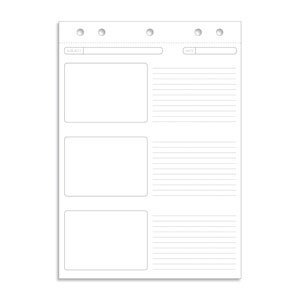
It’s called the Magna Storyboard Pad (pictured). Notice it has three areas where you can draw and lines for writing. “But WAIT!” you say. “I’M NOT AN ILLUSTRATOR!”
Well, I’m not either, but if you’re going to be a picture book author, you better be visualizing your story even before you start writing. This pad forces you to think in pictures. A lot of times, it’s easy for me to get swept away by my words when I should be visualizing my story first. And since I bought this pad, thinking in pictures has never been easier. And another secret?
No one has to see your pictures!
But I’ll show you some of mine so you’ll feel better about your artistic talent (because it’s gotta be better).
When I started on the sequel to my math adventure, MULTIPLYING MENACE, my editor told me I needed to meld one of my contracted stories with an earlier version of the sequel, MULTIPLYING MENACE DIVIDES. The contracted story was entitled, THE FROG PRINCE IN FRACTIONLAND. That meant I had to apply frogs throughout my original (that didn’t even have a frog in the background.) And I had to apply fractions throughout. This required pictures. Oh yeah, and I needed another villain. Panicking, I grabbed my math books, desperately searching for an idea. But then I remembered the storyboard pads. I hadn’t used them (even though it was at the top of my things to do list). I started with the new villain…

Her name was Diva Divine in a feeble attempt to use a play on words with division. Of course, through revision her name ended up being Matilda, but this is what she ended up looking like in the book:

There’s quite a bit of resemblance and I never had a talk with the illustrator, Wayne Geehan, about the witch. He suspected what she’d be like from her actions. But without my visualization on paper, her character may not have come out so well.
Now, the witch was the easy part. So much fun. I had her reading In Stye magazine and wearing Jimmy Ooze shoes (um…that never made it in the book…ha!).
The next part was thinking in fractions. So, I plotted out every element. Here’s one page example when I had to show how the division magic worked with dividing twelve kittens. I brainstormed some ways I could show this on the storyboard paper:
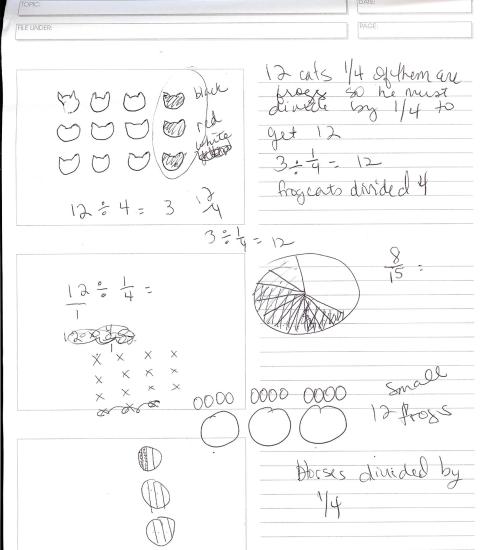
Not only did I brainstorm dividing the kittens into frogs, but I had to divide things by fractions, which makes a larger number. In the storyboard picture I used frogs, but they ended up being pigs. Here’s the finished page of the kittens.

After I completed this story, I was hooked! I would never again brainstorm without my storypad.
Here’s another example using my newest PRINCESS PEEPERS book entitled, PRINCESS PEEPERS PICKS A PET. These are the initial thoughts. Notice, I’m terrible at illustrating, but the ideas flow much more freely when I use it, and I can tell if my story would lend itself well to illustration. You need at least sixteen different scene changes for a picture book.
Here is Peepers trying to find a pet for the pet show:
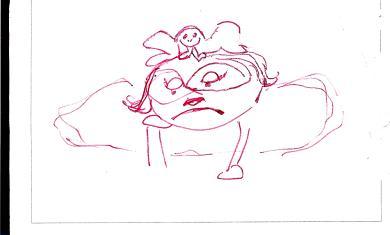
She’s frustrated because she can’t find anything (that’s a frog on her head!) In the finished book, she does find the frog and it looks like this:

Before I leave you with your Black Friday find, I’ll show you my newest picture book idea brainstorm.
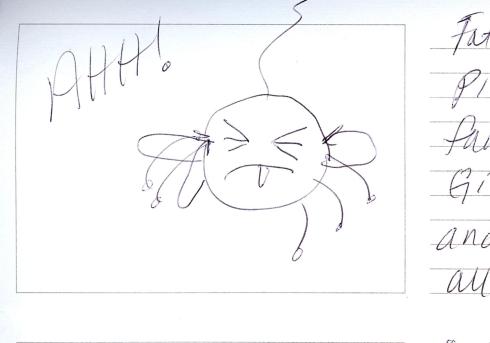
HAPPY THANKSGIVING!
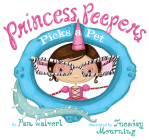
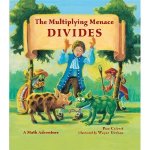 Pam Calvert has written picture books and stories for over ten years. Her picture books include MULTIPLYING MENACE: THE REVENGE OF RUMPELSTILTSKIN and PRINCESS PEEPERS, a Scholastic Book Clubs selection and listed as a Texas Mockingbird picture book pick. Her newest picture books will be out in the spring of 2011 entitled, MULTIPLYING MENACE DIVIDES and PRINCESS PEEPERS PICKS A PET. She’s writing new picture books as well as longer stories from her home in Houston, Texas.
 by
by I don’t know about you, but I’m a little weird. I like to make up words and twist them around, and call things and people by funny names. Sometimes this amuses other people, and it always amuses me. That’s one of the keys to storytelling: having fun with words and concepts, and not being afraid to put in your own little bit of wackiness.
Now, I love picture books, but when it comes to writing I tend to be a novel person. I write long. So I was a bit surprised when an idea for a picture book popped into my head and demanded to be written. It was inspired by my dog Emma. (Isn’t she cute?)
 Ever since my husband and I adopted Emma over the summer, it’s become a hobby of mine to come up with silly names for her. Miss Emma Dog. The Furry One. Emmakin Skywalker. She doesn’t seem to mind.
Emma gets very excited when she thinks she’s going for a walk. One morning, when she was trying to speed up the process by whimpering, I told her: “Hold on, Dogosaurus. We’re going.”
As we were on our walk, that word kept bouncing around in my head. Dogosaurus. And when I glanced over at Emma’s shadow, with its long snout and sharp teeth, it didn’t seem that far-fetched that a dog could turn into a dinosaur. And wow, what a whole lot of chaos that would be! Thus the idea was born.
At this point, the manuscript is still in its infancy. It’s gone through some major revisions, and I’m sure it’ll go through several more before it’s anywhere near done. But the initial idea, the initial weirdness, keeps me inspired to continue working on the story.
So as you’re thinking of ideas this month, why not try embracing your weirdness? Maybe there are things you do or say that people roll their eyes at? Use them! Maybe there’s a joke you made up that makes you laugh every single time you tell it? Mine it! The idea might be strange and silly, and it might entertain only you, but you never know where your inner weirdness can take you.
Anna Staniszewski lives near Boston with her husband and their adorably insane black Lab. She’s represented by Ammi-Joan Paquette of the Erin Murphy Literary Agency. Anna’s debut novel, MY UN-FAIRY TALE LIFE, will be published by Sourcebooks Jabberwocky in September 2011. You can visit her at www.annastan.com.
 by
by A great road trip game is called “No, It Wasn’t.” It’s played with partners. One begins telling a story—any story. The other interrupts as often as desired with, “No, it wasn’t”—or any grammatically-correct contradiction.
It may sound like this:
1: One morning, Jane went for a walk.
2: No, she didn’t.
1: That’s right. It wasn’t a walk. She was running. For exercise.
2: No, it wasn’t.
1: Actually, it was because someone was chasing her. A bad guy.
2: No, it wasn’t.
1: No, it was the police. Jane is the bad guy.
And so on. The challenge to the storyteller is to instantly change direction, as often as they’re prompted. As the story continues, the predictable story lines usually fall away, and the requirement to make changes opens the doors to great creativity. A new story begins to emerge, one that goes in radical new directions. In the example with Jane above, it would’ve originally been a story about her going to visit her friends. In only three twists, Jane is on the run from the police.
This can be a useful brainstorming game for writers too. Maybe you won’t end up writing the story in the direction the game led you, but it does force you to explore more options than Jane simply being out for a walk.
If you’re already working on a premise, write a quick logline for it. In your first sentence, try a “no, it wasn’t,” and see where it leads you.
Or start fresh. Choose a main character, any main character, then give them something to do. And so your game begins.
Need a prompt?
Here it is: When (Main Character) came home that day an old friend was waiting.
No, it wasn’t.
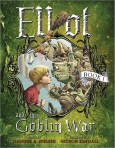 Jennifer A. Nielsen’s debut novel Elliot and the Goblin War was released in October 2010. And it comes with a warning–as of today, only 7 children who have ever read this book have lived to tell about it. If you’re very brave, perhaps you’re willing to take your chance with it.
The next book in the series, Elliot and the Pixie Plot will be released in May 2011. It’s pretty much like the first book, except it has a different plot. Different artwork too. Because that’d be pretty lame if they just used the same art all over again.
So this self-proclaimed intergalactic superpower Mike Jung and I have a little middle grade book review thing going. You may have read our bookish banter regarding Nan Marino’s touching Neil Armstrong is My Uncle and Other Lies Muscle Man McGinty Told Me or our unique take on Newbery Medalist Rebecca Stead’s time-travel thriller When You Reach Me. (After all, Elizabeth Bird did mention our review in FuseNews.)
In a pathetic, fly-by-the-seat-of-our-pants fashion we dubbed ourselves the Ebert and Roeper of children’s book reviews.
We think you agree that the name lacks the imaginative flair and je-ne-sais-quoi mystique you’ve come to expect from Tara and Mike. Especially Mike. In the words of the immortal Steve Martin, he’s a wild and crazy guy.
So we thought–hey–we’re writers! We can do better than that. What’s better yet–we know a lot of writers! Smart writers! (Notice how I’m buttering you up.) They can certainly do better than that! In fact, why don’t we sit back and do nothing while they do all the work? Yes, we’ll have THEM choose the title for our review series while we collect all the middle grade glory!
 We’re even offering up a prize! And again in the words of the immortal Steve Martin: “I’m picking out a Thermos for you. Not an ordinary Thermos for you. But the extra best Thermos that you can buy, with vinyl and stripes and a cup built right in.”
Well, I’m not sure if the prize is a Thermos. But it’s gonna be somethin’. Yes, you’re guaranteed SOMETHIN’.
Head on over to Mike’s Little Bloggy Wog for more details.
And tell him Ebert sent you. Or Roeper. We haven’t quite figured out who is who. (You see why we need a new name?)
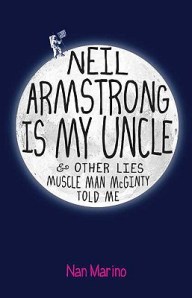 Who are Tara and Mike? Think of Ebert and Roeper–but discussing children’s books instead of movies. This week we’re giving two bookmarks up to Neil Armstrong is My Uncle & Other Lies Muscle Man McGinty Told Me by Nan Marino (Roaring Brook Press, May 2009).
“Muscle Man McGinty is a squirrelly runt, a lying snake, and a pitiful excuse for a ten-year old. The problem is…only I can see him for what he really is.”
Tara: So Mike, what attracted you to Neil Armstrong is My Uncle?
Mike Jung: Well, Tara, it was partly the cover (the moon, it’s a very evocative image), partly Nan being a Blueboarder and seeming like a decent sort, and partly the title, which really spoke to me somehow—I instantly felt like there was a story right there in the title. Why’d you read it?
Tara: The title especially drew me in. Even though it mentions the first man on the moon, I didn’t realize the story took place during the summer of 1969, so I was pleasantly surprised. I became immersed in the summers of my childhood, anticipating the arrival of the ice cream truck, just like the kids on Ramble Street.
Before I read it, I imagined Muscle Man McGinty was some sideshow freak at a local carnival. I’m glad he turned out to be a scrawny ten-year-old instead.
Mike: Ha! I was caught off-guard by the time period too. 1969 was the veeeeeery beginning of my time (I was born in the summer of ’69) so it didn’t trigger any memories, but I thought the setting was so vivid, and so lovingly created, that I was immersed in it right away. And I had the same thought about Muscle Man McGinty! I also loved the character he turned out to be—so much sadness, courage, generosity and patience rolled up in one runty little kid.
Tara: Uh, maybe I shouldn’t have dated myself like that. 1969 was before my time, but still, if you remove the historical backdrop—Vietnam and the lunar landing—the story has a timeless feel. It felt like 1979 in my neighborhood, but it could easily take place in 2009, although the kids would be wearing bike helmets and the adults would be talking about Afghanistan and flying cars. If we had flying cars, that is.
What about the novel hooked you?
Mike: I was hooked by more than one thing—the setting, as I mentioned, was superb—but it was the characters that really grabbed me, especially Tammy. I love the voice of Tammy. She’s an incredibly genuine, multi-faceted, fully-realized character. In my eyes, one of the ways to create a successful protagonist is to put all their flaws on glaring, unmistakable display, but still make them sympathetic and understandable. Tammy often comes across as self-involved, oblivious and sullen in all the normal 10-year-old ways—she’s not some kind of villain, but she’s also not super-cuddly and lovable. I loved her anyway.
Tara: Confession: I didn’t love Tammy all the way through the novel. But I loved that I didn’t love her. I can’t recall the last time I felt such conflicting emotion over a main character. I rooted for her, even though I didn’t necessarily agree with her actions. The narration was brilliant because it revealed Tamara’s world so slowly, making you trust her implicitly at first, but toward the end you realized she could be her own antagonist. It felt like that Oscar Wilde song by Company of Thieves: “We are all our own devil.” Tammy wants what she wants and she doesn’t see what she needs to see. I’m being very cryptic, aren’t I?
And I also have to admit, I loved liar Muscle Man more than Tammy sometimes. The way he complimented Tammy’s pitching during the Muscle-Man-against-the-whole-neighborhood kickball game was hilarious because it infuriated Tammy. She wanted to expose him as a loser and he wanted a friend. Muscle Man had a big heart and he was desperate to fill it up.
Why would you recommend this book?
Mike: YOU ARE BEING TERRIBLY CRYPTIC. No problem, though, it’ll keep your blog readers on their toes, show ’em life is real, etc. I agree about the gradual reveal of Tammy’s world—her dysfunctional family, her envy toward the neighbors, her brother and his friend—it unfolds beautifully. There are moments when Muscle Man just broke my heart—you got it exactly right, such a big heart and such desperate attempts to fill it up.
Ultimately that’s why I’d recommend the book, it has tremendous heart. The characters have so much emotional depth, there are moments of real poignancy, and the book ended with the perfect mixture of loneliness, grief, solace, reconciliation and hope. This book is a tour de force, and I’m gonna pounce on Nan’s next one.
Tara: Mike, there’s nothing left to say because you’ve said it all. All the puzzle pieces came together at the end in a very satisfying way, but I still see opportunity for a sequel. Nan, could you get on that right away, please?
 Neil Armstrong is My Uncle & Other Lies Muscle Man McGinty Told Me
by Nan Marino
Roaring Brook Press
May, 2009
Want it? Sure you do!

Blog Guest
Thanks to blog guest Mike Jung for the book banter.
Mike Jung has delusions of galactic conquest–lunar death beams, interstellar armadas, alien flunkies, etc.–but he probably has better odds for achieving notoriety by elbowing his way into the realm of published middle-grade fiction writers. He therefore restricts his empire-building activities to Twitter, which is better anyway because he doesn’t have to get out of his chair. Mike lives in Northern California with his wife and daughter, who exhibit immense patience for all his weirdo tendencies.
Reach for a Memory
by Nan Marino
When it comes to writing, there are good and bad days. On a good day, you’ve got tons of ideas. Words flow. The sun shines. Everything is easy. But there are times when idea spigot gets a little clogged. Don’t worry. It happens to everyone.
On days when I’m looking for the mental equivalent of bottle of liquid Drano, I reach back to my childhood memories. First I think of a particular moment and try to recall the feelings surrounding it. Then I write. When I’m done, I move things around, alter it a little (or a lot), and turn it into fiction.
My debut middle grade novel, Neil Armstrong is My Uncle and Other Lies Muscle Man McGinty Told Me, is filled with altered memories. When I was about ten, a boy who lived on my street challenged the entire block to a game of kickball. All of us against one kid! In real life after about five minutes, we got bored watching him chase after the ball, and we moved onto something else. In my book, that game stretches out for an entire week.
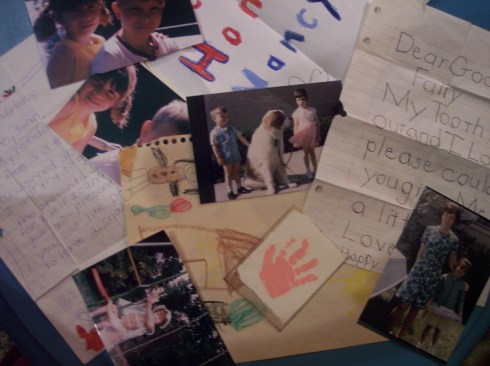
Childhood memories make great writing prompts. Below are more memories I incorporated into my book. Feel free to write about any of them to get your creative juices flowing:
The Ice Cream Truck: When 4th or 5th graders send me drawings of scenes from my book, someone always draws the ice cream truck scene. Everyone connects with Mr. Softee. It’s an iconic symbol of summer. Remember waiting for the ice cream truck to come around? Did you have a favorite flavor ice cream?
Kickball, baseball, handball: Did you play? Were you one of those kids who took it seriously or did you sit on the sidelines?
Barbeques: I like barbeques because they happen over and over again. We eat the same kind of food and gather together with the same group of family or friends. It creates that feeling of endless summer days. What happened at your barbeques? Did you have an uncle who made great cherry pies? Was there a neighbor who sang a special song?
Dandelions: Nothing separates adults and children more than their feelings about dandelions. It’s the first flower you probably picked, and the first one you gave to someone you loved. I dare you to find one person under the age of ten who thinks it makes perfectly good sense to spend your precious weekend hours trying to eradicate them from your front lawn.
Songs and Dances: Madonna or Nirvana? Springsteen or Sinatra? A single song can take you back to that day when you were seven… Need more inspiration? Download it and dance!
Historical events: What happened when you were young? Do you remember the first time a man walked on the moon, the bicentennial, the assassination of John Lennon, the Berlin Wall coming down, the first Gulf War, the Y2K scare? From a child’s eyes, these events are seen differently.
Your secret place: Was it up in a tree? Behind the couch? Or up on the garage roof?
Remembering ordinary moments from your childhood is a great way to begin writing. Next time you need some inspiration for your fiction, reach for a memory.
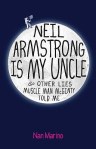 Nan Marino spent her childhood climbing trees and hanging out on garage roofs in the town of Massapequa Park, New York. Since then, she’s ventured a hundred miles south to the Jersey shore where she works as a librarian and lives with her husband and their dog. Neil Armstrong Is My Uncle and Other Lies Muscle Man McGinty Told Me, published by Roaring Brook Press (May 2009), is her first novel.
BUGS MAKE IT BIG IN GRAPHIC NOVELS…HERE’S HOW
by Aaaron Reynolds & Neil Numberman
(Interior. Aaron Reynolds, a writer of children’s books and graphic novels, is sitting at his writing desk. He’s typing, but suddenly stops when a shadow falls over his screen. It’s a kid, about ten or eleven.)
Aaron: (looking up) Hey.
Kid: Hey. Whatcha doin’?
Aaron: Um…writing. Who are you? What are you doing in my writing room?
Kid: I’m just some random kid.
Aaron: Ah. A random kid in my writing room. Okay.
Kid: Yeah. Act like I’m not here. (pause…Aaron starts to get back to work, but is interrupted) Aren’t you an author?
Aaron: (turning back around) Ignore you, huh? That’s gonna be tricky. Yeah. I write kid’s books and graphic novels.
Kid: Graphic novels? Like comic books?
Aaron: Kinda.
Kid: Whatcha writing now?
Aaron: An article about how a graphic novel gets made, but I wanted to write it LIKE a graphic novel, so that’s what I’m doing.
Kid: But…there’s no pictures. A graphic novel has lots of pictures.
Aaron: Not at first. Not mine anyway.
Kid: What?
Aaron: Seriously. I don’t draw.
Kid: I must have the wrong house then. I thought the dude that lives here makes graphic novels.
Aaron: I do. But I don’t draw them….I write them.
(Kid pauses while he thinks about this, then…)
Kid: That’s messed up.
Aaron: No, it’s not.
Kid: You can’t make a graphic novel without being able to draw.
Aaron: Well, I do. Like my new graphic novel…it’s called Joey Fly, Private Eye…
Kid: Way to work that in there. Nice plug. Smooth.
Aaron: Yeah, thanks. Well, Joey Fly starts out like this. A script, just like this one.
Kid: Just the stuff people say?
Aaron: Mostly. I also write in what I see happening in each scene.
(Kid flops into a big cushy chair and puts his feet on Aaron’s writing desk, makes himself at home. He looks at Aaron like he’s lost his mind.)
Aaron: See? Like that. It’s called “stage directions.”
Kid: Oh cool! Like actions and stuff!
Aaron: Yeah, exactly.
Kid: Do it again.
(Kid gets up, kind of excited now. He’s putting it all together in his head, but then he notices a fresh sandwich on Aaron’s desk. Goes over, lifts the bread…he’s kinda hungry…but decides he doesn’t like tuna. Flops back down in the chair.)
Kid: Hey, that’s awesome how you made me do all that stuff! And I do hate tuna.
Aaron: It’s a script. In the graphic novel, I write the story. I come up with the characters. In Joey Fly, Private Eye, I create what happens, what characters are in it, all that stuff. Then I put it into a story…a script like this.
Kid: But it’s not a graphic novel. No pictures.
Aaron: Not yet. It will be soon. But first, I break it into panels.
Kid: Panels?
Panel
Aaron: Like this. Chunks. How I imagine it will get broken into boxes in the finished graphic novel. This helps me figure out the flow and pacing of the story, helps me cut extra junk that’s not needed, and helps the illustrator figure out how he’s gonna lay out the pictures on the page.
Panel
Kid: Cool. I notice you use lots of words like “gonna” and “whatcha” and stuff. My Language Arts teacher would go nuts on you for that.
Panel
Aaron: Yeah, well… I try to write how people really talk. I think that’s important, especially for a graphic novel. It all depends on the character. Like, Joey Fly says some gonnas, but he also uses lots of detective-y phrases…
Panel
Joey: Life in the bug city. It ain’t easy. Crime sticks to this city like a one-winged fly on a fifty-cent swatter.
Panel
Aaron: Like that. That’s his opening line in the book.
Kid: Okay, that’s pretty funny.
Panel
Aaron: Well, I try.
Panel
Kid: But it’s still not a graphic novel.
Panel
Aaron: Man, for a random kid who shows up in my writing room, you’re seriously pushy.
Panel
Kid: Do you know many eleven-year-olds? We’re all like this.
Aaron: That’s right. Not being one, I forget sometimes.
Panel
Aaron: Well, now that it’s all broken into panels, I give it to my publisher. And once she’s happy with it, she sends it off to the illustrator and he starts drawing.
Panel
Kid: You tell him what to draw?
Aaron: No.
Panel
Kid: You tell him what the characters should look like?
Aaron: No.
Panel
Kid: What do you tell him?
Aaron: Nothing. Most of the time, we never even meet.
Panel
(pause…the kid’s mouth is hanging open.)
Panel
Kid: That is seriously messed up.
Panel
Aaron: That’s how it works. Unless you are the writer and the illustrator (which I’m not…I don’t draw, remember?), that’s how it works.
Panel
Kid: So what happens then?
Aaron: The illustrator looks at it and begins to sketch out what he thinks the characters look like.
Panel
Aaron: Like, for Joey Fly, Private Eye, the illustrator is a guy named Neil Numberman.
Panel
Neil: Hey kid. What’s up? Hey Aaron.
Panel
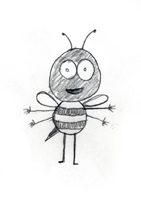
Aaron: Hey Neil. So, Neil might decide after reading this script that you look like this:
Panel
Kid: That’s me?
Neil: Yep.
Panel
Kid: You made me a bug!
Neil: Well, we’re talking about Joey Fly, Private Eye, so I’m thinking in bugs. It’s my job to use my imagination, to come up with my ideas of what Aaron’s characters and story look like.
Panel
Kid: Cool.
Panel
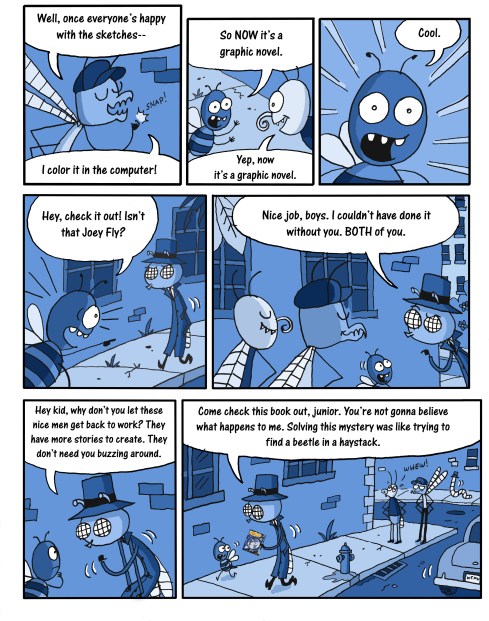
Neil: And as I start drawing and figuring out what it all looks like, Aaron’s story moves away from being a script and I start creating real characters…

Neil: …and pretty soon, I take Aaron’s written words and begin to put them into the mouths of the characters I’ve created.


Aaron Reynolds is a human, not a bug, but he often writes about bugs. He is the author of Chicks and Salsa, Superhero School, Buffalo Wings, and, of course, the Joey Fly, Private Eye graphic novels.
Neil Numberman is a termite currently residing in New York City. Joey Fly, Private Eye is his first graphic novel, but he is also the author/illustrator of the picture book Do NOT Build a Frankenstein.

So there you are, folks. That’s how to make a graphic novel. Thanks, Aaron & Neil. (And Joey & Sammy, too.)
PiBoIdMo’ers, maybe you’d like to approach your next picture book idea in graphic terms. Your story doesn’t have to be a novel to fit the format. Author/illustrator Sarah Dillard penned Perfectly Arugula in this style, with perfect results.
So, how’s it going today?
Want to be a fly on the wall in an agent’s office? If you were at the NJ-SCBWI conference last week, you got that kind of insider buzz. Some top agents in children’s publishing revealed what’s been sitting on their desks, and more importantly, what hasn’t been submitted.
The agent panel featured:
- Jill Corcoran, Herman Agency Inc.
- Jenni Ferrari-Adler, Brick House Literary Agents
- Rachel Orr, Prospect Agency
- Scott Treimel, S©ott Treimel NY
- Emily van Beek, Pippin Properties
- Marietta Zacker, Nancy Gallt Literary Agency
After brief introductions, the agents welcomed questions. The first attendee (OK, me) wanted to know: “What trends are you seeing in your submissions? Specifically, what are you seeing too often? And what aren’t you seeing?”
The agents were quick to say that vampires were overdone. They’re seeing a lot of fantasy, especially with werewolves and zombies–on their own but also vampire/werewolf/zombie hybrids.
Jill Corcoran added, “I’m seeing a lot of plot-driven manuscripts, but where the character isn’t fully developed.”
The agents thought that paranormal hadn’t yet peaked, while historicals were down. That’s not to say a fantastic historical couldn’t come along and raise the whole genre, but as of now, they weren’t selling well.
They also added, “please don’t send anything about bullies. We’re sick of bullies.” Seems there was a bully article in a prominent parenting magazine (or perhaps it was an Oprah episode?) which began an unwelcomed trend.
Turning their attention to what wasn’t being submitted, Marietta Zacker said, “We’re not seeing a true depiction and representation of our diverse population. Kids aren’t seeing themselves in books and that’s a problem.”
Rachel Orr said, “And please realize there should be other Chinese stories than those about Chinese New Year. And stories featuring African-Americans that are about something other than slavery.”
Scott Treimel added, “Don’t send a story about three characters from three different races that have adventures.” He said such stories tended to be stereotypical and poorly conceived.
Ms. Zacker emphasized, “Certainly, be true to your voice. But write outside of yourself. Look beyond yourself to the world around you.”
Rachel Orr commented that she sees stories about a kid who moves to a new house far too often.
Scott Treimel wondered, “Where are the stories about the boys who feel weird about their sexuality? What if the girl is aggressive for a change?”
The agents agreed that in regards to sex in YA novels, the sky’s the limit, but it must be organic to the story. Don’t be shocking just for shock’s sake.
An attendee asked if she had been rejected by an agent, but spent several months polishing the manuscript, is it acceptable to submit again?
The agents said that the writer should first look to the agent for a response. Typically, they’ll note if they want to see a revision. And a writer must put the work in before coming back a second time. Marietta Zacker said, “This sounds like common sense, but don’t forget that we remember you. We really do read submissions. Don’t make us feel like we don’t know you. Please say, ‘I sent this to you six months ago but I’ve revised it…'”
Emily van Beek chimed in with: “Remember that the world owes you nothing. You owe the world your best work.”
In regards to working with an agent, the agents said that their business is all about relationships and trust. “We’re partners in your career. We’re architects for your career. We have a design for you.”
Also remember that an agent has their favorite editors so they’re tuned to the tastes of a few dozen editors, but not all of them. It pays to shop your work around to find the best match.
And one of the agents commented that if something isn’t selling, move on. “I wonder about those people who try to sell the same story year after year. You’re a writer! Write something else.”
When the agents were asked what they’re currently working on, books they’re excited about, Marietta Zacker said they are asked this question frequently, “but we always shoot ourselves in the foot when we answer. We don’t want to pigeonhole ourselves. You shouldn’t necessarily send to us just because we liked something in particular. And we don’t want you to write to that preference, either.” Agents have a wide range of tastes. “We don’t know we want it until we read it.”
Emily van Beek talked about the importance of falling in love with a manuscript in order to represent it because they do all work on spec. “We don’t get paid until we sell it.” So her mantra tends to be, “If you can resist it, do. I know that sounds [harsh], but it’s true.” She finds projects she can’t live without. Then she has the passion to sell it.
Interestingly, she told us that Kathi Appelt’s Newbery honor The Underneath took two years and underwent eight major revisions.
Scott Treimel added, “Writing and revising are equally important skills.”
Some agents will help edit your manuscript for submission, others may not be that involved. It depends upon the agent. But remember that your agent is not a critique group. Be sure that you have reliable crit partners and that your manuscript is “polished to within an inch of its life” prior to submission.
So when does an agent know that the manuscript is ready to be submitted to editors? When do they let go? Jill Corcoran said, “When I think it’s phenomenal.”
And to end the panel, Jill Corcoran talked about endings. “I love endings that are expected, but unexpected; surprising but logical.”
And I suppose this is a logical place to end this post. Be sure to check back for more from the conference throughout this week!
Thirty-eight agents, editors, art directors and acclaimed authors. Two days. Twenty workshop sessions. The NJ-SCBWI is one little conference that packs a writing wallop.
Over the next few days, I’ll share notes from the event, from my own journal and that of writer Natisha LaPierre. So even if you weren’t there, it will feel like you were. (Just surround yourself with friendly folks passionate about children’s books while you read.)
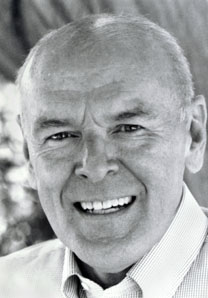 The first keynote presentation by Richard Peck, Newbery award-winning author of The Year Down Yonder, set a serious yet exciting tone for the conference. His unique voice extends beyond his books–when he speaks, he feels as big as a Shakesperean actor, filling the room, enunciating, using his entire body. (It was no surprise to learn that he belongs to a group of authors known as the “Authors Readers Theatre” who travel the country performing each other’s works.) Charming, witty, it is impossible not to be drawn in by Mr. Peck’s dynamic presence.
“I am a writer because of two boys on a raft,” he began, noting his love of Mark Twain. “Writers are readers first. Nobody but a reader ever became a writer. Read 1,000 books before you can write one.”
Mr. Peck encouraged attendees to look at other voices in order to find their own. And what does he think about “write what you know?” Rubbish. “A story is something that never happened to the author,” he said. “I assure you that J.K. Rowling never attended Hogwarts. Beatrix Potter was never a rabbit.”
A writer’s job is to add hope to reality. A story is always about change, and change is animated by epiphany. In his master class on Saturday, Mr. Peck explained epiphany further. When he asked middle school students to define ephiphany, an 8th grade boy said, “Epiphany is when everything changes and you can’t go back.” Mr. Peck thought that was the finest definition he had ever heard. The teacher informed Mr. Peck that the boy had lost his father, and his mother before that. That boy has been overdosed on reality. Now he needs hope.
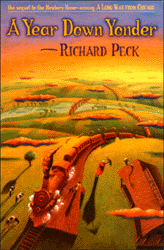 “A lot of fiction is about remembering better days.” The elder characters in Mr. Peck’s books are often patterned after the old men who frequented his father’s filling station in the 1930’s and 40’s. He recalls their conversations and makes “rough music out of real speech.” You can write in the voice of a young character, but have that young person know old people. Children want adults to be strong, but they often can’t find them.
Years ago, the books in his school library were kept under glass and you had to find the teacher for a key. “Consider that metaphor,” he said. “The teacher has the key.” Book are still as precious, but it is up to the writer to make them so. “You can teach children or fear the parent, but you can’t do both. We are the last literature teachers left because we can’t be fired. We’re unemployed!”
Every week Mr. Peck visits the book store and spends an hour perusing first lines. “We live in the age of the sound byte, so you have to ‘byte’ them out front.” He recited the first line of Charlotte’s Web to remind us of its power: “Where’s Papa going with that axe?” Six words on one line ignite the imagination. And then he gave a fine example of voice with M.T. Anderson’s Feed: “We went to the moon to have fun but the moon turned out to completely suck.”
He always travels with a book from the past and a new book. The book from the past reminds him that we’re all links in a chain, while the new title keeps him tuned to what’s coming next. “If we don’t know what publishers are releasing this year, how will we get on next year’s list?” He’s reading Laurie Halse Anderson’s Wintergirls, “the greatest argument for writing in first person. It skates too near to the truth.”
Mr. Peck concluded by reminding us that “a story is always a question, never an answer. We can ask the questions that no one else will ask.” Story is the most important gift we can give our youth. Think about that 8th grade boy. “Story might be the companion that a child needs.”





 Writing for Kids (While Raising Them)