You are currently browsing the category archive for the ‘Children’s Writing’ category.

I have something that’s so real.
Reality is your friend. That’s the best piece of advice I can give anyone about anything. Really.
Of course, it strikes even me that someone who makes a living distorting reality (i.e., writing fiction) would be so high on reality. Yet, here I am, with my message to other writers about elevating their fiction by keeping it real…
Now, let me take a step back and tell you that I wasn’t sure what this post was going to be about when I came up with this reality idea. (It was really only based on Tara’s brilliant Vogue cover.) Should I talk about the business of publishing, or the craft of writing? Should I talk about balancing life and art, or about using literature to explore life through art? I could see the positives in each of those approaches, and it made it really difficult to get started. So then I thought, maybe I could touch upon a few of these topics? Not all in one post, obviously, but maybe Tara would let me guest blog a few more times?
That’s my plan, at least. Shhh. Don’t tell her.
I’ve decided in this round, I’m going to focus on how we can use the reality of life to create meaningful art. So, to get back to where we started:
Reality is your friend. That’s the best piece of advice I can give anyone about anything. Really. But especially when it comes to writing fiction, reality is your best friend. It’s reality that makes your fiction come to life.
 Whenever I’m at a school to talk about writing with kids, I spend a lot of time telling kids that every book is an autobiography. Obviously, that doesn’t mean that in my private moments I am a vampire pig (à la HAMPIRE) or a chicken in pajamas (à la CHICKS RUN WILD). But every book I write is informed by my own reality. In some way or another, I am every one of my main characters. My kids are my main characters, too, sometimes individually or sometimes as a blended product, but there’s always a piece of me. Because, at the end of the day, if the only way to be a successful storyteller is to write what you know, well, is there anyone we know better than ourselves?
The temptation when we start writing is to create something grander, bigger, more than ourselves. After all, my life is fairly boring—I barely want to hear about it!—so why would anyone else want to read about my reality? So we start out creating characters that are better than everyone else, smarter, prettier, more talented, more perfect. Their adventures are epic. Their adversaries are the embodiment of evil.
And the result is often—not always, but often—unbelievable. In the “no one would believe this and therefore this story rings false” way.
As much as readers turn to literature to escape, to experience things that they cannot do, the reality is (and, remember, reality is your friend) that no reader likes to read about someone better than him for too long. The main character has to be relatable to keep a reader’s interest. And how do you craft a relatable character?
By making sure he is just a regular guy (who finds himself in extraordinary circumstances.) Basically, by keeping him real.
(This is hardly new advice. In fact, I’ve given this advice myself in a different form in my picture book workshops – that you should always make sure your main character is interesting, but well and truly flawed. Because it’s the flaws that keep him real.)
So, how do we use reality to craft fictional characters? Obviously, we can’t just write about ourselves or our kids exactly as we are. (Trust me, I’ve tried that. That’s a little too much reality.) The trick, I’ve found, is to choose interesting traits (perhaps from several different sources) and blend them together to create a new, fictional character grounded in reality.
Here are some examples:
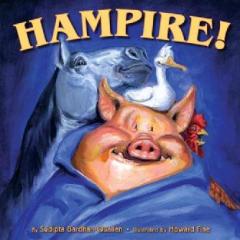 In HAMPIRE, Duck desperately wants a midnight snack, but is worried about running into the dreaded Hampire. The reality: every night, I want a midnight snack, and every night, I am convinced that if I step foot off my bed, the monsters will get me. The fiction: I am not a duck.
In PIRATE PRINCESS (available in May 2012 from HarperCollins), Princess Bea dreams of the pirate life, but when she boards the pirate ship, she realizes she’s awful at deck-swabbing (she has no housekeeping skills), she can’t be their galley cook (no culinary talents), and she is an ineffective lookout in the crow’s nest (she get’s seasick). The reality: I have no housekeeping skills, I have no culinary talents, I get seasick, and I think I’d look dashing in a pirate hat. The fiction: while Princess Bea doesn’t like to dress in silk, brocade, or chintz, and can’t stand the idea of being married to a prince, I love dressing up and look forward to a life with my Prince Charming (yes, Daniel Craig, I’m talking to you!).
In my forthcoming chapter book series, THE SPECTACLES OF DESTINY, the main character, Destiny, discovers she needs glasses. She’s worried about what she will look like (especially about whether they will make her nose look big) and what others will think of her glasses, from her friends on her soccer team to her classmates in the fifth grade. This one is complicated, because I drew from a lot of different sources of reality, so here’s a little chart of some of the sources:
| Something about Destiny | The inspiration |
| She wears glasses | My daughter Brooklyn and I both wear glasses, and we both initially worried about what other people would think of them. |
| She’s concerned about the size of her nose. | I’m concerned about the massive size of my nose. |
| She’s in the 5th grade. | My daughter Bella is in the 5th grade. |
| She loves soccer. | Bella and Brooklyn both love soccer. |
| She plays goalie. | Brooklyn plays goalie. |
| She’s super smart. | Bella and Brooklyn are both super smart. |
| She’s afraid of spiders. | I’m afraid of spiders. |
| She’s Indian American. | My whole family is Indian American. |
| She lives in New Jersey, outside Philadelphia. | We live in New Jersey, outside Philadelphia. |
| Her first pair of glasses are dark tortoiseshell. | Brooklyn’s first pair of glasses are dark tortoiseshell. |
| Her second pair of glasses are black with zebra-printed sides. | Brooklyn’s new pair of glasses are black with zebra-printed sides. |
| Her glasses let her see bits of the future clearly. | Brooklyn’s glasses let her see the present clearly. |
Obviously, I could go on and on with more examples of traits that I drew from my life or from my children’s lives. But you’re getting the idea. Here’s something I would add, though: in every place in the revision process where my editor asked for more detail, the things I added were inevitably true things about someone in my house.
So, one more time, let’s go back to the beginning: reality is your friend.
Do you believe me yet?
Sudipta Bardhan-Quallen is the award-winning author of many, many books for children, including picture books, nonfiction for young readers, and a forthcoming chapter book series called THE SPECTACLES OF DESTINY (due out in 2014). Her picture book QUACKENSTEIN HATCHES A FAMILY was selected for the California Readers 2011 Book Collections for School Libraries. BALLOTS FOR BELVA was named to the 2009 Amelia Bloomer List and received an Oppenheim Toy Portfolio Gold Award in 2008 and FLYING EAGLE was a National Science Teachers Association Outstanding Science Trade Book selection for Students K–12 in 2010. Her science book, NATURE SCIENCE EXPERIMENTS, was named a finalist for the 2011 AAAS/Subaru Science Books & Films Prize for Excellence in Science Books. And her books CHICKS RUN WILD (named one of Bank Street’s Best Children’s Books of the Year in 2012) and HAMPIRE! (nominated for a Maryland Black-Eyed Susan Award) are her personal favorites, and just fabulous.
Sudipta speaks at conferences, educator events, and schools across the country, teaching the craft of writing to children and adults. She lives outside Philadelphia with her three children and an imaginary pony named Penny. Learn more about her and her books at www.sudipta.com.
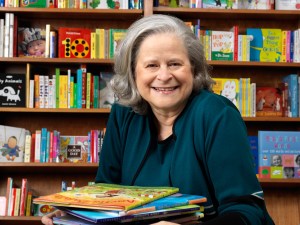
P.S. If you love Sudipta’s author headshot above, her photographer LifeArt Imaging is currently running a Groupon. Click here!
 I am so absolutely thrilled that BOY + BOT releases today because I’ve been waiting for it for a long, long time.
It’s the debut picture book by my good friend, Ame Dyckman—and get this—it’s illustrated by the hugely talented Dan Yaccarino! I mean, this has got to be the best picture book EVER with an author-illustrator team just as lovable as Boy and Bot themselves.
And for this very special day, I’ve got prizes to give away! One AFFIRMATIVELY AWESOME prize pack including BOY + BOT, stickers, bookmarks, and an *exclusive* BOT keychain clip made by author-zoologist-educator-sculptor Jess Keating!
So let’s get on with the fun!
TL: Ame, you and I have been friends for a few years now, after meeting at NJ-SCBWI first page sessions. (I knew I had to get to know you, with your spiky pink hair and Lego bracelet.) Is that how you began your kidlit career, attending SCBWI events?
AD: *laughing* Was my hair pink back then? I don’t remember my hair color at the time (it’s blue, now), but I remember thinking, “Wow! This Tara person is funny and nice and she really knows her kidlit! I like her!” BAM! Friends!
And yes, attending SCBWI events–YAY, NJ-SCBWI!–started everything for me! When I first joined, I knew I wanted to write picture books, but I didn’t know how. My first manuscripts were REALLY bad, but nobody made fun of me. Everybody was helpful. (YOU taught me how to page a PB, remember? I still have your diagram!) I went to as many events as I could—First Page Sessions, Mentoring Workshops, Networking Dinners, Annual Conferences, etc. I learned tons—still do!—and met lots of amazing industry professionals and made lots of wonderful friends. At the 2009 NJ SCBWI Annual Conference, I pitched BOY + BOT to Super Agent Scott Treimel, and he said, “I love it! Let’s work together!”
TL: I distinctly remember the 2009 conference and a certain editor making goo-goo eyes at you during lunch…but he had read your manuscript and was bonkers over BOY + BOT. I thought to myself, GO AME! You could feel the buzz about that manuscript at the event. You were in deep conversation with several agents.
So we want to know—how did this beep-worthy book idea come about?
AD: The short answer: I love robots! (I used to doodle robots instead of doing my math homework. Even in college!) The long answer: I love robots and unusual friendship stories and mirror stories always make me laugh, so I hoped mine would make other people laugh, too.
TL: So BOY + BOT is your debut and it has something like 347 starred industry reviews! Are you thrilled or what?
AD: I’m SO happy, and really grateful for all the reviewer love. Here’s hoping the little Boys (and Girls!) and Bots that Dan and I made the book for love it, too!
TL: We’re chatting on the eve of your book’s release. Will you be able to sleep tonight? It’s a little like Christmas Eve, isn’t it?
AD: It feels like Christmas Eve and Birthday Eve and Leaving-for-Disney-World-Tomorrow Eve all smooshed together! I was up until 3:45 this morning because I was so excited already! (But, I think I’d better try to nap later today—I just searched the fridge and then the entire house looking for the bag of baby carrots, only to find I’d put them in the clothes dryer!)
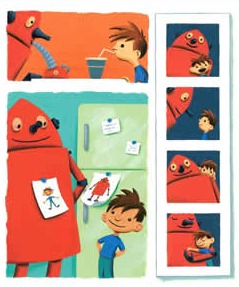 TL: How awesome was it to see Dan Yaccarino’s vision of your characters? Were they anything like you imagined?
AD: Seeing Dan’s first sketches was the greatest! My family gathered around, we clicked “Open,” and then we all shouted, “Look! Bot’s… BIG! That’s BRILLIANT!” (Up until then, we’d envisioned Boy and Bot being the same small size! I dunno why!) But a small Boy and a big Bot is GENIUS! We could already see all the wonderful humor and affection Dan was putting into the characters, and knew his final artwork would be amazing. When it came in, I loved it SO MUCH, I hugged my computer!
TL: *insert clever segue to Dan here*
Howdy Dan, Mr. Keeno Yaccarino! Tell me, when you read Ame’s manuscript, it was love at first sight, right? Kind of like BOY + BOT themselves, right? RIGHT?! (Say “affirmative,” Dan.)
DY: AFFIRMATIVE.
TL: Ame said said when the illustrations came in, she was surprised to see BOT was a big bot and not a small one, like Boy. Why did you make the friends different sizes?
DY: Hmmm. I’m not sure. I guess it was the vision that formed in my mind when I read the manuscript.
There is rarely a logical reason why I do things visually. I listen to my impulse and trust my vision. If it feels right and is right for the book, then I do it.
Then perhaps I’ll rationalize it later.
TL: OK, would you care to rationalize why the inventor is bald?
DY: All inventors should be bald!
TL: *spittake* You’ve got a point there. Plus he reminds me of a lightbulb, so that’s very clever.
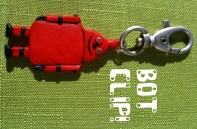 And here’s something else that’s clever—our contest to win the AFFIRMATIVELY AWESOME prize pack (book, Bot clip, stickers & bookmarks) PLUS there’s also TWO MORE copies of BOY + BOT to give away!
WOWZA!
Enter by telling us what you think Boy’s real name is. Ame says she’s always wondered about it. So let her know!
You get one entry for commenting and then one entry for every share on Twitter, Facebook, Pinterest, etc. Just mention it when you comment!
Have fun and good luck! Comments will close the end of April 20 and winners will be announced on April 21.
In 2008, I had the most nerve-wracking 20-minute drive of my life. My knuckles paled, my stomach gurgled, and my thoughts raced faster than the 35 MPH I could manage to clock on the highway. I was on my way to my first kidlit conference ever: the Rutgers University Council on Children’s Literature One-on-One Conference. AHHHH! Somebody help me!
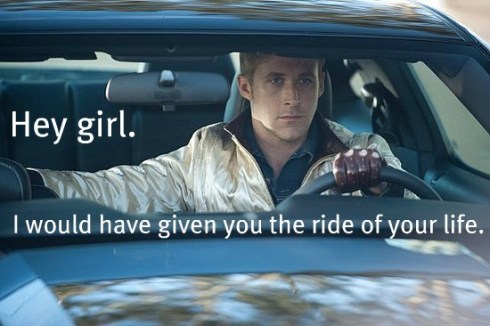
Thanks, Ryan. I know you would have, honey. But I digress…
I knew practically nada about writing for kids, but I had the start to a middle grade novel that had gotten good feedback from my critique group. So I slipped the first three pages into an envelope earlier that summer and waited patiently for the response. Thankfully, I was on vacation for the final two weeks of the countdown. It made my vacation go by much more slowly. I recommend this tactic to anyone who must wait—go to a beach and plop a lounge chair in the sand, facing the ocean. Or facing Ryan Gosling in surfing trunks. You’ll come to love the waiting.
But when the vacation was over and the car hit our driveway, I jumped out and dashed to the post office. Awaiting me was a thick envelope, and remembering the drill from college admissions, I knew this meant a “yes”!
So off I went. I was so green. (Although I wore a cute purple blouse.) But when the event was done, I blogged all about it. It helped me absorb the information like a SCBWI sponge. Hopefully my notes help prepare you for this year’s conference. You can review them all here: RUCCL 2008.
But Tara, what does this all mean?
It means that the RUCCL 2012 Application is now available!
And guess who’s your morning “Success Story” speaker?
As Miss Piggy would say, “MOI!”
Yeah, I was pretty floored they asked me. Trinka Hakes Noble sent me an email saying, “I hope you don’t mind, but I put your name forward as our Inspiration Speaker for the mentee breakfast. Would you be interested?”
Would I be interested? Are you kidding? Of course I am! Wow! Whoopee! Holy macaroni! Keeno Yaccarino!
Wait a second, what did I just agree to…? Pale knuckles and gurgling stomach again?
Well, I am hoping many of my blog readers will be accepted to the conference this year. Because not only do I want to see you succeed, I’ll need your help during my presentation. (Details to come. No, you won’t need to hold a barf bucket. Well, maybe. OK, don’t hold me to that promise.)
So polish up those manuscripts! You’ve got until July 2 to postmark them.
And if you have any questions about the conference, please ask away in the comments!
 Among those represented by the Erin Murphy Literary Agency, Luke Reynolds is known as the *real* Ryan Gosling (you had to be there). Although, I happen to think Luke is cuter, don’t you? Just look at that dimple! And I happen to know he’s a heckuva lot funnier.
He’s also smarter than my Ryan Gosling when it comes to publishing, writing and living.
Luke is the author of KEEP CALM AND QUERY ON: NOTES ON WRITING (AND LIVING) WITH HOPE. And he’s here today to give you that: HOPE. (Plus a copy of his book, plus a query critique, plus a personal “pep talk” phone call!)
Half of Luke’s book includes some reflections for writers on perseverance, hope, humor, gratitude, and work ethic, while the other half includes interviews with writers like Daniel Handler (a.k.a. Lemony Snicket), Katherine Erskine, Jane Smiley, and 11 other authors.
Without further Ryan Gosling references, take it away, Ryan! Erm…I mean Luke!
Making a Life
by Luke Reynolds
There are two places where fast, easy manoeuvres and accomplishments are both warranted and worthwhile: 1) In a snowball fight, when your opponents are slinging well-packed cold stuff at you faster than re-runs of Friends episodes appear on TBS; and 2) In getting the kids to bed when they’re already overtired after a long day of snowball fighting.
Most other pursuits in life don’t lend themselves to easy success. And at the top of a very, very long list of Stuff That Takes Forever comes the pursuit of writing. But that’s a good thing—a terribly hard, but fantastically good thing. Because deep down, none of us who love writing want it to be easy anyway. That’s not why we fall in love with something in the first place.
When we were children, people asked us, “What do you want to be when you grow up?” Very few of us, I’m guessing, responded, “I’d really love to find something easy—something that requires little skill, almost no perseverance, and happens fast.” Instead, most of us said we wanted to fly into outer space wearing massive white suits; or we said we wanted to sing on stage in front of a roaring audience; or we wanted to be pilots or race car drivers or scientists who found cures for every kind of disease or explorers who found distant lands.
Or we wanted to be writers.
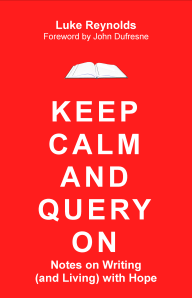 Novelist John Dufresne writes in his Foreword to KEEP CALM AND QUERY ON the following: “Writers want to write, not to have written.” Even though the manuscript of Keep Calm had been finished and proofed and was ready for publication, that line from John’s Foreword hit me hard and fast—much like a well-packed snowball or like a child screaming wildly that he isn’t ready for bed. The line speaks so loudly because it captures the essence of this pursuit we’ve chosen: a creative calling that is about making a life, not a living.
We write because we love the small giddy feeling that rises up like regurgitated food after we’ve eaten too much and then laughed too hard. We write because we like the problems (deep down) that our characters encounter, and we like the fact that there is no easy way out—either for our characters themselves or for us as we make plotting decisions. We write because we know that hearing no enough times and going back to our desks, reworking material, forging new work, and venturing back out into the wild, beautiful possibility of publishing makes our hearts beat fast.
So, deep down, we know it’s not easy. Nor do we want it to be. That’s not why we love it in the first place.
 Why do we love films and stories about underdogs? Why—for instance—does Atticus Finch inspire me to no end? It’s not because he took an easy case that guaranteed a sure-fire victory with no obstacles. I love Atticus because he took an impossible case that guaranteed a loss but his conscience demanded it and his soul echoed the call.
You love the books and characters and films you do, I believe, because you know that triumph is only beautiful when the journey is difficult, that getting the story right is profoundly moving only because you’ve known the story has been so stubbornly wrong—however slightly—in its previous lives.
The MG novel that my agent, the lovely Joan Paquette, signed me on was originally entitled ATTICUS AND ME. It was a story that came down my arteries and out through my fingertips. The first draft, though, would have guaranteed a speedy rejection from Joan. So she didn’t see Atticus until his fourth revision. And then Joan continued to revise Atticus into a character who was more authentic, more real—a character whose story meant more. Joan raised the stakes in the novel. And after quite a few rounds, Atticus is still growing, still changing.
And various picture book manuscripts are in their own worlds of revision, each entering a fifth, ninth, and eleventh or more incantation of their possible lives.
We write because we want to write, not because we want to have written. As writers, we start to accept the fact that—much like us—the characters that people our stories are going to need second-chances, harder obstacles, higher walls, deeper pain—and that all of this, eventually, leads to greater love. In the writing, for the writing, and through the writing.
So, then, the question remains: if we don’t want writing and publishing to be easy, what do we really want? I’d venture a humble guess: we want support. We want somebody—anybody, the mailman, Grandma, our children, our students, and maybe one day an agent and editor—to tell us that we have what it takes. We want support. We want to know that our work is worth it. That ninth draft of an MG novel or our twentieth time through a PB manuscript that has changed completely and become almost an entirely new book are both pursuits for which support is not only helpful, but essential.
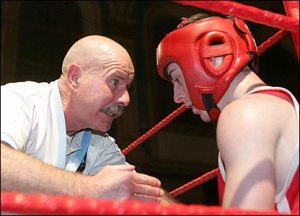 In short, we need someone in our corner, shouting in a voice of accountability, conviction, and faith to keep going. You have what it takes. Get through this draft. Try it from a different POV. Try it from a different character’s perspective. Try the story in present tense. Throw in a cow who believes he is Ryan Gosling. Throw in a turtle who eats books. Throw in a kid who thinks it’s over, until—
Until that voice. Listen it to it clanging inside the damn-near defeated walls of your heart. That voice confirms what you and I already know: we don’t want it to be easy. It’s hard. We know that. What we want is the pluck and the nerve and the faith to keep going—to make a life with our pursuit of writing and the way we embody it, rather than simply a living.
We want more than a contract and some cash. We want to craft the words that get us excited—that get readers excited. Or, as John Dufresne put it, we want to write, not to have written.
So: a toast. (I wish I had wine, but coffee feeds the writer in me more). To the very act of writing—in all its difficulty, stubbornness, painstakingly slow but remarkably beautiful worth. May we all, as writers and as people, keep calm and query on.
Thanks, Luke! Very inspiring. I need a tissue now. *sniff*
And you folks need to comment! Luke is giving away THREE PRIZES!
1. A signed copy of KEEP CALM AND QUERY ON.
2. A query critique.
3. A personal phone call and pep talk to discuss your writing career.
Your comment counts as one entry. You get an extra entry for each mention on social media: Twitter, Facebook, Pinterest, etc. Just mention it in your comment. Comments close the end of April 1 and winners will be randomly selected on April 2.
Now keep calm and comment on!
Luke Reynolds is editor of the forthcoming book for teens and tweens BREAK THESE RULES (Chicago Review Press, 2013). He has also co-edited BURNED IN: FUELING THE FIRE TO TEACH (Teachers College Press 2011) and DEDICATED TO THE PEOPLE OF DARFUR (Rutgers University Press, 2009). His newest books are KEEP CALM AND QUERY ON: NOTES ON WRITING (AND LIVING) WITH HOPE (Divertir Publishing, 2012) and A CALL TO CREATIVITY: WRITING, READING, AND INSPIRING STUDENTS IN AN AGE OF STANDARDIZATION (Teachers College Press, 2012). He loves garlic bread with passion, and loves children just about as much. He has taught grades 7-12 and he’s now a nightschool teacher and home-dad by day. His writing for children is represented by the formidably wise and oft-inspiring Ammi-Joan Paquette of the Erin Murphy Literary Agency. Keep calm and visit on at www.lukewreynolds.com.
 Ooga!
Ooga!
Know Tammi Sauer? She write new book. She write good book. Bob Shea draw picture. It ME WANT PET!
(Me read to five-year-old class. They giggle. They snort. They LOVE!)
Cave Boy star. Cave Boy want pet.
He find pet. Mama say no. Gah!
He find new pet. Papa say no. Gah, ug!
He get new new pet. Gran say no.
 Cave Boy sad. Me sad. You sad!
What Cave Boy do?
Me no tell.
You read book. Ooga!
So…
Daughters want draw. I ask, “What pet you want Cave Boy have?”
Daughter Eight draw dinosaur. Me say no. Too stompy.
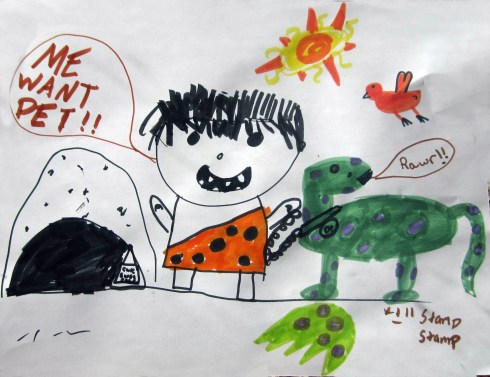
Daughter Five draw giraffe. Me say no. Too tall. No fit cave.
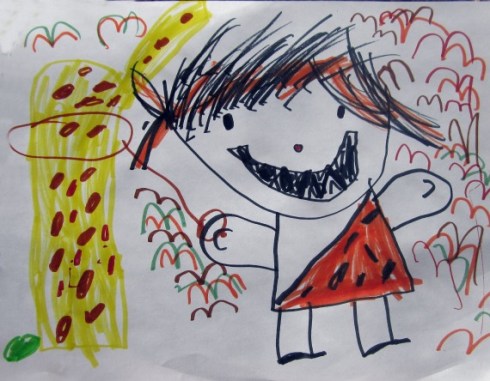
You have kid? Kid draw Cave Boy and new pet. Send to tarawrites (at) yahoo (dot) com by March 13. Me post here. Me pick pet. Kid win book.
OOGA!
Tammi Sauer author. She write many, many kid book. Book like CHICKEN DANCE and MOSTLY MONSTERLY and MR. DUCK MEANS BUSINESS. You visit her: TammiSauer.com. OOGA! (Ooga not book. Me like say OOGA!)
 Say what you will about Wikipedia—that it’s unreliable, that it’s unaccountable, that it’s run by a bunch of idealistic zealots—the fact remains that it is one of the most heavily accessed web resources in the world.
And so, one day as I was researching some of my favorite contemporary kidlit authors and illustrators, I found they were not mentioned in the online encyclopedia. Scott Magoon? Not there. Kate Messner? Nope. Tammi Sauer? Dagnabbit.
I think it’s time we rectified that situation. These folks deserve to go on record, especially those who have won awards for their work.
If you’re a frequent reader of this blog, I’d like to ask you a favor. Pick a favorite contemporary kidlit author or illustrator. Check to see if they’re in Wikipedia.
- List of Wikipedia Children’s Literature Authors
- List of Wikipedia Children’s Literature Illustrators
And if your favorite person is not there, pledge to create an article for that kidlitter by the end of March. Show your love for children’s literature and the people who create it!
Remember that Wikipedia wants you to source references when writing your article. There is a handy-dandy article creation wizard for those of you unfamiliar with the Wikipedia process.
If you are interested in participating, just leave your name and the name of your chosen kidlit personality below. I’ll check in at the end of this month with a master list of potential pages we’re creating.
C’mon, who’s with me?
 There are all kinds of scenarios in which a manuscript becomes a book. Sometimes it’s a series planned well ahead of time, sometimes the author is well-known and the project is signed on the basis of a proposal, sometimes the agent knows that the idea in itself is a winner and he/she sends it out to vast range of different editors, generating a lot of buzz in the process.
As an acquiring editor, however, my favorite way to come across a manuscript is much more quiet than any of these scenarios. It’s when I stumble across something in a pile of submissions that strikes my fancy. The reason it’s fun to discover things in this way, is that I am not reacting to a trend, but to something that particularly suits my taste. And this means I’m going to remain excited about it right up until the release date and beyond.
I’ve had quite a few books like this on my list. It’s hard to pick just one. But I think there is one that is particularly illustrative of this kind of scenario. It’s Bow-Wow Bugs a Bug by Mark Newgarden and Megan Cash.
 I got a completely different submission from Mark and Megan in the slush pile—unagented. Mark and Megan decided to send it to me because they had come across another project of mine that made them think I might be interested in their work. Their submission was beautifully packaged, in a folder, with lots of visuals and a pitch sheet. I won’t mention that project, because I still love it and hope that it will come out eventually in some form. For various reasons I wasn’t able to pursue it. Anyway, alongside the mystery project was a proposed series of board books based on a intrepid little terrier. Bow Wow Bugs A Bug was created later, as an anchor to this series.
There are a couple of inspiring things about this story. First, the project came through slush. I know we hear about things being discovered this way. But these stories are told for a reason—they are remarkable because they don’t happen very often. The reason Mark and Megan’s work stood out was that it was impeccably presented and it was exactly the kind of thing that I like to read. They had built an entire pitch package of the quality that we might mock up for a marketing meeting, and they thought very carefully about to whom they were sending it. It was funny, clever and visually stunning with selling points and a target audience outlined. The other important point to note is that, despite the appeal of this package, we ended up having them do a different project all together. They were willing to work with us (and did to an absolutely heroic extent) in order to build a good publishing strategy. And I was willing to work with them, because I could see very clearly that they had more than one project in them.
There is one point I would like to make clear. Mark and Megan are not push-overs. A willingness to work on something doesn’t mean a willingness to surrender your vision to someone else. It simply means that you are willing to hear feedback and try to incorporate it in a way that suits the project. Mark and Megan have a strong aesthetic perspective and I had long email exchanges with them over what to keep and what to leave out. It’s important to work with your editor, but it’s also important to maintain your point of view. Do not compromise to the extent that you don’t want to be associated with the finished book. Every change should be considered carefully. And that doesn’t necessarily mean “Do I take it or leave it.” Quite often it means, “What is it that this change will accomplish, and how can I find a way to accommodate it and still make this something that I love.” You have to live with your name on the cover.
I chose this particular example to write about because I think it exemplifies what authors should be looking for from their editorial relationships (and vice versa, really). I still maintain contact with Mark and Megan. We share taste and inspiration. There should be a certain amount of base understanding and sympathy between an creator and editor. You should share a vision for the project. And when you diverge, you should be able to discuss it reasonably and come to some compromise that you can live with. That’s how good books are made.
Tamson Weston is a published children’s book author and editor with over 15 years experience at several prestigious publishing houses including HarperCollins, Houghton Mifflin Harcourt and Disney Hyperion. She has edited many acclaimed and award-winning books for children of all ages. Tamson loves to collaborate with people and help authors, illustrators, agents and publishers bring projects to their full potential.
Among the authors Tamson has worked with with are Adam Rex, Mac Barnett, Robert Weinstock, Adam Gopnik, Jane Leslie Conly, Anne Rockwell, Deborah Hopkinson, Jen Violi, Alexander Stadler, Dan Santat, Florence Parry Heide, Dandi Daley Mackall, Brian Biggs, Marilyn Singer, Megan Cash and Mark Newgarden.
Tamson has an MFA in Writing and Literature. You can visit her website at www.tamsonweston.com.
 You probably know the talented illustrator Ryan Hipp—he’s the guy who designed the first PiBoIdMo logo. Well, now he’s got a cool sketch service to check out. You want something drawn? A robot eating a cupcake? A cupcake eating a robot? Or, even more awesomer—a cupcake robot? He’s your man! Check out his very cool site www.SketchRequest.com!
Ryan told me he’s a world-class procrastinator and we battled a little over who was better at putting off things. I think I won. I said I’d continue the argument tomorrow.
But I did ask Ryan to guest blog about his New Year’s resolutions and how to turn procrastination into pro-magination. Take it away, Ryan!
 by Ryan Hipp
The New Year is upon us all, and along with all the diets and promises to give up vices, many of us set resolutions and battle with the evils of procrastination in our professional lives. This is no different in the business of children’s literature. Take it from me—someone that really knows the sinking, overwhelming feeling deep in the pit of the stomach—someone that often doesn’t even know where or how to begin.
People ask me all the time, “So when’s your next book out?”. Wow, its, the worst question to get. Lately I say, “Oh yeah, I’m totally working on this awesome thing that I totally can’t talk about because its like on the verge of blowing up big time and I don’t want to unveil it too soon and stuff, you know?” But in secret, I haven’t sat down to work on it in weeks in some cases.
For me, the irony is that the rigors of being a kidlit professional means I spend a ton of time trying to secure school visits or sending out mailings, and not doing the very thing that all of that work stems from—the writing and the drawing. I am often feeling underwater with all the business that goes along with making books, that I have trouble concentrating on…well…making books!
And then there’s just normal life getting in the way. We all can relate to that, excuse or no excuse.
But here’s an indefensible excuse—the other embarrassing reality is that when I do actually have time to be creative and productive, I still sometimes don’t . I’ll get easily swayed by a call from friends to go out to a movie, or whatever. I’ll have full intentions of turning a free 24 hour Saturday into a work day, then find a way to completely blow it on fun and frivolity.
I’ll say, “I can just do it on Sunday”. But do I? Nope. Encore performance.
I find myself making every excuse in the world to keep away from my desk. Its as if I have a subconscious mental barrier that won’t allow me to begin writing or drawing if my office is cluttered or if I have other things on my mind. And then when I do sit down, sometimes it is a battle to stop goofing around watching cat videos on YouTube.
So here is what I have been doing to combat this of late:
Slow & Steady for the Win
Every little bit helps. 15 minutes a day for a week is still better than failing your intention to sit down for 2 hours on the weekend and then not doing it.
Get Out of the House to Get Work Done
A quiet coffee shop or restaurant away from distractions at home. (Tara: I spend at least one day a week at the library. Otherwise the fridge calls me too often.)
Turn off Phone/Computer
The battle for me is my computer is a tool for research and design—but also a distracting temptation. So I draw my thumbnails away from my desk, and I scribble my notes away from my computer. Then I bring that stuff back home when the momentum will keep me on-task.
Ask Someone Else to Keep Accountability
When you are your own boss, nobody will get on your case if you didn’t write today. So schedule someone to critique your work on a set schedule so you have regular benchmarks to shoot for.
But, when I do get an urge to goof around on YouTube, I cut myself some slack, and remind myself to watch the one thing that usually puts me in the right mood to get productive immediately afterwards. It’s an episode of the Babar animated series titled “To Duet or Not Duet” and it’s a wonderful lesson in procrastination and setting realistic goals. So the next time you are distracted or frazzled, I give you permission to take a break to watch it here:
So what are my resolutions for 2012? I am going to defeat another battle I have—submitting. I am TERRIBLE about sending my work out. But it is really the most important part. I am going to make a better effort at sending out my queries and samples—because all that diligence and hard work means nothing unless it gets discovered.
Be Good and Work Hard!
What are some of your tricks for getting the BIC—butt in chair?
 by Carol Hampton Rasco
President/CEO, Reading Is Fundamental (RIF)
What a special week in the Children’s Literature World…two of my favorite “specials” this month are the start of Picture Book Idea Month (plus two days!) and the birthday of Reading Is Fundamental where the 45th birthday will be celebrated Thursday, November 3 with Lilly and her famous purple purse with lots of children and special guests at the Library of Congress!
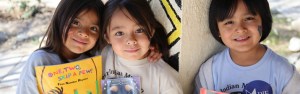 And you know what? I see PiBoIdMo as seriously connected to RIF and our mission. Each time I write or talk about this year’s major milestone birthday of 45 years for RIF, I talk about the 380 million magical moments, the 380 million books placed into the hands of children over these 45 years RIF has existed. And guess what? The majority of those 380 million moments have been brought about by picture books given our primary audience of birth to 8 years of age.
Within that age group, RIF seeks first to serve those children most in need and sadly, with poverty the greatest indicator of probable difficulty to read well and independently by the end of third to fourth grade, it means according to the latest poverty reports we have that even more children by comparison in years past to ignite, to motivate, to inspire to learn to read. This means in reality, we need so many different books in order to strike that chord deep within a child, to create the birth of that “aha!” moment, that “wow!” experience that has a child believing “If I can read, I can do anything, be anything.”
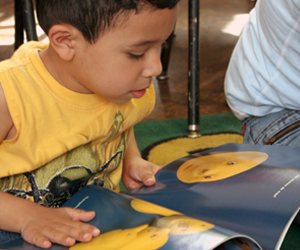 Last year I wrote in my guest post for PiBoIdMo noting three types of picture books we hear about most as on the “wanted” list by teachers, reading specialists, PTA parents, Kiwanis Club members—RIF volunteers of all stripes and professions: nonfiction that is “eye and mind catching”, bilingual books, and multicultural books. The requests continue to be the same. All three categories are also critical to the family involvement component RIF believes critical to the success of our mission in motivating children to love reading.
Last weekend I saw again in person the beauty of a picture book that had four generations of individuals pouring over a book, sharing common knowledge and experiences elicited by the book in front of them. It is a picture book about animals in winter—“it doesn’t look like a true fact book, they’re usually boring” as generation two noted in his 6-year-old voice. Generation one was intrigued by the pictures, generation two was eager to learn more about the animals he already had discovered, parents of gen two had no idea about some of the more unusual facts and gen three had information to add about ways these animals were viewed in “the olden days.” After going through the book the family discovered information added by the author at the back and headed to the computer, four generations together again! Gens one and two were reading the text even…what a great experience for the family together…it was a spontaneous activity shared following a meal and lasted with no whining for more than 30 minutes. This family is not unique, no reason this animal book would have been predicted to be the one to “catch their eyes” over others. But it connected for them; it was a prolonged magical moment. And to serve the children and families who need us most, we need lots and lots of books portraying life and our surroundings in oh, so many different ways!
 With Thanksgiving now on the horizon, our Hampton multi-generations will for the 32nd year read sometime before the meal begins “Thanksgiving at the Tappletons’” by Eileen Spinelli (1982 version) which was given to my son on his 6th birthday that year. It is a tradition every child entering the family savors when old enough to follow the laugh lines and even more when old enough to be a reader!
A magical moment…that is what you are creating in a picture book…memories that plant the seeds of a lifetime love of reading. My best wishes to all of you as you put those ideas into writing this month! Hurray, more magic is on the way!
Happy Reading!
Do you think you can meet the PiBoIdMo challenge and create 30 new picture book ideas in 30 days? Well then, sign-up for all the craziness!
Those who sign-up for Picture Book Idea Month will be eligible for prizes—and oh, are there prizes this year! Signed books, picture book critiques, original art by picture book illustrators, book jewelry, hand-made journals, vintage children’s books, and feedback from one of three literary agents. Plus more to come, including items from our PiBoIdMo Cafe Press shop, which will open on November 1. You’ll be able to get PiBoIdMo mugs, mouse pads, t-shirts and tote bags whose proceeds will support children’s book charities.
 To sign-up this year, you must do three things:
1. Subscribe to this blog via email. (Handy-dandy button in the left column.) This way you won’t miss any of the amazing guest bloggers.
2. Leave your full name in the comments of this post. The form will ask for your email address. Please be sure to enter it so I can contact you if need be. (Your address won’t be published and I won’t use it for any other purpose.)
3. Display the official PiBoIdMo participant badge on your blog, website, or social network. (Right click to save to your computer.) Please include a link back to taralazar.wordpress.com so folks know where to join the challenge. And if you’re game, mention what a super job Bonnie Adamson did on the logos. (If you don’t have anywhere to display the banner, then skip this one.)
Optional:
4. Add a firefly Twibbon to your Twitter avatar.
5. Join the PiBoIdMo Facebook discussion group.
6. Repeat the pledge 10 times fast:
I do solemnly swear
that I will faithfully execute
the PiBoIdMo 30-ideas-in-30-days challenge,
and will, to the best of my ability,
parlay my ideas into
picture book manuscripts
throughout the year.
That’s it. You’re good to go! (Wish I were good to go. I’ve got a sick kid at home today!)
PiBoIdMo will kick-off with the first guest post on October 30 this year, so you’ll have two extra days to get in those 30 ideas! Sign-up will close on November 3rd, so you must be registered before then to qualify for prizes!
Just visit here daily for inspiration from the guest bloggers, then keep a notebook or computer file of your daily ideas. There’s no need to post your ideas online or send them to me. If you’d like, comment on the daily posts with a simple “Eureka!” Remember, your ideas are for your eyes only! At the end of the month, I’ll ask you to sign a pledge confirming you did create 30 ideas, and then I’ll pick prize winners from that bunch.
Thanks for joining! I hope you enjoy this year’s PiBoIdMo! As always, if you have any suggestions for this event, please contact me at tarawrites (at) yahoo (dot) you-know-the-rest.
And now I leave you with my favorite Roald Dahl quote from THE MINPINS. I believe it sums up my intent for PiBoIdMo quite nicely, like a good ol’ English chap would:
And above all,
watch with glittering eyes
the whole world around you
because the greatest secrets
are always hidden
in the most unlikely places.
Those who don’t believe in magic
will never find it.





 Writing for Kids (While Raising Them)