You are currently browsing the category archive for the ‘Children’s Writing’ category.
The Picture Book Idea Month success stories just keep pouring in!
The latest news is from lucky Penny Klostermann who was named runner-up for the 2012 SCBWI Barbara Karlin grant! This makes THREE YEARS IN A ROW that a PiBoIdMo story either snatched the grant or was named next in line.
Without further ado, I’ll let Penny tell you all about it!
 In the fall of 2011, my wonderful critique group, Picture Bookies, made me aware of Tara’s brilliant concept, PiBoIdMo—30 picture book ideas in 30 days! My very first PiBoIdMo idea was to do a rewrite of THE NIGHT BEFORE CHRISTMAS. I know….holiday stories are hard to sell. I know….rhyme done right is hard to write! But, it was November…and Christmas was just around the corner…and I love the original. By the end of November, I had three different ideas for rewriting THE NIGHT BEFORE CHRISTMAS.
From the time I wrote the first line for my 25th idea, MARS NIGHT BEFORE CHRISTMAS, I knew it was my favorite.
Then, in December, Susanna Leonard Hill hosted a competition on her blog for a rewrite of THE NIGHT BEFORE CHRISTMAS. This brought my idea to the forefront, and I decided to work on it right away. I read every version of the story I could get my hands on. I researched Mars and Space! I got excited as words and phrases from my research enhanced my manuscript.
February 26, 2012, I emailed my manuscript to my critique group. As usual, their comments were incredible. I revised and revised and revised some more. Then on March 12, 2012, I mailed my manuscript to the Barbara Karlin committee…and waited.
I got the call/voicemail at 6:36 p.m. Friday, August 3rd. (Of course I took a picture of my call log!) I didn’t listen to the voicemail until 10:30 p.m. The caller said she was with the Barbara Karlin Grant, and could I give her a call. COULD I GIVE HER A CALL?????? I live in Texas. She was in California. It wasn’t too late! When she told me I was runner up I just couldn’t believe it. Uncontained happiness!!!
I have to say, Tara, that PiBoIdMo is out-of-this-world awesome. As I look through my list of ideas for the next manuscript to tackle, I am amazed. Your organization of the event with inspiring posts and interaction among so many picture book writers took my mind to places it wouldn’t go sitting alone in front of my computer. Thank you.
I just have to brag on my critique group, Picture Bookies. Rebecca Colby was the winner of the 2011 Barbara Karlin Grant. Also, in 2011, Mona Pease received a Letter of Merit. The other members are just as incredible. I am lucky to be a part of this group.
Congratulations, Penny, and thanks so much for sharing your success story! You can visit Penny online at her blog: “A Penny and Her Jots“.
Now folks, you know the old rhyme: “Find a Penny, pick it up, all day long you’ll have good luck!” So let Penny’s story sprinkle some good fortune on you.
PiBoIdMo guest bloggers and badges will be revealed on October 1st, with registration to begin on October 24th right here on this blog. Subscribe via email (← see left column) to make sure you don’t miss PiBoIdMo updates!
If you have suggestions about who you’d like to see guest blogging this year, please leave a name (or two or three) in the comments!
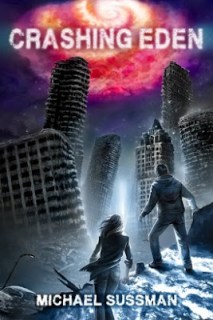 One of my favorite quirky picture books is OTTO GROWS DOWN by Michael Sussman, so you can imagine how thrilled I was to learn that Michael has a new YA novel, CRASHING EDEN. Well, Michael is crashing my blog today and he’s leaving behind a paperback copy just for you.
“Dr. Suss” (as I like to call him) is a prolific, versatile writer who has published books in diverse genres. So I asked him how he shifts gears to different formats and what obstacles he faces in doing so.
TL: Michael, you’ve written medical books, picture books, and now a young adult novel. How did you adjust from writing one genre to another?
MS: The toughest shift was from writing nonfiction professional books on psychotherapy to writing fiction. About 20 years ago I first tried my hand at a novel. Looking back at that manuscript, I cringe at how stiff and wooden my writing was—especially the dialogue. Thanks to practice and critiques from writer’s groups, my next novel was considerably better, although it too went unpublished.
After reading hundreds of picture books to my son, I decided to start writing for children. That transition was a breeze. Writing for kids totally freed my imagination and allowed me to be much more playful and fantasy-based. The result was OTTO GROWS DOWN, a story about a boy who becomes trapped in backwards time.
 In writing for young adults, I benefited from having already spent years honing my novel-writing skills. There were, however, two major differences. It was a stretch to write with the voice of a teenager, and that took a great deal of revising to get right. Secondly, I had to revisit my own adolescence, and that was no picnic!
TL: Which genre is your comfort zone?
MS: When it comes to writing, I’m such a perfectionist that I’m not sure I have a comfort zone.
Writing picture books is probably easiest for me, since the sky’s the limit when it comes to letting your imagination run wild. In terms of novels, I think I feel most comfortable writing thillers and mysteries, especially with a comic edge.
TL: How did you get the idea for CRASHING EDEN? What made you decide to tackle the YA genre?
I started trying my hand at fiction about twenty years ago. I wrote a psychological thriller and a comic mystery novel, neither of which were published. I developed severe writer’s block, which was immediately relieved when I began writing for young children. Looking back, I think I was working out unresolved issues from my own childhood. Next I turned to writing for young adults. Consciously, I chose YA because the market was hot! But unconsciously, I believe I realized that it would give me the chance to work on issues from my mostly miserable adolescence.
The genesis of CRASHING EDEN began with the title, which had floated around in my mind for nearly a decade. I’d been interested in world mythology for many years, and especially intrigued by the widespread myths suggesting that humans have degenerated from an ancient state of grace, symbolized by Paradise or the Golden Age.
I began to wonder what might happen if we were somehow able to recapture the state of mind supposedly experienced by people before the Fall. What if a device could be built that altered our brains in such a way that we felt like we were back in the Garden of Eden?
This led to speculating about how the God of the Old Testament might react to trespassers in his Garden. That’s where the story takes a controversial turn.
TL: What an intriguing premise! So, what YA reads have really stuck with you? To which books would you compare your style?
 MS: My favorite YA novels are Phillip Pullman’s trilogy, FEED by M.T. Anderson, UNWIND by Neal Shusterman, and MARCELO IN THE REAL WORLD by Francis X. Stork.
I’d like to think my style is unique, although I’d say it’s strongly influenced by two of my favorite novelists: Tom Robbins and Christopher Moore.
TL: How do you hope readers will react to your book?
MS: My ideal reader loved OTTO and is curious about the title of my novel. She’s intrigued by the notion that the widespread myths of a Golden Age were based on something real, and by the idea of returning to Edenic consciousness. She feels empathy for my troubled protagonist and gets caught up in his many dilemmas. She enjoys the humor and suspense of the story and finishes the book in one sitting. Then she recommends the novel to all her friends, posts glowing reviews on Amazon and Goodreads, and sends a copy of the book to her uncle, the filmmaker!
TL: Ha, ha! Don’t we all wish! So, with all those genres floating around in your head, do you ever experience writer’s block? If so, how do you overcome it?
Yes, I’ve definitely had periods when I couldn’t write a thing and couldn’t come up with a single idea. It feels awful. With other types of work you can just phone it in, but not with writing.
With mild writer’s block, I can overcome it by exercising, being in nature, taking a hot bath, meditating, or simply taking a break from writing. With more serious cases, it takes some psychological/emotional exploration. The blockage may be due to depression. It may stem from avoiding something that you need to write about. In one case, my writer’s block evaporated when I shifted from writing for adults to writing for children!
TL: I love that. Writing for children definitely frees the imagination and lets you go places adult fiction doesn’t.
Thanks to Dr. Suss for offering a paperback copy for me to give away! Just leave a comment to enter. You get one entry for your comment plus an extra entry for each share on social media, just let me know in a separate comment! A winner will be selected in one week. Good luck!
Want it now? Crashing Eden is available at Amazon, Barnes & Noble and Smashwords.
And visit “Dr. Suss” online because he’s hilarious and talented (and a good friend)!


 STORYTELLER: The Authorized Biography of Roald Dahl by Donald Sturrock cannot be missed, yet for two years I missed it. What is wrong with me? (Eh-hem, this is a rhetorical question, thankyouverymuch.)
Roald Dahl remains one of the most iconic children’s authors of all time, yet he began his career writing macabre short stories based upon his experience in the Royal Air Force during World War II. Just how did he evolve into the fantastical children’s author we all love?
Sheila St. Lawrence, Dahl’s literary agent at the Watkins Agency, is to thank. She realized “the ease in which Dahl could enter a child’s mind,” clearly apparent in his short story “The Wish”. In the tale, a young boy dares to walk across a carpet by stepping only on its yellow portions. Should his foot slip onto another color, he thought he would “disappear into a black void or be killed by venomous snakes.” This story was the only adult Dahl piece to feature a child protagonist to date, and it could not escape St. Lawrence’s attention.
After a disastrous two-year foray into playwriting, St. Lawrence implored Dahl to turn his literary aspirations elsewhere. Yet he ignored her kidlit suggestion, wrote stories that got turned down by The New Yorker, and instead got placed in the far less desirable (but still paying) Playboy.
Dahl’s publisher Alfred Knopf expressed interest in a children’s book, but then dropped a collection of adult stories called “Kiss Kiss” from Knopf’s 1959 list. Dahl spouted some choice words in response, threatening that Knopf would never squeeze a children’s book out of him.
Dahl once again became focused on writing for actors, as he wished to develop vehicles for his wife at the time, screen star Patricia Neal. After all, if Neal was working steadily, her income afforded him more time to write what he wanted to write. There were shows for Hitchcock and a drama series for TV based upon classic ghost stories, produced by Alfred Knopf’s half brother. But when the pilot episode encountered a controversy, the series got permanently shelved and Dahl was forced to return to the idea that evolved into JAMES AND THE GIANT PEACH.
I will say “and the rest is history” here, although STORYTELLER is only halfway through Dahl’s life story at this point. So like Sheila St. Lawrence, I implore you to turn your literary aspirations toward it.
But before I go, it would be a shame not to share with you Dahl’s advice to children’s writers, as told to Helen Edwards in an interview for Bedtime Stories exactly 42 years ago:
What makes a good children’s writer? The writer must have a genuine and powerful wish not only to entertain children, but to teach them the habit of reading…[He or she] must be a jokey sort of fellow…[and] must like simple tricks and jokes and riddles and other childish things. He must be unconventional and inventive. He must have a really first-class plot. He must know what enthralls children and what bores them. They love being spooked. They love ghosts. They love the finding of treasure. The love chocolates and toys and money. They love magic. They love being made to giggle. They love seeing the villain meet a grisly death. They love a hero and they love the hero to be a winner. But they hate descriptive passages and flowery prose. They hate long descriptions of any sort. Many of them are sensitive to good writing and can spot a clumsy sentence. They like stories that contain a threat. “D’you know what I feel like?” said the big crocodile to the smaller one. “I feel like having a nice plump juicy child for my lunch.” They love that sort of thing. What else do they love? New inventions. Unorthodox methods. Eccentricity. Secret information. The list is long. But above all, when you write a story for them, bear in mind that they do not possess the same power of concentration as an adult, and they become very easily bored or diverted. Your story, therefore, must tantalize and titillate them on every page and all the time that you are writing you must be saying to yourself, “Is this too slow? Is it too dull? Will they stop reading?” To those questions, you must answer yes more often than you answer no. [If not] you must cross it out and start again.
For me, these are words to write by. Funny that he should utter them within days of my birth! (Wait a second, did I just reveal my age?! Eh-hem, this is a rhetorical question, thankyouverymuch.)
UPDATE: Whoopsie. I looked at the wrong footnote. The quote above is from a letter Dahl wrote to “The Writer” Magazine in October, 1975: “A Note on Writing Books for Children”.
The contents of this post have been removed.
The contents of this post have been removed.
The contents of this post have been removed.
The contents of this post have been removed.
Writing is a solitary profession. Sitting on our bed, laptop balanced on a pillow, wearing mismatched jammies all day (well, that’s how I work, anyway), we don’t gab at an office water cooler or take swanky lunches with colleagues. We’re alone with our characters—who can drive us nuts! We’re alone with our ideas, our words, and a vat of java.
Most writers I know are hard on themselves. We are our worst critics. We can spend all day writing and feel as though we’ve accomplished nothing. It’s nice to hear someone say what we’ve written has potential, has vision, has made someone spit all over their keyboard in laughter (the highest compliment, I think).
So today I bring you the story of three kidlit friends who came together with one goal in mind—to take an author’s career to the next step. To provide an encouraging, supportive environment in which she can thrive. Folks, you gotta have friends. Luckily, the kidlit community includes some of the best people around.
Please welcome author Brenda Reeves Sturgis, consulting editor Emma Dryden, and agent Karen Grencik!

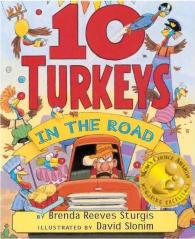 TL: Brenda, your debut picture book TEN TURKEYS IN THE ROAD was released by Marshall Cavendish last year and quickly earned both critical and commercial success. Most people think you publish one book and you’ve got it made. But you felt your career needed a boost. How did you come to this conclusion?
BRS: Thank you for this thoughtful blog post, and for interviewing the three of us.
I sold 10 TURKEYS IN THE ROAD in 2008 and at that time I was represented by another agent, but in 2010 we parted ways and I was left trying to navigate the children’s lit world, alone.
I queried for many months and got personal, kind rejections. After a long period of going it alone, I knew that I needed to find out what was holding me back from finding my perfect-for-me agent. I had heard of Emma Dryden for years, and had great respect for her. She was and is knowledgeable in all aspects of publishing. I was confident that by hiring Emma she would know what needed tweaking, and what I needed to do to progress in my quest. I contacted Emma and she agreed to consult, we set up a phone call, and I sent her my manuscripts.
TL: Emma, what was your reaction when you read Brenda’s work? What did you propose as the next step in her career?
 ED: When Brenda first contacted me, she explained her situation—she was a new writer with one book under contract; she’d been with an agent and was currently seeking a new agent; she was “trying to do everything right,” but it didn’t seem to be paying off and she was starting to question how she could keep her dream of being a children’s book author alive. There’s nothing that concerns and upsets me more than to hear an author or artist is questioning their dream. Coming up with a strategy to find an agent would be the easy part; helping a distressed author regain their confidence and adjust their outlook was something completely different—and that’s what our consultation was really all about.
Brenda’s ideas and writing are strong and smart. Her nervousness about doing everything right was what was holding her back, blurring her vision. We focused not only on figuring out a calm, focused strategy to query agents with her strongest possible manuscript, but we also talked a lot about how best to conduct oneself in a fickle marketplace, the importance of flexibility, the benefits of patience, and the significance of not giving up.
After several hours of email correspondence and phone conversations, I felt confident in encouraging Brenda to query Karen Grencik, an agent whom for various reasons I felt would not only be delighted by Brenda’s work, but who would have a compatible sensibility and outlook to suit Brenda’s own.
TL: Karen, what made you fall in love with Brenda’s work and make an offer of representation?
 KG: First of all, a great big “thank you” to you for taking the time to tell our story. It is a bit unusual, the manner in which we all came together, and I hope your readers will find it to be inspiring!
It is an honor to receive a referral from Emma Dryden, as I know the thought she puts into everything she does. I talked with Emma right away and when she stated that she thought Brenda had an untapped talent similar to two of the best picture book rhymers in today’s children’s book world, I knew I had to look at Brenda’s manuscripts. Brenda and I set up a phone appointment to discuss expectations, as there is always some concern about this when a previously represented author is seeking a new agent. I was worried that I might not be able to meet Brenda’s needs and I knew Brenda was feeling a bit gun-shy to jump back into the fray, but right off the bat we developed a sense of comfort and comraderie that’s made working together quite easy.
Not only did Brenda take proactive steps to jump-start her career again, but she took seriously and applied each and every practice Emma discussed with her, putting aside her considerable worries about what had come before and focusing instead on what she needed to do to accomplish her goals as a picture book author. This laid excellent groundwork for her to secure new representation. Yes, Brenda did need an agent—a strategic partner who shares her goals—but what she needed more was validation and a positive, safe working environment, which I’ve been delighted to be able to help provide. Now it’s my turn to find good homes for her fabulous picture books!
Brenda appeared in my life at just the right time, as Red Fox Literary had recently opened its doors, and I had the kind of time available to service my clients in a way that most agents only dream about. Over the past year that we’ve been working together, Brenda has learned to trust that I will do everything I can as quickly as I can, and that has allowed her to relax during the times that I’m not immediately available. And I’ve learned to trust that Brenda is a very hard worker, a perfectionist about her writing, and will only send me her very best work. Trust is a significant element of the best author/agent relationships, as it is of the best author/editor relationships as well.
For authors out there who feel isolated and alone, we three want to remind you that the universe is preparing for your success. An editor and an agent might be just waiting for you to show up. Be sure to pay attention to the signs. We certainly do!
TL: Karen, thanks! Your story is indeed inspiring!
Now back to Brenda…what are your goals for your career?
BRS: My goal remains the same as it was 8 years ago, and that’s to write the best, most original children’s books that I can. It’s important to me to help and make a difference where doors are opened, I strive to inspire, educate, and work as hard as humanly possible. I feel innately blessed to work with Karen and with Emma, and look forward to all good things coming our way. Thank you for your time with this Tara, I am truly appreciative for this opportunity.
TL: Thank you for sharing your story! I know it will help many writers as they examine their career progress. We should all recognize when it’s time to make a change and be brave enough to take action.
Please visit Brenda Reeves Sturgis, Emma Dryden and Karen Grencik’s websites where you’re sure to receive even more inspiration!
Holy Charlie Buckets, everyone! There were 90 entries in the picture book critique giveaway. What an enthusiastic response!
Random.org picked #57…and that means…
ROSE MARSH
…is the winner!
Rose, be on the lookout for an email from me.
Thanks to everyone who entered! I’ll be sure to host another critique giveaway soon, so be sure to subscribe if you haven’t already.
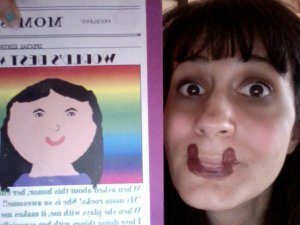
And now the consolation prize: a little chuckle. I think my daughter drew me so well for her Mother’s Day Gazette—a striking resemblance, don’tchathink? (OK, this is a terrible consolation prize. But since this blog is “Writing for Kids (While Raising Them)” I gotta stuff some kiddo stuff in every once in a while.)
 Today is the release day for THE EMOTION THESAURUS, and as part of the launch, Becca and Angela from the Bookshelf Muse are hosting Random Acts of Kindness Towards Writers!
Move over, I’m jumping on the bandwagon! (Yes, it’s a Radio Flyer. And the band is Maroon 5. And I have to smoosh in close to Adam Levine.)
Think about your fellow writers today and how they have helped you to achieve your literary goals. I have critique partners, blog followers, other bloggers, plus published authors and illustrators to thank. All those who have befriended me on the path to publication–people I didn’t know who offered that boost of encouragement when I most needed it. (And boy, do I need it A LOT! Why are we always so hard on ourselves?)
Come on, what other professional community is so awesome?
So as part of the kindapalooza today, I’m giving away a picture book critique. Just comment below to be entered; one entry per person by midnight tonight, but you can claim the prize at any time. It’s my way of giving back today.
And if there were any way I could shove a chocolate lava cake through the ether, you know I’d be giving that away, too. You’re just that incredible, writers!








 Writing for Kids (While Raising Them)