You are currently browsing the category archive for the ‘Children’s Books’ category.
This post comes as I’m frantically preparing for 25 guests later this afternoon. I’ve already cooked my grandmother’s homemade tomato sauce (which she called “gravy”), two enormous trays of baked ziti (with fresh ricotta from the Italian grocer), five pounds of chicken marsala, and a cannellini-spinach dip with crostinis. Oh yeah, there’s a cake, too.
I love to cook. I love to eat. I have fond childhood memories of three generations of Italian women in the kitchen. They were graceful to watch, their movements from counter to oven, oven to table. And the table! Covered in stuffed artichokes, fried cauliflower, string bean salad, veal cutlets, meatballs and cannoli.
I get a warm, tingly feeling whenever I think of Sundays at Grandma’s house.
I bet you have those same memories, too, albeit with different foods. Biscuits with milk gravy? Dolmades and baklava? Perogies? Irish soda bread? Empanadas? Pork dumplings?
Yes, start revving up those taste buds. Renee Ting of Shen’s Books would like to share just a few food-inspired picture books with you, those that celebrate dishes from around the world:
(OK, I must read Squeamish About Sushi!)
Books with food as a theme aren’t necessarily about cooking. The Apple Doll by Elisa Kleven features a little girl who makes a dried-apple doll as a way to calm her anxiety over starting school. In Little Pea, Amy Krouse Rosenthal introduces a main character who hates eating candy for dinner and can’t wait until his vegetable dessert.
Grab a fork and a knife and dig in! There’s much to celebrate when food is involved!
So how’s it going today?
THE IDEA BOX
by Susan Taylor Brown
I’m a collector. I can’t go on a walk without finding something I have to pick up and take home with me for my idea box. A stick. A rock. A broken toy. I also have a hard time throwing things away so an item headed for Goodwill might find its way into my idea box. It’s a great way to jumpstart my tired brain. Whenever I find something new or old or interesting, I toss it in the box.

Does something in my idea box jump out at you?
What kind of creature has a purple feather? What would a little kid be carrying around in that black jewelry box? Does that green silk scarf belong to a magician? What would those sunglasses be if they weren’t normal sunglasses? Who lost their yo-yo?
By asking myself questions about things in my prop box I can get my writing motor revved up again.
Whose black gloves are these?
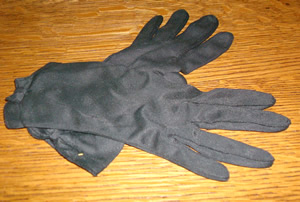
What kid is trying to solve the case of his grandmother’s missing brooch?

I know this is all about PiBoIdMo 2009 and I know you haven’t had a chance to build an idea box of your own yet. But wait. You probably already DO have one. Or even two. If you have a junk drawer where you toss items that don’t have a home, you have a good start on an idea box. Here’s my junk drawer.

Your turn. Go open any drawer in your house right now, junk or otherwise, grab something out of it and then write about it as though it were something entirely different.
What if the box of matches was really a bed for teeny tiny fairies?
What if the string was a rope to help a princess escape from the castle.
What if the ribbon was a rare snake that had been stolen from the zoo?
That’s all it takes. An ordinary object and a question, “What if?”
You get the idea.
Susan Taylor Brown is the author of all sorts of things including:
Hugging the Rock, Verse Novel (Tricycle, 2006)
Oliver’s Must-do List, Picture Book (Boyds Mills Press, 2005)
Robert Smalls Sails to Freedom, Easy Reader (Millbrook, 2006)
Can I Pray With My Eyes Open? Picture Book (Hyperion, 1999)
Enrique Esparza, Boy at the Alamo, Picture Book (Millbrook, forthcoming)
Today for PiBoIdMo, I’d like you to remember a favorite childhood moment.
Well, no, I lied. Sorry ‘bout that. I’m just trying to ease you into things.
What I really want you to do is recall an unfavorite childhood moment.
A time that you were scared.
Shy.
Anxious.
Really wanting your mommy.
Now, turn that situation around. Imagine you have magic powers to leap back in time and make everything better. What did you do? Create a silly scene? Make things disappear? Rewrite your own history?
Many authors have used the childhood creepy-crawlies to create something special instead.
 Afraid the boogeyman’s under your bed? Well, don’t be. In I Need My Monster by Amanda Noll, the kid actually likes the creature that dwells beneath his boxspring. When Gabe the monster leaves on a fishing trip, Ethan wonders how he’ll ever get to sleep.
Thunder and lightning scary? Not in Thunder Cake. The grandmother in Patricia Polacco’s story assures her granddaughter that the approaching storm means it’s time to bake a delicious cake. They quickly run around the family farm collecting eggs and milk (and a tomato) to bake a dessert that celebrates the crashes and booms.
 Animal phobia? In Susanna Pitzer’s Not Afraid of Dogs, a boy’s bravery in the face of storms, spiders and snakes shrinks away at the sight of a spaniel. But when Daniel’s Aunt leaves her dog Bandit with his family for a week, Daniel learns that dogs have fears, too. Daniel witnesses Bandit trembling during a thunderstorm and his concern for the canine makes him realize that he might like dogs after all.
 Teased by others? Trinka Hakes Noble takes a sad situation from her childhood and writes a happy ending in The Orange Shoes. The main character Delly is an artistic girl from a poor family. Delly’s teacher announces a shoebox social to raise funds for art supplies, but Delly doesn’t have shoes, so she is teased. When Delly’s father forgoes buying new tires and instead purchases orange Mary Janes for his daughter, Delly’s classmates stomp on her feet and destroy them. This is where Trinka’s story ends, but Delly’s tale takes off. Delly paints the shoes with a gorgeous pattern, camouflaging the scuffs and scrapes with vines and flowers, winning the highest bid at the shoebox social.
*Sniff, sniff.* (Sorry, I love that story so much, I can’t help but cry when I recount it.)
So let’s think. How can we work childhood’s murkier moments into stories of humor and heart?
Pick a moment.
Relive it.
Now rewrite it.
So how’s it going today?
My #1 tip for PiBoIdMo 2009? Celebrate the Weird Stuff in life. It’s good material for stories.
 Late one evening a weird thing happened to me. After my husband and I tucked our kids in, we heard an unexpected knock at the door. I opened it and found a kid standing on my front porch. He was selling newspaper subscriptions in an effort to go to…Cowboy Camp. I looked at this kid with his everywhere hair and thick glasses and uncowboy-like everything and knew I had a story.
Another weird thing happened a few summers ago. I was visiting my sister who, at the time, lived in a gorgeous area outside of Plymouth, Massachusetts. I loved every bit of the trip—except for my early morning wake-up call.
Each day the sun would come up around 4:30AM and the rooster who lived on the nearby farm would let me know it. Each morning my dislike for that rooster grew. And grew. I got to hoping that bird was missing out on a lot of barnyard fun since he had to make sure he was ready to greet the early morning sun in such a loud and enthusiastic way.
Sooo…since I was up anyway…I started brainstorming. What did that rooster miss out on? What had the other animals been up to when he was catching his zzzzzs? Then I knew—a barnyard talent show.
 The joke’s on me, though. In Chicken Dance the rooster didn’t sleep through the talent show after all. Instead, he ends up being one of the stars of the story as everyone who partakes in the competition is out for the grand prize—tickets to see Elvis Poultry in Concert: The Final Doodle-Doo.
Not all of my ideas show up at my door or wake me up at 4:30 in the morning. How I wish that were the case! But many of them do begin with Weird Stuff.
Today I want you to brainstorm some of the weird things in your life.
Do you live with a Giant Madagascar Hissing Cockroach? Do you come from an enormous family? Did you grow up on a pig farm? Have you had a strange run-in with a squirrel? With a rhino?
Go on. You know you’re weird, too. Get some paper and let’s celebrate it.
Tammi Sauer is the author of seven picture books (and counting). You can find her online at www.tammisauer.com and www.elvispoultrybooks.com.
Tammi’s Picture Books:
Cowboy Camp (Sterling, 2005)
Chicken Dance (Sterling, 2009)
Mostly Monsterly (S&S, 2010)
Mr. Duck Means Business (S&S, forthcoming)
Princess-in-Training (Houghton Mifflin Harcourt, forthcoming)
Oh, Nuts! (Bloomsbury, forthcoming)
Bawk and Roll (Sterling, forthcoming)
It’s Day 2 of PiBoIdMo. I hope you already have idea one down with more brewing. So go grab your coffee (and spoon) and sit down for the next piece of juicy inspiration.
(Yeah, today I’m making you sit down. Tomorrow I might make you jump up and run outside again. Ya never know. This month is gonna be crazy. Crazy like a Fox in Socks!)
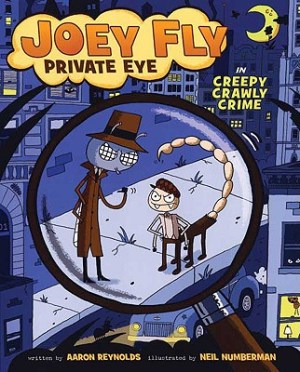 Today author Aaron Reynolds and illustrator Neil Numberman are stopping by to talk about their new book Joey Fly Private Eye (in Creepy Crawly Crime).
And since it’s Day 2, I’ve even got 2 blog posts for you!
First, I asked Aaron and Neil where the idea for Joey Fly originated and how it developed.
Aaron: It started for me with just a title…which was, at the time, Joey Off, Private Fly (get it, Off? Off bug spray?…get it?) Anyway, I loved the idea of a goofy mystery, having grown up with a steady diet of Scooby Doo and movies like Clue (and I’m a huge Agatha Christie fan). Bugs seemed the perfect cast of characters…all freaky and different, each with their own personalities and weird physical traits. From there, the story just took off.
See that, folks? The idea started with just a title.
Neil: When I first got Aaron’s script, I started buying all the film noir movies I could get my hands on, and creepy insect books from dusty old bookstores. That, and a couple books on city architecture in the 40s, and I felt good to go! I had my arsenal of bug characters and buildings to fill the street scenes, and noir-esque shots to compose many of the panels. I knew I wanted some Martin Handford (he of Where’s Waldo fame) type shots in there, too, because his books were always the greatest to sit and stare at for hours, and I want to bring that to Bug City.
OK, let me get this straight. Old movies and dusty books?
Eureka, picture book writers! Run to your local thrift store! (Sorry, I’m making you jump up today anyway. I told you things might get crazy!)
Got your idea yet? Well stay tuned, kidlit lovers. Aaron and Neil will be back later today with a graphic novel about how to create a graphic novel.

[UPDATE: PiBoIdMo 2010 sign-up has begun. Do not sign up on this post. Go to the PiBoIdMo 2010 kick-off post, scroll to the bottom and leave a comment to sign up.]
It’s here! Picture Book Idea Month!
Welcome!
Sharpen those pencils, open a Word document, grab a crayon. It doesn’t matter what you use, what matters is that you get an initial idea down. You might get such a great idea you can’t help but write the story immediately, or you might just record the first entry in this month’s idea file and leave it for a future burst of creativity.
I had so much fun doing this last year, but I was all by myself. I’m happy to have you join me. Four of the ideas from November 2008’s idea file turned into picture book manuscripts and one is out on submission. I expect you to have even better results.
So how is this going to work?
Stop here once a day in November for a new inspirational little tale. We’ll have guest bloggers and giveaways. And at the end of the month, if you’ve collected 30 ideas, you’ll get a PiBoIdMo badge for your blog (based on the logo above by Ryan Hipp) and a special super-secret prize. (You’ve guessed it, “super-secret” is code for “I don’t know what it is yet.”)
Now, get out of your seat.
That’s right.
I advocate butt-in-chair for getting writing done, but now I want you to jump up.
 Go lift up that area rug.
Peek underneath.
What would you expect to find there? Footprints, dust bunnies, a penny, a plastic board game piece missing since 2003?
What would you NOT expect to find there?
Now go stand in the far corner of the room.
(Don’t worry, you’re not being punished.)
Turn around and face the room.
Have you ever looked at this room from this angle? Probably not. What’s different about the room?
Now run outside.
(You get a rain check if it’s pouring.)
 Stand beneath a clump of trees.
What would a child create out of this little spot? Now imagine this same clump of trees in a different season. Did the child’s creation change?
OK, I hear you breathing hard. You’re tired of running around. And your neighbors are starting to gossip.
I think you get the point.
Change your perspective. Do things differently this month.
If you walk your kids to school every day, take a different path.
If you shop at a particular grocery store, go to a different one.
Start looking at your world from strange new angles.
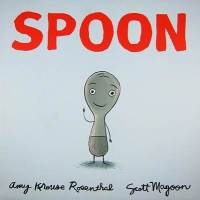 When we settle into a routine, we take things for granted. The teaspoon you use to stir your morning coffee is just a spoon, but Amy Krouse Rosenthal turned that spoon into the main character of a picture book.
Go sit now.
Open your notebook or Word document.
Write something down—a working title, a character’s name, a location, an unusual object. Something that may someday sprout into a story. You don’t have to write the story now, you just have to file the idea away for another day.
And you don’t have to stop at one idea a day. If you get a non-stop flicker of flashbulb moments, just keep writing.
All month long that idea file will grow. Maybe today’s idea will connect with an idea on November 14th and you’ll start building a plot in your head. Who knows? Anything can happen this month.
That’s the idea.
So, how’s it going?
 Hush little baby, don’t say a word.
Mama’s found a book that beats the herd.
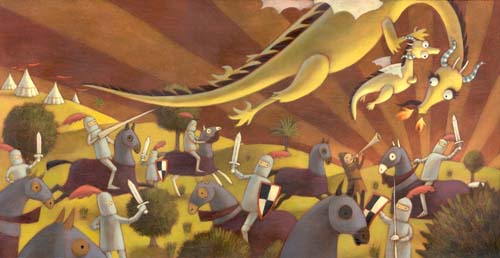
It’s got a little dragon and his mum.
She’s finding food for him, and not just crumbs.
A knight, a queen and a magician.
Yes, those folks are good nutrition.
Set to the tune of a sweet lullaby,
That author Boni Ashburn is awfully sly.
Please excuse my forced rhyme here,
Boni’s verse is better, don’t you fear.
In fact, that couplet with “nutrition”
Is the author’s, not my addition.
My three year-old just loves this book,
Hush Little Dragon boasts quite the hook.
So rush right out and grab this title,
Sorry I have nothing to rhyme with title.
Let me repeat just one more time,
Boni’s verses are better than mine.
Hush little baby, don’t say a word.
There’s a Hush sequel and maybe a third?
If Boni keeps writing books like this,
Kids everywhere will have reading bliss.
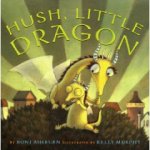 Hush, Little Dragon
Story by Boni Ashburn
Illustrations by Kelly Murphy
Abrams Books for Young Readers, March 2008
Want it? Sure you do!

Mirror Book by Heidi Swapp
Dear Vanity Press,
Your website stinks.
I can find more books on an archeology dig than on your site.
Your home page caters to would-be authors instead of book buyers.
Listen, I know your business model depends on signing authors rather than selling books, but at least give book selling a try. I’m sure you have some talented authors. Unfortunately, you make buying books a bothersome activity.
For instance, why do you distribute a press release without a direct link to the book you’re announcing?
Why is the search on your home page broken? I entered the exact title but got:
Can’t find what you’re looking for? Learn more about self-publishing by requesting a free publishing guide.
Thanks, but I’m interested in buying a book. You know, those papery, bound things you publish?
And when I do finally locate the book’s page, why is the excerpt always blank?
Do you think someone is going to buy a $31.99 children’s picture book without browsing a few pages first?
I’m here to tell you: no. Frankly, I don’t know any parent who would spend $32 on a picture book. Even Robert Sabuda’s gorgeous feats of pop-up acrobatics cost less.
I would like to support self-published authors, really I would. But you’re making it impossible.
Regretfully,
A Book Lover
 What makes you pluck a picture book off the shelf? A clever title? The author’s name? What about a charming little girl on the cover, stirring a delicious pot of noodles? That’s what got to me with Cora Cooks Pancit by Dorina K. Lazo Gilmore.
Maybe it’s because I love to cook. Maybe the bright little dot that said “Recipe Included!” spoke to me. (And, by the way, the recipe is delicious!)
But more than anything, vibrant primary colors and Cora’s smiling eyes drew me in. Illustrator Kristi Valiant’s paintings evoke a warm feeling as Cora cooks a traditional Filipino dish with her mama for the first time.
Cora is the youngest of many children and always gets the kiddie kitchen tasks, like licking the spoon clean. Valiant’s opening scene shows the family from Cora’s point of view, as she sits on the floor with the family dog. We see her family from the waist down, spread along the kitchen counter, performing their duties. It’s amazing how Valiant can make the poses so varied and expressive, only working with half a body. Some of the pencil lines remain, creating an illusion of movement—the bustle of the family kitchen.
Valiant’s image presents the conflict immediately: little Cora is not involved with family meal preparation. We feel Cora’s longing to be a “real cook.”
One day when her siblings leave the house, Cora asks to cook with Mama. Mama lets Cora choose the dish. Cora wants pancit.
Mama tells the story of how her own father taught her to make pancit, and Cora feels proud when she gets to wear her Lolo’s red apron.
What follows is a delightful, heart-warming exchange between mother/teacher and daughter/student. Valiant’s illustrations are spot-on, from facial expressions to body language. She gets every detail just right. Even Cora’s feet, slightly off-balance, reveal her trepidation as she prepares the noodles. Sunlight streams in through the kitchen window, framing Cora and Mama in a scene that highlights the special bond created with family tradition.
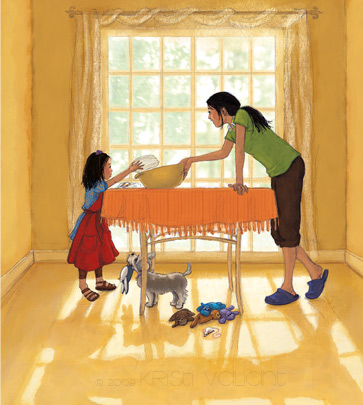
As usual, I won’t reveal the story’s ending. There’s an oopsie along the way, but there’s also a beaming Cora.
I was so impressed with this book’s illustrations, I asked Kristi Valiant for an interview. Luckily, she agreed to talk to me about the making of Cora and other fun illustration stuff. Watch for it soon!
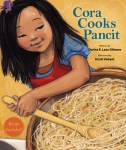 Cora Cooks Pancit
Text by Dorina K. Lazo Gilmore
Illustrations by Kristi Valiant
Shen’s Books, Spring 2009
Want it? Sure you do!
Last year I attended the Rutgers University Council on Children’s Literature One-on-One Plus conference. (Phew! That’s a mouthful. How ’bout I just say RUCCL from now on?)
It was my first big conference. It was my first conference, period. I thought I was prepared. I don’t get nervous in large crowds of people, nor do I find it difficult to go right up to someone and chat. And I love public speaking and performing. I’m not easily intimidated.
But, when I arrived, I realized it. I hadn’t fully prepared myself.
The day went by quickly. Those organizers pack the event chock full of excellent speakers and interesting topics. (See my post-conference notes from last year.) The time you have to meet people is the time it takes to walk from one presentation to another.
I didn’t get the opportunity to talk to many editors or agents. True, I had only just begun to write for children, and thus, I didn’t know who I should be chatting with anyway.
So I decided that I would try to help other first-timers. Here’s a list of lessons I learned last year. I hope they help you make the most of your day.
1. Research the faculty in advance.

2008 RUCCL mentors arrive
Find out which editors and agents are interested in the kind of work you produce. Make a list of their names, and if possible, look up their photos online. No, I’m not encouraging anyone to be a stalker! There are 80 professionals mixing it up with 80 attendees, all wearing name tags. If you don’t want to squint at people’s chests all day trying to figure out who is who, go online and see if you can find a photo to recognize people by sight.
Approach editors/agents only during appropriate moments. Don’t interrupt another attendee or tap the editor’s shoulder while they’re taking a big honking bite of sandwich. You should know that the restroom is a no-no! The best time you’ll have to approach professionals is between sessions. Another good time is when they announce where mentors and mentees should meet. (They will announce pairings via alphabetical order and ask “A-F” to meet in a specific area, like near the fireplace.) When I went to find my mentor for my 45-minute session, I didn’t immediately see her…because another attendee had already pulled her aside to talk.
And I’ll say it: lunch is a good time to talk. They will seat mentors at numbered tables that correspond with the five-on-five assignments. Although not everyone sits in the right place, it will be easiest to find people during lunch. But again, if someone is chomping on chicken salad, it’s probably not a good time to interrupt.
Why is it important to talk to the faculty directly? Because they may not accept your submission post-conference if you don’t make contact. Now that’s contrary to what I had heard about conference submissions, but I did get one submission returned after RUCCL, citing that they don’t accept unsolicited manuscripts. (Yes, RUCCL was clearly marked on the envelope and in the cover letter.)
So find editors. Ask if you may submit. Ask for a business card. Don’t give them yours unless they ask. Be professional, courteous, polite and to the point! There’s not a lot of time, so don’t ramble. Which brings me to my next lesson…
2. If you know your manuscript needs direction, say so.
My submission last year was a novel I had only recently begun. I was not yet clear on the plot or direction. But when my mentor asked me about it, I meandered. I had two general ideas of the possible direction in my head, but I wasn’t certain which path I should take. Instead of asking my mentor what she thought, I tried to make it sound like I was clear. And I obviously was not.
Another attendee had it right. She told me, “I explained to my mentor that I had started the novel but stopped because I was stuck. I told her I wasn’t sure the direction it should take. She then gave me some very good ideas and we brainstormed the possibilities.”
3. Don’t be afraid to speak up and ask questions.
During the five-on-five, the mentees had an opportunity to ask questions of the professional panel. But our discussion leader asked questions off a prepared, suggested list of topics. They weren’t necessarily the questions I wanted answered, but I didn’t speak up and ask what was on my mind.
Remember, this is your day. The conference is arranged to help you, the mentee, take the next step in your career. So if you don’t find the topics to be of interest, speak up. Politely interject and ask if you can introduce a question instead.

Mixing it up at lunch
4. Prepare a list of questions.
Questions about your submission, questions about the market, questions about the publishing house, questions about your other manuscripts. Whatever questions you have, take them with you. Refer to them. If there’s information you want to collect, this is the place to do it.
Another good idea is to bring a list of your manuscripts with one-line descriptions. Even if you just have ideas, ask if they’re good ones. A mentor might tell you to pursue idea A and D but not B or C because of current market dynamics, competition, or other factors (remember, one of those factors might be personal taste).
5. Have fun!
This is your day. It’s a step forward in your career. Enjoy it, use it to your advantage, learn from it. Congratulations and have a great day!
FYI
I added the schedule from last year as I recall it, for those interested in how the day is structured. Please realize this may not be similar to this year.
2008 RUCCL Schedule
• Arrive, get folder with schedule/mentor assignment/faculty bios, read through it, have breakfast, free time to mingle with other attendees
• Introductory speaker (2008, Kay Winters)
• Mentor session
• Panel Discussion (2008, “How a Manuscript Becomes a Book”)
• Lunch
• Five-on-Five Discussion (You, your mentor and four other mentor-mentee pairs)
• Keynote Speaker (2008, K.L. Going)





 Writing for Kids (While Raising Them)