You are currently browsing the category archive for the ‘Children’s Books’ category.
 One winter morning in 1976, my father was reading the Sunday paper when he stumbled across an ad for ice-skating lessons. He snapped the paper in front of me and asked, “It says you have to be able to skate across the length of the ice to sign up. Can you skate across the ice?”
“Of course I can skate across the ice,” I said, and then gulped a spoonful of oatmeal.
A minute later he was on the phone, registering me. What on earth made him believe a five year-old who had never put on a pair of skates could cross a slippery arena, I’ll never know. But I was excited to begin lessons and I imagined zooming around in circles, faster than everyone at South Mountain.
The next week I proudly stepped onto the ice in my new skates.
And promptly fell.
And fell again.
And again.
Then I learned to hold onto the side. And then I learned what it’s like to hit the boards AND the ice. And this was in the days before helmets.
A guard helped me off the ice. She told my father I could not be in group lessons. I thought I might cry. Then she suggested I spend a private lesson with her, learning to skate. My father agreed and by the end of the lesson, I was indeed moving across the ice.
I took group lessons every winter for a few years, earning my USFSA patches faster than everyone else. And when I had completed those patches, they told me I was ready for a coach and private lessons–lessons my family could barely afford.
I went for one private lesson and waited for my coach in the corner, practicing simple figures. The older skaters yelled at me because, unbeknown to me, I was hogging the JUMP corner. I was trying to stay out of the way, but I was totally screwing up their double lutzes.
And then when my father heard what time the coach wanted me at the arena–5:30am twice a week–that was the end of private lessons.
Over the years, I skated recreationally instead, going to the arena once a week and trying to teach myself. I was able to do a scratch spin and a waltz jump, crossovers in every direction, and a few fancy turns. But my real desire was to compete. I always thought…some day.
That day came as an adult. As soon as I had my own money, I took lessons. And like I had done as a child, I quickly moved up through the ranks. I hired a coach. I competed. And I won. In 2002, I competed at Adult Nationals in Ann Arbor, Michigan, after winning Gold at Eastern Sectionals and two other Golds, a Silver and a Bronze in other competitions that year. It was a dream come true.
I thought–if I can do this, I can do anything.
And now, here I am today, accepting an offer of literary representation. Skating gave me the confidence to pursue another dream, that of becoming a published children’s author. And now I’m one step closer to that dream.
I’m here to tell you–work hard, believe in yourself and your talents, find a great critique group and writer friends who support you, and go for it!
You will stumble. You will fall. But brush yourself off and soon you’ll hit your stride–or in my case–glide!
A few days ago in Think Before You Write, I mentioned that although a picture book is short, it doesn’t take a short time to write:
You whittle down the length so every word packs a punch, while still presenting a compelling page-turner, full of illustrative potential. (Which means you have to leave some things unsaid.)
So what does that mean? Leaving some things unsaid? Well, I’ve found perfect examples from Kathi Appelt. (Yes, Newbery Honoree Kathi Appelt. She knows her stuff.)
 Today my daughter asked me to read Appelt’s Bubba and Beau Meet the Relatives, one of our favorite picture books.
Appelt says a lot with a little, meaning she uses a few words to describe a situation, leaving illustrator Arthur Howard to fill in the blanks.
Bubba and Beau Meet the Relatives is about a baby boy, his bloodhound puppy and the Texan family relatives who come to visit one afternoon. Bubba’s Mama Pearl quickly prepares for the relatives’ arrival.
Appelt says: “First Mama Pearl went on a home improvement spree.”
Howard draws: Mama Pearl shoving clothes into a drawer, pushing an overstuffed closet closed, and sweeping Bubba’s toys underneath the bed.
Notice it took 19 words to describe the illustrations, but Appelt only used 9 words to set the scene.
Appelt says: “Then she handed out orders.”
Howard draws: Mama Pearl pointing to a cobweb which Big Bubba swats with a broom, Mama Pearl holding a bag for the bloodhound to put away his bones and balls, Big Bubba vacuuming with Beau riding the cleaner.
And there it took 36 words to describe the illustrations, but Appelt only used 5. (OK, I could have described the art in a tighter fashion, but I think you see my point.)
Later in the story, Appelt introduces “…Cousin Arlene and her dog, Bitsy.”
Appelt says: “Honey, it was froufrou city.”
Howard draws: Cousin Arlene in a frilly pink dress, with a pink bow to match the one atop Bitsy’s fluffy head.
Once again, Appelt’s petite word count packs a humorous punch, with Howard’s illustrations telling half the story.
In our favorite scene of the story, Bubba, Beau, Arlene and Bitsy have just been discovered in the mud hole. “Only one thing to do,” says Big Bubba.
Page turn. (Which means a surprise is coming!)
Appelt says: “Yeehaw, honey! It was a picture-perfect day in Bubbaville.”
Howard draws: The entire family sitting in the back of Big Bubba’s truck, which has been filled with a hose so it’s a southern-style pick-up truck pool.
At kidlit conferences and events I’ve repeatedly heard that picture book writers must leave room for illustrations. Bubba and Beau provides a superior example of how to write a successful tale that inspires brilliant pictures. The words and images work beautifully together like Bogey & Bacall, Astair & Rogers, and Lady Gaga & Elton John. (OK, maybe that last analogy wasn’t so good. But I needed something current.)
If you have a recommendation of a picture book that says a lot with a little, let’s hear it!
 A typical day as a newbie writer: sit down at the computer, start writing.
At least, that’s what I did two years ago. I got an idea and I didn’t stop to think: is this a good idea? Is it marketable? Has anyone written something like this before? Nope. I just wrote, motivated by my muse.
And perhaps this was good back then. I was honing my skills, finding the right words, crafting sentences, building stories.
But they were looooong stories. At an average 1,500 words my tales were neither picture books nor chapter books. I insisted I was writing picture storybooks, and I used Patricia Polacco’s body of work as an example of how my stories could be published, not realizing, c’mon, she’s PATRICIA POLACCO.
It took me a while to learn to THINK before I write.
An idea begins. I ponder it. I write down the initial concept. What is my topic—what is this story about on its surface? Bulldozers or ballet dancers or dragons? What is at its heart? Is it about friendship or fitting in or family? Who is my character and what does he want? What is my hook? Can I boil the concept down to one line?
Then I research. Is there anything similar already published? If so, I’ve got to change it up a bit. Or let it go.
I ask myself these important questions:
- Is this picture book marketable?
- Will someone pay $16 to buy it?
Granted, these are difficult questions to answer objectively. Of course you want to believe that everyone will buy your book! But as a mother of two picture book age kids, I know this isn’t the case. If we don’t love reading the book over and over again, I won’t buy it. I try to use my motherly instinct to answer these questions and I think of my other parent friends. (And then I stalk parents in the bookstore and ask them what they think. No, just kidding. But I’m tempted.)
If I can’t answer “yes,” the idea gets filed away for the future, when I can perhaps transform it into something more extraordinary.
If I do answer “yes,” (or even “maybe”) then I create a brief outline or I just write. And I keep the proper length in mind: 500 to 700 words.
Some writers may call this process stifling. But I call it smart. Because if you want to be published, you have to examine these elements before you write. Because although picture books are short, they don’t take a short time to write.
Sure, you may pump out a first draft in a few days, or even less, but picture book revisions could go on for weeks, months, even years until you get it right. You whittle down the length so every word packs a punch, while still presenting a compelling page-turner, full of illustrative potential. (Which means you have to leave some things unsaid.) With all that time invested in a product you want to sell, you’re playing Russian roulette if you haven’t researched the story’s potential first.
It took me a while to learn this, to realize this, so I’m just paying it forward. Many of you are probably nodding your head in agreement. And maybe some of you are waving a finger at me for being a creativity killer.
In any case, I’m eager to hear from both sides! Think or write? Or a hybrid of both?
So this self-proclaimed intergalactic superpower Mike Jung and I have a little middle grade book review thing going. You may have read our bookish banter regarding Nan Marino’s touching Neil Armstrong is My Uncle and Other Lies Muscle Man McGinty Told Me or our unique take on Newbery Medalist Rebecca Stead’s time-travel thriller When You Reach Me. (After all, Elizabeth Bird did mention our review in FuseNews.)
In a pathetic, fly-by-the-seat-of-our-pants fashion we dubbed ourselves the Ebert and Roeper of children’s book reviews.
We think you agree that the name lacks the imaginative flair and je-ne-sais-quoi mystique you’ve come to expect from Tara and Mike. Especially Mike. In the words of the immortal Steve Martin, he’s a wild and crazy guy.
So we thought–hey–we’re writers! We can do better than that. What’s better yet–we know a lot of writers! Smart writers! (Notice how I’m buttering you up.) They can certainly do better than that! In fact, why don’t we sit back and do nothing while they do all the work? Yes, we’ll have THEM choose the title for our review series while we collect all the middle grade glory!
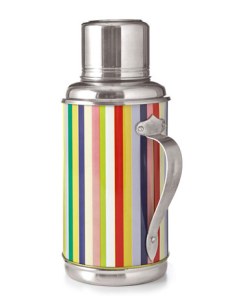 We’re even offering up a prize! And again in the words of the immortal Steve Martin: “I’m picking out a Thermos for you. Not an ordinary Thermos for you. But the extra best Thermos that you can buy, with vinyl and stripes and a cup built right in.”
Well, I’m not sure if the prize is a Thermos. But it’s gonna be somethin’. Yes, you’re guaranteed SOMETHIN’.
Head on over to Mike’s Little Bloggy Wog for more details.
And tell him Ebert sent you. Or Roeper. We haven’t quite figured out who is who. (You see why we need a new name?)
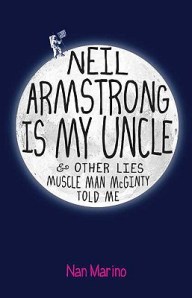 Who are Tara and Mike? Think of Ebert and Roeper–but discussing children’s books instead of movies. This week we’re giving two bookmarks up to Neil Armstrong is My Uncle & Other Lies Muscle Man McGinty Told Me by Nan Marino (Roaring Brook Press, May 2009).
“Muscle Man McGinty is a squirrelly runt, a lying snake, and a pitiful excuse for a ten-year old. The problem is…only I can see him for what he really is.”
Tara: So Mike, what attracted you to Neil Armstrong is My Uncle?
Mike Jung: Well, Tara, it was partly the cover (the moon, it’s a very evocative image), partly Nan being a Blueboarder and seeming like a decent sort, and partly the title, which really spoke to me somehow—I instantly felt like there was a story right there in the title. Why’d you read it?
Tara: The title especially drew me in. Even though it mentions the first man on the moon, I didn’t realize the story took place during the summer of 1969, so I was pleasantly surprised. I became immersed in the summers of my childhood, anticipating the arrival of the ice cream truck, just like the kids on Ramble Street.
Before I read it, I imagined Muscle Man McGinty was some sideshow freak at a local carnival. I’m glad he turned out to be a scrawny ten-year-old instead.
Mike: Ha! I was caught off-guard by the time period too. 1969 was the veeeeeery beginning of my time (I was born in the summer of ’69) so it didn’t trigger any memories, but I thought the setting was so vivid, and so lovingly created, that I was immersed in it right away. And I had the same thought about Muscle Man McGinty! I also loved the character he turned out to be—so much sadness, courage, generosity and patience rolled up in one runty little kid.
Tara: Uh, maybe I shouldn’t have dated myself like that. 1969 was before my time, but still, if you remove the historical backdrop—Vietnam and the lunar landing—the story has a timeless feel. It felt like 1979 in my neighborhood, but it could easily take place in 2009, although the kids would be wearing bike helmets and the adults would be talking about Afghanistan and flying cars. If we had flying cars, that is.
What about the novel hooked you?
Mike: I was hooked by more than one thing—the setting, as I mentioned, was superb—but it was the characters that really grabbed me, especially Tammy. I love the voice of Tammy. She’s an incredibly genuine, multi-faceted, fully-realized character. In my eyes, one of the ways to create a successful protagonist is to put all their flaws on glaring, unmistakable display, but still make them sympathetic and understandable. Tammy often comes across as self-involved, oblivious and sullen in all the normal 10-year-old ways—she’s not some kind of villain, but she’s also not super-cuddly and lovable. I loved her anyway.
Tara: Confession: I didn’t love Tammy all the way through the novel. But I loved that I didn’t love her. I can’t recall the last time I felt such conflicting emotion over a main character. I rooted for her, even though I didn’t necessarily agree with her actions. The narration was brilliant because it revealed Tamara’s world so slowly, making you trust her implicitly at first, but toward the end you realized she could be her own antagonist. It felt like that Oscar Wilde song by Company of Thieves: “We are all our own devil.” Tammy wants what she wants and she doesn’t see what she needs to see. I’m being very cryptic, aren’t I?
And I also have to admit, I loved liar Muscle Man more than Tammy sometimes. The way he complimented Tammy’s pitching during the Muscle-Man-against-the-whole-neighborhood kickball game was hilarious because it infuriated Tammy. She wanted to expose him as a loser and he wanted a friend. Muscle Man had a big heart and he was desperate to fill it up.
Why would you recommend this book?
Mike: YOU ARE BEING TERRIBLY CRYPTIC. No problem, though, it’ll keep your blog readers on their toes, show ’em life is real, etc. I agree about the gradual reveal of Tammy’s world—her dysfunctional family, her envy toward the neighbors, her brother and his friend—it unfolds beautifully. There are moments when Muscle Man just broke my heart—you got it exactly right, such a big heart and such desperate attempts to fill it up.
Ultimately that’s why I’d recommend the book, it has tremendous heart. The characters have so much emotional depth, there are moments of real poignancy, and the book ended with the perfect mixture of loneliness, grief, solace, reconciliation and hope. This book is a tour de force, and I’m gonna pounce on Nan’s next one.
Tara: Mike, there’s nothing left to say because you’ve said it all. All the puzzle pieces came together at the end in a very satisfying way, but I still see opportunity for a sequel. Nan, could you get on that right away, please?
 Neil Armstrong is My Uncle & Other Lies Muscle Man McGinty Told Me
by Nan Marino
Roaring Brook Press
May, 2009
Want it? Sure you do!

Blog Guest
Thanks to blog guest Mike Jung for the book banter.
Mike Jung has delusions of galactic conquest–lunar death beams, interstellar armadas, alien flunkies, etc.–but he probably has better odds for achieving notoriety by elbowing his way into the realm of published middle-grade fiction writers. He therefore restricts his empire-building activities to Twitter, which is better anyway because he doesn’t have to get out of his chair. Mike lives in Northern California with his wife and daughter, who exhibit immense patience for all his weirdo tendencies.
Whoa, that’s a long title. But it’s accurate! I asked some of my favorite authors and illustrators to pick three stand-out picture books of 2009. It wasn’t an easy task. I know because I couldn’t decide myself! So I dumped the job on them, just like New Jersey got dumped with snow this weekend. Except they’re a lot warmer than I am, cuddled up with good books instead of buried beneath a foot of the white stuff.
Check out their amazing selections and add a new book to your holiday wish list!
Boni Ashburn
Author of Hush, Little Dragon and Over at the Castle
 Rhyming Dust Bunnies
by Jan Thomas
Beach Lane Books
January 2009
A simple, hilarious introduction to rhyming that is not only adorable to look at, but also invites audience participation and is a perfect read-aloud. That’s right, perfect.
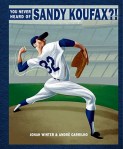 You Never Heard Of Sandy Koufax?!
by Jonah Winter and Andre Carrilho
Schwartz & Wade
February 2009
Striking illustrations coupled with a fantastic voice–this book makes you FEEL baseball. Jonah Winter is a picture-book biography genius–I had a hard time choosing between this one and Gertrude Is Gertrude Is Gertrude Is Gertrude (which has an equally excellent voice!).
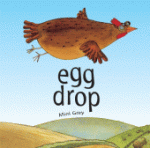 Egg Drop
by Mini Grey
Knopf Books for Young Readers
July 2009
Excellent humor of the dark, dry and deadpan sort, coupled with Grey’s gorgeous art.
This was impossibly hard! Three is too just too few. My “honor books” would be A Penguin Story by Antoinette Portis, Monkey With A Toolbelt And The Noisy Problem by Chris Monroe and Thunder Boomer! by Shutta Crum and Carol Thompson.
Jannie Ho
Illustrator of The Great Reindeer Rebellion and Light the Menorah
 Around the World with Mouk
by Marc Boutavant
Chronicle Books
November 2009
Last year when I was in France, all I could think about was getting my hands on this book (which was originally published in French), but only to find out later that Chronicle books were publishing it in the US this year. Marc Boutavant is one of my favorite illustrators; I’ve read his style described as “the modern day of Richard Scarry,” and I agree! With so many little details to look over, there is always something new to discover each time I open it.
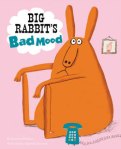 Big Rabbit’s Bad Mood
by Ramona Badescu and Delphine Durand
Chronicle Books
March 2009
Another one from Chronicle! I can’t resist Delphine Durand’s illustrations–so many funny little details to look at. I own many of her books, and am obviously a fan…(even wrote her a fan email!) Even though this story is about a grumpy rabbit, one can’t help but smile when looking at her silly characters.
 The Great Paper Caper
by Oliver Jeffers
HarperCollins Children’s Books
April 2009
I’m a great admirer of those who write AND illustrate their books. Oliver Jeffers’ illustrations are super cozy and serene, I want to live in that forest with the animals! Thumbs up to this quirky, winter mystery story.
Jacqui Robbins
Author of The New Girl…and Me
 A Book
by Mordecai Gerstein
Roaring Brook Press
April 2009
Kirkus called it “Metafiction for the picture-book set.” A young girl who lives in the book with her family struggles to find her story, trying on different genres and marveling at the giant mushy faces (that’s us) looking in on her. It’s funny, it’s smart, and it is truly unique. Plus, we read it five hundred times in the first month we had it and I never tired of it.
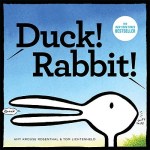 Duck! Rabbit!
by Amy Krouse Rosenthal and Tom Lichtenheld
Chronicle
March 2009
I was smitten with this book from the start. The concept is simple: is it a duck or a rabbit? Two voices argue. Giggling ensues. As I blogged in July, we get extra giggling in our house because my preschool son does not have the cognitive ability to see it both ways and so he thinks the point of the book is that some poor dope thinks that bunny’s a duck.
 Okay, I would be lying if I didn’t pick Two of a Kind, by, um, me (and Matt Phelan).
Atheneum
July 2009
I’d like to be cool enough to pretend I didn’t dance like a four year-old fairy girl whenever I turn to the page with my name on it. But I’m not. And I do. More than that, though, I still love the story and the way it makes kids nod in recognition.
Patricia Storms
Author/Illustrator of The Pirate and the Penguin
It’s really hard to pick just three books! Being a Canadian, you might wonder if my choices are Canuck books. Yup, they are…and they are all very unique and engaging.
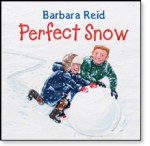 The Perfect Snow
by Barbara Reid
Scholastic
October 2009
Barbara Reid is a treasured Canadian talent who once again creates a visual delight with her plasticine illustrations. Reid creates a delightful story about the joys of creating snowmen and snow forts in the perfect snow of a winter day.
 The Imaginary Garden
by Andrew Larsen and Irene Luxbacher
Kids Can Press
March 2009
Andrew Larsen’s The Imaginary Garden is a beautiful story about the special bond between a grandchild and grandparent, and the power of the creative imagination. Luxbacher’s illustrations are magical and bursting with colour.
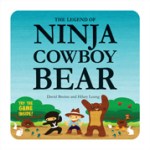 The Legend of Ninja Cowboy Bear
by David Bruins and Hilary Leung
Kids Can Press
September 2009
And finally, The Legend of Ninja Cowboy Bear is charming and fun story about friendship, and celebrating the differences in others. Hilary Leung’s illustrations are bright and utterly adorable!
Michael Sussman
Author of Otto Grows Down
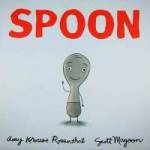 Spoon
Spoon
by Amy Krouse Rosenthal and Scott Magoon
Hyperion
April 2009
Modesty prevents me from mentioning Otto Grows Down (darn, I mentioned it!) But I also loved Spoon, which—like Otto—was illustrated by the supremely talented and charming Scott Magoon. I’m always amazed at Scott’s versatility, and once again he has employed the perfect style for this sweet and quirky story. I also admire Amy, since I’ve tried unsuccessfully for years to come up with a picture book about an inanimate object. Not an easy task, and she makes it look simple.
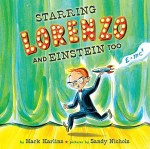 Starring Lorenzo, and Einstein Too
by Mark Karlin and Sandy Nichols
Dial
April 2009
Mark, who is the author/illustrator of many fine picture books, including Mendel’s Ladder and Music Over Manhattan, has produced an endearing story which celebrates the importance of family and the power of the imagination. The cool, retro illustrations are superb.
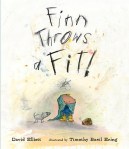 Finn Throws a Fit!
by David Eliot and Timothy Basil Ering
Candlewick
August 2009
Finally, I’m wild about David Eliot’s Finn Throws a Fit! This book is hilarious, and it’s a model for writers striving to tell a compelling story in the fewest words possible. Timothy Basil Ering’s artwork is astounding. I don’t know of a more creative illustrator working today.
So what were your favorite picture books of 2009?
Please leave a comment!
This is the second art gallery by illustrators who participated in November’s 30-picture-book-ideas-in-30-days PiBoIdMo challenge. You can see ideas taking shape–in the form of characters. (If you didn’t already know, editors are keen on character-driven picture books these days.) And just think, once these stories are published, you can say “I knew them when…”
Loni Edwards
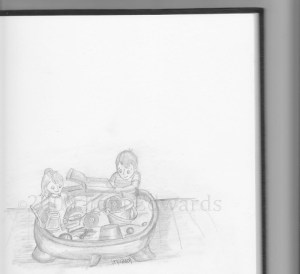
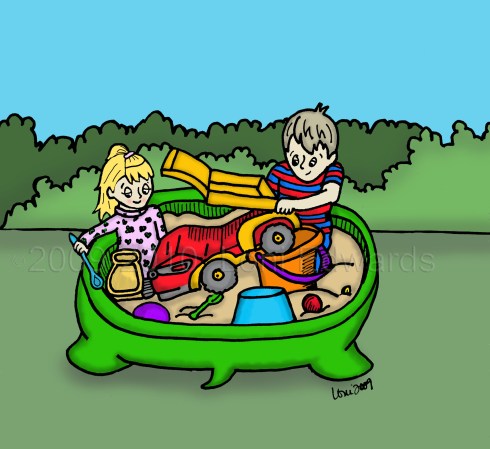
“This is a sketch from my story about going to Nana’s house. I’m entitling it ‘Two Kids in a Sandbox’ until I evolve the story more. I sketch, then I ink using a light table. I scan the piece into Photoshop where I color with a Wacom Tablet.”
Lynn Anne Bemis
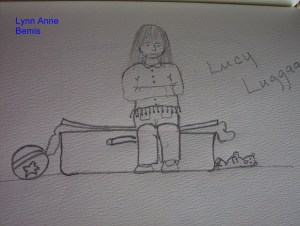
“I have not taken lessons as an illustrator. I am a ‘wannabe’ and this is the first year I started adding drawings to my story ideas. So as simple as they are, I am showing them to you. I am, you could say, ‘A work in progress.'”
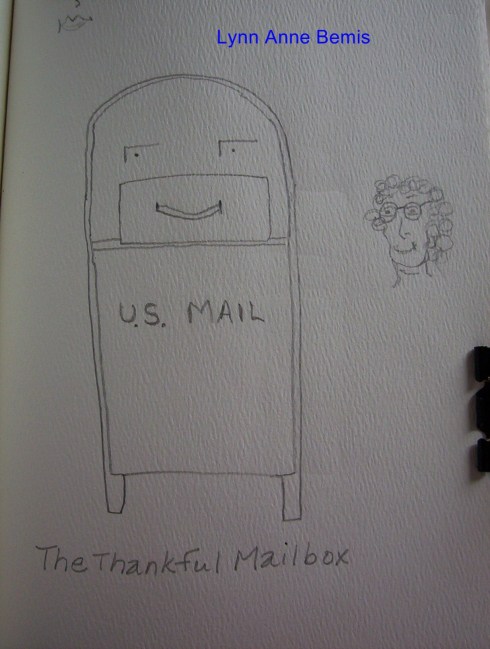
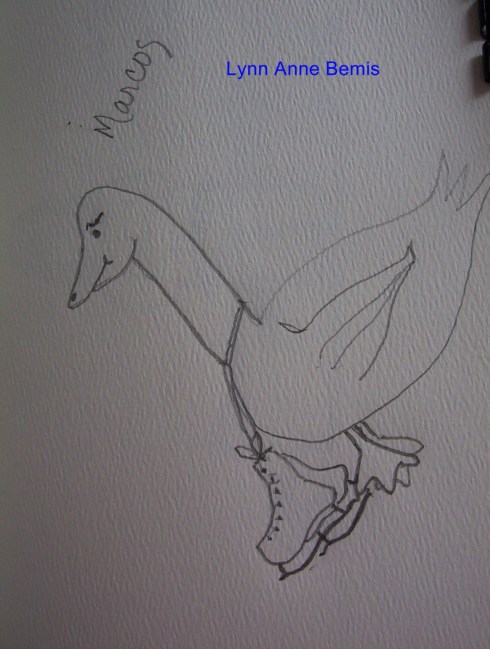
Debbie Ridpath Ohi
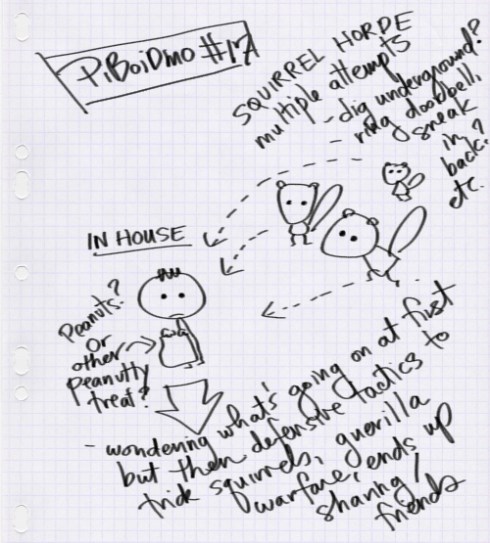
“Regarding the first sketch, this is how I brainstorm sometimes and I figured I’d try it for PiBoIdMo. As you can tell, um, my sketches are VERY rough.
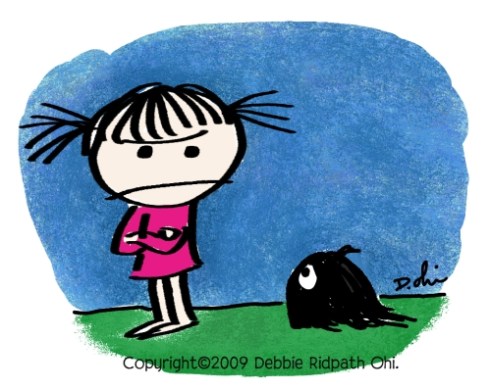
“I’ve always been fascinated by the juxtaposition of cute and scary. The monster guy in the second drawing was inspired by Little Nightmares, which I’d eventually like to include in a picture book. The girl is a character I came up with for my Snarkface cards and she demanded to be included in the drawing as well.
“The third sketch looks drawn on paper, but I actually did it in Corel Painter. I find that experimenting with different virtual media is fun, plus I enjoy trying out different styles. I did this sketch to accompany a text picture book idea. One of the reasons I enjoyed PiBoIdMo so much was because it not only inspired me as a writer but also as an illustrator.”

One more gallery to come, kidlit fans! Stop back soon for more insight into the illustrative process.
Drawings and sketches and art, oh my! Several children’s illustrators participated in November’s PiBoIdMo challenge by moleskining their way through the month. Below you can see what makes an artist’s brush tick…err, I mean flick.
And…this is just Gallery #1 in a series of 3. More illustrators and galleries to come!
Courtney Pippin-Mathur
“I’ve had these ideas bouncing around in my head for a while now, thanks to PiBoldMo, they are now on paper where they hope to grow into picture book dummies one day.”

The Bodyguard
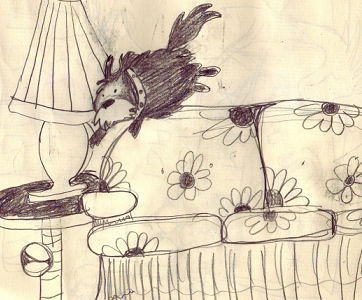
Fritz
Erin Nowak
“Attached is a sketch of the two main characters I got from this little sketch session: Warm & Toasty. Warm is a sweet cup of hot cocoa, and Toasty is her buttery wheat bread buddy. The VERY rough idea is that they’re used to being served up together on cold winter days, but the problem they’re having is that neither wants the other to shine too brightly. A friendship dealing with a little jealousy I guess. I also included my entire sketchbook page from that day as well, complete with scribbles and misspellings, just to give insight into the different ways illustrators work.”


Bonnie Adamson
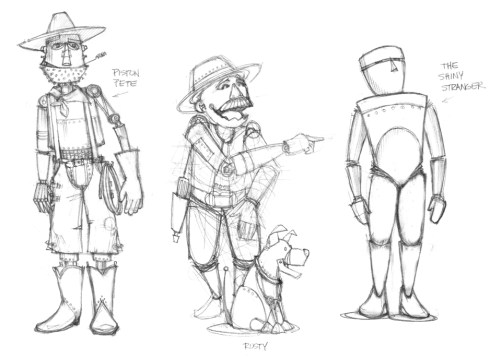
“The working title is “Robot Rodeo,” made up this summer while illustrating the bookshelf of the main character in Heather Burnell’s picture book, Bedtime Monster. It popped back into my head when I was trying to come up with an idea for day three of the PiBoIdMo challenge. The title was about all I had until I started sketching, and then the robot steer with his knobs and levers began to take on a sort of gentle steampunkish look, which gave me a bit more of a hook for the story. I’ve got a very rough first draft down, featuring a showdown between one of the battered old cowboy robots, Piston Pete, and the ‘shiny stranger,’ who’s, um, not from around here.”

More galleries to come, kidlit fans! Stay tuned…
Once there were crowds, and clinging jockeys, and horses to ride against in the razor-fine seconds it took to be first across the finish line.
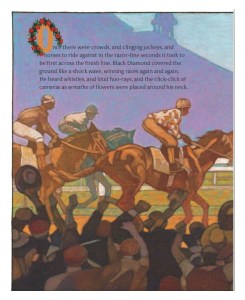 As an aspiring author, I’ve been told countless times about the importance of a first line. Never before has a picture book opening reined me in so tightly, so swiftly as Deborah Blumenthal’s Black Diamond and Blake, the story of a racehorse saved by friendship.
Black Diamond, a beloved racehorse, hero of the grandstand crowds, wins race after race. His jockey and owner feed him sweet apples, warm him with a red velvet blanket, and wrap him with such kindness that the horse only wants to win and make them proud.
But no athlete can dominate forever. Black Diamond grows sore, tired and eventually becomes injured. His fans boo instead of celebrate, ripping their losing tickets and tossing them to the ground. The sweet apples and sweet attention disappear.
A gruff, cigar-smoking man purchases Black Diamond and takes the horse to a prison rehabilitation program. The author was inspired by a New York Times article about inmates who cared for retired racehorses. “I read of the deep emotional connections that some inmates made with the animals, so that in the end, men saved horses and horses saved men,” Blumenthal explains.
At the prison, Black Diamond meets Blake, a soft-spoken man who feeds the horse cinnamon candies and takes him on long walks. The two bond in friendship. And then, one day, Blake is released and Black Diamond becomes despondent and difficult, longing for his caretaker, his best friend.
As usual, I never reveal a book’s ending, but the book is titled Black Diamond and Blake for a reason.
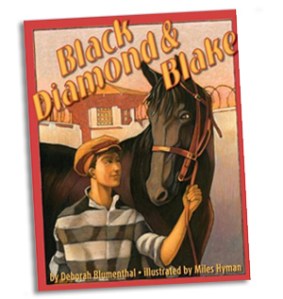 The Art-Deco-inspired illustrations by Miles Hyman render bold forms with a soft pastel stroke, a visual juxtaposition befitting this tale of a strong yet sensitive racehorse. The book is gorgeous in all respects—from the language, to the theme, to the green hills of the final spread.
Parents may appreciate Blumenthal’s beautiful words more than children (“in a minute that grew heavy with time”) and those younger than five may not be able to sit for the entire tale, although my horse-lovers, aged three and six, were mesmerized. While the publisher claims it’s appropriate for children up to age eight, I foresee this book being enjoyed by children as old as ten or twelve, especially if they love animals.
Black Diamond and Blake never gets too sappy or sentimental, but instead tells a story of friendship and second chances from the thrill of the races to the gentleness of a rolling countryside.
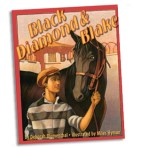
Black Diamond and Blake
Story by Deborah Blumenthal
Illustrations by Miles Hyman
Alfred A. Knopf, February 2009
Thanks to illustrator Bonnie Adamson, everyone who completed the 30 ideas in 30 days PiBoIdMo challenge has a winner badge to proudly display on their blog or website. Pick it up here!
If you’d like, link the badge back to the first PiBoIdMo post, so curious visitors will know what it is. This isn’t a requirement, just a suggestion.
Onto the Naoko Stoop print winners.
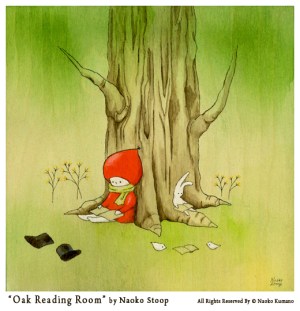
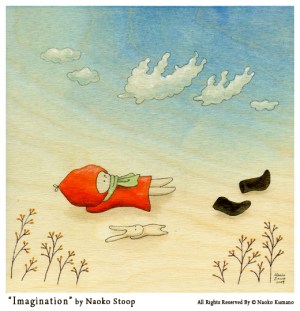
The winners of the prints were not drawn by random. Rather, I chose two people who were, in my opinion, the two most enthusiastic PiBoIdMo supporters. They commented frequently during the month and they both ended the event with nearly twice the number of ideas they were supposed to create.
Congratulations KELLY FINEMAN and JEWEL SAMPLE! You’ll receive an email to arrange delivery of your prizes.
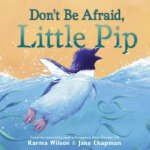 The random winner of the signed Karma Wilson book Don’t Be Afraid, Little Pip is BETH COULTON! You’ll receive an email asking for an address.
 The random winner of the signed Jennifer Swanson Penny and Rio book is LORI DEGMAN! An email’s coming your way, too.
Congratulations again to all the winners! You all deserve thanks for making PiBoIdMo a success!
And…stay tuned for a PiBoIdMo Art Gallery, brought to you by the many talented illustrators who sketched their way through November.





 Writing for Kids (While Raising Them)