You are currently browsing the category archive for the ‘Children’ category.
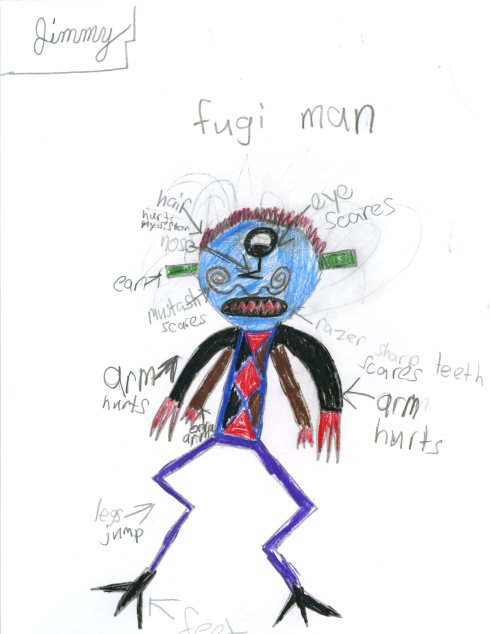
Here are four more monsters created by the students in Mrs. Mozer’s third grade class.
I asked them to pretend they could shop at The Monstore (the neighborhood shop in my debut picture book). What kind of monster would they buy? What special talents would it have? They came up with some fabulous creatures!
Denise:
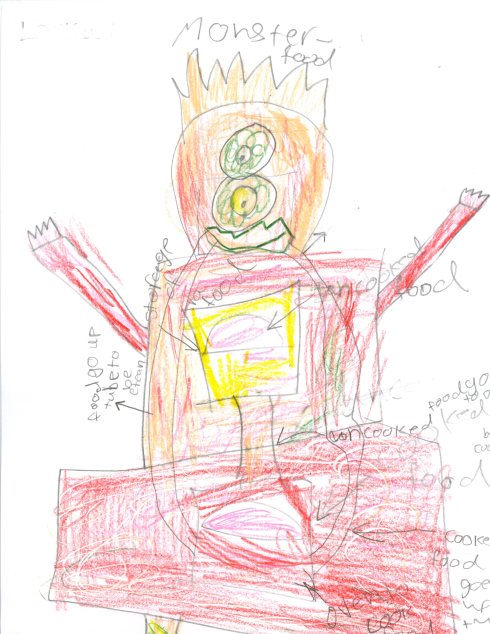
Hanna:

Jimmy:
Lucas:

Thanks again, Mrs. Mozer’s class. More illustrations to come next Monday! Have a monster of a week!
I was sure there was a Poetry Friday blogging meme, and there is, but it’s for sharing published poems, not original work. But I wrote this little ditty and had no place for it, so here it is. As parents, we love our children desperately, but sometimes the routine of the day can be trying. I think this captures that feeling of happiness mixed with exasperation.
THE SUN
My children revolve
around me, tiny
planets desperate
for warmth.
My skin, hot
to the touch.
Bacon splatter,
Scalded milk,
I burned
the toast
again.
On World Read Aloud Day March 9, I visited Mrs. Mozer’s third grade class via Skype and gave them an advance reading of my debut picture book, THE MONSTORE.
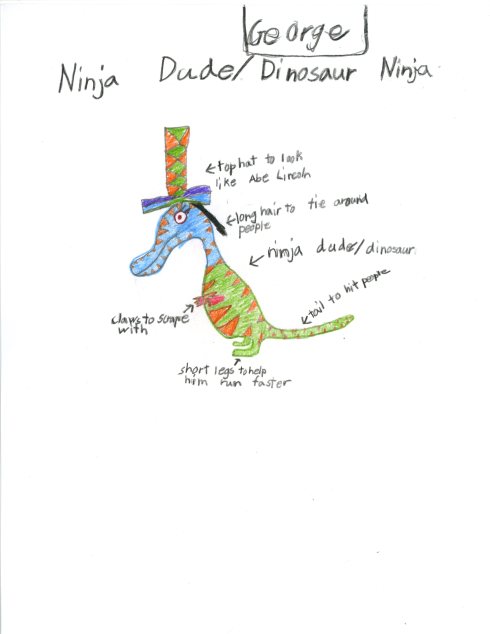
Then I asked the students–if you could buy a monster at The Monstore, what would it look like? What special talents would it have?
The class drew pictures and each Monday for the next few weeks I’ll be sharing them with you.
These kids are very creative! Give them a hand (applause, not an extra monster hand, although that would be very useful).
George:
Henry:

Julia:

Melanie:
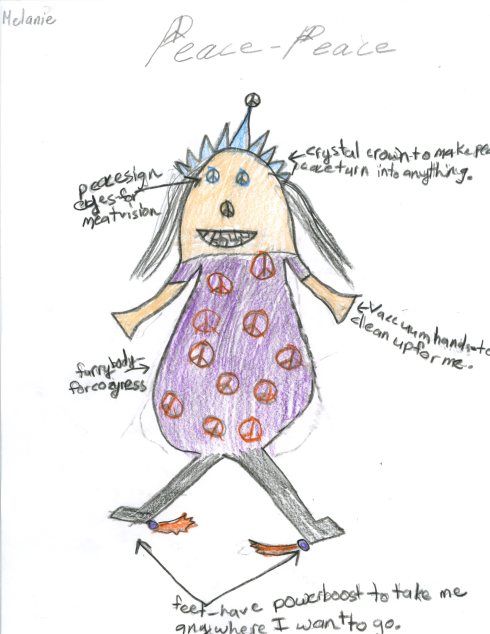
Thanks to Mrs. Mozer’s class for sharing their monsters!
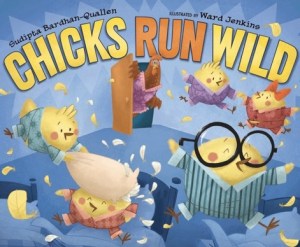 Do you have a love/hate relationship with bedtime? It’s a cozy time to snuggle and read a book with the kids, but it’s also when they refuse to settle down to sleep. Mom, can I sleep in your bed? Dad, can I have a glass of water? Could you fluff my pillow? Can we read one more book? Please? Five more minutes? Pretty please with sugar on top?
Ey yi yi. It’s enough to drive any mama hen wild! And it does in Sudipta Bardhan-Quallen’s new picture book, Chicks Run Wild.
In her Coop Sweet Coop, Mama has five chicks to put to bed. She tucks them in, gives them each a peck goodnight, but when she closes the door, they leap out of bed and cause a riotous ruckus. Feathers fly and Mama’s patience wears thin.

At first Mama scolds her chicks, but when she realizes her little ones are not ready for dreamland, she does something unexpected. Chicks Run Wild lets both parents and kids know it’s okay to break the rules every once in a while.

With a bright and cheery color palate, Ward Jenkins creates an adorable brood of five chicks with distinct personalities. One chick always has one eye opened, awaiting Mama’s departure. And there’s other fun details, like a spoof of the Beatles’ album cover Abbey Road, and Mama’s favorite read, Gone with the Wing. Sudipta’s jaunty rhyme makes you want to get up and shake your tail feathers with the family.
Bedtime is going to be a lot more fun with Chicks Run Wild. When your kids ask to read one more book, you’ll happily pick this one.
 Want it? Sure you do!
Chicks Run Wild
Story by Sudipta Bardhan-Quallen
Illustrations by Ward Jenkins
Simon & Schuster Books for Young Readers
January 2011
 by Susan Chodakiewitz
With a background in musical theater I approach writing children’s books very much like I do writing for theater. When I visualize the story I see the pictures unraveling as scenes on the stage. Are there enough possibilities in the words to develop back story and subtext for the characters? How will my words trigger the action in the scene? Do I know my characters motivation and desires? All these issues are key element to triggering my imagination for the story.
In my picture book Too Many Visitors for One Little House there are 20 members in the family including the dog and the fish and in order to get to know the story better I worked on a back story for each character.
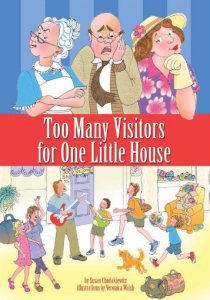 When I worked with illustrator Veronica Walsh on this book we spent hours discussing each family member in depth. What were there likes, dislikes, weaknesses? What did they love to wear? Who had squabbles with whom? Who admired whom? Which kids wanted to emulate which kids? Which kids were best friends? What were the problems between the in-laws, the married couples? Working with Veronica taught me SO much about my characters and introduced me to layers of story lines which I could eventually use for sequels to the book.
Creating the theatrical version of this book also taught me a lot about the writing process, about the characters and about what the story is really about. After finishing the theatrical version of the book I had learned so much about the story and characters that I found myself wanting to re-write the book.
Sometimes thinking about what song a character would sing on a particular page (scene) helps me discover what the character really wants, feels, and thinks. It helps me find direction to the story and makes it come alive to me.
From the get-go, the book Too Many Visitors for One Little House sang to me as a theatrical piece. From the early stages of writing my drafts I imagined the characters dancing and singing and visualized the staging of different scenes. My theatrical viewpoint is a constant guide to me during the writing process and really helps me unravel the story.
Engaging theatrically with a picture book not only benefits me as an author. I believe engaging theatrically with a book encourages a love or reading in children. After one of the performances of the book Too Many Visitors I observed several kids acting out one of the songs. The parents later emailed me that the kids asked the parents to read them the book many times that night. The next day they acted out the show with their siblings and invited guests.
I really believe this kind of theatrical engagement with a book and its characters can really encourage reading. Picture books are particularly engaging in this manner. I think by inspiring a child to act out a book can really deepen a child’s reading experience.
I am thrilled to be a picture book writer and to have the opportunity to encourage the love of reading.
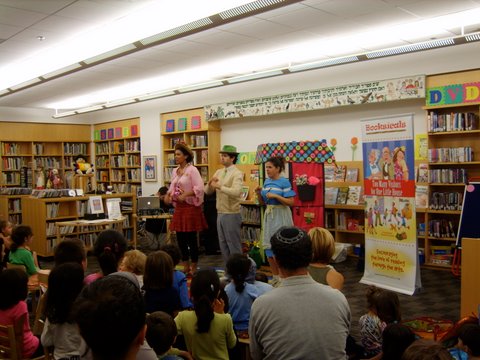
Susan Chodakiewitz is the author of Too Many Visitors for One Little House and the founder of Booksicals, Encouraging Reading Through the Arts.
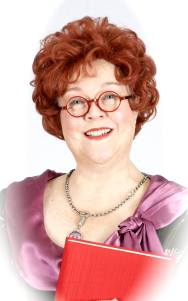 by Mrs. P
The books we read (or someone reads to us) as children are the books we never forget. They shape us in ways we may not even recognize: how we see the world, what we believe to be true, what we think is just or unjust. We tuck their lessons away for safekeeping and bring them out—for the rest of our lives—whenever we need help understanding a frustrating situation or making a difficult decision.
You’re driving to work in the morning, going the speed limit, when someone roars by, nearly knocking your car over. You get mad, but finally calm yourself by thinking, “It’s okay. Slow and steady wins the race.” You’re probably not also thinking, I believe this because my mother read Aesop’s “The Tortoise and the Hare” to me when I was 4 years old. But I bet that’s where it came from.
The books we read as children become a part of us. Have you ever noticed how many people use characters from children’s books as names for their pets, email addresses, sometime even their own children. These characters become almost like family to us. We first met them when our imaginations made little distinction between fantasy and reality, and we’ve lived with them longer than many of our “real” friends.
When I run into someone with a dog named Scout, for example, I know we have a mutual friend in a little girl from To Kill A Mockingbird. We can talk about her and share our impressions of her just as we could a real, live person we both knew. In that sense, children’s books also give us a comforting sense of community wherever we go.
It is for all these reasons that I started MrsP.com. I could think of nothing more valuable than creating a place where kids, who might not otherwise have the chance, could hear for free and with no advertising, a storyteller read them classic children’s stories.
I’ve just released my first book, Mrs. P’s Four Favorite Fairy Tales and Funny Stories with which kids can read along with me on my website. It’s the first of its kind: a truly interactive book that will help kids improve their reading skills in a fun and easy way.
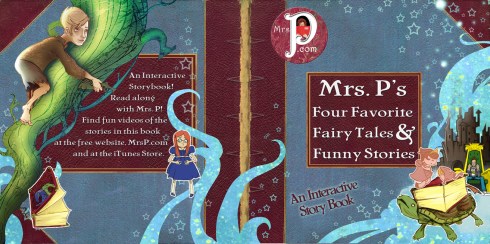
I’m proud of my website and new book, as well as my craft projects and games for kids that champion a love of books and reading. I always put a lot of thought and care into each of them before sending them into the world, because I know you should always look before you leap.
Hmm. I wonder where I learned that?
TV star Kathy Kinney (“The Drew Carey Show”), portrays Mrs. P and is also one of the creators of the website. The website endeavors to expose young people to great books and stories through a celebrity storyteller, Mrs. P. MrsP.com has no advertising and is completely free, making it a fun and educational online destination for teachers, parents and children. The site also contains interactive games, coloring sheets to download, and activity guides to accompany chapter books like Alice in Wonderland. Every story also offers read along options so children can see the words, which is helpful to early readers, and ESL students. Mrs. P is the recipient of The National Parenting Center 2009 Seal of Approval and the American Library Association distinction of “Great Website for Kids.”
 by Carol Rasco, CEO, Reading is Fundamental
At first glance, it seems almost too simple, offering children the opportunity to choose the books they want to read and own. But since 1966, choosing books has been the key feature of RIF programs where children often select multiple books per year. Does it make a difference?
In late September of 2010 results were released from a RIF-commissioned, rigorous meta-analysis conducted by Learning Points, an affiliate of the American Institutes for Research. Those results showed that giving children access to print materials is associated with positive behavioral, educational, and psychological outcomes. I invite you to study the results more fully as these results then move us to the importance of picture books in the early years of the children targeted by RIF. Detailed information about the study and its results can be found on the RIF website: www.rif.org.
How exciting it has been to learn more this year about PiBoIdMo by following carefully the informative guest posts each day as well as looking back over past year’s PiBoIdMo materials. Reading Is Fundamental deals more with picture books than any other genre, and this is all the more reason I appreciate this opportunity to visit with those of you participating in PiBoIdMo this year. I sincerely hope this opens a dialogue between you and RIF as I know you have ideas and information that could be of benefit to RIF.
Our coordinators in the field who might be teachers, reading specialists, PTA parents, Kiwanis Club members—volunteers of all stripes and professions—tell us repeatedly they seek more of three types of picture books: nonfiction that is “eye and mind catching”, bilingual books, and multicultural books. And at RIF, we do not necessarily see these three as mutually exclusive.
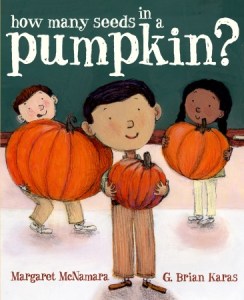 One example I have found of a book that certainly combines the nonfiction and multicultural features is HOW MANY SEEDS IN A PUMPKIN? by Margaret McNamara. I have shared this book numerous times in classrooms across the country and almost without fail, each time I read it some student or even multiple students will talk about the magic in the book. They have no idea they are learning math and science. At the same time the illustrations are clearly multicultural in portraying the world around the students – but would most people label it at first glance a ‘multicultural book’? No. It is a natural portrayal of the real world of mirrors and windows we stress in our Multicultural Literacy Campaign.
As part of our commitment to motivate young readers, RIF has increased efforts through our Multicultural Literacy Campaign to reach more African American, Hispanic, and American Indian children at risk of academic failure. We are deeply concerned about the growing number of quality reports and research studies showing the large gaps in literacy accomplishments too often found between these children and their peers. We know one aspect of promoting improvement is to provide more culturally diverse books so that children nationwide can discover the value of their own heritage while learning about the importance of others. You can learn more about our Multicultural Literacy Campaign at http://www.rif.org/us/about/literacy-issues/multicultural.
Choice is a key reading motivator. Allowing children control over what they read can help them build a lifelong, life-changing love of reading. We also believe choice is power. For underserved children, who have fewer opportunities than more advantaged children to make positive choices in life, offering a choice of books provides a taste of the dignity of personal autonomy. Even such small opportunities and encouragements to choose can inspire children to make greater choices: to choose learning, to choose success in school and life, to choose a brighter future. Quite simply, given the power to choose what they will read, children will chose to read to learn.
In addition to choice of book, RIF has two other key components to our book distribution program: motivational activities during the distribution (and nothing is more exciting than an author or illustrator coming to read!) and parent engagement.
I invite you to visit with us at RIF regarding ideas you have about how we can provide more books like those I reference and other inputs you may have on our various program components. I also encourage you to determine if there is a RIF program in your community where you might give one reading/presentation a year as part of our effort. Use the locator map (www.rif.org/maps) where you can easily access program sites near you; should you need assistance in making contact with a program(s) or you have questions/suggestions of any type for RIF, please contact me at crasco[at]rif.org.
My interest in PiBoIdMo has escalated over recent weeks, and I have started my own beginning short list of books I wish I could write. Who knows, I may figure out how to allocate the time to learn even more about this process over the next year and actually sign up—book one is one I have carried for three years in my head and there are two more beginning to take root. I want to take the excitement I have seen in children at the sea organ in Croatia and the pure awe I witnessed on the faces of students as they watched the making of smoke by an American Indian as he rubbed sticks together at a recent RIF distribution in DC and figure out how I can share those experiences with children who may not the opportunity to visit with an American Indian visit or take a trip to Croatia.
Children’s interests matter at RIF. We strive to develop their freedom to ask and answer questions, to experience adventures and new ways of perceiving the world around them through the books they choose. We are honored to have played a part in offering the millions of choices connected to the more than 366 million books provided to children since our founding…and we look forward to providing millions more.
Happy Reading!
 Reading Is Fundamental, Inc. (RIF), founded in 1966, motivates children to read by working with them, their parents, and community members to make reading a fun and beneficial part of everyday life. RIF’s highest priority is reaching underserved children from birth to age 8. Through community volunteers in every state and U.S. territory, RIF last year provided 4.4 million children with 15 million new, free books and literacy resources. For more information and to access reading resources, visit RIF’s website at www.rif.org.
Kids says the darndest things. And who better to give picture book authors great ideas than their readers? I asked Mrs. Lombardo’s 2nd Grade and Mrs. Mozer’s 3rd Grade classes what kind of book they would like to write and why.
“If I could publish a children’s book, it would be about…”
“Dragons because a lot of little boys like dragons.” – Oscar
“Soccer because I could teach others how to play soccer.” – Victor
“Dinosaurs because children like the T. Rex, triceratops and others.” – Aidan M.
“Friendship because children should learn how to be nice to each other.” – Mark
“Presidents because they are important for our country.” – Marshal
“Turkeys because it’s November.” – Dylan
“A girl and a boy walking in the woods and a witch would take them and bring them home. I would write it so some people would get scared a little bit.” – Taylor
“Dragons because I like dragons.” – Chris
“A little funny eraser who has big adventures all around the world because kids always like adventures.” – Gabriela
“Animals because lots of people like animals.” – Eliana
“Vampires and aliens because that is what most kids like.” – Annika
“A kid getting a pet. I would do it because they might like the book.” – Angelina
“Two girls who buy cotton candy. One of the girls eats it and the other one doesn’t. So it makes fun of that cotton candy. I would write this story because it makes me laugh.” – Neda
“Dragons. My book will be about dragons because it’s easy to make the problem and solve the problem.” – Thomas
“Friends because at school we learn about being bullied and good friends have to be nice to each other.” – Kyle
“Snow because children like to play in snow.” – Payoon
“Valentine’s Day because a lot of people like Valentine’s Day.” – Rebecca
“A girl and a boy helping others because other people could help others, too.” – Sophia
“A long time ago so kids can learn about a long time ago.” – Aidan Z.
“Christmas because it’s my favorite holiday.” – Halle
“A scarecrow, pumpkin, witch, house, people, crayons, lunch, snack, class. You could write a school.” – Vikesh
“A boy that could fly because it would be cool to see the world.” – George
“A boy who’s stuck in a haunted house because I like to tell spooky stories and it would be a cool adventure.” – Melanie
“A boy who could create pictures in his mind and make things happen because I think that would be exciting.” – Nick
“A girl who plays soccer because I think it would be interesting to read about a girl like me.” – Leah
“A girl who was teased because she was so good at math because I’m so good at math.” – Sophie
“A girl that has powers because I think that would be interesting.” – Hanna
“Dinosaurs because kids really like dinosaurs.” – Pierson
“A girl in a wheelchair because it would be cool to see how she dealt with school and her differences.” – Alex
“A girl that could fly because I would love to fly.” – Ella
“A girl that could go anywhere because she’d be able to get anything.” – Meredith
“A girl that wanted a dog because I want a dog and can’t get one.” – Denise
“A bear that is lazy and never helps people because it would be funny.” – Christian
“A boy who could fly because it’s my dream to fly and it would be cool to read about.” – Matthew
“People with powers because that would be cool.” – Jenna
“A boy who could fly because I like fantasy.” – Jimmy
“An alien who is friends with a boy because it would be cool.” – Julia
“A boy that could do amazing things because that would be interesting to read.” – Alexander
“A boy with super powers because that would be awesome.” – Henry
“Football because I know a lot about it and I play football.” – Tucker
“A kid who stunk at soccer and then becomes the best player on his team because it would be a good book.” – Lucas
“A boy who could fly because a lot of children want to fly and would like to read a book about it.” – Ethan
“A girl that has a brother and sister that annoys her a lot because I have a brother and sister that annoy me.” – Abby
 by
by As adults, it’s easy for us to get entrenched in the necessities of day-to-day living whether it be money, bills, work, deadlines, marketing, dinner, laundry, family time, and the list goes on… I know because I’m guilty. As a TV producer for World Wrestling Entertainment, Inc. for ten years, I was immersed in work, concentrating on my career, traveling around the globe, and trying to hold my own alongside 7 foot, 400 lb. men.
But everything changed when I started to hang around two little guys who weighed less than 30 lbs. After the birth of my two boys, I realized the importance of seeing beauty in the ordinary and opening my eyes to things I hadn’t before. I became curious and observant and enjoyed to watch a caterpillar inch along the sidewalk or the clouds drift along the sky. I gained a renewed sense of humor in gas and poop jokes and rediscovered what fun it can be to blow bubbles in your chocolate milk.
As I began to think like a kid, ideas and creativity flowed in my head like Roaring Rapids at Six Flags. I found all of my inspiration for writing came from my two boys. As a result, I felt an urge to express myself on paper.
 In fact, the idea for my first picture book, The Bug That Plagued the Entire Third Grade, came to me when one of my sons had that dreaded stomach virus that makes its way around a house until it’s hit every family member! When family and friends called to see how he was doing, I would say, “He caught the bug.” It’s something we all say when we’re sick, but it made me stop and wonder why we say that. Something clicked, so I expanded on the play on words of getting sick and catching an insect. Hence… “The Bug” was born.
The idea for my second picture book, Oh the Possibilities, a work-for-hire I wrote for John Hancock’s Back to School campaign, can also be credited to my two boys. John Hancock was looking for a children’s book about that age-old question, “What do I want to be when I grow up?” Everyone always takes the time to tell me how my boys are “all boy.” And they truly are, fascinated by everything from super-heroes to dinosaurs to trucks to dragons. I was thinking about professions and thought, what boy doesn’t dream of being a dragon, right? I built off that, so when my character, Miles, realizes he only has human genes and must decide on something soon, he runs through all the possibilities.
As my writing career was starting to take shape, I discovered one of the most dramatic shifts we can make as picture book writers is to see life through a child’s eyes. After all, who are our readers? Picture books are targeted toward 4 through 8 year olds and the rule of thumb is that children want to read about characters their own age or a bit older. So how do you get inside the head of a five year old? I don’t know about you, but I’m the type of person who can’t remember what happened yesterday, so there’s not much chance of me tapping into my own childhood memories and bringing to the surface what I was feeling when I was five. So the best way for me to identify with my main characters is to hang out with my readers. There’s nothing like picking up a crayon and coloring, blowing bubbles, whizzing down a slide, and running my fingers in a sandbox for inspiration.
Chances are, if we’re writing for children, we like to think of ourselves as young at heart. So as you’re wracking your brain for 30 ideas in 30 days, think of some of the children you come into contact with each day, whether it be your own, nieces and nephews, grandkids, or friends’ kids. However, this time, instead of watching from the sidelines, join the race or purposely plan an outing in the rain so you can stomp in the puddles together. Chances are you might just find inspiration from all the pint-sized fun, and reap the rewards, bigger than you ever imagined.
 Lori Calabrese is an award-winning children’s author. Her first picture book, The Bug That Plagued the Entire Third Grade, was awarded DFP’s Best Children’s Book Award. She writes for various children’s magazines, is the National Children’s Books Examiner at Examiner.com and enjoys sharing her passion for children’s books at festivals, schools and events. Visit her website to learn more: www.loricalabrese.com.
Lori has generously donated a rhyming picture book critique as one of the PiBoIdMo prizes. A random winner will be chosen in early December, from those who have completed the 30-ideas-in-30 days challenge.
Those of us you who were children once upon a time will surely remember how frustrating it was suddenly to have been plunked down in a world where everyone knew more than you did—about everything. Children spend a great deal of time trying to figure things out: where does snow come from? Why can’t dogs talk? What happens next? Or, as we say in our family: “Who ordered the veal cutlet?”*
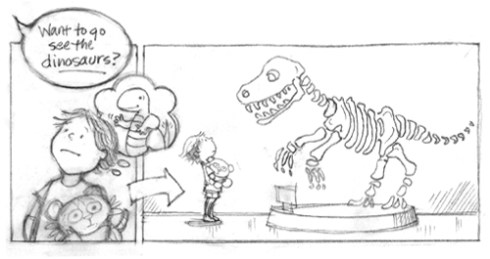
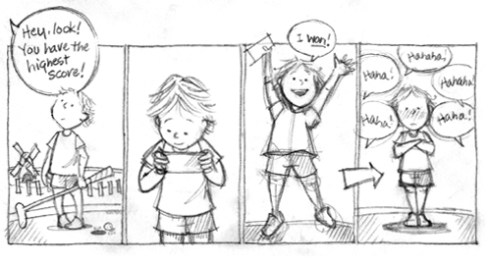
Kids develop their own little GPS-like subroutines, constantly recalculating to keep themselves on track—but sometimes, inevitably, they get it wrong. Misperceptions and missed information lead to misunderstandings . . . and—I won’t sugar-coat this—little misunderstandings often lead to:
Major Disappointment!
 Total Humiliation!
 Nightmares!
 (Yeah, I was grown before I figured that one out.)
Thank goodness for picture books!
In a picture book, you can check out your own real-live dinosaur any time from the Storybook Lending Zoo.
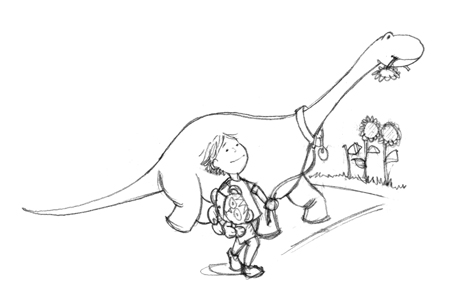 You can have the queen invite the golfer with the highest score to the palace for tea, and meet the prince, who is even worse at Goony Golf than you are.
 You can become a super-hero in training, and rid the world of evil, baby-eating furniture.
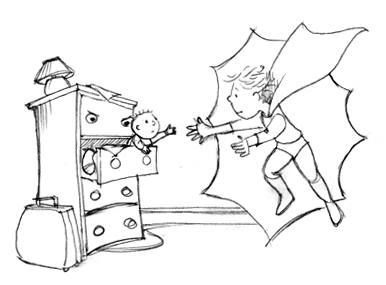 How cool is that? As children’s book writers and illustrators, we get to do this all the time. So, having aired three of my own neuroses . . . er, picture book ideas . . . here is a tip for today: think back to those times in your childhood when things were not quite what you expected them to be—and imagine what it would take to discover a new, old friend . . . or have the last laugh . . . or fly to the rescue.
And then, for the love of heaven, explain to the little person in your life that dinosaurs are really extinct; that, as silly as it sounds, low score wins at Goony Golf; and that, yes, if necessary, a very tiny baby can sleep safely in a dresser drawer . . . but only if you take the drawer OUT of the dresser first!
*A line from Mel Brooks’ Silent Movie . . . um, maybe you had to be there.
 Bonnie Adamson’s latest illustration project is BEDTIME MONSTER (¡A dormir, pequeño monstruo!) by Heather Ayris Burnell, released in September by Raven Tree Press.
Visit Bonnie’s soon-to-be-completely-overhauled website at www.bonnieadamson.net, or hang out with her on Twitter, where she co-hosts #kidlitchat on Tuesday nights and #kidlitart (for children’s book illustrators and friends) every Thursday.
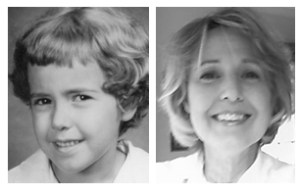 Bonnie then, practicing her skeptical glare; and now—-an older and wiser children’s book illustrator.
Prize Alert! Leave a comment to enter. One randomly-selected winner will choose one of the three picture-book-inspired sketches above for Bonnie to paint in watercolor (Dinosaur, Royalty, Superhero). One entry per person! Winner will be selected one week from today. Good luck!





 Writing for Kids (While Raising Them)