You are currently browsing Tara Lazar’s articles.

Thank you, everyone, for your outstanding doggo photos! If we had to choose based on appearance alone, it would be a tough call. We loved Bear’s homemade floofers and Library Dog’s regal aura. But we picked our two winners randomly with random.org, and we are pleased to announce them: KENDALL and WILLOW!
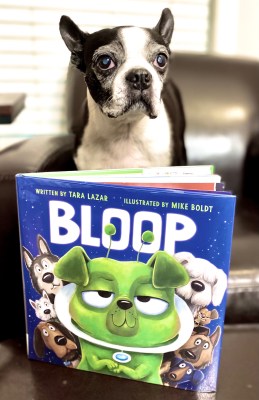
Kendall (Jyn Hall)
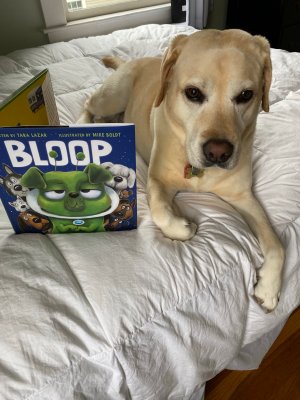
Willow (Lyn Jekowsky)
Mike Boldt will BLOOPIFY them both! Congratuations to owners Jyn Hall and Lyn Jekowsky! I will touch base with you on Twitter!
And now, here’s a gallery of all the BLOOP-lovin’ doggos! What good boys and girls!!!

Ellie

Chili & Layla
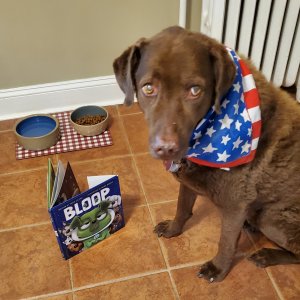
Hank
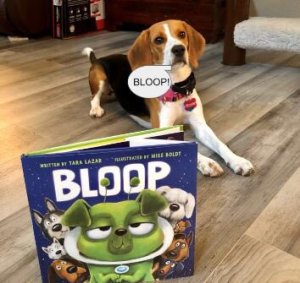
Rosie

Library Dog
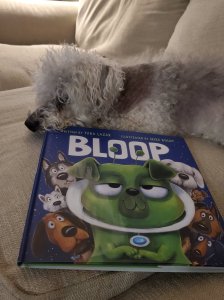
Maylo
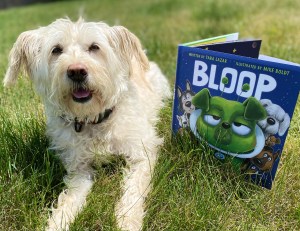
George
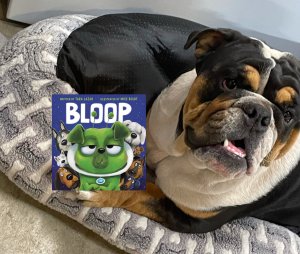
CuzO

Bear

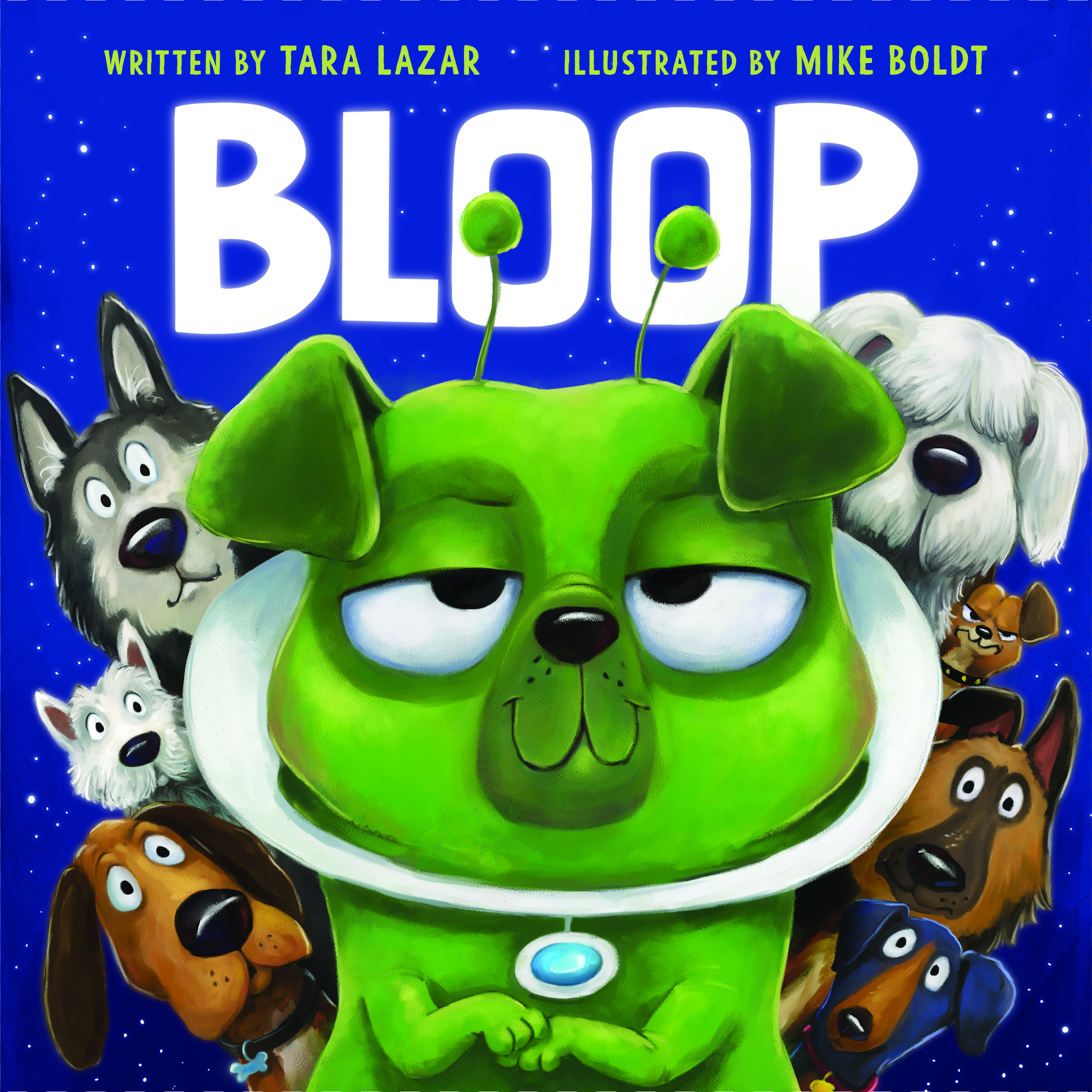
Today for BLOOP’s book birthday, illustrator Mike Boldt and I have cooked up something amazing.
This is Mike’s dog, Tula. And this is Tula on BLOOP:

You can win a custom BLOOP-IFED portrait of your fluffy bestie by illustrator Mike Boldt!
Mike will provide you with a high-quality digital illustration print.
We’ll randomly select one winner from Twitter and one from Instagram. TWO WINNERS! YEAH!
All you have to do is take a pic of your canine BFF with a copy of BLOOP, like this:
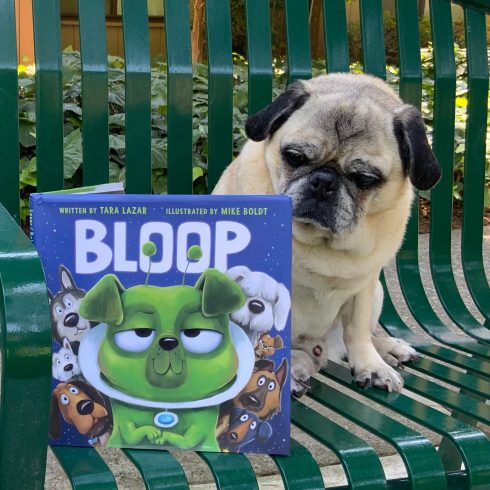
(That’s Rollie enjoying a good read.)
Then post it on Twitter or Instagram. Please include the following hashtags…
#BLOOP #HarperCollins #picturebook #BLOOPIFY
…and tag @taralazar on Twitter or @taralaser on Instagram.
Your mission lasts exactly one week!
You have until Tuesday, July 13th at Midnight PST to post your photo. Two random winners will be selected on Wednesday the 14th and announced here!
Let’s get BLOOPING!!!
Good luck!
by Jamilah Thompkins-Bigelow
Hi Tara! Thank you for having me on your blog today and hosting the cover reveal of ABDUL’S STORY, a picture book written by me and illustrated by Tiffany Rose (with art direction by Tom Daly).
ABDUL’S STORY is about a young boy who has many stories to tell about his community in Philadelphia. However, during writing period in his class each day, he never writes these or any stories because he’s ashamed of how he writes. His handwriting is sloppy. He misspells many words. Sometimes, he even writes some letters backward.
On top of these struggles, he also doesn’t see the stories of his community as being welcome because the stories read in his classroom are about people and communities that are not like the ones he knows.
Mr. Muhammad, a writer who looks like Abdul and tells stories like Abdul’s, visits his class and helps him to change his view. Abdul learns that the story he has to tell is valuable even if he struggles with writing, and even if his story is different.
The Story Behind the Story
The idea for ABDUL’S STORY came out of my work as a writer working in Mighty Writers community centers for kids. My main job was often to help kids see themselves as writers. I once taught a workshop for children, called “Get Published, Kids!” The goal was to help kids write stories for publication in magazines. There, I met a student (I’ll call him H) in this workshop who wrote one sentence in his writer’s notebook and told me he was done.
When I encouraged H to write more, he gestured to the other kids busily writing at his table with full pages in their notebooks and said, “I can’t be a writer like them.” H was only maybe six or seven years old at the time. It troubled me that a child so young could see himself as already incapable of doing something. The more I talked with him about his story, the more I realized that H lacked confidence because he couldn’t write neatly and had trouble spelling words. Still, I pushed him to write much more and to see value in the things he wrote.
At the end of our workshop session, H proudly showed his father the many pages he wrote that day. He did something he thought he was incapable of and was smiling from ear-to-ear. While that was gratifying, I thought a lot about other kids similar to H who don’t have empowering experiences with writing. What is a story that could help them?
Words of Advice for Aspiring PB Authors
My advice for PB authors is the same advice I would give to Abdul in my story and H: Remember that there is value in the story that you have to tell. Mine your experiences for the best material, and don’t dismiss your experiences just because they aren’t represented in books. Often the stories that are missing are the best stories. Additionally, don’t underestimate yourself just because you need to grow as a writer. Keep trying. Keep doing the work. You never know what you might be capable of.
And now…the cover reveal!
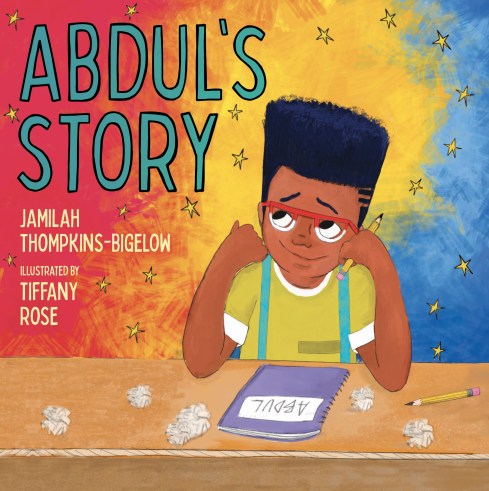
ABDUL’S STORY releases March 29th, 2022 from Salaam Reads/Simon & Schuster. Pre-order a copy today online or from your local independent bookstore.
And Jamilah will be giving away a signed copy of ABDUL’S STORY once it releases.
Leave one comment below to enter.
A random winner will be selected soon.
Good luck!
 Jamilah Thompkins-Bigelow is a Philadelphia-based educator and award-winning children’s book author. A curriculum writer and former English teacher, she has educated children and teens in traditional and alternative learning settings for over 15 years. Her picture books and middle-grade fiction center young Black Muslim protagonists and have been recognized as the best in children’s literature by Time Magazine, Read Across America, and NPR. Her books include Mommy’s Khimar and Your Name is a Song, an Irma Black Honor book. Her upcoming books include ABDUL’S STORY (2022), HOLD THEM CLOSE (2022), and SALAT IN SECRET (2023).
Find Jamilah online at jamilahthewriter.com, on Twitter @jtbigelow, and on Instagram @authorjamilah.
by Courtney Pippin-Mathur
First off, thank you to Tara for hosting my cover reveal on her blog!
HAPPY DIWALI is my most personal book, yet it has been a first for me in a lot of ways.
It will be my third picture book, but it is the first one that I wrote with someone else. The story is about a small girl celebrating Diwali with her family and how she overcomes her initial shyness. It was inspired by my daughter Kiran, and her love of family celebrations but her nervousness of large groups of people.
Diwali is the Hindu celebration of good over evil, light over darkness. This book follows how my sister-in-law Sanyukta brings the joys of Diwali to our culturally- and racially-mixed family in the US. Sanyukta has been involved every step, from writing the first draft (on the phone) to revisions, cultural notes, tips on how to draw a sari, or what should be on the endpapers. When we couldn’t meet in person, we would meet on Zoom. It has been an amazing experience to create a book with her! The photo below is our author photo in the book. It is from long ago but is our favorite picture together.
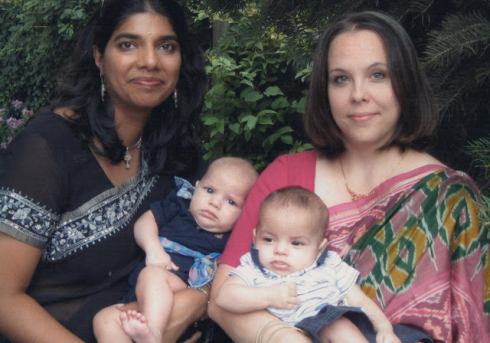
It is the first book in which every character except one (the main character) is an actual member of our family. I emailed or messaged each parent and asked for photos and tried to include every child in the family. Some might resemble the actual child more than others, and I did age down most of them, but it was a lot of fun!
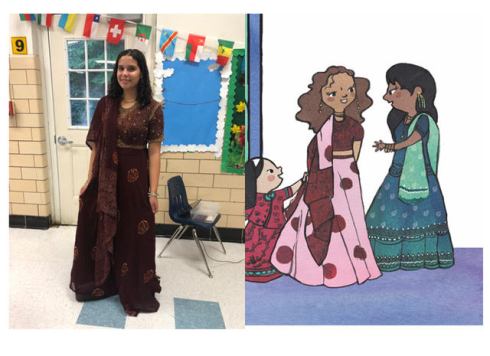
Here you can see my daughter in her favorite lehenga, and how I drew it in the book.
Below is one of my favorite images from the book. In in, the kids are painting diyas. Every year Sanyukta creates a craft, my favorite is painting clay diyas because I can re-use them every year.
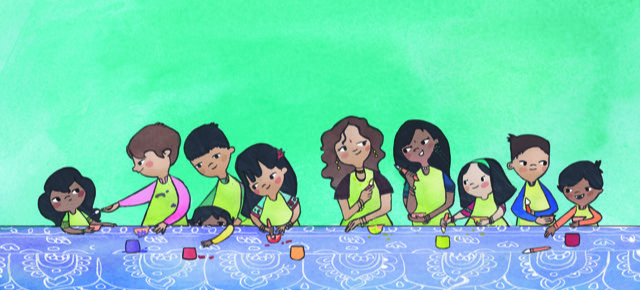
It is the first book where the (amazing) editor who acquired the book moved to a new publishing house during the illustration process. Thankfully, the book was left to another wonderful editor. The publisher and art director also moved to new publishing houses, but we were very lucky in that our new editor kept everything chugging along.
It is also the first book I worked on during the pandemic. It took me a few months after Covid first hit the US and everything shut down before I could draw again. Thankfully I had been allocated plenty of time.
Because it had been so long since I have seen many members of the family in the book, I keenly felt the loss of family gatherings as I worked and really look forward to them again soon.
I hope this book can be a thank you from me to my husband’s family for making me feel so welcome in their homes and for always including me in and teaching me about their traditions and culture.
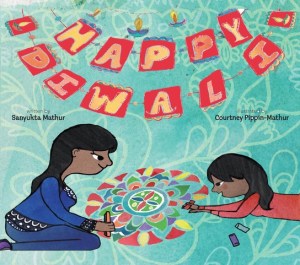
The designer pulled an image from the interior of the book to make the cover.
Here is the color sketch:
And here’s the final cover!
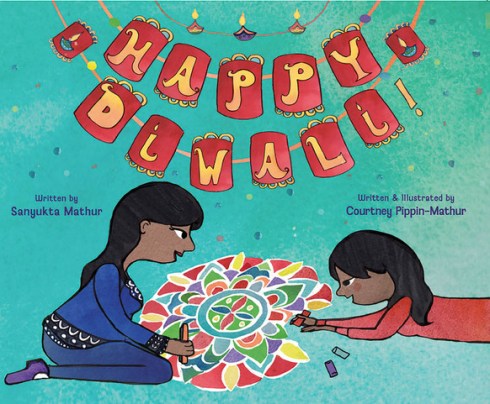
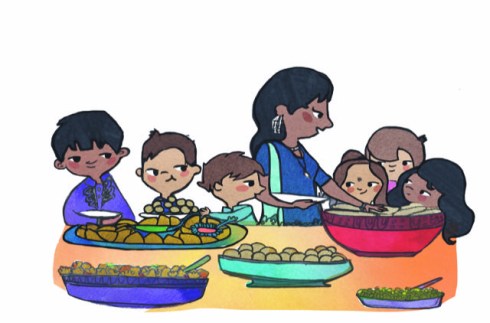
On the front is my sister-in-law Sanyukta and her daughter Priya drawing rangoli. They do that every year to welcome the guests. On the back cover is a group image of the kids eating, which is one of my favorite things to do at Diwali!
Courtney, thank you for sharing this beautiful book and your family traditions.
HAPPY DIWALI will be released September 28, 2021 and is available for pre-order now.
Blog readers, you can win an original sketch of a character (Rajini) from Courtney’s book!
Just leave one comment below to enter and a random winner will be selected soon!
Good luck!
Sanyukta Mathur is a social scientist and studies how to improve the health and well-being of young people around the world. She is the author of various research publications; HAPPY DIWALI! is her first children’s book. She lives in Maryland with her family.
Courtney Pippin-Mathur is the author-illustrator of MAYA WAS GRUMPY and DRAGONS RULE, PRINCESSES DROOL!. She lives in Alexandria, Virginia with her husband, three kids and one very energetic dog. She is hugely grateful to be part of a diverse and welcoming family who work hard to bring their traditions to the United States and to pass them to new generations. You can find more of her work at pippinmathur.com or on Instagram @pippinmathur.
by Refe & Susan Tuma
When we set out to design the cover of our new picture book, we knew we were in for a unique challenge.
For our first picture book, WHAT THE DINOSAURS DID LAST NIGHT, we worked with our designer at Little Brown to create a cover that was simple, colorful, and bold, and that put the dinosaurs and their mischievous personalities front and center. The cover of WHAT THE DINOSAURS DID AT SCHOOL uses a similar format, swapping out the blank wall and crayon scribblings for a classic green chalkboard.
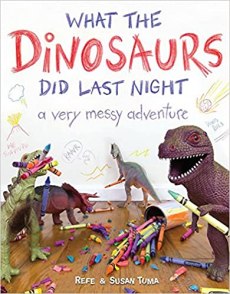

We spent a lot of time going back and forth between the two of us, with Mary-Kate our editor, and with our design team at Little Brown trying to come up with a way to use that same format for the cover of WHAT THE DINOSAURS DID THE NIGHT BEFORE CHRISTMAS. Maybe the title is scribbled across the gift tag of a giant present, or on the surface of an ornament hanging on the tree. These options were fun and Christmas-y, but they didn’t do a very good job of conveying the scope of the story and, more importantly, they didn’t give the dinosaurs much to do.
So, we abandoned the format of the previous books and began exploring other ideas.
Our biggest source of inspiration ended up being movie posters for classic Christmas movies. Nightmare Before Christmas, National Lampoon’s Christmas Vacation, White Christmas, even Ernest Saves Christmas. (Our riff on Nightmare Before Christmas was a lot of fun, with the tip of the tree bending down in front of the moon instead of the curled cliff of the original, but it a bit too abstract.)
We landed on the rooftop scene for a few reasons. First, getting the dinosaurs outside the house was a great way to highlight the magical, moonlit nighttime vibe that threads throughout the interior art. It also gave the dinosaurs the opportunity to explore somewhere they’ve never been in any of our previous books, which was fun. If you look closely, you’ll see we even got to sneak a nod to one of those classic Christmas movie posters…
With the concept set and the design sketched out, we got to work on the actual composition. And it was a lot of work!
Photographing an idyllic snowy rooftop under a moonlit sky is challenging enough under the best of circumstances. Doing it in the middle of the summer (after months of pandemic-related production delays) happens to be just about impossible. As a result, the final cover art is a composite of more than 17 individual photographs and effects, including the rooftop, lights, sky, snow, and of course the dinosaurs themselves.
This required some practical trickery. For example, to match the angle of the rooftop, we photographed the dinosaurs on piece of white posterboard tilted to roughly the same degree. We did something similar when photographing the string of lights to ensure they’d wrap naturally around the chimney.
The title treatment is our biggest link to the rest of the series, since it appears in about the same spot as on the other two covers. This time, instead of purely hand-lettered type, we pair it with something a bit fancier. We loved the way the swooshes on this font resembled dinosaur tails, as if it were created by splicing traditional Christmas type with just a hint of reptilian DNA. Better yet, the gold lettering on the dust jacket will be embossed in gold foil.
All in all, we’re thrilled with how this cover turned out and we can’t wait to share the rest of the book with the world!

WHAT THE DINOSAURS DID THE NIGHT BEFORE CHRISTMAS is available for preorder now anywhere books are sold.
And blog readers! Refe and Susan are giving away a picture book critique!
Just leave one comment below to be entered.
A random winner will be selected soon!
Good luck!
 Refe and Susan Tuma are a husband and wife team whose previous books include WHAT THE DINOSAURS DID LAST NIGHT, WHAT THE DINOSAURS DID LAST NIGHT: A Very Messy Adventure, and WHAT THE DINOSAURS DID AT SCHOOL. They live in Kansas City with their kids and a dog named Boris. Visit them online at dinovember.com, on Twitter @refeup and @sutuma and on Facebook at Dinovember.
by Jennifer Buchet and Little Medusa
A few Novembers ago, I was inspired to write a picture book story about snakes. Snakes are—
Little Medusa: Beautiful! Amazing! And very cuddly.

Actually, I was about to say that snakes rattle lots of people. They’re squeamish because…well…
The hissing. The slithering. The fork-tongues.
LM: Awww, how cute!
Not to everyone! But that’s the thing, Li’l Medusa. After attending a reptile show with my daughter at our local library, I…
LM: Best. Show. Ever!
…I wanted people to know that snakes are really fascinating. Did you know that snakes smell with their tongues?
LM: Of course! Snake are sssssuper sssmellers!
I drafted a story about pet snakes, but it needed more sparkle and less fang. Around the same time, I discovered PiBoIdMo (Picture Book Idea Month) was reformatting to Storystorm, and that come January, there’d be a whole new set of inspirational writing tips and tricks. Definitely something to look forward to because the holidays were knocking impatiently at the door. Instead of drafting stories, I was juggling magazine deadlines and planning the annual holiday party menu.
LM: Yummy! Did you serve buggy burritos?
Not quite (this party is rather swanky). I desperately wanted to vamp up the menu. Yes, tempura shrimp is delish, but having it at every special occasion “because it’s a tradition!” was constricting my appetite. With editors to please and taste buds to appease, I turned to mundane housework to alleviate the stress. Whilst sorting socks and sweaters, a real live mini-Medusa skipped into the laundry room.
LM: She didn’t turn you to stone, did she?
No, but she did scare me! This mini-Medusa was actually my daughter with a headful of tangled, knotted, serpentine-looking hair.

LM: Mama said I’d get used to traditional Gorgon hair but I don’t like Addie on my head.
Well in that moment, several events converged at once and I knew I had a tale about a Gorgon girl challenged by eons of family tradition.
LM: Oh, that’s me!! Just like you didn’t want shrimp, I didn’t want snakes in my hair!
Exactly. But I wasn’t sure how to morph this meatball of an idea into a grand bolognaise sauce. How would I make one of the most villainous figures in Greek mythology kid-friendly? I turned to Storystorm for tips on humorous writing and how to find the funny.
LM: My great-times-eight Granny Medusa is not funny. She was scary and mean. I don’t want to turn things to stone with a stare.
Nor do you like having Addie slither through your hair.
LM: Nope! Stony stares and slithering hair are not my kind of tradition. They’re more like pythonic problems!
Every day, I read the guest post and partook in the Storystorm exercise; you never know what new idea might happen, from a jazzy sentence or title, to a brand new story idea! By the end of January, not only did I have a bunch of new ideas, I also knew exactly where I was taking Little Medusa’s tale. I’m not sure where I’d be without Storystorm!
LM: Not having Storystorm? Now that’s a pythonic problem for you!
Absolutely! And the rest they say is hissss-story! Thanks to this wonderful, supportive and wise kidlit community, LITTLE MEDUSA’S HAIR DO-LEMMA is now on shelves, and in the hands and hearts of littles.
LM: Can we play Snakes ‘n Ladders now?
Sure!
LM: Hissy kissies, everyone!
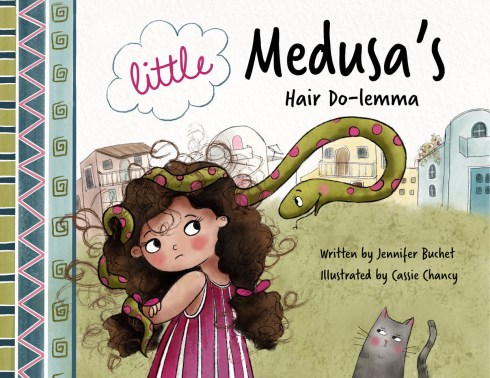
P.S. The menu did include Tempura Shrimp—with Blood Orange Sauce!
 Some days Jennifer Buchet rocks her own tangled Gorgon ‘do, but hopefully you won’t find a snake sliding through her hair! She’s an award-winning author, pre-kindergarten educator and self-proclaimed foodie. Her kidlit career officially started in 2011, writing for Cricket Media. Today, she’s a feature contributor for Faces magazine while also creating new picture books, chapter books and yummy recipes.
Her debut picture book, LITTLE MEDUSA’S HAIR DO-LEMMA (Clear Fork Publishing, May 2021) illustrated by Cassie Chancy, is on shelves now.
You can swap tales & recipes with Jennifer at buchetbooks.wixsite.com/mysite or on Twitter @Yangmommy.
You can easily support authors by leaving book reviews, asking libraries to carry their books and of course, purchasing their stories.
by Alli Brydon
Tara, thank you so much for hosting me on your blog (one of my favorites, btw) to celebrate World Ocean Day coming up on June 8th!
World Ocean Day has been designated by the United Nations as a day “for humanity to celebrate the ocean.” On June 8th every year, the global community comes together to recognize how essential our oceans are to our worldwide ecosystem and how important it is that we protect them. There are over a hundred virtual and in-person events planned all across the globe and for all ages, from Coralpalooza to a Smithsonian Museum Shark Talk to tons of beach clean-ups. Check the World Ocean Day event page to see about joining in the celebration!
How does this tie in to children’s books, you ask? My picture book LOBSTAH GAHDEN, which published this spring, contains themes of ocean conservation, collective action, and pollution solutions. I’m also excited to be hosting an Instagram Live reading on June 8th at 4pm ET to celebrate our world’s oceans.
Follow me on Instagram @allibrydon and come along! I might have a special guest or two.

LOBSTAH GAHDEN is a delightfully punny story about ocean life, conservation, and cooperation. Walter is a proud lobstah whose greatest dream is winning the annual Swell Gahdens contest. But, year after year, that honor always goes to his chowdah-head neighbor Milton. One day, when heaps of gahbage show up in their yahds, the rival lobstahs must join forces to find out how to prevent the trash from floating down from above. With wicked ah-some Boston accents, these lobstahs work together to save their gahdens from being ruined by heaps of gahbage.
Our oceans are beautiful, colorful, diverse ecosystems that are home to over a million species of underwater creatures. Unfortunately, humans are putting our friends under the sea at risk by polluting Earth’s oceans daily. Lobstah Gahden helps kids understand the importance of conservation, and additional backmatter about sea life and pollution shows readers practical ways they can help preserve our oceans.
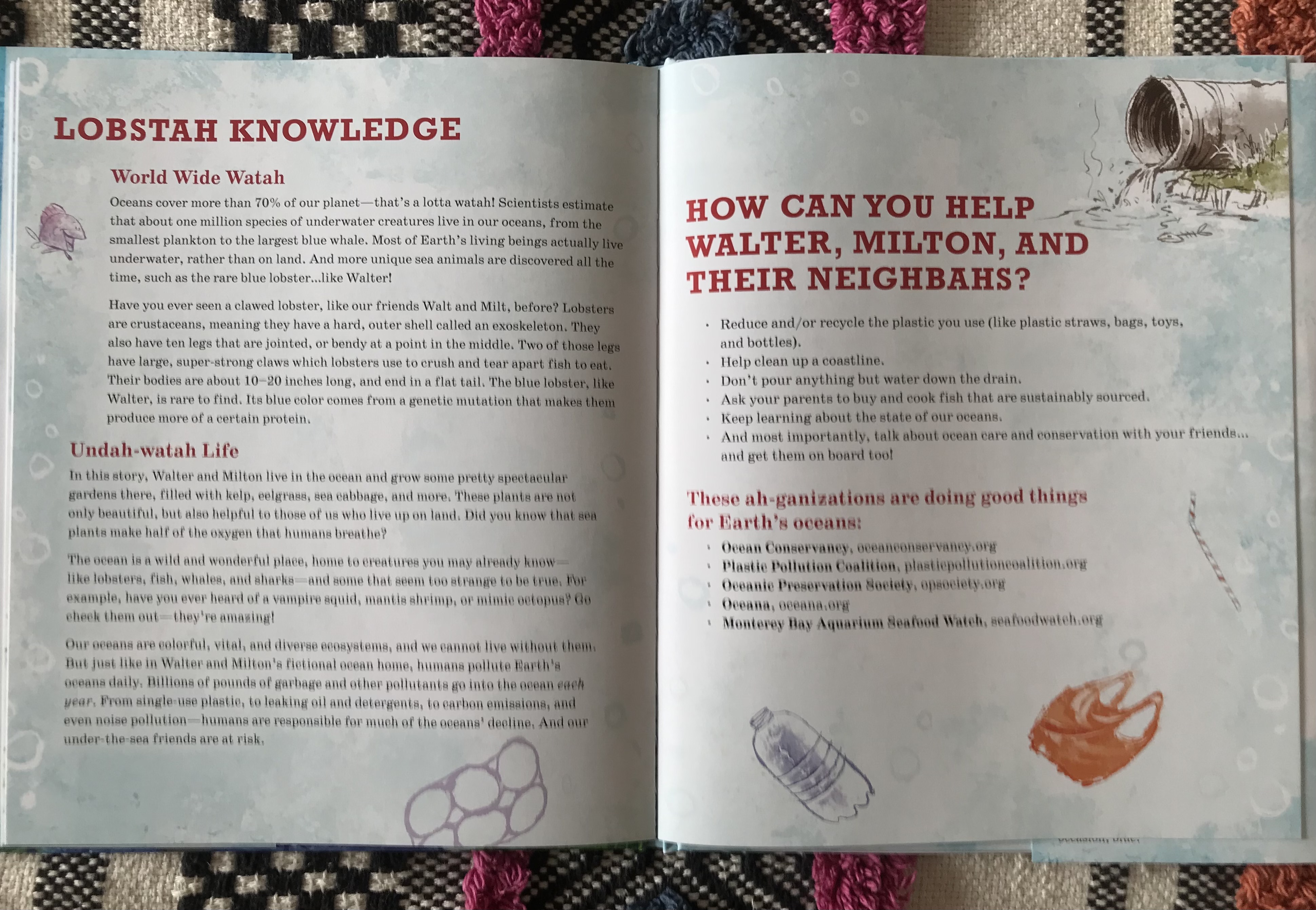
The ocean has always been important to me, having grown up in a beach town on Long Island, in New York. And now my kids are beach babies, too. We all care about ocean conservation, and are trying our best to stop contributing to the problem and be part of the pollution solution.
My co-author, EG Keller, and I hope that young readers will learn about the importance of ocean conservation, especially through the story’s humor and the bonus backmatter pages about sea life and pollution. And we really hope the book will inspire kids to follow Walter and Milton’s lead and help save our world’s oceans.
In addition to celebrating World Ocean Day along with the lobstahs and me, you can check out some other organizations that are doing great work to protect Earth’s oceans:
- Ocean Conservancy
- Plastic Pollution Coalition
- Oceanic Presevation Society
- Oceana
- Monterey Bay Aquarium Seafood Watch
- Terracycle, taking recycling to a whole new level
And here is an IGTV video that I posted in April to celebrate Earth Day. It offers 5 tips to being less “shellfish” and more caring about our Earth.
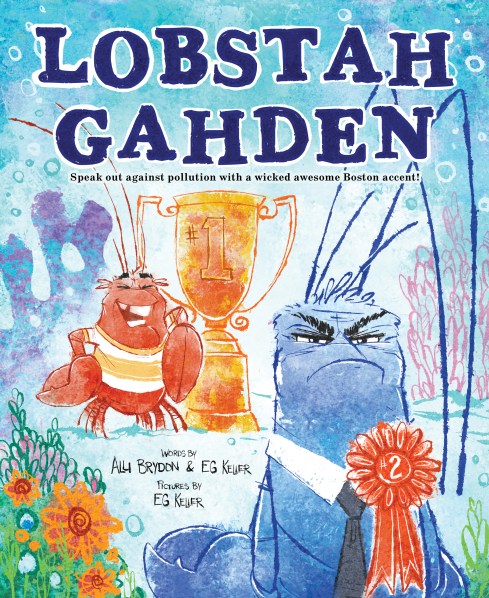
You can buy LOBSTAH GAHDEN—for ocean activists young and old—at your local indie bookstore, through bookshop.org, and from any brick-and-mortar bookstore or internet retailer.
Take care, chowdah heads…and don’t forget to reduce, reuse, and recycle!
In honor of World Ocean Day, Alli is giving away a copy of LOBSTAH GAHDEN!
Follow her on Instagram and leave a comment below to enter.
A random winner will be selected soon.
Good luck!
 Alli Brydon is a writer, kidlit editor, and New Yorker, and when she is not writing or editing, she loves to visit art museums, discover new music, chill at the beach, race her family down ski slopes, explore forests, and read books written for children and not-children. She is the co-author of Lobstah Gahden (Sourcebooks, April 2021) and author of Myths & Legends of the World (Lonely Planet Kids, October 2019). She has fiction and nonfiction children’s books forthcoming with National Geographic Kids, Disney, Odd Dot/Macmillan, and Amazon/Two Lions, and is constantly tuned to the world for new ideas. She is also a children’s book editor with 15 years of experience helping authors and illustrators create outstanding children’s books. Alli now lives with her family in the rolling hills just outside of London.
Learn more about Alli’s work at allibrydon.com (author site) and allibrydoncreative.com (editor site), and follow her on Twitter at @AlliBrydon and on Instagram at @allibrydon.
with author Charlotte Offsay
Hi Tara! Thank you for having me on your blog today and for hosting the cover reveal of my upcoming picture book HOW TO RETURN A MONSTER!

Charlotte, please tell us about the book!
If your grown-ups bring home a small monster, er, baby, don’t panic. Just send it back!
HOW TO RETURN A MONSTER is a humorous how to story about a child who can’t believe it when her parents bring home a fussy, stinky, parent-stealing monster. She hatches a plan to send it back to where it came from… and along the way, she learns that maybe siblings aren’t so bad after all.
Do you have a fun behind-the-scenes story about creating the book that you’d like to share?
I tend to get my story ideas from the things in my life that are taking up the most room in my heart. When I first began writing what would eventually become HOW TO RETURN A MONSTER, I was consumed with second-time mom guilt about no longer being able to give my daughter the same amount of attention. She was just starting pre-school and I felt terrible separating from her for the first time and spending that time with her baby brother.
I had also heard countless stories from friends of how older siblings were reacting to having a new baby at home. I heard everything from ignoring to harming, and while it was clear these children loved their new siblings, one overarching theme prevailed—it was a hard adjustment for the older sibling to no longer be the sole focus of their parents’ attention.
My worries about my daughter made their way to the written page and I began writing a story about an older sibling feeling replaced by a new baby. I first wrote a traditional narrative arc story about a train feeling replaced by a shiny new train, but the story felt too much like a sad twist on Toy Story.
I wanted to capture and normalize the emotions around feeling replaced, but I also wanted to write a fun and entertaining story that kids would be able to connect to in a positive way. After one long brainstorming (venting) session with my husband, I realized that in order for the story to work it needed humor. I kept re-envisioning characters and story structure and eventually arrived at a humorous how-to story about a child who tries to return her sibling in the mail. This is the manuscript that is being illustrated by the talented Rea Zhai and will be published this September by Beaming Books.
How did you find your publisher?
I first connected with Beaming Books during #PBPITCH on Twitter.

I was querying at the time and had just been asked for more work by my now agent, the wonderful Nicole Geiger at Full Circle Literary. I signed with Nicole and we accepted the offer from Beaming Books!
Any words of advice for aspiring PB authors?
Don’t be scared to take the core concept/heart of your manuscript and start over. Play with structure, try an entirely different narrator, change the setting – you may just discover the key to unlocking that stubborn work-in-progress! Happy writing!
Blog readers, Beaming Books is giving away a copy of HOW TO RETURN A MONSTER when it’s released! Just leave one comment to enter.
A random winner will be selected.
Good luck!

Credit: NataliaL Photography
CHARLOTTE OFFSAY was born in England, grew up in Boston, and currently lives in Los Angeles with her husband and two small children. Through her work, Charlotte hopes to make children laugh, to inspire curiosity, and to create a magical world her readers can lose themselves in time and time again. She is the author of, The Big Beach Cleanup, (Albert Whitman 2021). How to Return a Monster is publishing this September from Beaming Books, followed by A Grandma’s Magic, publishing in March 2022 from Doubleday Books for Young Readers.
Learn more about Charlotte’s work at charlotteoffsay.com and follow her on Twitter at @COffsay and on Instagram at @picturebookrecommendations.
May is Celiac Awareness Month and I’m thankful to have author Michal Babay here to talk about her new book, I’M A GLUTEN-SNIFFING SERVICE DOG (Albert Whitman) which just released in April. It’s narrated by service dog and poodle-extraordinaire Chewie, and is based on the true story of his partnership with Michal’s daughter who has celiac disease.
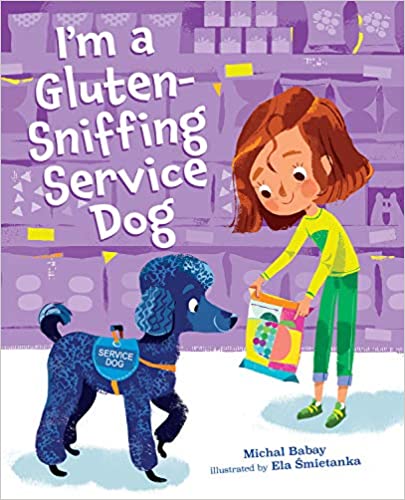
Michal, blog readers always enjoy learning how an author gets an idea for a story. This one comes from personal experience. Can you tell us a little about that?
Yes. 2019 was unfortunately a terrible year for my family because my daughter had been in and out of hospitals. Once she was finally healthy and we had recovered emotionally, I really wanted to write a book about her celiac journey. (I knew it would be therapeutic for both of us to share her story.) However, every writing attempt came out too heavy and serious. Since I normally write humorous stories, I struggled to find the right way to tell her story and stay true to my real writing voice. Luckily, I have AMAZING writing partners! Shannon Stocker suggested flipping things around and writing this story from our service dog’s point of view—and that was my door into the manuscript! As soon as Chewie began narrating his own story, the entire thing finally fell into place. Anytime I got stuck on a scene, I just looked over at the poodle racing around my house and I knew exactly what he’d say or do in that situation.

There’s a lot to learn about Celiac—how did you write it in such a way that’s digestible for young readers? (See what I did there?)
HA! Nicely done! And actually, that’s very similar to how I wrote about celiac. I used humor and a goofy dog as the narrator to keep the story interesting. By having Chewie sniff items like salad dressing, vitamins, and shampoo, I was able to show that gluten hides in unexpected places in a very kid-friendly way. It was my way of writing about celiac (and how it affects everything that we use) without saying it outright. After all, if Chewie needs to check things like medicine or lotion for gluten, then the reader automatically realizes those products could be unsafe for Alice or anyone with celiac disease. Additionally, there’s one spread in the book where Alice is too sick to do almost anything – she can’t even go to school anymore. All she wants is to feel healthy and normal again. I wanted this spread to be a window into the physical and emotional realities of celiac disease in a kid-relatable way. Luckily, my editor Andrea Hall also wanted us to include informational backmatter for parents and caregivers. So I was lucky enough to create a story that kids can enjoy, and still have a page for adults with celiac facts.

Chewie is so adorable that this book will appeal to kids who don’t have celiac, too. How can I’M A GLUTEN-SNIFFING SERVICE DOG help these children understand the disease?
This book helps create empathy and understanding of how invisible diseases can affect the day-to-day lives of people. After all, even though Alice “looks” healthy, kids learn how sick she actually is. I hope readers use this book to show children how to look beyond surface appearances and listen with their hearts.
Chewie’s story also answers questions kids may have about the training and use of service dogs. Learning about Chewie’s training takes away the mystery of a working dog. I wanted to give readers a window into the amazing world of service dog training, and to demonstrate how important these dogs are for maintaining the physical and emotional well-being of their handlers.
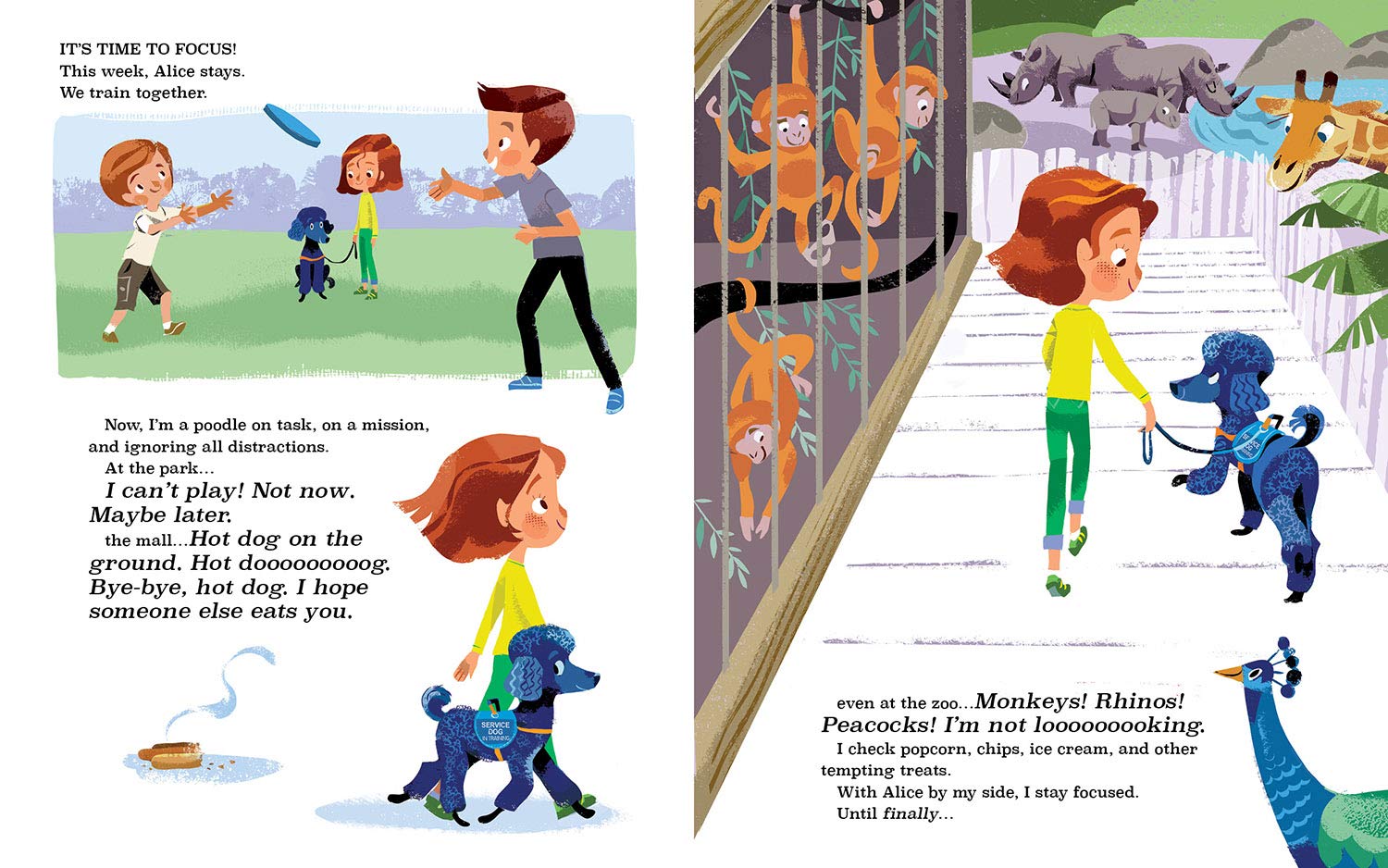
Michal, thanks for sharing your personal story and Chewie with the world! This book is a wonderful way to spread awareness of this invisible disease.
Blog readers, you can win a copy of I’M A GLUTEN-SNIFFING SERVICE DOG! Just leave one comment below to enter. A random winner will be selected soon!
Good luck!
 Michal Babay is a former elementary school teacher and current picture book author. She lives on the west coast with her human family and an ever-increasing amount of animals, including three dogs, one cat, a fish, a snail, and a rescue bearded dragon named Gus Pirate Potato. Visit her at michalbabay.com and follow her on Twitter @MicBabay.
by Annie Bailey
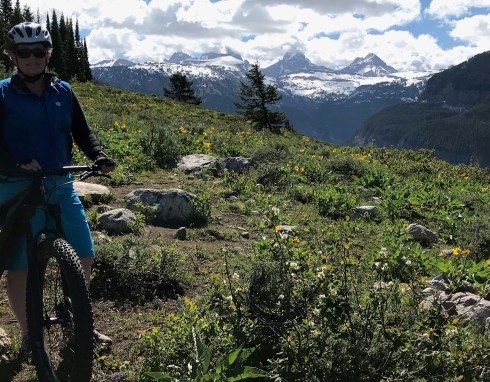
This is me on June 24, 2019, in the Tetons, mountain biking with my husband. Afterwards, we had lunch at a charming café situated next to the runway of the town’s small airport where we could watch the propeller planes land and take off.
It was a perfect day, and our ride on the mountain trails had given me a lot of time to think. On the drive home, I turned to my husband and said something I never thought I’d say.
“It’s okay if I never get published.”
I’d been pouring my heart into my writing for years—starting just after my first son was born in 2003. In 2016, I signed with my agent. Since then, we’d worked together for THREE YEARS and hadn’t sold a thing. Two weeks before that day in the mountains, my agent and I had a very honest conversation about how things were going. We were both frustrated. But at the end of the discussion, I told her, “If you’re still all in, I am too.” And we both were.
But as I told my husband on the car ride home, it was time to let go of things I couldn’t control. Getting published was one of those things. I could write a story to the best of my ability, but I couldn’t control if an editor would want to publish it. I couldn’t control the state of the economy and how it influenced acquisitions, or the political climate, or if an editor had too much of this or that on her list. I would still write, of course. But I was no longer going to put pressure on myself to achieve results that I had no say in. I felt a lot of relief and peace when I came to that conclusion.
We had only been home a short while when my phone rang.
“You have an offer,” my agent said. For not just one book, but two. A series.
I’m so pleased to share the cover of my very first book in that series, an idea from my 2013 PiBoIdMo (now Storystorm) list.
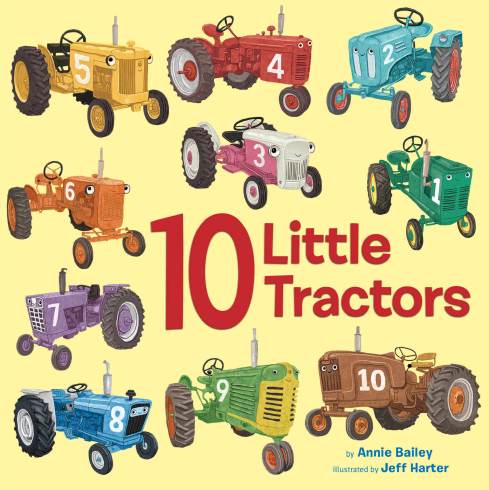
10 LITTLE TRACTORS releases November 2nd, 2021 from Doubleday Books for Young Readers and is now available for pre-order.
The second title, 10 LITTLE EXCAVATORS, releases February 2nd, 2022.
Boy has it been a crazy year. But I’m still all in, doing my best to focus on what I can control in my writing journey. I hope you are still all in, too.
Thanks for sharing your success story, Annie! What incredible timing!
Blog readers, you can win a copy of 10 LITTLE TRACTORS, which you’ll receive after publication in November.
Comment once to enter. A random winner will be selected soon!
Good luck!
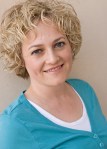 Annie Bailey is a children’s author, songwriter, and mom to four boys. She loves laughing, reading, playing the piano, soccer, biking and baking. Doubleday Books for Young Readers will release Annie’s first board books, 10 LITTLE TRACTORS and 10 LITTLE EXCAVATORS, in Fall 2021 and Spring 2022. Abrams Appleseed will release her first picture book, MUD!, in Spring 2022. She has also released a children’s album titled THERE IS JOY. Annie served on the 2015 and 2016 Best in Rhyme Award committee and currently enjoys serving as the Regional Advisor for the SCBWI Utah/Southern Idaho region. Annie lives in rural Idaho in a renovated farmhouse complete with her very own train car. (Which, of course, has time traveling capabilities.) Visit Annie at anniebailey.com or on Facebook, Twitter & Instagram @byanniebailey.





 Writing for Kids (While Raising Them)