You are currently browsing Tara Lazar’s articles.
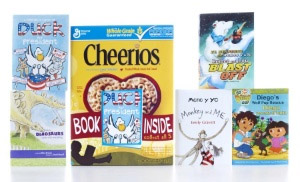
Who doesn’t love Cheerios? Little circles of oat goodness! The TV show “Glee” pays homage to Cheerios by naming their cheerleading squad after the superior cereal. And since we’re already cheering, let’s whoop it up for the Spoonfuls of Stories program! Cheerios distributes 6 million children’s stories in its specially-marked bookish boxes. Bravo!
Well, I do love Cheerios.
When I’m not hating them.
You see, my love/hate relationship with the ubiquitous toddler treat runs deep—deep in my carpeting, that is.
So for the new parents out there, take heed. Sure, run out and buy What to Expect When You’re Expecting. But then, expect Cheerios to be on your grocery list for a lifetime, so pay attention to these lessons:
- Do not purchase carpeting that is the same color as Cheerios. My sand-colored shag disguises stray O’s. We’re endlessly grounding whole grain cereal into the fibers and getting little circles stuck to the bottom of our feet.
- Do not enter the ceramic tile of your kitchen with said Cheerios attached to your heels. You will go flying. It won’t be pretty. (Hey Mom, is that a new dance?)
- Do not buy Cheerios at Costco. The enormous box won’t fit into any cabinet. You will be forced to let it live on the kitchen floor, within easy reach of a newly-walking toddler. You will soon have 5,392 Cheerios dumped onto your floor…with 5,391 rolling under the refrigerator. All the money saved by buying in bulk will be beneath your icebox.
- Do not buy fruity Cheerios in rainbow colors to solve the carpeting dilemma. They will not be eaten, these strange, colorful cereal mutations. Instead, necklaces will be made. Bracelets. They look so beautiful glued to construction paper. If you lick them and press them against the wall, look—they stick!
- Murphy’s Law of Cheerio Consumption: if you place one Cheerio at a time on the baby’s tray to avoid cereal being thrown on the floor, she will eat each quickly and cry for more. If you put more than one on the tray, they will be immediately swiped onto the ground. (Corollary: number of Cheerios provided to your child is inversely proportionate to their hunger.)
I’m sure you other parents have your own Cheerio life lessons. Please share them! (The lessons, not the Cheerios. I have enough all over my floor to make a meal, thankyouverymuch.)
P.S. While I have your attention, please vote for the books to be included in the 2010 Spoonfuls of Stories program. Me, I like Bear’s New Friend by Karma Wilson and The Hair of Zoe Fleefenbacher Goes to School by Laurie Halse Anderson.
Corollary
 What makes you pluck a picture book off the shelf? A clever title? The author’s name? What about a charming little girl on the cover, stirring a delicious pot of noodles? That’s what got to me with Cora Cooks Pancit by Dorina K. Lazo Gilmore.
Maybe it’s because I love to cook. Maybe the bright little dot that said “Recipe Included!” spoke to me. (And, by the way, the recipe is delicious!)
But more than anything, vibrant primary colors and Cora’s smiling eyes drew me in. Illustrator Kristi Valiant’s paintings evoke a warm feeling as Cora cooks a traditional Filipino dish with her mama for the first time.
Cora is the youngest of many children and always gets the kiddie kitchen tasks, like licking the spoon clean. Valiant’s opening scene shows the family from Cora’s point of view, as she sits on the floor with the family dog. We see her family from the waist down, spread along the kitchen counter, performing their duties. It’s amazing how Valiant can make the poses so varied and expressive, only working with half a body. Some of the pencil lines remain, creating an illusion of movement—the bustle of the family kitchen.
Valiant’s image presents the conflict immediately: little Cora is not involved with family meal preparation. We feel Cora’s longing to be a “real cook.”
One day when her siblings leave the house, Cora asks to cook with Mama. Mama lets Cora choose the dish. Cora wants pancit.
Mama tells the story of how her own father taught her to make pancit, and Cora feels proud when she gets to wear her Lolo’s red apron.
What follows is a delightful, heart-warming exchange between mother/teacher and daughter/student. Valiant’s illustrations are spot-on, from facial expressions to body language. She gets every detail just right. Even Cora’s feet, slightly off-balance, reveal her trepidation as she prepares the noodles. Sunlight streams in through the kitchen window, framing Cora and Mama in a scene that highlights the special bond created with family tradition.
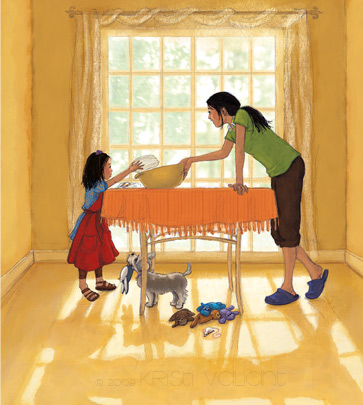
As usual, I won’t reveal the story’s ending. There’s an oopsie along the way, but there’s also a beaming Cora.
I was so impressed with this book’s illustrations, I asked Kristi Valiant for an interview. Luckily, she agreed to talk to me about the making of Cora and other fun illustration stuff. Watch for it soon!
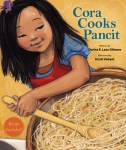 Cora Cooks Pancit
Text by Dorina K. Lazo Gilmore
Illustrations by Kristi Valiant
Shen’s Books, Spring 2009
Want it? Sure you do!
Last year I attended the Rutgers University Council on Children’s Literature One-on-One Plus conference. (Phew! That’s a mouthful. How ’bout I just say RUCCL from now on?)
It was my first big conference. It was my first conference, period. I thought I was prepared. I don’t get nervous in large crowds of people, nor do I find it difficult to go right up to someone and chat. And I love public speaking and performing. I’m not easily intimidated.
But, when I arrived, I realized it. I hadn’t fully prepared myself.
The day went by quickly. Those organizers pack the event chock full of excellent speakers and interesting topics. (See my post-conference notes from last year.) The time you have to meet people is the time it takes to walk from one presentation to another.
I didn’t get the opportunity to talk to many editors or agents. True, I had only just begun to write for children, and thus, I didn’t know who I should be chatting with anyway.
So I decided that I would try to help other first-timers. Here’s a list of lessons I learned last year. I hope they help you make the most of your day.
1. Research the faculty in advance.

2008 RUCCL mentors arrive
Find out which editors and agents are interested in the kind of work you produce. Make a list of their names, and if possible, look up their photos online. No, I’m not encouraging anyone to be a stalker! There are 80 professionals mixing it up with 80 attendees, all wearing name tags. If you don’t want to squint at people’s chests all day trying to figure out who is who, go online and see if you can find a photo to recognize people by sight.
Approach editors/agents only during appropriate moments. Don’t interrupt another attendee or tap the editor’s shoulder while they’re taking a big honking bite of sandwich. You should know that the restroom is a no-no! The best time you’ll have to approach professionals is between sessions. Another good time is when they announce where mentors and mentees should meet. (They will announce pairings via alphabetical order and ask “A-F” to meet in a specific area, like near the fireplace.) When I went to find my mentor for my 45-minute session, I didn’t immediately see her…because another attendee had already pulled her aside to talk.
And I’ll say it: lunch is a good time to talk. They will seat mentors at numbered tables that correspond with the five-on-five assignments. Although not everyone sits in the right place, it will be easiest to find people during lunch. But again, if someone is chomping on chicken salad, it’s probably not a good time to interrupt.
Why is it important to talk to the faculty directly? Because they may not accept your submission post-conference if you don’t make contact. Now that’s contrary to what I had heard about conference submissions, but I did get one submission returned after RUCCL, citing that they don’t accept unsolicited manuscripts. (Yes, RUCCL was clearly marked on the envelope and in the cover letter.)
So find editors. Ask if you may submit. Ask for a business card. Don’t give them yours unless they ask. Be professional, courteous, polite and to the point! There’s not a lot of time, so don’t ramble. Which brings me to my next lesson…
2. If you know your manuscript needs direction, say so.
My submission last year was a novel I had only recently begun. I was not yet clear on the plot or direction. But when my mentor asked me about it, I meandered. I had two general ideas of the possible direction in my head, but I wasn’t certain which path I should take. Instead of asking my mentor what she thought, I tried to make it sound like I was clear. And I obviously was not.
Another attendee had it right. She told me, “I explained to my mentor that I had started the novel but stopped because I was stuck. I told her I wasn’t sure the direction it should take. She then gave me some very good ideas and we brainstormed the possibilities.”
3. Don’t be afraid to speak up and ask questions.
During the five-on-five, the mentees had an opportunity to ask questions of the professional panel. But our discussion leader asked questions off a prepared, suggested list of topics. They weren’t necessarily the questions I wanted answered, but I didn’t speak up and ask what was on my mind.
Remember, this is your day. The conference is arranged to help you, the mentee, take the next step in your career. So if you don’t find the topics to be of interest, speak up. Politely interject and ask if you can introduce a question instead.

Mixing it up at lunch
4. Prepare a list of questions.
Questions about your submission, questions about the market, questions about the publishing house, questions about your other manuscripts. Whatever questions you have, take them with you. Refer to them. If there’s information you want to collect, this is the place to do it.
Another good idea is to bring a list of your manuscripts with one-line descriptions. Even if you just have ideas, ask if they’re good ones. A mentor might tell you to pursue idea A and D but not B or C because of current market dynamics, competition, or other factors (remember, one of those factors might be personal taste).
5. Have fun!
This is your day. It’s a step forward in your career. Enjoy it, use it to your advantage, learn from it. Congratulations and have a great day!
FYI
I added the schedule from last year as I recall it, for those interested in how the day is structured. Please realize this may not be similar to this year.
2008 RUCCL Schedule
• Arrive, get folder with schedule/mentor assignment/faculty bios, read through it, have breakfast, free time to mingle with other attendees
• Introductory speaker (2008, Kay Winters)
• Mentor session
• Panel Discussion (2008, “How a Manuscript Becomes a Book”)
• Lunch
• Five-on-Five Discussion (You, your mentor and four other mentor-mentee pairs)
• Keynote Speaker (2008, K.L. Going)

[10/19/10: UPDATE! PiBoIdMo 2010 is almost underway. See announcement.]
[11/1/09: UPDATE! PiBoIdMo 2009 has launched! Click here for details!]
November is only a few weeks away, so while novel-writing friends gather up their character notebooks and plot outlines, I’m preparing to do exactly what I did in November 2008: generate one new picture book idea a day.
This is different from Paula Yoo’s NaPiBoWriWee last May, when writers wrote one new picture book a day for seven days. (Phew! I couldn’t keep up with that.)
And it’s different from YA author Jo Knowles’ JoNoWriMo, where children’s writers take a month and a half more (from mid-September to November 30) to complete a kidlit project.
This November’s writing challenge is all about ideas.
They say it takes 10 to 30 days to form a habit, so I’m encouraging picture book writers to get in the daily habit of idea generation. Do it for November, let it continue into December, and start off the new year still collecting tiny seeds that may some day sprout into a story.
An idea for a picture book could be as simple as a title, like Misfit Museum. Or you could take a fall stroll one afternoon and be inspired by foliage floating on a lake. (You might jot down “watercolor pond.”) It doesn’t have to be a full concept, or even a good one. Heck, I’m sure we’ll all have some stinkers in there. But by creating an idea file, you’ll have a document to turn to when you’re low on inspiration.
Why is this a good idea? During an online chat with literary agent Sean McCarthy last year, he was asked about the qualities his ideal client might possess. “Prolific-ness” was his answer. Agents like when their picture book authors are constantly creating. That means there’s more potential books to sell.
At the end of November, you should have 30 new story starters (or close to 30…we do have Thanksgiving festivities to think about). Last year I walked away with 22 ideas, four of which turned into picture books. And I refer to that idea file at least once a week.
Now all we need is a flashy name. NaNoWriMo-lite? (Way, way lite. With extra cream and sugar.) Nah. Something snazzier. Give it a try! It needs a name!
If you’d like to participate, please comment below. I promise to post ideas for idea generation all November long and check in with progress reports.
 Picture book brilliance isn’t easy to achieve, as many children’s writers know. Telling a story in 500 words–with page turns that work within a 32-page format–challenges the most talented of writers.
Let’s not forget that a picture book should appeal to both parent and child. Silliness keeps the kids begging “again!” But if a parent thinks the language is too repetitive or annoying, you’ll lose the gatekeeper. (You know, the one with the wallet.)
Sappy stories can attract Mom and Dad, but kids might declare them snoozers. I recall tearing up at a lovely, sentimental picture book while my daughter rolled her eyes. “Mom, what is wrong with you?”
So what makes a great picture book that both parent and child can call a favorite?
A balance between humor and heart, imagination and reality.
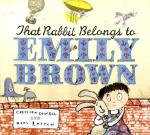
That Rabbit Belongs to Emily Brown by Cressida Cowell and Neal Layton has it all.
Emily and her stuffed pal Stanley explore the world together–they scuba-dive, swing through the rain forest, and launch into outer space. But they are constantly interrupted by a rat-a-tat-tat on their garden door. Her Royal Highness Queen Gloriana’s guardsmen keep insisting that Emily give her Bunny-Wunny to the matriarch. It is the Queen’s decree!
Now, the Queen tries to be fair about it. She offers all these new-fangled toys in exchange, upping the ante each time Emily refuses. But the Queen’s toys are “stiff and new and gold and horrible…with staring eyes and no smile at all.” Once it’s clear that Emily will not trade Stanley, the Queen resorts to extreme measures.
Emily awakens the next morning without Stanley! She knows who’s behind his disappearance and marches straight to the palace. But the Queen is not happily playing with her Bunny-Wunny. She’s crying over him.
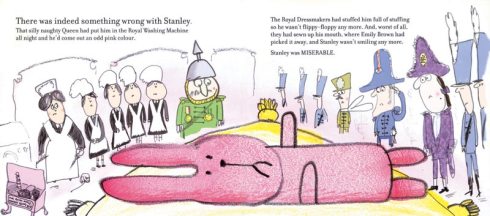
That silly, naughty Queen had Stanley re-stuffed and washed, turning him an odd pink color. They were both miserable.
As usual, I won’t tell you how it ends. You’ll just have to pick it up for yourself. And cuddle with it. And go on adventures together. Wear out the pages a bit.
That Rabbit Belongs to Emily Brown celebrates the special bond between child and toy. Almost everyone had a lovey, that one thing we couldn’t live without, dragged by a leg to grocery stores and Grandma’s. This story reminds adults that there’s still a kid inside us, longing to curl up with our own flip-floppy stuffed rabbit.
Luckily we can snuggle with a cute kid instead, reading Emily Brown over and over and over again.
 That Rabbit Belongs to Emily Brown
Written by Cressida Cowell
Illustrated by Neal Layton
Hyperion Books for Children
Want it? Sure you do!
 Remember those embarrassing dance moves your Aunt Myrna unveiled at Cousin Frannie’s wedding? She flapped her arms, wiggled her tush and tumbled onto the parquet floor?
Well, that’s not this chicken dance.
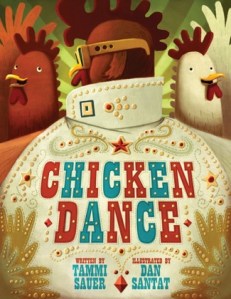
No siree, this Chicken Dance is a brilliant barnyard romp featuring two hilarious hens and their idol Elvis Poultry, thank you. (Thankyouverymuch.)
Author Tammi Sauer grew up on a Kansas farm, tending cows at dawn. Those daybreak chores paid off, ’cause this little lady sure knows how to milk the humor.
According to henhouse pals Marge and Lola, Elvis Poultry is a hunk of bawking love. When the barnyard talent show is announced, the pair discover the grand prize is two tickets to Elvis’ Final Doodle Doo concert tour. They must win!
But the ducks waddle by and wave a wing at the hopeful hens. “Don’t bother, drumsticks.” Seems ducks are top dog at this farm.
Marge and Lola test out their talents but the ducks quack at every failed attempt. When Marge and Lola finally hit the stage–following solid goat, pig and cow acts–they stammer and gulp. A duck heckles, “What’s the matter? Are you chicken?” so they begin to flap, shake and bawk. Just regular chicken stuff, nothin’ fancy. But the crowd loves it and crows for more.
The next spread features Marge and Lola performing dance moves that would make Aunt Myrna shake in her boots. They vogue, point like John Travolta, domo arigato misuta robotto, and walk like an Egyptian. Illustrator Dan Santat makes chickens boogie better than So You Think You Can Dance finalists.
I can’t reveal the contest results, as that would spoil all the feathery fun. But I will tell you that Elvis is in the building. Err, I mean barn.
 The jokes even extend beyond the story, with end pages that demo step-by-step “Disco Chicken” and “Chattanooga Choo Choo” dance moves. Funky album covers replace the typical staid author and illustrator photos.
Yes, just one look at the blinged-out, white-caped Elvis Poultry on the front cover, and you know this ain’t your Aunt Myrna’s paltry poultry impersonation.
Can’t get enough of the silliness?
Publisher Sterling Kids is holding a video contest now through October 31. Just shake your tail feathers along to the official music and post your hoe-down on YouTube.
And tell them Elvis Poultry sent ya.
 Chicken Dance
Written by Tammi Sauer
Illustrated by Dan Santat
Sterling Kids, August 2009
Want it? Sure you do!
Come visit a new website that lets kids spread their storytelling wings.
Storybird is “collaborative storytelling for family and friends.” When I first heard the tagline, I scratched my head. What is this all about? Then I got the beta tester invite. And I played on the site for hours. Days. My daughter begged, “Mommy, can we make another Storybird?”
So what is this high-flying new creature?
Storybird helps you create a tale with an intuitive book-like interface and a whimsical selection of artwork. (We’re not talking stick-figures here. These are high-quality images from some of the most talented “undiscovered” children’s illustrators today, like Irisz Agocs and Victoria Usova.)
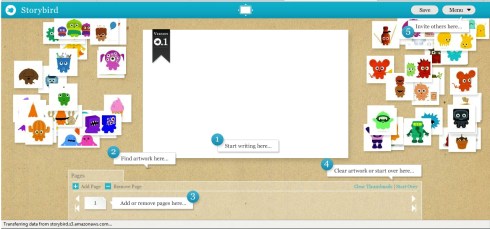
Select an artist’s work to begin. A page appears in the center of the screen, surrounded by thumbnail images. Simply drag and drop an image onto a page, then write text to accompany the picture. Add as many pages as you like and you’ll soon have a bonafide book—one that looks professional, one that can be read online over and over again. You can choose to keep your Storybird private, or you can share it with the Storybird community. And they can read it online over and over again.
But the smartest feature of Storybird brings family and friends together. Is Grandma in Gary, Indiana? Cousin Kate in Kalamazoo? You can invite them to write a page in your story. Or two pages. There’s no limit…and what’s better, there’s no fee to join Storybird. According to CEO Mark Ury, “Making, sharing, and reading Storybirds online will always be free. Printing and premium services—when we introduce them later this year—will have a fee associated with them.”
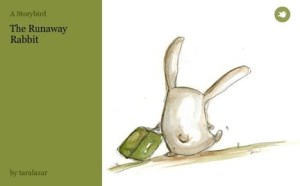
Read this Storybird
(Uhh, Mark, could you please hurry up with that? My daughters want a copy of The Runaway Rabbit in their hands right away.)
Other planned features include the ability to: choose artwork based upon theme, upload your own images, and record your voice to accompany Storybirds. For those on the go, an iPhone app is coming, too.
What’s more, Storybird wants your ideas to improve and enhance the service. The site has only been live for 6 days, but educators in over 100 countries have already asked for a multi-user platform to help teach literacy skills in classrooms. Ury says his company is working on a teacher log-in that would enable students to work under that account without having to submit their information. Storybird be nimble, Storybird be quick.
And Storybird be popular! Some stats from their not-quite-a-week online:
- 1,000 users in 100+ countries
- 8,000 unique visits
- 76,000 page views
- 7-minute average visit
- some Storybirds viewed 325+ times each
Families and teachers will see enormous benefits in Storybird, as will artists. Storybird creates a marketplace to share your work and develop a fan following. If you’re an aspiring children’s illustrator, I encourage you to sign up.
So what are you waiting for? Slide a kid onto your lap and flap your wings on over to Storybird. (Or, if you’re like me, you don’t even need a kid. The child inside you will have plenty of fun on her own!)
 When my father got a Kindle, he was awestruck by its instant gratification: “The books come out of the air!”
And now, I have a similar cry of joy: “The books hover in the air!”
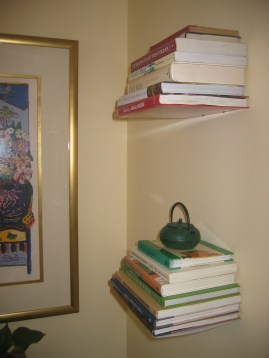
I’m not talking about a Kindle, which is still too steep for me to consider. No, I’m referring to the amazing Umbra conceal bookshelf. (Which, at less than $10 from The Container Store, is a whole lot cheaper than any e-reader.)
Magically, a stack of books sits upon the wall, seemingly suspended sans anchor. An artful arrangement, as minimal as minimalism gets, the Umbra conceal bookshelf creates a floating home for a flotilla of tomes.
How it works: the L-shaped bracket screws into the wall. Place the last page of a book on top of the shelf and slide it to the wall. Below the shelf, two tiny hooks hold the back cover up—ingenious! You can then stack 6-8 books on the first, concealing the bracket on the wall to create the levitation illusion.
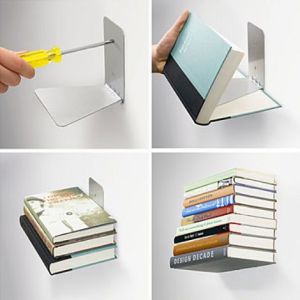 However, there are a few caveats. With the large shelf, the books should be no deeper than 10”, and the total weight of the books shouldn’t exceed 20 lbs. or they will sag. (Grab a stack of books and weigh it on your bathroom scale. I had what I thought was a heavy bunch, but it was only 13 lbs. No sweat for the Umbra.)
Next, the arrangement of books can be a little tricky. I bought two shelves for cookbooks. I have about 40, and it took some shuffling to create perfect pyramids of progressively smaller books. Some books were smaller in length, but not in width—and vice-versa. If you have a large collection of books, however, finding a pleasing aerial aesthetic shouldn’t be an issue. You can even display small objets d’art atop the books, as I did with a Japanese cast-iron teapot.
Finally, you need to install the shelf into a stud and use a hardcover for the bottom book. But paperbacks work well mid-stack, as you’ll see I put the meatless Moosewood between Jim Dodge and the Barefoot Contessa.
Books are works of art, and never before have they been so suitably displayed. I can’t imagine the Kindle being hung on the wall for artistic appreciation. But go ahead, get your e-reader. I’ll just keep buying more books…and more Umbra bookshelves.
Kidlit Book Trailers
Bookselling is changing rapidly with advances in technology and the belt-tightening economy. Publishers and authors are having an ongoing discussion of electronic rights, trying to anticipate the future of digital books.
But the forces of technology aren’t all daunting. Heck, authors are having a blast creating book trailers to promote their titles. What better way to capture the attention of an increasingly online, plugged-in audience?
Award-winning storyteller Dianne de Las Casas has created a Ning community for sharing and discussing kidlit book trailers. Authors are invited to post their trailers and other videos (like a school visit). Bibliophiles can browse the selections to discover great reads.
http://kidlitbooktrailers.ning.com
Haven’t seen a book trailer? Here’s a gorgeous one from the site: Where the Mountain Meets the Moon by author/illustrator Grace Lin.
The Unread
Here’s where you cover your ears because I’m gonna toot my own horn. Picture book author Heather Ayris Burnell (Bedtime Monster, Raven Tree Press 2010) interviewed me for her Unread series of aspiring authors. As you may have guessed, there’s almost as much talk about food as there is about books.
Besides Unread, Heather’s blog is dedicated to author interviews, book reviews and being a writer and librarian. So there’s lots of reasons to visit regularly.
http://frolickingthroughcyberspace.blogspot.com/2009/08/unread-interview-with-tara-lazar.html
Mitali Perkins’ Fire Escape
I am in awe of this woman. Not only is Mitali Perkins an amazing novelist, she shares the most compelling kidlit news and information via Twitter and her blog, with special emphasis on multi-cultural issues. If you haven’t visited, you really need to.
http://www.mitaliblog.com
http://twitter.com/mitaliperkins
Meet Eric Carle
August 23, 2009 marks Eric Carle’s 80th birthday and there’s a big bash at The Eric Carle Museum of Picture Book Art in Amherst, MA. Crayola will unveil “The Very Hungry Caterpillar Green” crayon as part of the celebration. Wow, getting a crayon named after your work. Now that’s iconic.
http://www.carlemuseum.org/Programs_Events/Upcoming/Meet_Eric_Carle/
Sudipta Bardhan-Quallen’s Picture Book Intensive
On November 15, picture book author Sudipta (yes, she has earned one-name status) will lead a four-hour picture book intensive workshop in Princeton, NJ for the NJ-SCBWI.
Some topics she’ll cover:
- Choosing Timeless Themes
- Ebb & Flow of Tension
- Creating Emotional Attachment to the Main Character
- Finding Ways to Make Your Book Re-Readable
- Humor and Heart
- Query Letters
- Marketing
I know I’ll be there!
For more info:
http://sudiptabq.wordpress.com/2009/08/10/picture-book-writing-intensive-workshop/
To Register:
http://www.newjerseyscbwi.com/events/091115-pbintensive.shtml
Do you have any can’t-miss kidlit links to share?
Remember Andy from the movie Funny Farm? Chevy Chase in his post-Caddyshack and SNL days, sliding down fame’s slippery slope, but still hilarious as a wanna-be author who moves to rural Vermont to pen The Great American Novel.
Instead of peace and quiet, Andy gets a crazy mailman and an acute case of writer’s block. It’s a fish-out-of-water story, one that inspires his wife Elizabeth to name a squirrel after him in her first children’s book—a book that a publisher accepts with a $5,000 advance. (She asks, “Is that much for a first book?” as he reels.)
Many children’s book editors warn against submitting talking squirrel tales. Seems they’re overdone. Was Elizabeth from Funny Farm to blame for an influx of fluffy rodent submissions? The world may never find out.
Despite the creature caveat, I’m writing about squirrels. But non-fiction, based upon our recent experience.
A violent July storm blew a squirrel’s nest from a tree near our property. A neighbor and I found day-old squirrels on the bike path. Gently, we moved the nest onto the grass. I assured her since the tree was closest to my home, I would contact the proper authorities. I assumed the police or animal control would be the right call.
I was wrong. Had I telephoned those authorities, the squirrels might have been destroyed.
Instead, I found an informative resource in Squirrel-Rehab.org. I learned that if the babies were cold, the mother would not take them back. The nest was covered in hail from the storm. The pups were indeed cold and wet, squirming and chirping, in obvious distress. I followed the instructions to warm the babies and tried to reunite the family, but by 10pm, the mother was still missing as another raging storm began. I brought the babies into my home.
I cared for them for nearly 48 hours and then brought them to licensed wildlife rehabilitators Wild Baby Rescue in Blairstown, NJ. The video below documents our short time with the squirrel pups, the inspiration for a new story. Elizabeth, you ain’t stopping me.