You are currently browsing Tara Lazar’s articles.
Kids love when they think they’re smarter than adults, don’t they? Try putting your shirt on as pants or wearing your shoe as a hat and they’ll double-over with laughter at your stupidity.
Similarly, in writing, having a clueless narrator produces sure-fire giggles. Knowing more than the protagonist is like being in on a secret joke with the author. It’s one of the keys to writing humor for children.
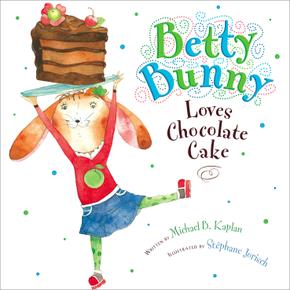 But one of the biggest mistakes in writing humor, according to Executive Editor Steve Meltzer, is random humor—humor that doesn’t serve to drive the story forward but exists merely as a gag. “Even the absurd needs to make sense and be believable,” said Meltzer. He then read BETTY BUNNY LOVES CHOCOLATE CAKE as an example of humor that feels effortless and works within the context of the story. When Betty Bunny’s parents tell her she’s a “handful” so often, she thinks it’s a term of endearment and tells her mommy she’s a “handful” right back. (Of course, I’m rushing out to buy the book right now! I know, I’m a handful!)
Remember when writing picture books for kids, your audience includes parents, too. Some humor should be for their benefit. Think of the old Bugs Bunny cartoons—watch them now and there are jokes that certainly went over your head as a child. Pixar films also have a unique way of delivering entertainment that parents enjoy. (Like in “Finding Nemo” when Nemo is waiting to sabotage the filter. The dentist goes to the bathroom and Peach says, “Potty break! He grabbed the Reader’s Digest! You’ve got 4.2 minutes!”)
Mr. Meltzer also reminded us to take advantage of page turns because “they’re the writer’s rimshot.” Page turns should be surprising and fun. They create suspense: “And then…” [page turn] “BAM!” Hit them with your best [rim]shot.
 Audrey Vernick and Olugbemisola Rhuday-Perkovich also examined humor in picture books and suggested “take something we all know and insert something absurd that doesn’t belong…the unfamiliar in the familiar.” Audrey did just this in her debut IS YOUR BUFFALO READY FOR KINDERGARTEN?. The humor in the book happens when the buffalo goes to school, helping to ease readers’ fears about the first day of Kindergarten.
Other ways to add humor to your stories include having a funny sidekick, inserting a running gag, and taking the joke beyond the typical expectation of three. When the joke happens a fourth time, it’s hilarious because we already thought it was over after the third instance.
Misunderstandings, like those literal translations in Amelia Bedelia are also humor winners. Comic wordplay is another technique to try. Combine words, create new words, use funny sounds (onomatopoeia). My debut picture book is THE MONSTORE—a store where you buy monsters. The mashed-up title signals that this will be a funny book. (At least I hope you’ll think it’s hilarious!)
So, are there other humorous devices you like to use in your writing?
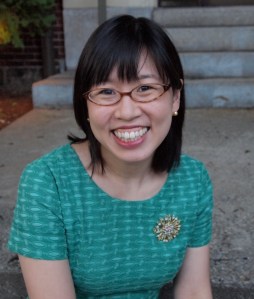
Photo Credit: Alexandre Ferron
Did you know that author/illustrator Grace Lin was Chinese? Well, she didn’t.
As a child, she was the only Asian in her elementary school, so she saw herself as an ordinary white, middle-class kid living in upstate New York. She pretended she wasn’t Asian. None of the books she read had characters that looked like her. It wasn’t until her school librarian pulled out “The Five Chinese Brothers”, the sole ethnic title, that Grace was reminded she was different.
At the NJ-SCBWI conference in Princeton this past weekend, Grace Lin gave the keynote presentation and told us about her identity crisis as an illustrator. In art school she imitated styles and she made art to impress other people. She wanted to hear, “You’re such a great artist, Grace! How do you draw so well?”
But she soon realized she was copying others, wanting to be like Michaelangelo, and making art for the wrong reasons. “Be an artist because you have something to share with the world,” she told us. So Grace began to draw things that made her happy.
She found that Chinese folk art, with its bright colors, patterns and lack of perspective appealed to her. Every inch of the illustration was utilized–there were no blank spaces. This folk art resembled Matisse, and she began to see an East-West commonality in the art she preferred, which became an East-West identity that she embraced.
If Grace was to make art that was important to her, she had to think of what was most important in her life: her family. So she created a family portrait that was uniquely her own–colorful, vibrant and in a style that was not seeking to impress, but merely being who she was.
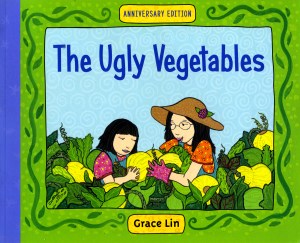 Grace explained to us that our art should have a personal connection. “If it’s not important to me, why do it?” Her first book was very personal, reflecting on the time she spent with her mother in the garden, tending to Chinese vegetables. She used to be embarrassed by the strange plants that grew outside her home, but she now realized the importance of her heritage. She remembered how she never saw herself in books, and she wanted to give other Asian children the chance to see themselves represented.
Instead of being pigeon-holed as an ethnic author, Grace Lin has seen her books melt away race and culture and appeal to every child. “Pre-conceived notions of the market don’t really matter,” she said. She reminded us that if we create what we love, what’s important, our passion will always shine through and find an audience.
Up Next from the Conference: Humor in Picture Books
‘Twas the night before Conference and all through the hotel,
Authors were dreaming of merchandise deals with Mattel.
The manuscripts were printed with name and website,
In the hopes that an agent would find love at first sight.
The editors were snoring tucked into their rooms,
Knowing before them a day of pitching looms.
And while I am too warm, and Corey Rosen Schwartz too cold,
We share a king bed because the queen rooms are all sold.
Out in the hallway, there arose such a noise,
Wouldn’t you know it, it’s the conference’s only two boys.
The place is packed with slinky stiletto-heel wearers,
‘Cause style in books means style in fashion is fairer.
A kidlit conference is full of women who are hot,
Who sell tons of stories while you just want one shot.
But we authors are friendly, we certainly don’t bite,
We’re not filled with envy, we’re not filled with spite.
We will welcome you to our world that’s so crazy,
So will editors and film agents who’ve worked with Scorcese.
Get out there and network! Polish your pitch to a shine!
Relax in the lounge with a smooth glass of wine.
A kidlit conference is the place to make a friend,
It’s where deals happen ’cause deal-makers attend!
But don’t drone for hours about your book’s premise,
Talk about your life, your hobbies. Do you play tennis?
And don’t just stand there, go mix and go mingle.
Don’t stare at the editors like they’re all Kris Kringle.
Be yourself and you’ll find that you’ll be an attraction,
Don’t croon like Jagger about not gettin’ no satisfaction.
Be happy, be cheerful, take crits with salt if need be,
Remember we’re here to help you succeed, see?
(Excuse the bad meter, I’m not really a poet.
Ask Corey the rhyme genius, she really does know it.)
And with that I bid you a hearty good luck.
Break a leg, do your best, get that writer’s block unstuck.
Enjoy yourself for three days and two nights.
Happy Conference to all, and to all a good write!
by librarian Jackie Reeve
Last Tuesday the Children’s Book Council held a 90-minute Children’s Author Speed Dating event at BookExpo America. This was a chance for librarians and booksellers to meet each other and almost 2 dozen teen and children’s authors. As an elementary school librarian (K-4), this was the perfect event for me to get started at BEA. And it was very much like a short first date with each author, complete with some awkward pauses and some great conversations cut short by that cursed buzzer. I loved it.
Nineteen authors were given three and a half minutes to pitch their upcoming books and themselves to a roundtable of excited book lovers. When the buzzer sounded the authors moved on to the next table, leaving each group with a taste of their process, their new work, and their personalities. But for me, that short little “date” was enough time to become enamored of some new books and some new authors. They were all just so lovely.
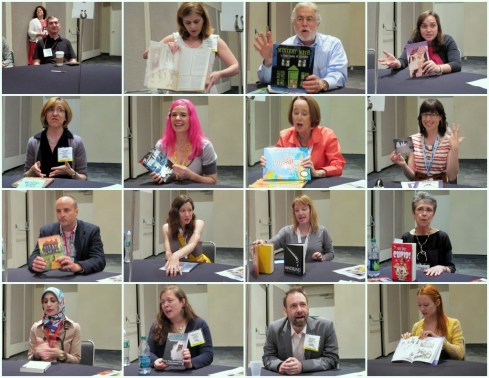
No one sits still for photos while speed dating, so I apologize to the authors in advance for any mortifying poses I captured. They don’t deserve such cruelty. From left to right, starting with the top row: James Dashner, Jane Hampton Cook, David A. Adler, Lisa Greenwald, Linda Urban, Laini Taylor, Susan Stockdale, Ashley Spires, Clete Barrett Smith, Maria Rutkoski, Jennifer Roy, Kate McMullan, Tahereh Mafi, Carrie Jones, Jeff Hirsch, and Laura Lee Gulledge.
We didn’t leave with any whole books, but I left with bookmarks and samples, a list of ARCs and galleys to track down at the Expo (I scored 6 of the 19), and several more titles to add to my book order for next year. Plus I was inspired to connect with some of the authors further, through their Twitter accounts and maybe even a visit to my school (budget willing). As exhausting as those 390-second bursts could be, this was by far my favorite part of the Expo. I would recommend it in a heartbeat to anyone who wants to connect with authors beyond a quick fangirl moment (“I loved your last book!”) in the autograph line.
Here is the complete list of authors we “dated”, with their websites and Twitter handles where available:
- David A. Adler, Mystery Math: A First Book of Algebra (Holiday House): www.davidaadler.com
- Jane Hampton Cook, What Does the President Look Like? (Kane Miller): www.janecook.com
- James Dashner, The Death Cure (Random House): www.jamesdashner.com AND @jamesdashner
- Lisa Greenwald, Reel Life at Rockwood Hills (Abrams): www.lisagreenwald.com
- Laura Lee Gulledge, Page By Paige (Abrams): www.cobaltdesigns.biz/lauralee AND @WhoIsLauraLee
- Jeff Hirsch, The Eleventh Plague (Scholastic): www.jeff-hirsch.com AND @Jeff_Hirsch
- Carrie Jones, After Obsession (Bloomsbury): www.carriejonesbooks.com AND @carriejonesbooks
- Alan Katz, Mosquitoes Are Ruining My Summer; Me Me Mine; Poems I Wrote When No One Was Looking (Simon & Schuster): www.alankatzbooks.com
- Jon Klassen, I Want My Hat Back (Candlewick): www.burstofbeaden.com AND @burstofbeaden
- Tahereh Mafi, Shatter Me (HarperCollins): www.taherehmafi.com AND @TaherehMafi
- Kate McMullan, Myth-o-Mania series (Capstone): www.katemcmullan.com
- Jennifer Roy, MindBlind (Marshall Cavendish): www.jenniferroy.com
- Marie Rutkoski, The Jewel of the Kalderash (Macmillan): www.marierutkoski.com AND @marierutkoski
- Clete Smith, Aliens on Vacation (Disney): www.cletebarrettsmith.com
- Ashley Spires, Binky Under Pressure (Kids Can): www.ashleyspires.com AND @ashleyspires
- Susan Stockdale, Bring on the Birds (Peachtree): www.susanstockdale.com
- Laini Taylor, Daughter of Smoke and Bone (Little, Brown): www.lainitaylor.com AND @lainitaylor
- Linda Urban, Hound Dog True (Houghton Mifflin Harcourt): www.lindaurbanbooks.com
- Meg Wolitzer, The Fingertips of Duncan Dorfman (Penguin): www.megwolitzer.com

Jackie Reeve is a school librarian living at the Jersey Shore, married to an Englishman, and loving her crafty life. She catalogs her attempts at being a domestic diva, her globetrotting adventures, and her love for all things kid and book over in The Orange Room at www.jackiereeve.com. And beware, she has a dangerous obsession with cardigans. You can find her on Twitter @jackiereeve.
 Laurie Isop is one lucky woman. Then again, luck has nothing to do with it. It’ more like skill, talent and persistence.
Who is Laurie Isop? She’s the first winner of Cheerios’ annual New Author Contest, which she won in 2009. Her book HOW DO YOU HUG A PORCUPINE? will appear in a million Cheerios boxes and the hardcover will be released with Simon & Schuster in July.
So how did Laurie get so lucky? (Err, I mean, how did she win?) Luckily (and this time I mean it), she agreed to an interview! Today she shares her journey with other aspiring children’s authors.
So go grab a bowl of the famous breakfast O’s and read how you, too, could have your name in boxes.
 When did you first hear about the Cheerios contest and what made you decide to enter? How long had you been writing for children?
I’d been trying to crack the children’s market for about 10 years when I heard about the contest. I had drafted the story, “How Do You Hug a Porcupine?” prior to learning about the contest. My sister owns a bookstore in Stoneham, Massachusetts (shout-out to The Book Oasis!) and she sent me a link to the contest and encouraged me to enter.
How did you get the idea for your story HOW DO YOU HUG A PORCUPINE?
We were sitting around the dinner table talking about “warm fuzzy” people vs the “cold prickly” types, and the idea was born from there. I wanted to do something with animals to make it more age-appropriate. We had such a good time, talking about the different animals and envisioning all sorts of ways for the porcupine to win his hug. I probably revised my story eighteen or twenty times before I submitted it.
How did you find out that you won? What was your reaction?
I was having “one of those days” last October 2009. You know, one of those self-fulfilling prophecy-type days your mother warned you about when you were twelve, and again when you were thirty? The sky was ashen, the roads slick with the endless, penetrating drizzle of fall in the Pacific Northwest. Paul and I were several hours behind schedule, and I was eying the front door of a house I knew contained a bathroom in desperate need of cleaning. Lucky me, I sulked, my hand poised to open the door.
And then the phone rang.
I looked at Paul, sighed, and pasted an I-love-my-job smile on my face. “Studio 6 – this is Laurie!” I gushed, expecting a bride-to-be on the other end (our ‘real’ jobs are with the wedding studio).
“Is this…Laurie Isop?” queried the lovely voice on the other end. I rolled my eyes. Darn solicitors, I thought. They aren’t even sure how to pronounce my name!
I couldn’t have been more wrong.
Then I cried a little, and called my mom and sister.
 What was the process like to produce the book? Did you make revisions? Did you have a hand in selecting the illustrator, Gwen Millward (whose illustrations I loved in GUESS WHAT I FOUND IN DRAGOD WOOD)?
My editor at Simon & Schuster worked closely with me to tweak and polish the manuscript. They were in charge of selecting the illustrator, and I was able to communicate my design ideas to her. Once the proofs started coming in it got super exciting!
What has been the best part of your experience with the Cheerios contest?
Actually winning the contest was fantastic and very emotional—it was something I wanted for a long time. It was like a whole new page was turning and I felt like doors were going to open for me, so that’s an exciting feeling. It’s all been very flattering and also validating. And, winning the contest has motivated me to write every day. The best part, though, was receiving a letter from a mother of a two-year-old boy in Illinois. She told me he had never said more than one-word “sentences.” She picked up the story in a box of Cheerios and read to him. Right away he asked for the story to be read again, and again! She wrote in her letter that his first sentence was “how do you hug a porcupine?” Pretty cool.
Wow. Now I’m crying! What a touching story.
What are your upcoming plans? Do you have more books in the works?
I am working on a few different projects and I have several titles in various stages of the submission process. I’m incredibly excited to do some local readings and signings once “How Do You Hug a Porcupine?” is out in hardcover in July, and I’ve been invited to Boston to read/sign in some bookstores. Coast to coast!
What is your best piece of advice for new writer’s hoping to break into the children’s market?
Be persistent – don’t give up! Read your book to anyone that will listen and note their reaction. Are the children wide-eyed and wanting you to turn the pages? I also recommend writing in different settings; I used to write in coffee shops, libraries, karate places – anywhere that provided inspiration. And, of course, edit, edit, edit.
Thanks so much, Laurie! Congratulations and best wishes with your book!
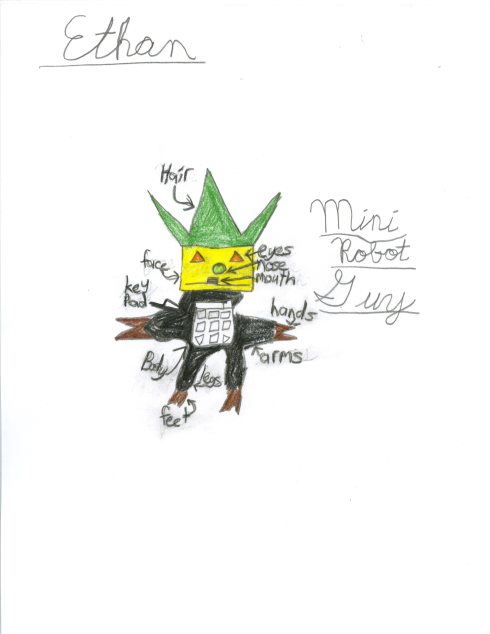
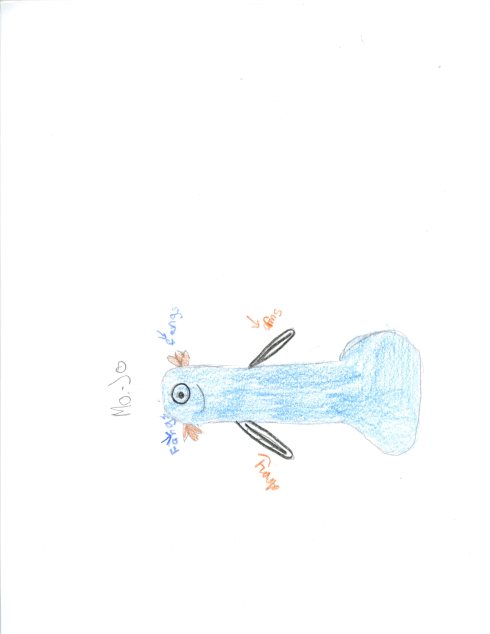
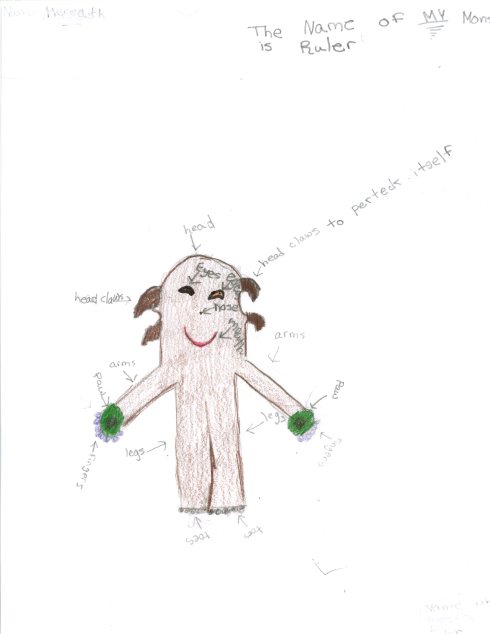
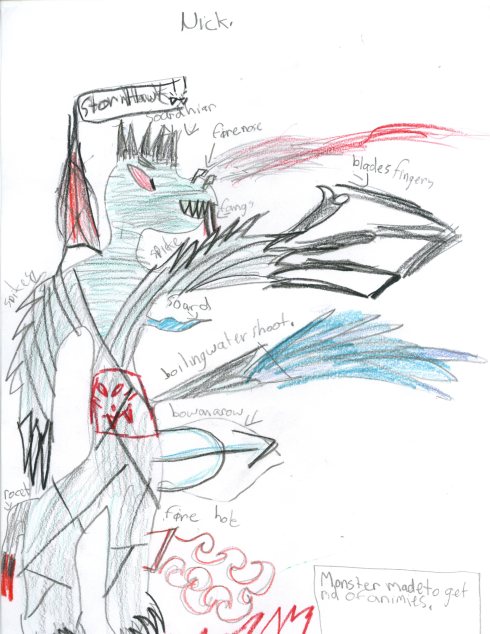
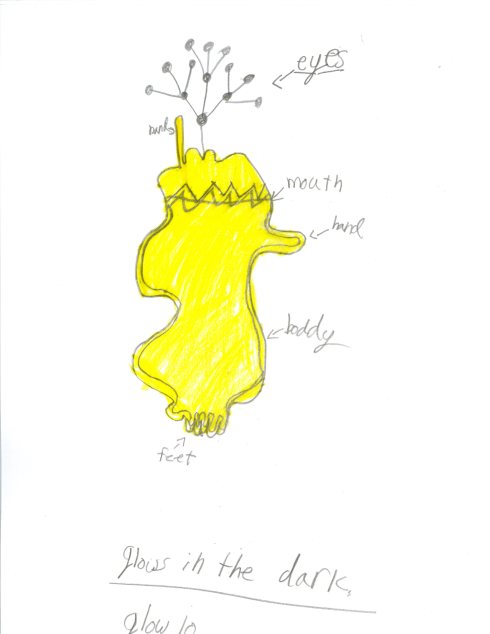
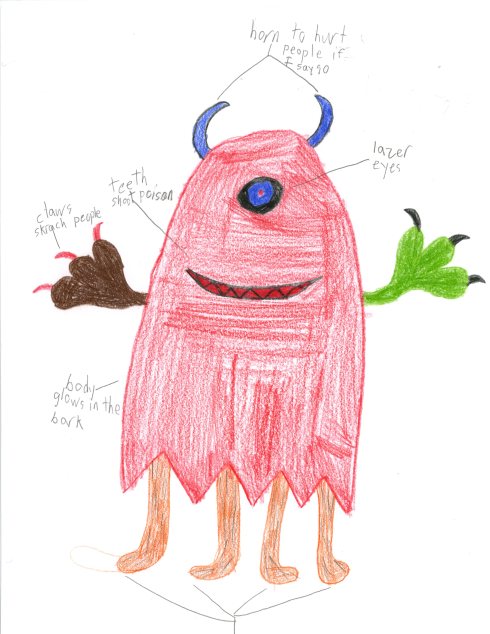
What kind of monsters do Mrs. Mozer’s 3rd graders have for us today? Well, they envision small, furry, cute monsters…except for Nick. I wouldn’t want to mess with Nick’s creature–he’s fierce!
So what do you prefer: a monster you can cuddle, or one who will protect you from evil-doers? I’d like a little of both!
Thanks again to these creative kids for sharing their Monstore merchandise with us. This is the last installment of Monster Monday…until I visit YOUR CLASS NEXT!
Does your class wanna Skype with me? I’ll visit any classroom via Skype in June. All you have to do is ask! I’ll give an advance reading of THE MONSTORE, lead you in a creative writing exercise, and of course, ask you what monster you’d like to buy at the Monstore!
Ethan:
Jenna:
Matthew:

Meredith:
Nick:
Sophie:
 “Oh, reading…what they did before fun was invented,” says Candace Flynn (on Disney’s Phineas & Ferb). Candace’s grandmother persuades her to read Sherlock Holmes but Candace scoffs. But the next morning, Grandma finds Candace bleary-eyed and hunched over the book. Candace hasn’t stayed up reading it–she’s stayed up reading the ENTIRE COLLECTION! “Before fun was invented, indeed,” snarks Grandma.
Plenty of kids know that reading is fun. And blogging, too! Like Erik the Great. (Great name, huh?) This nine-year-old bibliophile began a book blog to share his favorite titles with other kids. Erik the-story-loving-3rd-grader piqued my interest, so I invited him to talk about children’s lit and blogging.
Why did you want to start a blog?
I wanted to because I LOVE books. I read all the time (I even get into trouble in school sometimes for reading so much). My grandmother told me about a time when she was in a book store shopping for a book for me. She said she didn’t know what to buy for me and a kid in the store recommended that she get “The Strange Case of Origami Yoda” by Tom Angleberger for me. He told her he was sure I would like it (and I did). So I thought that if she would take book advice from a kid, maybe other people would too. At first I wanted to write reviews for newspapers but my Dad suggested a website. I thought a blog was a good idea because I could talk to people all over the world about books and then people could also tell me what they think about the books I write about and suggest books for me to read.
How did you get started?
When I had the idea to make a blog, my Mom and I went on the computer to find the best place to make a blog and we liked WordPress. I looked at other book review blogs and websites to kind of get an idea of what I’d like my blog to look like. Then I just started writing. I started writing about some of my favorite books and then readers started suggesting books and then I started watching for new releases. My school let me pass out flyers about my site and I left flyers at books stores and libraries and that helped me get more readers. Then I started to read other book blogs (like yours) and commenting on the posts they have and the other bloggers started to visit my site. I really like to see what other people are reading and what they think about it.
What did you hope to accomplish with the blog?
I wanted to not just review books, but I also wanted to talk with other kids and adults about books. I just wanted to find people who love reading as much as I do. Then I started asking authors and illustrators if I could interview them about writing books and making pictures for books. It’s really interesting to talk to the people actually creating books.
Do you know what you want to do when you grow up? Do you want to be involved with books, or something totally different?
I really want to be an inventor when I grow up. I already have some ideas for inventions like a refrigerator that you don’t ever need to open the door so that you save energy (and it’s voice commanded, too). I think being an inventor, I will have to read (and write) a lot. My Mom is a scientist and she writes a lot of books and articles and is reading all the time. Right now I am actually writing my first book called “The Adventures of Tomato and Pea”. It’s about aliens getting stranded on Earth and trying to get back to their home planet (planet -Oarg).
Sounds like a fun story, Erik! Thanks for talking to me about blogging. And thanks for blogging about books!
You can find Erik at www.thiskidreviewsbooks.com, most recently reviewing MOON OVER MANIFEST by Clare Vanderpool, to which he gives 4 out of 5 bookworms.
And check out the monster Erik wishes he could buy at The Monstore!
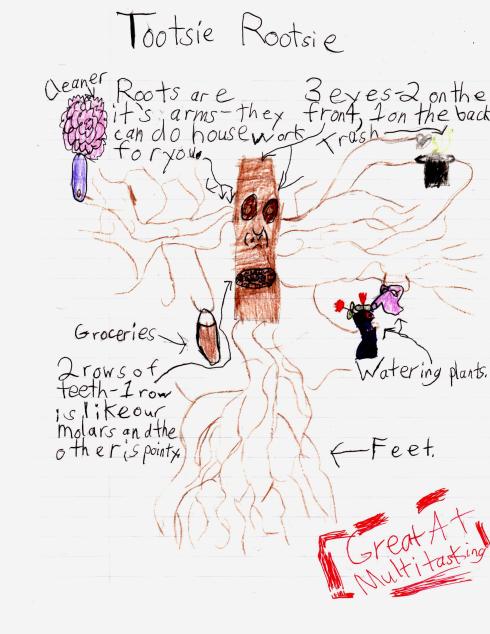
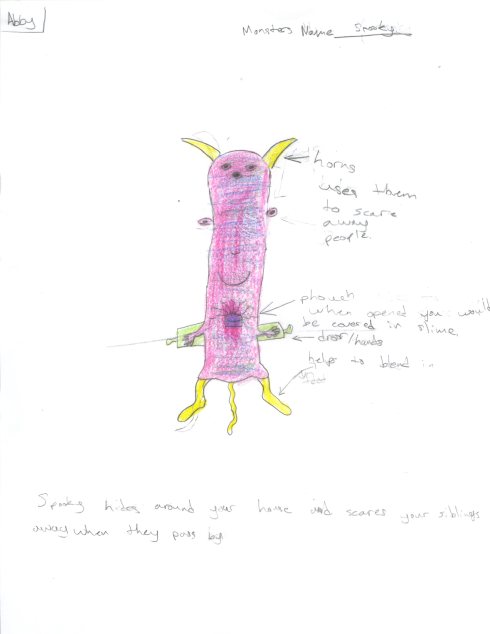
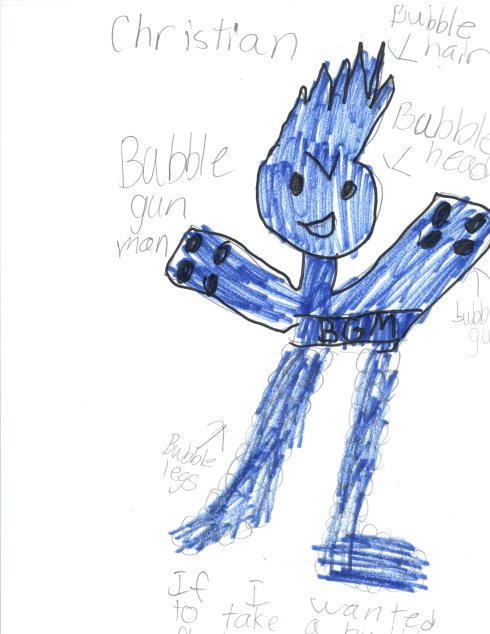
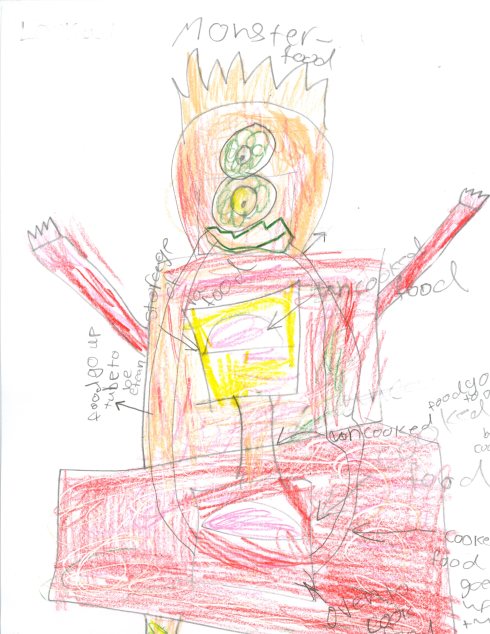
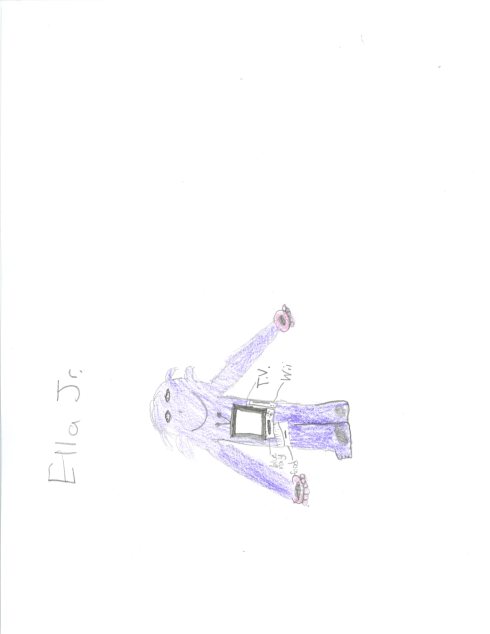
Well I was so excited about my Quentin Blake find that I forgot to post the awesome monsters from Mrs. Mozer’s third grade class! I asked them to imagine a monster they could buy at the Monstore–what would it look like? What special talents would it have? Their answers just prove that kids have more creativity than adults! I mean, who else but a kid would invent a bubble gum man? Chew on that! (Or gee, is that a bubble GUN man? Either way, these monsters are cool! Excuse me while I go play Wii with Ella Jr.)
Abby:
Christian:
Denise:
Ella:
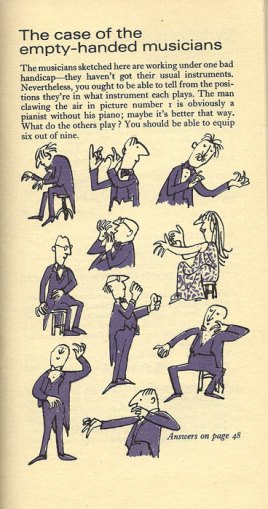
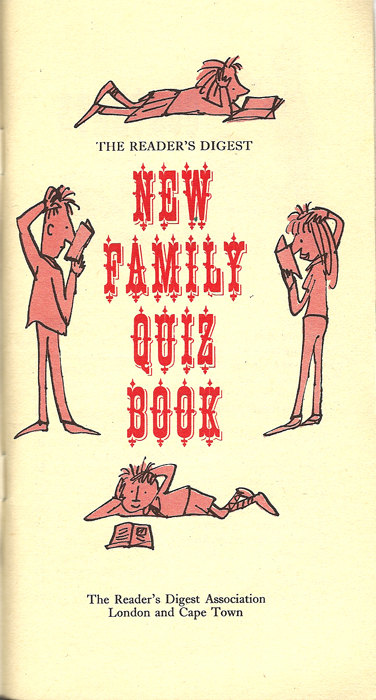 I recently discovered a little gem of a book, a 1967 Reader’s Digest “New Family Quiz Book” with illustrations by Quentin Blake (mysteriously uncredited, but undoubtedly his).
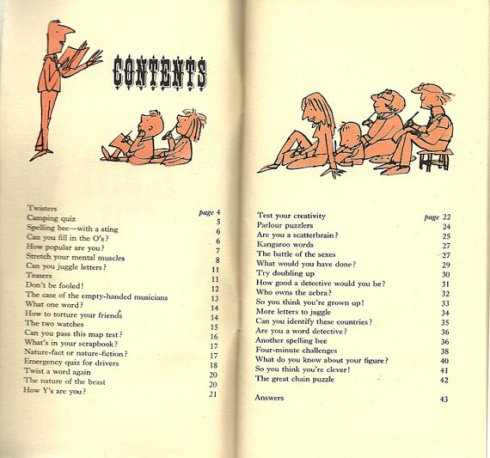
The book is full of brain teasers and word puzzles, but there’s also a section that tests your creativity.
Jot down your answers to the following questions–your choice of responses shows your creativity. I’ll be back in a few days with the answers!
Object: Which responses do you feel apply to you?
1. Would you rather be considered:
a. practical ?
b. ingenious ?
2. Does following a schedule:
a. appeal to you ?
b. cramp you ?
3. Do you often get behind in your work?
a. Yes
b. No
4. Do hunches come to you just before you go to sleep?
a. Yes
b. No
5. Do you often fret about daily chores?
a. Yes
b. No
6. Do you like to introduce the speaker at a meeting?
a. Yes
b. No
7. Do you sometimes feel anxious about the success of your efforts?
a. Yes
b. No
8. Do you like work in which you must influence others?
a. Yes
b. No
9. Are you fundamentally contented?
a. Yes
b. No
10. Do you spend many evenings with friends?
a. Yes
b. No
11. Do you frequently day-dream?
a. Yes
b. No
12. Do you remember the names of people you meet?
a. Yes
b. No
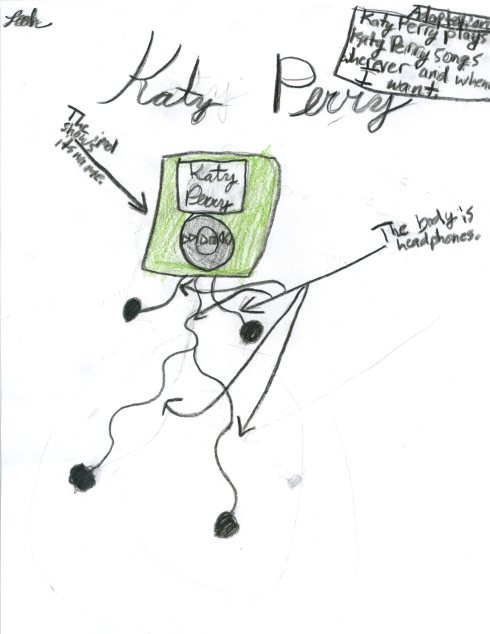
This week, I’ll have to borrow the Katy Perry monster from Leah. How did she know that I love “Firework”?
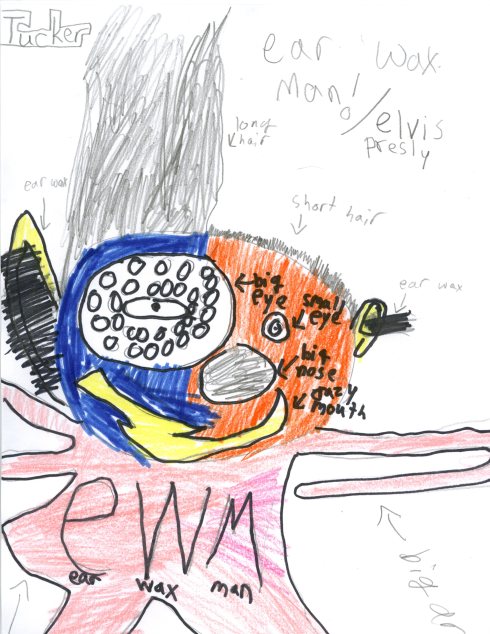
I’m a little worried about Ear Wax Man getting loose, though. And I’m curious why his nickname is Elvis Presley…???
Another huge thanks to Mrs. Mozer’s third grade class for the creative monsters! I wish they were all available at The Monstore. I’d most certainly go broke snatching them up.
Alex:

Leah:
Pierson:
Tucker: