You are currently browsing the monthly archive for March 2022.
I’m pleased to welcome Katie Mazeika to the blog today––she’s a long-time Storystormer and now she’s here to reveal the cover of her debut as an author-illustrator: ANNETTE FEELS FREE: The True Story of Annette Kellerman, World-Class Swimmer, Fashion Pioneer, and Real-life Mermaid. Take it away, Katie!
Thank you, Tara, for hosting the cover reveal of ANNETTE FEELS FREE: THE TRUE STORY OF ANNETTE KELLERMAN, WORLD-CLASS SWIMMER, FASHION PIONEER, AND REAL-LIFE MERMAID (September 13, 2022, from S&S/Beach Lane Books).
I first came across Annette Kellerman’s story in the summer of 2017. At the time, I was looking at interesting women from history for a series of illustrations––her resolute determination captured my attention, as did the swim records she broke, her grace and showmanship in and out of the water, and her steadfast belief in women being able to compete fairly against men. I did my piece on Annette and moved on to the next image. Well, that was the plan anyway. But Annette’s story stuck with me and begged for a longer exploration.
When Annette was very young, she was diagnosed with a childhood disability and had to wear leg braces. When I was a toddler, I lost my right eye to cancer. I understood all too well how having a disability (especially at such a young age) can change the trajectory of one’s life. Yet it wasn’t just that connection that drew me to her. The more I researched, the more there was to love about Annette! She was a champion swimmer who set world records when she was a teen (some of which remain unbroken today), fashion pioneer, fierce feminist, spunky heroine, and one of America’s first movie stars. What’s not to love? I admire her tenacity and refusal to conform to the expectations of her time. Brave women are often underestimated.
I was lucky; although her swimming career started more than one hundred years ago, I found dozens of photos, newspaper articles, and even videos of Annette swimming and performing. I even found stills from a film where she appeared nude, (she was the first movie star to do so, although that didn’t make it into the book!). ANNETTE FEELS FREE is about determination, disability, girl power, and the birth of a sport!
I am thrilled to share with readers this story that I fell in love with and have so enjoyed researching! Thank you again, Tara, for helping me share Annette.

Blog readers, Katie will be giving away a copy of ANNETTE FEELS FREE when it is released.
Dive in with a comment to enter.
A winner will be randomly selected in September.
Good luck!
 Katie Mazeika is an Ohio girl, born and raised! She grew up in Cincinnati, went to The Columbus College of Art and Design, and now lives in the Cleveland area with her husband, two kids, and two dogs.
Katie quickly fell in love with children’s books and can’t imagine a better job than making books for young readers. ANNETTE FEELS FREE is her author/illustrator debut. She has a second picture book biography about Beulah Henry (a.k.a. “Lady Edison”) coming out with S&S/Beach Lane Books in 2023. Katie illustrated books for the Chicken Soup for the Soul BABIES series: EVERYONE SHARES (EXCEPT CAT) by Jamie Michalak (Charlesbridge 2022) and EVERYONE SAYS PLEASE (EXCEPT CAT) by Jamie Michalak (Charlesbridge 2022), and is at work illustrating a third book in the series.
When she’s not drawing, Katie likes to spend her time gardening or reading other people’s books. You can find her at katiemazeika.com, on Twitter @kdmaz, or on Instagram @kdmazart.
Ahh, spring! Can I go outside now?
Well, I live in New Jersey where spring weather is a bit iffy—75 and sunny one day, a blizzard the next. Best to keep my nose buried in the books a while longer.
Thankfully, a gorgeous book just arrived! Meet APPLE AND MAGNOLIA by Laura Gehl, illustrated by Patricia Metola.

What a sweet cover! And it earned THREE starred reviews! Thankfully, Laura Gehl agreed to an interview!
Laura, you know this blog is all about story ideas…so how did this idea germinate?
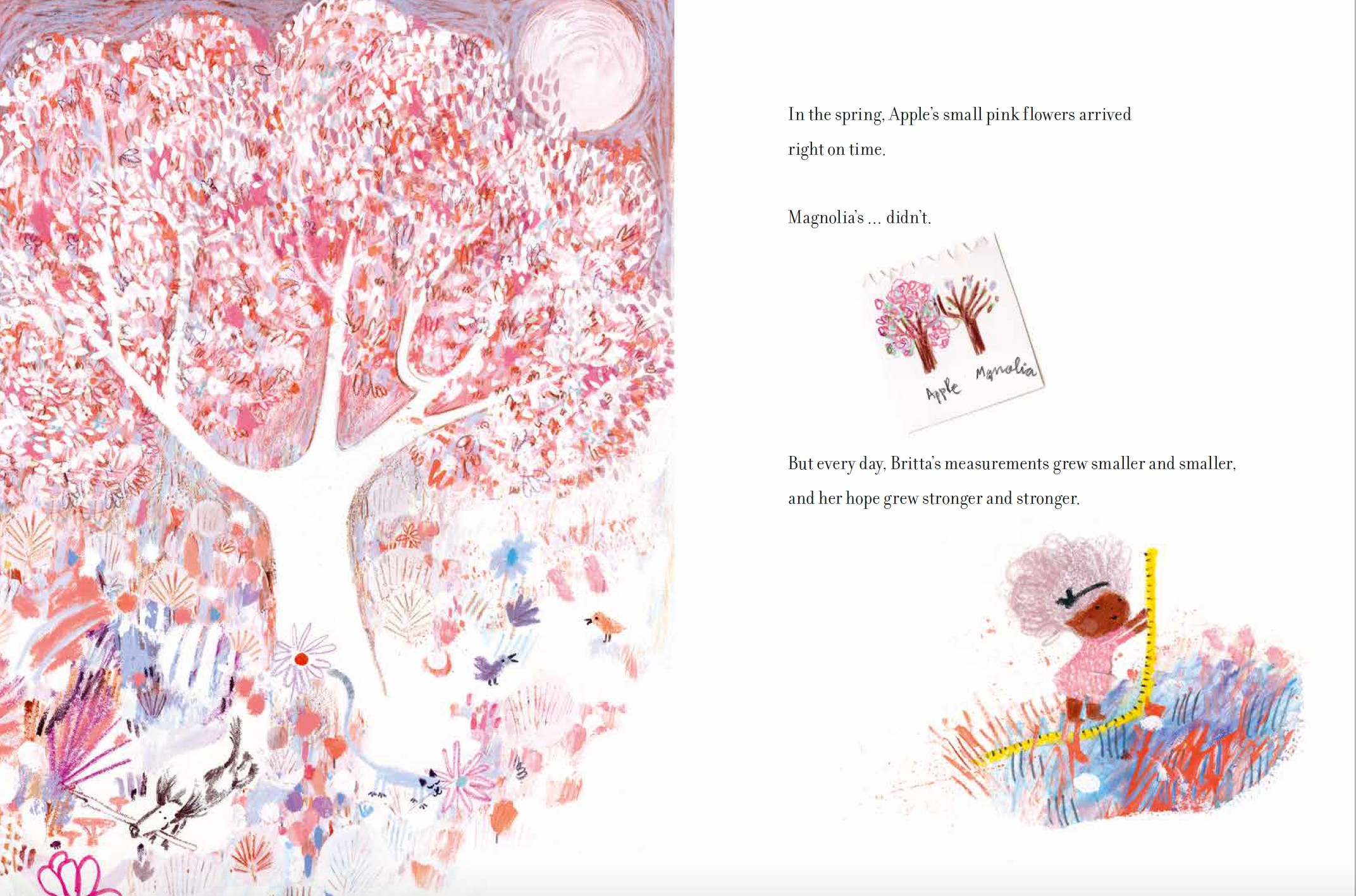
The seed for this idea came from research I read several years ago about how trees communicate with one another. That research is more widely known now, but at the time it was completely new to me. The fact that trees can send one another nutrients, and can warn one another of danger, struck me as something extraordinary and amazing. APPLE AND MAGNOLIA grew out of my desire to write about this real, special relationship between trees.
But this story isn’t just about trees, is it? Tell us how Nana’s character came into play.
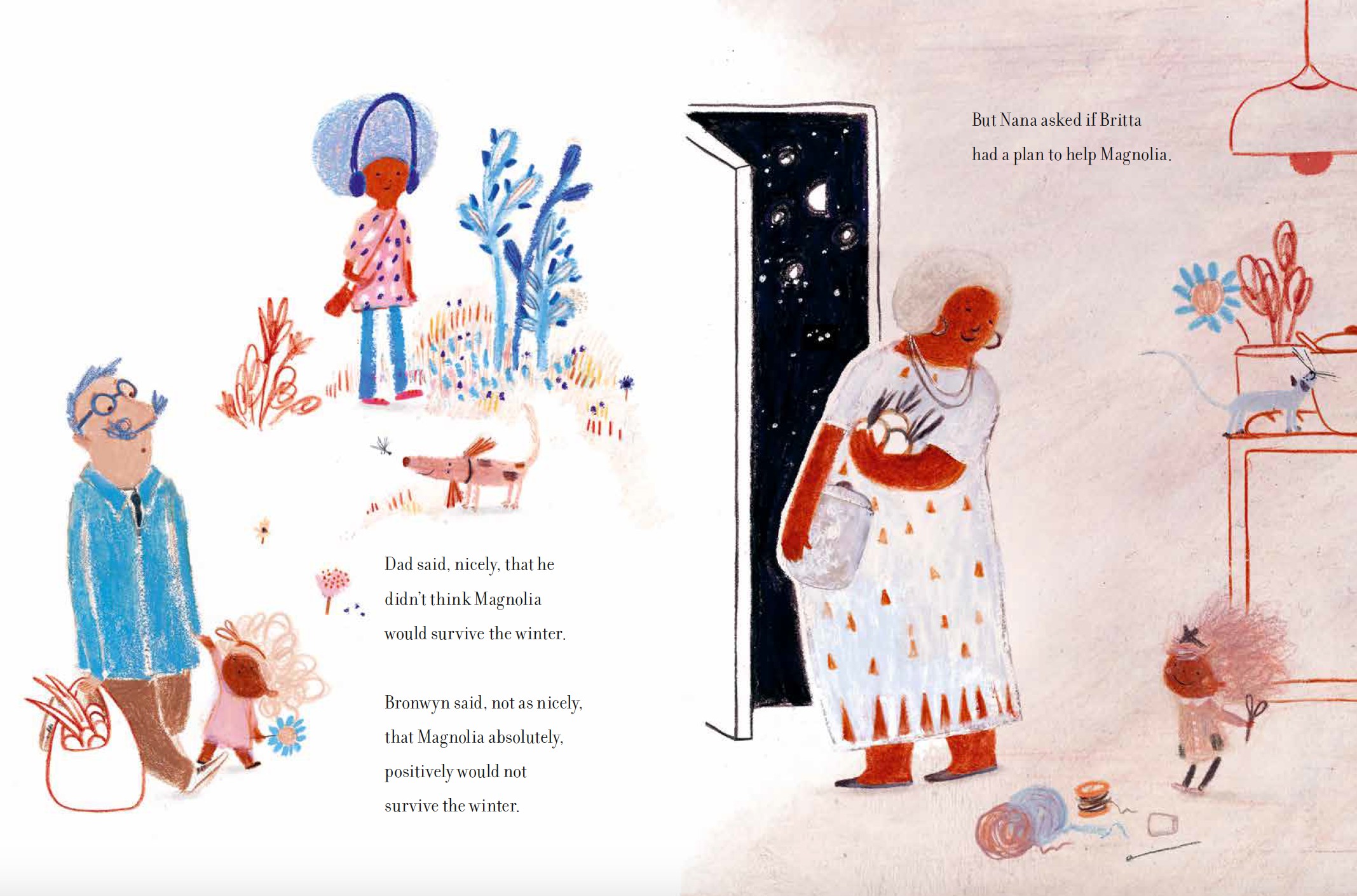
You’re right, the story isn’t just about trees. The story is also about Britta’s unwavering belief in the face of doubters. Britta is convinced Apple can help when Magnolia falls ill, and she doesn’t let Dad and her older sister Bronwyn dissuade her. But I wanted Britta to have a supporter in addition to the doubters…because I hope all kids can find a supportive adult in their lives, whether a relative or a teacher or a coach. That’s where Nana comes in.
How did the story grow from early drafts to the final?
Britta’s attempts to help the two trees feel closer to one another (the scarf, the string telephone, the lights) changed over time…I remember my critique partners helping brainstorm ideas for that! As I got closer to the final draft, I added in tree language, like “Britta felt a seed of hope start to grow” and “Britta’s hope blossomed too.” Also, my initial title was TWO TREES, which of course grew into APPLE AND MAGNOLIA.
Why did you choose those two trees, an apple and a magnolia?
Choosing two trees was hard. I wanted trees with beautiful spring blossoms, I wanted one to be a fruit tree, and I wanted trees with names that sounded somewhat like human names (sorry, Brazil nut tree!). I liked that apple trees and magnolia trees can both have pink flowers but that the two types of blossoms don’t look similar in shape or size. Also, I have a magnolia tree in my yard, which I love!
What do you hope readers will take away after reading APPLE AND MAGNOLIA?
I hope kids take away from this book that trees are connected to one another, that we are connected to trees, and really that all living things in our world are connected. I also hope young readers leave this story with the realization that when they face doubters in their lives…even bigger, older doubters…they don’t have to listen. When kids disagree with adults, sometimes kids are the ones who know what they’re talking about!
Amen to that! Kids can be so much more intuitive than adults.
Laura, thank you for sharing this beautiful book with us. I understand there’s also a discussion guide and activity resource at flyawaybooks.com/book/apple-and-magnolia.
And blog readers, you can win a signed copy of APPLE AND MAGNOLIA! Just leave one comment below.
A random winner will be selected next month.
Good luck!
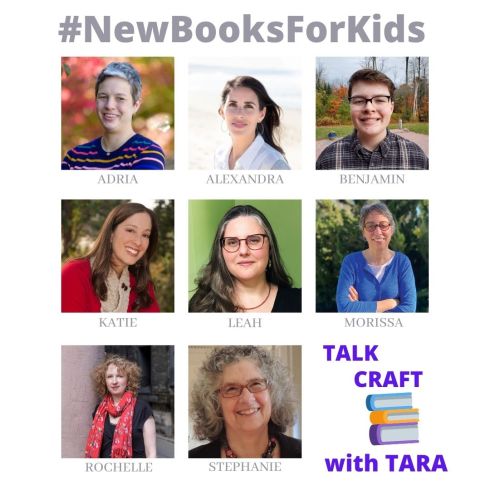
Thanks, Tara, for inviting New Books for Kids back to your blog. We were here last year at the start of our debut journey together talking about what else?—debut groups!
For this visit, Tara asked us to consider how we approach the craft of writing. From inspiration to polished manuscript, what is our process? You wondered, “Do we start with a theme when we write? A character? A structure? How do we revise?” Here are some answers from New Books for Kids.
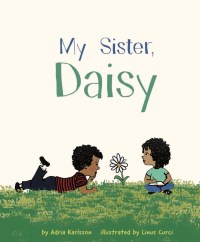
 Adria Karlsson (MY SISTER DAISY, illustrated by Linus Curci):
Almost always my books start out as ideas jotted down in a notebook, on a sticky note, or in my phone. I love novel information and when I hear something that makes me go, “Wait. What?!” – that’s usually a good indication I’m going to have to investigate further. Sometimes the ideas come from within my own thoughts when I’m tackling a problem of my own, helping a kiddo get through a tough moment, or celebrating someone’s accomplishment. It’s a long way from there to a proper story and sometimes I never do figure out how to move it out of “concept” and into “story.” Despite that, I like my collection of dysfunctional ideas and come back to them often to see if any of them have germinated. The evolution into a story often occurs when I figure out the theme that will carry the concept.
About Adria: Once upon a time, Adria Karlsson could have been found teaching people, training cats and dogs, or tutoring dyslexic kids, but now they spend their time writing and parenting. They set off on a new adventure every day to discover fresh alchemies of words and ideas that will build a good story. Visit her online at adriakarlsson.com or on Twitter: @adriakarlsson.
 Alex Katona (DINNER ON DOMINGOS, illustrated by Claudia Navarro):
When I have an idea, I just start writing. I don’t think too much about an arc, but I try to have a theme in mind. My first draft is MESSY—I try not to be too critical and just get my ideas down. After the initial thoughts are on paper, I leave it for a few days to figure out where to go next. When I come back to it, I break it apart and dissect it. I think about character development and pacing and page turns, but I continue to think about the theme. I even write the word or phrase on a post-it note and stick it near my laptop so I’m constantly reminded of it.

About Alex: Alex has been writing stories since she was young. When she’s not writing, you can find her surfing, exploring the outdoors, or reading. She lives with her husband, son, and dogs in Southern California and believes in the connective power of food. Dinner on Domingos is based on her own childhood. You can visit her at alexandrakatona.com or on Twitter @Alex_KatonaC.
 Benjamin Giroux (I AM ODD I AM NEW, illustrated by Roz MacLean):
Our youngest member finds inspiration for writing from his everyday life. He wrote the poem that became his debut book I AM ODD I AM NEW as a school assignment in which he expressed his experience living as a person with autism in a neurotypical world. The book series he’s currently working on also channels his everyday moments and was inspired by Monty, his pet snake. What in your own life inspires you?

About Benjamin: Benjamin, whose book was given the prestigious Kirkus Reviews Star, has been featured on many websites, in the Huffington Post, and on the Today Show and Good Morning America. He was named Poet Laureate of Plattsburgh, New York, and has also been the face of the National Autism Association’s antibullying campaign. His poem has been translated into several languages. He is now an award-winning songwriter. Visit him at benjamingiroux.com.
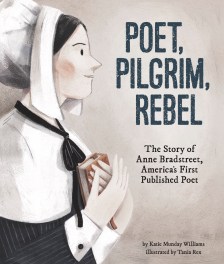
 Katie Williams (POET, PILGRIM, REBEL: The Story of Anne Bradstreet, America’s First Poet, illustrated by Tania Rex):
While the ‘craft’ of writing involves many different phases and elements, I think my favorite one is the brainstorming phase. To me, this is one of the most important parts since it determines the subject of your story. Setting, POV, main character, those all come later, but first you need your subject. There are so many ways to brainstorm ideas and none of them are wrong. Some people enjoy perusing the news looking for interesting people or events. Others might sit and meditate, seeing what comes to them naturally. For me, I love to look around and attempt to see the world with new eyes. How would my children see that clump of trees? As a hideout? A scary forest? A home to an animal? With nonfiction, it can mean looking at a historical figure with a fresh take on it. Sure, that person grew up to be famous, but what were they like as a child? What were their dreams/hopes/fears? When you look at the world in a fresh, new way, you’ll literally find story ideas everywhere!
About Katie: Katie is a Public Health Nurse, Lactation Consultant, and Author. She has always been an avid reader and was once so engrossed in reading Black Beauty that she missed her school bus home. She lives in Santa Cruz, CA with her husband and two children, where they enjoy digging for sand crabs and attempting to bring the entire beach home with them in their pants. Visit her online at katiemundaywilliams.com or on Twitter: @KatieWills79.
 Leah Rose Kessler (RAT FAIR, illustrated by Cleonique Hilsaca):
What happens when you’ve tried everything, and your story still doesn’t feel right? As counterintuitive as it sounds, my craft tip for you is to let it go. Sometimes the best thing you can do for your manuscript is set it aside. Even if it’s the story of your heart, the one you’re certain you’re destined to publish, stop working on it. Drop it like a handful of lava. Put it out of your mind.
Create a folder labeled “To Come Back To Later” and plop it in. Then walk away. Have a piece of toast. Repaint your bathroom. Learn how to ski. After enough time has passed (I’m talking months, not days), one of two things is likely to happen. Either you’ll find that you’re immersed in another manuscript and don’t feel the need to visit that folder, or you’ll go back and take a peek and realize your brain has been working on it in the background all along; all the mentor texts you’ve read, the movies you’ve watched, the life you’ve lived, will have added up into a big swirl of insight and inspiration while you weren’t even looking. You’ll be able to take your story forward in a direction you never would have been capable of if you’d kept on picking and poking at it all those months ago.

About Leah: Leah spent much of her childhood up a tree with a stack of books. These days, when she’s not reading or writing, she’s an on-again, off-again elementary school teacher and a lifelong biologist. She lives in Michigan with two humans and two cats and has a soft spot for scurrying creatures of all shapes and sizes. Her work has appeared in Cricket Media’s Babybug and Spider magazines. Leah is represented by Natascha Morris at The Tobias Literary Agency. Visit her online at leahrosekessler.com or on Twitter: @leahrosekessler.
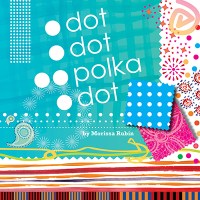
 Morissa Rubin (DOT, DOT, POLKA DOT, forthcoming from POW! Kids Books):
As an author/illustrator my creative process is messy, intertwined, and not at all linear. Sometimes I start with words and other times it is an image or visual idea that gets me started. I am very interested in the interplay of word and image, and I usually work in one realm for a bit and then switch to the other to see if I can let both sides develop together. I want to make sure that both sides of the equation (words and art) speak to me equally, each offering a different window into the work that is emerging. As a graphic designer and long-time publication designer, I think a lot about how a concept is reflected in its visual structure. How is the sequencing, pacing, and “chunking out” of the work reflected in both the words and phrasing, and how can it also be expressed with color, texture, pattern, and composition. But at some point, I do separate passes, focusing on just the words and language one time and then doing a visual edit at another time. I keep inching along, back and forth, back and forth.
About Morissa: Morissa is a graphic designer who thinks polka dots, paisleys and plaid are better together. She received her BFA from RISD and her MS from MIT’s Visible Language Workshop. Morissa lives in Sacramento where she teaches typography and other design courses at UC Davis and Sac State. Visit her website at morissarubindesign.com/books or on Twitter: @MorissaRubin and Instagram: @morissa.s.childrensbooks.
 Rochelle Melander (MIGHTIER THAN THE SWORD: Rebels, Reformers, and Revolutionaries Who Changed the World through Writing, illustrated by Melina Ontiveros):
The idea for MIGHTIER THAN THE SWORD came from teaching writing to young people. I wanted to create a resource that would tell the stories of people who wrote to share big ideas, fight for equal rights, and heal the environment. When I researched and wrote each chapter, I started with the question: How did they use writing to change themselves and the world? These hooks guided my writing—and I used them to tell the story. When I revised, I read my words aloud, listening for juicy words and interesting twists and turns that would hook the readers. This process works well for writing and revising picture books, too. I start with the theme or question, using that to research, brainstorm, or write the story. When I revise, I listen with the imagination of a child. How will this story unfold for them? What words will appeal to them? Where will they get hooked? And where will they get lost? That helps me to find my way forward.

About Rochelle: Rochelle wrote her first book at seven and has published 11 books for adults. Mightier Than the Sword won the 2021 Cybils Award for Middle Grade nonfiction. She’s an ADHD coach, an artist educator, and the founder of Dream Keepers, a writing workshop for young people. She blogs at writenowcoach.com and rochellemelander.com. Find her on Twitter and Instagram: @writenowcoach.
 Stephanie Wildman (BRAVE IN THE WATER, illustrated by Jenni Feidler-Aguilar and translated into Spanish as VALIENTE EN EL AGUA by Cecilia Populus-Eudave):
Like several of my colleagues, I also find inspiration in the day to day. My forthcoming picture book Treasure Hunt combines two activities I do with my grandchildren. But how does one go from inspiration to polish? My most important craft tip (as a non-illustrator) is putting the manuscript (after rewrites and those ever so valuable critiques) into a picture book dummy format. That allows me to focus on page turns – will the reader want to turn to the next page? What can be pictured with this text? Are too many pages taking place in the same scene? I can better answer these questions once the manuscript is formatted like a book. And of course, read it out loud.
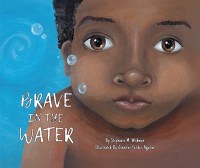
About Stephanie: Stephanie became a Professor Emerita after serving as the John A. and Elizabeth H. Sutro Chair at Santa Clara Law. In that role she authored books, law review articles, and journalistic pieces. She is a grandmother, mother, spouse, friend, good listener, and she can sit “criss-cross apple sauce” thanks to her yoga practice. Lawley Publishing will release her second children’s book Treasure Hunt (illustrated by Estefania Razo) in November 2022. Find her at stephaniewildman.com or on Twitter: @SWildmanSF.

Thank you for sharing your craft tips, authors!
Blog readers, do you have a craft or process tip that works especially well for you? Please share in the comments!
Finally, here they are. The Grand Prize Winners of Storystorm!
These stormers registered, completed the challenge, and were randomly selected with the help of Urania Smith of Kidlit Nation.
Each winner has been paired with a kidlit literary agent to receive feedback on their best 5 story ideas, helping them decide which ideas to pursue as manuscripts. I also added one additional prize of an idea consult with yours truly.
If you didn’t win a Grand Prize, please hold on tight. Winners of the individual daily prizes will be announced soon!
Steve Jankousky → Ammi-Joan Paquette of Erin Murphy Literary Agency
Elizabeth W Saba → Tara Gonzalez of Erin Murphy Literary Agency
Jess Burbank → Sean McCarthy of Sean McCarthy Literary Agency
Alison Ferguson → Kelly Sonnack of Andrea Brown Literary Agency
Cristina Ergunay → Charlotte Wenger of Prospect Agency
Midge Smith → Lisa Fleissig & Ginger Harris-Dontzin of Liza Royce Agency
Jen Anyong → Maeve MacLysaght of Copps Literary Services
Zoraida Rivera → Susan Hawk of Upstart Crow Literary
Candace Spizzirri → Tara Lazar of This Here Blog

These winners should start polishing their ideas and fleshing them out into concise pitches. I’ll be emailing you shortly with details!
Congratulations to all!
This is a sketch drawn by my friend Paula Cohen during a virtual critique group meeting.
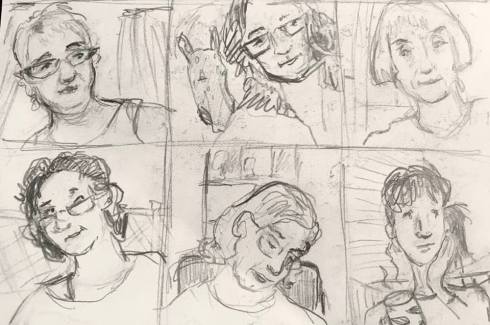
Paula’s top left and then there’s (clockwise) Karen Rostoker-Gruber (with an animal mask on the wall behind her), Margery Cuyler, me (with tea), Laurie Wallmark, and Rachelle Burk. It was a lovely meeting full of laughter and sharp writing feedback, plus it was the highlight of everyone’s month since we’ve not been together during the pandemic. In the “before times” we would gather for breakfast at Panera and inevitably stay for lunch, too! But since March 2020, it’s been Zoom-a-zoom-a-zoom-a-zoom.
We were all eagerly anticipating Paula’s debut picture book as author-illustrator (originally titled SHIRLEY’S STORE, then SHIRLEY’S BIG IDEA) because we had been together through the many revisions she made, through agent queries, through publisher submissions, and finally through the offer with Levine Querido. We all rode that rollercoaster with Paula (screaming, laughing, crying and holding tight with sweaty palms).
Finally, TODAY IS THE DAY! Happy book birthday, Shirley and BIG DREAMS, SMALL FISH!

Let me tell you about Shirley 1.0! Shirley is really Paula’s mom, “working” at the family grocery store in Albany, NY. I remember we joked with Paula about how the first Shirley looked a little too matronly to be a young kid.
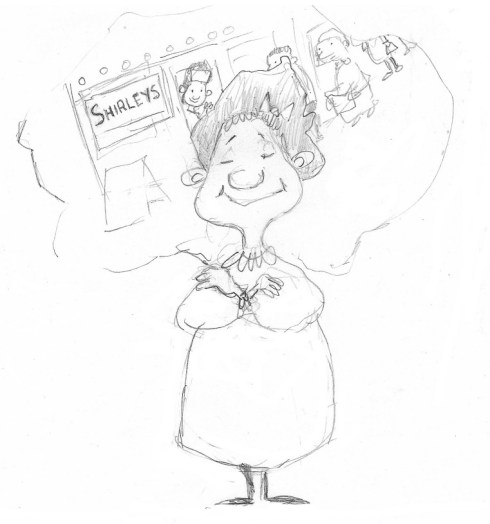
One of Paula’s original Shirley sketches.
And Uncle Morris appeared a little too senior for his wife to be having a baby in the story.
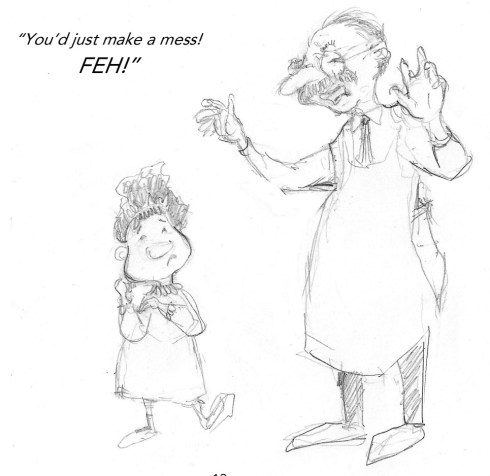
Oh, how we laughed with Paula! She took the criticism well, with humor. Of course, Shirley and Uncle Morris went through some transitions…they both got more hair…
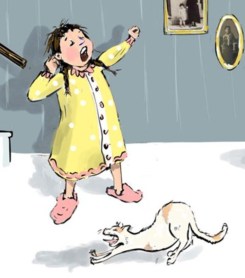
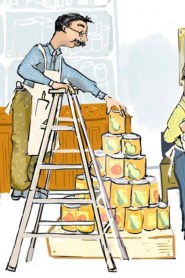
I remember Paula being particularly proud of this spread in BIG DREAMS, SMALL FISH—where the neighborhood customers are trying Shirley’s store delicacy from the comfort of their homes.

The original page didn’t show the true depth of Shirley’s effect on the neighborhood (but we loved it all the same).

The change was her art director’s suggestion, and it was brilliant. The new scene shows the diverse immigrant community. There’s the glow of the lights from within the apartments and plenty of smiles. It radiates warmth—just like Paula’s original sketch, but on a neighborhood scale.
And just like the real Shirley, who embodied warmth and shared the importance of family in her community, too. BIG DREAMS, SMALL FISH is Paula’s homage to her mother.
And this blog post is my homage to Paula. She passed away suddenly on Thursday.
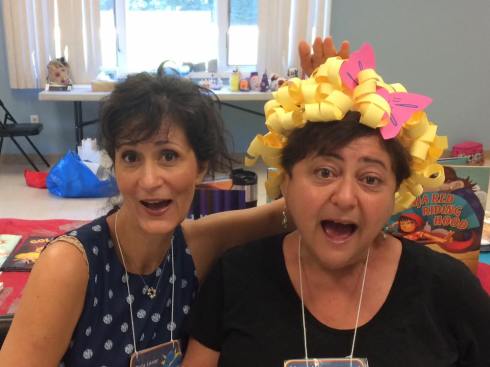
Visiting Paula’s summer camp on “Fractured Fairy Tale Day”. She made that Goldilocks wig!
I’m in a state of shock and disbelief. Paula was one of those vibrant, upbeat, joyous people you loved to be around because she made you feel good. She gave great big hugs in a tiny 4’10” frame. Her art was always a delight. In fact, I met Paula at a NJ-SCBWI conference because of her art. She had displayed a playful image of a polar bear and a girl swimming underwater. I sought her out to compliment her.
Here’s a sketch of that polar bear and girl, who became characters in a friendship story that she hoped to sell soon.
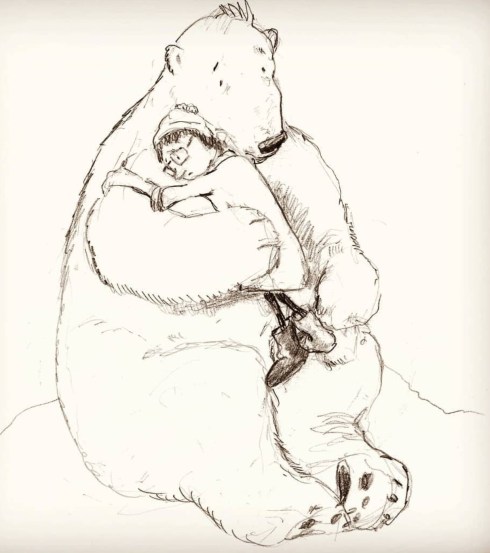
And Paula’s polar bear even got to be a star with the Coney Island Polar Bear Club!

Well, this was supposed to be a post about BIG DREAMS, SMALL FISH but it’s about Paula instead. You can see the joy she brought to others through her art, and my own dream is that Paula’s work will have a ripple effect, touching everyone who comes across it. It was her dream to be an author, and she did it. Mazel Tov, Paula!
So please, check out Paula’s book. Share it, request it at your library, do what you can to spread the warmth.
Thank you!

Paula and her beloved pooch, Joxter the Schnauzer.





 Writing for Kids (While Raising Them)