You are currently browsing the monthly archive for March 2015.
If you read my recent #ReFoReMo reverie, you know that I go out on a lot of dates. No, I’m not trying to relive my college days. I’m taking myself out on these dates…TO THE BOOKSTORE. There I get to sip a half-caff vanilla chai latte with a twist and pore over the newest picture books. Of course, I love the ones with a twist. Twist is the word-o-the-day, boys and girls!
So here are three books that I just had to buy. And, I’ll tell you why. PLUS, I’ll even chat with one of the creators and give away his book. Because it’s just that “special.”
In no particular order…
MY GRANDMA’S A NINJA
by Todd Tarpley and Danny Chatzikonstantinou

Why I love it:
It’s absurd—imagine an elderly lady in pearls and readers with a stealthy, drop-from-the-ceiling approach. Her grandson Ethan is dubbed the cool kid for his zip-lining ninja nana, but her antics begin to wear on him and his friends. However, Grandma has a plan! (Plus there’s a twist!) Humor and heart abound in this tale, which is always a kickin’ combination.
.
HOME
by Carson Ellis

Why I love it:
The illustrations evoke the warmth and security of home. The reader travels around the world—real and imaginary—to view the variety of abodes that people, animals, even a Norse god, call their own. Then the author/illustrator circles back to her own home, her studio, the very place she created this charming book. She closes by asking the reader, “Where is your home?” What a heartfelt discussion HOME will elicit. It makes you want to hug the book tight. I can’t think of a better snuggle-up-at-home read right now.
.
SPECIAL DELIVERY
by Philip C. Stead and Matthew Cordell

Why I love it:
Oh, the adventure! Oh, the absurdity! Sadie wants to deliver an elephant to her favorite aunt who “lives almost completely alone and could really use the company.” Sadie enlists many methods to get her treasure to Great-Aunt Josephine…by plane, by train, even by alligator. Two surprises come at the end—we finally learn the meaning of “almost” and we also know Sadie is a girl who stays true to her word.

The illustrations by Matthew Cordell are a perfect accompaniment to this quirky tale, like mashed potatoes with gravy. One just makes the other even better. So I asked him about his process for SPECIAL DELIVERY. (Sadly, no mashed potatoes were involved.)
Special Delivery has a very loose, sketchy style. How did you arrive upon that design for the story?
My style in general has always been rather loose and sketchy. Early on I was a bit more timid about it, but as years have passed, I think it’s gotten looser and sketchier, and I’m happy about that. In my conversations with Phil about this, I think he tailored the story a bit to my art style and approach, and I really took it to the brink (or at least as close as I’ve yet come) with my loosey-goosey attack of pen to paper based on his story. The book is very fast-paced and madcap, which goes hand in hand with a very fast-paced and madcap line.

The cover is a clever play on the famous “Inverted Jenny” postage stamp. How did you come up with that idea?
 This was really interesting… Usually the creation of a book cover is a long, drawn out, sometimes-grueling process. So many people at the publisher and beyond have to be satisfied with the book cover before it’s given approval. And it usually comes late in the process of making the book (at least it does for me). But I had just finished sharing the first sketch dummy with Phil and Neal Porter (our terrific editor) and the moment I hung up the phone, the cover image zapped into my head. One of the most–if not THE most–famous US postage stamps, the “Inverted Jenny” was the perfect solution to our cover. Not only does Special Delivery feature a wild ride in an old biplane, but it features stamps and other fun things postal. Heck, it’s called SPECIAL DELIVERY! A tip of our hats to this famous stamp was the answer. Roughly and quickly, I sketched up my re-imagining of the Inverted Jenny and emailed it to the guys I’d only just spoken to. And they loved it as much as I did. Thankfully, when we ran it up and up the flagpole at Macmillan, we got thumbs up all the way.
What was your favorite part of the entire project?
I love so much about this book. Its wild, free, and fun spirit. The story. The art and design of it. It is so fast and spontaneous and fearless in many ways. But the thing I love the most about SPECIAL DELIVERY–and I’m about to get sticky sweet here, but so be it–is the bond that formed between Neal and Phil and me during the making of it. There was this synergy happening as the book came together in its various stages, and our heads were always in the same electric place. I enjoyed getting to know them both better in the process and sharing in this thing together and being completely on the same page throughout. There was some weird, good magic at work here.
I’ll say! The story feels absolutely timeless, as if it’s been around a long time and will be a favorite for years to come.
And why don’t you see for yourself, blog readers? I’m giving away a copy of SPECIAL DELIVERY to one random commenter. Please comment only once. I’ll randomly select a winner in two weeks and deliver it right to you! Good luck!

It’s come to my attention that we need a collective noun for children’s book writers and authors.
I am therefore inviting your input.
If you’d like to suggest one for writers and a different one for authors, please feel free. (Can’t forget illustrators!) Leave as many collective nouns as you’d like. Of course, you get points for cleverness. I’ll pull them together in a future post so we can vote on them. And then, perhaps, when we see a gathering of these wonderful folks, we’ll know what to call them.

For those of you who didn’t grow up on 80’s music, this is A Flock of Seagulls.
First, let’s announce some winners!
The winner of the LITTLE RED GLIDING HOOD F&G is:
NATALIE LYNN TANNER!
The winner of Dev Petty’s I DON’T WANT TO BE A FROG is:
JHAYSLETT!
Congratulations! Be on the lookout for an email from me.
…So this week I did a boatload of Skype visits for World Read Aloud Day. Almost TWO DOZEN! Phew. My own kids are fed up with THE MONSTORE, as evidenced by my elder daughter’s video—mouthing the words and rolling her eyes while I read in another room. (She thought she’d get away with it, but I found it on her iPad! Oooooh! BUSTED!)
One of the most frequently asked questions during these Skypes was: “Out of all your books, which is your favorite?”
Now I know some authors claim—like parents of multiple children—to love them all equally, to not to have a favorite. But I do. And I’m not ashamed about it!
It’s whatever I just finished writing. My newest manuscript.
Once I complete a new story that my agent approves, I just go NUTSO with excitement. I dream of who may acquire it, which rock star illustrator will be tapped to illustrate it…plus I imagine Merry Makers creating the must-have accompanying plush toy. (Or maybe even a stuffed me!)

Yeah, I told you I go NUTSO.
There’s something about a fresh story. It’s a feeling I wish I could recreate as I BEGIN a new story, but often with a new manuscript, there’s a lotta chewing of fingernails (which is why I haven’t been able to put on my new Jamberry nails).

How can you recreate that newly-subbed, fresh-and-juicy, shinier-than-Turtlewax feel?
The best way out is always through. Write something new and get-r-done. If writing were easy, then everyone would have a published book. There should be joyous celebrating once something is finished and submission-ready. If you’re feeling just ho-hum, that manuscript is not pumped up full of YOU.

Photo credit: Scott Beale
That’s another thing I want to talk about today, finding YOU as a writer.
Years ago, when I was writing flash fiction for adults, I stumbled across a marvelous piece in an anthology. It was about two young women with a strained relationship going back to their parents’ house to pack it up. Their mother was fading away, doing strange things, leaving herself bizarre notes to capture pieces of her memory. The sisters found one of these notes in the bookshelf, held each other sobbing, and then laughed at the absurdity of it all. The story was so lyrically written, and so poignant. Why couldn’t I have written that?
So I tried writing something based upon that style—that lovely, lilting, poetic style. Like a sunset watercolor over the rippling bay. And you know what? It stunk. Worse than the bay.
Even though it was stilted and forced, that story taught me a little about who I was as a writer…by showing me who I WAS NOT. It was one step in finding my true voice.
I always say no piece of writing is wasted time. It’s all practice. Even the junk is worth something!
So, tell me, out of all that you’ve written, what is your favorite?
Please leave a comment (with a link, if appropriate).
May you share a boatload.
Oh, rejection!
We all face it. Even published authors. Even Jane Yolen!
This is how I consider rejections now, after seven years in the business:

But when you’re still unpublished, rejections somehow hurt more.
Besides applying a baking-powder-and-vinegar salve three times daily, how do you ease the sting?
Welcome author Emma Walton Hamilton. She will teach you what those rejections really mean and how you can use them to your advantage.
 by
by Manuscripts are like children–we birth them, nurture them, pour our heart and soul into helping them be the best they can be. Then we send them into the world, praying they have what it takes to succeed. If we’re lucky, and we’ve done our job right (we hope), they’ll fly. But inevitably, we–and they–must muddle through setbacks and tests of resolve before they can claim their place in the world.
One of those setbacks is rejection. Manuscript rejections are an unavoidable part of the writing life…but that doesn’t mean they aren’t painful. It also doesn’t mean they can’t be converted into learning opportunities. This is such an important distinction that Julie Hedlund and I devote an entire module to “Interpreting Rejections and Dealing with Feedback” in our new Complete Picture Book Submissions System, which we created to support picture book authors through every step of the submissions process, since we know firsthand how challenging that process can be. (Check out Julie’s recent blog post exposing one of her earliest query letters.)
Converting the experience of rejection from personally devastating to professionally useful begins with bearing a few important things in mind:
- Manuscripts get rejected, not writers themselves. Meaning, this is not about you–it’s about the manuscript not being a right fit with that agent or publisher.
- It’s business–not personal. The reasons for the rejection may in fact have less to do with the quality of your writing and more to do with the focus of the agent or publisher at this time, or the limitations of their current resources.
- Hundreds of famous children’s authors received rejection letters on what later became their most successful manuscripts, including Dr. Seuss, J.K Rowling, Madeline L’Engle, Stephanie Meyer, Meg Cabot, C.S. Lewis and many, many more. (Check out Literary Rejections if you don’t believe me, or could use a little company for that misery.)
- The wrong fit at one place can be the right fit somewhere else. Moreover, that somewhere else will serve you and your manuscript better than the first place would have, because they “got it.”
- There may be a gift accompanying the rejection at best, insight into how to improve your manuscript or query, and maximize your chances of nailing the next submission; and at least, the opportunity to strengthen your commitment and resolve. (An old acting teacher of mine used to say, “Never mind the talent, do you have the tenacity?” This is just as relevant for writers.)
Maybe the rejection includes some feedback worth considering (although it’s important to distinguish between meaningful feedback and form letter feedback, which is something else we focus on in the Complete Picture Book Submissions System… it’s easy to confuse the two.) But even without feedback, every rejection is an opportunity to revisit your query and/or your manuscript. Is it really submission-ready? Is it structurally sound, formatted correctly, typo-free? Is every word essential?
Finally, it’s important to take care of yourself during this time. Sending your creative work into the world can make you highly vulnerable, and it’s easy to lose perspective. Do whatever you do to nurture and reinvigorate yourself: take walks, meditate, see a movie, go shopping, get a massage. Seek the company and communion of fellow writers for support, learning and perspective. Most of all, keep writing–generate new material to keep building your portfolio, stay in the flow, and avoid having all your eggs in one basket. That is, after all, the real work of being a writer.

Emma Walton Hamilton is a best-selling children’s book author, editor and writing coach. With her mother, actress/author Julie Andrews, Emma has co-authored over thirty children’s books, seven of which have been on the NY Times Bestseller list, including The Very Fairy Princess series (#1 Bestseller), Julie Andrews Collection of Poems, Songs and Lullabies, the Dumpy the Dump Truck series, Simeon’s Gift, The Great American Mousical, and Thanks to You–Wisdom from Mother and Child. Emma’s own book, RAISING BOOKWORMS: Getting Kids Reading for Pleasure and Empowerment, premiered as a #1 best-seller on Amazon in the literacy category and won a Parent’s Choice Gold Medal.
My books were too quiet.
Or that’s what I kept being told. Never mind that Margaret Wise Brown and Clement Hurd’s lullaby in prose GOODNIGHT MOON, a book about a bunny who stays in bed throughout the entire book, is and continues to be one of the most consistently best-selling books in history…according to publishers, quiet didn’t sell. My agent submitted my books to publisher after publisher and we heard the same words over and over. It’s too quiet. There needs to be more action. I always got great compliments on my art, but as much as they seemed to like the way I drew, nobody was hiring me to illustrate their books.

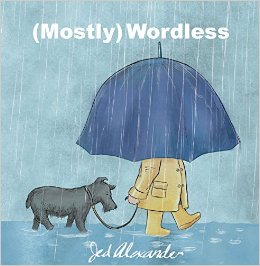
So I decided to make a book on my own terms. I would make a book that was everything that publishers said they didn’t want from me. Too quiet? My book was going to have hardly any words at all. Instead of one long narrative, it would be a series of short pieces and vignettes, most of which had no perceivable plot. Even the format was unconventional: rather than typical children’s book dimensions it was a square. Instead of the usual 32 pages, it was 52. It was everything publishers didn’t want but it was the book I wanted to make. And the only way it would see print was if I self-published it.
 To raise the money, I decided to use crowdfunding. I spent nearly a year researching everything I could about successful crowdfunding campaigns. I discovered that Kickstarter would be my best option. Though I had no experience in business or marketing, I came up with a marketing plan and budget. Though I had never made a video before, I shot my video on my iPhone and learned how to use the editing software on my Mac.
My goal was $7,000 dollars. Some of my friends told me this was too ambitious. That I was asking for too much. That I should set my sights lower. But this was how much I determined I would need to make the book that I wanted to make, and if I couldn’t make the book I wanted to make, I didn’t see any point in doing it at all. And if I failed, the only thing I stood to lose was the time I invested.
Once the campaign began, I got to work. I used every spare moment I had to promote my book. I spread the word on social media. I arranged an interview on a local radio station. I e-mailed everyone I knew.
My campaign succeeded beyond my expectations. Authors and illustrators I admired posted links to my project on their Facebook pages. My project became a staff pick on Kickstarter and one of their “projects of the day,” which meant that my video was featured on their home page. They even used my project as an example on their phone app. I raised over $10,000, well in excess of my $7,000 goal, and was able to use the extra money to enhance my book with extras like spot lamination and color endpapers.
While a few of my supporters were friends and family, most of them were people I didn’t know who had come to believe in my project. One of them was a small press publisher who offered to sub-distribute the book once I met my goal. The publisher would put their name on it, and with the legitimacy that a veteran publisher afforded, I could get the book into libraries and bookstores and I could get it reviewed.
I made some mistakes along the way but I’ve had the opportunity to learn from them. The book has opened many doors for me. It’s gotten a number of positive reviews. I’ve held signings and done lectures and taught classes. I’ve met a lot of wonderful people I wouldn’t have otherwise met.
But most important of all, my book is being read. And if you self-publish using crowdfunding you may not be the next J.K. Rowling, but I guarantee you will have readers. Because crowdfunding not only provides you the funds you need to publish, but it builds enthusiasm for your book and an audience that you wouldn’t have otherwise had. That book that everyone rejected, that no one was willing to publish will finally have readers.
And above all else, isn’t that the reason we do this? Because we love books so much we want to make them and share them and have others enjoy them? Because otherwise you’re in the wrong business.
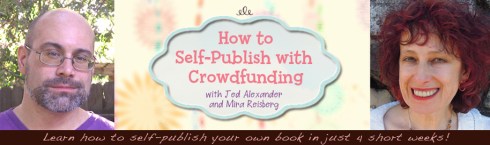
Jed Alexander is the author/illustrator of (MOSTLY) WORDLESS, which he originally self-published with crowdfunding finances and which was then picked up by a small traditional publisher. He is represented by Abigail Samoun of Red Fox Literary. Find out more about Jed at JedAlexander.com.
Jed will also be co-teaching an extraordinary course on How to Self- or Indie- Publish with Crowdfunding starting March 23rd with Mira Reisberg. The course covers print, e-books, crowdfunding, marketing, social media, and much more.





 Writing for Kids (While Raising Them)