Have you ever considered writing a picture book biography?
I’ll be honest. I never did.
My perception of bio writing was that it was snooze-worthy, the stuff read by droning teachers in echoing classrooms. Don’t ask me where I got that impression, although it might have to do with Doc Shapiro’s U.S. History class circa 1986.
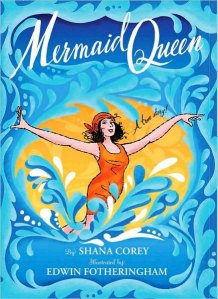 Then, at the recommendation of Kelly Fineman, I read Mermaid Queen: The Spectacular True Story of Annette Kellerman, Who Swam Her Way to Fame, Fortune & Swimsuit History!
Wowza. Have you seen this book? The splashy, colorful illustrations grabbed me, but it’s the story that kept me turning the pages. And it’s not about some über-famous woman, either. I had never even heard of Annette Kellerman until I read this book.
Kellerman invented water ballet, introduced the idea of the female athlete to the masses, and became the first woman to attempt swimming across the English Channel. She designed the modern swimsuit, freeing women from their heavy woolen garb.
Shana Corey’s mermaid tale proves that picture book biographies can be imaginative and fun, and they don’t have to be about a president to make a splash. (Yeah, I used that pun twice. Sorry. It’s day 15. Stick with me here.)
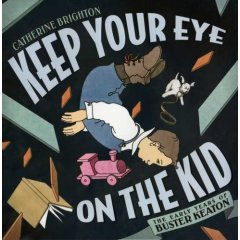 Catherine Brighton’s Keep Your Eye on the Kid focuses on the early years of Buster Keaton.
Did you know Harry Houdini gave Buster his name after watching baby Keaton tumble down the stairs? (“Gee, that was some buster the kid took!”) His parents had a touring act and would throw him across the stage every night. These unusual details, told in Buster’s voice, toss you into the story. The sentences are crisp and tight, and Brighton doesn’t dwell on the demanding reality of Buster’s touring lifestyle. She keeps it fun and lighthearted, with illustrations that mimic an old comic book. And the cover? You’ll fall head over heels for it. [Insert corny laugh track.]
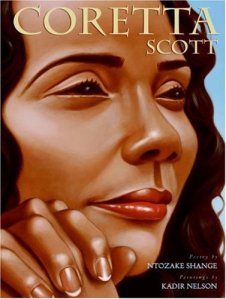 Coretta Scott by is a lyrical biography by Ntozake Shange, illustrated with bold paintings by Kadir Nelson.
It doesn’t begin “I was born on April 27, 1927” and thank goodness for that. Instead the first page reads, “some southern mornings/the moon/sits like an orange/sliver by the treetops.” There’s a simple, glorious painting of the glowing sliver above a silhouette of trees, the sky wide open. Yet the next page introduces the reality of segregation. Coretta and her siblings “walked all/of five miles to/the nearest colored school/in the darkness/with the dew dampening/their feet.” The rest of the story sings, as Coretta meets Martin Luther King, Jr., marries, and helps lead the Civil Rights Movement.
These three books represent the best of picture book biographies, telling a story with style rather than bogging it down in facts. This is not your history teacher’s non-fiction. No siree.
Today for PiBoIdMo, do research. Read picture book biographies. Which ones sing to you?
Is there a figure in history who fascinates you? What has been written about that person? Are there picture book biographies or texts for older children? How can you tell that person’s story in 32 pages, in a way that’s suitable for young children? Which details would you keep? Which would you toss? Would you tell the story in verse or prose?
So, how’s it going today?

 Ryan Hipp



 Remember when I promised PiBoIdMo’ers that if you ended the month with 30 ideas, there would be a special prize? But I just hadn’t figured it out yet?
 What do a macramé owl, Celia Chompers, and a town called Fate have in common? Nothing, really, except that they’re all written in my little green notebook.
 Every writer should have a notebook. Not one of those fancy, leather-bound ones. You know, the kind that’s so nice, you hate to mess it up by writing in it? No, I recommend the little spiral ones that usually sell for 39¢. And, they’re easy to find in your purse, because the end of the spiral wire is always sticking out, just waiting to jab you. Perfect.
 Shhh…don’t tell Tara, but she’s become one of my biggest inspirations. More specifically, her alphabetical list of