You are currently browsing the category archive for the ‘Uncategorized’ category.
 People who aren’t directly involved in the publishing industry ask me where I get my ideas from all the time. I’m always tempted to respond with something like, “I steal them from first graders” or “I ask my Ouija board.” I think everyone reading this post knows that ideas come from absolutely everywhere and anything. From the mundane to the downright bizarre, everything is fair game. Consequently, writers are perpetual treasure hunters, the black crows of society.
Most writers I talk to can trace their treasure hunting days back to childhood. Once a seeker, always a seeker. When I was a kid, I had a secret drawer in my dresser where I hid my eclectic collection of treasures. It included things like my favorite Bonnie Bell Lip Smackers, sea glass, a cool cat’s eye marble, miniature Hello Kitty colored pencils, and a tiny box of Worry Dolls. There was no rhyme or reason to what I declared a treasure. They were just random objects that evoked feelings in me that really couldn’t be put into words. And for that reason, they were special.
If we’re really being honest with ourselves we know when our stories are rooted in something deeper than just a good idea. There’s an invisible connection to some intangible variable that we can’t always put our finger on. Love? Passion? Truth? Whatever it is, when it’s there, you know it. And for that reason, those stories are special.
While I believe that treasure hunting out in nature or out in the real world is infinitely more inspiring than virtual treasure hunting on the internet, physical expeditions aren’t always possible. So here’s what you do: Head over to Etsy, eBay, YouTube, Pinterest, Zappos—wherever your web weakness might be—and look for things you really love or really hate. You can pretty much find a story seed in anything that makes you ridiculously happy or sad. How do I know this treasure hunting exercise actually works? Meet French Bulldog Puppy Can’t Roll Over.
.
Holy cute, right?!
When I watched that video clip about two years ago, I wanted to reach into the computer screen and put that little hunk of sugar in my pocket. I was so punch drunk on puppy love I wrote a story about a French bulldog named Gaston. Just so we’re clear, GASTON isn’t a picture book about a dog that can’t roll over. Thirty-two pages featuring a beached dog may not be as endearing or as entertaining in print as it is on film. However, what YouTube puppy did do was inspire a new character and that character was very eager to tell me his story. The manuscript, which took several weeks to complete, sold to the first editor who read it. Christian Robinson is illustrating. The book will be published by Atheneum/Simon & Schuster next year.
So that’s my advice on Day 12, PiBo people. Go treasure hunting and find the shiny things that make you swoon, swear, sigh, or smile.
If you’re still stuck after that, go talk to a first grader.
 Kelly DiPucchio is the award-winning author of fourteen children’s books, including New York Times bestsellers, GRACE FOR PRESIDENT, and THE SANDWICH SWAP, a book co-authored for Her Majesty Queen Rania Al Abdullah of Jordan. Kelly’s books have appeared on The Oprah Show, Good Morning America, and The View. Kelly’s new picture book, CRAFTY CHLOE, illustrated by Heather Ross, (Atheneum) received a starred review in Kirkus and was featured on The Martha Stewart Show. Visit Kelly at www.kellydipucchio.com, or follow her on Twitter @kellydipucchio.
Hey, crafty writers! Kelly is generously donating a picture book critique to a lucky PiBoIdMo’er who completes the 30-ideas-in-30-days challenge. Leave a comment here…and if you also end the month with 30 ideas and take the PiBo-Pledge (posted for you to sign in early December), you’ll be entered to win. Good luck!
 “This person has no business being in children’s books.”
Read that again.
Imagine it being said in front of a crowd of over a hundred of your peers and various industry editors and art directors… at the NY SCBWI conference.
Your work is up in front of a big auditorium on a video screen with a panel with loud microphones when these words are spoken…
Imagine that person that it was said about was YOU.
DON”T WORRY! It wasn’t.
It was ME.
In 2009.
Yes. An art director declared me as a person who has NO BUSINESS being in children’s books … in front of the entire world of children’s books.
It felt worse than the worst college art critique I could have ever imagined. I was a grown woman. I had already had a hot career as a hot shot in cartoon merchandise. I shrunk in my seat. I wanted to run out of the room. My heart pounded.
I went home that night on the train back to Long Island… and cried. Crying on The Long Island Rail Road is like visiting Dante’s bonus level of hell. Those words echoing in my head…
The Art Director who said it—we shall call: “The A.D. WHO SHALL NOT BE NAMED”—but that name was burned into my mind. Branded onto my frontal lobe. I went home to google the crap out of this person. Bleary and blood-shot-eyed hours later…I knew everything they had ever worked on. I was sure some day… I’d encounter this A.D…

Now, I wasn’t automatically like Scarlet O’Hara shaking my fist in the air against the sunset vowing that “Tomorrow is another day!” No… I hit rock bottom. I questioned it all. Why? Why children’s books? Was I nuts to think I was good enough? Was I certifiably insane to think that I had the talent and ideas and stories to share with kids?
I went down, down, down into a pit of self doubt. I spent the good part of the next six months doing nothing. Hanging on to those words for a good long while…. but…
You just can’t keep a good pencil down… so eventually, I found myself, drawing myself out of that hole. I drew for myself. I made all kinds of silly art. Whatever I wanted to draw and paint, I made. I allowed myself to indulge in my imaginative whims. Whatever floated my boat, floated out of my pencil. This was new. The feeling of having nothing to lose, so why not? I was no longer thinking about what I thought the publishing industry wanted to see. I was drawing what I wanted to see for myself. I told myself stories as I drew. I wrote them down in messy notebooks.
Funny thing about this… I liked what I was drawing. So, I put it into my portfolio.
Then I had two important people enter my life. One a successful illustrator, who told me I WAS good. The other, my first agent. Who—obviously thought I was good enough to sign. That was the first time I thought of The A.D. Who Must Not be Named… and thought “…one day…you are gonna eat your words…!”
A year went by. I showed my portfolio a lot. The more I showed it—the better I got at reading the reviewer’s body language and interpreting the feedback. I listened at critiques but I chewed up the feedback and spit out what did not taste right.
I started to trust my own vision. The vision of what I wanted to do and who I wanted to be as an illustrator and maybe just maybe, a writer too.
I got my first books as an illustrator. One was a novelty book and some early readers. They were for small publishers and I found the work to be not what I wanted for myself. I wanted a picture book with a big publisher.
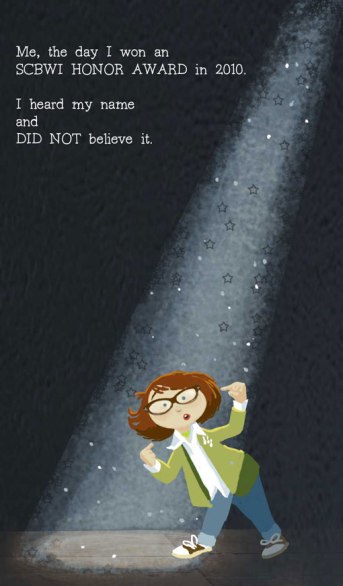
I went back to the 2011 SCBWI NY Winter Conference. I entered a piece in the art showcase and won an honor award. I got up on the same stage where “A.D. Gate “ went down and got hugs and recognition. Talk about a weird moment. I thought of that Art Director then… and those words. This time—those words felt like a dare.
“Oh yeah, A.D. Who Must Not be Named? I have no business in children’s books? You just watch me…” I was hoping that person would be there. I found out who was on the jury for the show. (The Art Director Who Must Not Be Named was not one of them.) I decided to find each one of the judges and meet them.
I did that for the next six months. I was like a bounty hunter. I crossed each one of the judges of a list as I met them. I made some amazing connections. I got my all of my work and myself in front of the eyes that already had a good feeling about what I do.
Some time went by. I did a lot of work on story ideas and characters. Still no bites from big publishers… so I did something way out of my comfort zone. I applied to give a character design workshop at the NE SCBWI Spring 2012 conference. While I was there… I got my first offer.
Donna Mark, Art Director at Bloomsbury wanted me to illustrate a middle grade chapter book called “The Quirks – Welcome to Normal”.
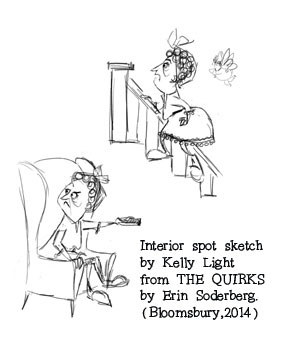
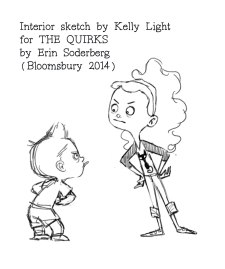
Take that Art Director Who Must Not Be Named.
Then I got a call from Alison Donalty, Art Director at Balzer and Bray, an imprint at Harper Collins. Another middle grade chapter book.
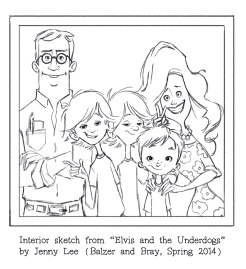
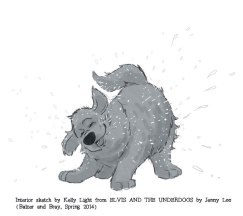
Those words from The A.D. Who Must Not Be Named were barely audible any longer. Now I HAD business in children’s books!
Next—an un-ending amount of calls about a character on a postcard that I mailed out… all from art directors and agents from all of the major publishing houses…
My first picture book as author/illustrator will be from Balzer and Bray as well , “Louise Loves Art”.

Those words in my head? Silenced.
“Who were you again? Oh, an art director? Oh yeah… that one who said something cruel…I think I remember your name… wait… I may have to google you…”
TWO more picture books with Harper Collins.
You, A.D. Who Must Not Be Named, have been (almost entirely) wiped from my memory.
You see, it’s kind of fabulous to have revenge—validation—someone to point to as a huge road block that I decided to drive through. I defied his label of me because only I can define myself. Don’t tell me I can’t—cause I will show you—not just that I can- but I will—and I will do it big.
Maybe… just maybe… I should be a tad grateful. That person forced me to grow. They could have been a hell of a lot more tactful in their choice of words in front of all of those people!!!! BUT—they don’t call these things “growing pains” for nothing….
I want everyone to take away from this, REJECTION is not a done deal. Critiques are not the end of the world. Public humiliation is tough—but if you know yourself—you can shed it. IF you hold on to who you are and what you do that is uniquely you and do it to the best of your ability. Do not stop! Keep getting better through the work. Follow your own heart—your own head—the beat of your own drum. Show those people in publishing—YOU are here.
These days, I am contacted, happily, by many art directors.
Last week, The A.D. Who Must Not Be Named contacted me. “Just wanted to drop a line to say that I love your work.”
One day—I will shake that hand and be gracious—cause that is what professionals do, but in my head… I will hear… BAZINGA!!!!
Kelly Light’s pencil is sharpened and she’s not afraid to use it.. She is currently working hard on her first three books. All due out Spring 2014: ,THE QUIRKS – WELCOME TO NORMAL, written by Erin Soderberg (Bloomsbury), ELVIS AND THE UNDERDOGS, written by Jenny Lee (Balzer and Bray), LOUISE LOVES ART, by Kelly Light (Balzer and Bray). Spring 2015 brings LOLA KNOWS A LOT, by Jenna McCarthy (Harper Collins).
Kelly lives in Long Island and currently has power!! She is, right now, drawing in her attic studio surrounded by old radios, books, cartoon collectibles and is usually singing very loudly. Head over to Kelly’s website and read her blog all the way back to 2009 and maybe you can figure out who The Art Director Who Must Not Be Named is! Sketch along with her on Twitter @kellylight.
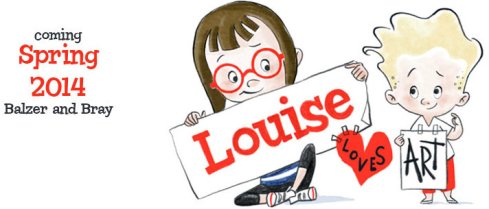
I love Kelly’s art, and Louise loves art period, and now you can love both Kelly *and* Louise because you can win a Louise sketch by Kelly! Just comment on this post to enter (one comment per person). A winner will be randomly selected one week from today. Good luck!
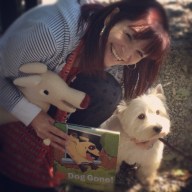 The countdown is on, PiBo peeps!
In a few days, the challenge of producing one idea per day for the month of November will be upon us. Bring it!
If, like me, you’ve been stuck in a rut lately, this is the best time to blast the cobwebs from your brain and set to task. So…
- Creative space clean and tidy: Check!
- Pencil sharp, sketchbook open: Check!
- Ready to draw: Ch … wait! Draw? Isn’t PiBoIdMo for writers?
No. That’s the beauty of PiBoIdMo. You can be an illustrator and still participate—heck, you don’t have to write at all—you can sketch your ideas.
A doodle can develop into a character sketch that turns into a scene, which might eventually become a concept for a book—it’s a great way to flesh out story ideas.
And doodles don’t always have to become an entire picture book either. Portfolio or promotional pieces can happen this way, too. So, it’s a three-fer—bonus!
As an illustrator who likes to write, but struggles with words, I go to what comes easiest first. Sketching. No thinking. No pressure. Just me, my pencil and a blank page. That’s why I am looking forward to PiBoIdMo.

However, even the best of intentions can go stale if the motivation well has dried up. Obviously that’s what PiBoIdMo’s for, too, but what if that’s not enough or you simply have blank-page syndrome, and you’re still stuck?
Get out! Go on, you heard me, grab your sketchbook and leave the house. Here’s some additional ways to kick start that motivation and prepare for PiBoIdMo:
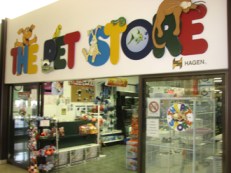 SHOPOHOLIC: Pouring over the classics in your favorite library or bookstore is an obvious choice, but ever thought to mosey through a shop you might not otherwise frequent—certainly not for inspiration, anyway? Pet stores are choc full of fascination, especially those exotic ones. Tarantula watching might trigger a Halloween tale, reptile research could spark an alphabet book or snake sketching might lead you to that perfect promo card. Other stores to consider include: antiques, costume, hobbyist, candy or maybe try a farmer’s or fish market.
SHOW UP: The Original Art Show at the Society of Illustrators in New York City is an amazing exhibit that showcases some of the best picture book art of the year under one roof. Not only can you get up close and personal with the real art but most of the selected picture books are on display too. You can see how the art was used, and check out the story at the same time. The OAS times perfectly with PiBoIdMo. If you can’t make it to Manhattan, visit the website and check out the featured artists here. This year’s show runs from October 24 to December 22, 2012.
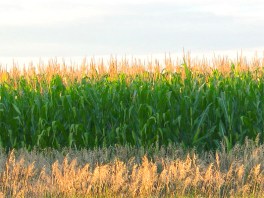 TAKE A HIKE: Whether you live near a beach, park, forest, farm, or town square, going for a walk is healthy for PiBo mind and body. If time is precious in your daily schedule, allow yourself 30 minutes once a week to walk off some PiBo stalemate, but remember to open your eyes. Look at your surroundings. Really look. Notice colors, human interaction or simply cloud watch. Don’t force it, just watch and let the mind capture moments. It might take a few tries to get all that chatter out of your head, but don’t forget your sketchbook and pencil for when it clears!
SEASON’S GREETINGS: Halloween hangovers, corn maze castaways, apple bobbing, pumpkin picking, and Thanksgiving get-togethers are all perfect fodder for inspiring new ideas. Put your observational powers to the test and see if you can put a new spin on time-old themes. Let the fall season motivate new ideas!
 Music is my main motivator indoors. I jump up and dance, and don’t care how ridiculous I might look. I do it to release energy, loosen limbs, and rev up the creative force within.
Heading outdoors motivates me in more internally charged ways. When I let go internally, the ideas flow effortlessly. All I have to do is catch them with sketches, doodles and scribbled notes. I’m stoked for this year’s PiBoIdMo, motivated and raring to go! What’s motivating you?
Leeza Hernandez lives in central New Jersey. Her debut-authored picture book DOG GONE! released in June with a companion book CAT NAPPED due for release in Spring 2014. She is currently illustrating John Lithgow’s latest picture book NEVER PLAY MUSIC RIGHT NEXT TO THE ZOO, due for release in Fall 2013. Leeza is also the newly-appointed Regional Advisor for New Jersey SCBWI. Follow her on Twitter @leezaworks.

Listen up!
Leeza has some SWAG for you!
There’s a DOG GONE! goody bag including a bookmark, postcard, signed book, signed poster, and an original signed lineart drawing from the book!
Plus there’s two paperback copies of EAT YOUR MATH HOMEWORK! One for you, one to give as a gift!
DOGGONE AWESOME!
Just leave a comment to enter. A winner will be randomly selected one week from today.
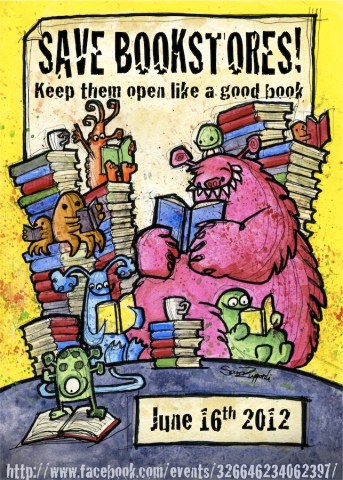 The brainchild of literary agent Kelly Sonnack, Save the Bookstores Day is a way to show our favorite brick & mortar stores that they still matter. That we support them. That we love them! That we CANNOT LIVE WITHOUT THEM!
I spoke with Kelly and three of her clients about this special day and how they plan to celebrate.
TL: Kelly, how did this holiday come to be?
KS: The Save the Bookstores event started one morning when, after reading about the obituaries of several indie bookstores in my publishing industry news, I got on Twitter and said that I was sick of hearing of these great stores closing and that there must be something I/we could do about it. I was met with immediate support when I suggested we pick a day and all go buy books together, across the nation, and the event was born from there.
Last year, we had a great response. The beauty of the event is that everyone can take the event and promote it as they see fit. Last year some book lovers took it upon themselves to print flyers and distribute them outside their favorite bookstore, in anticipation of the day. Others have blogged and emailed, Tweeted and Facebook’d. It’s been a unifying book lovers event so far and has reached to Asia and the UK (and probably more places I don’t even know about!)—it’s a simple way to support the books we love and the stores that sell them.
TL: What is your favorite childhood memory about books?
 KS: One of my favorite childhood memories about books is the small library at the church we went to when I was a kid. It was nestled under a creaky staircase and chock-full of fabulous picture books. We were allowed to check out a book each, each week. But the choosing was the hardest part! I probably read 10 books before I picked which one I could take home with me.
TL: What is your hope for this new holiday? What is your ultimate goal?
KS: My ultimate goal is to save bookstores! I want to stop seeing postings of bookstores that haven’t been able to get high enough revenue to keep their doors open. It would be tragic to lose our brick and mortar stores; I want to remind people that their patronage really does make a difference. That we can keep stores in business by supporting them.
TL: And finally, what books will you be buying? What books do you recommend?
KS: The event is actually on my due date, so there’s a chance I’ll be phoning in my order to my favorite local bookstore instead of being able to browse the shelves for surprises and discoveries (hands down the best part about brick and mortar stores). If I get to browse, I’ll likely be browsing the board book section to see if there’s something I haven’t gotten for Baby Girl. But (aside from Bridget and James’ fabulous books, and Sharon’s which can be preordered), I’m looking forward to getting my hands on a copy of Jennifer Bosworth’s STRUCK, Michelle Hodkin’s THE EVOLUTION OF MARA DYER, Tom Angleberger’s FAKE MUSTACHE and I want to get a copy of HOW TO BABYSIT A GRANDPA by Jean Reagan for my dad, who will soon be a new grandpa! As far as what I’d recommend to others, anyone who hasn’t gotten a copy of Anna Sheehan’s debut YA novel, A LONG, LONG SLEEP will be wisely spending their money on it. And Carolyn Marsden’s THE WHITE ZONE is a powerful read for anyone interested in the conflict in Afghanistan from a middle-grade perspective. For any new parents or friends of new parents, Heather Leigh’s HEY, LITTLE BABY is sure to become a family favorite. You can’t help but getting a little choked up by that one.
Thanks, Kelly! Three of your clients—Sharon, Bridget and James—want to weigh in, too. I asked them why bookstores are important to them. (Besides the obvious reason of selling their titles!)
Sharon Cameron
 My mother took me to the library like she took me to church—regularly, once a week, no excuses. The library was our haunt. But she could never understand why I would check out the same book over and over again, signing my name on the little card slipped into the slot attached to the back cover (remember when we did that?). My signature would be beneath my own signature, which was beneath my own again, and maybe four more times above that. My mother would look at the card containing mostly my name and say, “Okay. We’ll buy it.”
There was nothing more special. The library was a reading free-for-all, but going to the bookstore was all about picking out a treasure. I got to take my time, pick the book up, feel its weight, know if the cover was bumpy or slick, see the size of the type, hear how much noise a page made when it turned. And then that book was not just a borrowed thing to be returned, but mine, a friend for life. My copy of Johnny Tremain stayed with me for dozens of readings until its unfortunate death from a broken (overused!) spine. My paperback of Pride and Prejudice has worn to bend in any direction, fitting perfectly into my left hand.
That is why children—why all of us—need bookstores, and why I will be celebrating Save the Bookstores Day at Parnassus Books (Nashville, TN). An image on a sales screen is only an image. It cannot show us what is so easily experienced when we hold a book: the heft and feel of an author’s imagination.
Sharon Cameron is the author of THE DARK UNWINDING, coming September 2012 from Scholastic Press. Visit her website at SharonCameronBooks.com.
Bridget Heos
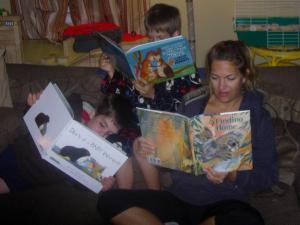 I have a quote hanging over my desk by Anton Ego from Ratatouille: “The world is often unkind to new talent, new creations, the new needs friends.”
Bookstores are some of the first friends a book has, and that’s one reason I’m excited for my first bookstore book, MUSTACHE BABY, to come out next Spring. The neat thing is that readers want to befriend the new, too, and bookstores help us to do that. Bookstore workers have gotten my sons through many “I’ll never read again” moments that happen when you finish a series you love. They introduced us to Origami Yoda, Max (Bob Graham), The Dinosaurs of Waterhouse Hawkins, and so many books that, in a way, are part of our family.
I’m going to the Reading Reptile and the Plaza Barnes & Noble here in Kansas City, not as an appearance, but just to buy books.
Bridget Heos is the author of the non-fiction picture book series WHAT TO EXPECT WHEN YOU’RE EXPECTING (LARVAE, JOEYS, and other animals). She also writes YA non-fiction. Follow all her insects and antics at AuthorBridgetHeos.com.
James Burks
 I think there’s something magical about walking into a bookstore and discovering a new book. A book that I’ve never seen or heard of before but I see the cover and it intrigues me. I pick it up, I look inside and I know that I have to own this book.
If I didn’t have a bookstore to go to I’d probably just be wondering the streets, lost, searching for that magical connection.
James Burks is the author of GABBY AND GATOR, BEEP AND BAH, and the upcoming BIRD AND SQUIRREL graphic novel. He is the illustrator of Tara Lazar’s THE MONSTORE, too! Check out this character and all his characters at JamesBurks.com.
If you want to help SAVE BOOKSTORES, please join the Facebook Group! Tell us where you’ll be shopping on June 16th and what you’ll be buying!
And please SPREAD THE WORD! Share the adorable poster on your social networks, blog about it, tell your teachers, organize a caravan to your local indie! Do your part to keep bookstores in business and bringing us great reads!
Thank you Kelly, Sharon, Bridget & James!

Last week I got the thrill every author looks forward to—a rough sketch of my book cover for THE MONSTORE. (Phew, I need an editor. I don’t mean every author looks forward to THE MONSTORE cover, but it sure would be a boon to my sales if they did!)
The cover was only in black and white, but WOWIE! To see my characters starting back at me with these eager “read me” expressions was as thrilling as holding my daughters for the first time. (Except then I was exhausted and thirsty. At least this time I was well-rested with a huge ceramic vat of chai.)
I immediately printed it out and my five-year-old and I colored it in. Then we slapped it on the basket of the scooter that I use to tool around the neighborhood. Yep, it’s now a MONSTOREMOBILE!
We then scooted over to the elementary school to…
View original post 122 more words
Do you own a Salina Yoon book? If you have young children, chances are you do. The prolific author-illustrator has more than 180 titles to her credit—mostly baby board books and novelties for the kinder set. As a new mother, I received many Salina Yoon titles as gifts, from a shiny, glittery shape book to the candles of MY FIRST MENORAH.
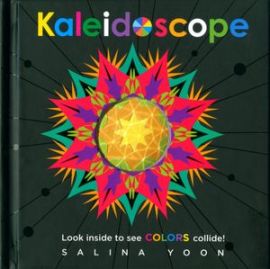 But her newest title, KALEIDOSCOPE, a lead novelty book by Little, Brown and Company, introduces Ms. Yoon to a whole new audience—adults. The colorful, swirling, twirling novelty book was created to appeal to both the young and the young at heart, and I can attest that it’s a huge hit at our home.
I talked with Salina about her newest book and the many challenges she encountered during the creation process. Ms. Yoon doesn’t grant many interviews, so I’m thrilled to host her!
Before we begin, though, take a look at the charming trailer, with original music by James Kremsner.
1
TL: Can you give us the definition of a novelty book…and how do they differ from board books?
SY: Novelty books are books with interactive components, like touch-and-feel elements, lift flaps, plush, glitter or foil accents, pop-ups, lenticulars, sound chips, special die-cuts, and more. Board books simply refer to a book’s binding, which is a book having stiff, board pages that are made to be durable for the very young. Since novelty books do include pop-up books, they can be for older children, while board books are primarily for babies to preschool.
TL: How did you get into designing novelty books?
SY: I’d never heard of “novelty books” until a field trip to Intervisual Books in my early college years. It was years later that I remembered this company and came back to ask if I could intern for them as a book designer. This was my first real exposure to novelties—and I fell head over heels in love! Even after I left the company (to relocate to be with my then-fiancé), I couldn’t get novelties out of my mind! Each novelty is like a puzzle with various pieces having to fit: the format with the concept, the concept with the text, the text with the art, the art with its readers, all in one! I couldn’t find a position in San Diego that would allow me to keep creating novelties except to create them at home and submit to publishers. My first 20+ books were acquired by Intervisual Books, my former employer. That led to Simon & Schuster, Penguin, Scholastic, Random House, and the rest is history.
TL: You are an extremely productive author-illustrator, with almost 200 titles. But you said this time KALEIDOSCOPE pushed you to your creative limits. How so?
SY: My previous titles were all for the babies to kinder market, a market I was very familiar with throughout my now 12-year career. You could almost say I could do these in my sleep. KALEIDOSCOPE was the biggest wake-up call ever. When my publisher acquired this title, the editor envisioned a different kind of book. She envisioned a book that would appeal to adults, while still appealing to children. She wanted a sophisticated approach to the art for an upscale market, appropriate for museum bookstore shelves and specialty gift stores. I had never created art for the adult market, nor had I written for it, so it was a completely new and terrifying challenge. In fact, I wasn’t sure I could pull this off. Several times, I thought this was beyond my abilities, but fortunately, my editor knew different. It took numerous revisions to achieve what it ultimately came to be. This is a new kind of novelty book, even for me!
TL: How differently did the book turn out from your original concept?
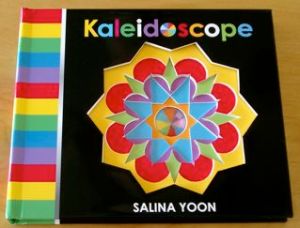
SY: At first glance, it may appear to be similar. My original version featured very flat, geometric designs. The rhyming text gave hints to what the design could be; a nautical compass, fireworks, or a cowboy boot’s spur. The concept was simple and direct. After various revisions, the art is now more organic and evocative. It attempts to capture universal moments in our lives that are peaceful, nostalgic, glorious, or inspired. The kaleidoscope lens allows the reader to reflect on those personal moments in a playful and entrancing way.
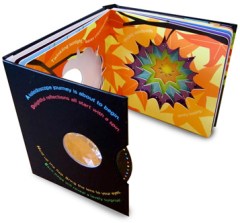
TL: The kaleidoscope wheel on your book is a multi-faceted clear resin that spins and makes the illustrations shimmer—like the autumn page with leaves that appear to be fluttering in the breeze. What was the design of the original kaleidoscope wheel?
SY: When creating a novelty book, one must always be cost-conscious because the biggest killer of a novelty is its production cost. So I found a very inexpensive kaleidoscope party favor (a toy) from a party store, removed the lens with an X-Acto knife, and placed it in my handmade submission dummy on a rotating wheel. I knew that this particular lens would be accessible to printers in China and reasonably priced since it was on a very inexpensive toy. But to my utter surprise, Little, Brown wanted a bigger, bolder lens regardless of the higher-cost factor. They worked with a manufacturer to customize and mold the gorgeous 2″ faceted lens. It’s very common for publishers to ask me to find ways to cut costs, but this was a rare occasion where the publisher actually allowed me to increase the production budget! It was worth every penny, I think.
 TL: It definitely was! How do you hope readers will react to KALEIDOSCOPE?
SY: To start, I hope the readers are of ALL AGES! Most novelties are targeted to the youngest audience. I hope KALEIDOSCOPE breaks that mold, as Rufus Butler Seder’s Scanimation books have (GALLOP, SWING). Some books are just so cool that it appeals to everyone, with or without children at home. I hope readers find the book visually appealing, thoughtful, entertaining, and most of all, surprising. I hope it brings out the child in the reader when spinning the kaleidoscope wheel. And for our youngest readers, I hope it stirs up their imagination and they squeal in delight!
I hope it pushes the boundaries of what books can be, and make a case for keeping printed, bound, hardcover books alive!
TL: KALEIDOSCOPE makes a strong case! You mentioned there was even a “sequel” in the works. Can you leak some advance details?
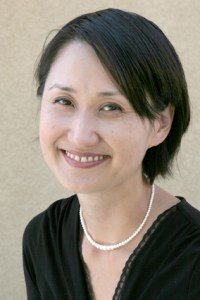
SY: The sequel is PINWHEEL, due to launch one year from now. The art is near complete. As the title suggests, it has a spinning component, but utilized in an entirely different way from KALEIDOSCOPE. My editor recently told me that when she shared one particular spread in the book with her sales team, it generated applause! *faints* That’s all I can say. I hope to be back to share it with you in depth!
TL: Absolutely! I can’t wait to hear more about it! Thanks so much for sharing your creative process. It was a pleasure chatting with you about your work. I hope folks will visit you at SalinaYoon.com to learn more about your books.
And now, it’s time for the giveaway!
One lucky person will win a signed copy of Salina Yoon’s KALEIDOSCOPE!
Just leave a comment to enter. You get an extra entry for each mention on social media: Facebook, Twitter, Pinterest, etc. Just tell me about it in your comment. Entries close the end of March 27th and I’ll “spin the wheel” to choose a winner on March 28th.
Good luck and thanks for visiting!
If you want to publish a book for children, the first thing you must do is ask yourself why.
Is your motivation to publish a kid’s book one of the following?
- Your kids/grandkids/nieces/nephews/neighbors/students love a story you’ve written.
- It would be fun to see your name in print.
- You want to sign autographs.
- You want to make money, quickly.
- You want your artist cousin/sister/friend to illustrate it.
If you answered “yes” to any of the above, please read this post. I write this to save you a lot of time and frustration. Because it’s not an easy business. NOT. EASY. AT. ALL.
New writers often believe they can pen one story in an hour or two, never revise it, yet somehow land an agent and a publishing deal—-as if the simple act of writing begets publication.
 Hitting one baseball does not mean the Yankees will draft you. Likewise, writing one story does not mean Random House will offer you a contract. Although, keep hitting that ball, make it go higher and farther…learn about fielding and sliding, too…and play seriously for years, and you just might make it.
Everyone believes the first thing they write will be golden and they’ll never receive a single rejection. We are all HOPEFUL. But, everyone is wrong. (Including me!) Trust me, this will NOT happen. It has NOT happened to ANYONE. (Except for Kevin Henkes.)
The motivation to write a children’s book should be:
- You love to write. You were born to write. You can’t NOT write.
- The child inside you is begging to get out and explore.
- You love children’s literature and want to contribute worthy stories to the genre.
- You want to inspire children to read, write, create, imagine and dream.
- You enjoy learning from children. (Yes, your primary goal should not be to teach them. Teachers, parents and guardians teach. Books are meant to be fun.)
- You want to work hard to establish a career as a kidlit author. You’re in it for the long haul.
 Notice fame and fortune have nothing to do with it. That’s something a small percentage of authors achieve. (Yes, authors can have dozens of books in print yet they cannot support themselves through writing alone. Moreover, advance checks can take a long time to arrive, and royalties trail about about 6-9 months behind book sales.)
And even if you become a famous author, most people won’t recognize you by sight or name. It will never get you the window table at The Four Seasons on a busy Saturday night. You’re better off making a reservation as “Doctor Lazar”.
It takes most children’s writers years to land their first book deal. And selling one book does not guarantee future book sales. Selling each subsequent book can get MORE difficult, especially if one (or more) of your titles do not sell as well as the publisher expected.
I don’t mean to be discouraging. I want to be REALISTIC. Children’s literature is a BUSINESS. And this business is like any other—it takes hard work, commitment, talent and a little luck, too. If you’re writing a children’s book on a whim, you might end up being very disappointed when you realize how tough it really is.
In short, I’ve made more money and worked fewer hours in EVERY OTHER JOB I’VE EVER HAD.
BUT…
There’s no job I’VE LOVED MORE. (Besides being a mom, of course.)
Just because you’re writing for children doesn’t mean it’s easy. In fact, it is more difficult to become a published kidlit author than it is to become any other kind of author. (That’s because there’s a tremendous amount of competition. Everyone believes writing for kids is easy because they’re kids. Not so.)
So do it because you LOVE it. You LOVE it like you CAN’T LIVE WITHOUT IT. Because children don’t deserve anything less than YOUR VERY BEST WORK.

Steps you should take:
- Earn a degree in English and/or Creative Writing.
- Read hundreds of books in your chosen kidlit genre (picture books, non-fiction, middle grade novels, graphic novels, YA).
- Write. Write. And write some more.
- Join a critique group specific to the genre in which you wish to publish. YA novelists don’t necessarily know a lot about picture books and vice-versa.
- Join SCBWI.
- Attend professional kidlit conferences, book fairs and other literary events.
- Revise. Revise. And revise some more.
- Research agents and editors online.
- Establish a social media presence. Make writing friends. Gain a support system.
- Consider investing in professional writing books, magazines and services like Publisher’s Marketplace (which will show you what books are selling, which agents are selling them, and to whom), The Horn Book, Publisher’s Weekly and The Children’s Writer’s and Illustrator’s Market Guide.
- After at least two years of writing, try submitting. Don’t send your work out in huge batches. Research who likes the kind of work you produce and target a few. If only rejections come back, try another small set of subs, revise again or write something else.
- Never give up. Keep writing new stories. Those who make it in this business are those who persevere!
Excellent online resources for aspiring children’s authors:
- SCBWI
- The Purple Crayon
- Writing for Children and Teens
- Twitter Chats for Writers
- SCBWI (formerly Verla Kay’s) Blueboards
- Myths and Truths of Writing for Children
- Preditors & Editors
- Literary Rambles: Spotlighting Children’s Book Authors, Agents and Publishing
- Author April Pulley Sayre’s How to Become A Children’s Book Author
 by Tamara Ellis Smith
Here is a joke for you all:
Why did the picture book writer wait and then cross the road?
To get a PiBo Idea!
I do a lot of hanging out within my landscape: small-town rural Vermont. I spend time in the cornfield behind the farm at the end of my block, out on the river trail at the edge of our town park, in the red pine woods, and up the various local mountains nearby. (Okay, maybe not as often up those mountains, but I just climbed one last weekend so it is still fresh in my mind…and in my achy thigh muscles!)
I get much of my inspiration from being inside my landscape.
This has been clear to me for a long time. The natural environment is full of tiny and majestic muses—the trees, rivers, flowers, blades of grass, ferns, rocks, and wind—all of them hold images, voices and ideas within them. I even have a blog about this, called Kissing The Earth, which I created with fellow children’s book writer, Sharry Wright. In it, we explore how landscape inspires writing, and how landscape in its own right can play a vital role in story-telling.
Today, though, I want to share a new revelation about landscape with you all.
So back to that aspiring writer-chicken. The one who waits on one side of the road before crossing. She waits. She sees the blue-purple chicory flowers at her feet. She hears a pair of squirrels chattering in the tree above her. She sniffs in—do chickens even sniff?—the rich, earthy smell of the woods just across the road.
As we continue on with this amazing PiBoIdMo challenge, I want to urge you to cultivate the art of waiting. And specifically, to cultivate the art of waiting within a landscape. As I said earlier, I truly believe that the trees, rivers, flowers, blades of grass, ferns, rocks and wind all hold stories within their ancient and organic roots and leaves and layers and flow. But in order to be privy to those stories, we have to be willing to create a space for them. And that’s where the waiting comes in. Waiting creates that space—a time-space, a physical-space, and a magic-space—and it is within that space that the alchemy of our imaginations and the earth’s secrets come together. Sparks fly, bubbles rise, and the best—oh the best!—ideas burst forth.
Ideas that feel brand spanking new and inevitable all at the same time.
In practical terms, I am talking about a change in perspective. An openness. And the search for the link between the child-within and the child-like quality of the story. Sometimes when I am mulling over an idea for a picture book, or a draft that isn’t quite working, or staring at a blank page all it takes is being quiet and still somewhere outside to make all of that shift. The experience of waiting within the landscape really can bring forth ideas. It also re-ignites that incredible sense of wonder and possibility that playing outside stirred up in us when we were children. And it also creates a sense of gratitude—for the world, for yourself, and for the way we are all connected.
Won’t you join me in the wide and wonderful Out There?
Tamara Ellis Smith has written a middle grade novel and several picture books, all pre-published. Her picture book manuscript, Milo’s World, was a finalist in the 2006 W.I.N. competition. Her middle grade novel won an honorable mention in the 2008 PEN New England Discovery Awards and was a runner up for the 2008 SCBWI Works-In-Progress grant. Tamara is represented by Erin Murphy of Erin Murphy Literacy Agency. You can learn more about her at tamaraellissmith.com and can read more about landscape and writing at her blog Kissing the Earth.
 by Ruth Spiro
In 2003, I sold my first picture book manuscript, Lester Fizz, Bubble Gum Artist, as the result of a contact made at the SCBWI Annual Conference. In the five years between the sale and my book’s release in 2008, I had plenty of time to think about innovative ways to promote it. Yes, my marketing plan included the tried-and-true mailings, signings and presentations, but I also wanted to do something a little different. That’s just me.
With a moderate investment of time and money, in 2006 I created my own holiday, “Bubble Gum Day.” Unsure of my publication date at the time, I chose the first Friday in February because aside from Groundhog Day, there’s little else going on. This year, Bubble Gum Day falls on Friday, February 4.
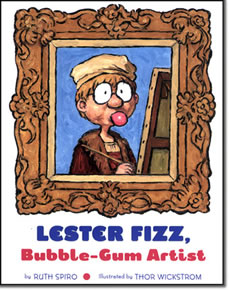 The premise is simple: On Bubble Gum Day, kids pay fifty cents to chew gum at school, with the proceeds used for any project or charity the school chooses. Kids have fun, schools benefit, and my name and book title get valuable publicity.
Six years later, it’s become a fun and effective promotional tool that has increased my visibility as an author and “Bubble Gum Expert.” It has also gained me exposure in both print and broadcast media, including The Washington Post Express, The New York Daily News online and Good Day Sacramento, as well as on radio stations in both large and small markets. This holiday with kid-appeal has been celebrated in countless schools, public libraries, children’s museums and community organizations.
Most importantly, schools and community groups have used Bubble Gum Day to do some wonderful things. One school raised enough money to buy a goat for a village in Africa through Heifer International. Another used their proceeds to purchase snacks, which they sent to soldiers in Iraq. Yet another school collected used books instead of money, and wound up with over one thousand books, which they donated to local women’s shelters.
Frankly, when emails with these stories began appearing in my mailbox, I stopped thinking about the holiday as a promotional tool—it’s become so much bigger than that.
 This year, I’ll spend Bubble Gum Day with a group of second and third graders in Oak Brook, IL. The money they collect will go to Reading is Fundamental. They don’t know this, but I plan to chew lots of bubble gum too, for which I’ll also make the required donation!
Then, as in past years, I’ll eagerly anticipate the emails, photos and packages of letters I’ll receive over the coming weeks, as schools tally up their proceeds and continue to make Bubble Gum Day a sweet success!
Win a signed copy of Lester Fizz and a bubble gum prize pack! Send a photo of your most creative bubble gum bubble—in a group (like your class), individually, or like one of Lester’s unique bubbles. Email photos to bubblegumday@gmail.com with the sujbect line “Tara Lazar contest” by February 7th. Ruth will select a winner and some bubble photos will be featured here. Good luck!
Ruth Spiro is the author of Lester Fizz, Bubble-Gum Artist, published by Dutton. Her essays and articles have appeared in FamilyFun, The Writer and Woman’s World, as well as The Right Words at the Right Time: Your Turn, edited by Marlo Thomas, and several Chicken Soup for the Soul titles. She frequently speaks at schools and conferences. Visit her online at www.ruthspiro.com. Learn more about Bubble Gum Day at www.bubblegumday.com.
Confession time. This post has nothing to do with writing or reading.
I just gotta say it: I love rings.
And not ordinary ones.
Crazy, kitschy, funky rings. Big and loud.
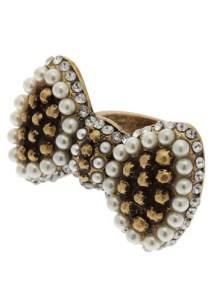
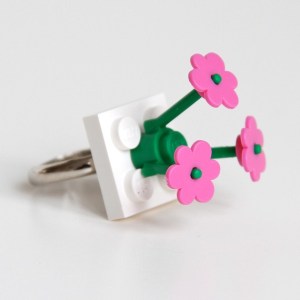

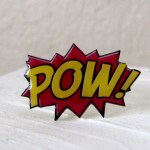
I’ve spent too much time trying to act my age. And why? I’m a picture book author! I should be able to wear Legos on my fingers, right? And polymer clay sushi. And dictionaries. Yes, dictionaries.
Let your inner goofball shine!





 Writing for Kids (While Raising Them)