You are currently browsing the category archive for the ‘Picture Books’ category.
by Diandra Mae
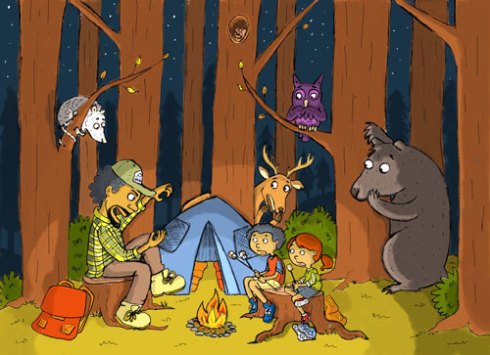
Living a creative life can be a scary thing. You battle things like self-doubt, fear and resistance. You worry about never having another “good idea.” You can get caught up in reviews, the madness of sales stats or caught up in measuring yourself against others.
Don’t give in to that negativity. When you choose this life as a creative, you must remember that what you are doing is important. That it is vital. That it is good work. You must not lose focus on what is most important: the story.
When you work for the story you are trusting that your work matters and the universe will reward you with inspiration aplenty. When you work for the story you are telling those fears you’ve got more important things to do, and they will disappear. When you work for the story, you are part of what is true.
So take up your pens, pencils, keyboards and styluses. Stare down that blank page or screen before you. Tell yourself, “I’ve got this” and get to work.
And since this month is all about inspiration, here are a few more of my favorite quotes on creativity:
“Creativity comes from trust. Trust your instincts, and never hope more than you work.” ~ Rita Mae Brown
“You can’t wait for inspiration, you have to go after it with a club.” ~ Jack London
“Ideas are like rabbits. You get a couple and learn how to handle them, and pretty soon you have a dozen.” ~ John Steinbeck
“Another word for Creativity is Courage.” ~ George Prince
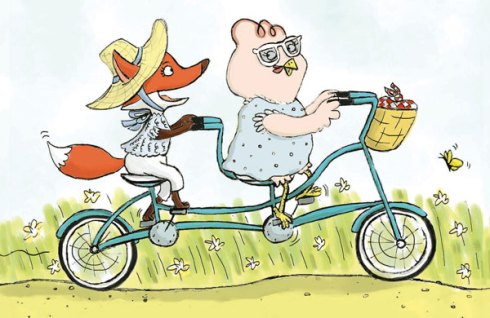
Diandra is generously giving away an 8×10 print of her “Bicycle Built for Two” illustration. Leave a comment to enter. A winner will be randomly selected in one week!
 Diandra Mae is an author-illustrator who enjoys bringing a sense of playfulness and humor to the stories she illustrates and the picture books she writes. She is the Illustrator Coordinator for the Houston SCBWI chapter, as well as an active participant of The Sketchables and PictureThis! To see more of her work or just to say hi, visit her blog, website or tweet!
 by Shutta Crum
PiBoIdMo is about beginnings—first ideas, first notes, and then, hopefully, first drafts from the exciting tidbits we’ve jotted down during the month. While thinking about beginnings I remembered one of my first writing classes: high school journalism. I don’t remember much from the class except that a good lede should always include the answers to four important questions: the 4 Ws. These are: who, what, where, and when. After a good lede, we were taught the story could move on into the details of how, or why.
Good ledes are something that the news reader doesn’t really notice, but are crucial to keeping the reader’s attention. They quickly dispense with niggly concerns and important facts so the reader can settle into the story. It is a technique every picture book writer ought to know.
Answering those four questions right up front in any story tucks the reader in. However, as with many aspects of writing the picture book, the writer for the very young has to do it faster, with fewer words, and sometimes in verse!
Better than hearing this from me—and more fun—is studying how some of our best picture book writers, and illustrators, do it. Below are some of my favorite examples, in prose and in verse.
(Prose) Rosemary Wells, from MAX’S CHOCOLATE CHICKEN.

“One morning somebody put a chocolate chicken in the birdbath.”
Let’s parse this opening line. When: one morning. Who: somebody. (We also see a picture of that somebody—Poppa?) What: put a chocolate chicken. Where: in the birdbath. (And what a great hook for a young child! Why would someone do that?)
(Verse) Karma Wilson, from BEAR SNORES ON.

“In a cave in the woods
in his deep, dark lair,
through the long, cold winter
sleeps a great brown bear.”
Where: in a cave in the woods in a deep dark lair. When: through the long cold winter. What: sleeps. Who: a great brown bear. (And she did all this with perfect meter! Note: be sure to read Karma’s earlier post, on Nov. 2nd.)
Of course, we are blessed by the illustrations in our picture books. In addition to everything else they do so well, the art carries a great deal of this initial informational load. If the setting is a farm, we see that and it may not be mentioned at all in the text. If it is nighttime, or winter, or the main character is a bear . . . these may, also, not be directly mentioned. If it is not said in the text, it is then incumbent on the illustrator to add that context. Look at Jane Yolen’s Caldecott-winning book, illustrated by John Schoenherr.
(Free verse) Jane Yolen, from OWL MOON.

“It was late one winter night,
long past my bedtime,
when Pa and I went owling.”
When: late one winter night, long past my bedtime. Who: Pa and I. What: went owling. There is no mention of where . . . that is covered by the beautiful farm scene in the illustration.
Occasionally, leaving out more than one of these details may actually enhance the story by focusing the reader’s attention on another detail that may be of more importance. For example, study Jon Klassen’s new book I WANT MY HAT BACK. There is no where indicated (except for a few rocks and sprigs of grass). Nor, even a when. Who and what are of prime importance. (Who: I. What: Want my hat back.) Against almost completely blank pages readers really notice those eyes on the bear and the rabbit. The facial expressions are subtle, yet so important for understanding the story. In an intensely illustrated background, the significance of those looks might get lost. We assume it is some place where there are bears and rabbits and other animals. And the when is unimportant. As in all things, once you know the rules you also know when it may be best to break them.
(Prose) Jon Klassen. From I WANT MY HAT BACK.

“My hat is gone.
I want it back.”
So study first lines for how good writers quickly dispense with the basic questions any reader has about the world of the story. Then once you’ve tucked your readers in, you can lead them on to discover the answers to those other two important questions: how the story unfolds and why.
 Shutta Crum is the author of twelve picture books, two novels and two forthcoming picture books. Her latest picture book MINE! (Alfred A. Knopf, 2011) was just named an SLJ Best Book of the Year. THUNDER-BOOMER! (Clarion, 2009) was named an ALA and Smithsonian Magazine notable book. For more info, including teaching guides, visit shutta.com.
 by Laura Murray
Kids love to laugh (don’t we all!) And what’s better than a LOL (laugh-out-loud), giggle-inducing picture book?
So where do you get those snicker and snort-worthy ideas for your own picture books?
- Be an eavesdropper: I absolutely love to listen to my own children or my kindergarten students as they imagine and pretend. Listen when they are in the back seat of the car joking with their friends and they somehow forget you are driving. Listen as you sit on a park bench at the playground or when you help out in the classroom. These places are loaded with funny kid conversations and picture book ideas.
- “Baby Bloopers”: On the last page of Parents magazine, there is a section called “Baby Bloopers” where parents write in about the super funny things kids of all ages do or say. When I received this magazine, I would tear out these pages and keep them in a file. (*Parenting magazine also had a back page called “How Embarrassing” that I collected too.)
- Google “Funny things that kids say”: You will not only provide yourself with many laugh-out-loud moments reading the hits that come up, but you will also fill your PiBoIdMo idea notebook!
The idea for The Gingerbread Man Loose in the School started as a funny line that came straight from my three-year old’s mouth one day as she dubbed herself “one smart cookie.” It reminded me of a school Gingerbread Man hunt we did in Kindergarten and …voila… several questions later, I had the makings of a Gingerbread Man story with a new twist.
What questions am I talking about?
The very same ones that Karma Wilson and Tammi Sauer mentioned in their earlier posts—
- What if? What if a class baked a Gingerbread Man, but he got loose in the school when they went to recess? What if he was really searching for them, instead of running away?
- What could go wrong? Oooh—maybe he could land in a lunch sack, or get stuck on a rolling volleyball…
But there was one more question that I pondered for this particular story—
- How can I raise the funny factor? (What mischief would kids identify with in this school setting?)
Hmm… sliding down handrails, spinning in the principal’s chair, cookie-related word play, (and absolutely not “being eaten” in the end)!
So, as you look for your own ideas, remember to—
- Listen to kids (or read about their escapades.)
- Write down what they say and do, especially if it tickles your funny bone.
- Take the idea you love the most and start asking questions – What if? What can go wrong?
- And if your idea lends itself to humor—then ask, “How can I amp up the kid-LOL factor?”
There is nothing quite like hearing a child’s chuckle as you read your story, so…
GO FOR THE GIGGLE!
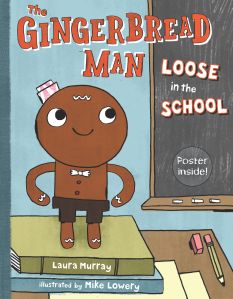 Laura Murray is a children’s author, former teacher, and mom of three mischief makers. Her debut rhyming picture book, The Gingerbread Man Loose in the School (GP Putnam’s Sons, July 2011), was chosen as a Junior Library Guild Selection, received a starred ALA Booklist review, and has inspired a forthcoming sequel entitled—The Gingerbread Man Loose on the Fire Truck! She loves writing picture books with funny, mischievous characters, and middle grade adventure/mysteries. Please visit her online at www.LauraMurrayBooks.com.
Laura got the opportunity to meet Mike Lowery, the book’s awesome illustrator, and have him sign a few copies of The Gingerbread Man Loose in the School after its release. Please leave a comment to win a first edition (includes a poster) signed by both the author and the illustrator. A random winner will be drawn one week from today.
by Audrey Vernick and Olugbemisola Rhuday-Perkovich
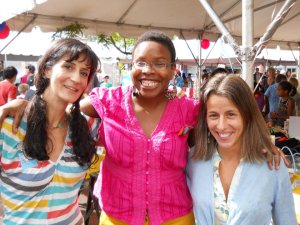
Tara, Gbemi & Audrey at the 2011 Princeton Book Fair
Alike in nearly every way, we are polar opposites in our attitudes toward novels and picture books. Olugbemisola approaches novels bravely while Audrey cowers. Audrey is undaunted by the prospect of writing picture books while Olugbemisola is daunted and then some. Our post is a public discussion of these weak spots and strengths (which we’d never call strengths in reality, but we don’t want to start off by sounding insecure).
ORP: What are the easiest elements of picture book writing for you? How do you think in a picture book way?
AGV: First, thank you, Gbemi, for not asking this question in the way you surely mean, which is Why is it that you’re so scared of writing novels but the same doesn’t hold true for picture books? I appreciate that.
Statement of obvious: with picture books, I set out knowing I will ultimately be using a very limited number of words. That takes the scare away. It is, in large part, the length of novels that frightens the bejeezus right out of me.
I start to tell the story. I try to find its arc, work toward an ending, and I don’t panic when it’s getting really, really long, because I know that’s part of my process now.
I know some picture book writers are very successful using a sort of formula, but that’s not part of my process. The first step is what I think of as weighing—does it have enough to go from being a fragment of an idea to being a picture book.
Often, it doesn’t. I don’t throw away the fragments—they could still develop. But I don’t usually push too hard in that first attempt if it’s not happening naturally. If it feels like it has legs, I’ll usually get a first draft in a single sitting. And then I’ll revise the hell out of it.
Picture book revision is about cutting away everything that is not essential. Duh, you all say. That’s what revision is. And I know that’s what we all say revision is, but with picture books, I really mean it. I cut away more than I leave. Then I try to sculpt what remains. I find the story and, perhaps more importantly, the voice, by figuring out what doesn’t have to be part of the story.
AV: Does this all sound scary to you? Or just very different from your process?
ORP: It makes sense, of course, because you are a very sensible person. Maybe kind of a show-off too, Ms. First Draft In A Single Sitting.
AV: And here I interrupt to point out that, as Gbemi, a writer, knows, my first draft does not often resemble whatever it ultimately turns into. So shh.
ORP: Humph.The idea that I have a set amount of words as my goal—what is it for PBs now, 5? 3?—is terrifying for a long-winded writer like me.
The truth is that I have no process for writing picture books. I’ve never tried. When you asked me why I hadn’t, it took me a little while to uncover the obvious: ginormous, volcanic, pervasive FEAR.
I was often the type of child who believed that I could do anything if I really, really wanted to and worked hard enough. This belief sometimes resulted in unfortunate performances in school talent shows, yes, but it kept me taking risks, challenging myself, keeping me in the moment, with a small goal. I think that I start with the idea that A PICTURE BOOK IS SOMETHING I CANNOT DO, and it goes downhill from there. It becomes something I should not try, because it won’t be GOOD.
I was also the child who wanted to be good at things. And unfortunately that’s the child who’s winning these days. That child sometimes didn’t answer a question in class because she was not 110% sure that it was the “right” answer. That child is trying to keep me from being a writer.
AV: There’s no such thing as 110%.
ORP: I went to schools that had As and A-pluses. You could get 110% if you tried hard enough and knew the secret password. (And now continuing and pretending Audrey’s not here.) I recently met with an author friend, and explained (rather pompously) that I think too “big” for picture books, that all of the stories in my head are epics, with many subplots and threads and themes. (Sounds way better than ‘I’m scared,’ yes?) She saw through that easily enough and suggested that I start by taking one chapter of one of those epic stories, and thinking of that as a whole story, as a picture book.
Hmmmm…sounded doable, and just thinking that way helped me tighten my novel WIP as well.
She also mentioned that she’s in the process of trying out a new form of writing, working on it every day, just because. Not because she’s preparing this work for submission, not because the market is demanding it, but because she wants to try it. She’s taking the risk.
I need to take the risk. Not because I’d like to publish a picture book, however cool that may be. But because the process, the work itself will be creative food. Because writing it, even just for myself, will be an important step away from the disease of perfectionism toward the kind of freedom that I need to write anything successfully. And because during these 30 days of PiBoIdMo, I’ve had one, maybe two ideas (if I’m being generous with myself, and I think I’d like to be). But instead of pronouncing myself a failure and wishing I was something that I’m not, I should be who I am and just write. Without worrying about how “good” it is, or even how good it will be when the brilliant real me that’s always there waiting to rescue me from that mediocre impostor with my name takes over. But because I’m a writer. I’d like to try. And that’s all I have to do.
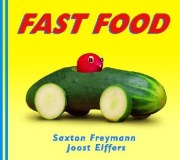 AV: I want to use phrases like “creative food.” Maybe we could collaborate on a picture book about creative food?
ORP: My first thought was, I could never do anything like Saxton Freyman. But that’s GONE! My next thought, the one I will keep is: We can do something awesomely US together. So why don’t we have some fun and give it a whirl?
 Olugbemisola Rhuday-Perkovich was the ‘new kid’ at school many times over, in more than one country, and currently lives with her family in Brooklyn, NY, where she loves walking and working on crafts in many forms. Her middle grade debut novel, 8TH GRADE SUPERZERO, received a starred review from Publisher’s Weekly and was named one of Amazon’s Best Books of the Month. It was also chosen as an IRA Notable Book for a Global Society and NCSS-CBC Notable Social Studies Trade Book for Young People. Olugbemisola holds a Master’s in Education, and a Certificate in the Teaching of Writing from the Teachers College Reading and Writing Project at Columbia University, and has a great time incorporating all of her different ways of working and playing into author visits and workshops. She is a member of SCBWI, a PEN Associate Member, and a former Echoing Green Foundation Fellow. Visit her online at http://www.olugbemisolabooks.com.
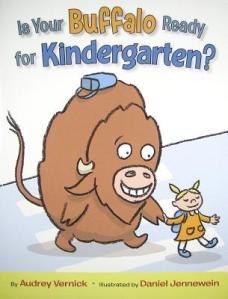 Audrey Vernick is the author of IS YOUR BUFFALO READY FOR KINDERGARTEN? (an IRA/CBC Children’s Choice Book); SHE LOVED BASEBALL: THE EFFA MANLEY STORY (one of Bank Street College’s Best Children’s Books of the Year; a Junior Library Guild Selection; and on the 2011 Amelia Bloomer List). She also wrote the novel WATER BALLOON. In the next two years, she has four more picture books coming out and she really, really, really means to get to work on another novel. Audrey holds an mfa in creative writing from Sarah Lawrence and is a two-time recipient of the NJ Arts Council’s fiction fellowship. She is a member of SCBWI and PEN. Visit her online at www.audreyvernick.com and stop by her blog at http://literaryfriendships.wordpress.com.
 by Casey Girard
My journey to conceiving my own picture book ideas began when I graduated college as an illustrator. I had my portfolio; I was all ready to go find an author in need. When I got to my first conference I was immediately asked, do you write? I was at a loss. I knew I loved illustrating stories but I figured my job was to illustrate other people’s ideas. Seven years later, many more conferences attended, hundreds of children’s books read, numerous illustrations finished, and much time spent being involved in children’s publishing, I have found the stories I want to write.
At the beginning of creating my own stories, I was overwhelmed. My biggest hurdle was observing the plethora of picture books already out there and then realizing that there was room for mine. I started with thinking about how many books I wanted to read. Most people have to-read lists that will never be finished and that’s how they want it. So, add in that there are an infinite number of stories to be told because life changes constantly and revelations about the world are made every minute, new stories are born every single day with readers waiting to read them.
Getting past fears and doubts let me free to accept and explore my ideas. If you are excited by something, don’t be afraid and don’t doubt your ability to make it into a good picture book. Your voice is unique and you will tell your story in a way that connects with someone else. You can never give up on it and you can never give up on yourself. Don’t let fear hold you back. Work on your craft, give the idea you can’t help but write all the love and time it needs to grow into a publishable book, and you will succeed.
Don’t be afraid:
- To accept your idea
- To start
- To change
- To challenge yourself
- To tackle the story that you love no matter how crazy you think it will seem to others
- To ask for help
- That your idea isn’t worth it
If you love your idea and believe in it as a picture book others will, too.
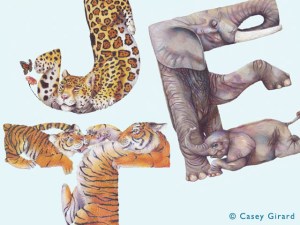 Casey Girard is a freelance illustrator/designer. She has worked with two authors, illustrating their self-published books, NATTY & RINGO and I LOVE YOU EVERY SECOND. She recently became the Illustrator Coordinator for the New England SCBWI. She recently co-founded the blog Picture This, a site all things picture book art, links, quotes, videos, articles, news, events and more. Stop by for some inspiration. To see more of her work visit her blog – caseyg.com, where she runs two weekly themed posts: Matt’s Choice and Wednesday Animal. You can also find her on Twitter, @CaseyGirard.
Casey is giving away three letters of your choice from her illustrated alphabet. Only the X isn’t available. Leave a comment to enter and a winner will be randomly selected one week from today.
 by
by There’s one thing you should know about me right upfront: I love making lists. There’s something that I find both focusing and freeing about having to crystallize my thoughts into this form; while I might not cover everything there is to say on the given subject, just the act of making the list helps me focus on the things I feel are most vital.
So, picture books. During these grand days of PiBoIdMo goodness, I’ve been giving a lot to the form. Certainly they are a big part of my life: I write them, I read them, I sell them (for my authors). But what pushes a text from a short story into a perfectly crafted masterpiece? Editors are not looking for something that’s just sweet, or nice, or passable. And I’m not either. Texts like these would very likely have sold five or ten years ago. But nowadays? The bar is a lot higher.
Which leads me very nicely to my list. What makes a picture book text stand out from the pack? What kinds of stories should you be crafting? What are my top tips and most targeted advice for perfecting the craft of writing picture books? Read on to find out!
1. Think outside the box.
The beauty of events like PiBoIdMo is that they focus the power of volume. “Quality not quantity,” the adage goes—but sometimes, it takes quantity to find that quality. It’s the old familiar brainstorming routine, whereby the free-flow of ideas stirs up the mind to the extent that the mundane gives way to the extraordinary.
So stir up those creative juices! Get crazy! Make lists and put unexpected elements together. A shark… and a train? A pigeon… and a bus? Like a phenomenal preschool-aged Glee mashup song in fully illustrated form, you too can strike gold with your big out-of-the-box idea.
2. Focus on a character.
If every era has a buzzword, the one for the contemporary picture book marketplace would be: character-driven. Everyone wants to see (or be) the next Fancy Nancy. But what does that mean to you, sitting as you are with brain to fingers to keyboard?
What editors don’t want: copycat stories. (Oh! I know: Stylish Suzie! Or maybe… Frilly Jilly!) No. The key to parsing out this riddle is to go deeper. Put your own spin on the demand, and focus on the core premise: Kids want someone they can connect with. They want to see a bit of themselves in the larger-than-life heroes who fill their pages. They want a dash of crazy; a spark of excitement; a quirky, interesting, fully-themselves hero or heroine who can take their imagination by storm.
Be original. Be flamboyant. Give specific character details. And give your readers a brand-new friend they can take home in their pocket.
3. Embrace the universal.
So far my tips have been all about the crazy, the creative, the new-and-oh-so-different. Now I’m going to take all that back a notch, add a great big qualifier on top. Your picture has to be fresh, new, original—yes. But!
It also has to be about the same ol’ thing.
What? After all that talk of originality, now this? Here’s the thing: It’s not enough to have a wild and wacky premise. There also has to be some deeper core to the story that connects with readers on its most basic level. I’ve heard them described as the “universal child emotions” that need to be represented in order for the story to fully hit its mark.
Now, please note that we’re not talking about morals or lessons or message here. What are talking about is theme, subtly underlaid, weaving throughout the text and supplementing the story.
The list of universals is endless: love, friendship, overcoming fears, trying new things, getting along with others, sibling rivalry, leaving someone or something you love, sickness, loss. It’s as long as life itself, and honestly? The simpler the better. (Which, come to think of it, could totally be point #4 on my list, but a list of 4 simply cannot compete with a list of 3.)
So there you have it—my three top tips. I hope they will help you as you take your ideas and craft them into stellar picture books that take the marketplace by storm. So… are you ready? Get set, WRITE!
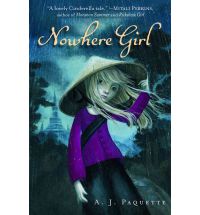 Ammi-Joan Paquette writes picture books and young adult novels, plus she’s a literary agent with the Erin Murphy Literary Agency. Her latest book is Nowhere Girl, published in September 2011 by Walker/Bloomsbury. She lives in the Boston area with her husband and daughters. Visit her online at AmmiJoanPaquette.com.
by Wendy Martin
“Everybody walks past a thousand story ideas every day. The good writers are the ones who see five or six of them. Most people don’t see any.” ~ Orson Scott Card

Five things to do to see new ideas:
- Make up songs. Sing them loudly and off-key.
- Wear clothes that don’t match. Top the outfit off with a funny hat.
- Climb a tree and hang upside-down.
- Splash in mud puddles.
- Reach for the big box of crayons. The one with the sharpener in the box.
If you’re at all like me, you have a lot of ideas swirling around in your brain almost constantly. They wake you up from a deep sleep, or make you lose count when you’re measuring the 3 ½ cups of flour into that cake recipe.
The trouble with a brain awhirl in ideas is sifting through the crowd to find the ones that will make a good picture book. We’re grown-ups. We think grown-up things like obeying the speed limit, who to vote for in the next election or whether we remembered to lock the front door. Sometimes I wonder about other things, too. Like if I can save money by installing solar panels, or what it would be like to live in a house underground.
In order to come up with ideas, really fun, child-like ideas that will appeal to the picture book crowd, we have to put our adult brain on the shelf. Kids don’t care about the speed limit, who’s running for office or if the house is locked up tight when they leave it.
That list above? Each one of the suggestions will help you get in touch with your inner 4-year-old. You know you want to! Just pick one and do it until you stop feeling silly and start enjoying yourself. Then take a refreshed look at the world around you. What do you see/hear/think now?
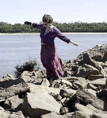
Did you see the hidden message in the image above? Take another look if you didn’t. Do you see now? Leave a comment below for a chance to win the original watercolor! A winner will be selected randomly in one week.
 Wendy Martin is the illustrator of 5 picture books, 3 of which she also wrote. Her first book was chosen as a finalist for the best children’s book of the year during the 2009 Coalition of Visionary Resources annual international COVR awards. Her latest book, The ABCs of Lesser-Known Goddesses: An Art Nouveau Coloring Book for Kids of All Ages was released in June. She is a founding member of both the middle-grade book blog, From the Mixed-Up Files of Middle-Grade Authors, and the initiative to make November International Picture Book Month. Visit her on the web at WendyMartinIllustration.com, Twitter @WendyMartinArt or Facebook.
 by Jodi Moore
It’s okay to write a 2,000+ word picture book.
*braces self for screams of disbelief, coffee cups dropped, any chance of securing another book deal/agent/critique opening vanish, my own editors paling in shock, possible angry mobs at my doorstep and Tara questioning why-oh-why did she ever ask me to guest blog for PiBoIdMo?*
Now, hold up. I didn’t say it would be publishable. I just said it’s OKAY to write one. In fact, sometimes it may be necessary.
As picture book writers, we are challenged to deliver big ideas in as few words as possible. We are expected to fully develop our story, our characters, our plotline; captivate our audience; fashion a fabulous first sentence and create a satisfying end.
All while leaving room—and extending faith—for the illustrations.
It’s no easy task. So I ask…why would you limit yourself in the beginning with a word count?
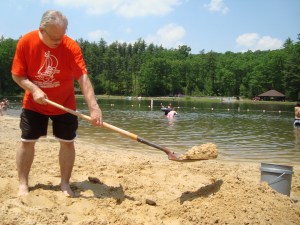 Perhaps it may help to look at this in a different way. Let’s say I want to build a perfect sandcastle. If I only look at a finished product, say, one of my husband’s illustrious creations, and size up the amount of sand comprising the castle itself, I may decide I only need a few large buckets of sand to complete the task.
But that’s not what he starts with. Larry begins with an entire sandy beach. Using a large shovel, he piles on tons of sand. He sifts through bucket after bucket of the grainy particles. He packs it high as a mountain, scraping up more sand than he could possibly need.
That proud hill is his main idea. It’s the structure. The mass from which he will carve out his masterpiece. It’s his 2000+ words.
 And then, he sculpts. He edits. He revises until he can see the more subtle nuances of the castle. Sometimes, a wall will cave or a doorway will be in the wrong place. But that’s okay, because he still has plenty of sand left. He can add. He can rebuild. My husband hasn’t limited himself to a few buckets of sand.
Why should you?
From your comments and posts on both this forum and Facebook, I know that you’re all busy creating your own pile of ideas. Embrace them…and write what’s in your heart. Use every word that’s necessary and a few that – you may find out later – are not. Restricting your words too early on may constrict your idea, choking the very life out of it. Let it breathe; let it swell. Let those words FLOW.
There will be plenty of time to revise—and reshape!—later.
Writing picture books can be a DAY at the beach. Shed those limitations and dig in!
 Jodi Moore is the author of WHEN A DRAGON MOVES IN (May 2011, Flashlight Press) and the soon-to-be-published GOOD NEWS NELSON (Story Pie Press). She writes both picture books and young adult novels, hoping to challenge, nourish and inspire her readers by opening up brand new worlds and encouraging unique ways of thinking. You can visit her at www.writerjodimoore.com.
 by
by For PiBoIdMo, I’m giving you a very special gift.
Your very own Inspiration Fairy!
This Fairy will grant new ideas and make your kidlit dreams come true!
All you have to do is the following:
- click on her for the full size image
- cut
- color
- attach her somewhere close to your work space.
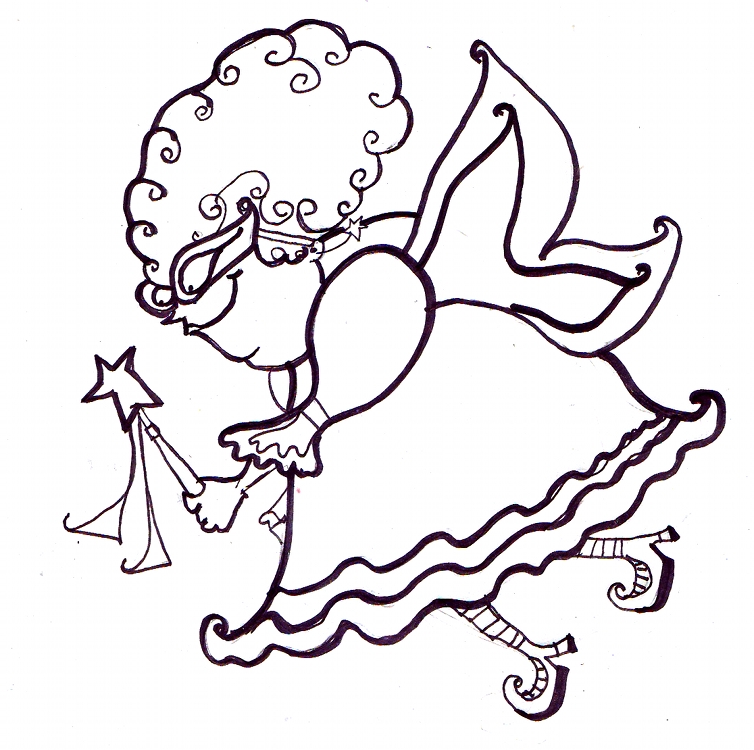
Next, (and this is the only way to make fairy magic happen:) You have to believe.
And in order to believe, you have to work. You have to write or draw something as often as you can. And never give up! (for more than a few minutes or days at least)
The things you create can be things that are wonderful, horrible, short, long, happy, funny, sad and even things that will probably be better off in the recycling bin.
But, you have to do it.
You have to work for it.
And you have to believe.
I speak from experience. It took five years to get my first book published. It was the first book I wrote and the first publisher I sent it to. But, it took five years for the planets to align, my skills to improve and to get the yes. During these years, I hoped, despaired, submitted and almost quit a million times.
I give you this fairy to remind you that the kidlit adventure is dangerous, slow and might even bring you to tears occasionally.
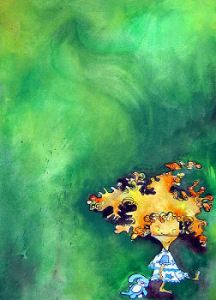 But, hang in there, keep at it, work it and most of all, believe.
Courtney Pippin-Mathur is an illustrator and writer. Her first picture book as a writer and illustrator, MAYA WAS GRUMPY, is coming out Fall of 2012 with Flashlight Press. She juggles paint, paper, keyboard and three kids. She wouldn’t wouldn’t have it any other way.
Courtney is giving away an original watercolor painting of the Inspiration Fairy to a lucky commenter. A winner will be selected one week from today! Good luck!
 by
by I was so heartened to read Carol Hampton Rasco’s opening blog post on PiBoIdMo because she made two comments that really resonate with me. Well, she said one, and then she quoted a savvy but jaded six-year-old.
First, she noted that the top picture-book choice of teachers, reading specialists, and Reading is Fundamental volunteers is NONFICTION. That buoyed me because that’s what I write. In fact, my agent, Erin Murphy, has two of my nonfiction picture books under submission right now. The six-year-old, however, quickly brought me down to earth. As he peered at a terrific looking book, he said, “it doesn’t look like a true fact book, they’re usually boring.” That’s good news for the book he was enjoying but “aargh” for the others.
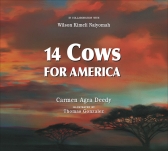 We can all cite other terrific NF PBs. Some of my favorites include MIND YOUR MANNERS, ALICE ROOSEVELT! by Leslie Kimmelman; 14 COWS FOR AMERICA by Carmen Agra Deedy, which is available in both English and Spanish (which is perfect, since Rasco also said that bilingual books rank among the top-three most-wanted); and YOURS FOR JUSTICE, IDA B. WELLS by Philip Dray. Citing counter-examples to the six-year-old’s complaint, however, is beside the point. It’s his experience and his impression that count. So, what can we, as NfPiBoWr (that’s nonfiction picture-book writers) do to alter his conclusion that “true fact” books are boring?
 Language and illustrations, of course, contribute hugely to enlivening books that happen to be accurate. Rasco also commented that what adults want for the children they read and give books to are books that are “eye and mind catching.” Great illustrations catch the eye; lilting, lively, lyrical text captures the mind. Neither of these is quite sufficient, however, if the topic—and we are dealing with ideas during PiBoIdMo here—is lackluster.
As a nonfiction writer, my ideas come from a number of places—the news, teacher-friends who lament the lack of good books about X, expert-friends who share fascinating stories about their research, and sheer curiosity. But, the biggest source of my ideas is Carus.
Who?
Carus is the family of magazines that is sometimes abbreviated to “COBBLESTONE.” These include, for various age groups, not only this magazine about American History but also DIG on archeology, APPLESEEDS and FACES on culture, CALLIOPE on history, ODYSSEY on science, and others. It’s not that I steal ideas from other writers; I steal ideas from myself. Here’s what I mean.
Most of these magazines are theme-based, and a couple of times a year, I check their Writer’s Guides to see what intrigues me. What I see now in ASK, a science magazine for six- to nine-year-olds, for instance, are calls for proposals for nonfiction articles on dreams and dreaming, “all the fish in the sea” on a census of fish, spelunking, and animal sounds. Don’t these sound like great grist for topics?!
While ASK targets the perfect age group for picture-book readers, magazines for older readers inspire ideas, too. For instance, FACES is soliciting articles on “Ghosts and the Spirit World” and COBBLESTONE on the 1963 “March on Washington.” There are many other fine nonfiction magazines as well—RANGER RICK and KNOW, for example. All of these can suggest possible picture book topics.
What’s critical for me, though, is not the general theme but what I just said. They suggest possible topics. Or, actually, the big ideas lead me down multiple paths to them. The themes themselves are often too broad for a picture book. But they can spark an idea for a specific article that might then transmogrify into an idea for a picture book.
For instance, when COBBLESTONE sought articles for an issue on Mark Twain, I consulted a friend who is a Twain expert. She suggested an idea for an article that became the basis for one of the picture books that is under submission. Similarly, in response to an issue of COBBLESTONE on the “Freedom Rides,” I wrote an article on music in the civil rights period. My research for this article revealed to me more than I had known about children’s involvement in civil rights—and that led to my other PB under submission. (In fact, I wrote and sold a whole middle-grade nonfiction book, WE’VE GOT A JOB: THE 1963 BIRMINGHAM CHILDREN’S MARCH, that was inspired by that article. But, that’s the topic for another blog!)
So, my recommendations for PiBoIdMo are to:
- Check out great kids’ magazines.
- Use their suggestions as springboards for your own. And
- Inspire and be inspired by bored six-year-olds!
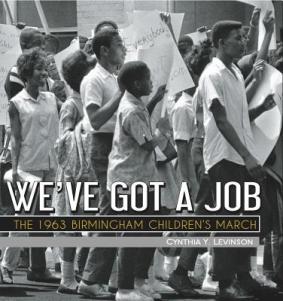 Cynthia Levinson has sold two dozen articles and stories on a wide range of topics to some of the best children’s magazines. Her debut middle-grade book, WE’VE GOT A JOB: THE 1963 BIRMINGHAM CHILDREN’S MARCH (Peachtree Publishers), will be published in February 2012.





 Writing for Kids (While Raising Them)