You are currently browsing the category archive for the ‘Picture Books’ category.
You get a lot of spam, right? (Don’t worry, this isn’t spam.)
I do, too.
But lately, the nature of the spam has changed. I’m receiving all kinds of press releases from companies who want to announce products on my blog. And, these folks have really done their homework! (No, they haven’t, just like my new middle-schooler. Sigh…a story for another time.)
They’d like me to blog about their moto-scooters, high-tech floss, fireplace pokers, vegan wallets (they’re no longer called “vinyl”), birdhouses and beanbags. You name it, they think you, my readers, would LOVE it! The mistake they make is not even reading my blog or relating their story to this blog’s readership. They’re all “thrilled to announce” their stuffy stuff but fail to convince me why *I* should be thrilled.
And then, I received an email from CuratedQuotes.com. They offered to design a quote image for my blog. Why, here’s something I would actually use! That my readers might actually want, too!
I spend a lot of time searching for re-usable images on which to overlay a quote.
Like this:

And this:

(Ugh, I’ve misplaced the image credits, which were all Creative Commons-ified.)
But here’s some folks that will do this for me. And make it look all cute and jazzy. So I said YES! And I sent them my very own quote!
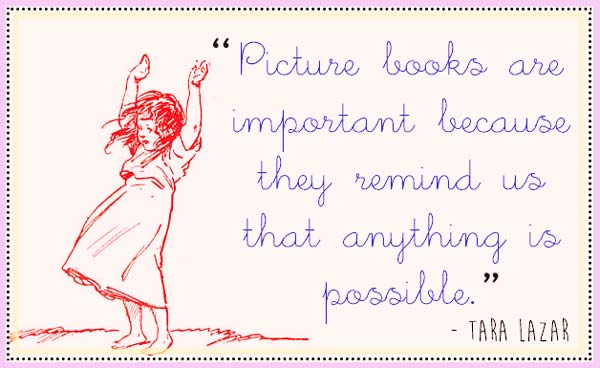
Isn’t it wonderful? (I imagine that’s a little girl doing “the wave” with a wave.) Feel free to use the image quote yourself!
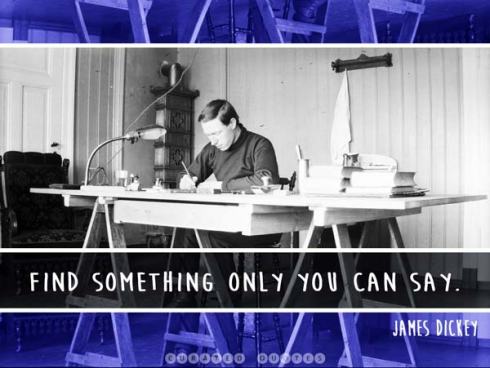
CuratedQuotes.com categorizes all these lovely quotes for us. They have a plethora of profound, beautiful quotes prêt-à-porter, for use in your social media communiques. (Those are such fancy-schmancy words! But when quotes look so fancy-schmancy, you need to keep up.) Here are 57 awesome quotes about creativity, like this one I picked just for you:
I’m so pleased CuratedQuotes.com contacted me.
They get us. They really get us.
And they will REALLY get you. They’re offering to make a custom image quote for one of my lucky blog readers! Just enter the quote you want to be picture-fied in the comments by October 1st. A random winner will then be selected. Good luck!
Good morning, writers! (Yawn! Stretch! Crack fingers. Sip tea.)
Let me tell you the reason for my uber-early morn, besides rousting my middle-schooler from her zombie-slumber. Not only do I have a SCBWI event at a “hipster cafe” (according to said middle-schooler), but I’m here to announce another debut by a friend! I’m pleased to share with you an adorable Noah’s ark tale, GOODNIGHT, ARK by Laura Sassi. Once again, a picture book writer makes a breakthrough with a new twist on a familiar theme.
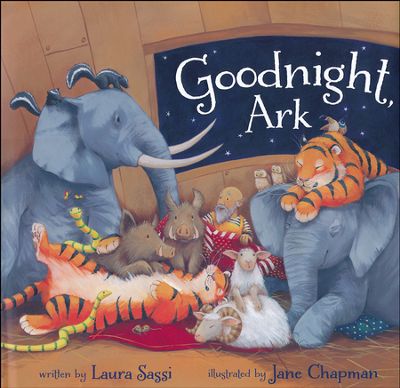
Laura, a lot of time on this blog is spent talking about inspiration and story ideas (because of PiBoIdMo). What’s the genesis of GOODNIGHT, ARK?
First off, I just love your play on words here. The Biblical story of Noah’s ark is indeed found in Genesis! And I’ve always loved the story of Noah and the flood and all those animals packed in the ark two by two. Indeed one of the earliest stories I ever wrote – just for fun as a seven or eight year old – was a funny retelling of Noah and his ark. It has illustrations and everything—including horrendous spelling. My mom saved it. Wasn’t that sweet of her? This new Noah’s ark story, however, has a different genesis—experience! As a fellow Jersey girl, you know we’ve had some mighty fierce storms in the past few years and my kids and dog did not like them. Indeed howling winds and pelting rain sent them tumbling into our bed more than once. However, I thought that a story about ordinary kids piling into an ordinary bed might be boring, so I kept flipping the idea until—Zip! Zing!—it hit me—I could set the tale afloat on Noah’s ark! I knew I wanted my story to rhyme, and so once I had my setting, it was fun to brainstorm which animals might pile in and what might happen when they overloaded poor Noah’s bed.
Such an adorable idea! My kids are always crowding into my bed, and I remember doing it myself as a kid.
Did you have any hesitations about writing in rhyme? You know, because we hear so often not to do it because it’s difficult to do well.
Actually, I did not. Some stories are just meant to rhyme. For GOODNIGHT, ARK, I used the rhymes to create page turn riddles to encourage young readers to guess what will happen when page turns. But writer beware! You better make sure you have a good ear for it because creating good rhyming verse is complicated. You not only need to follow your established meter, you also you need to make sure your rhyme and meter are not driving the story. There is nothing worse than forced rhymes where words are inverted to make the rhyme or meter work, or where the plot has to go in awkward directions in order to rhyme. Stay away from that kind of rhyme!
You’re so right, some stories are meant to rhyme. And it’s good to follow your instincts for a story. I often say that the “gut” is a writer’s best friend. This business is so subjective. You can’t please all the readers all the time, so be true to your vision. 
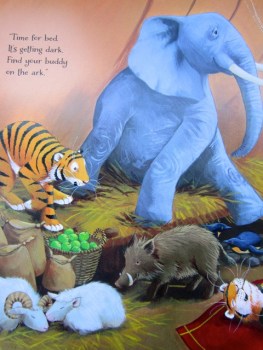 How did you land this debut contract?
The first key to opening that contract door was to find an agent who believed in my writing. The second key was not settling for what I thought at the time was my best effort, but pushing myself to take the manuscript to the next level before subbing it to publishers. The third key was sending GOODNIGHT, ARK to small, but well-thought-through sub list. For several months my agent and I heard nothing, then all of a sudden there was a flurry of interest. The manuscript ended up going to three acquisition meetings and getting two offers! In the end I chose Zonderkidz because I loved their vision for the story which they saw as a perfect piece to bridge both the Christian and broader secular markets. And then I was completely over the moon when, soon after signing the contract, the editor emailed me to say that Jane Chapman had agreed to illustrate it!
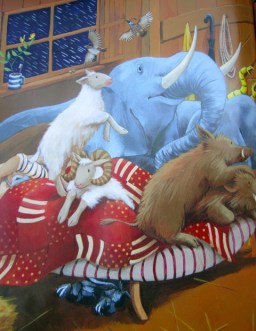 WOWZA! You hit kidlit gold there! Every author dreams of getting a top-notch illustrator attached to their project. Did you go thru the roof of the Ark when Jane Chapman said “yes”?
I first encountered Jane Chapman’s work when reading Karma Wilson’ BEAR SNORES ON to my children when they were little. And I LOVED the way she rendered Karma’s little creatures and that big bear with such warmth and sweetness. I couldn’t wait to see how she would depict the frightened tigers, skunks on board the ark in my story. I had no doubt she would do a wonderful job and I was right! Her lovely lantern-lit illustrations are rich and engaging. And here’s a funny tidbit: Shortly after I found out that Jane had signed on to illustrate GOODNIGHT, ARK, I read an interview with Jane Chapman over at Joanne Marple’s blog. At one point Joanna asked Jane if she had any favorite animals that she loved to draw. Jane answered something along the lines that she’s often commissioned to draw bears and mice, but that she’d really love the opportunity to draw some other more unusual animals such as ostriches…or WILD BOAR! (Well, there are wild boar in GOODNIGHT, ARK, so when I saw that I smiled because I knew, or at least hoped, that Jane was just as excited about this project as I was.) GRUNT! SQUEE! (That’s me trying to sound like an excited boar!)
What a cool surprise!
Speaking of such, what’s one of the surprise bonuses of the recent publication of your book?
This is an easy and wonderful answer for me. Special mother/daughter bonding time! I had no idea my nine-year-old would be so excited about the publication of GOODNIGHT, ARK. From theme-based cookies to celebrate the launch, to being my sidekick at book signings, I’ve loved the extra time she and I have spent together doing GOODNIGHT, ARK things. For example, this past Saturday, she accompanied me to a book signing at a lovely independent book store just north of us. She helped the children settle down, then took pictures while I read the story. Afterwards, she helped hand out the craft, and then (and this is my favorite part) completely of her own accord, she gently walked around to each child with the skunk puppet I’d brought along to help me read the story, and asked each child if they’d like a chance to pet the skunk. The children LOVED that! And so did I! In a couple of weeks my fourteeen-year-old will be accompanying me on a road trip down to Lexington, VA to do double book signings. I hope that will also be a special mother/son bonding trip. (With skunk in tow, of course.)
Awesome. I love how your kids are involved. My middle-schooler says “yeah, yeah, Mom” when I get excited about a manuscript. Then she asks for a grilled cheese, stares at it while I read, and then exclaims, “Mommy, that story is too cheesy, just like this sandwich.” Why do I bother to wake her?
Thanks so much for sharing your story with us, Laura! And I understand your publisher will be sharing the book with us!
Comment below once for a chance to enter the GOODNIGHT, ARK giveaway. You must have a US address (and not a PO Box). You have until September 28th to enter!
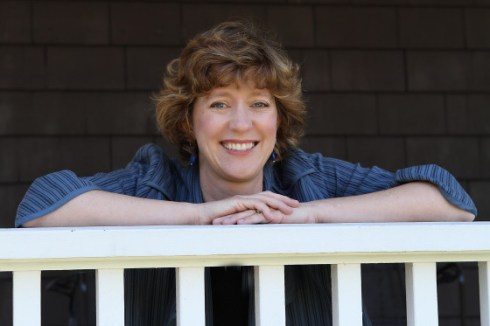
Laura Sassi has a passion for telling humorous stories in rhyme. She writes daily from her century-old home in New Jersey where she lives with her husband, two children, and a black Cockapoo named Sophie. Her poems, stories, articles, and crafts have appeared in Highlights for Children, Cricket, Ladybug, Spider and Focus on the Family’s Clubhouse and Clubhouse Jr. and elsewhere. GOODNIGHT, ARK is her first picture book. Visit her at LauraSassiTales.wordpress.com.
September should be “giveaway month” here on the blog, since we’ve got a bounty of books ‘n’ stuff. The winner of THE LAKE WHERE LOON LIVES was Carol Nelson, who was notified, and who exclaimed that she never wins anything. I was tickled to prove her wrong!
And today we’ve got yet another giveaway, from a long-time blog reader and PiBoIdMo participant, Lori Alexander. Her debut picture book, BACKHOE JOE, is being released TODAY! A round of applause for Lori! I sat down with her to discuss the making of a debut. (Well, I sat HERE, while she sat THERE. We did not sit together, although I would have loved to. I mean, look at her! Isn’t she adorable?)
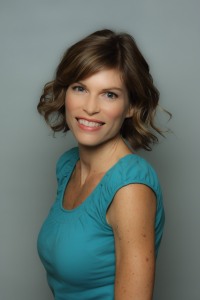 Lori, there are many truck books on the market because they’re so popular with young children. (In fact, once an editor told me not to write a truck book because of others already out there!) Tell us what makes BACKHOE JOE different and special!
You are right, Tara! There are lots of truck books. When my son was younger, he was crazy about construction. He wore truck shirts and slept on truck sheets and had truck birthdays. We pulled the car over for close-up looks at construction equipment (which set an exhausting precedent on cross-country trips, with me wishing my son had been born a dinosaur fanatic instead. No stops!). We also sought out as many construction books as we could get our hands on. After a while, they all seemed similar to me: a bulldozer pushes, a dump truck dumps, an excavator digs. A playground is built at the end. To mix it up, my son and I had lengthy conversations about what we would do with our own backhoe. Our backhoe could scoop Legos into a pile, dump dirty laundry into the washer, and drive all the neighborhood kids to school (that front loader is roomy!). These dreamy discussions led to the kernel of the idea for BACKHOE JOE which is about a boy who tries to adopt a “stray” backhoe. So, like pirate books and dinosaur books and princess books, BACKHOE JOE joins a crowded subject, but I’m hoping he will dig out some space of his own on the bookstore shelves.
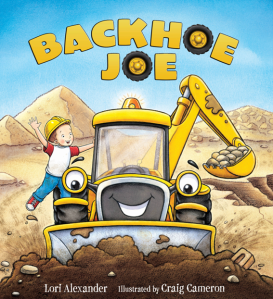 I’m sure he will! (I mean, look at him! Isn’t he adorable?) And that’s what we all have to do, take a common theme and make it unique! I love the idea of a truck as a pet.
Is this the project that landed you an agent? How did you pitch it?
That is something you hear editors ask for…a fresh twist on a common theme! With Backhoe Joe, it took me a few years to get it right. My early drafts were about a boy asking for a backhoe for his birthday, through a series of letters to his parents, à la I Wanna Iguana. I received some positive feedback from a small publisher, who liked the concept, but wasn’t sold on the letter format. Many more months of big-picture revisions as well as tiny tweaks lead to the current version. I received some positive feedback from agent Mary Kole during a webinar critique, and that gave me the boost of confidence I needed to begin querying agents. I queried with BACKHOE JOE but had two other PB manuscripts ready to go, in case an agent was interested. Lucky for me, one was! And you asked how I pitched it. I believe in the cover letter I said something completely cheesy, like “it’s FANCY NANCY for boys!”
Well, that would certainly grab my attention!
What can you share about your debut book experience that’s been most surprising?
While writing BACKHOE JOE, I really tried to nail the page breaks. I studied the page turns in my favorite picture books and read blog posts about layout (Tara’s “Picture Book Dummy, Picture Book Construction: Know Your Layout” is one of my favorites). I submitted BACKHOE JOE to my agent divided into 16 spreads. I thought she might want to remove the breaks and submit it to publishers in paragraph form, but it never came up. I was surprised (in a good way!) when my editor at Harper agreed and the final layout of Joe was exactly how I envisioned it. All that homework paid off!
Another surprise was, although I should have known better, having one sale under your belt doesn’t make it any easier to sell the next book. Rejection—a thing of the past? Not so!
Ha, don’t I know it! They never stop, but they do get easier to swallow. (However, I am not advocating eating your manuscript.)
What’s your favorite line in the book?
My absolute favorite line is on the last page, but I don’t want to spoil anything. I will say Craig Cameron did a fantastic job bringing Joe to life and he set-up the twist ending beautifully.
Aha, I LOVE a twist ending! I think it’s so important for a successful picture book, to surprise your audience, to extend the story beyond the story. Let them imagine what happens next (plus set yourself up for a sequel)!
My second favorite bit is when the main character, Nolan, tries to train Backhoe Joe like he’s a dog. But naughty Joe revs at the mailman, buries his cone in the flowerbed, and digs in the garbage. It was fun to think about the ways a dog and a construction truck might behave similarly.
Sounds hilarious!
OK, one last question. I have a list of fun words I posted recently, which has become quite popular. What’s your favorite word?
This time of year, my favorite word is monsoon.
Yeah, I love ooh sounds!
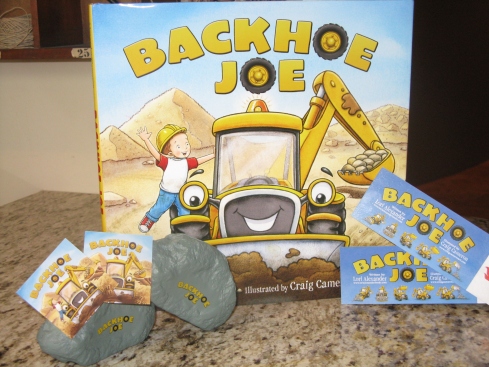
And now our readers are gonna make ooh sounds (corny segue, Tara) because Lori has a BACKHOE JOE prize pack to give away! Just leave one comment below by September 23rd!
The prize pack includes a signed copy of BACKHOE JOE, bookmarks, stickers, and squishy foam stress “rocks”. (Hey, I could use some of those! Remember, the rejections never cease!)
Thanks, Lori!
Lori Alexander lives in Tucson, Arizona, with her husband and two rock-collecting kids. Her family always brakes for road construction so they can admire the dozers and diggers. Lori still secretly hopes a backhoe will follow them home. She is represented by Kathleen Rushall of Marsal Lyon Literary Agency. This is Lori’s first picture book. Visit her at LoriAlexanderBooks.com.
by Sudipta Bardhan-Quallen
 It’s back to school season here in New Jersey (or, outside Philadelphia, as I typically refer to it) and that means big changes in my household. All summer, my kids and I are bums. We hang out at the beach, at the pool, at the mall. We travel, we sleep in, we do nothing. Summer is heaven.
But come September, my children’s lives change. Gone are the no schedule, no stress days and in their place we have wake up alarms, agenda books, and deliverables (and, it seems, a LOT of laundry!). The kids aren’t the only ones who go back to school—as a children’s book author, the school year means that I go back to school as well.
Every year, between school visits, Skype visits, and events like Dot Day or World Read Aloud Day, I connect with about 100 different schools all around the world. Because I spend so much time with school kids, I end up doing quite a bit of teaching, especially teaching writing. Which happens to be a completely different skill than actually writing.
There is a very stupid expression that you sometimes hear people throw around: “Those who can, do. Those who can’t, teach.” I want to be very, very clear here: that is one of the dumbest things I’ve ever heard. Not only is it disparaging, inflammatory, and demeaning, it also has the distinction of being very WRONG. I definitely knew that before I personally started working with schools, but now that I teach on a regular basis, I can tell you that those who teach can do better than anyone else.
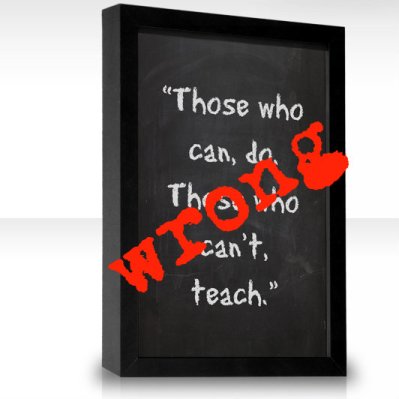
It has to do with the nature of teaching. In order to teach someone a skill, you have to know it so well that you can explain every step, even the ones you do automatically or on muscle memory. Here’s an example: when I was in graduate school, I bought a brand new Mustang that I couldn’t drive. Because it was a stick shift and I only knew how to drive an automatic. So I had a friend try to teach me how to drive stick. We got in my car, I started it up, and I asked him what to do next. He said, “OK, now drive.” I looked at him blankly. “Just don’t stall the car,” he added. I had no idea what that meant. So he said, “Don’t ease off the clutch to quickly. Or too slowly!”
At that point, I threw him out of the car. He, to this day, doesn’t understand what had upset me.
He knew how to drive a manual, and things that I needed to know—how to properly come off the clutch when changing gears, how to tell when to shift up or down, etc.—were things he’d stopped thinking about. So he couldn’t teach me to do them because he hadn’t been thinking about all those little steps that you do to succeed that once you’re successful, you completely forget about.
(For the record, I can now totally drive a stick.)
When I started teaching writing, I struggled with this same thing. I thought to myself, How can I teach something that I just DO? Trust me, this was very difficult to figure out. But the more I did figure it out—the better I got at teaching others how to write—the better I actually got at writing. Just like my friend who failed at teaching me how to drive my Mustang because there were so many things he was doing on autopilot that he couldn’t explain, as writers, we do that same thing. When you get to a certain point in your writing journey, you don’t even think about certain things like how to conceptualize a complex character or add layers to your plot, you just do it. But if you try to teach someone else how you do what you do, you have to break down every action into baby steps so that you can show your students how to mimic your actions. This forces you to think through your methods, and in the process, refine them even more.
So even if you’re not at the point in your publishing career where you are teaching, I’d like to encourage you to think like a teacher to become a better writer. For example, instead of saying, “I’m going to create a charismatic main character,” I’d ask you to analyze what steps you’d take to do that, like:
- Start with something familiar
- Add some positive unique features
- Give the character some flaws that make him or her relatable
- Give him or her positive relationships (family, best friend, etc.) and negative relationships (nemesis, villain, etc.)
- Temper every extreme (like “good” or “bad”) with something that brings it back a notch (like “good but hates kittens” or “bad but rescues kittens”)
The more you go through this process of treating your writing objectives like lesson plans, the deeper you’ll understand what you’ve done when something work—and what you may have left off inadvertently when something doesn’t work.
When you’re a good teacher, your students will benefit. When you yourself are your own student, your teaching skills make you so much better at doing.
Happy Back to School!
 Sudipta is an award-winning author of over 40 books and the co-founder of both Kidlit Writing School and Kidlit Summer School. Her books include DUCK DUCK MOOSE, TYRANNOSAURUS WRECKS, ORANGUTANGLED, and over thirty more books that have been acclaimed by the Junior Library Guild, the California Reader’s Collection, the Bank Street Books Reading Committe, the Amelia Bloomer list, and many more. Find out more about her by visiting Sudipta.com or her blogs Nerdy Chicks Rule and Nerdy Chicks Write.
Sudipta’s new class: Picture Book A to Z’s: Plotting in Picture Books
The Picture Book A to Z series is designed to be a collection of master level classes that cover all of the fundamentals of picture book craft. While each class is complete on its own, taken together, the series will teach you everything you ever wanted to now about picture books- and a lot more!
The ability to craft a strong picture book plot is one of the factors that separates unpublished writers from those who consistently sign publishing contracts to see their work in print. This course will teach you the essentials of creating compelling plots, starting with Arcs, Beginnings, and Climaxes — then literally taking you through the alphabet. Each topic will be explored in depth, both in the lessons and in the discussion forums and webinars. The writing exercises that are a part of of the course are designed to help you apply the lessons to your own writing seamlessly and immediately. By the end of the course, you will never look at plotting the same way again! The first course in this series, Plotting in Picture Books, will begin on October 6, 2014.
Bonus Critique: Register for Plotting in Picture Books before September 20, 2014 and receive a free picture book manuscript review and 20-minute Skype session with Sudipta Bardhan-Quallen, redeemable within six months of the course’s completion.
Thanks, Sudipta! And now for the giveaway…either a 20-minute telephone/Skype PB critique with Sudipta or one of her signed books. The choice is yours. Just comment once below by September 16th to enter!
Before we talk cumulative tales with guest author Brenda Reeves Sturgis, it’s time for a little blog business. The winner of EXTRAORDINARY WARREN is:
SUSAN CABAEL!
Congratulations…and be on the lookout for an email from me.
Now let’s get to a LOON-y interview with Brenda…

Your newest book, THE LAKE WHERE LOON LIVES, is a cumulative tale (like The Old Woman Who Swallowed a Fly), where each new scene builds upon the previous ones, all repeated in the text. What inspired you to write a cumulative picture book…and what special considerations does a writer have when writing such a story?
I didn’t set out to write a cumulative tale, but just set out to write what I heard in my head and in my heart.
I live on a lovely little lake in Maine and I am always elated when the loons come back to the lake in the spring. Their haunting hoots and wicked wails always leave me breathless wanting to hear more, and so when the story came to me as a gift in the middle of the night (which is my usual writing time). I just began writing, and writing and writing and what appeared was THE LAKE WHERE LOON LIVES.
In a cumulative story, each line builds and stacks on the previous sentence, and loon is written in rhyme so that made it even more challenging because every time I changed a word, the story would start to crumble and I would have to rewrite not only the sentence that I was revising but also all of the sentences before it, so that I would keep the right rhythm and meter.
I wanted to depict what a day in the life of a loon might be like, so I put in chicks, a fly, a fish that would snap at the fly, a boy on a dock that would give fishing a try, a cast, a struggle, and a splash and a swish, and then after a HUGE RUCKUS, the story starts to unwind where Mama Loon finds the SPOT on the lake that she loves best. She tucks her chicks in tight, and just like all loving Mamas do, she reads her babies a goodnight story before she settles in with a nice cup of tea by her campfire.

Little did I know when I wrote it that the illustrator would illustrate LOON so totally different than I had pictured, and I am so very glad that she did. Because in this loon story mama loon LOVES to waterski, she is daubed white and black because her chicks used her as a canvas with Loon White waterproof paint. I think the illustrator, Brooke Carton did a fabulous job with her loose illustrations which compliment the tight text very nicely.
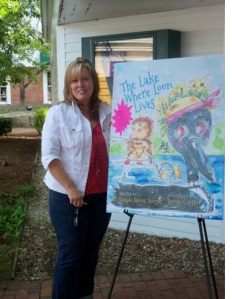 I hope your readers will enjoy reading THE LAKE WHERE LOON LIVES as much as I enjoyed writing it. Islandport Press has been wonderful to work with, and they had a book launch for LOON at The Maine Audubon Society in May, and I’ve been busy with signings and events almost every weekend since.
Why are cumulative tales beneficial for young children?
Cumulative stories teach word repetition and children therefore know what to expect in the story, which then helps them learn languague and pick out familiar words. This enhances their reading abilities, making for a stronger student and a more confident learner. A cumulative story is a perfect tool to teach a reluctant reader.
Tell us about Islandport Press. How did you find them and why was this story such a good fit for their list?
I’d heard about Islandport for years, and when I started researching their books I saw that they were Maine-and-New-England-themed, so on a whim, I submitted to them on my own, then sent an e-mail to my agent Karen Grencik saying, “By the way, I submitted to Islandport!” She answered back, “GREAT, fingers crossed!”
I got the acceptance e-mail while sitting in the Biddeford Library. I went outside, sat on the curb and cried, because up until that point, I didn’t know if I got published on a fluke, or if I had any kind of talent or chance at another book at all. It was a wonderful process, and I am so grateful to Dean Lunt the publisher, and Melissa Kim my editor. They have an amazing marketing staff, they are kind and thoughtful and amazing to their authors!
Also, on the back of LOON, something I am most proud of is a nice blurb by author Chris VanDusen.
What’s next for you, Brenda?
TOUCHDOWN, after 7 years, after winning Smart Writers, after being rejected 50 times (not once because of the writing but because of the marketing “hook”) has become a finalist for the MeeGenius Author Challenge, and whoever wins will be awarded $1500.00.
Good luck, Brenda! And thanks for giving away a copy of LOON to our blog readers.
Comment below by August 29th or a chance to win! And feel free to ask Brenda questions about cumulative stories or her work.
Is your goal to get a picture book published?
Yes? Awesome!
So I’m here to tell you, write a picture book.
Ha! That seems like DUH advice, doesn’t it?
But I don’t want you to waste your time, like I did, writing for magazines, trying to build publishing credits, if magazine writing isn’t your ultimate goal. Magazine writing is a completely different skill, and while credits are nice, they are not going to make or break you. Magazine credits prove you’re a professional and that you’ve been through the editing process, but they won’t convince anyone to buy your manuscript if it’s a sub-par story. You need to hone your picture book skills, and that only comes with writing dozens of picture books.
Agent Ammi-Joan Paquette takes clients based on their submission, first and foremost. “For me, the number one focus is on the writing: the voice, the story, the way the language sparkles and draws me in. If you’ve got that, I’ll follow you just about anywhere. All the writing credits, awards, and fancy degrees in the world—on their own—won’t make me take on an author. It’s about the writing, pure and simple.”
I received some misguided (but well-intentioned) advice when I began writing for children. I was told to place fiction in magazines in order to build my writing resume. So I gave it a shot. Then I found out how difficult it was to place stories. Not any less difficult than getting a book published! (I don’t know why I thought it would be.)
Your story must fit the theme of the magazine issue, which means you’re better off reviewing editorial calendars first, then writing to fill that need. Instead, I wrote what I wanted to write and then found it was only appropriate for a single issue, to be published in three years’ time! Magazines are often booked far in advance. Back in 2008, if I were to place that story, it would have been printed in 2011. Yikes!
Now that’s probably an extreme example, but it’s an important lesson I learned. I was veering off my intended path to publication.
A magazine story has to be more descriptive than the language in a picture book because there are far fewer illustrations to accompany the text. You’re often writing for a single spread with no page turns, and page turns are crucial to picture book pacing, humor and reader anticipation. So I was writing for a wildly different format and not for the goal I desired: to get a picture book published.
Some will argue that writing for credits is necessary prior to getting a book deal, but I say that is incorrect. As long as you have a professional-looking, easily found web presence and membership in a professional writing organization like SCBWI, that’s all you need in your bio to prove that you’re “serious”. The thing you need most of all? You know—a winning manuscript! I had zero children’s publishing credits prior to getting my agent and a book deal. I’m definitely not alone in this.
Children’s magazines are wonderful, but if they’re not your goal, you don’t need to use your precious writing time in this manner. Want a picture book deal? Write picture books! (I say books, plural, because if an agent is interested in your manuscript, that agent will ask for more of your work.)
And I hope that’s not DUH advice!
Do you agree or disagree? Share your opinion in the comments!
I know what you’re thinking—where has Tara been all July? (Well, maybe you’re not thinking that. Maybe you’re daydreaming about a fro-yo fix. And who could blame you?)
Well, it’s August and I’m back with an extraordinary interview. The talented author-illustrator Sarah Dillard turned what she thought was a picture book into an adorable early-reader chapter book. What did it take to get EXTRAORDINARY WARREN published? Let’s find out while we devour our fro-yo…
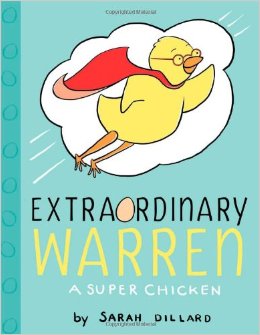 Sarah, what exactly made you realize that WARREN was destined for more than a picture book?
When I started working on Warren, I intended it to be a picture book but I felt that the story and ideas that I wanted to tell with him were a little more complex than the picture book format would comfortably allow. This is not to say that there are not complex picture books because there certainly are. But with Warren, it just seemed like he needed a little room to spread his wings. I didn’t worry about chapters though until a few drafts in. At that point it felt like there were natural breaks in the story for chapters. I have to say, when I am working on something I don’t automatically think “I am writing a picture book or this is going to be a chapter book.” I focus on the character and the story and let it unfold and then see what fits it best.
That’s great advice, to focus on character.
Thanks, Tara. I also wanted to add, that as picture books seem to be skewering younger, there is a great opportunity for illustrated early readers and chapter books to fill the gap for the beginning reader.
So what inspired Warren’s creation? How did he hatch?
Warren began as a doodle of a chicken looking at an egg. He looked curious to me and felt like a character who was looking for life’s answers. Did I draw the egg first or the chicken? I’ll never tell!

My favorite spread in WARREN is the one with the hill in separate panels. How did you come up with that unique visual concept?
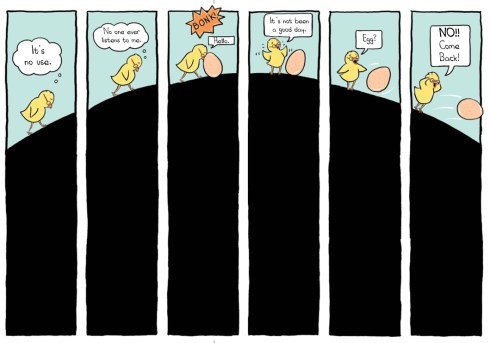
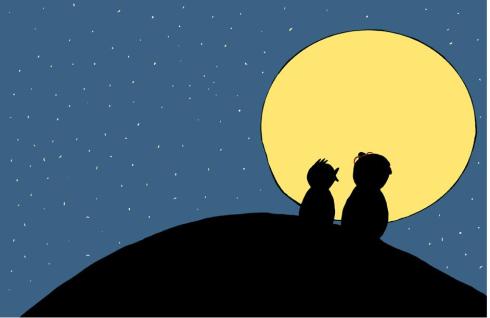
That is one of my favorite spreads too! When I started thinking about how I would do the art for this book, my art director suggested a limited palette—with three colors plus black and white. I was hesitant at first but when I realized that I could use black as more than just an outline, the art took a fun graphic turn. I felt the use of black for the hill added just the right drama for this spread. I also liked the idea of having basically one hill but several panels that show Warren’s progression up and over that hill. I think it works both literally and figuratively for this part of the story.
How different is it to write/illustrate your own book as opposed to just being an illustrator on a project?
I think it is quite different to illustrate my own book than illustrating someone else’s work. Illustrating someone else’s story is a huge responsibility. It is kind of like having someone say here is my beautiful child, please raise it. I am very conscious of wanting to do justice to the story as the author might have envisioned it while also bringing my own sensibility to the story.
When I am illustrating my own work having the art serve the story becomes the primary focus. I’m thinking of the images and what part they will have in telling the story as I write, so the art and the words feel inseparable to me. I think when I am working on my own books I have a stronger intuitive sense of what the story will need and am more willing to take risks to give it that. For instance, WARREN is done digitally and in a style quite different than any I have worked in, but I think it was the best approach for the book.
We’re hearing a lot about how editors want character-driven stories. What about Warren’s character makes him especially appealing?
That is a great question, and I’m glad that you find WARREN appealing! In creating WARREN, I tried to think about things that I thought about as a child, and probably still think about; the big questions—Who am I? What is my place in this world? I think we all want be special in some way but worry that maybe we are not. WARREN taps into that and hopefully it makes him someone that the reader can relate to and cheer on.

 And…are there more WARREN books planned for the future?
I’m happy to say YES! EXTRAORDINARY WARREN SAVES THE DAY will be published in October. I don’t want to give too much away, but I can say that this book will deal with another of life’s big questions. Finally, we will learn, once and for all, why the chicken crossed the road.
Thanks, Sarah!
I’ll let my blog readers know that you’re giving away a signed copy of EXTRAORDINARY WARREN: A SUPER CHICKEN—they just have to leave a comment by August 8th. Hey, that’s even better than fro-yo!
Sarah Dillard studied art at Wheaton College and illustration at Rhode Island School of Design. She lives with her husband in Waitsfield, Vermont. For more about Sarah and her books, visit SarahDillard.com.
 by
by As an author who’s slowly been transitioning from novels to picture books (my first picture book will be out in March 2015), I’ve realized that picture book techniques have started influencing my novel-writing process. Here are a few examples.
1. Brevity and Word Choice
This is probably the most obvious connection. When you’re used to working with 500 words, you tend to get a little pickier about the words you use in longer projects. Even when I have 50k words to work with, for example, I still find myself making sure to cut out unnecessary phrases (particularly unneeded dialogue tags) and using strong verbs and interesting nouns to make each sentence count.
2. Tying the End to the Beginning
This is my favorite picture book technique. In picture books, the ending almost always echoes the beginning of the tale. I love using this approach in novels, reflecting something from the opening chapter in the closing chapter in a different context. This technique shows us that the character has grown and changed, and it also makes the story feel cohesive and satisfying.
3. Repeating for Emphasis
Repetition can be great in picture books, but in novels it can feel like telegraphing. A strong repeated image, however, especially one whose meaning deepens over the course of the story, can work well if it’s revisited throughout the novel. It can help show how the meaning of that image or experience has changed for the character over time.
4. Using the Senses
In picture books, we have to be mindful of not focusing too much on the visual details so that we don’t step on the illustrator’s toes. That means we have to use other senses to give the story depth. I try to use a similar multi-sensory approach in my novels, so I’m not simply describing how things look to the characters, but I’m also thinking about the smells, sounds, and textures around them. I’ve also found myself using a lot of onomatopoeic words—kapow!
For those of you who write in longer and shorter formats, how do you find the two influencing each other? What’s your favorite picture book technique to use in novel-writing? Please comment below and join the conversation!
.
 Born in Poland and raised in the United States, Anna Staniszewski grew up loving stories in both Polish and English. Currently, she lives outside Boston with her husband and their crazy dog. When she’s not writing, Anna spends her time reading, daydreaming, and challenging unicorns to games of hopscotch. She is the author of the My Very UnFairy Tale Life series and the Dirt Diary series. Her newest novel, The Prank List, released on July 1st from Sourcebooks. You can visit Anna at www.annastan.com.
It’s my birthday, but I’d rather not be reminded, because I’m slipping ever so closer to eligibility for the “AARP Junior” card, as my father likes to josh. (Thanks, Pops.)
Last year on my birthday, something fun happened—my agent and I announced the acquisition of LITTLE RED GLIDING HOOD by Heidi Kilgras at Random House Children’s. And this year, Meredith Mundy and Merideth Harte of Sterling have stepped up to the birthday cake. They have acquired NORMAL NORMAN, a story that began with just the quirky title. (Always have pen and paper on you, folks. I jotted it down on the grocery check-out line.)

Many thanks again to Ammi-Joan Paquette for brokering the deal. Here’s the full scoop:
Who here has yet to pay a visit to THE MONSTORE? It’s okay, we’ll wait. (You won’t regret it!)
Once you’ve stopped off to visit Tara Lazar’s deliciously quirky debut picture book, you will of course want to know what else she has on the horizon. And the answer is: much, much more! The next book to drop will be I THOUGHT THIS WAS A BEAR BOOK, coming from Aladdin in summer 2015.
And today, I’ve got still more good news—which is really the reason we’re here today. Tara Lazar’s brand new picture book, NORMAL NORMAN, tells the story of Norman, a little creature who does not want to do all the normal things that creatures do. He wants to be different! Unique! Unexpected! Not everyone likes this plan… not at all. What is a think-outside-the-box creature to do?
I’m delighted to say that NORMAL NORMAN has been acquired by Meredith Mundy and Merideth Harte at Sterling, and that an illustrator is already on board: the talented Stephan Britt. Congratulations, Tara—and here’s to Norman!
–Joan
What’s interesting about Norman is that I never specify what kind of animal he is in the text nor the art notes. I leave it completely to S.Britt. So I’m excited to see what animal he chooses–if Norman’s even a real animal at all!
That’s why it’s fun to keep yourself open to possibilities in your manuscript and never dictate too much in the art notes. Norman being an amorphous being leaves plenty of room for the illustrator to go wild! This kind of freedom will no doubt lend an extra layer of fun to the book.

by Ashley Fedor, Editor and Director of Content at MeeGenius
 In the next few weeks MeeGenius, the #1 app with over 700 e-books, will be kicking off our Author Challenge—an open challenge for aspiring authors. I wanted to let you know about it in advance and invite all aspiring authors to participate. I exchanged some emails with Tara prior to writing this post and we thought it would be a great opportunity to share some aspects of our publishing process.
At MeeGenius, the publishing process begins—where else?—in the slush pile! As the editor, I read through hundreds of submissions, looking for stories that I know will resonate with our readers. This could mean unique characters, an engaging voice, a topic that will be particularly powerful to parents, or simply great writing.
Once I decide to acquire a manuscript and the contract is signed, then the fun part begins! I work with the author on 1-3 editorial passes. We collaborate to take the manuscript from something good to something great. This can take anywhere from one week to several, depending on our timelines.
Once we have a finished manuscript, I assign it to an illustrator and provide art direction. The illustrator sends a round of sketches, which I review with an eye for editorial accuracy (if a character is supposed to be wearing a dress but she’s wearing snow pants, we need to fix it!) as well as layout (if it’s a landscape picture, will the text fit on the page?).
At the same time, the manuscript is sent out for narration and cues (word highlighting). Once all assets are completed, it’s time to build the book! Our production team works tirelessly to create beautiful e-books, QA them across platforms to catch any issues, and finally, to send the book out into the world.
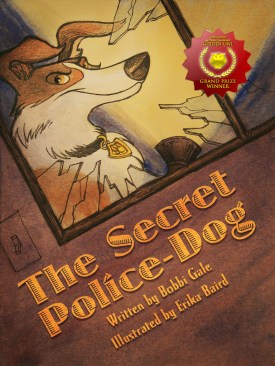
Previous Winner: The Secret Police Dog
Thank you so much Tara for giving us the stage here to share this exciting opportunity with your audience.
Here’s a post by our CEO Wandy Hoh that shares what we’re looking for in “MeeGenius authors”.
All other challenge details can be found here.
The challenge kicks off next Monday, June 16th!
Good luck!





 Writing for Kids (While Raising Them)