You are currently browsing the category archive for the ‘Picture Books’ category.
Oh, rejection!
We all face it. Even published authors. Even Jane Yolen!
This is how I consider rejections now, after seven years in the business:

But when you’re still unpublished, rejections somehow hurt more.
Besides applying a baking-powder-and-vinegar salve three times daily, how do you ease the sting?
Welcome author Emma Walton Hamilton. She will teach you what those rejections really mean and how you can use them to your advantage.
 by
by Manuscripts are like children–we birth them, nurture them, pour our heart and soul into helping them be the best they can be. Then we send them into the world, praying they have what it takes to succeed. If we’re lucky, and we’ve done our job right (we hope), they’ll fly. But inevitably, we–and they–must muddle through setbacks and tests of resolve before they can claim their place in the world.
One of those setbacks is rejection. Manuscript rejections are an unavoidable part of the writing life…but that doesn’t mean they aren’t painful. It also doesn’t mean they can’t be converted into learning opportunities. This is such an important distinction that Julie Hedlund and I devote an entire module to “Interpreting Rejections and Dealing with Feedback” in our new Complete Picture Book Submissions System, which we created to support picture book authors through every step of the submissions process, since we know firsthand how challenging that process can be. (Check out Julie’s recent blog post exposing one of her earliest query letters.)
Converting the experience of rejection from personally devastating to professionally useful begins with bearing a few important things in mind:
- Manuscripts get rejected, not writers themselves. Meaning, this is not about you–it’s about the manuscript not being a right fit with that agent or publisher.
- It’s business–not personal. The reasons for the rejection may in fact have less to do with the quality of your writing and more to do with the focus of the agent or publisher at this time, or the limitations of their current resources.
- Hundreds of famous children’s authors received rejection letters on what later became their most successful manuscripts, including Dr. Seuss, J.K Rowling, Madeline L’Engle, Stephanie Meyer, Meg Cabot, C.S. Lewis and many, many more. (Check out Literary Rejections if you don’t believe me, or could use a little company for that misery.)
- The wrong fit at one place can be the right fit somewhere else. Moreover, that somewhere else will serve you and your manuscript better than the first place would have, because they “got it.”
- There may be a gift accompanying the rejection at best, insight into how to improve your manuscript or query, and maximize your chances of nailing the next submission; and at least, the opportunity to strengthen your commitment and resolve. (An old acting teacher of mine used to say, “Never mind the talent, do you have the tenacity?” This is just as relevant for writers.)
Maybe the rejection includes some feedback worth considering (although it’s important to distinguish between meaningful feedback and form letter feedback, which is something else we focus on in the Complete Picture Book Submissions System… it’s easy to confuse the two.) But even without feedback, every rejection is an opportunity to revisit your query and/or your manuscript. Is it really submission-ready? Is it structurally sound, formatted correctly, typo-free? Is every word essential?
Finally, it’s important to take care of yourself during this time. Sending your creative work into the world can make you highly vulnerable, and it’s easy to lose perspective. Do whatever you do to nurture and reinvigorate yourself: take walks, meditate, see a movie, go shopping, get a massage. Seek the company and communion of fellow writers for support, learning and perspective. Most of all, keep writing–generate new material to keep building your portfolio, stay in the flow, and avoid having all your eggs in one basket. That is, after all, the real work of being a writer.

Emma Walton Hamilton is a best-selling children’s book author, editor and writing coach. With her mother, actress/author Julie Andrews, Emma has co-authored over thirty children’s books, seven of which have been on the NY Times Bestseller list, including The Very Fairy Princess series (#1 Bestseller), Julie Andrews Collection of Poems, Songs and Lullabies, the Dumpy the Dump Truck series, Simeon’s Gift, The Great American Mousical, and Thanks to You–Wisdom from Mother and Child. Emma’s own book, RAISING BOOKWORMS: Getting Kids Reading for Pleasure and Empowerment, premiered as a #1 best-seller on Amazon in the literacy category and won a Parent’s Choice Gold Medal.
My books were too quiet.
Or that’s what I kept being told. Never mind that Margaret Wise Brown and Clement Hurd’s lullaby in prose GOODNIGHT MOON, a book about a bunny who stays in bed throughout the entire book, is and continues to be one of the most consistently best-selling books in history…according to publishers, quiet didn’t sell. My agent submitted my books to publisher after publisher and we heard the same words over and over. It’s too quiet. There needs to be more action. I always got great compliments on my art, but as much as they seemed to like the way I drew, nobody was hiring me to illustrate their books.

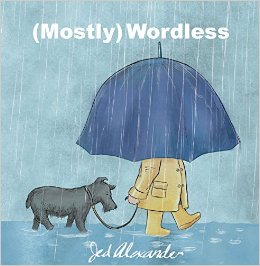
So I decided to make a book on my own terms. I would make a book that was everything that publishers said they didn’t want from me. Too quiet? My book was going to have hardly any words at all. Instead of one long narrative, it would be a series of short pieces and vignettes, most of which had no perceivable plot. Even the format was unconventional: rather than typical children’s book dimensions it was a square. Instead of the usual 32 pages, it was 52. It was everything publishers didn’t want but it was the book I wanted to make. And the only way it would see print was if I self-published it.
 To raise the money, I decided to use crowdfunding. I spent nearly a year researching everything I could about successful crowdfunding campaigns. I discovered that Kickstarter would be my best option. Though I had no experience in business or marketing, I came up with a marketing plan and budget. Though I had never made a video before, I shot my video on my iPhone and learned how to use the editing software on my Mac.
My goal was $7,000 dollars. Some of my friends told me this was too ambitious. That I was asking for too much. That I should set my sights lower. But this was how much I determined I would need to make the book that I wanted to make, and if I couldn’t make the book I wanted to make, I didn’t see any point in doing it at all. And if I failed, the only thing I stood to lose was the time I invested.
Once the campaign began, I got to work. I used every spare moment I had to promote my book. I spread the word on social media. I arranged an interview on a local radio station. I e-mailed everyone I knew.
My campaign succeeded beyond my expectations. Authors and illustrators I admired posted links to my project on their Facebook pages. My project became a staff pick on Kickstarter and one of their “projects of the day,” which meant that my video was featured on their home page. They even used my project as an example on their phone app. I raised over $10,000, well in excess of my $7,000 goal, and was able to use the extra money to enhance my book with extras like spot lamination and color endpapers.
While a few of my supporters were friends and family, most of them were people I didn’t know who had come to believe in my project. One of them was a small press publisher who offered to sub-distribute the book once I met my goal. The publisher would put their name on it, and with the legitimacy that a veteran publisher afforded, I could get the book into libraries and bookstores and I could get it reviewed.
I made some mistakes along the way but I’ve had the opportunity to learn from them. The book has opened many doors for me. It’s gotten a number of positive reviews. I’ve held signings and done lectures and taught classes. I’ve met a lot of wonderful people I wouldn’t have otherwise met.
But most important of all, my book is being read. And if you self-publish using crowdfunding you may not be the next J.K. Rowling, but I guarantee you will have readers. Because crowdfunding not only provides you the funds you need to publish, but it builds enthusiasm for your book and an audience that you wouldn’t have otherwise had. That book that everyone rejected, that no one was willing to publish will finally have readers.
And above all else, isn’t that the reason we do this? Because we love books so much we want to make them and share them and have others enjoy them? Because otherwise you’re in the wrong business.
Jed Alexander is the author/illustrator of (MOSTLY) WORDLESS, which he originally self-published with crowdfunding finances and which was then picked up by a small traditional publisher. He is represented by Abigail Samoun of Red Fox Literary. Find out more about Jed at JedAlexander.com.
Jed will also be co-teaching an extraordinary course on How to Self- or Indie- Publish with Crowdfunding starting March 23rd with Mira Reisberg. The course covers print, e-books, crowdfunding, marketing, social media, and much more.
 by Dev Petty
I wrote a whole post for this very blog some time ago about NOT writing and just thinking. I wrote about getting to the heart of your story idea in your head before you ever write a word. I believe in that process…big time. But it’s not how I wrote I DON’T WANT TO BE A FROG. That’s a different story. That’s the story of how a sort of basic story idea turned into one with legs…frog legs! In fact, it was the writing of FROG that taught me to slow down and think, to find the story thread before I started writing.

I knew I wanted to write a story all in dialogue. I wanted it to be funny. And I wanted it to be about a frog. I like frogs, it was that simple. Not much to go on, eh? Believe me, my first efforts on frog reflected just how thin the idea was. Frog went from animal to animal saying “I want to be like you…because…you’re furry (or you can fly or you can hop).” It was repetitive and a little hollow and NOTHING REALLY AT ALL HAPPENED. These are the sort of problems I usually suss out when I’m just thinking instead of writing, so I don’t usually have this situation. But there was something about the first draft I liked enough to keep at it.

This is when I stopped and realized I needed to answer my own critical, favorite story writing question.
“What is this about?”
The answer, as written, was “A frog who wants to be a rabbit or a cat or an owl.” And after a ton of rewrites and rearranging, it wasn’t getting any better on the page. So I stopped revising. I stopped writing. As I closed the laptop and started thinking, I realized it was a little deeper. The answer really was, “This is a story about a frog who doesn’t want to be a frog.” It’s about wanting to be something other than what you are. Now THAT’S a little more interesting. When I started thinking about it that way, the story opened up and it wasn’t anymore about cats or owls, it was about nature, it was about accepting your nature.
That answer allowed me to start thinking about the frog, the good parts, the bad parts, the way we all sometimes envy things about others that we can never, and probably should never have. The story was getting deeper, but still…nothing really happened. The frog went from animal to animal saying he wanted to be them and then the book ended. You’re a frog. Get over it.

Confession. I’ve tried to write novels. A bunch of em. I am a Viking at writing three awesome chapters and then running out of steam, throwing the laptop across the room and eating ice cream for a while. But I do it often enough that I’ve learned a few things. Newsflash Dev, your story has to have a PLOT and not just be a rambling treatise on frog existentialism. So I decided to bring a new character in…a wolf…who would act as a bit of a therapist, a reality checker who would point out the good parts of being a frog through his own nature. Once something happened, the wolf, my story had a turn and a direction and something, albeit small, happened. I hope kids will read frog and realize that everyone has things they want to change about themselves, and that’s a totally okay, natural thing to explore. But you also sort of have to accept who you are, find the bright parts about who you are and work with what you have.
I guess the truth is, I sort of violated most of my own rules of picture book writing in the writing of the one picture book I have out there. I kind of teased a good story out of a pretty mediocre one. But that’s ok too, it taught me a lot about finding that thread. It helped me develop a process…find the thread FIRST! Remember to TELL a story and not just muse.
Since we’re talking story threads, I thought I’d put down a few tools I use to try to figure out what I’m getting at when I’m developing a story idea in my head, before I start writing.
- I write a poem. It’s not the kind of poem anyone would ever, ever, ever want to read. But the lack of rules in poetry allow me to explore an idea without limitations. I usually write pretty long, stream of consciousness poems about my story idea and most of it will be total garbage. But usually, when I read it through, somewhere in there is a thread I can hold onto and start crafting a story around.
- Imagine your story as a trailer. I’d never thought of this one until I started watching a lot of picture book trailers and working on my own, for Frog. But when you have to introduce your character, a story problem, a plot twist and a possible solution- you’ve covered a lot of story elements and it’s pretty easy to find where you need to go a little deeper.
- Ask yourself what your story is about. Sounds obvious, I know, but I forget to do it ALL THE TIME. And, while you’re busy talking to yourself, why not have a whole conversation?
“Dev, what is this story about?”
“Well, it’s about a frog who wants to be a cat or an owl or something else.”
“Gosh, Dev, that’s not very interesting.”
“It’s not? Crap. OK, it’s about not wanting to be a frog.”
“Getting there.”
“You’re bossy. Fine. It’s about not wanting to be what you are.”
“That’s sad.”
“Okee…it’s about accepting who you are.”
“Bingo!”
“I don’t like you.”
“I don’t like you either.”
Finally, Never throw anything away. Whether you save one giant list of picture books in Scrivener or text files or email drafts (I’m partial to that one), never give up on a story. Put it aside, let it steep, even put it in total cold storage, but don’t throw anything away. SO many of my stories come from little breadcrumbs of ideas I left myself along the way.
Dev Petty is the author of I DON’T WANT TO BE A FROG (Doubleday 2015, Illustrated by Mike Boldt) and CLAYMATES (Little Brown, 2017). A former film effects artist, she lives in Albany, California and writes funny books for kids and immature adults. Visit her at DevPetty.com.
Do you want to be a frog? No? Do you want to own a frog? Not really? How about own a SIGNED COPY of Dev’s I DON’T WANT TO BE A FROG? Plus bookmarks? Yes? OK then, leave one comment below and a winner will be randomly selected in two weeks! Good luck!
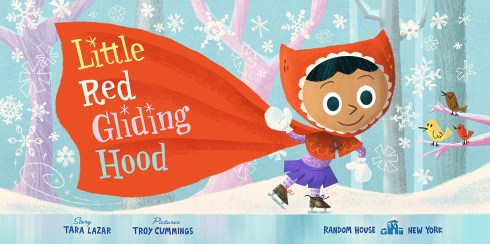
Guess who’s gliding your way this October?

Illustrated by the amazing Troy Cummings (of NOTEBOOK OF DOOM fame), this story is a mish-mash of fairytales set in a winter wonderland. (No, not Boston.) It’s all quite fantastically fractured, without cumbersome crutches.
Troy’s got a groovy retro style that pops with personality. I asked him a few questions about bringing Red and her pals to life.
Troy, how were you introduced to LITTLE RED and why did you choose to work on it?
My editor at Random House said she had me in mind to illustrate a fractured fairytale called LITTLE RED GLIDING HOOD. The title alone made me smile. Then I read the manuscript and I shouted “YES! SIGN ME UP!” after the first few page turns.
The story was super-funny, and clever, and full of action. Drawing fairytale characters would be fun, but coming up with ice-skating wintery versions of those guys in frozen-fairytale-land? COME ON!
I really couldn’t wait to start—I filled my sketchbook with character ideas on the bus ride home.

These are the first designs I cooked up. Red looks very similar to how she is in the book—although her eyes were much huger in the first draft…but she’s got her little pointy ears on her hood, and oversized head.
The Big Bad Wolf is probably “badder” in the book. Although it looks like I had already planned on giving him that big awesome puffy shirt that accentuates his chest hair.
And I was also playing with giving each of the three pigs their own skates to match their jobs—with blades that resembled a trowel, a saw, or a scythe. But I couldn’t get it to work, so now they just have plain old skates.

And here are all my thumbnails for my book cover ideas. I try to do a million of ’em to see what kind of ideas I can shake out. They actually picked my secret favorite one for the real cover, which was great.
How did you decide upon the overall look for the book?
Well, it’s a winter story that takes place mostly outside—which would lend itself to white/gray/off-brown/… but it’s also a kooky fairy tale, so I wanted to sneak in as much color as I could. So I got to play and make crazy purple and yellow trees, and give the characters colorful scarves and mittens, etc.
I also tried to differentiate Little Red and the Big Bad Wolf in their designs… she’s short and blocky, he’s tall and lanky. She’s neat, he’s shaggy. She’s got big eyes, he’s got “bad guy” eyes, she’s fully dressed, he’s uh, not…etc. etc.

And the other thing I tried to do was avoid warm colors, except for Little Red’s actual riding hood…in most scenes, it’s the only red thing we see—it should be brighter and bolder than anything else, hopefully drawing attention to her even when she’s a tiny skater on the horizon.
(With one exception—she takes a break at Grandma’s house in the middle of the book, so I flooded that page with warm/bold colors: the fireplace, the floorboards, and even the walls have lots of warmer colors. Then she’s back outside at the pinky-purple little piggy’s house, out in the snow…)

How does working on an author’s story differ from working on your own?
When I write my own stories, I always start by waaaaay overcooking things. My manuscripts are too long and my words are redundant with my pictures, big-time. The writer-half of me panics that the illustrator-half is going to leave something out, so my copy ends up sounding way too descriptive, like this:
The fuzzy blue frog put on her yellow striped size 3 pajamas before hopping on her new two-wheeled bicycle, which had been colored 30% MAGENTA in Adobe Photoshop CS5.
And then when it’s time to illustrate, I realize that I could have just written:
The frog rode away.
and let the illustration do the rest of the work. I feel like I’m slooowly getting better at this, but I still haven’t totally figured it out.
I also think that when I’m illustrating my own story, I finish by drawing a picture that more or less lines up with what I was thinking when I wrote the story. THE END.
BUT!
When I illustrate someone else’s story, it becomes really fun to work with what they’ve written, and try to come up with images that “complete” the scenes/emotions/ideas they’re setting up. They author will have described characters, events, ideas and emotions, which I should support and illustrate. But the author will also _not_ describe certain events, actions, characters, etc. (on purpose!), letting me complete the scene.

For instance, here’s a line Tara Lazar (you!) had written for LITTLE RED GLIDING HOOD:
She swizzled down the river and saw a flurry of friends gathering beneath a banner.
This is all the copy needs to say—the author hasn’t spelled out exactly who has gathered beneath the banner. I get to do that! Then it’s fun to try to come up with something neat/funny that supports the text, but also has little surprises if you spend some time on it. (Who’s hanging out under the banner? Maybe Miss Muffet, bored [setting us up for the spider on page x/] Or Humpty Dumpty, walking with confidence (or nervously holding the handrail?)… Or bo-peep, distracted by something while her sheep are eyeing the exit. (etc., etc.)
I get to play around in this world the author has created, and maybe set up a few characters/events that will payoff later in the story, and (ideally) throw in little details to surprise the reader on subsequent readings.
I also think there’s this really cool thing that happens when an author and illustrator work together:
- The author comes up with a story, characters, and a world that I couldn’t have come up with on my own. She puts images in my head.
- I, in turn, draw these images and interpret her world/characters/architecture/bowls of porridge/etc., which are likely to be entirely different than what she might have envisioned. (At least, the details might be different—I should be hitting all the right notes to support the voice/tone of her manuscript.)
- And then: MAGIC! The difference between what the author had in mind vs. my interpretation ends up being this thing that’s, ideally, better than what either of us could have cooked up on our own… (I say “magic”, but that’s also a result of smart editing/art direction.)
This project was super, sooooper fun. I’m really happy with how it turned out, and it makes me want to work on more kooky fairytales. (Or more Tara Lazar stories!)
Thanks, Tara!
Thanks so much, Troy! You’ve done an incredible job, far better than anything I could have ever imagined! I’m one ecstatic author.
And now, the giveaway…
LITTLE RED GLIDING HOOD will be released on October 27 and you can pre-order now, but…you can get a full sneak peek by winning an F&G of the book (folded and gathered galley version)!
Just leave a comment below (one per person) and you will be entered into a random drawing. You have until Feb 28th to comment; I’ll pick a winner on March 1st!
GOOD LUCK!
And stay warm out there! Especially you Boston folk!
 by
by Greetings!
My name is David Michael Slater. As an author of 20+ books (for children, teens, and adults) I am always interested in new ways of reaching readers. Self-publishing has never appealed to me. I have nothing whatsoever against it, but the sky-high pile of self-published titles one must compete with is simply too daunting, especially when so many people report not wanting to take the time to sift through that pile for the gems. The traditional route is as daunting as ever, but I do not bash it either. But it is a rough go, especially with a project that seems risky in any way.
Enter Inkshares.

My newest picture book, Hanukkah Howie vs. Santa Claus, recently launched with this newfangled “crowd-directed” publisher. Inkshares makes final decisions about projects based on pre-sales. This is a fascinating new approach that, thus far, I find extremely reasonable.

Why?
First, I can understand Inkshare’s desire to minimize their risk by taking on properties with proven market appeal (via pre-sales). What publisher wouldn’t? The result has been my working my tail off trying to secure these pre-sales, and I must admit it’s fairly exhausting.
What’s the payoff?
How about 50% of gross revenues and a non-exclusive contract?
Hard to argue that both sides don’t benefit from such an arrangement.
 The process is simple, you approach Inkshares with your project. In my case, I came to them with the finished text and an illustrator (the awesome UK artist Andy Catling) already on board. The Inkshares team evaluates your project, and if they deem it’s potentially viable, they will guide you through the steps of setting up a project page and then a launch.
They do help with social media marketing during the funding period, but mostly it’s up to you. So far so good. We’re a week in and funding at 23%.
You can learn much more at Inkshares.com. If you are interested in my project, you can read the entire (500 word) text, see the hilarious art, and note the exceptional blurbs (like the ones below) coming in from popular and bestselling authors at HowievsSanta.com.
Good luck on your on publishing paths, wherever they may take you!
“A new holiday tradition deserves a new holiday classic read aloud, and David Michael Slater has delivered just that, right to our door, by sleigh and by Hanukkopter.”
–David Lubar, Author of Hidden Talents and Sleeping Freshmen Never Lie
Hanukkah Howie vs. Santa Claus “could bring about world peace, but only if you do your part.”
–Heeb Magazine
You’ve written a picture book manuscript and now you want to know if it’s ready to send out. Here are seven crucial questions to answer.
Overall:
The first three questions focus on the overall story.
1. Topic: Is the story kid appropriate, kid appealing?
2. Language: Is the story age appropriate? Have you used interesting, fun language? Have you allowed places for kids to join in, such as a refrain to repeat?
3. Illustrations: Have you left space for the illustrator? Don’t describe every visual, but leave that to the illustrator. However, DO add things you touch, smell, taste and hear.
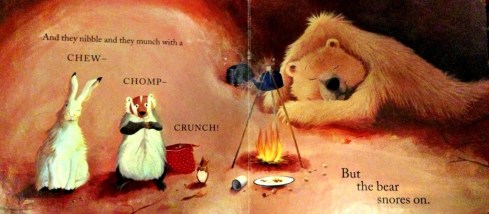
From BEAR SNORES ON by Karma Wilson & Jane Chapman
The next four questions focus on the structure and how well the story will lay out in a 32-page format.
Instructions for these questions: Divide your manuscript into a minimum of fourteen sections, with each section a scene in the story. The fourteen sections will roughly be equal to the number of double page spreads in a 32-page picture book. (If you have fewer than fourteen sections, it’s probably a magazine piece, not a picturebook.) Now, consider each section and answer these questions.
4. Does each section have an action to illustrate?
5. Does each section make you want to turn the page?
6. Does each section advance the story? If you take out a page, does it destroy the story?
7. Does the plot have a narrative arc with a beginning, middle and end?
If you answered, “Yes” on all these questions, then submit your story with confidence.
Not sure about any of the answers? Children’s book author Darcy Pattison and children’s book author/illustrator Leslie Helakoski will co-lead a unique workshop, PB&J: Picture Books and All That Jazz at Highlights Foundation in Honesdale, PA on April 23-26, 2015. Join them and learn how to make your story rise above the fierce competition.
Another PiBoIdMo success story…from author-illustrator Kevan Atteberry!
Follow the link to the EMU’s Debuts site to read on and enter the BUNNIES!!! giveaway.

The talented Kevan Atteberry, author-illustrator extraordinaire, is joining us today to talk about the evolution of Declan, the exuberant monster in his new picture book, Bunnies!!!
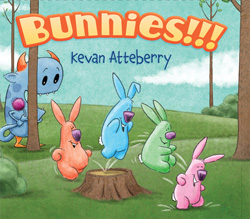
Welcome, Kevan!!
MG: Who came first, Declan, or the bunnies?
KA: The original Declan was not the Declan that lives in the book. For the past few Octobers I’ve challenged myself to create a monster a day for the whole month and post them on Facebook. Completely from scratch. On October 20, 2012, I drew this monster:

KA: I am pretty certain I drew the monster first. But the bunnies were an immediate addition. The comments I got on this monster were split between those who thought the monster was going to eat the bunnies and those who thought the monster was smitten with them. This intrigued me.
MG: In relation to that, did the images come first, or the storyline, or was it…
View original post 599 more words
It’s that season—the sniffling, sneezing, coughing cacophony of wintery colds. Your household may have already been hit. And, yes, it may be hit again. The germ mafia is on the loose.
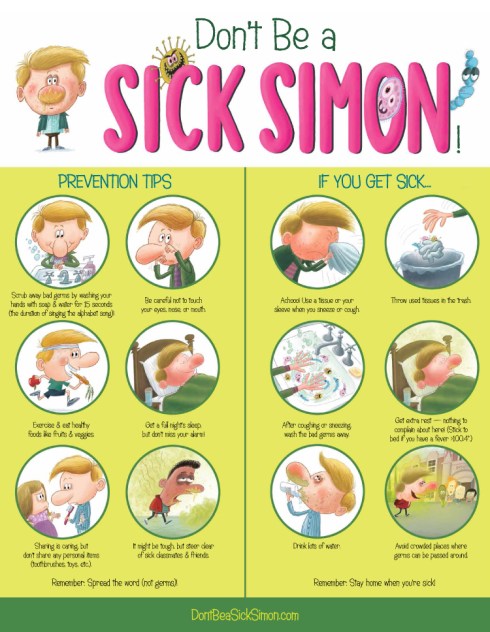
So what’s a parent to do? Well, you can ensconce yourself in Purell and pull that germy Kindergartener on your lap. SICK SIMON by Dan Krall is here to delight and educate you both with disgustingly charming clarity.
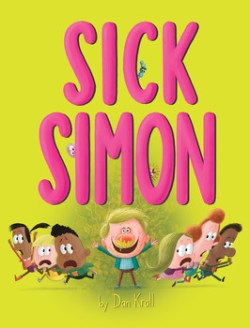
Kids love oozing yuckiness and ridiculously-behaving characters, so you can say SICK SIMON has it all.
Simon begins his week thinking it will be the best ever! But his nose becomes a bulbous faucet of green slime. An eerie radioactive glow surrounds him as he trudges through school. His sneezes coat the classroom in a putrid fog. Kids shriek and escape in horror-movie-style terror.
Simon remains germed up as the school eventually empties, leaving Friday’s highly-anticipated kickball game with just one player—the baron of bacteria himself, Sick Simon.
Of course, the germs are THRILLED. They hail Sick Simon as their hero!
Author-illustrator Dan Krall even drew these microscopic cretins of crustiness with amazing accuracy. Just look at these guys and their real-life counterparts!



Being that we are obsessed with story ideas on this blog, I asked Dan what prompted his newly-released viral sensation. It was none other than his young daughter, who became a bacterial beacon as soon as she began school. (We parents know this all too well.)
I asked Dan if we could see early incarnations of his main character. Was his nose always so gross?

You betcha!
GROSS is GREAT. Kids love it.
And you’ll love it, too, because SICK SIMON teaches kids how colds and viruses get around in an entertaining, silly, slimy way. You’ve got a hapless character, oozing greenish gooeyness, and grateful germs.
And, if you leave a comment below, SICK SIMON may show up on your doorstep!
Don’t worry, though–we’ll wash it off with an antibacterial wipe first. We’ll throw in a laminated poster, tissues and hand sanitizer to ensure you stay healthy, too.

 Dan Krall is an author, illustrator, and an animator. He worked as a character designer on the popular films How to Train Your Dragon and Coraline. He was also the art director for the television shows Scooby Doo Mystery Incorporated; Chowder; and Samurai Jack; as well as a Development Artist for Foster’s Home for Imaginary Friends, The PowerPuff Girls, and Dexter’s Laboratory. He lives with his wife and daughter in Los Angeles.
His newest book, SICK SIMON, is available now from Simon & Schuster Books for Young Readers.
by Hillary Homzie and Mira Reisberg
You have an idea for a book! Yahoo! It’s one of those ideas that hits you so deep in your gut that you immediately scribble it into a little notebook. Your stomach bubbles, not in an indigestion sort of way, but in a nervous-happy–giving-birth-to-a-germ-of-an-idea way. So how do you know if the idea is really picture book idea? What if it’s actually a chapter book or a middle grade novel, how do you know?
Well, you don’t. Not right away.
Of course, there are the obvious tip-offs that your idea is not a picture book. Take your idea through this list and see how it stacks up.
- Age of the protagonist.
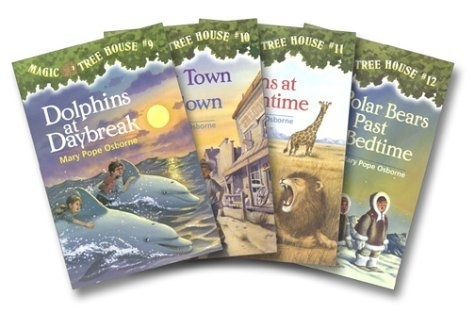
These days picture books are generally geared for ages 2-7, although there are still picture books geared towards older elementary school, especially in nonfiction. Still, there’s no question that picture books are skewing younger with shorter word counts. If your primary character is in first through third grade (or ages 6-9), and is longer than 700 words, chances are you have a chapter book. And if your character is a fourth or fifth grader, chances are you have a younger middle grade novel (for ages 9-10). Now sometimes, often, older chapter books overlap with middle grade. Is Stuart Little an illustrated chapter book or an early middle grade? There is no hard and fast answer here, especially since the term chapter book has often been used in a general way to indicate a book for elementary school children that has chapters. However, often in publishing when we say chapter book, we often mean an early chapter book. Think Magic Tree House, Junie B. Jones or Geronimo Stilton. Of course, exceptions apply in everything (and really, would it be any fun if there weren’t?). But read on to help you determine where your idea fits best.
- Interest of the main character.
Is your main character interested in something that will be appealing to younger children? E.g. If you’re story is about a child who’s excited about writing cursive, this means the main character is probably eight, and chances are it’s a chapter book story. If you’re an author/illustrator who has created lots of charming or edgy black and white illustrations to go with the story, chances are it’s a chapter book. Early middle grade books are also starting to feature illustrations more. This is great news for illustrators.

Page from “Notebook of Doom” chapter book series by Troy Cummings
- Period of time.
Does your story occur over a year? Six months? You may have a chapter book or young middle grade on your hands. Now there are exceptions, picture books such as Diary of a Worm, which chronicles a character over a large period of time, or nonfiction picture books that occur over a long time like biographies. The majority of contemporary picture books take place over a brief period of time, while chapter or middle grade books usually have the luxury of taking their time with a story.

- Type of protagonist.
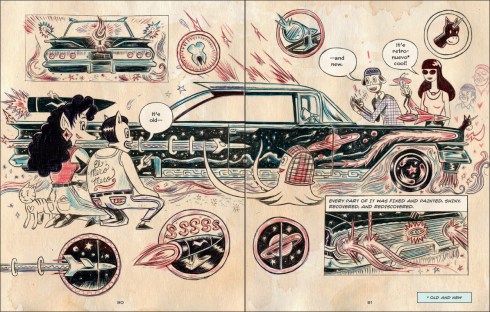
Are your main characters animals or personified objects? Chances are it’s either a picture book or an early chapter book. Older kids generally want to look more sophisticated with “grown-up” books, but of course there are always exceptions, like the fresh middle grade graphic novel Low Riders in Space, which features a dog, an octopus, and a mosquito as main characters.
Generally, if you like writing really short manuscripts with simple plots, often with animal characters on topics of interest for very young kids, you’re a picture book person. If you like the luxury of time and space for writing slightly longer books (from 1500 to 15,000 words) that still have pictures for slightly older kids ages 6-9, with or without animal characters, then you’re a chapter book writer (or maybe even an early reader person, but that’s a post for another day). And if you like much more complex plot lines, much longer storytelling, stories for early middle school kids, then you have an older middle grade idea.
So…what kind of ideas do you have?
Bonus info: Mira and Hillary will be co-teaching an outrageously fabulous interactive e-Course, the Chapter Book Alchemist, starting January 12th. Together and with the help of Mandy Yates, they make it ridiculously easy to write a chapter book or early middle grade during the 5 fun-filled weeks. The course features optional critique groups, weekly live webinar critiques, lots of lessons and exercises, the option for critiques with Mira or Hillary (with a free Scrivener course) and Golden Ticket opportunities to submit directly to agents and editors. Click here to find out more about this once-in-a-lifetime adventure with potential life and career changing benefits! Click here to find out more.
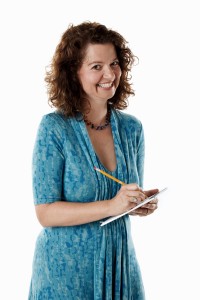
Hillary Homzie photo by Suzanne Bronk
Hillary Homzie is the author of the chapter book series, Alien Clones From Outer Space as well as the middle grade novels, Things Are Gonna Get Ugly, The Hot List, and Karma Cooper Unplugged (forthcoming). Some of her books are currently being made into an animated television series. Hillary teaches in the graduate M.F.A. program in children’s writing at Hollins University as well as for the Children’s Book Academy. She is also a former stand up comedienne. Visit her at HillaryHomzie.com.
 Mira Reisberg is an award-winning children’s book creative, a former kidlit university professor and a former literary agent. She is also the Director of the Children’s Book Academy and has taught many now highly successful authors and illustrators. Visit her at childrensbookacademy.com.
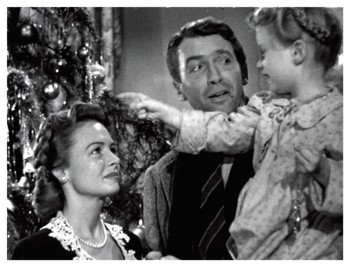
“Look, Daddy! Teacher says every time a bell rings, a PiBoIdMo’er gets a prize!”
That’s right, Zuzu. It’s the final prize announcements for PiBoIdMo 2014! Sit back and scroll down. I hope you find your name!
I will be emailing all winners within the next week to arrange prize delivery. Be on the lookout for an email from me.
Congratulations to everyone and see you next year!
.
Kristi Valiant’s PRETTY MINNIE Winner:
MARY ZYCHOWICZ
.
Kelly Bingham’s Critique Winner:
JENNIFER SWANSON
.
Karen Henry Clark’s SWEET MOON BABY Winner:
ANDREA MACK
.
Pat Zietlow Miller’s Book Winners:
LORI ALEXANDER (SOPHIE’S SQUASH)
KATHY HALSEY (WHEREVER YOU GO)
.
Sudipta Bardhan-Quallen’s PB Course at Kidlit Writing School Winner:
KATHRYN AULT NOBLE
.
Jennifer Arena’s 30-Minute Consult Winner:
CATHY BALLOU MEALEY
.
Deborah Freedman’s THE STORY OF FISH & SNAIL Winner:
KRISTI VEITENHEIMER
.
Molly Idle’s FLORA & FLAMINGO signed poster Winner:
EMILY KEEL
.
Tammi Sauer’s NUGGET & FANG Winner:
SHEL LEDREW
.
Josh Funk’s PB Winners:
MATTHEW WINNER (MONSTER NEEDS A CHRISTMAS TREE)
MARIA J. CUESTA (THE RAINDROP WHO COULDN’T FALL)
ANDI BUTLER (REX WRECKS IT)
MARY JANE MUIR (RUTH THE SLEUTH)
DEE KNABB (ESTHER’S HANUKKAH DISASTER)
.
Corey Rosen Schwartz’s NINJA RED RIDING HOOD Winner:
SUSAN HALKO
.
Barbara Krasner’s GOLDIE TAKES A STAND Winner:
SUSAN SCHADE
.
Shelley Moore Thomas’s NO, NO, KITTEN! Winner:
LAURA PURDIE SALAS
.
Deborah Underwood’s Book Winners:
DARYL GOTTIER (EASTER CAT)
ANITA BANKS (SANTA CAT)
.
Dev Petty’s Critique Winner:
JANET SMART
.
Kelly Light’s LOUISE LOVES ART Book and Holiday Print Winner:
HAYLEY BARRETT
.
Henry Herz’s Critique Winners:
RON TUCKER
JAMIE DEENIHAN
.
Emma J. Virjan’s NACHO THE PARTY PUPPY Book & Tee Winner:
SHARON GILTROW
.
Marsha Riti’s THE CRITTER CLUB Books Winner:
CARRIE CHARLEY BROWN
.
Diana Murray’s Critique Winner:
SARAH SKOLFIELD
.
Liz Garton Scanlon’s GOOD PIE PARTY Winners:
CAROLINE LEE WEBSTER
CELESTE BOCCHICCHIO-CHAUDHRI
.
Ruth McNally Barshaw’s ELLIE FOR PRESIDENT Winner:
ELEANOR RUBIN
.
Mylisa Larsen’s Critique Winner:
KIRSTEN BOCK
.
Aaron Reynolds’s Book Winners:
BETH GALLAGHER (CREEPY CARROTS)
MARTY MCCORMICK (CARNIVORES)
WENDY FEDAN (DESTRUCTOSAURUS)
.
Trinka Hakes Noble’s THE ORANGE SHOES Winner:
ROSIE POVA
.
And now the prizes you didn’t even know about!
A picture book critique <800 words, donated by Alayne Kay Christian:
LYNNOR BONTIAGO
.
A complimentary stay at Palm Creek Cottage on Tybee Island, a “Writer’s Getaway” donated by Elaine W. Duree:
AMY MARIE SMITH
.
A copy of Jaqueline Woodson’s THE OTHER SIDE, signed by illustrator E.B. Lewis, donated by Sally Flannery:
DIANA DELOSH
.
Remember, even if you didn’t win a prize, you’re still a winner because you’ve ended the year with more picture book ideas! Yes, it really is a wonderful life!





 Writing for Kids (While Raising Them)