You are currently browsing the category archive for the ‘PiBoIdMo 2010’ category.
 by
by Last year, I participated in PiBoIdMo. At the end of the month, I had about 34 ideas on my list. Participants were writing to Tara with comments like “Oh, I am jumping out of my socks with excitement to get started developing all these FABULOUS ideas into picture books” and “I have 30+ of the best ideas on the planet and I am certain they will be lining the shelves of bookstores by spring.”
I looked at my list. And I thought “Blech.” I don’t have a single good idea. I was irritable. And jealous. Why is everyone else feeling so motivated and inspired, and I am feeling like an utter failure? I even joked on my blog:
While other people have come up with 30 wonderful diverse ideas for PiBoIdMo, I have a list of 30 pathetic variations on the Three Bears theme.
Goldifox and the Three Hares
Tawnylocks, Goldi’s Little Known Twin
Goldi-Rocks and The Three Bear Band
Well, the joke is on me. Because guess what? I ended up selling GOLDI ROCKS AND THE THREE BEARS to Putnam!
So, here is my humble advice. Don’t dismiss any of your ideas.
Finding the perfect idea is like mining. What may not seem at first to be a dazzling gem, may end up being your diamond in the rough. You have to sift carefully through what you’ve collected. Show your list to some trusted people. Even if you don’t win the agent prize, you can still get feedback. Ask a writer friend or critique partner to view your list. Ask your kids! Get a second opinion. And a third.
I may have missed the initial sparkle, but let me tell you… my blog followers did not. They commented in droves “The GOLDI ROCKS one shines.” I was too visually impaired to see it, but they realized it right away and let me know I’d struck gold.
And keep your list going all year. Add to it, when the littlest inkling crosses your mind.
GOLDI ROCKS was idea #28.
You never know when you are going to hit your jackpot.
 Corey Rosen Schwartz is the author of Hop! Plop!, an Eric Carle Museum Picture Book of Distinction. Her next book, THREE NINJA PIGS, is due for release in 2012 (not soon enough in Tara’s opinion). It will be followed by GOLDI ROCKS AND THE THREE BEARS, which would never have been conceived were it not for PiBoIdMo. Corey spends her free time Facebooking all the funny things that come out of her five and six year old’s mouths. (You never know what comment will inspire a PB!)
Corey has generously donated a picture book critique as one of the PiBoIdMo prizes. A random winner will be chosen in early December, from those who have completed the 30-ideas-in-30 days challenge.
Those of us you who were children once upon a time will surely remember how frustrating it was suddenly to have been plunked down in a world where everyone knew more than you did—about everything. Children spend a great deal of time trying to figure things out: where does snow come from? Why can’t dogs talk? What happens next? Or, as we say in our family: “Who ordered the veal cutlet?”*
Kids develop their own little GPS-like subroutines, constantly recalculating to keep themselves on track—but sometimes, inevitably, they get it wrong. Misperceptions and missed information lead to misunderstandings . . . and—I won’t sugar-coat this—little misunderstandings often lead to:
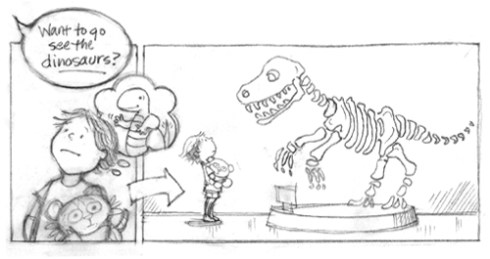
Major Disappointment!
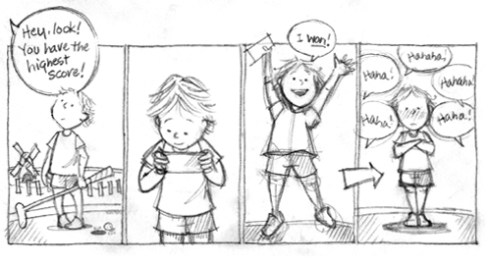
 Total Humiliation!
 Nightmares!
 (Yeah, I was grown before I figured that one out.)
Thank goodness for picture books!
In a picture book, you can check out your own real-live dinosaur any time from the Storybook Lending Zoo.
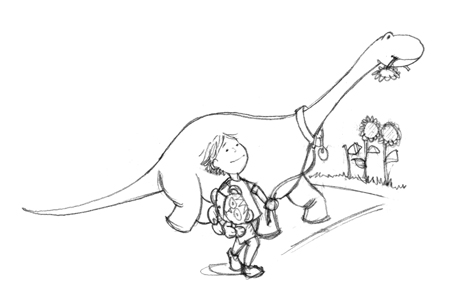 You can have the queen invite the golfer with the highest score to the palace for tea, and meet the prince, who is even worse at Goony Golf than you are.
 You can become a super-hero in training, and rid the world of evil, baby-eating furniture.
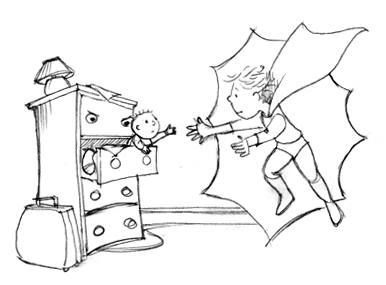 How cool is that? As children’s book writers and illustrators, we get to do this all the time. So, having aired three of my own neuroses . . . er, picture book ideas . . . here is a tip for today: think back to those times in your childhood when things were not quite what you expected them to be—and imagine what it would take to discover a new, old friend . . . or have the last laugh . . . or fly to the rescue.
And then, for the love of heaven, explain to the little person in your life that dinosaurs are really extinct; that, as silly as it sounds, low score wins at Goony Golf; and that, yes, if necessary, a very tiny baby can sleep safely in a dresser drawer . . . but only if you take the drawer OUT of the dresser first!
*A line from Mel Brooks’ Silent Movie . . . um, maybe you had to be there.
 Bonnie Adamson’s latest illustration project is BEDTIME MONSTER (¡A dormir, pequeño monstruo!) by Heather Ayris Burnell, released in September by Raven Tree Press.
Visit Bonnie’s soon-to-be-completely-overhauled website at www.bonnieadamson.net, or hang out with her on Twitter, where she co-hosts #kidlitchat on Tuesday nights and #kidlitart (for children’s book illustrators and friends) every Thursday.
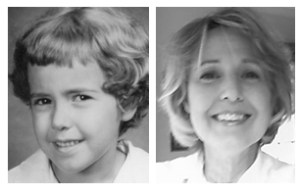 Bonnie then, practicing her skeptical glare; and now—-an older and wiser children’s book illustrator.
Prize Alert! Leave a comment to enter. One randomly-selected winner will choose one of the three picture-book-inspired sketches above for Bonnie to paint in watercolor (Dinosaur, Royalty, Superhero). One entry per person! Winner will be selected one week from today. Good luck!
 by
by As an author/illustrator of picture books, my process for creating picture book characters involves a constant back and forth between my keyboard and sketchbook. I have to “draw them out.”
I start with my keyboard, and the first thing I do is ask myself lots of questions about my main character.
- What does she love?
- What does she hate?
- Is she messy?
- What type of clothes does she wear?
- What’s her favorite color?
- Does she have pets?
- Is she scared of lizards?
- Does she play the violin?
- Is she afraid of her mailman?
- Does she like to eat Cool Whip sandwiches on white bread? (okay, that one was MY favorite sandwich when I was little!)
- Would she help her worst enemy?
- Is she cute? Precocious? Bookish? Obnoxious?. . .
 I get pretty specific and allow for the unexpected to pop in. Don’t we all love a character with some weird little surprising personality quirk?
When I finally hit upon the perfect character who has her own unique gumbo of personality traits, then it’s time to pull out the sketchbook. I draw facial expressions and hairdos. Wardrobes and bedrooms. I really get to know my character visually–I need to be able to see how she likes to stand (arms crossed protectively in front or hands sassily on hips), what she likes to wear (tie dyed t-shirts or tutus), and what things she loves to do (ballet or tai kwon do).
Then I think about objects that would inhabit her world. Little details scattered in the illustrations of a picture book help create a rich character, kind of like the world building writers do when writing fantasy stories. I just do my world building visually–actually drawing a world with beds and chairs and clothes and people. For me, visualizing my world is a necessary step before I begin to think about writing plot. I like to have my stage set and my characters in full costume before I turn them loose to tell me their stories.
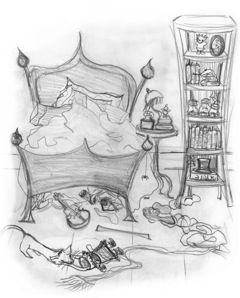 If I’ve done my job, then my main character and how she relates to the world will lead me to a plot. There will be something in her personality that stands out, and it’s up to me to put something in her way. For example, if she really hates something–like sports. I make her put on a pair of soccer cleats and play. Or, if she’s really embarrassed about something–like her frilly blankie that she sleeps with every night. I make sure someone exposes her at a spend-the-night party.
I ask myself “What’s the worst thing that can happen to my main character based on her unique personality?” And, then I do it to her (I know–I’m such a meanie!). But, since I’m an illustrator, I do this visually. I draw the way she would stand if forced to put on full soccer gear. I draw her reaction to being exposed at the party.
And, this conflicted character that I’ve pulled out, drawn out, of her comfort zone, leads me back to my keyboard to bang out a story . . .
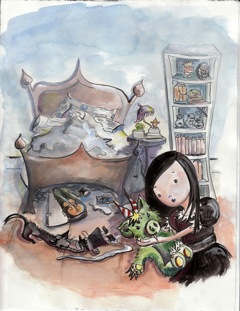 Sarah Frances Hardy, a Southern girl living in Oxford, Mississippi, took an early retirement from practicing law to paint and write full time. She has exhibited her work in galleries throughout the Southeast as well as in New York. Her corporate clients include Steve Wynn who purchased several of Sarah Frances’s paintings for the Beau Rivage Resort in Biloxi, Mississippi.
Sarah Frances’s debut picture book, pitched as “Wednesday Addams meets Fancy Nancy”, which she wrote and illustrated will be published by Viking Children’s Books in 2012. Sarah Frances also writes middle grade novels which are set in the South. She is inspired by her three daughters, who each couldn’t be more different.
Sarah Frances is represented by Joanna Volpe at Nancy Coffey Literary and Media Representation. Learn more about Sarah Frances Hardy at her website www.sfhardy.com and her blog www.plotthis.blogspot.com.
Shaping a poem
the body builder
pumps
flexes
tones and
tautens
as
snip
snap
snip –
the gardener
prunes and shapes
and
whoosh!
the very
clumsy clown
colours the sky
with brightly bobbing
balloons of
thought
© Kathryn Apel 2010
 Playing with words to inspire creativity
I write poetry. And I write picture books. And this is a good thing, because poetry and picture books go hand-in-hand… beautifully!
If I’m stuck for inspiration or enthusiasm in my picture books, or I’m at that point of doubting that I’ll ever find ‘the’ perfect word (or any words, for that matter)—I write poetry. Poetry prompts me to play with words again.
We all know the cliché that writers paint pictures with words, but when I’m writing poetry, I get three distinct visual images—and they’re all of me! Let me put you in the picture, too…
 The first is a bit of a joke, because in reality I can’t lift more than a bar of chocolate… BUT—I see myself as The Body Builder toning up by pumping poetry. Composing poetry flexes creativity. It hones vocabulary and encourages wordplay. It pinpoints weaknesses and forces me to focus on specific ‘muscles’. The more poetry I write, the greater my control of my writing muscles—of words. And that is vital when writing picture books!
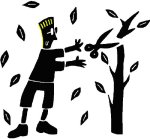 As The Gardener, I am a topiary artiste, intent on pruning and shaping; looking at the bigger picture and trimming it into a recognisable form. There is a certain ruthlessness in laying bare a thing of beauty. Poetry is a lot like a topiary tree—each word carefully placed to create a sharp, clear image. Excess words snipped away. There is no room for clutter. Each word must earn its place. A lot like … a picture book!
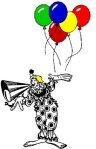 And then I see myself as The Clumsy Clown clutching fistfuls of colourful helium balloons… but can she keep them all in her grasp? No way! Poetry has a way of releasing thoughts to, float, fly, drift and swirl like a bunch of brightly bobbing balloons. Thoughts that could become a poem… or even a picture book… For me, a tramp over paddocks (with notebook in hand) is the perfect time to release the balloons, where they can dip and sway and soar to greater heights in the vast, open sky.
When writing poetry, I am carried away by my imagination.
Come fly with me!
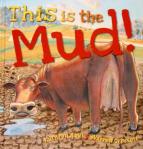 Kathryn Apel is the author of the rhyming picture book This is the Mud! published by Lothian/Hachette Australia in 2009 and read on ABC Play School in 2010. You can follow @KatApel on Twitter, or visit her website, katswhiskers.wordpress.com. Kat is also the co-founder of #pblitchat, the weekly chat for those who work in the picture book publishing industry. You don’t have to be on Twitter, Facebook or any other social media to join the chat. Read all about it at picturebooksonly.wordpress.com.
 by Lori Degman
Thanks, Tara, for letting me be a guest blogger for PiBoIdMo 2010! I was an avid follower last year and came away with more than thirty story ideas (some great, some not so great). It really jump-started my brain!
About a week ago, I sat down to write this post and drew a blank. I just couldnʼt come up with a good idea (pretty ironic, huh?). The next day, after the weather forecasters predicted record-breaking winds, I said to my husband, “That forecast sure was overblown.” When I stopped laughing (well after my husband), I realized I had found my topic—PUNS! Iʼm a sucker for a pun—good or bad—I just canʼt get enough of them!
Most puns just pop out of my mouth, without really thinking about them, but Iʼve learned how to purposely create puns, too—some of which have lead to funny, punny picture book stories! Though some puns go over childrenʼs heads, the adult readers catch them—and itʼs important to please your adult audience as well. After all, theyʼre the ones who will be reading your book again and again and again (hopefully)!
Here are some ways you can create puns—Iʼm sure there are tons more:
Put a twist on an idiom or slang phrase:
- Mrs. OʼLearyʼs cow kicked the bucket.
- Baking a pie is a piece of cake.
- Being a vampire really sucks! (Not for kids, but I thought it was funny.)
Think of animals and related traits:
- The cow was udderly delightful.
- The elephant packed his trunk for a trip.
- Having skunks for neighbors really stinks!
 Make references to well-known fairy tale and nursery rhyme characters:
- Maryʼs in trouble and now sheʼs on the lamb.
- The Big Bad Wolf stomped off in a huff.
- Mother Goose hatched a plot.
Any of these puns might make a great starting point for a story. I hope this gets your imagination off and punning (sorry)!
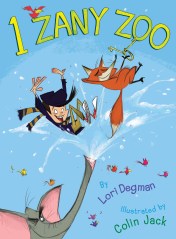
Lori Degman is a teacher of deaf and hard of hearing students. She currently lives in Vernon Hills with her husband, John and two sons, Sean, 24 and Brian, 21. Her first picture book, 1 Zany Zoo, was the winner of the 2008 Spoonfuls of Stories Contest and was released July 2010 by Simon & Schuster. For more punny stuff, visit her at loridegman.blogspot.com.
 by
by A great road trip game is called “No, It Wasn’t.” It’s played with partners. One begins telling a story—any story. The other interrupts as often as desired with, “No, it wasn’t”—or any grammatically-correct contradiction.
It may sound like this:
1: One morning, Jane went for a walk.
2: No, she didn’t.
1: That’s right. It wasn’t a walk. She was running. For exercise.
2: No, it wasn’t.
1: Actually, it was because someone was chasing her. A bad guy.
2: No, it wasn’t.
1: No, it was the police. Jane is the bad guy.
And so on. The challenge to the storyteller is to instantly change direction, as often as they’re prompted. As the story continues, the predictable story lines usually fall away, and the requirement to make changes opens the doors to great creativity. A new story begins to emerge, one that goes in radical new directions. In the example with Jane above, it would’ve originally been a story about her going to visit her friends. In only three twists, Jane is on the run from the police.
This can be a useful brainstorming game for writers too. Maybe you won’t end up writing the story in the direction the game led you, but it does force you to explore more options than Jane simply being out for a walk.
If you’re already working on a premise, write a quick logline for it. In your first sentence, try a “no, it wasn’t,” and see where it leads you.
Or start fresh. Choose a main character, any main character, then give them something to do. And so your game begins.
Need a prompt?
Here it is: When (Main Character) came home that day an old friend was waiting.
No, it wasn’t.
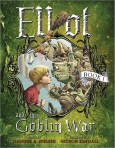 Jennifer A. Nielsen’s debut novel Elliot and the Goblin War was released in October 2010. And it comes with a warning–as of today, only 7 children who have ever read this book have lived to tell about it. If you’re very brave, perhaps you’re willing to take your chance with it.
The next book in the series, Elliot and the Pixie Plot will be released in May 2011. It’s pretty much like the first book, except it has a different plot. Different artwork too. Because that’d be pretty lame if they just used the same art all over again.
 An interview with Joey Fly creators
Aaron Reynolds and
Neil Numberman
Last year Aaron & Neil taught us how to create a graphic novel with a demonstration from their 2009 debut Joey Fly. Well, the creepy-crawly duo is back and so is Joey, in his new buggy sequel. Aaron & Neil shed some insight on the process of creating a second book in a series.
If you like Aaron & Neil’s buggy caricatures, be sure to leave a comment. Neil will create you in buglife! For every 10 comments, we’ll randomly select one caricature winner. Good luck!
Aaron and Neil, in creating the Joey Fly sequel, what cues did you take from the first book?
 Aaron: I had established Joey and Sammy in the first book, and obviously that was staying the same, but I wanted to build on their relationship and take it to the next level. I think we did it…Sammy develops a love interest, but he’s in over his head. Joey still considers Sammy as much hindrance as help, but his concern for Sammy continues to deepen along the way.
I also really wrestled with the format of a customer showing up on the doorstep with a case for them to solve. That’s a very clear format for these types of books, a kind of throwback to old detective mysteries, Encyclopedia Brown, Scooby Doo, and Veronica Mars models of mystery, and works well for a kids’ mystery. In the end, I decided to keep things in that format, but I’ve also been intrigued to explore the idea of a mystery evolving right around Joey and Sammy, like you see happen in old Agatha Christie movies. I’m exploring that for an upcoming book in the series.
 Neil: There were a lot of things I wanted to bring from the first book for consistency’s sake. I start and end each book off with a one panel spread, which is an attempt to bring the readers into our world smoothly. We also stuck with the monochromatic look, which keeps that film noir vibe, but with many new colors in this book for many new themes. It’s actually something I wanted to get away from with this second book, but our editor, Reka Simonsen, was very smart and steered me back. I’m glad she did, especially based on the reception of the first book. Folks seem to dig the look, and it’s ours now! It lets us stand apart from the other kids’ graphic novels out there.
 What things changed?
Aaron: I think the mystery itself is better. I was torn in the first book between whether the mystery was too easy for a kid to solve before the end, or just right. That’s further complicated because this is a series that’s really accessible to mid-elementary kids, but also a great read for the 4th-8th grade set. In book #2, I feel like I got the balance just right. Writing mystery is a challenge unto itself. I hope, like all things, the more I do it, the better I get!
The other challenge is that, unlike many kids’ books, these characters aren’t kids. They live in an adult bug world…so the challenge becomes to create situations and obstacles that are kid-friendly and kid accessible, that you still believe these characters would encounter in the world we’ve created.
Neil: On my end, the quality in the art has really evolved, for the better. The character design has tightened up for Joey and Sammy, the city scenes are more involved. My favorite change, and I mentioned it above, is that I get to use the monochromatic look a lot more. Sometimes it’s used to set mood, sometimes as symbolism (the color I chose for Trixie Featherfeelers’ dressing room was very deliberate), and sometimes just to set up a joke.
I also played around with the panels a lot more, trying to make it more fun. I was so nervous with the first book, and I was very worried that my decisions would ruin the story, so the panel boxes are very tight and rigid. I had a lot more fun with the visual narrative in this one; tall panels, short panels, heart-shaped panels, no panel borders, it was a lot more fun.
As far as the actual drawing, this book takes place during a cold snap, so I got to draw a lot of bugs in scarves, jackets, and snowcaps!
 How did you develop new characters?
Aaron: I knew I wanted to set the book in a theatre, and that was a cue for the characters that evolved to tell the story. I wanted a ridiculous Alan Rickman from GalaxyQuest type character…addicted to the craft of theatre…and that came out in Fleeago. But it’s also fun playing with ethnicity and age. So we have a South American tarantula, and a geezer skeeter. Bottom line…bugs make fantastic characters and give you so much to explore because they themselves are so unique.
Neil: The characters Aaron made in this one are brilliant. I’ve always been fascinated with great characters, from Charles Dickens’ to J.K. Rowling’s, and Aaron really knows what he’s doing there. There’s nothing more fun in the process than creating the character sketches; a grandiose, dramatic tarantula, a villainous stinkbug, a love-struck gypsy moth, and a geriatric mosquito. They were a lot of fun to draw over and over again. Oh, and let’s not forget, an entire bedbug chorus.
Since you had already been paired for the first book, with the second title, did you collaborate more?
Neil: There was about as much collaboration between the two of us directly as there was with the first Joey Fly… none. The entire process of the books goes through the editor, and I think that benefits all parties involved. And of course, the publisher has every right to look over all communication, since, y’know, they’re paying us!
So I don’t see the manuscript until it’s basically whittled down to what you see in the book. I might request a line here or there to help the flow of the art. From then on, Aaron gets some say on the art, especially the character design, but really doesn’t see much until the finishes. And after that it’s just minor changes and adjustments that he requests.
Aaron: All true, we never collaborate during the creation of the book itself. It’s amazing what happens when you take two artists, a writer and an illustration, and unleash them completely separately on the same story. They each develop their own vision for it and something truly magical happens that doesn’t quite happen in the same way when you are working side by side on a project. Having said that, I love collaboration and hope Neil and I will have the chance to partner down the road on a project in a more give and take way. Would be fun!
 Are there more Joey Fly books in the works?
Aaron: I’ve already written a third book for the series and started a fourth. Neil and I love the characters and hope to continue the series with many more.
Neil: I really hope we get to do another. I suppose it all depends on the performance of this one, but Aaron’s told me some key components of the plot, and I already have a cover and more monochromatic themes in mind. Without saying too much, it involves maybe one of my most favorite things of all time: ghosts. Jeez, I hope I get the chance to draw insect ghosts!
Aaron: Book #3 contains ghosts, taxidermy, a run-down barrio, a pipe organ, a big game hunter, an orphanage in trouble, and two insect nuns. With that much of a sneak peek, you should be able to solve the mystery yourself!
 Aaron Reynolds is a human, not a bug, but he often writes about bugs. He is the author of Chicks and Salsa, Superhero School, Buffalo Wings, and, of course, the Joey Fly, Private Eye graphic novels.

Neil Numberman is a termite currently residing in New York City. Joey Fly, Private Eye was his first graphic novel, but he is also the author/illustrator of the picture book Do NOT Build a Frankenstein.
Be sure to leave a comment for Aaron and Neil. For every 10 comments, we’ll randomly select one winner to receive a bug caricature by Neil! Good luck!
 by
by I’ve always been fascinated by the idea of being little. I am a little sister (my sister is five years older than me). Now that we’re adults and friends that difference is pretty much nonexistent, but when we were young, five years was the Grand Canyon. All I wanted to do was spend time with my big sister, doing the things that she got to do. And all she wanted to do was… anything else. I even wrote a story about it in second grade called “It’s Not Fair!”
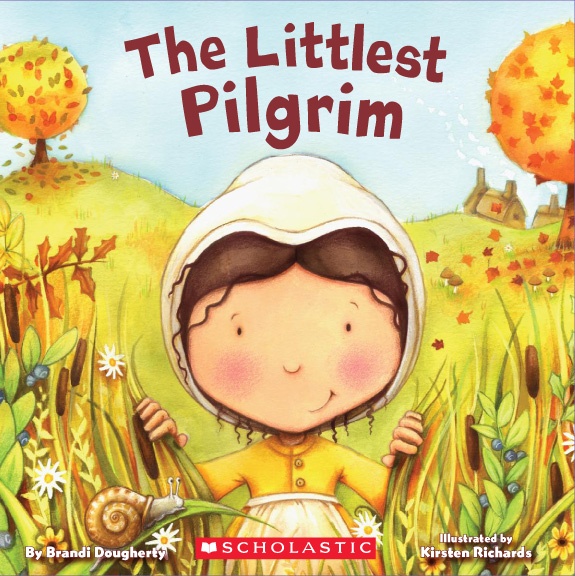 That’s where I got the idea for my first picture book The Littlest Pilgrim. Well, truth be told, the title actually popped into my head during a meeting and I thought it was cute and wanted to write a story around it. But it didn’t take long for me to circle back to my memories about being little. So, I wrote a story about Mini who is the littlest pilgrim in her village and she just wants to help. Everyone tells her she’s too little for all the grown-up chores and duties, so she strikes out on her own and finds something she isn’t too little for: making a friend.
After The Littlest Pilgrim came out and hit the New York Times Best Seller list (you still have to pinch me about that one!), I was thrilled to be able to write another “littlest” book. As I started thinking about holiday themes, a picture of me in my first grade Christmas play popped into my mind.
 I was one of the stars in the night sky (the yellow star in the green skirt, to be exact) leading Mary and Joseph to Bethlehem. I had one line to recite in the play. And I was a very shy kid, so it was kind of terrifying to stand on that big, bright stage and speak my one line. I loved the idea of turning that around and writing about Max (the littlest kid in his class, of course). Max wants nothing more than to be the star of his school Christmas play and have a million lines to recite, but he ends up being the actual star with only one line.
So, as you can see I like to take memories of my own experiences from childhood and turn them slightly to the right or to the left – adjusting the lens a little bit and discovering a different character or story hidden there.
Now it’s your turn. Peruse a class picture from elementary school, dig through that box of handprint turkeys and leaf collages, or just reach back in your mind and find a childhood memory that you can turn to the right or to the left. Who or what is hidden there?
In addition to her two picture books, Brandi Dougherty is the author of three middle grade novels: Miss Fortune (Scholastic, 2010), The Friendship Experiment (Scholastic, 2009), and The Valentine’s Day Disaster (Scholastic, 2008). She worked in publishing in New York for eight years and now resides in San Francisco where she is mom to an adorable and rather spoiled dog. Visit her at www.brandidougherty.com.
 by
by In my day-to-day life I’m a dreary, straight-laced stickler for rules. I’m obsessively punctual with my rent. I always wear my seatbelt. And I’d never dream of going through the Express Lane at the grocery store with more than fifteen items in my cart.
But when it comes to writing picture books, I’m proud to be a rule-breaking outlaw.
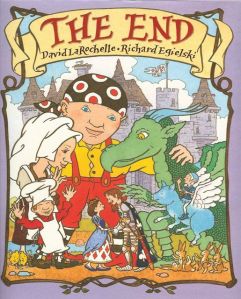 Who says a picture book needs to be told from start to finish? My fairy tale The End is told in reverse chronological order, from end to middle to beginning.
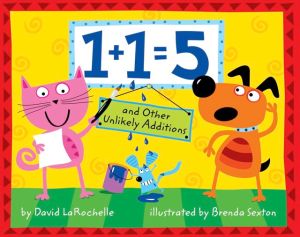
In fact, who says a picture book needs a traditional beginning, middle, and end at all? My latest book, 1 + 1 = 5 And Other Unlikely Additions, is simply a collection of surprising (but plausible) math facts. 1 + 1 = 3? 1 unicorn + 1 goat = 3 horns! 1 + 1 = 6? 1 duet + 1 quartet = 6 musicians! Who would have guessed that a list of equations could make a successful children’s book, but it works.
 Which brings me to my writing tip for today: forget about the rule that says a good book needs a plot with a character and problem and solution. Today, just make a list. The Top Ten Ways to Avoid Doing the Dishes. Reasons Why I Should Have a Horse. My Favorite Things to Do with Peas Instead of Eating Them. You decide on the topic.
Come to think of it, maybe I’m not such a rule-breaker after all. There are plenty of wonderful picture books which are, at their hearts, simply lists:
Jane Yolen’s humorous How Do Dinosaurs Say Goodnight?
Lauren Stringer’s clever and beautiful Winter is the Warmest Season
Judith Viorst’s classic Alexander and the Terrible, Horrible, No Good, Very Bad Day
Of course successful list books like these are more than a recitation of boring items. They resonate with a child’s emotions, shine with beautiful language, explode with humor, or invite the reader to look at the world in a new way.
And you can write a memorable children’s book, too! Just pick up your pencil and start making a list.
David LaRochelle has been creating books for young people since 1988. His next picture book, The Haunted Hamburger and Other Ghostly Stories, illustrated by Paul Meisel, will be released by Dutton in 2011. He lives in White Bear Lake, Minnesota and is currently catching his breath after a busy month of carving pumpkins, some of which can be viewed at his website www.davidlarochelle.net.
Get Out and Live, Your Stories are Depending on You
 by
by Ideas are endless, and everywhere! You can find ideas on a backyard walk, or at a trek to the zoo. You can find them in the news, or in the newspaper. Keep your eyes open and really look around. Listen to the chatter of little children, look at the bark of trees. Discover life around you through the eyes of a child.
Trees have faces if you look closely enough. Clouds can create castles. And in the humdrum of everyday activities, you can find a story just waiting to be told. While on my way to take my daughter to school, I was delayed by turkeys in the road. Instead of allowing a panic mode to overtake me (because we were going to be late), I simply enjoyed that moment.
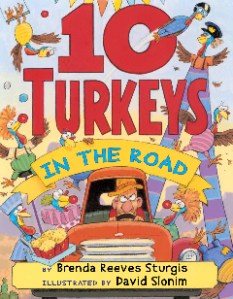 And my debut picture book, 10 Turkeys in the Road, Marshall Cavendish, 2011, was born. I stopped to smell the roses, or better yet, to watch the turkeys. Soon after, I was awakened with the story of the turkeys in my head.
And after 3 major revisions and a year later, editor Margery Cuyler discovered 10 Turkeys at the RUCCL conference.
A trip to the zoo resulted in my story waiting to be sold, My Gorilla Brother, and an afternoon outing to watch my nephew play football, resulted in my story Touchdown! which won first place in the 2007 Smart Writers Contest judged by Verla Kay.
You can find ideas everywhere! A sight, or a smell, or a sound triggers them, but you must to get “out,” and experience life to find them.
One place that most initial ideas will not be found is in front of a blank computer screen. Ideas must first take root in your soul, and then once they are rooted, they are ready for watering, shaping, and pruning.
Yes ideas are endless, and they are anywhere and everywhere you can possibly imagine. Your stories are waiting for you, so get busy and get outside. Live and enjoy your life so you can first imagine, and then write your stories, as only you can.
Brenda Reeves Sturgis began her writing career four years ago, after meeting Lynn Plourde at a school visit. She bought every one of Lynn’s books and asked the question that would change her life, “How do I become a writer?”
Lynn directed Brenda to the CWIM (Children’s Writer’s Illustrator’s and Market Guide book, by Alice Pope), and also to SCBWI (Society of Children’s Book Writer’s and Illustrator’s). One of Brenda’s favorite sayings is, “When the student is ready– the teacher will appear!”
Brenda is generously offering a picture book critique as one of the PiBoIdMo prizes. Finish 30 ideas in 30 days to become eligible to win!





 Writing for Kids (While Raising Them)