You are currently browsing the category archive for the ‘PiBoIdMo 2010’ category.
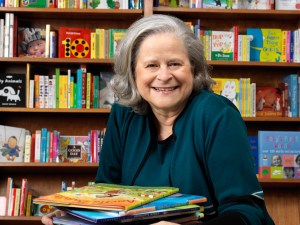 by Carol Rasco, CEO, Reading is Fundamental
At first glance, it seems almost too simple, offering children the opportunity to choose the books they want to read and own. But since 1966, choosing books has been the key feature of RIF programs where children often select multiple books per year. Does it make a difference?
In late September of 2010 results were released from a RIF-commissioned, rigorous meta-analysis conducted by Learning Points, an affiliate of the American Institutes for Research. Those results showed that giving children access to print materials is associated with positive behavioral, educational, and psychological outcomes. I invite you to study the results more fully as these results then move us to the importance of picture books in the early years of the children targeted by RIF. Detailed information about the study and its results can be found on the RIF website: www.rif.org.
How exciting it has been to learn more this year about PiBoIdMo by following carefully the informative guest posts each day as well as looking back over past year’s PiBoIdMo materials. Reading Is Fundamental deals more with picture books than any other genre, and this is all the more reason I appreciate this opportunity to visit with those of you participating in PiBoIdMo this year. I sincerely hope this opens a dialogue between you and RIF as I know you have ideas and information that could be of benefit to RIF.
Our coordinators in the field who might be teachers, reading specialists, PTA parents, Kiwanis Club members—volunteers of all stripes and professions—tell us repeatedly they seek more of three types of picture books: nonfiction that is “eye and mind catching”, bilingual books, and multicultural books. And at RIF, we do not necessarily see these three as mutually exclusive.
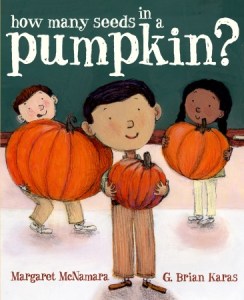 One example I have found of a book that certainly combines the nonfiction and multicultural features is HOW MANY SEEDS IN A PUMPKIN? by Margaret McNamara. I have shared this book numerous times in classrooms across the country and almost without fail, each time I read it some student or even multiple students will talk about the magic in the book. They have no idea they are learning math and science. At the same time the illustrations are clearly multicultural in portraying the world around the students – but would most people label it at first glance a ‘multicultural book’? No. It is a natural portrayal of the real world of mirrors and windows we stress in our Multicultural Literacy Campaign.
As part of our commitment to motivate young readers, RIF has increased efforts through our Multicultural Literacy Campaign to reach more African American, Hispanic, and American Indian children at risk of academic failure. We are deeply concerned about the growing number of quality reports and research studies showing the large gaps in literacy accomplishments too often found between these children and their peers. We know one aspect of promoting improvement is to provide more culturally diverse books so that children nationwide can discover the value of their own heritage while learning about the importance of others. You can learn more about our Multicultural Literacy Campaign at http://www.rif.org/us/about/literacy-issues/multicultural.
Choice is a key reading motivator. Allowing children control over what they read can help them build a lifelong, life-changing love of reading. We also believe choice is power. For underserved children, who have fewer opportunities than more advantaged children to make positive choices in life, offering a choice of books provides a taste of the dignity of personal autonomy. Even such small opportunities and encouragements to choose can inspire children to make greater choices: to choose learning, to choose success in school and life, to choose a brighter future. Quite simply, given the power to choose what they will read, children will chose to read to learn.
In addition to choice of book, RIF has two other key components to our book distribution program: motivational activities during the distribution (and nothing is more exciting than an author or illustrator coming to read!) and parent engagement.
I invite you to visit with us at RIF regarding ideas you have about how we can provide more books like those I reference and other inputs you may have on our various program components. I also encourage you to determine if there is a RIF program in your community where you might give one reading/presentation a year as part of our effort. Use the locator map (www.rif.org/maps) where you can easily access program sites near you; should you need assistance in making contact with a program(s) or you have questions/suggestions of any type for RIF, please contact me at crasco[at]rif.org.
My interest in PiBoIdMo has escalated over recent weeks, and I have started my own beginning short list of books I wish I could write. Who knows, I may figure out how to allocate the time to learn even more about this process over the next year and actually sign up—book one is one I have carried for three years in my head and there are two more beginning to take root. I want to take the excitement I have seen in children at the sea organ in Croatia and the pure awe I witnessed on the faces of students as they watched the making of smoke by an American Indian as he rubbed sticks together at a recent RIF distribution in DC and figure out how I can share those experiences with children who may not the opportunity to visit with an American Indian visit or take a trip to Croatia.
Children’s interests matter at RIF. We strive to develop their freedom to ask and answer questions, to experience adventures and new ways of perceiving the world around them through the books they choose. We are honored to have played a part in offering the millions of choices connected to the more than 366 million books provided to children since our founding…and we look forward to providing millions more.
Happy Reading!
 Reading Is Fundamental, Inc. (RIF), founded in 1966, motivates children to read by working with them, their parents, and community members to make reading a fun and beneficial part of everyday life. RIF’s highest priority is reaching underserved children from birth to age 8. Through community volunteers in every state and U.S. territory, RIF last year provided 4.4 million children with 15 million new, free books and literacy resources. For more information and to access reading resources, visit RIF’s website at www.rif.org.
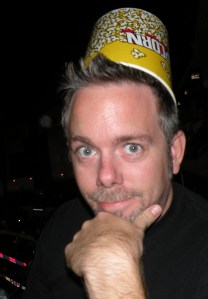 by James Burks
It’s day 18 of PiBoIdMo and I’m here to give you inspiration or at least a small push towards the finish line. I’m sure that, at some point in your life, most of you have put together a puzzle. It could have been a small puzzle with only a hundred pieces, or a ginormous puzzle with a bazillion pieces. Regardless of the size, if you can put together a puzzle then you can put together a story. So let’s get started.
To put together a story puzzle, the first things you need are the pieces. That’s where your ideas come in. Every single idea you come up with is a piece of the story puzzle. This includes characters, settings, or lines of dialogue; you name it, they are all pieces of the puzzle. And here’s the best part: there are no wrong pieces. If a piece doesn’t seem to fit into the puzzle you’re working on, you can set it aside to use later.
Here’s an example of a recent story puzzle that I put together:
About a year ago, I sat down and tried to come up with my next great idea. I had just sold my first two stories to different publishers and was trying to come up with a third story that my agent could send out. I had the first piece of my story puzzle: a squirrel. I spent the next few days creating more pieces. I gave the squirrel a name (another puzzle piece), and I came up with a bunch of stuff that he loved to do (more puzzle pieces). After a few days I took all the pieces and arranged them into a simple story, drew some rough drawings (for illustrators, these are more pieces), and sent it off to my agent. My agent thought it needed something more, though, and at the time I didn’t know what that was. So I set the entire puzzle aside and went off to work on another project.

After about a month, my agent called and asked if I had come up with any new ideas. I hadn’t. Or at least that’s what I thought. After hanging up the phone I started running through a bunch of random ideas while surfing the internet. I remember contemplating Amelia Earhart (I think the biopic was coming out or had just came out), went from there to Penguins, then to the South Pole, and from there to a bird migrating south for the winter. (It’s always a good idea to let your brain off its leash once in a while and let it run free. You never know what it might bring back.) Something about a bird flying south for the winter ended up sticking with me.
I didn’t know it just yet but I had just found another piece to my story puzzle.
From there, everything seemed to magically fall into place. I took the bird migrating south for the winter and stuck him with the squirrel from my earlier story. A small part of my story puzzle took shape.
Then I started to ask myself a series of questions to fill in the rest:
Why do they have to migrate south together for the winter? There had to be a reason and it had to be big. I asked myself what would happen if Squirrel was forced to go along after he unintentionally sacrificed his entire winter stash of food to save Bird from an attacking cat. He would have no other choice; if he didn’t go with Bird then he’d starve.
But, where was the conflict? What was going to make my story interesting? Maybe they were like the odd couple. I imagined Bird as a total free spirit who just wanted to have fun, while Squirrel was a bit neurotic and was all about responsibility. Squirrel can’t stand Bird, but they’re stuck together. A natural conflict of personality that would provide for some humorous scenes.
This left one last question. How would the two characters change by the end of the story? What would their character arc be? In the case of this story, I decided to have Bird learn to be a little more responsible and Squirrel learn to have a little more fun. The story, at its heart, would be about finding a balance between having fun and being responsible. And by the time the journey ended, they might even become friends.
At that point I could pretty much see the overall structure of my puzzle. The edges were complete and all the major parts were coming together. All I had to do was fill in the missing pieces in the middle, which solidified as I wrote the outline and got to know the characters better. Two weeks later I sent it off to my agent, we made some minor tweaks, and eventually sold it to a major publisher. (Deal announcement pending; I’m drawing and writing the book for release sometime in 2012.)

I hope you find inspiration in my recent experience and are able to put together some great story puzzles of your own. Just remember that there are no wrong pieces. You may not use every idea or piece you think of right now, but every piece (used or not) helps you build your puzzle. Now go forth and conquer the book world!
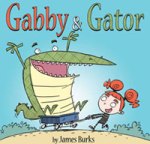 James Burks has spent the last 15 years working in the animation industry on various movies and television shows, including The Emperor’s New Groove, Atlantis, Treasure Planet, Home on the Range, Space Jam, The Iron Giant, Wow Wow Wubbzy, and most recently on Fan Boy and Chum Chum. His first graphic novel for kids, GABBY AND GATOR, was published by Yen Press in September 2010 and is a Junior Library Guild selection. James is currently working on a picture book with Lerner/Carolrhoda entitled BEEP AND BAH (2012), and the graphic novel mentioned above.
James is giving away a signed copy of GABBY & GATOR! Leave a comment to enter. A winner will be randomly selected one week from today.
Thanks to James for the PiBoIdMo 2010 logo and badges!
 by Mark Ury
Blogging always seems to include sharing some sad truth about yourself, whether it’s your obsession with trash TV or one too many trips to the freezer for more mint chocolate chip ice cream (P.S. these are examples and any resemblance to my life is coincidental). So here’s my share: I can’t draw.
Admitting you can’t draw isn’t much of anything, really. Over 90% of the world can’t draw. But context is everything. Admitting I can’t draw to my bowling friends isn’t worth a second glance (P.S. I don’t bowl), whereas sharing it with picture book writers and illustrators is like asking your bowling friends to switch to five-pin balls since your wrist is to weak to use the grown-up sizes (P.S. this has never happened). It’s kinda sad and wimpy.
Now, don’t feel embarrassed for me (P.S. you are not my mother). I have at my disposal an entire platform to compensate for my lack of artistic skills. With it, I can inspire myself to great heights and pen imaginative stories that kids everywhere read and love. But, sleazily cross-promoting my venture is not what this post is about (P.S. unless you find my venture intriguing and possibly useful, in which case we should have coffee and be friends). No. This blog post is NOT about (shameful) marketing or even (sad) admissions of inferior uses of pencils. It’s about music. Or, more specifically, it’s about how music helps me get the feeling of a story long before (and sometimes after) I’ve seen the images or typed the words.
It’s quite possible you are already familiar with how music can shape your work. If so, perhaps you might be better off reading Sarah Dillard’s post—it has cute bunnies. But if you’re like me (P.S. heaven help you), you may only be modestly aware of how music can be used to give your story the tone or pitch your characters are longing for (and, eventually, if you score that deal with HarperCollins, your readers).
For the longest time, I *thought* what was inspiring the tone of my writing were the images I would paper on my walls, stash in my notebook, or hide under my pillow (P.S. the images under my pillow were not at all being hidden from my mother). Weathered photos of Sid Vicious and Marianne Faithful propelled my early poetry. An image of Kate Spade holding one of her early designs became the central figure in one of my (wretched and unfinished) screenplays, and a stark image of Vanessa Redgrave has been taunting me to start my graphic novel (P.S. yes, you read correctly that I can’t draw).
But, upon reflection (.PS. while searching for a theme for this blog post), only recently did I notice that while images were influencing *what* I was writing about, the actual tone came from the music around me.

This story, about memory and love, was shaped by This is the Kit’s Two Wooden Spoons—an earthy and lush little song that I couldn’t get off of replay on my iPod. And my story about a gruesomely self-centered girl rose from the the chill of Radiohead’s There There (P.S. This is ironic since Thom Yorke wrote the song as a kind of bedtime story for his son. P.P.S. I am glad I am not Thom Yorke’s son).

Music has shaped my copywriting and creative direction, too. Commercials, ads—even the design of products and services—have musical DNA from bouncy ABBA tunes, 80s Brit-pop, and recently, the alt-country acoustics of Kathleen Edwards. And why not? Music is this perfect mix of math and emotion, logic and passion. It’s the ideal stimulant for a tired mind and great whip to a lazy idea (P.S. my ideas need constant flogging). Mostly, it’s a great friend to writers, who need to balance structure and character with some sort of texture or flavor that they can’t quite articulate.
So here’s my suggestion: include music in your work. Better yet—let it muscle itself between your sketches and copy. Replay favorites and dig up old tunes. Drift through lyrics and free associate. Use sound to create new stories (don’t you WANT the East-End boys and West-End girls to meet?), vivid places (just what does the town in Simon & Garfunkel’s My Little Town look like?), and beguiling characters (surely Tom from Suzanne Vega’s Tom’s Diner is worth examining?). Most of all, let music do what it’s meant to do: alter your rhythm. Great stories don’t come from staid patterns.
As for me, I’m wrapping this post feeling less insecure about my poor pencilmanship. (This is quite possibly because I’m listening to The Wild Strawberries and thinking of pie rather than having stared down my limitations (P.S. It is.).) Either way, music saved the day, again.
 Mark Ury is the cofounder of Storybird, an occasional writer, and almost always nibbling chocolate.
 by Salina Yoon
Toys, toys, toys! I love toys! They are often the inspiration to my novelty books—board books with interactive features. They are designed to be touched, pulled, squeezed and played with, so my books and toys are like cousins.
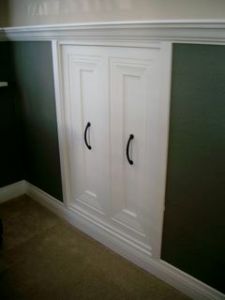 Colored stacking rings, the Connect Four game, wooden puzzles, rubber duckies, and even a football has inspired a book idea! And sometimes, it’s not even a toy at all. Random objects will inspire me. My husband’s toolbox, kitchen utensils, scrap fabric, a greeting card, and even a funny jack-o-lantern on Halloween! I can’t get away from ideas creeping into my head because I’m surrounded by objects. Needless to say, I develop a ton of ideas every year. About a dozen are usually good enough to publish. And the others crawl back into my deep, dark dummy closet of doom. (See photo!)
 My books are concept- and format-driven, so I’m not looking for story ideas. I look for fun concepts that allow a child to interact in a meaningful way from the physical design of the book. Rock & Roll COLORS is an excellent example. The book has a hidden track within each narrow page that allow a shiny disk to roll back and forth when the book is tilted. It makes a nice, satisfying clunking sound when the disk hits the edge. Each side of the page has an image with die-cuts, so the foil comes shining through. Each spread focuses on one color, and both images on the page are that same color. It’s so simple, but effective!
 So how does this help you if you’re not developing novelty books? I say keep an open mind! Even simple objects can inspire, if you let them. For the PiBoIdMo challenge, all you need are concepts.
Surrender to your imagination! I don’t actively try to create ideas as much as allowing ideas to come into my head. Allow your mind to be free! Relax. Smile. Enjoy the process. Like the Chinese finger trap, the harder you pull, the stronger it resists. Don’t stress too much about trying to think up great ideas. When they come a-knockin’, just invite them in!
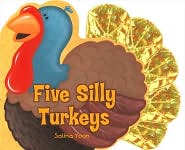
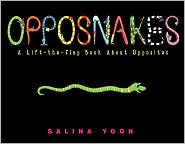 Salina Yoon is the creator of over 150 innovative books for young children. She has been named a finalist for the CBC’s Children’s Choice Book Awards for K-2nd Best Book of the Year, for Opposnakes (S&S/Little Simon), received the Oppenheim Toy Portfolio Gold Seal awards for Little Scholastic TOYS (Scholastic/Cartwheel) and Rock & Roll COLORS (Scholastic/Cartwheel), and the Nick Jr. Family Magazine Best Book of the Year award for My First Menorah (S&S). An author search on B&N, Amazon or IndieBound is the best way to track Salina’s books down. There are lots and lots of new titles releasing soon! (And Salina promises to have an updated website in Spring, 2011.)
Kids says the darndest things. And who better to give picture book authors great ideas than their readers? I asked Mrs. Lombardo’s 2nd Grade and Mrs. Mozer’s 3rd Grade classes what kind of book they would like to write and why.
“If I could publish a children’s book, it would be about…”
“Dragons because a lot of little boys like dragons.” – Oscar
“Soccer because I could teach others how to play soccer.” – Victor
“Dinosaurs because children like the T. Rex, triceratops and others.” – Aidan M.
“Friendship because children should learn how to be nice to each other.” – Mark
“Presidents because they are important for our country.” – Marshal
“Turkeys because it’s November.” – Dylan
“A girl and a boy walking in the woods and a witch would take them and bring them home. I would write it so some people would get scared a little bit.” – Taylor
“Dragons because I like dragons.” – Chris
“A little funny eraser who has big adventures all around the world because kids always like adventures.” – Gabriela
“Animals because lots of people like animals.” – Eliana
“Vampires and aliens because that is what most kids like.” – Annika
“A kid getting a pet. I would do it because they might like the book.” – Angelina
“Two girls who buy cotton candy. One of the girls eats it and the other one doesn’t. So it makes fun of that cotton candy. I would write this story because it makes me laugh.” – Neda
“Dragons. My book will be about dragons because it’s easy to make the problem and solve the problem.” – Thomas
“Friends because at school we learn about being bullied and good friends have to be nice to each other.” – Kyle
“Snow because children like to play in snow.” – Payoon
“Valentine’s Day because a lot of people like Valentine’s Day.” – Rebecca
“A girl and a boy helping others because other people could help others, too.” – Sophia
“A long time ago so kids can learn about a long time ago.” – Aidan Z.
“Christmas because it’s my favorite holiday.” – Halle
“A scarecrow, pumpkin, witch, house, people, crayons, lunch, snack, class. You could write a school.” – Vikesh
“A boy that could fly because it would be cool to see the world.” – George
“A boy who’s stuck in a haunted house because I like to tell spooky stories and it would be a cool adventure.” – Melanie
“A boy who could create pictures in his mind and make things happen because I think that would be exciting.” – Nick
“A girl who plays soccer because I think it would be interesting to read about a girl like me.” – Leah
“A girl who was teased because she was so good at math because I’m so good at math.” – Sophie
“A girl that has powers because I think that would be interesting.” – Hanna
“Dinosaurs because kids really like dinosaurs.” – Pierson
“A girl in a wheelchair because it would be cool to see how she dealt with school and her differences.” – Alex
“A girl that could fly because I would love to fly.” – Ella
“A girl that could go anywhere because she’d be able to get anything.” – Meredith
“A girl that wanted a dog because I want a dog and can’t get one.” – Denise
“A bear that is lazy and never helps people because it would be funny.” – Christian
“A boy who could fly because it’s my dream to fly and it would be cool to read about.” – Matthew
“People with powers because that would be cool.” – Jenna
“A boy who could fly because I like fantasy.” – Jimmy
“An alien who is friends with a boy because it would be cool.” – Julia
“A boy that could do amazing things because that would be interesting to read.” – Alexander
“A boy with super powers because that would be awesome.” – Henry
“Football because I know a lot about it and I play football.” – Tucker
“A kid who stunk at soccer and then becomes the best player on his team because it would be a good book.” – Lucas
“A boy who could fly because a lot of children want to fly and would like to read a book about it.” – Ethan
“A girl that has a brother and sister that annoys her a lot because I have a brother and sister that annoy me.” – Abby
Today’s inspiration from author-illustrator Adam F. Watkins is purely visual. You figure out the story—and you can also win this signed illustration. Just leave a comment! A winner will be randomly selected one week from today.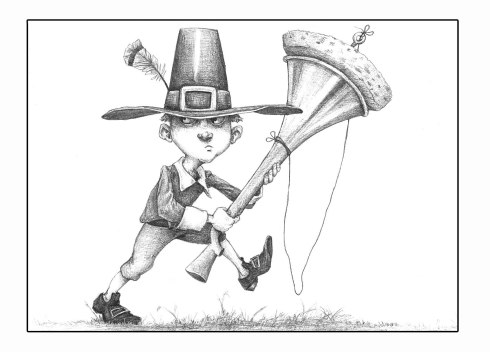 Adam lives in southern Ohio with his wife Amy and daughter Lucy. He graduated from the Columbus College of Art and Design in 2004, where he majored in illustration. He studied under C.F. Payne his junior and senior years. He worked for an advertising agency in Cincinnati after graduation and is now a full-time freelancer. He loves children’s books and the outdoors. Adam hopes to one day share his illustrations and stories with kids all over the world.
Some awards he has acquired along the way:
2003 – Society of Illustrators student show
2004 – Best in Show, Art of Illustration Show
2006 – Gold Addy Award
 by
by Okay, so I have my picture book idea for today. Yay! But I kind of feel the need to get another one in…to get ahead, you know?
And then I worry if I am following the rules or not. Am I even allowed to think of 30 ideas in ONE day, or is it a MUST that I pace myself and only create one idea per day? And what happens if I get a good idea that’s so amazingly HOT that I must write a draft NOW? Not next month. Not next week. Not tomorrow. NOW.
I MUST DROP EVERYTHING AND FOLLOW THIS IDEA NOW.
And then I realize that PiBoIdMo is not about rules.
Break the rules if you need to. Just break ’em.
 PiBoIdMo is about getting on a first name, maybe even nick-name basis with your muse.
(And really, some of the best children’s books don’t really follow the rules, now do they?)
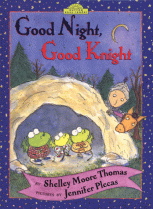
I mean, some books have amazing vocabulary for being an easy reader. (Uh-hum….mine for example.) I put in the word “Methinks” in my easy reader series, Good Night, Good Knight. And I got to keep it in! I also put in some words that may or may not be real words, but they sounded so nice together and were words that are fun when they dance on your tongue.
Really, there is only one rule when writing a book for kids. It’s got to encourage the reader to TURN THE PAGE. It’s got to engage the child in the story enough that they WANT to learn to read it themselves.
(Well, maybe there are two rules…*Get Kids to Turn the Page* and *Inspire Kids to Read.*)
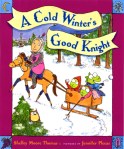 Shelley Moore Thomas is also known as the StoryQueen. I know what you’re thinking…does she really wear a ridiculous crown, fake jewels and a velvet cape? Does she really play with puppets? Well, er um…yes…and yes. But wait! Don’t go! It’s not as strange as it sounds. She’s a writer for children and, well, we do weird things sometimes. Her latest book is A Cold Winter’s Good Night.
It’s not always about the cute bunnies.

I’ve been drawing a lot of bunnies lately. Well, actually one bunny in particular.
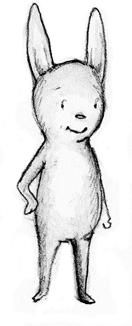 He is very persistent and keeps showing up when I’m doodling, waiting for his chance to star in a story. He is not what I am supposed to be drawing right now. I am supposed to be drawing chickens and mice and Christmas trees as well as coming up with a brilliant picture book idea everyday, none of which have had anything to do with bunnies so far. But he keeps showing up, begging for attention like a puppy who wants to go for a walk.
I have nothing against him, I think he is kind of cute. It’s just that I have no time right now for cute little bunnies. I really need to be working on these other things, before I can pay any attention to him.

So I am just trying to ignore him. And the more that I try to ignore him, the more I find myself thinking about him. Where did he COME from? Why does he keep BOTHERING me? What does he WANT? What does he NEED? WHO is this BUNNY?
Ideas are funny things. Sometimes it seems that you will never have another good idea again no matter how hard you try. Sometimes you need to wheedle an idea out of a germ of a thought. And sometimes they just burst through the door and kick you in the head. Who knows which ideas will grow into a full fledged story and which ones will just fizzle away. The best that you can do is listen to them, push them if they need it and give them a chance to shine.

I don’t know yet who this bunny is or if he will ever grow into his own story. All I know is that he’s been bugging me and pretty soon I am going to have to do something about it. The other characters are starting to complain.

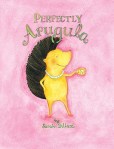
 Sarah Dillard is an award-winning author/illustrator. Her latest book is Perfectly Arugula.
You can win Sarah’s signed illustration of Bunny and Mouse above! Leave a comment to enter. (One entry per person.) A winner will be randomly selected one week from today. Good luck!
 by
by I don’t know about you, but I’m a little weird. I like to make up words and twist them around, and call things and people by funny names. Sometimes this amuses other people, and it always amuses me. That’s one of the keys to storytelling: having fun with words and concepts, and not being afraid to put in your own little bit of wackiness.
Now, I love picture books, but when it comes to writing I tend to be a novel person. I write long. So I was a bit surprised when an idea for a picture book popped into my head and demanded to be written. It was inspired by my dog Emma. (Isn’t she cute?)
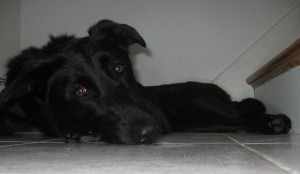 Ever since my husband and I adopted Emma over the summer, it’s become a hobby of mine to come up with silly names for her. Miss Emma Dog. The Furry One. Emmakin Skywalker. She doesn’t seem to mind.
Emma gets very excited when she thinks she’s going for a walk. One morning, when she was trying to speed up the process by whimpering, I told her: “Hold on, Dogosaurus. We’re going.”
As we were on our walk, that word kept bouncing around in my head. Dogosaurus. And when I glanced over at Emma’s shadow, with its long snout and sharp teeth, it didn’t seem that far-fetched that a dog could turn into a dinosaur. And wow, what a whole lot of chaos that would be! Thus the idea was born.
At this point, the manuscript is still in its infancy. It’s gone through some major revisions, and I’m sure it’ll go through several more before it’s anywhere near done. But the initial idea, the initial weirdness, keeps me inspired to continue working on the story.
So as you’re thinking of ideas this month, why not try embracing your weirdness? Maybe there are things you do or say that people roll their eyes at? Use them! Maybe there’s a joke you made up that makes you laugh every single time you tell it? Mine it! The idea might be strange and silly, and it might entertain only you, but you never know where your inner weirdness can take you.
Anna Staniszewski lives near Boston with her husband and their adorably insane black Lab. She’s represented by Ammi-Joan Paquette of the Erin Murphy Literary Agency. Anna’s debut novel, MY UN-FAIRY TALE LIFE, will be published by Sourcebooks Jabberwocky in September 2011. You can visit her at www.annastan.com.
 by
by As adults, it’s easy for us to get entrenched in the necessities of day-to-day living whether it be money, bills, work, deadlines, marketing, dinner, laundry, family time, and the list goes on… I know because I’m guilty. As a TV producer for World Wrestling Entertainment, Inc. for ten years, I was immersed in work, concentrating on my career, traveling around the globe, and trying to hold my own alongside 7 foot, 400 lb. men.
But everything changed when I started to hang around two little guys who weighed less than 30 lbs. After the birth of my two boys, I realized the importance of seeing beauty in the ordinary and opening my eyes to things I hadn’t before. I became curious and observant and enjoyed to watch a caterpillar inch along the sidewalk or the clouds drift along the sky. I gained a renewed sense of humor in gas and poop jokes and rediscovered what fun it can be to blow bubbles in your chocolate milk.
As I began to think like a kid, ideas and creativity flowed in my head like Roaring Rapids at Six Flags. I found all of my inspiration for writing came from my two boys. As a result, I felt an urge to express myself on paper.
 In fact, the idea for my first picture book, The Bug That Plagued the Entire Third Grade, came to me when one of my sons had that dreaded stomach virus that makes its way around a house until it’s hit every family member! When family and friends called to see how he was doing, I would say, “He caught the bug.” It’s something we all say when we’re sick, but it made me stop and wonder why we say that. Something clicked, so I expanded on the play on words of getting sick and catching an insect. Hence… “The Bug” was born.
The idea for my second picture book, Oh the Possibilities, a work-for-hire I wrote for John Hancock’s Back to School campaign, can also be credited to my two boys. John Hancock was looking for a children’s book about that age-old question, “What do I want to be when I grow up?” Everyone always takes the time to tell me how my boys are “all boy.” And they truly are, fascinated by everything from super-heroes to dinosaurs to trucks to dragons. I was thinking about professions and thought, what boy doesn’t dream of being a dragon, right? I built off that, so when my character, Miles, realizes he only has human genes and must decide on something soon, he runs through all the possibilities.
As my writing career was starting to take shape, I discovered one of the most dramatic shifts we can make as picture book writers is to see life through a child’s eyes. After all, who are our readers? Picture books are targeted toward 4 through 8 year olds and the rule of thumb is that children want to read about characters their own age or a bit older. So how do you get inside the head of a five year old? I don’t know about you, but I’m the type of person who can’t remember what happened yesterday, so there’s not much chance of me tapping into my own childhood memories and bringing to the surface what I was feeling when I was five. So the best way for me to identify with my main characters is to hang out with my readers. There’s nothing like picking up a crayon and coloring, blowing bubbles, whizzing down a slide, and running my fingers in a sandbox for inspiration.
Chances are, if we’re writing for children, we like to think of ourselves as young at heart. So as you’re wracking your brain for 30 ideas in 30 days, think of some of the children you come into contact with each day, whether it be your own, nieces and nephews, grandkids, or friends’ kids. However, this time, instead of watching from the sidelines, join the race or purposely plan an outing in the rain so you can stomp in the puddles together. Chances are you might just find inspiration from all the pint-sized fun, and reap the rewards, bigger than you ever imagined.
 Lori Calabrese is an award-winning children’s author. Her first picture book, The Bug That Plagued the Entire Third Grade, was awarded DFP’s Best Children’s Book Award. She writes for various children’s magazines, is the National Children’s Books Examiner at Examiner.com and enjoys sharing her passion for children’s books at festivals, schools and events. Visit her website to learn more: www.loricalabrese.com.
Lori has generously donated a rhyming picture book critique as one of the PiBoIdMo prizes. A random winner will be chosen in early December, from those who have completed the 30-ideas-in-30 days challenge.





 Writing for Kids (While Raising Them)