You are currently browsing the category archive for the ‘Children’s Books’ category.
 guest post by Megan E. Bryant
DUMP TRUCK DUCK, my first picture book, is about a crew of construction ducks who build a park. But what most people don’t know is that it’s also the book that built a bridge for me to become the kind of writer I’ve always aspired to be.
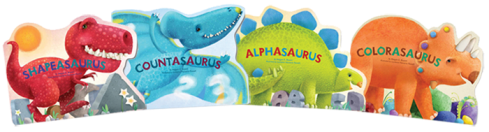
When I started writing DUMP TRUCK DUCK, I’d already been fortunate to publish several board books. Conventional wisdom says that it’s hard to sell board books without illustrations attached, but for me, brainstorming and writing board books was fun, it was easy, it was safe. The secret to selling a board book without art is to have a fantastic idea that is tailored to the format—something that can’t just as easily be a picture book; something that a publisher simply can’t resist. It also helps to have series potential or an angle for table placement—seasonal and holiday can be a tough sell for high-priced picture books due to their shorter selling seasons, but lower-cost, eye-catching board books are a natural fit.
Board books came easily to me, but what about the pages of ideas I had—for picture books, middle-grade series, and YA novels? There were so many other stories I wanted to tell. What was keeping me from pursuing them?
One word: myself.
To make these book dreams a reality would involve several things that scared me: taking big risks with my writing, surviving setbacks, and ultimately facing failure (and lots of it!). When my longing to tell these stories grew even louder than my fear, I realized that it was time to try. I started writing and writing and writing—writing my heart out—and revising until the drafts of various manuscripts numbered into the hundreds. I started querying agents, too, which led to several months of rejection. During this process, I had the idea for DUMP TRUCK DUCK; when I asked my then-three-year-old daughter what she thought about it, she laughed with enthusiasm and replied, “Write that book, Mommy. Write it right now!”
How could I resist?
It took about three months to have a strong, polished draft of DUMP TRUCK DUCK. Since I was compelled to write it in rhyme, I knew that every syllable had to be perfect. Nothing will torpedo a rhyming manuscript faster than uneven rhythm or forced rhymes. All that work paid off; Dump Truck Duck was the manuscript that brought in several offers from agents, including one from Jamie Weiss Chilton, who has been an amazing agent and even better friend for five years now. Jamie loved Dump Truck Duck and couldn’t have been more enthusiastic about it. When we went on submission, I was giddy with excitement.
Then the rejections started rolling in—for four long years.
It sounds egocentric, but I have to admit I was surprised. Weren’t trucks an evergreen topic, beloved by boys and girls? Didn’t the ducks add a unique angle? Wasn’t the rhyme just right? Jamie wasn’t ready to give up, but in my heart I wondered if it was time to face the sad truth that maybe some manuscripts, no matter how hard you’ve worked or how much you’ve believed in them, are not meant to become books.
Then, it happened: The editorial director at Albert Whitman loved DUMP TRUCK DUCK as much as Jamie did; as much as my daughter did. After the offer came in, I walked around in a state of disbelief for weeks. Astonishingly, that was just the start of a period of extraordinarily good news. In four months, we received offers on seven other books, including a chapter book series, a board book series, and my YA debut. Of course, the only reason we were able to sell so many books in such a short period of time is because I never stopped writing. Even during the darkest times, when I was so discouraged it was hard to walk into bookstores; even when I wondered if I’d ever sell another book again. The gift of all those rejections was learning a fundamental truth about myself: I would always write, no matter what. And that is one reason why I didn’t give up, even when common sense would dictate it was time to move on.
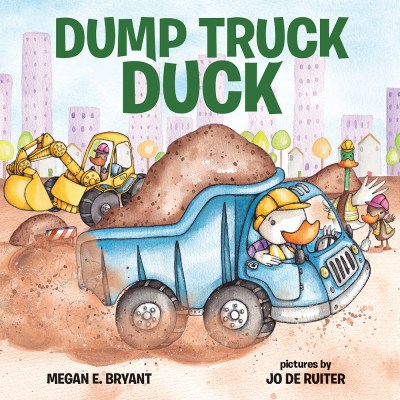
To watch my manuscript for DUMP TRUCK DUCK transform into a book with adorable illustrations by Jo de Ruiter was a joy that defies description. I’m so grateful to everyone who worked so hard to make this book, from Jamie and Jo to the talented team at Albert Whitman. I’ve tried to do my part to promote it by setting up readings and events for children, along with my very first blog tour. This has been a book truly worth celebrating—and celebrate we did, with a fabulous construction-themed launch party!
Children grow faster than books; I was never able to present my preschool-aged daughter with the copy of DUMP TRUCK DUCK she so eagerly anticipated. She’s a big girl now—eight years old and reading independently—and there’s a new preschooler in our lives: my son, who loves nothing more than when his sister reads DUMP TRUCK DUCK to him. Hearing my words spoken in her sweet voice truly makes it worth the wait.
Thank you, Megan! What an inspiring story. And so many more books to come. Congratulations!
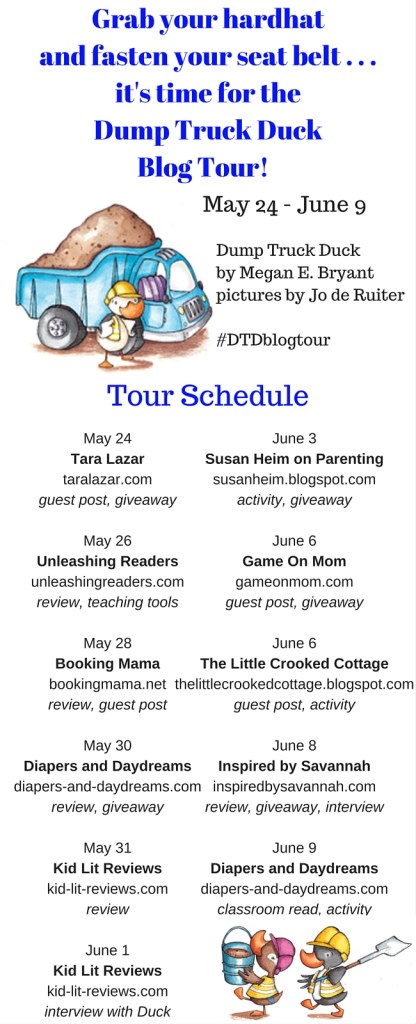
Megan is generously giving away a copy of DUMP TRUCK DUCK. A winner will be selected by random at the conclusion of her blog tour. Just leave a comment below to enter and good luck!
This morning I thought I was still at the NJ-SCBWI Summer Conference because I stumbled downstairs expecting to find fresh-baked coffee cake and a fruit platter. Instead, I found a slumbering adolescent who never got up for middle school and missed the bus. Hence, I was rudely thrust back into the life of a mom. Sigh. So I decided to ignore my life for a while and write this post. Relive the glory days!
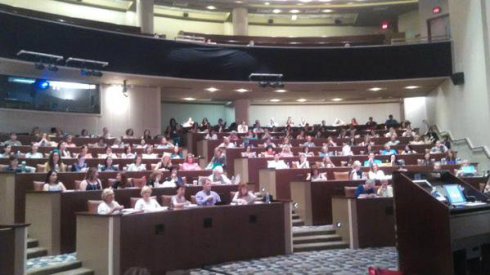
This would make a great WHERE’S WALDO? spread.
The weekend was chock full of good friends, like author extraordinaire Tammi Sauer, whom I’ve known for SEVEN YEARS but had never met in person. I wanted to make a good impression upon her, so I picked her up from the airport…and then proceeded to get hopelessly lost in Newark. We did spy a ’57 Chevy during one of our dozen-or-so U-turns, so perhaps all was not lost.

’57 Chevy! Yes, I snapped this while we were stopped.
And then, we got cut off by a rumbling, muffler-roaring Racini. RACINI, PEOPLE! Only in Jersey.

Racini! (Not the full license plate.)
Of course, there were also the usual suspects present: Sudipta Bardhan-Quallen, Kami Kinard, Marcie Colleen, Ame Dyckman, Adam Lehrhaupt, our fearless RA Leeza Hernandez, and newly-signed talents like Jason Kirschner, Colleen Rowan Kosinski and Kelly Calabrese. (For those of you with bets in the pool, Ame’s hair shone bright blue this year, bordering on periwinkle, stylishly accented with a coral red bow.)
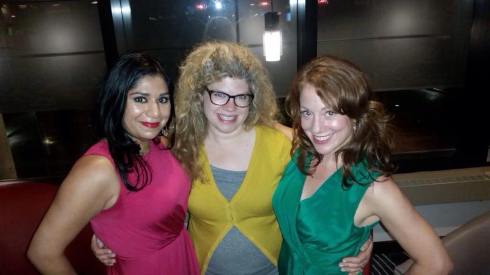
Sudipta, Marcie & Kelly. Yes, they can go by first names only.
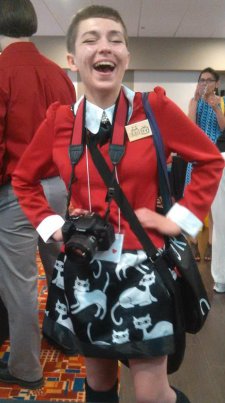
Katya Szewczuk from KidlitTV let us know that her last name is pronounced “Shove Chuck.” Sadly, Chuck Palahniuk was not in attendance. What a fight club that would have been! (P.S. Isn’t Katya adorable? I call her Ame Dyckman Jr.)
Carrie Charley Brown, Kirsti Call, Lori Degman and Robin Newman were there, too…but the Witherspoon Grill couldn’t get us a table for 10. For shame! But they did get us a bottle of Prosecco. Next time, it should be on the house.
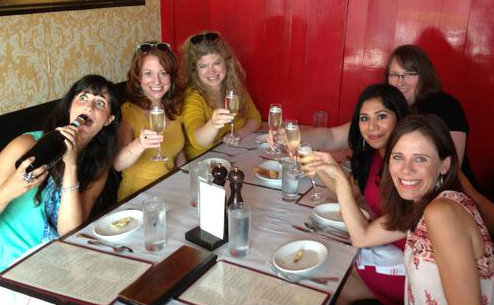
Me, Kelly, Marcie, Kami, Sudipta and Tammi
My editor from Sterling, the smart and lovely Meredith Mundy, made an appearance with a stack of NORMAL NORMAN cover designs from which to choose. Tammi, an author of eight Sterling titles, offered her expert opinion, too. And guess what? We all agreed on two favorites. (Now do we eeny-meeny-miney-mo?)

NORMAN!
I only saw critique partners Corey Rosen-Schwartz and Mike Allegra briefly. I waved to Mike from my post at the registration table. Then he promptly dissolved into the crowd. This became a new picture book idea. Thanks, Mike!
So I bet you’re like ENOUGH ALREADY, TARA. GET TO THE NUGGETS.
Opening Keynote by Denise Fleming
 Denise encouraged us to find out what age we really are. No, this isn’t a plug for how-old.net. Go back to your childhood and discover the age of your true voice. Denise never aged past Kindergarten. Me, I’m perpetually 8.
So that’s what you write. Dig down to emerge as a child, forever locked in a state of wonder.
Denise told us an impromptu paper-making class inspired her to choose this art form as her picture book medium. She evolved from precise watercolor paintings to a more loose, bold, colorful style. HER STYLE. Her illustrations set her apart. She asked us to ponder what makes us each unique. You’ve got to offer something different and not be like everyone else. Stand out, don’t blend in.
Oh, by the way, Denise thinks you’re pretty.
 Workshop One:
Writing Picture Books that Sell! by Tammi Sauer
With 23 contracts in 10 years, you’ve got to listen to and respect Tammi’s advice. She presented her top 12 tips for picture books, citing from her titles as examples. The quirkiest thing I found out is that she loves to use the name “Louise.”
Tammi recommends reading A LOT of picture books. You will begin to absorb information about their structure and format without even realizing! This knowledge will then seep into your manuscripts.
Tammi also wants us to write titles that POP. Up the tension in your stories and use words that SING.
Me? My name sings. I shall hereforthto be known as Tra-la-la Lazar.

Workshop Two:
Writing Mainstream (BUT COOL!) Picture Books by Ame Dyckman and Adam Lehrhaupt
This dynamic duo demonstrated a lot of energy, pizzazz and “special sauce.” No, we’re not talking about McD’s. Their “cream of creativity” is a mixture of unique elements that add up to writing a hook-y, mainstream winner. Slather on your own writing style, stir in heart and humor, and you will concoct a winning picture book recipe.
But remember, that’s just the sauce—an accent. Your picture book still needs meat! Pick popular subjects, relatable situations and age-appropriate “big picture” messages to make your story its most delish.
 Workshop Three:
Thinking Outside the Box to Market Your Book with Jen Malone
I call this presentation “How to Sell Your Book Without Being Creepy.” As natural introverts, we writers don’t like going outside to deal with “people and weather.” We abhor the uncomfortable, used-car-like sales pitch. We don’t want to plaster the interwebs with “BUY MY BOOK!” Ick.
So what’s an author to do? Jen presented unique, creative ways to market by simply being you. Look outside your own book community to find opportunities for connections. Offer others what they want and they might just offer what YOU WANT—an introduction to a new audience. Jen has been doing work with the Girl Scouts and a famous bakery to reach her target audience, tween girls. (And, there are CUPCAKES involved. Win, win, stuff yer face.)
Workshop Four:
7 Revision Tips to Take your PB from WAAH to WOW! by Sudipta Bardhan-Quallen and Marcie Colleen
Don’t let the high-heels distract you. These two PB experts offer furlongs of fabulous advice. (Furlongs? I gotta stop the alliteration.)
They emphasized reviewing your picture book to ensure visual variety. This refers to textual elements as well as compositional ones. Think story AND layout. Think page turns. Think scene changes. Dump anything that’s repetitive or passive without purpose.

Workshop Five:
Is Your PB Worthy? by Marie Lamba
 Oh, how I regret not getting a photo of Marie hugging her presentation easel. Adorbs.
Marie, an author and agent, bubbles with enthusiasm for picture books. She brought some of her all-time favorites to share and exclaimed, “Isn’t that HILARIOUS?” while doubled over in laughter.
We all want that—a reader who loves our book five, ten, even 20 years after first reading it. So how do we get that?
Be different. Don’t just write the first idea that comes to mind. Write five ideas. Then another five. Use the tenth one. Applying this tip from Donald Maass means you’ll arrive upon something no one has done.
Marie also shared the top 10 mistakes she sees in picture book submissions. For example, she doesn’t want to see “just a schtick.” (Don’t you LOVE Yiddish words?)
Your picture book can be ridiculous, but quirky humor isn’t enough. She cited her own manuscript about a girl who wears gloves on her feet and pretends she’s a monkey. It’s cute and funny, but it’s not enough. Marie didn’t have a story, she had a schtick. Your manuscript needs a plot to matter.
Other common errors include rhyming NO MATTER WHAT and writing a slice-of-life vignette—a set-up instead of a story.
 Sunday Morning Keynote:
Top 10 Things You Need to Know About the Children’s/YA Market by Harold Underdown
Harold! You have to love him. (You have to follow his Purple Crayon website!) He’s bursting with kidlit experience and wisdom.
First, he told us some great news: the children’s publishing market rose 20% last year!
Hard copy books are not disappearing and ebooks are not replacing them. In fact, the ebook market has hit a plateau and represents only 15% of the children’s market, but that number leans heavily toward YA. Picture books are preffered in hard copy by a wide margin.
Bookstores (both online and brick-and-mortar) are now the biggest sales channel (40%), as opposed to schools and libraries in years past.
Know that diverse books are hot and that writers and publishers are taking this issue seriously.
YA remains a boom area, MG is very healthy and PBs are experiencing renewed interest. Some are even calling this time “the golden age of picture books.”
However, Howard emphasized that you should always do your best work and not focus on what’s hot. This is what will get you published.
Workshop Six:
Marrying the Right Manuscript with the Right Publisher by Steve Meltzer
 Steve is a welcomed, popular mainstay at NJ-SCBWI. He emphasized doing your research when searching for a publisher. It’s important to seek out comparable titles published within the last three years, those that are of a similar subject and format, but not famous or mega-selling. No one’s gonna believe your series is the next Harry Potter. Query with a reasonable comp, not an outrageous claim.
Workshop Seven:
The Changing Face of Humor in Picture Books by Steve Meltzer
Do I even have to talk about this? Steve and I disagree. I respect his opinion immensely, but I think a popular recent title missed the mark and had opportunity for so much more humor than it presented. He nudged me on the lunch line, “It’s a great book.” I topped my salad with bleu cheese and thought about it.
 Closing Keynote:
How to Be a Writer Without Losing Your Mind by John Cusick
John Cusick said much about life as a writer and agent, how he uses an Iron Man figurine on his desk to distinguish agent-time from writer-time, and how to balance our life roles.
He reminded us that our job is to “sit down and start.” Don’t worry about writing the whole book. Write a little bit for now. (This resonated with me. I tend to panic about writing AN ENTIRE NOVEL when I should really just put one word in front of the other.)
Also, no one cares if you stop writing. YOU MUST be the motivator.
Have a writing friend you can complain to…and let them know that this is their purpose. (Not their sole purpose, of course. We all need to kvetch and we need a kvetch catcher.)
Bottom line, it’s irrational and childish to make things up for a living. It’s crazy-making. So embrace it. Be crazy. It’s crazy that anything can be this good!
“Don’t worry about being normal because what you do is extraordinary,” John said.
I couldn’t agree more. How about you?
It’s come to my attention that we need a collective noun for children’s book writers and authors.
I am therefore inviting your input.
If you’d like to suggest one for writers and a different one for authors, please feel free. (Can’t forget illustrators!) Leave as many collective nouns as you’d like. Of course, you get points for cleverness. I’ll pull them together in a future post so we can vote on them. And then, perhaps, when we see a gathering of these wonderful folks, we’ll know what to call them.

For those of you who didn’t grow up on 80’s music, this is A Flock of Seagulls.
You’ve written a picture book manuscript and now you want to know if it’s ready to send out. Here are seven crucial questions to answer.
Overall:
The first three questions focus on the overall story.
1. Topic: Is the story kid appropriate, kid appealing?
2. Language: Is the story age appropriate? Have you used interesting, fun language? Have you allowed places for kids to join in, such as a refrain to repeat?
3. Illustrations: Have you left space for the illustrator? Don’t describe every visual, but leave that to the illustrator. However, DO add things you touch, smell, taste and hear.
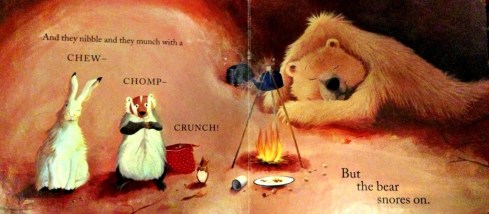
From BEAR SNORES ON by Karma Wilson & Jane Chapman
The next four questions focus on the structure and how well the story will lay out in a 32-page format.
Instructions for these questions: Divide your manuscript into a minimum of fourteen sections, with each section a scene in the story. The fourteen sections will roughly be equal to the number of double page spreads in a 32-page picture book. (If you have fewer than fourteen sections, it’s probably a magazine piece, not a picturebook.) Now, consider each section and answer these questions.
4. Does each section have an action to illustrate?
5. Does each section make you want to turn the page?
6. Does each section advance the story? If you take out a page, does it destroy the story?
7. Does the plot have a narrative arc with a beginning, middle and end?
If you answered, “Yes” on all these questions, then submit your story with confidence.
Not sure about any of the answers? Children’s book author Darcy Pattison and children’s book author/illustrator Leslie Helakoski will co-lead a unique workshop, PB&J: Picture Books and All That Jazz at Highlights Foundation in Honesdale, PA on April 23-26, 2015. Join them and learn how to make your story rise above the fierce competition.
 by
by As an author who’s slowly been transitioning from novels to picture books (my first picture book will be out in March 2015), I’ve realized that picture book techniques have started influencing my novel-writing process. Here are a few examples.
1. Brevity and Word Choice
This is probably the most obvious connection. When you’re used to working with 500 words, you tend to get a little pickier about the words you use in longer projects. Even when I have 50k words to work with, for example, I still find myself making sure to cut out unnecessary phrases (particularly unneeded dialogue tags) and using strong verbs and interesting nouns to make each sentence count.
2. Tying the End to the Beginning
This is my favorite picture book technique. In picture books, the ending almost always echoes the beginning of the tale. I love using this approach in novels, reflecting something from the opening chapter in the closing chapter in a different context. This technique shows us that the character has grown and changed, and it also makes the story feel cohesive and satisfying.
3. Repeating for Emphasis
Repetition can be great in picture books, but in novels it can feel like telegraphing. A strong repeated image, however, especially one whose meaning deepens over the course of the story, can work well if it’s revisited throughout the novel. It can help show how the meaning of that image or experience has changed for the character over time.
4. Using the Senses
In picture books, we have to be mindful of not focusing too much on the visual details so that we don’t step on the illustrator’s toes. That means we have to use other senses to give the story depth. I try to use a similar multi-sensory approach in my novels, so I’m not simply describing how things look to the characters, but I’m also thinking about the smells, sounds, and textures around them. I’ve also found myself using a lot of onomatopoeic words—kapow!
For those of you who write in longer and shorter formats, how do you find the two influencing each other? What’s your favorite picture book technique to use in novel-writing? Please comment below and join the conversation!
.
 Born in Poland and raised in the United States, Anna Staniszewski grew up loving stories in both Polish and English. Currently, she lives outside Boston with her husband and their crazy dog. When she’s not writing, Anna spends her time reading, daydreaming, and challenging unicorns to games of hopscotch. She is the author of the My Very UnFairy Tale Life series and the Dirt Diary series. Her newest novel, The Prank List, released on July 1st from Sourcebooks. You can visit Anna at www.annastan.com.
On the Facebook PiBoIdMo group, I’ve been asking picture book writers which topics they want to see on my blog. Then it finally dawned on me (and Dawn is my middle name, so this should have occurred far sooner)—I should ask on the blog. DUH.
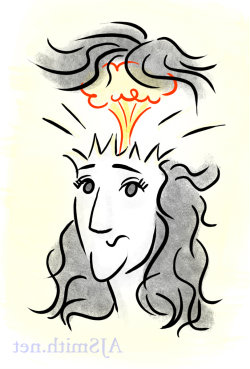
Tara-ra-BOOM-dee-ay by AJ Smith
See that? It’s my head exploding from the geniusity. (Yes, I made that word up. I’m allowed. I write picture books!)
So here I am, asking you, dear blog readers, what is your most burning, brain-blasting kidlit question?
Leave it below in the comments and later this month, I’ll strive to answer them all.
But just remember, you’ll be getting an answer from someone with half a head.
Happy Mother’s Day to my mama-writer friends. What you do every day is amazing! You created kids…and now you create stories!
And what I just did is amazing, too. I gave birth to a new book cover!
(Well, really, Benji Davies did.)
I THOUGHT THIS WAS A BEAR BOOK releases in August 2015 from Aladdin/Simon & Schuster. But you can catch a glimpse of the alien-bear mayhem right here, right now:

Many thanks to my very cool editor, Alyson Heller, and art director, Karin Paprocki, at Aladdin. And of course, none of this would be possible without über-agent Ammi-Joan Paquette.
More sneak peeks to come soon. I promise you a cute bear tushy.
Have a great day, Mama Bears!
 by author Chieu Urban
Thank you Tara, for inviting me to spread awareness of Books and Smiles for Haiti to this talented group of authors, illustrators, agents, editors, and children’s book enthusiasts.
For the past few summers, I have shared my books with the children of Haiti, and the pictures and smiles and thankful notes I’ve received remind me of why I enjoy creating books for kids. I think that it would be fantastic if they were to receive even more books from our community.
Please join me in sharing your wonderful books for the sweet children of Haiti. Although their needs are much bigger, these gifts will bring smiles to their faces and joy to their day.
I am thankful to President Steven Mooser of The Society of Children’s Book Writers and Illustrators for kindly donating two boxes of books and jump starting the campaign! The amazing people of Life Connection Mission are dedicated to getting the books to the children. They are a non-profit organization serving the poorest children in the Western Hemisphere. A special thank you to the generous authors, illustrators, and children’s book community who have already contributed to this project.
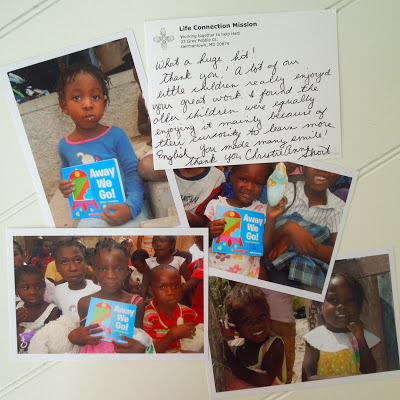
Photo courtesy of Life Connection Mission
We are collecting board books, picture books, beginning readers, and information books with pictures of animals, science, space, and more.
Our goal is to have a really great collection of books by the end of the school year, when they will be crated up and transported to Haiti. I am very excited about this project and look forward to partnering with our talented children’s book community.
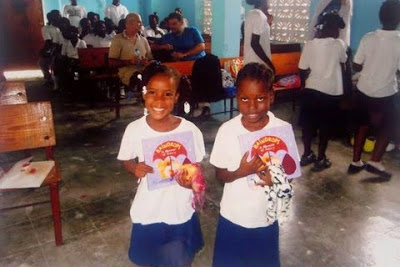
Photo courtesy of Life Connection Mission
If you would like to participate in Books and Smiles for Haiti, please email me at chieuurbanstudio (at) gmail (dot) com for the mailing address. Together, we will see our efforts grow. Please join our Facebook group page for updates.
Thank you, Chieu!
And now for the giveaway…
If you pledge to donate to Books and Smiles for Haiti, I will enter you into a drawing for a picture book critique from me, Tara Lazar. I will keep the comment thread open through the month of March. Just leave a comment stating you’ve donated in order to be eligible for the critique. And thank you for supporting this wonderful cause!
Today we’re lucky to have Peggy Robbins Janousky visiting to share highlights from SCBWI FL’s Picture Book Intensive. Take it away, Peggy!
 I have attended many picture book intensives over the years, but this one topped them all. Participants were treated to an all-star panel that included: agent Deborah Warren of East West Literary, editor Laura Whitaker of Bloomsbury, author and editor Andrea Davis Pinkney and author Toni Buzzeo.
The presentations were practical, but powerful:
- Always bring your “A” game.
- Rhyme is not taboo, but bad rhyme is.
- Picture books are getting shorter and are being targeted for younger audiences.
- Show, don’t tell.
- Hook me and keep me hooked.
- Be passionate about your book and be able to pitch in just a few sentences.
One of the best things that was presented was the HOT list. These are the topics that editors and Barnes and Noble want now:
- Moments of the day
- School stories
- Learning concepts
- Holidays (MLK, Valentine’s Day, 4th of July, St. Patrick’s Day)
- Friends and family
- Biographies
- Character-driven stories
- Original stories that every kid will love
- Interactive picture books
- Finding the new in the old
If you haven’t taken an intensive before, I strongly urge you to consider it. Intensives are exactly that, intense. They give you the opportunity to delve in deeper and they also give you the opportunity to get to know the presenters on a more intimate level. I came away from this intensive with a new sense of purpose and drive. I also came away with a few good friends. All in all, it was money worth spending.
I have to admit, I almost did not attend the Miami conference. I was having a pity party and I wasn’t really up for the company. I had broken my leg in three places. Needless to say, getting around was a wee bit difficult. I was ready to bail. I am glad I didn’t. The first page of my manuscript was read during “first page reads”. Much to my surprise, the panel loved it. One editor wanted to know who wrote it, an agent wanted to read more, and another editor wanted to acquire it. I have to admit, I was in shock. By the end of the weekend, thanks to the help of a good friend, I had signed with that agent. Just one month later… My bio and picture are up on the East West Literary website. The editor that I mentioned is considering three of my manuscripts. And I am still pinching myself.
I will tell you that this was not an overnight success. I have attended many conferences and taken copious notes. I have revised, cut, and revised some more. I have also had moments where I was so rejected that I thought I would never put myself through another critique again. So what’s the moral of the story? Never give up. Never let pity or self-doubt get the upper hand. Believe with all your heart that your day will come. Then get off your butt and get to that conference. Your happily ever after is waiting for you to show up!
Peggy Robbins Janousky uses her offbeat sense of humor to write offbeat picture books. When she is not writing, Peggy uses her time to rescue stray animals. Much to her family’s dismay, she keeps them all.
 And thanks to Kristen Fulton for adding this summary of Andrea Pinkney’s workshop: The Write Stuff.
- Writers write every day, whether it be a holiday or vacation.
- Find your “twinkle”—what makes you sparkle around others?
- Establish immediacy—using voice, characterization, mystery and drama.
- Ask yourself, “Why does the reader want to come on this journey and what makes the reader stay on this journey?”
- Writing is fun—and hard work.
- Writing is re-writing at least 10 times.
- Just get started and keep going.
- Read every day, whether it be a holiday or vacation.
Kristen Fulton writes non-fiction picture books and is running an amazing non-fiction picture book retreat with loads of agents, editors, and authors on July 7-12. Check out her website for details!
Let’s welcome Mindy Alyse Weiss back…she’s got the scoop from the recent SCBWI FL Conference. And boy, what a scoop it is! It’s chocolate fudge with rainbow sprinkles!
Ever wonder about an editor’s wish list? Wonder no longer! In the Editor Panel, Stacy Abrams, Kat Brzozowski, Aubrey Poole, Laura Whitaker and Andrea Pinkney discussed what kind of projects they’re seeking—and not seeking. There seems to be a trend away from dystopian and paranormal novels in YA.

Stacy Abrams, Executive Editorial Director of Bliss and Entangled Teen
Contemporary (no paranormal or dystopian). Can have an issue in it, but the book can’t be about the issue.
Kat Brzozowski, Associate Editor, Thomas Dunne Books, MacMillan
Dystopian is hard. Would love a good YA mystery. Comes across as loving dark but does love girl meets boy and they kiss, light romantic contemporary stuff for girls.
With social media, if you do one thing well but don’t like another, don’t force it.
Aubrey Poole, Associate Editor, Sourcebooks Jabberwocky and Fire
Loves sci fi, YA, not looking at genre really—it’s the stories that stand out within a genre. More experimenting with format. Read more about her wish list here.
Laura Whitaker, Associate Editor, Bloomsbury Children’s Books
She’s tired of dystopian and paranormal YA. She wants to be immersed in a story so much that she’s physically removed from her own issues. She wants to read about real people. Contemporary, original voice. With MG and YA, networking is important. Do a lot of digital marketing initiatives. You can get a huge impact from doing a blog tour. “Help me help you.”
Andrea Pinkney, Vice-President and Executive Editor, Scholastic
More diversity, African American boys, adventure, mystery, fun. Contemporary stories. *You need to normalize and not make it about the problem, even with something like bi-polar.” She’s interested in a novel with a character who has piercing or a lot of tattoos.
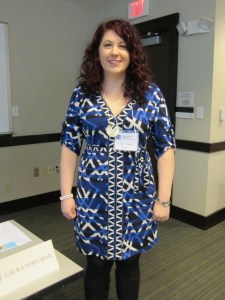
Laura Whitaker, Associate Editor, Bloomsbury
Besides writing a well-crafted story, how do you catch an editor’s attention? Laura Whitaker presented “Dating 101: What Makes YOU Desirable to an Editor”.
Tell her something interesting about your writing journey. What drew you to telling this story? Let her know any cool things you can share about yourself—show what makes you vibrant and unique.
Title—come up with something original that represents your work. If the title is the same when you’re published and there’s a story behind how you arrived at the title, marketing will want it later for a blog/Tumblr piece.
She’ll look at a query for 30 seconds to a minute. First thing should be the hook, then a two sentence synopsis (three if you have to), then info about yourself.
Your website is your calling card—especially for picture books.
Do you tweet out interesting, dynamic tweets? It’s the best way to build connections with other authors, agents, and editors. Twitter is more important for MG and YA.
Interact! Do you write about the process or what you’re working on? Marketing and publicity want to see your social media platform. The more social media, the better—but it is not a substitute for the craft.
Thanks again, Mindy!
Come back on Friday for the rest of the scoop from SCBWI FL. We’ll have vanilla and strawberry for those who don’t like chocolate. (Don’t like CHOCOLATE? Who are you people???)





 Writing for Kids (While Raising Them)