You are currently browsing the category archive for the ‘Children’s Books’ category.
OK, time’s up! Do you have 30 new picture book ideas? You do? Excellent! Time to take the PiBoIdMo pledge to qualify for one of our keeno-Yaccarino prizes. (Sorry, there are no Dan Yaccarino books to give away. I just like that phrase.)
I do solemnly swear that I have faithfully executed
the PiBoIdMo challenge, and will to the best of my ability,
parlay my ideas into picture books from the list of 30 I have created.
Now I’m not saying all 30 ideas have to be good. Some may just be titles, some may be character quirks. Some may be problems and some may create problems when you sit down to write. Some may be high-concept and some barely a concept. But…they’re yours, all yours. Small seeds that may sprout into a story.
You have until December 3rd at 11:59:59PM EST to sign the pledge. Remember, this is an honor system pledge. Those who sign will be entered into the random grand prize drawing: review of your best 5 ideas by a literary agent. There are three grand prizes! Thanks to Jill Corcoran of Herman Agency, Inc., Lauren E. MacLeod of Strothman Agency, and Elana Roth of Caren Johnson Literary Agency for volunteering their time and expertise to PiBoIdMo.
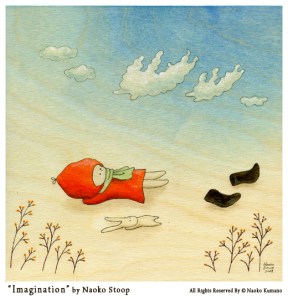
In addition, I have two adorable kidlit prints by illustrator Naoko Stoop to give away–something to keep you inspired throughout the year.

Winners will be drawn and alerted on December 4th. Grand prize winners must contact their assigned agent no later than December 7th. Winners will be given full instructions…when they win!
If you’re an illustrator who participated and want to display your artwork, when you sign the pledge, please let me know that I should contact you to collect images. I’ll create a special PiBoIdMo art gallery to showcase your sketches.
Illustrator Ryan Hipp, who so generously created the PiBoIdMo logo and participator badge, is busy making you an “I did it!” badge to proudly display on your blog. Everyone’s a winner, so it will be posted when the grand prize winners are announced.
Finally, a ginormous THANK YOU to everyone who participated in PiBoIdMo, from the guest bloggers to the aspiring writers and illustrators to the authors and agents. This has been a inspiring month full of creativity and imagination and, not to sound corny, but I couldn’t have done it without your support and enthusiasm!
*Sniff, Sniff*
So enough of the sappy stuff, go sign the pledge. When you leave a comment, be sure to put your email address in the email field so I know how to contact you. You do not have to put your email address in the comment itself. And, you do not have to submit your 30 ideas–they are yours. Treasure them. Just your name and “I did it!” will suffice. Let everyone see your virtual John Hancock. Or maybe that should be a virtual Jon Scieszka?
Making a Difference with Diversity
by Tara Michener
 I have been blessed to have my own informal mini-focus group for picture book ideas. I have been mentoring children alongside my husband Jason for over five years. If you listen really closely, kids will tell you what they want to read by the questions that they ask.
We work with a diverse bunch of young people and we often have heard questions like Am I pretty? and What am I? and Why can’t I be like everybody else? I provide answers to these questions in my first book Who I Am, Not What I Am.
Main character Janelle is bi-racial and finds that her classmates ask her lots of questions about her race, which in turn makes her question herself.
I had a great chat with a lady of mixed heritage at one of my book signings. She told me that she wished that she had seen more books like Who I Am when she was growing up. She mentioned that people always wanted her to claim a race and they did not understand her as an individual. The idea of being a part of more than one racial group boggled their minds.
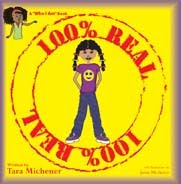 Jason and I thought deeply about the types of books that we would want our future child to read considering we are an interracial couple. We also observed the bond of friendship in those we mentor. A child may not be happy or outgoing but when he/she finds that special friendship, something magical happens. That magic belongs in a book to show children how important it is to be a great friend. 100% Real, my second book, explores a friendship between Janelle and a newly-adopted child in her class.
Children need to see themselves in books and find the answers to their questions in regards to self-worth. They also need to have a greater understanding of those around them. This helps them to see the world from a diverse perspective and allows them to embrace those who are different from themselves.
How can you explore diversity in your writing?
Have you ever considered researching a neighborhood that differs from your own?
Be creative and remember that diversity is more than just race.
Think about reaching a demographic that is under-served in the kidlit genre.
Explore the shelves at the bookstore. Be active in outreach and community service and find out what is missing from those shelves by your best resource… the reader.
I am blessed to be able to be around so many young people to help but also to observe issues that may challenge them so that I can use the written word to help them through the tough times.
The best ideas come from thinking outside the box.
Read something great!
 Tara Michener is an author and speaker who teaches children and adults the importance of diversity and self-esteem.
 Brief Encounters of the Picture Book Kind
by Melissa Azarian
I think you can find a picture book idea in even the briefest encounter, and I’ll prove it.
Years ago, I celebrated my best friend’s birthday at Lucky Cheng’s, a Drag Queen Cabaret Restaurant. Lucky Cheng’s was not so lucky for me. All day long, I had a migraine brewing, and shortly after ordering dinner, I could not fight it off anymore. I ran downstairs to the bathroom, shut the stall door, and prayed to the porcelain Goddess of Migraines.
When I finally emerged from the stall, I realized I was not alone in the ladies room. A 6 foot 1 drag queen—6 feet 4 in those stilettos—was reapplying lipstick. He turned around, gave me the once over, and said, “Honey, you don’t look so good.”
As ill as I was, I had to smile. I don’t look so good? Certainly, I could’ve said the same to him. He overdid his makeup (such a pretty face didn’t need so much makeup), and that V-neck dress was all wrong for him! But why ruin the moment?
I told him that I’d had a lot of migraines and this was another doozy. He sympathized.
So how do you turn a migraine, a drag queen, and bathroom bonding into a picture book? Easy. Just view the whole scene from a child’s perspective. And tweak it a bit.
It could be a picture book about a girl who is excited to go to a party because she bought the perfect gift. She loses the present on the way, but she meets an unlikely friend, who makes her laugh and saves the day.
Maybe it’s about a quiet girl who gets paired up for a class project with a talkative, confident kid. She doesn’t think they can work together until she discovers that they each have something unique to contribute.
Or it’s about an outspoken child who is always hushed, but in the end, his outspokenness helps prevent a mishap at the park.
I could probably come up with ideas all day, based on this one incident. And it’s because, at its core, this is a story about a memorable character.
Think about someone you met briefly and have never forgotten. What quality makes this person so unforgettable? Maybe—if you tweak it a little—the brief encounter will inspire your next picture book.
 Melissa Eisen Azarian is the author of The Amistad Mutiny: From the Court Case to the Movie (Enslow Publishers 2009). A former assistant district attorney, legal editor, and newspaper reporter, Melissa is now a children’s writer. She co-chairs her local PTO’s Visiting Authors Committee. Besides occasional migraines, Melissa suffers from revisophobia, a condition that causes her to write new manuscripts rather than revise existing ones. She is thinking of starting a support blog for fellow revisophobics.
 Everyone knows it can be tough coming up with story ideas. So, where do I get mine? Sal’s Literary Ideas & Auto Parts in South Boston. Sure, Sal’s prices are steep. But you can’t beat his 30-day warranty.
Seriously, folks. Where do ideas come from?
I concur with Robert Olen Butler, who writes that “art comes from the place where you dream. Art comes from your unconscious; it comes from the white-hot center of you.”
How can we gain access to this mysterious unconscious? The key is a relaxed and receptive inward focus. Allow your mind to wander, unhindered by critical analysis or judgment.
I find that I’m most receptive while walking, preferably in a natural setting. Any repetitive movement can help: jogging, bicycling, swimming, davening. A hot bath can also do the trick. Alternatively, just sit or recline in a comfortable position, allow your breathing to deepen, and enter into trance.
Sometimes what surfaces is a story title or the name of a character. I was walking along the Charles River when the name Wiggle-Me-Won’t appeared out of nowhere. This grew into a story in verse concerning twin brothers: Wiggle-Me-Won’t and Wiggle-Me-Will.
More often, an image will surface. I recently awoke with the image of a boy enveloped in a mattress, with only his head and feet sticking out. This image turned into The Sinkopedic 3000, a story about a boy who discovers a world within his mattress.
 If none of this helps, consider purchasing my newly developed IdeaCatcher.
We’ve all heard that ideas are “in the air.” Employing the latest in windsock technology, my IdeaCatcher literally snags those suckers as they float by. For a mere $29.95, be the first in your critique group to own this revolutionary device!
Michael Sussman is a clinical psychologist and writer who resides in the Boston area. His debut picture book—Otto Grows Down—was published by Sterling, with illustrations by Scott Magoon. Dr. Sussman is also the author of A Curious Calling: Unconscious Motivations for Practicing Psychotherapy, and the editor of A Perilous Calling: The Hazards of Psychotherapy Practice.
Thanks to Debbie Ridpath Ohi for the IdeaCatcher illustration.
Have you ever considered writing a picture book biography?
I’ll be honest. I never did.
My perception of bio writing was that it was snooze-worthy, the stuff read by droning teachers in echoing classrooms. Don’t ask me where I got that impression, although it might have to do with Doc Shapiro’s U.S. History class circa 1986.
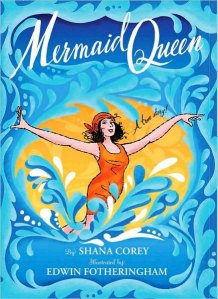 Then, at the recommendation of Kelly Fineman, I read Mermaid Queen: The Spectacular True Story of Annette Kellerman, Who Swam Her Way to Fame, Fortune & Swimsuit History!
Wowza. Have you seen this book? The splashy, colorful illustrations grabbed me, but it’s the story that kept me turning the pages. And it’s not about some über-famous woman, either. I had never even heard of Annette Kellerman until I read this book.
Kellerman invented water ballet, introduced the idea of the female athlete to the masses, and became the first woman to attempt swimming across the English Channel. She designed the modern swimsuit, freeing women from their heavy woolen garb.
Shana Corey’s mermaid tale proves that picture book biographies can be imaginative and fun, and they don’t have to be about a president to make a splash. (Yeah, I used that pun twice. Sorry. It’s day 15. Stick with me here.)
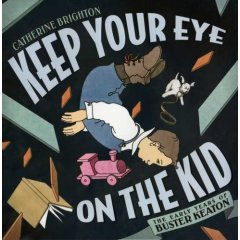 Catherine Brighton’s Keep Your Eye on the Kid focuses on the early years of Buster Keaton.
Did you know Harry Houdini gave Buster his name after watching baby Keaton tumble down the stairs? (“Gee, that was some buster the kid took!”) His parents had a touring act and would throw him across the stage every night. These unusual details, told in Buster’s voice, toss you into the story. The sentences are crisp and tight, and Brighton doesn’t dwell on the demanding reality of Buster’s touring lifestyle. She keeps it fun and lighthearted, with illustrations that mimic an old comic book. And the cover? You’ll fall head over heels for it. [Insert corny laugh track.]
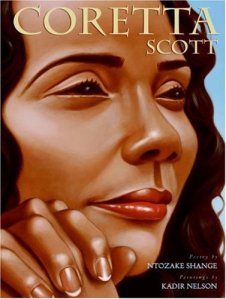 Coretta Scott by is a lyrical biography by Ntozake Shange, illustrated with bold paintings by Kadir Nelson.
It doesn’t begin “I was born on April 27, 1927” and thank goodness for that. Instead the first page reads, “some southern mornings/the moon/sits like an orange/sliver by the treetops.” There’s a simple, glorious painting of the glowing sliver above a silhouette of trees, the sky wide open. Yet the next page introduces the reality of segregation. Coretta and her siblings “walked all/of five miles to/the nearest colored school/in the darkness/with the dew dampening/their feet.” The rest of the story sings, as Coretta meets Martin Luther King, Jr., marries, and helps lead the Civil Rights Movement.
These three books represent the best of picture book biographies, telling a story with style rather than bogging it down in facts. This is not your history teacher’s non-fiction. No siree.
Today for PiBoIdMo, do research. Read picture book biographies. Which ones sing to you?
Is there a figure in history who fascinates you? What has been written about that person? Are there picture book biographies or texts for older children? How can you tell that person’s story in 32 pages, in a way that’s suitable for young children? Which details would you keep? Which would you toss? Would you tell the story in verse or prose?
So, how’s it going today?
This week author/illustrator Carin Berger visited our public library with her box of tricks: thousands of pieces of cut paper in wavy, curvy shapes. Children grabbed the pieces—cut from catalogs, magazines, newspapers and ephemera—and arranged them on black construction paper to create animals, rain forests, people, trains, robots…just like Ms. Berger does in her books. She’s a collage artist—quite possibly the world’s most delightful vocation.
Did Ms. Berger always know she wanted to be an author/illustrator? Not necessarily, although she was always interested in telling a story through images.
Carin shared with us a book she created when she was 10 years old, called The Naughty Jester. Already she was using cut paper to help tell her tale, and her talent is apparent, even at this young age.


Carin didn’t start writing children’s books until she had a child of her own. When her infant daughter didn’t sleep well, she stayed up in the wee hours writing silly poetry, illustrating her words with collage. Turns out the notion wasn’t so silly and the sleepy little project became her first book, Not So True Stories and Unreasonable Rhymes.
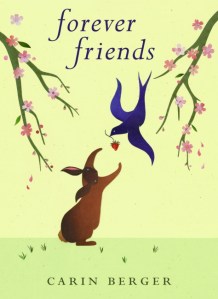 Ms. Berger told us secrets. If you look at the items the naughty jester is juggling, you’ll find those same images repeated in her books. The blue bird is one of the main characters in her Spring 2010 title Forever Friends. And her daughter’s name Thea appears in every book. You have to look hard to find it.
So today’s idea tip is to walk over to that pile of junk mail on your kitchen counter (come on, you know it’s there) and start cutting. Take an interesting pattern, perhaps from a clothing catalog, and cut a fancy little shape. Not just a circle or square, but perhaps a swirl like a wisp of a cloud on a windy day. When you’ve collected enough shapes, put them down on a piece of paper and shuffle them around. Overlap them or spread them out.
What did you make? Is it a character? A place? A strange object that needs a function? What does it do and why? What could appear in the negative space?
Now, if you’ll excuse me, I’m busy with scissors and glue.
So how’s it going today?
Before I start receiving umpteen emails pointing out the misspelled title of this post, let me make it clear: that’s not a typo.
A few days ago, Ruth Spiro encouraged you to take a walk, read the newspaper or bake cookies instead of waiting for your big idea.
But what if it’s too cold to go outside? What if the paperboy forgot to stop at your house? And what if you’re out of flour and sugar?
Well, then Flickr.
You can travel the world on your computer. You can see things you wouldn’t find on a stroll around the neighborhood. It’s not as depressing as the paper, and while you can’t eat the photos, I’m sure some delicious goodies will pop onto your screen…eventually.
Use the Flickr interestingness link (again, not a typo) and you can view a selection of recent photos culled from millions of images. Why, just a few clicks of the “reload” button and I came across these beauties:

Photo Credit: Miss ellan eous
Where is that little girl? Who made the lantern for her? Her body language appears to be apprehensive. What or who is she approaching?

Photo Credit: just_ginge2007
Where is this mysterious land of milk and honey with skies like pumpkin pie?
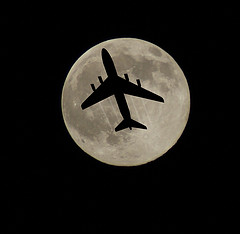
Photo Credit: Clara Don
Fly me to the moon. Let me play among the stars.
So, how’s it going today?
Reach for a Memory
by Nan Marino
When it comes to writing, there are good and bad days. On a good day, you’ve got tons of ideas. Words flow. The sun shines. Everything is easy. But there are times when idea spigot gets a little clogged. Don’t worry. It happens to everyone.
On days when I’m looking for the mental equivalent of bottle of liquid Drano, I reach back to my childhood memories. First I think of a particular moment and try to recall the feelings surrounding it. Then I write. When I’m done, I move things around, alter it a little (or a lot), and turn it into fiction.
My debut middle grade novel, Neil Armstrong is My Uncle and Other Lies Muscle Man McGinty Told Me, is filled with altered memories. When I was about ten, a boy who lived on my street challenged the entire block to a game of kickball. All of us against one kid! In real life after about five minutes, we got bored watching him chase after the ball, and we moved onto something else. In my book, that game stretches out for an entire week.
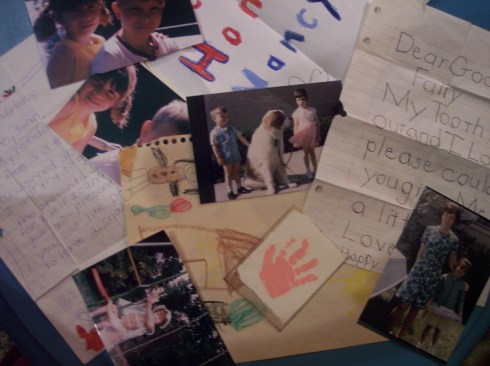
Childhood memories make great writing prompts. Below are more memories I incorporated into my book. Feel free to write about any of them to get your creative juices flowing:
The Ice Cream Truck: When 4th or 5th graders send me drawings of scenes from my book, someone always draws the ice cream truck scene. Everyone connects with Mr. Softee. It’s an iconic symbol of summer. Remember waiting for the ice cream truck to come around? Did you have a favorite flavor ice cream?
Kickball, baseball, handball: Did you play? Were you one of those kids who took it seriously or did you sit on the sidelines?
Barbeques: I like barbeques because they happen over and over again. We eat the same kind of food and gather together with the same group of family or friends. It creates that feeling of endless summer days. What happened at your barbeques? Did you have an uncle who made great cherry pies? Was there a neighbor who sang a special song?
Dandelions: Nothing separates adults and children more than their feelings about dandelions. It’s the first flower you probably picked, and the first one you gave to someone you loved. I dare you to find one person under the age of ten who thinks it makes perfectly good sense to spend your precious weekend hours trying to eradicate them from your front lawn.
Songs and Dances: Madonna or Nirvana? Springsteen or Sinatra? A single song can take you back to that day when you were seven… Need more inspiration? Download it and dance!
Historical events: What happened when you were young? Do you remember the first time a man walked on the moon, the bicentennial, the assassination of John Lennon, the Berlin Wall coming down, the first Gulf War, the Y2K scare? From a child’s eyes, these events are seen differently.
Your secret place: Was it up in a tree? Behind the couch? Or up on the garage roof?
Remembering ordinary moments from your childhood is a great way to begin writing. Next time you need some inspiration for your fiction, reach for a memory.
 Nan Marino spent her childhood climbing trees and hanging out on garage roofs in the town of Massapequa Park, New York. Since then, she’s ventured a hundred miles south to the Jersey shore where she works as a librarian and lives with her husband and their dog. Neil Armstrong Is My Uncle and Other Lies Muscle Man McGinty Told Me, published by Roaring Brook Press (May 2009), is her first novel.
Waiting for the Big Idea? Don’t!
by Ruth Spiro
 What do a macramé owl, Celia Chompers, and a town called Fate have in common? Nothing, really, except that they’re all written in my little green notebook.
I’ve always been amused by that iconic light bulb that appears above a cartoon character’s head to symbolize a bright idea; too bad it doesn’t actually happen in real life. (Although, it may be a good thing––imagine the effect on global warming…) When I first started writing, I often sat at my desk, waiting for that moment to occur––the Big Idea. When I tired of waiting, I did something else: Walked the dog, read the newspaper, baked some cookies. I soon noticed it was at those times that “ideas” began to appear.
I’d write these “ideas” on scraps of paper and throw them into my purse. Later, I might find them while digging for the dry cleaning ticket; sometimes, the scraps ended up being used for bubble gum disposal. I needed a notebook.
 Every writer should have a notebook. Not one of those fancy, leather-bound ones. You know, the kind that’s so nice, you hate to mess it up by writing in it? No, I recommend the little spiral ones that usually sell for 39¢. And, they’re easy to find in your purse, because the end of the spiral wire is always sticking out, just waiting to jab you. Perfect.
You may be wondering why I’ve put the word “idea” in quotes. (See? Like that.) It’s because the things I write in my notebook are actually “details.” (There, I did it again.) They’re observations, snippets of conversation, or even cool names I notice in the obituaries, like Celia Chompers. (By the way, if any of her relatives are reading this, I’m sorry for your loss.) They don’t have to be full-blown ideas, just the potential for an idea. Takes some of the pressure off, doesn’t it?
Don’t wait around for your Big Idea. Take a walk, buy a notebook and start collecting details. Put them together, take them apart, pick one and just start writing. Oh, and feel free to use the macramé owl. It’s been hanging around for a very long time.
Got any details you’d like to recycle?
Let’s have a Detail Swap.
Leave a detail as a comment below.
Leave a penny, take a penny. You know how that goes.
Ruth Spiro is the author of the award-winning picture book, Lester Fizz, Bubble-Gum Artist. (Reviewed on this blog.) It’s the story of a boy who feels he doesn’t fit in with his family of artists, until he discovers his own unique talent in an unexpected medium––bubble gum! Her articles and essays have appeared in The Writer, FamilyFun, Child, and Chicago Parent, and her stories have also been published in popular anthologies, notably The Right Words at the Right Time, Volume 2, edited by Marlo Thomas, and several Chicken Soup for the Soul titles.
A frequent speaker at schools and conferences, Ruth may be contacted through her web site at www.ruthspiro.com.
What Tara Doesn’t Know…
by Karma Wilson
 Shhh…don’t tell Tara, but she’s become one of my biggest inspirations. More specifically, her alphabetical list of 365+ Things Kids Like has become one of my biggest inspirations. In fact, I never would have guessed that a blog entry could become so central to my writing process.
Whenever I sit down to write children’s poetry I have two websites up at all times. One is a rhyming dictionary and the other is Tara’s list.
I scroll down the list and I try to come up with one poem for each item.
For me, when writing poetry, it is often the basic idea that eludes me. Sometimes all I need is a word or a thought and WALA, presto-chango, alakazam—a poem finally makes its way into my befuddled brain matter! I used to ask my kids, “What should I write a poem about?” But now, instead of harassing my “couldn’t care less” tweens and teens I just click open Tara’s list.
Here’s an example of a poem inspired by the first entry…acrobat.
AcroBat
He flies through the air
With greatest of ease
He flies and he doesn’t
need a trapeze!
He dips and darts
through the darkest of night
he doesn’t needs nets
and he doesn’t need lights.
He hangs upside down
for hours, no less.
Who is this gymnast?
Who? Can you guess?
He sees with his sonar
imagine that!
The amazing, stupendous,
Acro Bat!
So, if you’re just desperately thirsty for an idea I’ve found Tara’s list a wellspring of inspiration.
Karma Wilson is the author of more than 20 popular picture books, including Bear Snores On, Baby Cakes, A Frog in the Bog and a new volume of poetry called What’s the Weather Inside?
Karma is generously giving away one of her books as part of PiBoIdMo! (Your choice: Don’t Be Afraid, Little Pip or Mama Always Comes Home.) Please leave a comment to be entered in the drawing. A winner will be randomly picked at the conclusion of our month-long idea extravaganza. Good luck!
So how’s it going today?





 Writing for Kids (While Raising Them)