You are currently browsing Tara Lazar’s articles.
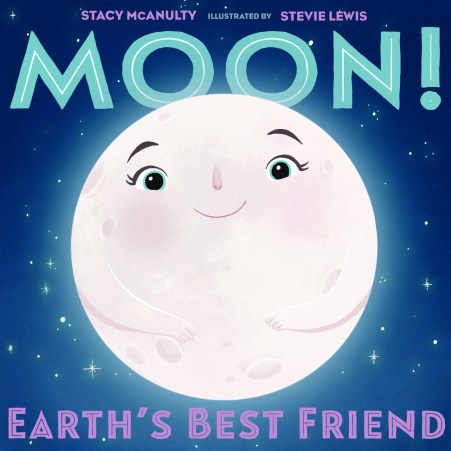
Last week I texted Stacy McAnulty because I heard the most amazing news!
Stacy, I just learned your new book MOON! will be on Elon Musk’s next SpaceX rocket. How did you arrange to be the first picture book in space?!

Ha! Wouldn’t that be something. I love seeing my books in stores and in libraries. Knowing it’s in space would be amazing. Yet not as amazing as seeing MOON in the hands of young readers. Astronauts and aliens are welcome to read my books, but I do write for kids.
OK, so your book isn’t going to the moon, but other objects from earth have…and have stayed there to form their own colony! How on earth did a pair of nail clippers get left on the moon?
I wish I knew! NASA has a list of what’s been left behind, but they don’t include the why. And since there’s no weather (no wind, rain, snow, etc.) on Moon, the objects could technically be right where the astronauts left them. However, with hardly any atmosphere, Moon is pummeled constantly by space rocks (asteroids, meteoroids). There’s a chance things have been destroyed by impact—including the nail clippers. If the next astronauts brought back those nail clippers, I wonder what they’d go for on eBay. They probably belong in the Smithsonian.
Now that’s an auction to break the Internet!
In your book, Moon and Earth are besties. But what if we had two natural satellites instead of the one moon—would all three be best friends, or would there be a lot of push and pull between them?
Earth is certainly capable of having multiple best friends. She’s so kind—she lets us live here after all. But I can imagine Moon being slightly jealous of another natural satellite. Moon’s life revolves around Earth. Literally. She’d be a little bummed to share that spotlight. Luckily, Moon doesn’t have to share. Unlike Mars, Saturn, Jupiter, Neptune, and Uranus, which all have multiple moons. Moon is a one and only!
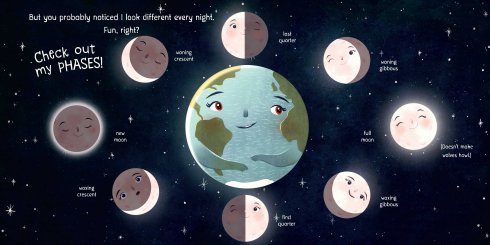
We know Moon has many different phases. What do you think is Earth’s favorite look for her BFF?
Full Moon for sure! We get to see her whole, beautiful face. But we don’t want to phase-shame. Moon looks gorgeous all the time. Earth and I agree on this.
Do you have a favorite moon fact that didn’t get into the book?
I learned about synchronous rotation: Moon rotates on her axis and revolves around Earth at the same rate, approximately 27.3 days. That means we see the same face of Moon. I do talk about this in the book, but I never get to use the term “synchronous rotation.” It’s such a nerdy-sounding phrase. I love it. “I suffer from synchronous rotation.” Also, here’s a fun-fact that didn’t make the cut. Moon is moving farther away from Earth at a rate of one inch per year. Bye-bye, Moon!
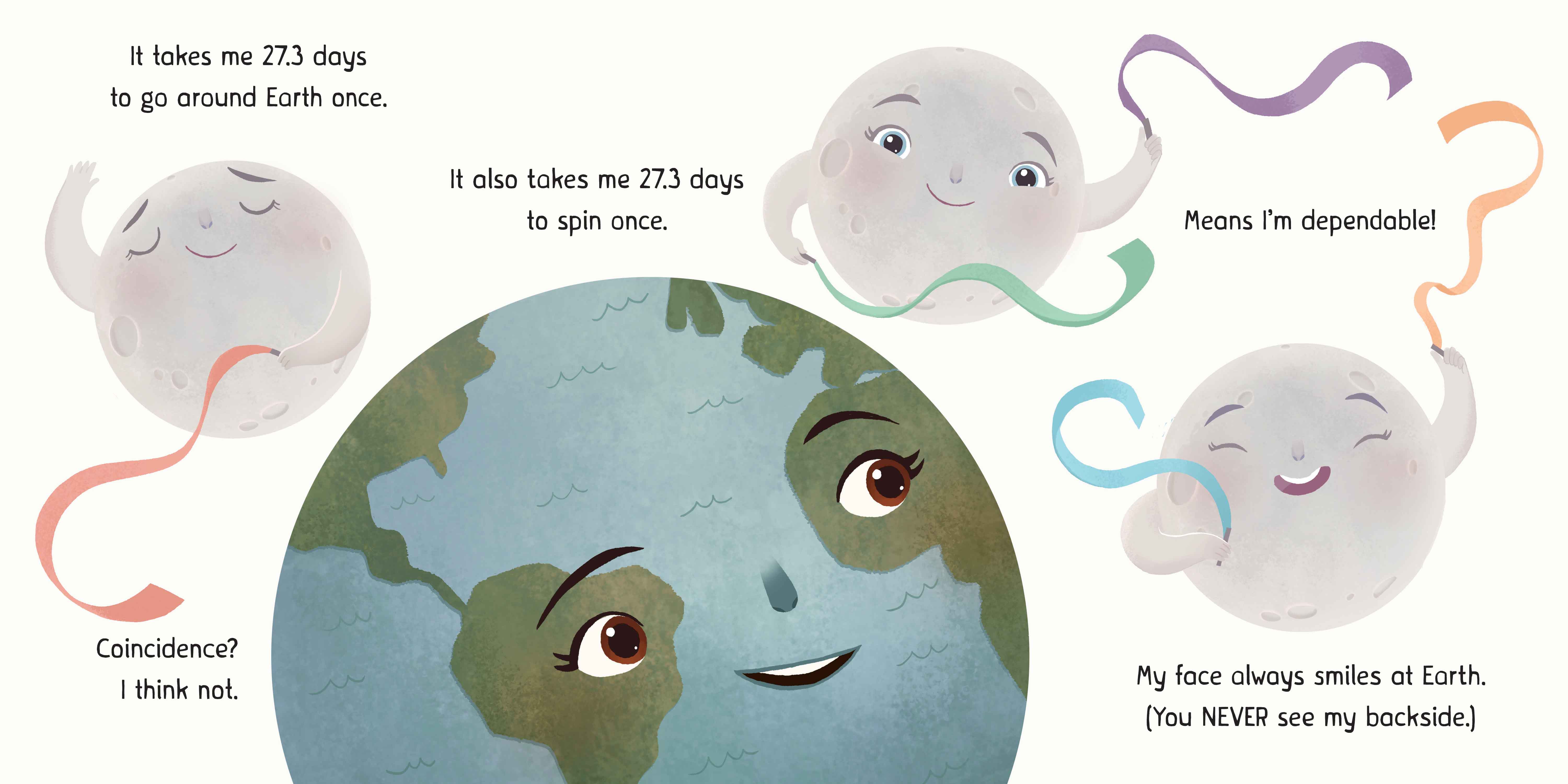
No, no, don’t go away Moon! I mean, Moon probably likes to get away, but with her best friend. Do you think Earth and Moon like to go out and do cool things together? Like sing karaoke?
Oh, yes! They’d very much be into karaoke! Who isn’t? Their song would have to be a duet. Maybe “I Got You Babe” by Sonny and Cher. That works!
That’s a fun one! They definitely don’t want to try “Blue Moon” or “Bad Moon Rising”!
OK, kidding aside, you made this entire non-fiction series so fun for kids—by letting Sun, Earth and Moon narrate their own stories. How did you discover that unique angle?
Like all great discoveries, it was by accident. Sort of. I like to tell the story of Earth’s birth when I visit schools. Before I wrote Earth, I wrote a story about a pet rock. It was fiction like everything else I’d written to that point. In the manuscript, this pet rock lived with numerous children for thousands of years—going from caveman times to today. I shared this pet-rock story, and my critique grouped hated it. But what I realized through their candor, was that I wasn’t writing a story about a rock but about Earth. She’s been here a long time and us humans are pretty new. So I penned a story about our planet, and from the first draft, I knew it had to be narrated by the star of the show, Earth! (Of course, Earth is not technically a star.) When I tell this to kids, I always ask, “Was that pet-rock story—that unpublished story that only lives on my hard drive—a failure or a step in the process?” They always give the right answer.
Those kids are so smart! Thanks for chatting with me about your newest book, Stacy.
MOON! EARTH’S BEST FRIEND launched into bookstores nationwide this week! Be sure to check it out! (And you don’t even need a telescope!)
Astronaut Lazarbeam approves!
If you’re a regular reader of this blog, you know that I recommend kidlit writers secure an agent. Literary agents provide many crucial services that go far beyond selling manuscripts. A good agent guides you through every step of your career—the ups, the downs, the slumps, the triumphs. They are your ever-hopeful cheerleader and your biggest fan (often the smartest one, too). As one literary agent states, “There’s no greater professional joy than championing a book that you believe in and watching the world delight in it.”
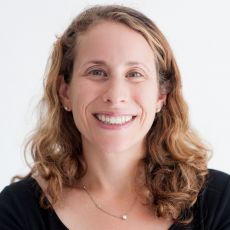
Today I’m delighted to interview that agent, Alyssa Eisner Henkin. She serves as Senior Vice President of Trident Media Group.
Alyssa, why (and how) did you get into representing children’s literature?
 When I was a second-semester-senior English major in college, I suddenly found myself finding a way to tie children’s literature into all my term papers. I wrote one called “Tip Me Over and Pour Me Out” about tea in Alice in Wonderland. And for my History of India class I wrote another about the British Raj in India as shown in the works of Hodgson Burnett and Kipling. I took this as a sign that I was meant to work in children’s publishing. And later that summer when I attended the Radcliffe (now Columbia) Publishing Course, I found myself making a bee-line for all the kidlit jobs, although nobody really used the term kidlit back in 1998.
In the spring of 1999 I was hired by S&S Books for Young Readers where I spent over seven years as a children’s book editor. And in year six of those seven years, when I decided I wanted to segue into the more entrepreneurial pursuit of agenting, I only ever considered doing so if I could be a children’s book agent. I’ve heard it said that children’s literature is the body of literature people know the first and the best, and that’s definitely true for me! Luckily for me, Trident specifically sought out a children’s book agent in the Fall of 2006 and they were open to hiring someone with an editorial—rather than an agenting—background.
How did the years spent working as an editor influence your agenting style?
I think my years spent working as an editor taught me a lot about the importance of having an editor who is an advocate, someone who can really sell the publisher’s sales force on an author’s book and make them realize they have something really special on their hands, as opposed to just another book in a sea of many books that will fly under the radar.
I always try to make editors realize that they need to pound their drums about the book and get the jacket just right if they want the book to really shine.
I also learned about the importance and transformative powers of revision. If I fall in love with an author’s voice, I will still take on the project even if it means a year or two of editing until the plot and the story arc are in the shape they need to be in order to sell.
Can you pinpoint a particular quality that makes you fall in love with a voice?
I’m a huge sucker for setting so the ability to conjure a sense of place that feels palpable always goes a long way with me. When I think back on the books I love, both front list titles and those that I still hold dear from my childhood, the #1 thing that stands out to me is how much I love the characters. So, when voice grabs on and makes me care, like really care such that I’m still thinking about the characters after the fact, then I know the voice has done its job. Lyrical lovely language that I want to quote doesn’t hurt anything either, of course!
I know agents get asked this a lot, but is there anything specific you’re dying to see? What’s on your wish list?
With the popularity of graphic and middle grade novels, I’m trying to expand my stable of illustrators and author-illustrators at the moment. I’m also very influenced by my rising-4th-grader son’s love of shorter books, so I’d love to find more fictional manuscripts for middle grade in verse or alternative shorter text formats that still manage to tell a full, high-stakes story. I’m a huge fan of nonfiction and history, and while the category in younger MG has kind of exploded already, I still think the market could really use a series like I SURVIVED, but for upper elementary age and middle school readers; there’s a big hole for kids after they finished many of the I SURVIVED and WHO WAS/IS books. And I’m also keen for books that are laugh-out-loud funny, as I never see enough of those in either MG or YA. And I always gravitate towards books with vividly-drawn settings, bonus points for those regional, cultural, and ethnic flavors that I’ve yet to see much of in kidlit before.
Beyond the writing, what else do you look for in a client?
I tend to look for clients who are hardworking, passionate about their craft, and good at marketing. Again, a sense of humor in life as well as in art is a virtue. And also patience is a big plus.
Speaking of patience, can you explain why it’s an important virtue in authors? What do you advise your clients to do during the wait?
It’s rare that things happen exactly as we expect them to. Sometimes books take a long time to sell and sometimes they sell quickly but the contracts due to various reasons take time to be finalized. Sometimes there’s an auction but bidders are on vacation, so the whole timeframe gets pushed back a month. Everyone has their own “dog ate my homework” story when it comes to waiting and publishing. And once the book is sold and paid for, odds are there will be more waiting, whether it’s for an edit letter, marketing plan, illustration sketches, sales figures etc. I always tell my clients to keep busy when their books are on submission: Try writing or outlining new works. Revise your five year goal plan. Get a lot of exercise. Binge watch a worthy show. Spend time in the company of loved ones and dear friends. A watched pot never boils!
Does a potential client have to have a blog and/or a large social media following for you to sign them?
If it’s celebrity- or news-driven nonfiction, having some social media out of the gate holds value when getting editors to read a proposal. But for fiction and more scholarly nonfiction or picture books, it’s certainly not a prerequisite when I go on submission. It’s nice if by the time of publication authors have a way for readers to reach them online. And I’ve had several clients tell me that booksellers have reached out to them on Twitter pre-publication, so again, it does hold value, but I always put the most stock in the book itself.
When you have a client project ready to submit, what steps do you go through? How do you strategize the submission process?
When a project is ready for submission, I love creating a submission list that includes a variety of different editors. Generally, these include a mix of imprints at larger houses and smaller houses, and includes editors at all different career stages. The common thread is that I know these editors to be hungry for this particular type of book. I usually learn who is looking for what by doing research on PubMarketplace and Manuscript Wishlist. And since I’ve worked with a bunch of editors over a number of years at this point, sometimes I also intuitively just know who might like what. Depending on the type of book, I usually submit to be between 8 and 14 editors at any given time. That way, the list is small enough to make each editor feel special. But the body of editors reading is large enough to have a healthy competitive situation if it goes to auction.
Over the course of your agenting career, what accomplishments are you most proud of?
I love seeing client dreams come true, and quite a lot have in my 12+ years as an agent. I’ve had my hands in numerous long-running bestsellers, a major motion picture and the early stages of a Broadway musical. I’ve seen clients win Caldecott, and Printz Honors and Siebert and Belpre Awards. I’ve helped put in motion author tours, conference appearances, and front-of-store promotions, and have been instrumental in keeping titles in hardcover for years. I’ve negotiated offers that doubled and tripled from where they started. But my greatest achievement is overall is not doing anything by rote, and always trying to think outside the box. Because of this, each new situation becomes a wonderful learning experience that often sheds light on the next book…and the one after that.
What changes and challenges in publishing do you foresee happening over the next few years?
Children’s publishing is incredibly competitive with many more agents and one less big six (now big five) publishers in town now, and I wouldn’t be shocked by further consolidation in the future. Clearly bookselling in the era of amazon.com offers up many challenges for booksellers and authors generally. The fact that B&N, after having been owned by one individual for so long, has been recently purchased by an equity firm is leaving a lot of people wondering about the future of book chain retail in the digital age. That said, there are several new kidlit publishers as well as Indie bookstores on the rise, and I think audio originals and graphic and illustrated books are growth areas. As long as libraries and schools continue to have book-buying budgets and people continue to have kids, I’m relatively optimistic about the future of kidlit publishing.
And lastly, are you open to submissions?
I am open to submissions, five pages in the body of a query letter for longer works, complete PB texts in the body of a query, and any art or illustrations inserted as links in a query letter, no attachments. Email to ahenkin@tridentmediagroup.com.
Alyssa, thank you for an informative and engaging interview!
Good luck with your queries, kidlit writers!
As you all know, the publishing industry works at a snail’s pace. Maybe slower. It takes time to find the right publisher and go through all the steps necessary to publish a book. Writers must be perseverant and patient.

But the actual writing process also takes time. This was the case with my new picture book NO BEARS ALLOWED. Here’s a quick timeline for how things went down, from concept to publication:
2012
Yay! An idea was born. Believe it or not, this book started with an inside joke (but don’t ask me to explain it to you, it makes no sense!). Yet somehow, the phrase “No Bears Allowed” stuck with me. I saw humor in it, and I knew that one day, it would become a children’s book. I tucked it away in my inspiration folder, where it would remain for 3 years.
2015
I was leafing through my ideas one day, and I stumbled across the phrase that I had once fallen in love with. That’s the moment I committed to developing this story. I wrote the first draft, and the second, and so on, so on. I kept getting stuck on the ending, so it took about 8 months to write. Then I swiftly sent it off to my critiques partners, who helped me bring the text to the next level. By the end of the year, I had a polished book. Now, I just needed to sell it.
2016
This was a milestone year. I got my first agent! I did my happy dance for days. In my naiveté, I thought I would soon be swimming in contracts from the Big Five. NO BEARS ALLOWED would surely find its home in a few months, right?!

Nope. That’s not how the cookie crumbled. My then-agent did submit it to various publishers, but never followed up because we had decided to part ways. So there I was, agent-less, contract-less, and feeling utterly and completely dejected.
2017
But wait, suddenly there was hope on the horizon! After receiving 3 offers, I landed a new agent at a reputable firm. My dreams were back on track. Except—this agent didn’t want to submit NO BEARS ALLOWED because they felt it was a “quiet” story.
I decided to take matters into my own hands, and with that agent’s blessing, I subbed it on my own. A few months later, I received an R & R (revise & resubmit) request from Alayne Christian, editor at Blue Whale Press. I revised the text, and they acquired it. It went through several rounds of rigorous editing, but it was smooth sailing after that. We found a talented illustrator, Tara J. Hannon, who not only produced quality work, but did so quickly.
2019
Victory! By May of 2019, I was holding the ARC in my own hands. It was definitely worth the wait. I’m ecstatic that my story made its way into the world. Its themes touch on overcoming one’s fears and resisting the urge to judge others and make preliminary assumptions. If everyone could follow this advice, we would be living in a very different world!
NO BEARS ALLOWED will be officially released July 1. It’s now available for pre-sale.

About the book:
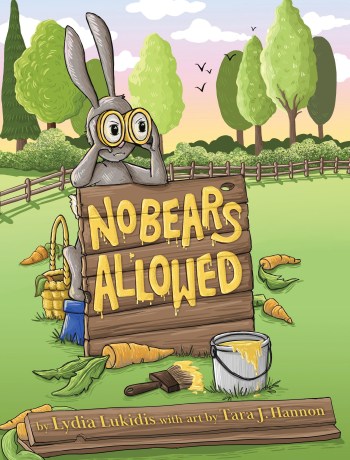
Rabbit is afraid of many things, but most of all he’s afraid of gigantic, monstery, BEARS! The very nervous Rabbit is soon confronted by his worst fear who appears to be far more interested in making new friends than causing Rabbit any real harm. Despite his apprehension, Rabbit agrees to join his jovial new acquaintance for dinner, but wait a minute . . . is Bear planning to “have” Rabbit for dinner? In this tender story about a very nervous rabbit and a lovable bear, Rabbit discovers that things aren’t always as scary as they seem, and sometimes you may just have more in common with others than you think.
 Lydia Lukidis is a children’s author with a multi-disciplinary background that spans the fields of literature, science and theater. So far, she has over 40 books and eBooks published, as well as a dozen educational books. Her latest STEM books include The Broken Bees’ Nest and The Space Rock Mystery.
Lydia is also passionate about spreading the love of literacy. She regularly gives writing workshops in elementary schools across Quebec through the Culture in the Schools Program. Her aim is to help children cultivate their imagination, sharpen their writing skills and develop self-confidence. Visit her at lydialukidis.com.
Hooray, it’s a new baby!
Wait, it’s TWO new babies! Because two brothers star in YOUR FIRST DAY OF CIRCUS SCHOOL!
One brother is brand new; the other already knows the ropes. One will show the other how it’s done. And then, vice-versa.
It’s blasting into a bookstore near you TODAY!
Kirkus Reviews said: “In this feel-good story, an older brother helps his younger sibling navigate the first day of circus school. Whether getting ready for school themselves or relating to the comfort of having a loved one as a guide, young readers will enjoy this upbeat twist on the genre.” And Imaginary Elevators wrote, “Kids will love this book.”
To celebrate the release of my 7th picture book, I’m giving away 30-minute Skypes galore, either for your classroom or for you, if you’re a writer.
To enter, simply tell me your favorite act in the circus. I’ll randomly select 7 classroom winners and 7 writing winners. Just let me know which one you are when you comment below!
Good luck!

I’ve spent the last several months with my head deep in a dictionary, editing THE WHIZBANG WORDBOOK, so excuse me if I’m a little definition-sensitive these days. But hear me out. This is important stuff.
How many of you have done this—set arbitrary goals that signal, in your mind, that you’ve become a success?
If I get a literary agent, then I’m a success.
If I get one book deal, then I’m a success.
And then you hit those goals, and suddenly, that definition of success gets tossed out the window.
No, one book deal isn’t successful! Two book deals would be!
And then you get those two deals. But again, it’s not enough to be deemed a success in your eyes.
So you compile an entire list of criteria for success.
A lead title!
A starred review!
Two starred reviews! Three! Four!
An Indies NEXT selection!
A Junior Library Guild selection!
A New York Times bestseller!
A Caldecott!!!!
The bar of success keeps inching higher. You are forever chasing it, feeling like a failure for not being successful!
But I’m here to tell you, YOU ARE A SUCCESS.
OK, I’m not telling you this just because *I* think you’re a success and I want to be all warm and fuzzy.
Let’s look at the WORD.
Notice that “success” is part of “succession”:
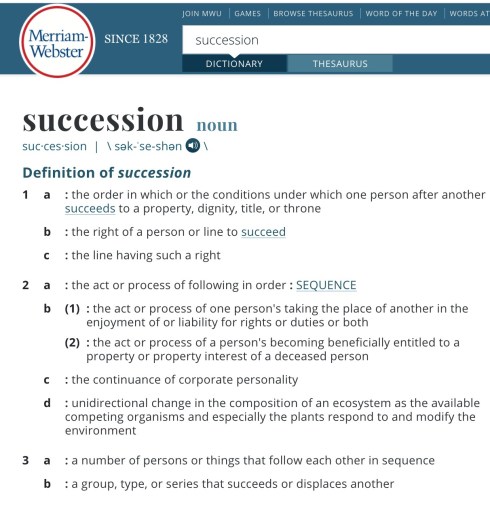
And that the meaning of succession is someone or something that follows another.
The Latin root of both words is succedere, which means to “come after or follow after.”
So all those goals you’ve lined up? And the ones you’ve already hit? They follow one after another after another and they’re the original definition of success—to continue to reach those goals and thus, form new ones.
You cannot say you’re not successful if you have conquered at least one goal on your list. You are.
The real meaning of being successful is forming goals, reaching them, and ascending to a new level, with loftier goals. As long as you are striving, you are succeeding.
Success is not stagnant. Success is always moving forward.
So FOREVER ONWARD, writers!
Here’s to being a SUCCESS—many times over!

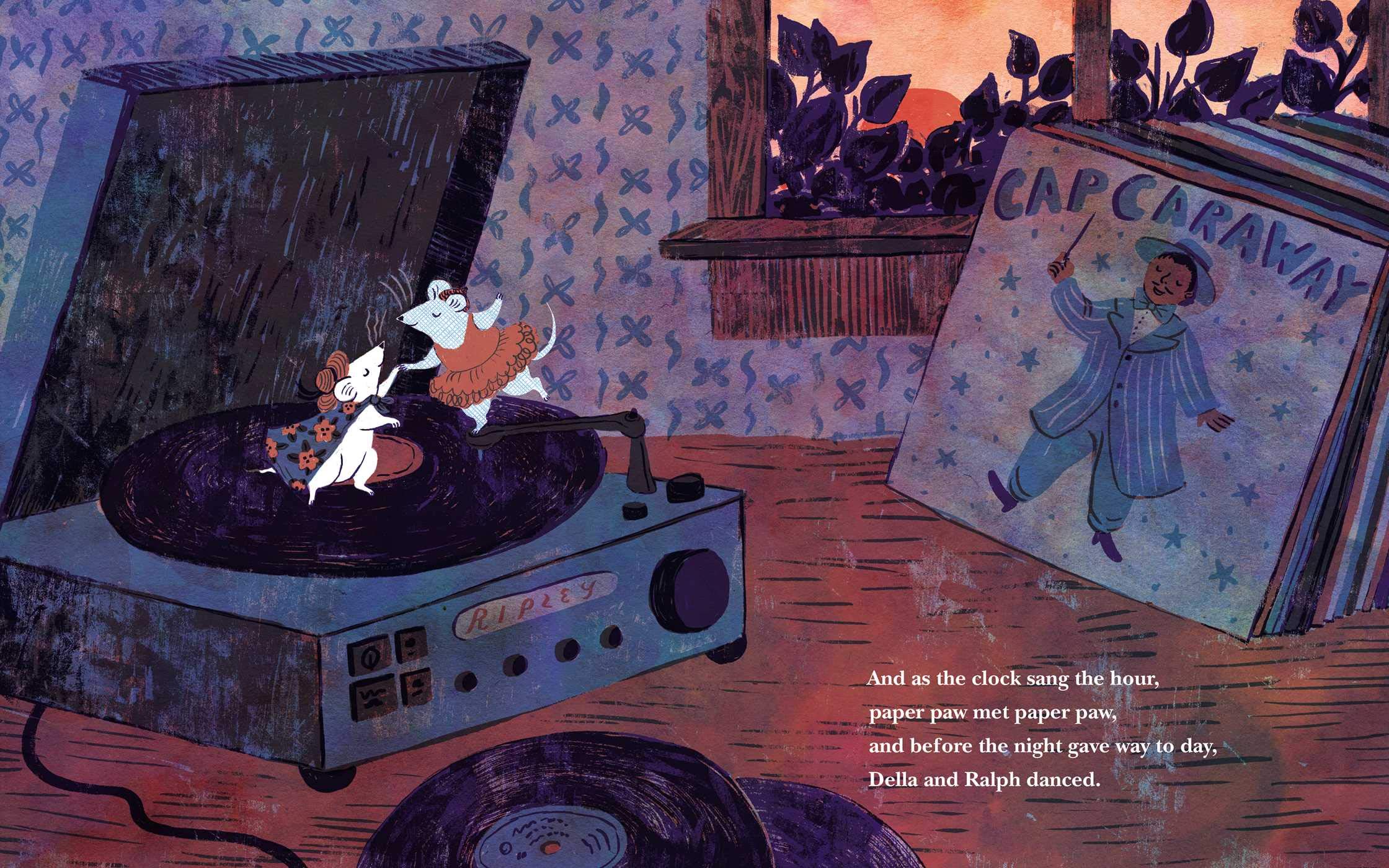
When I opened the envelope containing PAPER MICE, I let out a small GASP! because it was so sweet and lovely. LOOK:
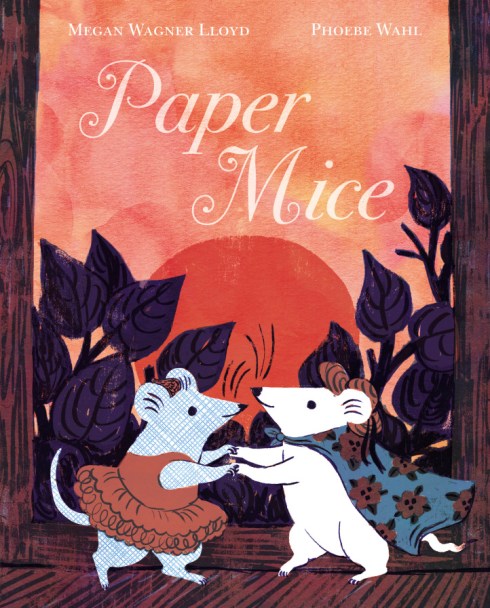
The mice! The color palette! The wood grain! The blue flowered cape! The setting sun!
Marvelous, I thought. So I emailed Megan.
Megan, the book’s opening line is so simple, yet so enticing. “With a snip and a clip, and a clip and a snip, the paper mice were made.” Was this also the first line you wrote? Or did it take a lot of revision to pare it down to just the most essential words?
I just checked my first draft and that is the first line I wrote. Actually, the beginning of the story is still very much intact from the first draft, but after about one quarter the way in, it’s completely different now.
At first I set up the story with that voice, but then jumped into a much different, more dialogue-heavy style. After sharing my first draft with my critique group, everyone gave me similar feedback that they liked the first part best and was there any way for me to carry that kind of feeling through the whole story. So that was my challenge—to take that kind of old fashioned, lyrical voice that had come to me at the beginning and then try to continue that throughout while also telling an active and meaningful story.
Does that lyrical voice come naturally to you? Or did you dig deep to uncover it?
I think being able to get into the voice and mood of a piece in general is kind of one of my writing superpowers. That’s one of the things I’ve always enjoyed and that I’ve gotten a lot of positive feedback on from even before I was published. But it took me a lot of digging to discover that I could write picture books (I was focusing on novels for about eight years before I really tried writing picture books). And it has taken me a lot of time and many, many (many!) practice projects to understand plot, story structure, and character development.
What is one of the most important lessons you’ve learned about picture book plot, story structure or character development?
How interconnected the three are, and that the plot must develop authentically from the characters wants, needs, and actions.
This is now your fourth picture book. Is there anything new you learned about the process of making a picture book during this project?
I feel like I’m always learning with every project! With Paper Mice, I learned to dig deeper (even when I think I’ve already done so) to really find the theme of the story.
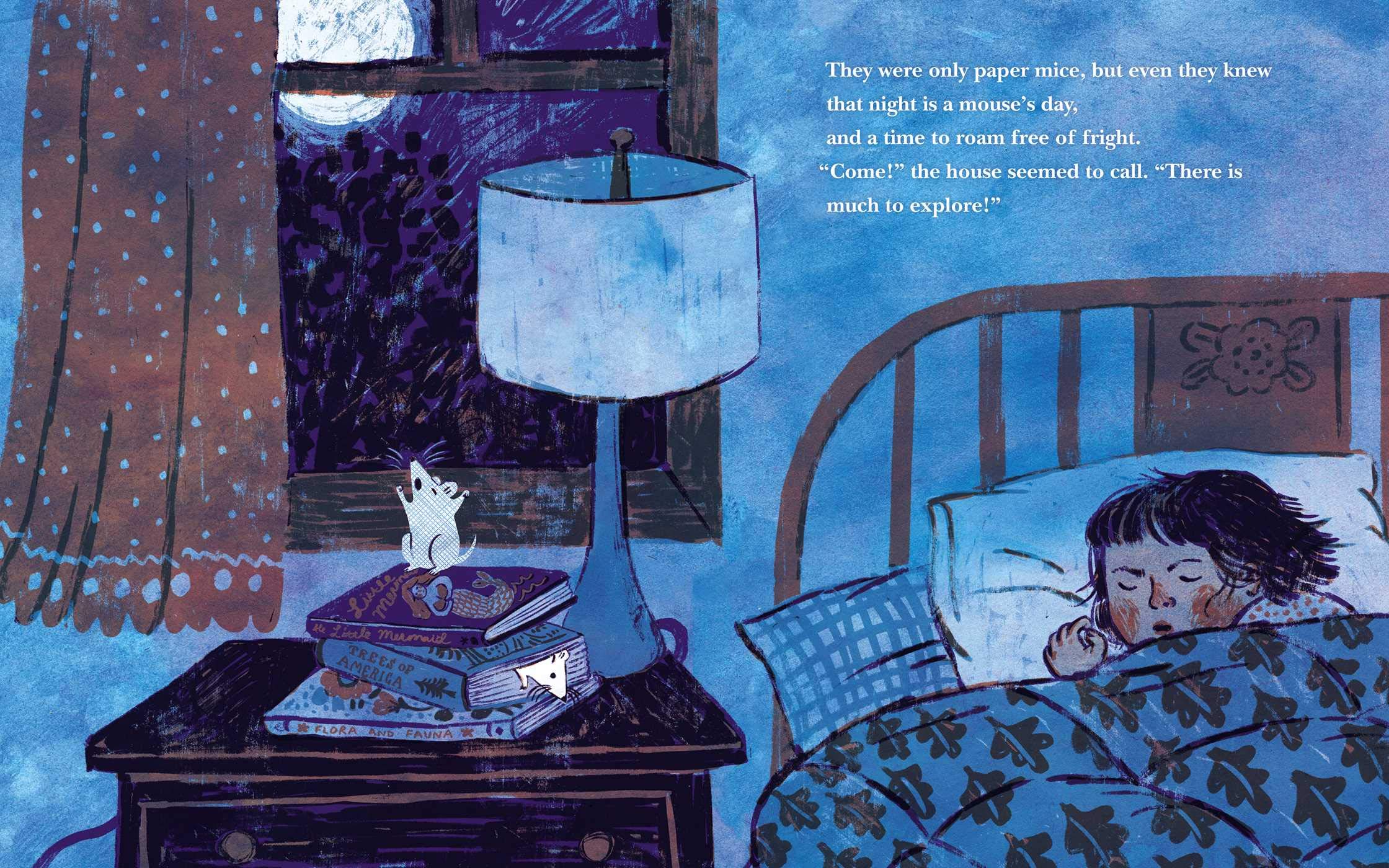
“They were only paper mice, but even they knew night is a mouse’s day…” The mood of this story is perfect for bedtime. What do you think Della and Ralph read before their bedtime?
I think they both like fairy tales and adventure stories, though nothing too scary right before bedtime!
Since the adventures of the Paper Mice are secret, do you have any behind-the-scenes secrets about making the book?
Well, when I was just starting out with publishing, I made a list of “dream illustrators”—artists and illustrators who I dreamed of working with someday. And Phoebe Wahl, though I didn’t even know if she was interested in illustrating kids books at that time, was at the top of my list! I never told anyone about this list. Imagine my surprise when my editor told me that she’d found the perfect illustrator for PAPER MICE—Phoebe Wahl! It was such a serendipitous moment and has always made the project feel extra-special to me.
Speaking of extra-special, I heard you had a rather exciting auction for another project recently.
I’d love to! I recently sold a middle-grade graphic novel (in a very exciting seven-house auction) to Scholastic! The book is called ALLERGIC and is about animal-obsessed girl who is about to finally get a dog of her own—only to discover she’s allergic to animals. It’s inspired by my own experiences growing up allergic to all animals with fur or feathers (but is fiction). Michelle Mee Nutter is my amazing illustrator co-creator on this project—her art is incredible, and I’m beyond thrilled that we could team up. ALLERGIC is scheduled to come out in 2021, and then we will be making a second graphic novel together for Scholastic as well.
Wow, that is amazing! Circling back to PAPER MICE, what aspect of this book do you hope readers will most connect with?
I hope most of all that readers find it a cozy and comforting read, one that makes their life a little less overwhelming and a little bit sweeter and more fun.
PAPER MICE is a delightful, cozy nighttime adventure. It was released this week and is now available anywhere books are sold. Thank you for chatting about it, Megan!
Would you like a copy of PAPER MICE?
Leave a comment below and a random winner will be selected in a couple weeks!
Good luck!
 Megan Wagner Lloyd is the author of Finding Wild, Fort-Building Time, Building Books and Paper Mice. Upcoming titles include the picture book The ABCs of Catching Zs as well as the graphic novel Allergic. She lives with her family in the Washington, D.C. area. Visit her at meganwagnerlloyd.com.
As I present winners for the last several giveaways, I want to also make the post useful for everyone, even if you didn’t win a prize. So I asked followers on Twitter what they wanted me to write about…
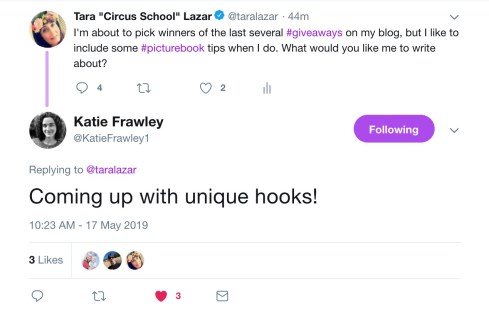
Ahh, Katie, if only I knew the answer to that! We would all be guaranteed a run-away hit!
But seriously folks, what I do is try to stay on top of what’s being released and what’s coming out so I don’t duplicate something that’s already out there. Has that tactic worked? Scanning announcements in Publisher’s Marketplace and Publisher’s Weekly? Visiting bookstores twice a month? Asking my local librarians what new titles they’ve acquired?
Well, yes and NO. Definitely NO.
I wrote a blobfish manuscript right before a barrage of blobfish books got bought. Nice timing, Tara. I had thought to myself, “I haven’t seen any picture books about blobfish,” which is really code for “everyone is writing a blobfish book RIGHT THIS SECOND!”
Now that doesn’t mean the world won’t want YOUR blobfish book. It’s just that the world didn’t want MINE (at the time).
Unique hooks are like strikes of lightning. Hold an umbrella during a storm and you might get hit. What that means is—be open to all the inspiration going on around you. Something you see or overhear might lead to a hilarious title that inspires a whole new story. Ducks circling my table at an al fresco breakfast led to a knee-slapping title.
Put aside time every day to just sit and daydream. Let your mind wander. Go out in public and eavesdrop.
 I happen to like wackiness in picture books. A new book with a fantastic hook IMHO is LLAMA DESTROYS THE WORLD. The llama in the story is so hungry he eats EVERYTHING and creates a black hole. Now that’s ludicrous. And I gotta read it.
What books hook you? Study them. Figure out why. What about the title and premise makes you want to pick them up immediately? And then try to do that in your OWN, UNIQUE WAY.
After all, you’re a unique writer. You’ll find your unique hook.
 With my book 7 ATE 9, I began by thinking of a popular schoolyard joke that every elementary student would know. I wanted a punchline to be the title. AND BOOM! “Why was 6 afraid of 7?” smacked me upside the head.
BECAUSE 7 ATE 9!
And then I was off to the races. Seriously. I immediately thought about 6 visiting a “Private I” and things went from there.
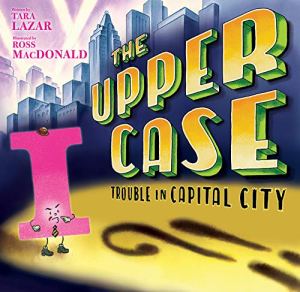
For the sequel, coming out in October, I wanted Private I to continue with his punny sleuthing, so after numbers, I naturally turned to letters. AND BOOM! The title THE UPPER CASE came to me for its play on a detective CASE and a letter CASE. Fun times, fun times. (Then it took me over a year to think of the 3rd book’s hook!)
Another fantastic thing I learned about finding subjects for picture books is asking a toy store: what’s new and hot in toys at the moment? Typically trends in toys lead to trends in books. So make friends with your local librarian and your local toy seller!
And now…onto our recent winners! Congratulations to all. I will be emailing you shortly.
BADGER’S PERFECT GARDEN by Marsha Diane Arnold
Julie K. Rubini
AWAY WITH WORDS: THE DARING STORY OF ISABELLA BIRD by Lori Mortensen
Celeste Bocchicchio-Chaudhri
Poetry Skype with author Shannon Anderson
Emmie R. Werner
THAT’S FOR BABIES! by Jackie Azúa Kramer
Anita Banks
A KITE FOR MOON by Jane Yolen and Heidi E.Y. Stemple
Lisa Howie
COWHIDE-AND-SEEK by Sheri Dillard
June Sengpiehl
untitled by Timothy Young
CeceLibrarian
Rinda Beach
by Timothy Young
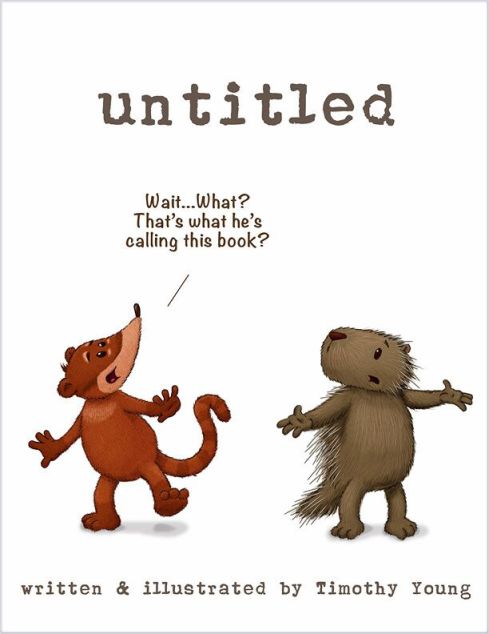
My latest picture book, untitled, comes out on May 28th. You are probably asking yourself “Why would he not give his book a title?” I did give my book a title, I called it untitled. When I originally started thinking about this book it had a different title. I was calling it “Another Stupid Book by Timothy Young.” I liked that title a lot but when I told a school librarian the title she was confused and thought it was a sequel. I started to like that one less so I started thinking that it needed a new title.
The book is about two characters, Carlos and Ignatz, who are waiting for me to tell their story. They are getting frustrated and begin making suggestions about what they could be doing and complain about being stuck in my book. Some of my placeholder titles while I was working on it were That Weird Book or The Ridiculous Book but I wasn’t really happy with those as I was with the original.
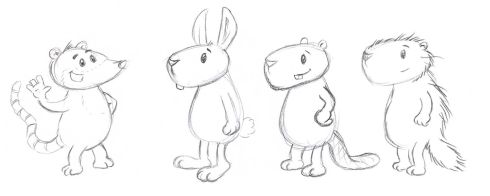
Some of my early character designs.
The way I work, while beginning the initial stages of writing a story I’m also designing the main characters. I knew I wanted one of them to be a coatimundi, a Central American relative of the raccoon. I had seen a family of them climbing in the mangrove trees on a trip to Mexico and I fell in love with them. The other guy went through some changes (which gets incorporated into the story). He began as a rabbit, but that was too common. He’s been a beaver, a porcupine and a capybara.
While working on the illustrations for a book I often have new ideas for the story. I will re-write as needed to make the book come together. Sometimes the illustrations compliment the words and sometimes they depict something totally different from what the characters are saying. At this point I thought about going to another extreme with the title. For a little while it was called The Incredibly Amazing Adventures of Carlos and Ignatz. I thought the contrast to what I was doing with the story was funny but I was still not completely satisfied.

The alternative titles; these appear on the back cover of untitled.
I started to think of it as untitled. I was thinking about how, if an artist does not give a piece a title it is labeled untitled which then becomes the title. What would happen if I specifically chose that as the title? I started to like it. It would be absurd to call a picture book untitled. I like the absurd. I checked, nobody else has been stupid enough to call a picture book untitled. I then thought of a couple of revisions in which the lack of a title becomes a part of the story. It worked.
Now I had to ask my publisher what they thought. They knew I had not settled on a final title and were being very patient. I approached them with some trepidation, I feared they would never agree to try to market a picture book called untitled. Happily, I was wrong and they loved it, they got it and they were on board with the idea.
So now we have to see what everybody else thinks. I’ve had copies of the book in my hands since April and I’ve read it to a number of schools that I’ve visited. I’m very pleased with their reaction. I keep having to go back to this spread after I’m finished reading because the students want a longer look at the book covers. I had a lot of fun drawing Carlos and Ignatz in the styles of the books I’m parodying.

Click to view larger.
Thanks, Tim, for sharing the backstory of untitled!
Leave a comment below to win a copy of untitled. Two winners will be randomly selected at the end of the month! (Shall we call this contest entitled?)
If you would like a second chance to win, you can visit Tim’s new blog where you can see the book trailer for untitled and leave a comment there.
Good luck!
When people ask me when I first knew I wanted to be a writer, I share a story about a dream I had over 12 years ago. An actual dream. A dream that woke me up at 2am and had me jumping out of bed to write it down so I wouldn’t forget. I wasn’t trying to be a writer at the time. I’m guessing I just wanted to share my dream with my husband and sons. But I loved it. LOVED it. So I wrote it down.
My dream was about a cow who accidentally left her farm and (unknowingly) created chaos wherever she went. I thought this was funny because whenever I see cows, they never really seem to be doing anything. They’re just sort of standing there. Not playing. Or frolicking. I’ve rarely even seen them walking. I thought it could be funny to have a picture book with a cow character who is “just standing there” but in an unusual place for a cow to be. What sort of chaos would that cause?

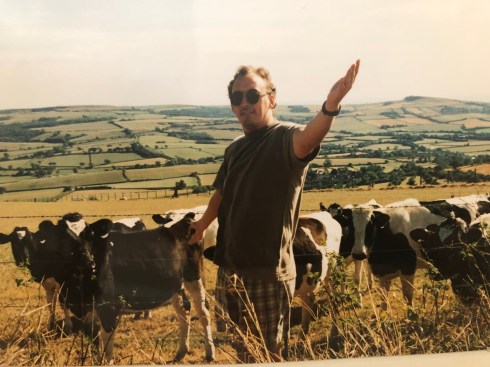
I’ve always been charmed by cows. They seem so sweet and curious to me. One of my favorite photos of my husband Mark was taken during a trip to England. I had wanted to get a picture of the beautiful scenery, but before we knew it, Mark was surrounded by cows. I joked, “Maybe they think you’re the farmer?” In the photo, I imagine the cows thinking, “Hey, what’s going on? Can we play?”
I think a lot of cow humor, like in Doreen Cronin and Betsy Lewin’s CLICK, CLACK, MOO (one of my favorite picture books) and even with the Chick-fil-A cows, is how the cows are acting like cows for the most part, but there is a suggestion that there is more going on than we can see.
One of my favorite Far Side comic strips illustrates this perfectly…
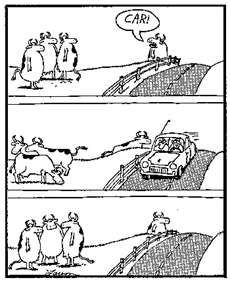
In early drafts of my manuscript, hide-and-seek was just a small part of the story, the opening scene. All the cows were playing together, but Bessie got distracted and accidentally left the farm. (I had a running list of “cow games” that I could possibly use for other Bessie stories, like “cow patty-cake” and “cow tag.” 🙂 The idea was that these cows were doing more than we realized, just like the Far Side cows. But in my early versions, after Bessie left the farm, she wasn’t playing the game anymore.
After I joined a critique group and started getting feedback from other writers, I noticed that the game of cowhide-and-seek was getting the most attention and compliments. Several revisions later, I finally realized the entire story could be about the game. And that the reason Bessie accidentally leaves the farm could be because she is looking for the perfect hiding spot.

So back to my dream. I wasn’t a writer at the time, but something about that idea got me started. I probably did share the dream with my family, but I also started writing. I feel like I learned how to be a writer with Bessie. Bessie and I have been through a lot—revisions, submissions, rejections, more revisions, and so on. But how special to have the idea that inspired me to become a writer end up as my debut picture book. It’s a dream come true. Literally.
Thanks for sharing your journey, Sheri…and congratulations on COWHIDE-AND-SEEK…which releases TOMORROW!
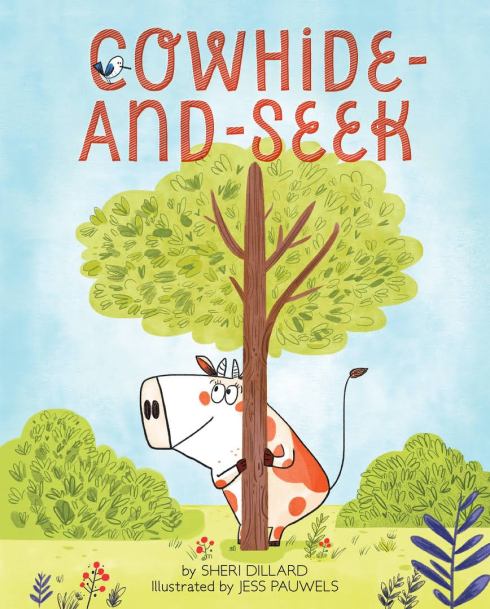
You can win a copy of Sheri’s debut! Just leave a comment below to enter. A winner will be randomly selected very soon!
GOOD LUCK!
 Sheri Dillard is a children’s author and preschool teacher/librarian. She lives in Atlanta, GA, with her husband Mark, three sons, and a 100-pound puppy named Captain, who is not so good at hiding. Cowhide-and-Seek is her first book.
Visit her at sheridillard.com, on Twitter @sheridillard and Instagram @sheridillard.
When my debut THE MONSTORE arrived in 2013, there was one kidlit debut group, but it was primarily for YA and MG releases. But I asked if I could be involved because there was no “debut PB” blog. There were a few of us brave PB authors who charmed our way in. But now a debut picture book group is an ACTUAL THING! Hot-diggity-dachshund!
So today I would like to introduce you to THE NOTABLE19s! All these delicious titles will be releasing this year from new talents…
The Notable19s is a baker’s dozen of authors and illustrators who are debuting with their first-ever book, first author-illustrator book, or first book with a medium-to-large publisher in 2019. They want to share some writing or illustrating wisdom that they’ve learned on their journey to being published.
(Click on an author’s name to be transported to their website.)

When Stephanie V.W. Lucianovic wrote THE END OF SOMETHING WONDERFUL (Sterling), she thought she had an idea of what the illustrations would look like on every page, particularly the last one. But then George Ermos brought his amazing vision to the story and captured all that was darkly funny and sweet about the book. The last page of the book is both so perfect and something Stephanie never would have thought up herself. When you’re a text-only author, remember that the book is not just yours anymore and be open to the magic that comes from collaboration.
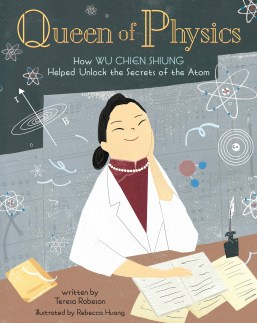
Teresa Robeson feels that being part of a larger creative community is integral to her publishing success. She recommends: joining SCBWI and attending events both regionally and in other chapters; participating in challenges like 12×12 (where she connected with her first agent), Storystorm, and NaPiBoWriWee; applying for opportunities like We Need Diverse Books; and being in one or more critique groups. Winning the WNDB mentorship with Jane Yolen led to a polished manuscript that became her debut picture book, QUEEN OF PHYSICS (illustrated by Rebecca Huang; Sterling).

Marcie Flinchum Atkins, author of WAIT, REST, PAUSE: DORMANCY IN NATURE (Millbrook Press, 2019), thinks you shouldn’t let your busy life hold you back from writing. Since her kids were toddlers, she’s been carrying a “writing bag” around stuffed with manuscripts in different stages, craft books, and research articles. This enables her to work on the go–in the pick up line at her kids’ sports practices, in the orthodontist’s waiting room, or in the ten-minute break between conference sessions.

Cathy Ballou Mealey, author of WHEN A TREE GROWS (illustrated by Kasia Nowowiejska; Sterling) suggests pasting your PB draft into a word cloud generator like WordItOut or Wordle to visually gauge the frequency of words in your text. A word cloud can help you find terms to cut or replace with stronger choices.
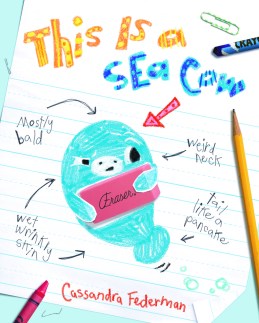
Cassandra Federman is the author-illustrator of THIS IS A SEA COW (Albert Whitman, 2019), in which a child writes a school report about sea cows and the subject is not happy with her portrayal. Sea Cow—or Manatee, as she prefers to be called—comes to life on the pages of the report and decides to defend herself with her own fascinating facts about manatees. Cassandra’s advice is to have honest, respectful conversations with your editors and art directors. Don’t be afraid! Discussing intentions, what works, what doesn’t, and why, will always lead to improvement.
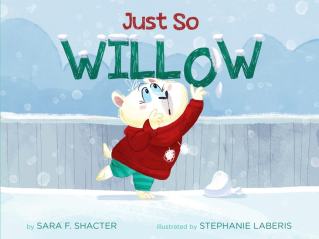
In Sara F. Shacter’s picture book, JUST SO WILLOW, a type-A polar bear learns to let go. “Ironically, Willow helped me do the same! Early versions of my manuscript received the same comment from multiple editors: the end fell flat. I tweaked to no avail. Then editor Brett Duquette had the insight that led to my ‘ah-ha’ moment: the first three lines were bigger and funnier than the rest of the story. So I deleted everything but those compelling first lines and began anew. Success! Moral: experimentation is freeing. You can always go back to the original version.”
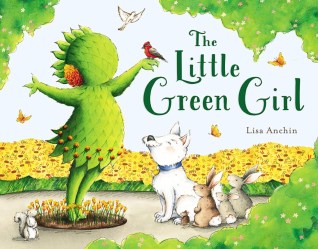
Lisa Anchin’s debut author-illustrated picture book, THE LITTLE GREEN GIRL (Dial), is about a persistent and curious little plant. Lisa, like the Little Green Girl, has learned that persistence is key in publishing. Her book took three years and thirteen drafts before it found a home at Dial, and it will be almost exactly five years from the very first sketch to publication. Don’t get discouraged if a project feels like it’s taking too long. Stick with it, and keep revising until it’s the best it can possibly be.
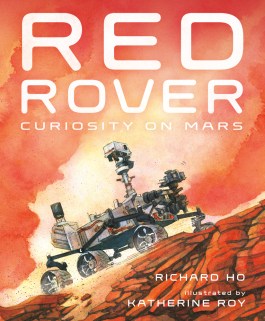
Richard Ho is the author of RED ROVER: CURIOSITY ON MARS, illustrated by Katherine Roy and published by Roaring Brook Press/Macmillan (October 29). In choosing a planet (take a bow, Mars!) as the narrator of a story about the Curiosity rover, Richard wanted to explore how far outside-the-box he could venture when it comes to matters of POV and story structure. As it turns out, Mars’ voice perfectly mirrored the wide-eyed innocence and wonder of a child observing Curiosity’s epic journey across a vast red landscape.

BRAVE MOLLY (Chronicle), by Brooke Boynton-Hughes, is a nearly wordless picture book that tells the story of a girl who has to overcome her fears in order to find her own voice and make a new friend. Molly’s story was born of Brooke’s frustration with her own shyness, social anxiety, and self-doubt. Telling our personal stories can feel vulnerable, but there is strength in sharing our own experiences. Be brave, like Molly, and tell the story that only you can tell.
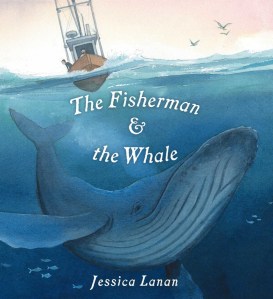
Jessica Lanan is the author and illustrator of THE FISHERMAN AND THE WHALE and illustrator of over five other books. She finds it important to develop a habit of artistic exercise, regularly attending figure drawing groups, drawing and painting from life as often as possible, and keeping a sketchbook on hand at all times. Technical ability opens doors; the more artistic skill you can develop, the more options you will have to visually tell your story.
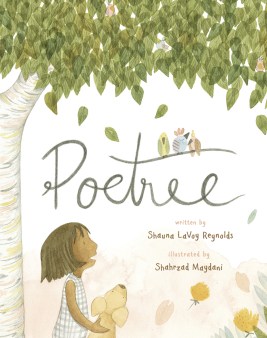
Shauna LaVoy Reynolds, author of POETREE (illustrated by Shahrzad Maydani; Dial), tells kids that passionate readers make the best writers. It’s true for adults, too! If you write picture books, take the time every week or so to raid your local library’s new releases. Bring home and read a stack of books, taking note of what works (and what doesn’t.) This will help get your brain into picture book voice mode, keep you aware of market trends, and of course satisfy your story-loving inner child.
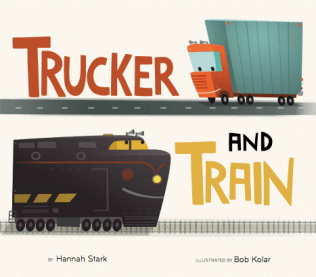
Hannah Stark, author of TRUCKER AND TRAIN (illustrated by Bob Kolar; Clarion/HMH), considers herself a student of picture books more than a writer of them. Ann Whitford Paul’s book WRITING PICTURE BOOKS recommends typing up the text of recent picture books you love and those you thought were dreadful. With illustrations removed you can better study what works and what does not in the text. As a writer this has helped me learn so much about pacing, page turns, word count
and craft.
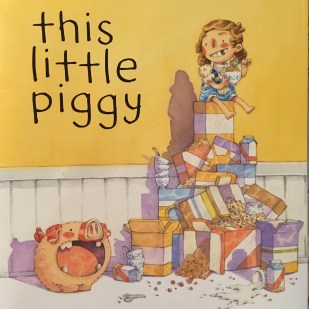
James Serafino, author-illustrator of THIS LITTLE PIGGY (Philomel) says, “The best advice I can think of for any writer is to work on your whole story. Don’t just focus on the beginning or your favorite part. I’ve spent days on writing the perfect opening line only to get to the end of the story and realize it wasn’t where the story should begin at all. Whenever you sit down to write go through the whole story arc from start to finish, every time. Don’t get stuck on small details until later when you can enjoy writing them into a story that works.”
To visit ALL of these fabulous authors and illustrators, visit Notable19.weebly.com and subscribe to be alerted when each title is available! Also follow along on Twitter @notable19s.





 Writing for Kids (While Raising Them)