You are currently browsing Tara Lazar’s articles.
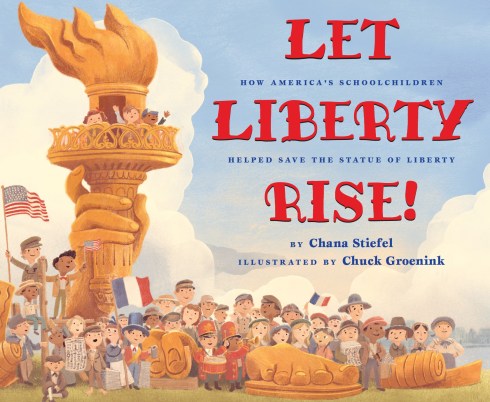
Author Chana Stiefel is here today to release the cover of her upcoming nonfiction book, illustrated by Chuck Groenink: LET LIBERTY RISE! HOW AMERICA’S SCHOOLCHILDREN HELPED SAVE THE STATUE OF LIBERTY. This book will be released on March 2, 2021 with Scholastic…
But first, Chana shares a few things she’s learned in the process of creating this nonfiction book:
1. Listen to your friends for book ideas!
A few years ago, when humans still ate meals together, I invited my author friends Sue Macy and Jackie Glasthal over to my house for Friday night dinner. Jackie mentioned that she had published a middle grade novel based on the true story of the building of the Statue of Liberty.* Many of us know that the French sent the statue to America as a symbol of friendship. But did you know that America didn’t want it? And New York’s richest millionaires refused to contribute $100,000 to build the pedestal! Joseph Pulitzer, owner of the World newspaper, was outraged. He insisted that the statue stand in New York harbor, the gateway to America. Pulitzer said he would print the name of every person who donated to the pedestal fund—no matter how small the sum or how small the person. Guess who donated their pennies to America’s first crowd-sourcing campaign? KIDS, of course! Right then and there, I knew this story had to become a picture book! Jackie gave me her blessing and offered to help.
2. Do the research!
Researching this book took years. Back when humans could take ferries and visit libraries, Jackie and I met at the Bob Hope Memorial Library on Ellis Island. We pored over archives and took pictures. I also time traveled in the map room of the New York Public Library, scrolling through microfilm of the World newspaper from the 1870s. I read through stacks of books and shared every exciting fact with my family. (You’re welcome, kids!)
3. Practice patience!
Even after you’ve received multiple critiques and edited your manuscript a bazillion times, publishing takes time—enough time to turn copper green. But waiting for a great book deal and the perfect illustrator is worth it! Illustrator Chuck Groenink captured 1870s America oh-so-beautifully, down to the adorable knickers on the newspaper boy. My editor at Scholastic Dianne Hess and I fact checked every single word. (Fab facts: How many stars were on the U.S. flag in 1876? In how many pieces was Liberty shipped to America? Answers below**!)
4. Take nothing for granted.
Publishing a book is an incredible gift and for that I will always be grateful. I hold my torch high for Dianne, Chuck, my family, my critique partners, the kidlit community (thank you Tara!), and my former agent John Cusick. Most of all, I am grateful to Jackie for giving me the gift of this story. Sadly, Jackie passed away three years ago. She stood for liberty, freedom, and friendship and this book is dedicated to her memory. On that bittersweet note, presenting the cover of LET LIBERTY RISE!

*Liberty on 23rd Street by Jacqueline Glasthal, illus. by Alan Reingold, Silver Moon Press, 2006.
**Answers: 38 stars; 350 pieces
 Chana Stiefel is the author of more than 25 books for kids. In addition to LET LIBERTY RISE! (Scholastic, 3-2-21), Chana’s books include MY NAME IS WAKAWAKALOCH, illustrated by Mary Sullivan (HMH), ANIMAL ZOMBIES…& OTHER REAL-LIFE MONSTERS (NatGeoKids), and DADDY DEPOT, illustrated by Andy Snair (Feiwel & Friends). She is represented by Miranda Paul at Erin Murphy Literary Agency. Learn more at chanastiefel.com. Follow @ChanaStiefel on Facebook, Twitter, and Instagram.
Let’s face it, we’re all cranky right now. We’ve been sequestered at home for months without any clear end. Plus my regular bookstore “date with myself” to browse and discover new books has taken a serious hiatus.
I know we’re all in the same boat, so my pledge to you, dear blog reader, is to help kidlit writers feel less alone at sea by introducing you to fun new books.
Cristina Ergunay just released this adorable bedtime read…

Cristina, any author releasing a book in 2020 has every right to be cranky—it’s difficult to get the word out when everyone is hunkered down at home. But Cranky Crab, living under the shimmering sea, what’s his excuse?
Like any small, strong-willed child, Cranky Crab has no interest in settling down for the night—and is testing the boundaries of bedtime. There are too many other things to do! But Crab needs a good night’s sleep and grows crankier with every page turn, almost to the brink of an underwater meltdown. Thankfully, Mama Crab knows just how to change the dynamic and calm her little crustacean.
Did you think about character before you wrote the story….like, why a crab?
Actually, I didn’t think about character in the original version, and that story didn’t sell. Lovely turns of phrase, dreamy creatures, and sweet rhyming with well-metered stanzas are all part of the recipe, but without a strong character, creating tension by swimming against the proverbial tide, the rest of the bedtime story fell flat.
So revisions later, I picked one of my sea creatures to be that character, and crab felt like a very natural choice because kids can easily relate to feeling grumpy when you don’t want to do something—and yet, I wanted crab to find reassurance in the end, that no matter how cranky you feel, you’re still loved.
Ah, character is so important to the success of a picture book! Your crabby guy is just ducky! And I love the other cute creatures who make cameos.


If you hadn’t picked a crab, what other kind of animal would make a good bedtime grump?
I think maybe a Black Rain Frog would make a great bedtime grump! I don’t know much about them, but the mug on this frog is outstanding! Maybe there’s a story in there?

Credit: MELBOURNEER.COM
Cristina, what other creative ways have you tried to promote your new book?

 It’s been challenging to get creative in the time of COVID, and maintaining some kind of an online presence—social media, connecting with local libraries for virtual storytimes—has been essential. I made a fun promotional door hanger for kids to use at bedtime—I love Heather Gross’s illustrations, her crab makes me laugh! I hope it helps other families to take the tension away from cranky bedtimes!
Do you have any special before-bed rituals that help you settle in for a good night’s sleep?
I like to turn on my strings of twinkle lights, get into my pajamas, and read Treasure Island or Paddington to my daughter until she falls asleep. Or until I fall asleep. Whichever comes first.
Reading before bed is also my favorite way to wind down. But sometimes I’m cranky and refuse to put the book down. That’s why picture books at night are a smart idea—they’re short and yours is definitely sweet!
Cristina is giving away a copy of BEDTIME FOR CRANKY CRAB plus a door hanger so your bedtimes will be sweet, too.
Leave one comment below to enter.
A random winner will be selected next month.
Good luck!
Three attempts to solve a problem—you’ve been told thirty trillion times this is the way to build a picture book plot. I even covered it in an earlier post.
It’s a tried-and-true method for telling a story. But does an editor reviewing all these similarly-structured submissions feel like she’s been there and read that? Well…….maybe.
There are other ways to frame picture books by using different story structures, as Tammi Sauer once pointed out during Storystorm.
But if those formats aren’t right for your story and you choose a more traditional arc, when is it OK to abandon the “three attempts”? When is it reasonable to break free from this rule?
First, we have to look at the why.
Why do we employ the “three attempts” structure? TO BUILD TENSION.
The main character tries to solve their problem and fails, repeatedly. This tension invests the reader in the protagonist’s struggle. It compels you to turn the page.

However, I wrote a manuscript recently where the protagonist doesn’t even realize she has a problem. The reader sees the problem, but the character is oblivious. It doesn’t make sense for her to attempt multiple solutions because she doesn’t see anything wrong in the first place!
Remember, three attempts builds tension. But that’s not the only way to achieve “what happens next?” excitement and anticipation.
In my manuscript, the humor comes from the reader knowing more than the main character (that’s a kind of “superiority humor”). The humor builds because the protagonist keeps mistaking her surroundings for something else, something that’s familiar to her. That escalating humor adds to the tension—OH NO! DOESN’T SHE GET IT YET?!
There’s also a deadline, an end goal that the reader and the main character both know. But can she get there if she’s so confused? You don’t know. More tension.
Bottom line—if you’ve built tension into your story via another means, you don’t need the three attempts. It certainly didn’t make sense for my story. Who tries to get out of a jam they don’t know they’re in?
Let’s look at picture books that build tension in different ways.
[Meta Device]
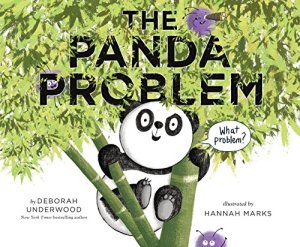
THE PANDA PROBLEM by Deborah Underwood & Hannah Marks
In this meta tale, the narrator and Panda argue about who’s the main character. The narrator wants Panda to be the protagonist with a problem to solve. But Panda thinks the narrator is the main character because uncooperative Panda is the narrator’s problem. This story mocks our “problematic” picture book rule. It keeps the tension high as both characters wrestle to control the story.
[Versus Device]
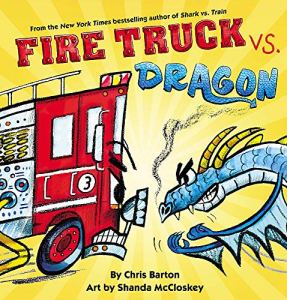
FIRE TRUCK VS. DRAGON by Chris Barton & Shanda McCloskey
A follow-up to Barton’s popular SHARK vs. TRAIN of 10 years ago (wow, time flies!), this new “battle” features a stand off between the reader and the characters. The reader understands what the two friends excel at, but the fire-starter and fire-squelcher don’t ever mention THOSE skills. That’s “superiority humor” again, with the reader knowing more than the characters. The tension arises from wondering if fire truck and dragon will ever get to what’s downright obvious to everyone else.
[Chronology Device]
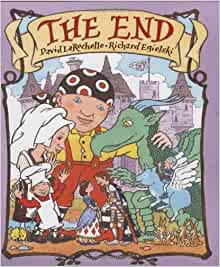
THE END by David LaRochelle & Richard Egielski
This story is a fairytale told backwards. There’s a surprise each page turn as you discover what happened immediately prior to the current sticky situation. Does that create tension? You bet, as each spread also displays a new predicament.
[Parallel Structure]
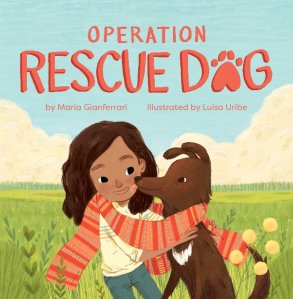
OPERATION RESCUE DOG by Maria Gianferrari & Luisa Uribe
The parallel picture book tells two tales which eventually converge. The tension is kept high by a back-and-forth narrative between the two main characters. In this book, Alma misses her military mama. She and Abuela decide to adopt a rescue dog as a surprise for mama’s return. The rescue dog, Lulu, is lonely and afraid, without a family. Both characters face delays in their journey to the dog rescue rendezvous. But at the end, Alma and Lulu finally meet and it’s destiny!
Some of these stories also employ the classic “ticking clock” or deadline to achieve tension. THE END ends at the beginning. OPERATION RESCUE DOG has two ticking clocks—Alma wants to adopt a dog in time for her mother’s return…plus, the Dog Rescue Truck is only open for a limited window. Will they make it there on time?
For the “ticking clock” device, think of Cinderella’s carriage turning back into a pumpkin at midnight!
So while you’re reading new picture books, pay attention to the building of tension. Did the author use three attempts to solve the problem, or a different device? Were you still riveted? Compelled to turn the page? Invested in the main character’s plight? Then take note and try to break free in your own writing!
Guess what? I’m giving away an hour-long kidlit career consultation via video chat.
Leave one comment below to enter.
A random winner will be selected next month.
Good luck!
There are many clever picture books being released, but I don’t want you to miss the cleverest:

This non-fiction story looks at a horse who made scientific history. It’s a fun ride for all ages (just look at the cute illustration of Hans by Mike Lowery)!
Like OLD ROCK a few weeks ago, I learned about CLEVER HANS via SCBWI’s free webinars, and I felt compelled to reach out to author Kerri Kokias about this equine wunderkind.
Kerri, how did you first learn about Clever Hans?
I learned about Clever Hans in an Introduction to Psychology class I took in college.
Oh wow, back in college! So you held onto the idea for a long time before writing it. What was the spark that made you say—hmm, maybe this is a picture book?
When I began writing for children and brainstorming ideas for writing a narrative non-fiction picture book, Hans immediately came to mind. Since Hans had stayed on my mind for the twenty-some years since college, I knew there was a strong hook to his story. And the idea of a horse that could count, tell-time, solve math problems, read, spell, and more has obvious kid appeal. I also knew how Hans’ story ended and that he had a lasting scientific impact. It felt almost like the story could write itself! Although, of course, it’s never that easy.
It never is!
Did the story go through several rewrites? Did you have to change tack (pun intended) anywhere in the process?
Ha! Good joke, Tara. No, it’s that the research proved to be more involved than I originally anticipated.
Before I spent a lot of time digging up sources, I did a quick survey of what was more widely known about Hans in popular culture. It didn’t take long for me to notice the discrepancies that I’d have to sort out. I ordered a copy of the original research report on Clever Hans, which was written in 1911 and translated from German. I spent a lot of time reading, rereading, and generally slogging through those 275 pages. The language used in that time period (and in research reports in general) can be long-winded and dry, and the fact that the text was translated, so I wasn’t even reading what was originally written, meant I needed to slow down to make sense of everything.
Luckily, my education and professional background in social science research had acclimated me to parsing through research reports, which helped. I also tracked down as many original newspaper reports as I could find, which was super fun—especially when they included old photographs!
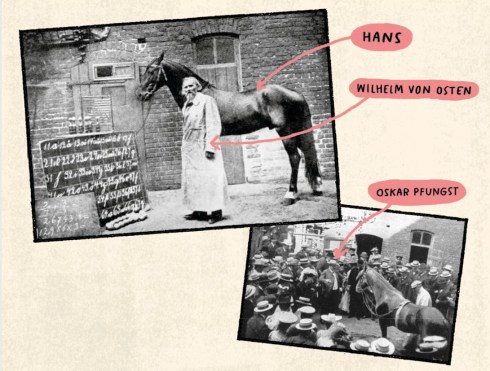
Mike Lowery incorporated wonderful details of the time period including the style of dress and architecture.
Mike, can you tell us about your preparation for CLEVER HANS?
I was especially excited about this book because it takes a look at Germany in the early 1900s. My wife is from Germany so for the past decade, I’ve had the pleasure of getting to go and explore the country when we visit our family and friends there. I did a LOT of research into what Berlin looked like around that time and even worked in a few real hotels, cafes, restaurants, and even a newspaper stand. The drawings in the book are simple, but I wanted to also get the clothing just right. Luckily my wife was able to help by finding books about clothing from that period, too.

It looks very authentic, Mike!
Kerri, do you have any funny behind-the-scenes story about “the making of” this book?
It was always a happy surprise to see Mike’s illustrations through his process. When I was writing the book I kept wondering how an illustrator would handle the story since the setting doesn’t change much and the characters are more or less limited to Hans and a variety of old, white men. But oh my gosh, Mike added so much personality and humor in the illustrations! I’ve laughed out loud at several discoveries and continue to notice new details with each reading.
OK, you have to give me an example of a LOL moment!
Of course! Several examples come to mind…
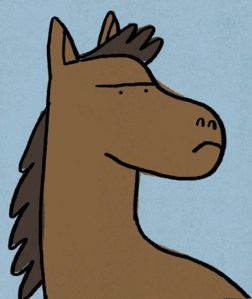
There’s a scene where Hans is tired of answering questions and he has the best grumpy expression I can possibly imagine on a horse.
There’s a scene where a confused chicken is watching Hans be questioned…

…and another where there is a bird on a scientist’s head and a snake peeking out of his pocket.

At one point scientists wondered if Hans could be psychic and Mike drew a hilarious spread of his interpretation of Hans as a psychic mind reader.
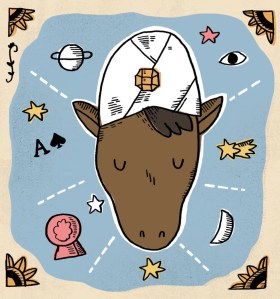
And I think my all-time-favorite is of when a scientist tried to imitate Hans answering a question by getting on his hands and knees and tapping out his answer like Hans did.

Those are all hilarious, especially grumpy Hans. I did feel his frustration with being constantly questioned and trotted out for entertainment. His contribution to science and scientific study proved to be crucial, though, and I’m glad kids today can learn about him through this fascinating and fun book!
Congratulations to you and Mike. I’m giving CLEVER HANS four hoofs up!
CLEVER HANS is available now from Putnam/PRH!
Kerri is also giving away a copy, so just comment once below to enter.
A random winner will be selected in two weeks.
Good luck!
Author Bridget Heos interviews illustrator Mike Ciccotello…
Here it is! The cover of our upcoming picture book, TREEMENDOUS: DIARY OF A NOT YET MIGHTY OAK. It’s due out March 9, 2021 from Crown.
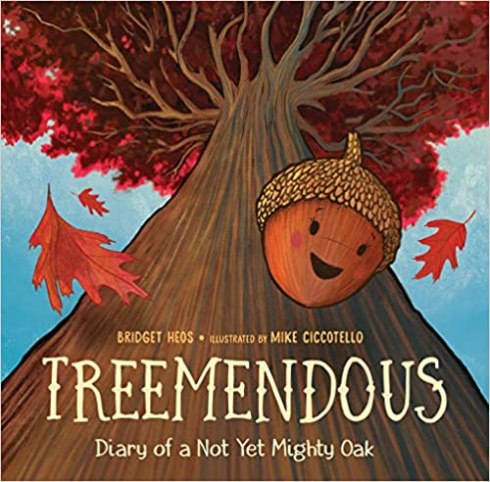
Mike, I love the image of TREE (as acorn) falling and his hopeful expression! It made me think of a leap of faith that changes everything. How did you think of that cover image?
Thanks so much, Bridget. This idea felt good right from the start. It showed our main character taking that leap of faith you mentioned while the backdrop of her mother is hinting at what the acorn’s future could bring. We knew our acorn was going to be the focus. It was just a question of what point during her journey we were going to show. The combination of the vantage point and her falling made this such an exciting part to showcase.
Were there other covers that the Crown team was considering?
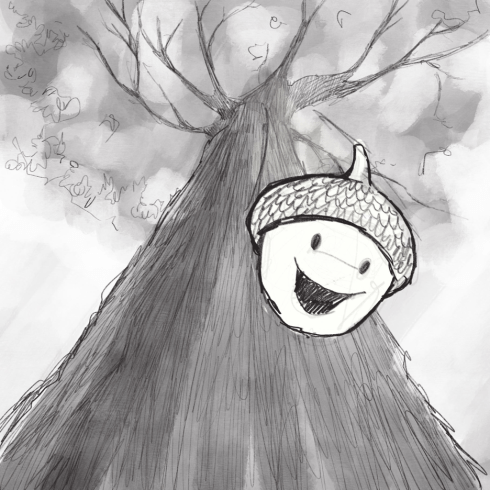
Yes, this was one of three designs. I tried a version with our acorn hanging from a branch, dreaming of all of life’s possibilities. Then I did a much different version that showed our acorn in front of a flat backdrop of her mother’s bark. Both of these options tell a story, just not as exciting as the more dynamic perspective that was selected.
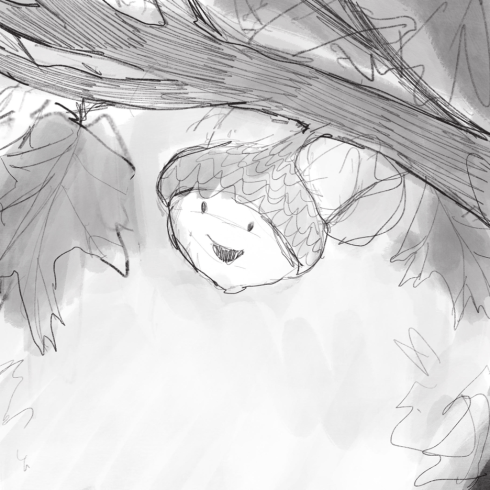
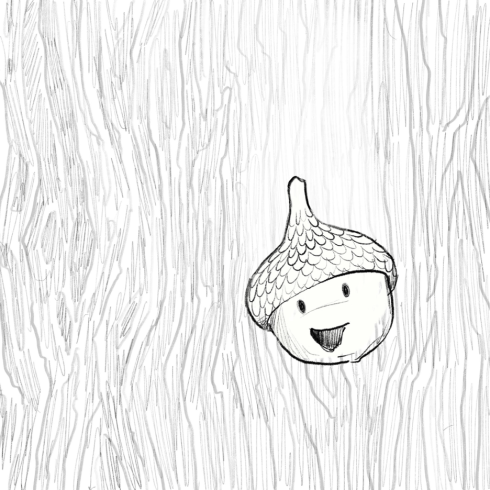
You did such an amazing job bringing warmth and life to TREE. Any sketches that show the evolution of ACORN or TREE?
Of course!
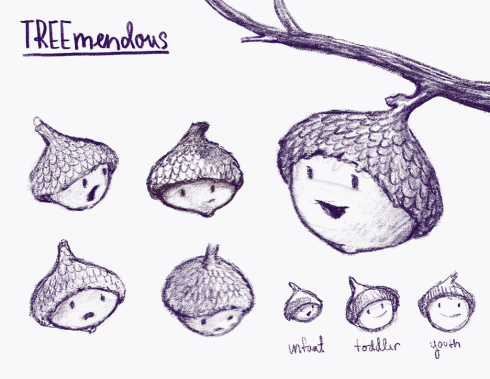
Thank you, Bridget and Mike, for showing us a glimpse of your seedling!
TREEMENDOUS hits bookstore (and virtual) shelves on March 9, 2021!
Shannon Hitchcock has published four middle-grade novels, but today she’s celebrating her picture book debut with a cover reveal of SAVING GRANDDADDY’S STORIES. Actually, it’s a DOUBLE cover reveal because she’s sharing both the jacket cover and the inside cover…
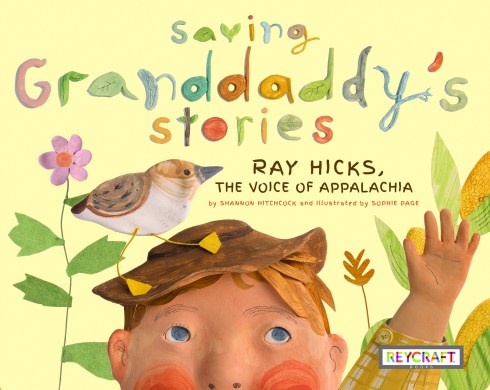
You’re pretty lucky to have TWO covers, Shannon!
That’s my favorite thing about the illustrations! The more kid-friendly image of Ray as a little boy is on the jacket, but when you remove the jacket, there is an image of Ray with his wife, Rosa, on their front porch.
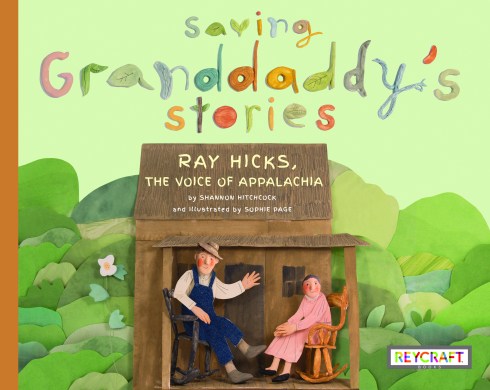
That makes sense since your story features Ray in both stages of life. Can you tell us a little about the book and why the subject is special to you?
SAVING GRANDDADDY’S STORIES is a picture book biography about oral storyteller Ray Hicks. It starts when he’s a little boy listening to his grandfather tell stories and follows his journey to becoming a champion storyteller who was known as the “Voice of Appalachia.”
I grew up in the foothills of the Blue Ridge Mountains near where Ray lived, and like Ray’s family, mine loved to tell stories, too.
How did you find your publisher?
I read a Publishers Weekly article about a new publisher called Reycraft, and since one of the editors quoted was from West Virginia, I thought my story set in Appalachia might appeal to him.
I love the 3D quality of the title lettering and the sculpture of young Ray. Who’s the illustrator?
Sophie Page is a mixed-media illustrator originally from Conway, Massachusetts, and a graduate of the Rhode Island School of Design. She crafts images in two and three dimensions. Her illustrations for SAVING GRANDDADDY’S STORIES are made from clay, paper, fabric, wire…and a handful of Jack’s magic beans.
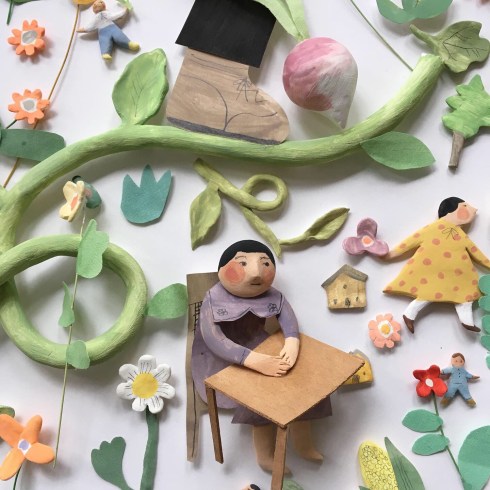
It looks like your book has a lot of STEM…haha! But seriously, what about this story makes it a good choice for school libraries and classrooms?
Teachers and librarians can use SAVING GRANDDADDY’S STORIES as a tool for teaching figurative language, for analyzing how Jack and the Beanstalk has been retold by different cultures, and for exploring the Appalachian Region and its traditions.
Shannon, congrats on your debut picture book. Do you have any advice for aspiring PB authors?
Write what you’re passionate about and never give up!
Shannon Hitchcock was born in North Carolina and grew up in the foothills of the Blue Ridge Mountains. She is the author of four middle grade novels, Flying Over Water, One True Way, Ruby Lee & Me, and The Ballad of Jessie Pearl. Her books have been featured on many state award lists and have received acclaimed reviews. Saving Granddaddy’s Stories is Shannon’s debut picture book, releasing October 22, 2020. She recently moved to Asheville, North Carolina, where she can see the mountains every day. For more about Shannon and her books, visit her at shannonhitchcock.com.
by Hope Lim
I AM A BIRD came together as I reflected on how two interactions I had on the same day evoked opposite emotions.
I live in San Francisco and run most mornings in Golden Gate Park. I have passed the same woman a few times and noticed how she always looks straight ahead with a stone face and carries a big duffel bag. One morning, fear struck me as I saw her, but I was not certain why. I came home from running that day, thinking about how I would write about the stranger.
Later that morning, my husband told me about how my daughter and her bird songs made people smile and wave on their way to school. They rode a tandem bike and my daughter would sit in the back and pretend to be a bird, caw-cawing all the way. His description of my daughter soaring high like a bird brought an immediate contrast to the unfounded fear that I was trying to transfer to paper. At that moment, my daughter jumped into my story as the main character.
I have to thank my editor, Kate Fletcher, for her vision and guidance and to Hyewon Yum who brought the story to life with her rich illustrations and insightful interpretation of the story. I was especially moved by how Hyewon captured a child’s fear in such a creative and authentic way.
The book releases February 2, 2021 from Candlewick, but the cover is here today!
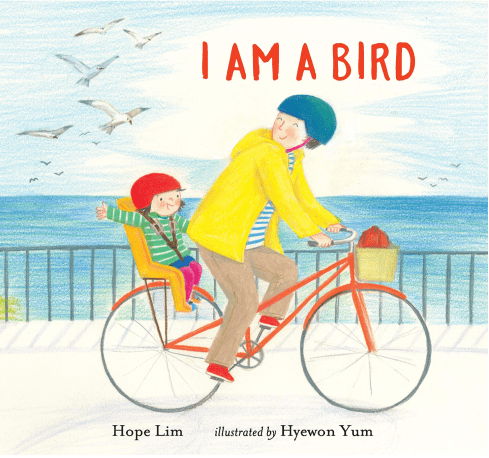
My hope is that I AM A BIRD encourages readers to soar above our differences and bias and celebrate what we have in common.
 Hope Lim is a children’s book author from South Korea and currently lives in San Francisco. Her debut book, I AM A BIRD, is to be released by Candlewick on February 2, 2021. Her debut will be followed by MY TREEI, Neal Porter Books/Holiday House in Summer 2021 and MOMMY’S HOMETOWN, Candlewick, in Fall 2022. Find more about Hope and her books at hopelim.com.
It’s the age-old question: what’s for dinner? Pizza? Or Tacos?
Tough decision! Pizza could have anything ON it, but then a taco could have anything IN it. Limitless possibilities! So who’s the best?
Luckily, author-illustrator Stephen Shaskan has settled the debate with his newly released chapter book:

This is the first in a delicious new illustrated series!
I like to interview folks about their books, and luckily, both Pizza and Taco were available to take a seat, and they didn’t even leave melted cheese on my couch! Not a chunk of cheddar or a morsel of mozzarella! What polite guests.

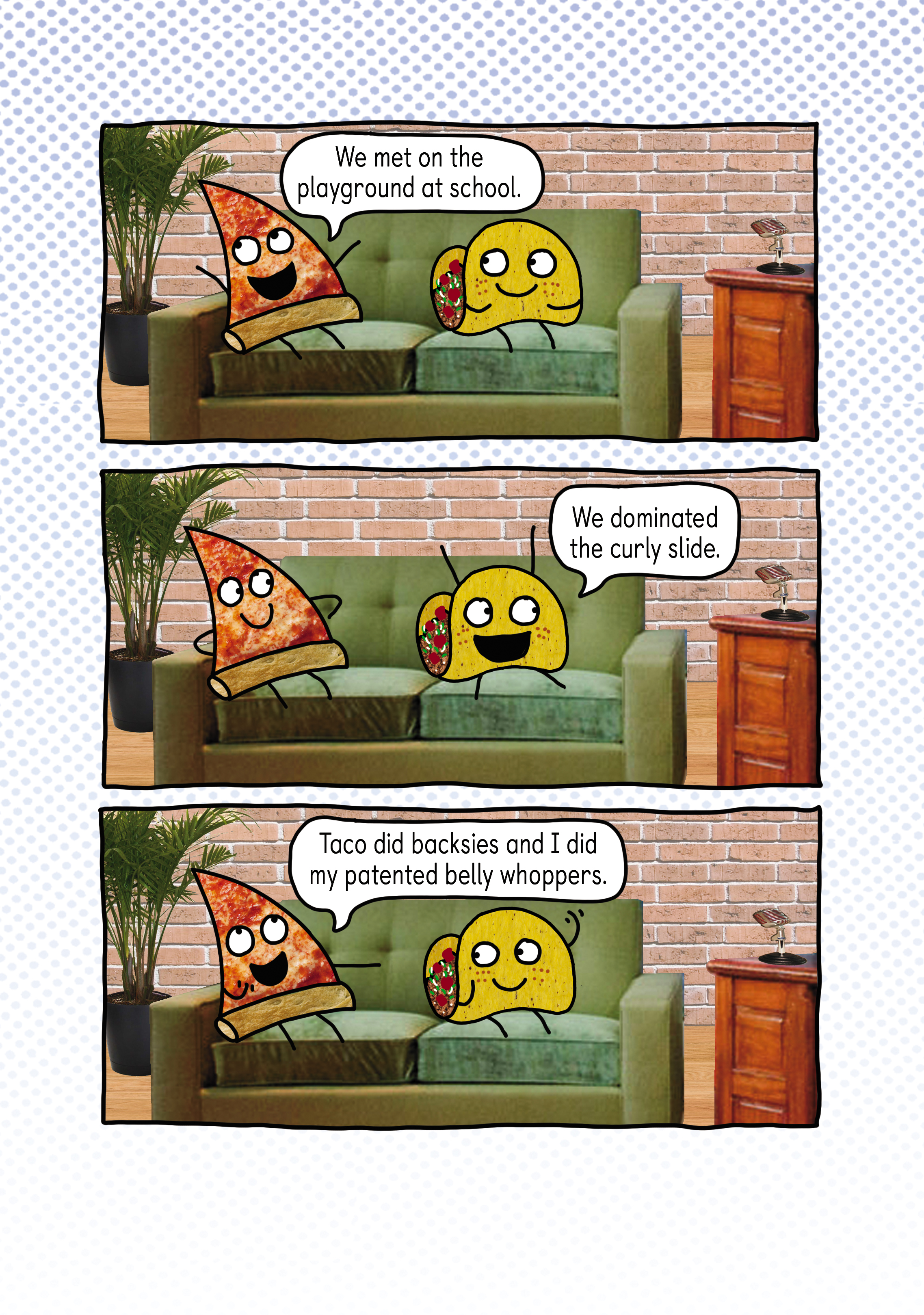
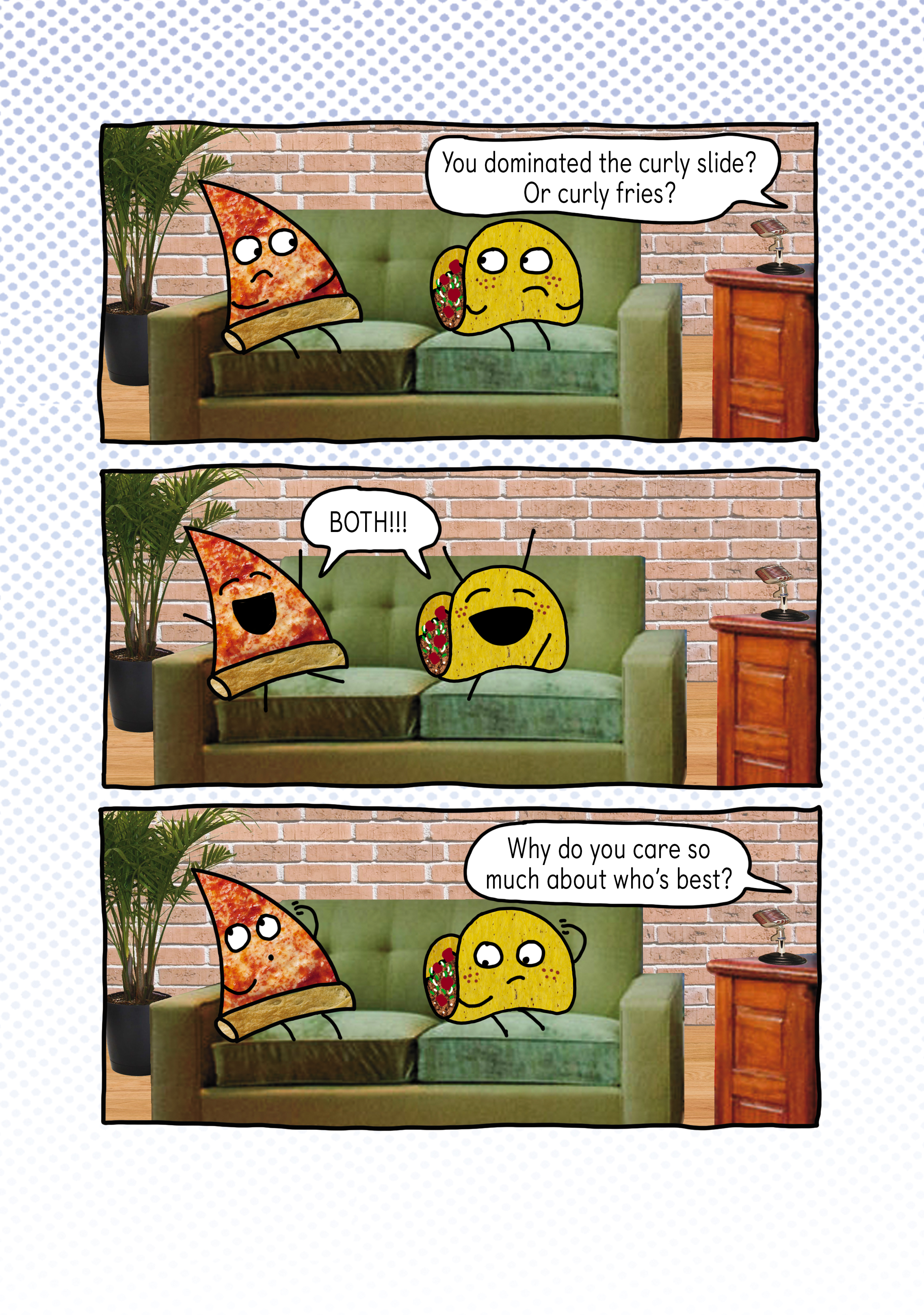

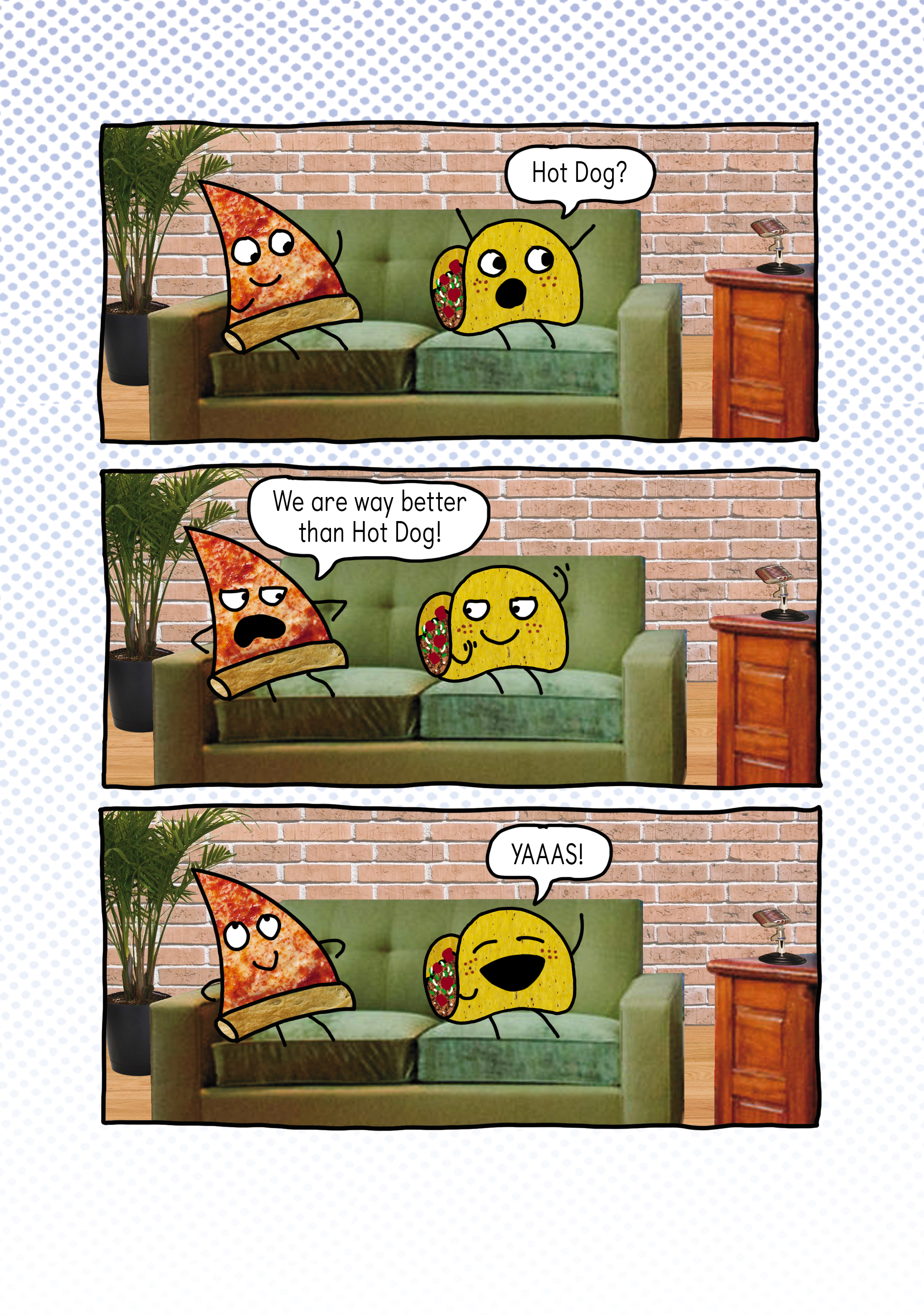


What? Don’t you like tunafish sandwiches?
Guys, come back!!! I’ve got pickles, too!
OH WELL.
Maybe you want to figure out who’s best. (Do so quickly, because you don’t want to be late for their BEST PARTY EVER in the Spring!)
Stephen is giving away a signed copy of PIZZA AND TACO: WHO’S THE BEST? to a lucky winner.
Just leave one comment below to enter.
Winner will be randomly selected in July.
(Sorry, actual pizza and taco not included. They don’t travel well.)
I hope you’ve been taking advantage of all the free webinars available to kidlit writers and illustrators! One introduced me to OLD ROCK (is not boring) by Deb Pilutti—which I must share with you! Because…often I’ll hear that certain subjects aren’t kid-friendly enough for a picture book main character. I’ll even say this myself while teaching. Yep. Guilty as charged.
But Deb Piluitti knew that an OLD ROCK could be a delightful MC with tons to teach nay-sayers.
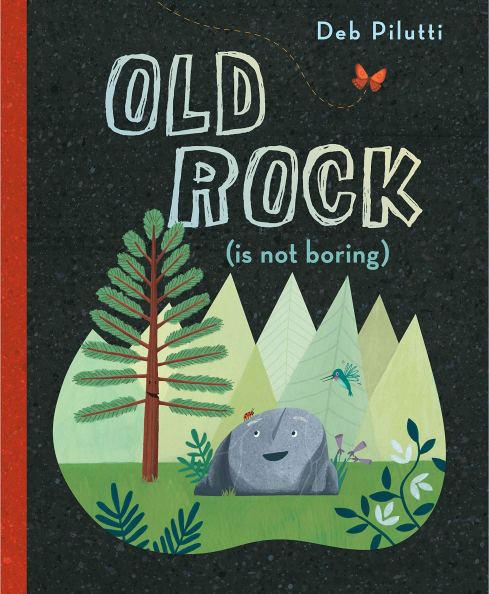
Deb, how did the idea for OLD ROCK roll into your head?
I have two different answers for that, and both are true.
My family has always liked to hike. In Michigan there are many wooded trails with pine trees, wildflowers, gently sloping hills and every so often you will see a large boulder, sitting on a hillside, without any other rocks or boulders around. And you wonder, How did THAT get here? (Spoiler: glaciers were involved.) I think this question created space for the idea to form.
One day I was doodling in a notebook and drew a rock with a face on it. I liked it and wondered if I could write a story about a rock character. Then I thought, rocks don’t DO anything. They just sit there. That would make for a boring book—which became the premise for the story. Old Rock’s friends think being a rock must be awfully boring. They can’t imagine sitting in the same spot, day after day.
And right now we’re all sitting in the same spot for a long time! What serendipitous timing!
I love how OLD ROCK breaks a picture book rule, which is to NOT jump back and forth in time. But you do this so seamlessly in the story. How did you use the illustrations as a visual cue between the past and present?
Oh, is that a rule? Haha, I guess it helped that I didn’t know.
But seriously, it was a challenge to differentiate past from present day. The main device I used was to change the color palette.
The past starts out in fiery unnatural colors, pinks and yellows and oranges, and gradually shifts as time progresses.

Present day is depicted in blues and greens.
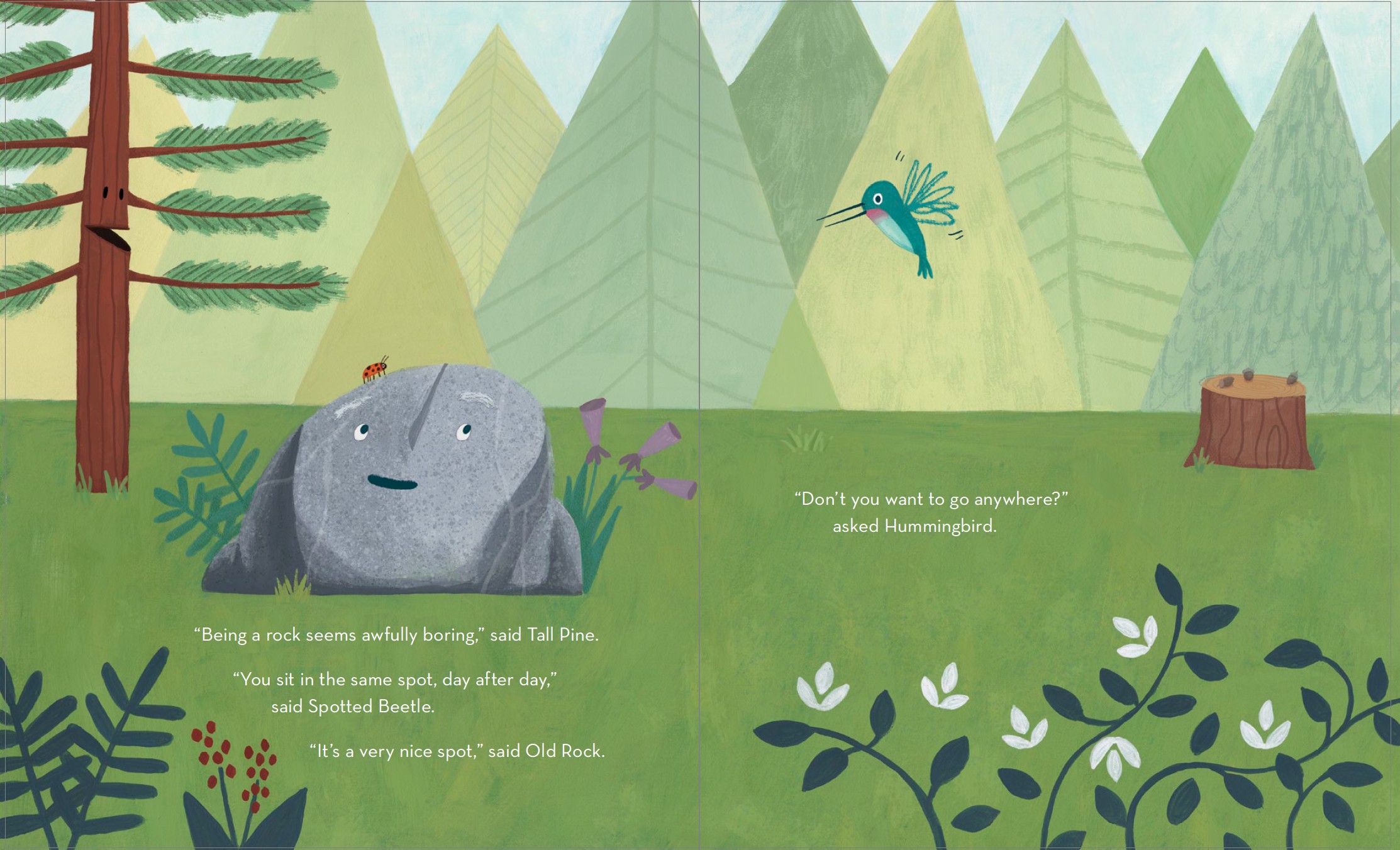
Old Rock’s appearance changes as time passes and becomes smaller, worn down with rounded edges, cracks and grey eyebrows.
Haha, I didn’t even notice the change in eyebrows! Then again, your humor steals the scene often…

Also, the present is always shown from a static vantage point, the spot at the edge of a clearing in the middle of a pine forest. Scenes from the past occur over a large geographical area, with angles and motion to suggest forward movement and genuine tumult.
Inanimate objects as main characters—like Amy Krouse Rosenthal’s “Spoon,” Josh Funk’s “Lady Pancake” series and now your OLD ROCK—do you think that’s a trend or is it here to stay?
 True, we are seeing more fun & silly anthropomorphic books for sure, including your own hilarious 7 ATE 9, illustrated by Ross MacDonald, but the concept has been around awhile.
One of my favorite books as a child was LITTLE BLUE AND LITTLE YELLOW, by Leo Lionni, a very dramatic picture book about two splotches of color.
I think it’s a childhood tendency to anthropomorphize an object. I remember my own children picking up a stick or a piece of food and giving voice to it. I talk to my Pez dispensers all the time or say “excuse me” when I bump in to a side table. And I have been talking to rocks and trees for as long as I can remember. I think of them as witnesses to life on this planet. Once they become a character, they can have feelings or empathy or misbehave and we can look at the world from their perspective. I think there are a lot more inanimate objects to explore. Any guesses on what the next big one might be?
Oh, you’ve put me between a rock and a hard place! I have no idea, but I welcome all the anthropomorphizing we can get!
You’re right, we make objects come alive as children, so why not do that in stories? I love it.
Do you have any secrets about the “making of” OLD ROCK?
I don’t know if I’d call them secrets, but a lot of research and background information went into the choices I made for the characters and illustrations. The book isn’t nonfiction, after all it does have a talking rock in it, but I think it would be categorized as informational fiction.
I did much more research for this book than any other. I talked with a geologist, an evolutionary biologist and a paleobotonist, plus read books and online resources about glaciers, volcanoes, and dinosaurs, and the research informed or changed the narrative.
In my first draft, Old Rock erupted out of the volcano as a blob of lava, but after researching rock types, I decided Old Rock should be a metamorphic rock which formed underground with heat and pressure and has course grains, like Gneiss. And though the location is never stated, I wanted Old Rock to end up in one of my favorite places: Along the western edge of the Michigan’s lower peninsula, overlooking Lake Michigan. That meant I needed to choose characters that were either native to Michigan, like Spotted Beetle (ladybug) and Tall Pine (white pine), or visitors, like Hummingbird. Ruby Throated hummingbirds spend the winter in Central America and then fly north in the spring. Old Rock is transported to the spot near Lake Michigan by the same glacier that formed it. None of this information is in the text, nor is it crucial that the reader know these facts, but they helped shape the story.
That is fascinating, Deb! Your research helped to make the story authentic with its cast of supporting characters.
Thanks so much for the opportunity to chat about OLD ROCK. It was a challenge and a joy to make the book.
And I know my blog readers will have a lot of joy reading your book. And winning it!
Leave one comment below to win a signed copy of OLD ROCK from Deb Pilutti.
A winner will be chosen randomly next month!
Good luck!
During quarantine, we’ve seen people connect and celebrate using song. Neighbors harmonize from their windows for front line workers. Friends croon from cars for drive-by birthdays. Families play “Name that Tune” via Zoom.
It’s no wonder; singing happens to release stress. As a former teacher, I often sang with students before tests or to reinforce tough topics. According to Julia Layton of How Stuff Works, singing lets out endorphins that help people feel good. When an individual sings in front of others, there is often an added benefit: improved confidence.
 So what does all this singing have to do with books? More and more, picture book and other authors are writing Book Songs for students that accompany their printed work. Megan & Jorge Lacera worked with Annie Birdd Music for their super-fun Zombies Don’t Eat Veggies song, Dawn Prochovnic wrote lyrics for Where Does a Pirate Go Potty?, Kwame Alexander shared “Kwame & Randy’s” MixTape 52, and Josh Funk created catchy tunes for his Lady Pancake & Sir French Toast books. I’ve also written songs related to my picture book My Quiet Ship, and also my latest Albert Whitman book, Way Past Mad. I felt lucky to record these songs with Leo Gade and Elizabeth Christman, amazing student singers from the Philly Boys and Girls Choirs.
I began using the instrumentals of my Book Songs as intros for a “Stuck at Home” video series that I started during quarantine to inspire kids/classrooms to create and connect in simple ways. In Video #7, the 76ers Sixth Man, a Philadelphia super fan, shared his idea: write and sing a song for someone you love.
EUREKA! That video led to a fun collaboration: the 76ers Sixth Man and Way Past Books are now kicking off the first annual Book Song Challenge!
With the school year coming to an end, our students, teachers and librarians have not only read a lot of books, but have also been under a lot of stress (#understatement).
For the contest, students are challenged to create their own Book Song about their favorite book this year. Hopefully, kids can feel good and confident as we celebrate books AND the end of the year for our hard-working students, teachers, and librarians.
Three winners will receive a $76 book gift card for themselves and a $1000 book gift card that will be sent to their school or library. These gift cards will be fulfilled by awesome indie bookseller, Children’s Book World.
As an author who writes small books about big feelings, it’s hard not to consider how kids and school professionals are feeling right now. I’m looking forward to piloting this challenge this year with the 76ers Sixth Man and growing it together as a community where we can share books, book songs, and celebrate the most important thing we have: our future.

 Hallee Adelman is the author of My Quiet Ship (2018), Way Past Mad (2020), Way Past Worried (coming Fall 2020), and two additional Way Past titles (2021). With a Ph.D. in Educational Leadership and Learning Technologies, Adelman has taught university and elementary students, having been nominated for the Disney Teacher of the Year Award on multiple occasions. She loves sharing writing tips with educators, children, teens and writers. She is married with two children and two dogs. Random facts: Adelman also produces documentary films. She keeps sour gummies in her desk drawer. She is currently engineering a giant leprechaun trap thanks to Tara Lazar’s most recent book!





 Writing for Kids (While Raising Them)