You are currently browsing Tara Lazar’s articles.
Yes, I’m from Jersey where “lotsa” is a word.
But enough formalities, let’s get on with the prizes!


The new blog subscriber winner of the three-picture-book prize pack is: ORTHODOXMOM3!
Congratulations! I’ll be sending you an email shortly!
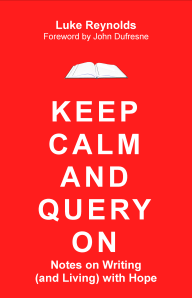 And now onto the KEEP CALM AND QUERY ON goodies from Ryan Gosling (aka Luke Reynolds)!
First, the winner of the signed book is: MARY ZISK!
Next, the winner of the query critique from Luke is: REBECCA COLBY!
Finally, the lucky person who gets a phone call pep publishing talk with Luke is: SUSAN G. CLARK!
Okay, ladies, try to KEEP CALM!
I’ll send you an email later today!
Congratulations to all! And remember…there’s more giveaways coming in April!
It’s Picture Book Palooza month!
(And obviously exclamation mark month, too.)
 When I first began writing for children, my critique group invited an author to speak to us about the publishing process. But we hadn’t realized this author paid to be published with a vanity press. Was she an author? Technically, yes. But after listening to her story, we realized that she might have her name on a book, but she was definitely not an author.
Disclaimer: I am not suggesting everyone who publishes with a vanity press is not an author. Some are excellent authors who are commercially and critically successful. They have taken charge of their career and I applaud them.
But this is the story of the kind of person vanity presses take advantage of—or perhaps the kind of person who takes advantage of vanity presses. At the end, I’ll ask you—do you think she fits the definition of an author?
She began by touting how quickly she wrote her book. She admitted she didn’t think a traditional publisher would acquire it. “Random House? Simon & Schuster? I knew they wouldn’t want it.” So after a few Googles, she found a vanity press that claimed to screen submissions.
The week she submitted, they sent an enthusiastic message offering to publish her book. For a fee, of course. While she wouldn’t tell us exactly how much she paid, she admitted it was between $5,000 and $10,000, although she only had to pay that fee once. Each subsequent book she published would not cost her as much (although it would elicit other fees). More on the sequel later.
She handed out her book, a holiday title, and let us read it. The first few lines were a monologue—single words emphasized with exclamations—but no explanation. She intended those words to be said in disgust, but they were words that conjure excitement in children, so without any other clues, we interpreted them as positive statements. On the third page when the character finally elaborated on his hatred of the holiday, our group was thoroughly confused.
Could the story have benefitted from a critique or two? A revision or two? Certainly. But she didn’t belong to a writing group. She didn’t have the time. Her adult daughter corrected the story for grammar but those were the only changes.
She was very pleased with how “flexible” this publisher was and how much they listened to her illustrative input. (Well, if you’re paying thousands of dollars, you shouldn’t expect anything less.) She made the artist redraw her animal characters several times so they would exactly resemble her real-life pets, the stars of the story.
However, insistence on getting the drawings “just right” delayed the book and severely limited her sales window. The book released just 2-3 weeks prior to the holiday for which it was written. Her vanity press arranged a signing for her at a bookstore and she was thrilled when she heard herself referred to as “the author”.
But is she really an author, with all those missteps and instant gratification? In my opinion, no. One of my dear friends, whom I can hear in my head, is saying, “So if a book is what she wanted, why is that so bad? Be happy for her.”
OK, I can see that the book made this woman very happy. But honestly, her flippant attitude toward our craft irritated me. It’s so very different from what I’ve been taught about working hard for something, being professional, and the satisfaction of a job well done.
In a day when self-esteem is so highly regarded and protected, when we’re giving every kid on the team a trophy just for showing up, when party games like “pin the tail on the donkey” don’t have winners or losers, and “good job” is a common parent refrain even when the job is not good, vanity presses have slipped into the culture quite easily.
But the final part of her story is the most baffling. The vanity press expressed interest in releasing a series of books based upon her characters, and as mentioned previously, she would not have to pay the hefty initial publishing fee. Her response floored us.
“Well, I’m really busy right now, but maybe in a year or two.”
Huh? You mean you have a chance to actually sell more books and make back some of your money but you are “too busy”?
Five years later, a search for her name turns up just one book. No series ever materialized.
So my next question is—was she even a writer? I don’t know writers who are “too busy”—because we must write. It is what we do. We can’t NOT write.
We write for many reasons. Some are writing with the goal of publication. Some are writing for the sheer pleasure of creation. Why do you think this woman wrote? And is she an author?
Thanks to everyone who visited Salina Yoon’s post about her newest and most challenging novelty book, KALEIDOSCOPE. The winner of the signed copy is:
 DONNA SHEPHERD!
Congratulations, Donna! Be on the lookout for an email from me…
Didn’t win? No worries. There’s more giveaways coming in the next two weeks. Yes, it’s a busy Spring over here! Here’s a sneaky peekie (what my five-year-old calls it):
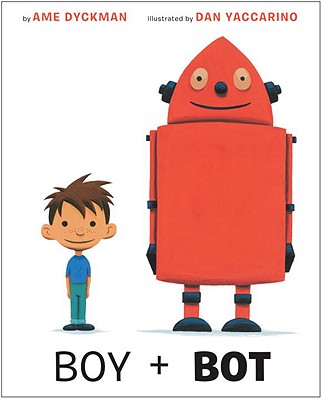
Ame Dyckman and Dan Yaccarino’s BOY + BOT
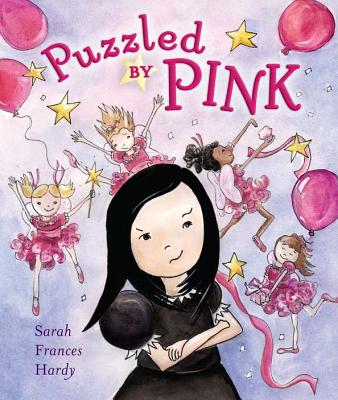
Sarah Frances Hardy’s PUZZLED BY PINK
Carolyn Crimi and Stephanie Buscema’s PUGS IN A BUG

Ammi-Joan Paquette & Marie Letourneau’s THE TIPTOE GUIDE TO TRACKING MERMAIDS

It’s a Picture Book Palooza!
Plus, don’t forget, if you’re not already subscribed to my blog via email, join today to be entered into a SEPARATE “new follower” three-picture-book-prize-pack giveaway on April 1st (EXTRA YARN, BOY + BOT, ARNIE THE DOUGHNUT). I’m not foolin’! Just enter your email address in the left column.

Last week I got the thrill every author looks forward to—a rough sketch of my book cover for THE MONSTORE. (Phew, I need an editor. I don’t mean every author looks forward to THE MONSTORE cover, but it sure would be a boon to my sales if they did!)
The cover was only in black and white, but WOWIE! To see my characters starting back at me with these eager “read me” expressions was as thrilling as holding my daughters for the first time. (Except then I was exhausted and thirsty. At least this time I was well-rested with a huge ceramic vat of chai.)
I immediately printed it out and my five-year-old and I colored it in. Then we slapped it on the basket of the scooter that I use to tool around the neighborhood. Yep, it’s now a MONSTOREMOBILE!
We then scooted over to the elementary school to…
View original post 122 more words
You may have never heard of Ursula Oaks, but she’s a pioneer. She and her family are one of only a handful of East-Coast bibliophiles who have become stewards of a Little Free Library.
 What’s a Little Free Library? Just as it sounds, it’s a small structure—a little bigger than a breadbox—that houses books which are free to borrow. Take a book, return a book, leave a book. Visit as often as you wish. And there’s never an overdue fine!
The brainchild of Todd Bol and Rick Brooks, the Little Free Library enterprise began in 2009 and flourished in the Wisconsin and Minnesota region. Intended to support literacy, social empowerment, youth and community development, the libraries sit on front lawns and places of business, encouraging neighbors and patrons to read…and share great literature.
A map on the LittleFreeLibrary.org website displays registered LFLs around the country. I was hoping to find one in New Jersey, but alas, none exist. (Don’t worry, my neighbor and I plan to change that soon.)
But I did find Ursula Oaks in Silver Spring, MD, living just three miles from my brother’s home. Originally I planned to visit her and the little library-on-stilts in her side yard, but since that didn’t work out, we chatted via email about her experience with being a Little Free Library “home librarian”.
TL: When and why did you decide to open a Little Free Library?
UO: I first heard about the LFL movement on an NPR program out of Wisconsin Public Radio called “Here On Earth: Radio Without Borders”, which is hosted by the amazing journalist Jean Feraca. She interviewed the founders, and the whole thing sounded so fun and meaningful that I went home that night and told my husband and son about it. They were both interested, too, so we started making plans. We thought the idea was a perfect melding of our shared love for building things, for libraries, and for books. Our son Liam loved the idea that we could select books from our own collection to share, and that we could host something in our yard that the whole community could take part in. My husband Craig was excited to have a new building project. And we all loved the creative aspect of designing and painting something totally unique. That was September of last year. It took us five months to actually get it completely finished, due to schedules, weather, travel, etc. The finished library finally went up in the yard on January 25 of this year.
TL: How did it get built and why did you choose the Madeline theme?
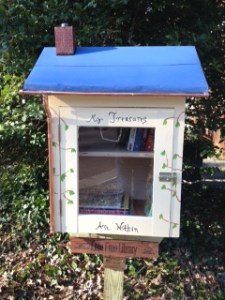 Craig is great with woodworking, so he built the structure, complete with copper run-off pipes, tin roof, and clear plexiglass front door. I sketched out the design based on the original Bemelmans drawings in one of our Madeline books, and everyone pitched in to paint, including 7-year-old Liam. Frankly we were surprised at how well it turned out, because none of us is particularly gifted with a paintbrush.
The story of how we ended up with the Madeline theme is a bit convoluted. We knew we wanted to do some kind of stylized approach to the house, so we thought about a barn or a farm house or bird house, and then at some point I suggested we try to come up with an idea that had some connection with a book we love—something that people would recognize and understand. Liam has always loved the Madeline stories, and we had recently returned from a visit to Paris for Thanksgiving, so the idea came to us pretty quickly once we went down that path, especially because while we were in Paris we passed an enormous house that looked incredibly similar to the Madeline house.
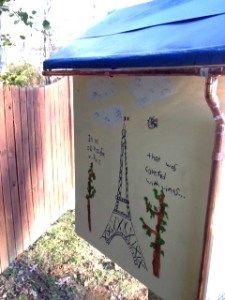 We decided to let Liam have free rein with the back of the house, but he needed help because he insisted on including an Eiffel Tower. He did the trees and the bird and the flag on the top of the tower.
TL: How does the Little Free Library work? Can people take any book they want? Do they have to return them? Can anyone add to the collection?
UO: The motto of the LFL movement is “take a book, leave a book”, but there’s no check-out/check-in system, and anyone is welcome to take a book. It’s been amazing to see how well this works, totally organically. Some people take and leave books, some just take, some just leave. I put a small notebook and pen inside inviting comments, and we have had many, all of them very positive. Many of them mention what a nice addition it is to the community, and many comment on the attractiveness of the structure itself. It seems to invite people to stop and linger. All of the books we originally stocked it with have been taken, replaced by an equal number of books from many other people.
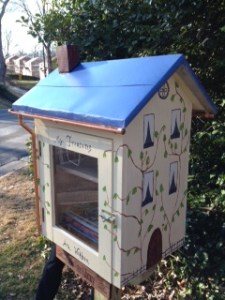 TL: Can you share some of the comments you’ve received?
UO: “This is beautiful and a treasure! Can we donate books to the cause?”
“We love it! My daughter has exchanged books three times already! Thank you!”
“Add a toilet.” (from a child)
“Gorgeous! Where did you get the cabinet?”
“We love your library!”
“Such a nice little library! It makes us happy just seeing it!”
“Amazing. Makes the world a better place.”
“I love this library.”
“So fun to trade books.”
“What a very sweet and thoughtful addition to our neighborhood. I will have to leave you a treat in return for your great idea.”
“The idea is so amazing. I want to make one when I grow up!!!”
“Thank you so much. We love the house, especially the rain gutters.”
TL: Have any of your neighbors expressed interest in starting their own Little Free Library?
UO: Yes, one person expressed interest. I think people have discovered ours after reading the recent USA Today article about how others have gone about establishing theirs.
TL: What has been the best part of owning a Little Free Library?
UO: The best part of it is seeing it every day and feeling like it is adding a bit of community-building and joy to our neighborhood.
I am always amazed at how it continues to enrich our lives. Let me share with you an interesting anecdote. Craig was getting ready to go to work and walked out to find an enormous FedEx truck in the street. He figured someone had ordered some furniture or something, but then he saw the FedEx guy looking at our Little Free Library. He said “hi” to him and the guy said he had seen a story about LFL on TV and had looked on the web site to see where there might be one in his area (he lives in northern Maryland). He realized there is only one in the state (ours) and said he finally had a chance to come down and check it out! I just thought that was pretty sweet.
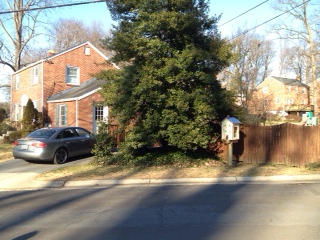
Thank you, Ursula and the Oaks Family! I wish you many happy years of home librarianship! Who knows…maybe the FedEx guy will deliver an endless supply of books!
So blog readers, how about you? Are you eager to set up your own Little Free Library? Let us know in the comments. And visit LittleFreeLibrary.org to get started!
 Among those represented by the Erin Murphy Literary Agency, Luke Reynolds is known as the *real* Ryan Gosling (you had to be there). Although, I happen to think Luke is cuter, don’t you? Just look at that dimple! And I happen to know he’s a heckuva lot funnier.
He’s also smarter than my Ryan Gosling when it comes to publishing, writing and living.
Luke is the author of KEEP CALM AND QUERY ON: NOTES ON WRITING (AND LIVING) WITH HOPE. And he’s here today to give you that: HOPE. (Plus a copy of his book, plus a query critique, plus a personal “pep talk” phone call!)
Half of Luke’s book includes some reflections for writers on perseverance, hope, humor, gratitude, and work ethic, while the other half includes interviews with writers like Daniel Handler (a.k.a. Lemony Snicket), Katherine Erskine, Jane Smiley, and 11 other authors.
Without further Ryan Gosling references, take it away, Ryan! Erm…I mean Luke!
Making a Life
by Luke Reynolds
There are two places where fast, easy manoeuvres and accomplishments are both warranted and worthwhile: 1) In a snowball fight, when your opponents are slinging well-packed cold stuff at you faster than re-runs of Friends episodes appear on TBS; and 2) In getting the kids to bed when they’re already overtired after a long day of snowball fighting.
Most other pursuits in life don’t lend themselves to easy success. And at the top of a very, very long list of Stuff That Takes Forever comes the pursuit of writing. But that’s a good thing—a terribly hard, but fantastically good thing. Because deep down, none of us who love writing want it to be easy anyway. That’s not why we fall in love with something in the first place.
When we were children, people asked us, “What do you want to be when you grow up?” Very few of us, I’m guessing, responded, “I’d really love to find something easy—something that requires little skill, almost no perseverance, and happens fast.” Instead, most of us said we wanted to fly into outer space wearing massive white suits; or we said we wanted to sing on stage in front of a roaring audience; or we wanted to be pilots or race car drivers or scientists who found cures for every kind of disease or explorers who found distant lands.
Or we wanted to be writers.
Novelist John Dufresne writes in his Foreword to KEEP CALM AND QUERY ON the following: “Writers want to write, not to have written.” Even though the manuscript of Keep Calm had been finished and proofed and was ready for publication, that line from John’s Foreword hit me hard and fast—much like a well-packed snowball or like a child screaming wildly that he isn’t ready for bed. The line speaks so loudly because it captures the essence of this pursuit we’ve chosen: a creative calling that is about making a life, not a living.
We write because we love the small giddy feeling that rises up like regurgitated food after we’ve eaten too much and then laughed too hard. We write because we like the problems (deep down) that our characters encounter, and we like the fact that there is no easy way out—either for our characters themselves or for us as we make plotting decisions. We write because we know that hearing no enough times and going back to our desks, reworking material, forging new work, and venturing back out into the wild, beautiful possibility of publishing makes our hearts beat fast.
So, deep down, we know it’s not easy. Nor do we want it to be. That’s not why we love it in the first place.
 Why do we love films and stories about underdogs? Why—for instance—does Atticus Finch inspire me to no end? It’s not because he took an easy case that guaranteed a sure-fire victory with no obstacles. I love Atticus because he took an impossible case that guaranteed a loss but his conscience demanded it and his soul echoed the call.
You love the books and characters and films you do, I believe, because you know that triumph is only beautiful when the journey is difficult, that getting the story right is profoundly moving only because you’ve known the story has been so stubbornly wrong—however slightly—in its previous lives.
The MG novel that my agent, the lovely Joan Paquette, signed me on was originally entitled ATTICUS AND ME. It was a story that came down my arteries and out through my fingertips. The first draft, though, would have guaranteed a speedy rejection from Joan. So she didn’t see Atticus until his fourth revision. And then Joan continued to revise Atticus into a character who was more authentic, more real—a character whose story meant more. Joan raised the stakes in the novel. And after quite a few rounds, Atticus is still growing, still changing.
And various picture book manuscripts are in their own worlds of revision, each entering a fifth, ninth, and eleventh or more incantation of their possible lives.
We write because we want to write, not because we want to have written. As writers, we start to accept the fact that—much like us—the characters that people our stories are going to need second-chances, harder obstacles, higher walls, deeper pain—and that all of this, eventually, leads to greater love. In the writing, for the writing, and through the writing.
So, then, the question remains: if we don’t want writing and publishing to be easy, what do we really want? I’d venture a humble guess: we want support. We want somebody—anybody, the mailman, Grandma, our children, our students, and maybe one day an agent and editor—to tell us that we have what it takes. We want support. We want to know that our work is worth it. That ninth draft of an MG novel or our twentieth time through a PB manuscript that has changed completely and become almost an entirely new book are both pursuits for which support is not only helpful, but essential.
 In short, we need someone in our corner, shouting in a voice of accountability, conviction, and faith to keep going. You have what it takes. Get through this draft. Try it from a different POV. Try it from a different character’s perspective. Try the story in present tense. Throw in a cow who believes he is Ryan Gosling. Throw in a turtle who eats books. Throw in a kid who thinks it’s over, until—
Until that voice. Listen it to it clanging inside the damn-near defeated walls of your heart. That voice confirms what you and I already know: we don’t want it to be easy. It’s hard. We know that. What we want is the pluck and the nerve and the faith to keep going—to make a life with our pursuit of writing and the way we embody it, rather than simply a living.
We want more than a contract and some cash. We want to craft the words that get us excited—that get readers excited. Or, as John Dufresne put it, we want to write, not to have written.
So: a toast. (I wish I had wine, but coffee feeds the writer in me more). To the very act of writing—in all its difficulty, stubbornness, painstakingly slow but remarkably beautiful worth. May we all, as writers and as people, keep calm and query on.
Thanks, Luke! Very inspiring. I need a tissue now. *sniff*
And you folks need to comment! Luke is giving away THREE PRIZES!
1. A signed copy of KEEP CALM AND QUERY ON.
2. A query critique.
3. A personal phone call and pep talk to discuss your writing career.
Your comment counts as one entry. You get an extra entry for each mention on social media: Twitter, Facebook, Pinterest, etc. Just mention it in your comment. Comments close the end of April 1 and winners will be randomly selected on April 2.
Now keep calm and comment on!
Luke Reynolds is editor of the forthcoming book for teens and tweens BREAK THESE RULES (Chicago Review Press, 2013). He has also co-edited BURNED IN: FUELING THE FIRE TO TEACH (Teachers College Press 2011) and DEDICATED TO THE PEOPLE OF DARFUR (Rutgers University Press, 2009). His newest books are KEEP CALM AND QUERY ON: NOTES ON WRITING (AND LIVING) WITH HOPE (Divertir Publishing, 2012) and A CALL TO CREATIVITY: WRITING, READING, AND INSPIRING STUDENTS IN AN AGE OF STANDARDIZATION (Teachers College Press, 2012). He loves garlic bread with passion, and loves children just about as much. He has taught grades 7-12 and he’s now a nightschool teacher and home-dad by day. His writing for children is represented by the formidably wise and oft-inspiring Ammi-Joan Paquette of the Erin Murphy Literary Agency. Keep calm and visit on at www.lukewreynolds.com.
Do you own a Salina Yoon book? If you have young children, chances are you do. The prolific author-illustrator has more than 180 titles to her credit—mostly baby board books and novelties for the kinder set. As a new mother, I received many Salina Yoon titles as gifts, from a shiny, glittery shape book to the candles of MY FIRST MENORAH.
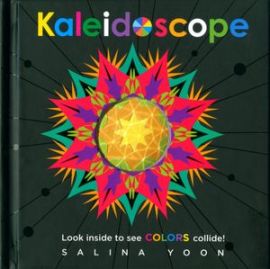 But her newest title, KALEIDOSCOPE, a lead novelty book by Little, Brown and Company, introduces Ms. Yoon to a whole new audience—adults. The colorful, swirling, twirling novelty book was created to appeal to both the young and the young at heart, and I can attest that it’s a huge hit at our home.
I talked with Salina about her newest book and the many challenges she encountered during the creation process. Ms. Yoon doesn’t grant many interviews, so I’m thrilled to host her!
Before we begin, though, take a look at the charming trailer, with original music by James Kremsner.
1
TL: Can you give us the definition of a novelty book…and how do they differ from board books?
SY: Novelty books are books with interactive components, like touch-and-feel elements, lift flaps, plush, glitter or foil accents, pop-ups, lenticulars, sound chips, special die-cuts, and more. Board books simply refer to a book’s binding, which is a book having stiff, board pages that are made to be durable for the very young. Since novelty books do include pop-up books, they can be for older children, while board books are primarily for babies to preschool.
TL: How did you get into designing novelty books?
SY: I’d never heard of “novelty books” until a field trip to Intervisual Books in my early college years. It was years later that I remembered this company and came back to ask if I could intern for them as a book designer. This was my first real exposure to novelties—and I fell head over heels in love! Even after I left the company (to relocate to be with my then-fiancé), I couldn’t get novelties out of my mind! Each novelty is like a puzzle with various pieces having to fit: the format with the concept, the concept with the text, the text with the art, the art with its readers, all in one! I couldn’t find a position in San Diego that would allow me to keep creating novelties except to create them at home and submit to publishers. My first 20+ books were acquired by Intervisual Books, my former employer. That led to Simon & Schuster, Penguin, Scholastic, Random House, and the rest is history.
TL: You are an extremely productive author-illustrator, with almost 200 titles. But you said this time KALEIDOSCOPE pushed you to your creative limits. How so?
SY: My previous titles were all for the babies to kinder market, a market I was very familiar with throughout my now 12-year career. You could almost say I could do these in my sleep. KALEIDOSCOPE was the biggest wake-up call ever. When my publisher acquired this title, the editor envisioned a different kind of book. She envisioned a book that would appeal to adults, while still appealing to children. She wanted a sophisticated approach to the art for an upscale market, appropriate for museum bookstore shelves and specialty gift stores. I had never created art for the adult market, nor had I written for it, so it was a completely new and terrifying challenge. In fact, I wasn’t sure I could pull this off. Several times, I thought this was beyond my abilities, but fortunately, my editor knew different. It took numerous revisions to achieve what it ultimately came to be. This is a new kind of novelty book, even for me!
TL: How differently did the book turn out from your original concept?
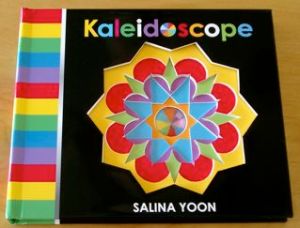
SY: At first glance, it may appear to be similar. My original version featured very flat, geometric designs. The rhyming text gave hints to what the design could be; a nautical compass, fireworks, or a cowboy boot’s spur. The concept was simple and direct. After various revisions, the art is now more organic and evocative. It attempts to capture universal moments in our lives that are peaceful, nostalgic, glorious, or inspired. The kaleidoscope lens allows the reader to reflect on those personal moments in a playful and entrancing way.
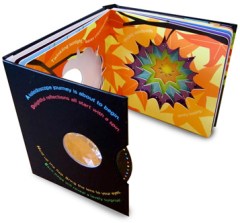
TL: The kaleidoscope wheel on your book is a multi-faceted clear resin that spins and makes the illustrations shimmer—like the autumn page with leaves that appear to be fluttering in the breeze. What was the design of the original kaleidoscope wheel?
SY: When creating a novelty book, one must always be cost-conscious because the biggest killer of a novelty is its production cost. So I found a very inexpensive kaleidoscope party favor (a toy) from a party store, removed the lens with an X-Acto knife, and placed it in my handmade submission dummy on a rotating wheel. I knew that this particular lens would be accessible to printers in China and reasonably priced since it was on a very inexpensive toy. But to my utter surprise, Little, Brown wanted a bigger, bolder lens regardless of the higher-cost factor. They worked with a manufacturer to customize and mold the gorgeous 2″ faceted lens. It’s very common for publishers to ask me to find ways to cut costs, but this was a rare occasion where the publisher actually allowed me to increase the production budget! It was worth every penny, I think.
 TL: It definitely was! How do you hope readers will react to KALEIDOSCOPE?
SY: To start, I hope the readers are of ALL AGES! Most novelties are targeted to the youngest audience. I hope KALEIDOSCOPE breaks that mold, as Rufus Butler Seder’s Scanimation books have (GALLOP, SWING). Some books are just so cool that it appeals to everyone, with or without children at home. I hope readers find the book visually appealing, thoughtful, entertaining, and most of all, surprising. I hope it brings out the child in the reader when spinning the kaleidoscope wheel. And for our youngest readers, I hope it stirs up their imagination and they squeal in delight!
I hope it pushes the boundaries of what books can be, and make a case for keeping printed, bound, hardcover books alive!
TL: KALEIDOSCOPE makes a strong case! You mentioned there was even a “sequel” in the works. Can you leak some advance details?
SY: The sequel is PINWHEEL, due to launch one year from now. The art is near complete. As the title suggests, it has a spinning component, but utilized in an entirely different way from KALEIDOSCOPE. My editor recently told me that when she shared one particular spread in the book with her sales team, it generated applause! *faints* That’s all I can say. I hope to be back to share it with you in depth!
TL: Absolutely! I can’t wait to hear more about it! Thanks so much for sharing your creative process. It was a pleasure chatting with you about your work. I hope folks will visit you at SalinaYoon.com to learn more about your books.
And now, it’s time for the giveaway!
One lucky person will win a signed copy of Salina Yoon’s KALEIDOSCOPE!
Just leave a comment to enter. You get an extra entry for each mention on social media: Facebook, Twitter, Pinterest, etc. Just tell me about it in your comment. Entries close the end of March 27th and I’ll “spin the wheel” to choose a winner on March 28th.
Good luck and thanks for visiting!
Me announce winner of ME WANT PET contest.
But first, if you a parent/caregiver/teacher with picture book kids, subscribe to blog (see left column). Me have more book contest soon. Comment on this post if you new subscriber and you can win THREE PICTURE BOOK PRIZE PACK (BOY + BOT, EXTRA YARN, ARNIE THE DOUGHNUT)! Me pick winner APRIL 1. THIS NO APRIL FOOL’S!
Now ME WANT PET winner.
It be Anna, age 9! ConBATulations!
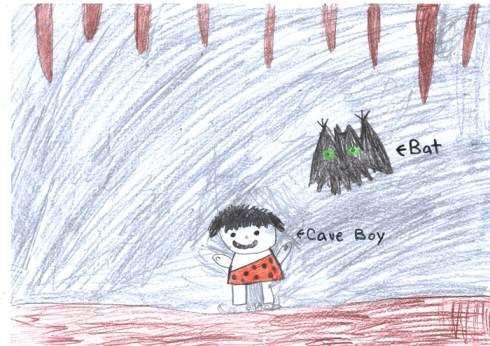
Now me show you more great pets!
Isaac, age 6:

This Kid Erik, age 10:

Josie, age 8:
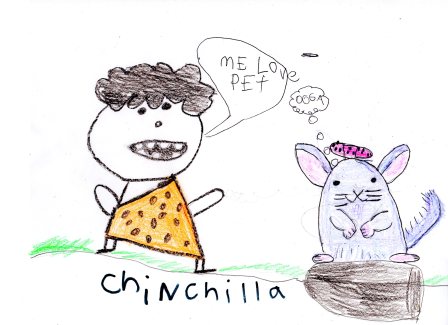
Jordan, age 6:

Renn, age 5:
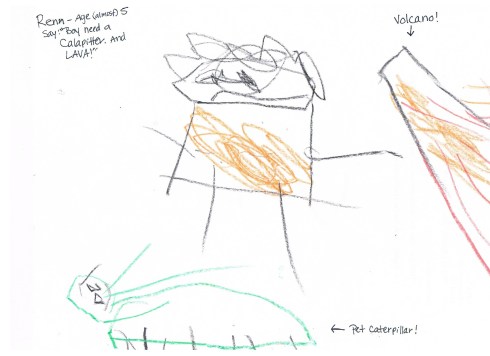
Me and Tammi Sauer thank all kids who draw pets!
Maybe Tammi write SEQUEL!
OOGA!
One of the most frequently asked questions by new kidlit writers is “why do editors say not to write in rhyme?” There’s plenty of picture books written in rhyme, right? They get published somehow!
Well, the answer is a bit complicated. It’s not that editors don’t necessarily LIKE rhyme. It’s just that it is very difficult to do well. Here’s why:
- Rhyme scheme can dictate story–but shouldn’t. Tales should unfold organically, not be forced into the confines of the rhyme. Often it’s suggested to write in prose first—so you don’t get locked into a plot that doesn’t work—then translate it to rhyme.
- Common rhyme schemes can be stale. Editors see them again and again. Avoid overly simple, one-syllable rhyme schemes like go/show/know, to/you, me/be/she/he/see, run/fun/sun, day/may/way/say. If your reader can guess the word at the end of the line before they get there, your rhyme scheme may be too common. Editors want to read rhyme that surprises them.
- Forced rhyme or near-rhyme can ruin a story. This is when words don’t exactly rhyme unless you mispronounce them. Once in a while this is acceptable, but more than a few times in a manuscript and it distracts.
- The meter (or beat) must be spot-on. That doesn’t just mean the number of syllables in each line, but the emphasis on those syllables. Meter shouldn’t be so sing-songy and constant that it lulls the reader to sleep (unless maybe it’s a bedtime book) or so rough that it tongue-ties the reader and forces them to speak unnaturally. Some good rhyming books offer a break in the rhyme scheme for variety—not unlike a bridge in a song.
- Rhyming books are difficult to translate into other languages. An editor may not want to lose out on foreign book sales, so they’ll pass on a rhyming project.
However, if your heart is set on rhyme and if you have a talent for it, you should go for it. At first, Karma Wilson listened to the “don’t rhyme” advice.
“When I first started submitting some 15 years ago all the guidelines said, ‘No rhyme and no talking animals!’ For THREE years I avoided rhyme and talking animals. But guess what my first book sale was? BEAR SNORES ON! And guess what the guidelines said for McElderry books? NO RHYME AND NO TALKING ANIMALS! My passion is rhyme, and talking animals are great as long as they have something interesting to say.”
Yes, you can break the rules like Karma. But get your rhyme critiqued and know whether or not you can nail it.
Me, I’m terrible at rhyme and I know it. I cannot “hear” meter. I’ve tried and failed. My friends have coached me, but I still don’t get the right beat. I can’t dance to it. (I can’t dance anyway. Think Elaine from Seinfeld. Sweet fancy Moses!)
So what is successful rhyme? I’m glad you asked! I’ve got a few examples for you.
In HUSH, LITTLE DRAGON, Boni Ashburn spoofs the lullaby “Hush, Little Baby”. Instead of buying her baby a mockingbird, the mama dragon in the story brings her darling son various villagers to eat. It’s delightfully tongue-in-cheek. Some of the best lines:

Here she comes with a fresh magician.
Don’t mind the taste—he’s good nutrition.
…and later on…
If Mama finds a mean old queen,
Honey, you are lucky—that’s good cuisine!
Notice how these rhymes are out of the ordinary. They’re surprising and fun, plus the words have multiple syllables. She also rhymes “flee” with “fiery” and “bolt” with “revolt”. I challenge you to find these rhymes in another book! You won’t—and that is what makes this story so special.
Jean Reidy’s LIGHT UP THE NIGHT is an example of rhyme that elicits glorious illustrations. Remember that in picture books the art tells half the tale, and these lines create an expansive view of our world (click on image for larger version)…
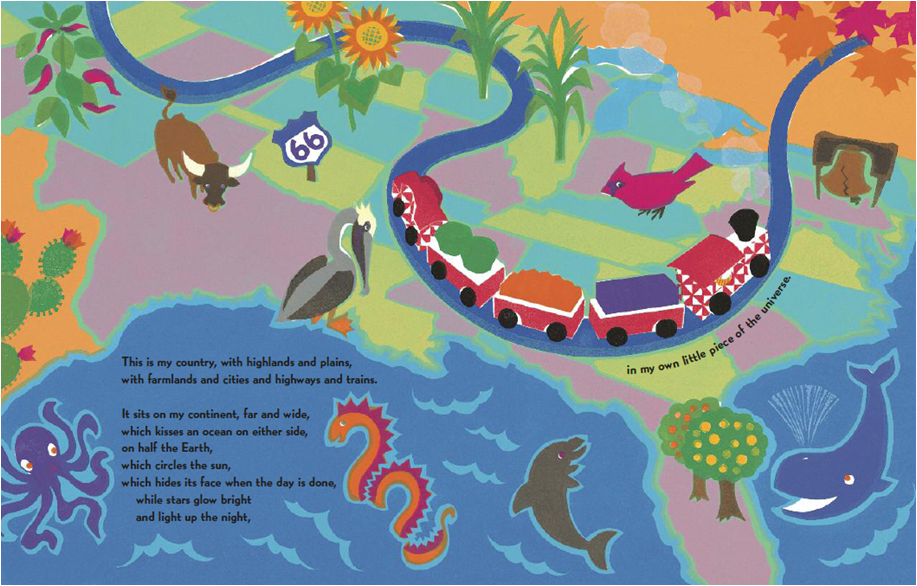
This is my country, with highlands and plains,
with farmlands and cities and highways and trains…
Notice how there is a break in the rhyme scheme at the end of the stanza—and that line is set apart in the illustration for emphasis. Coincidentally, Jean blogged today about her decision to write in rhyme. Go check it out!
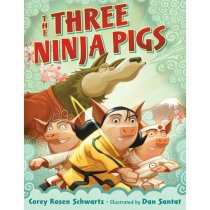 In Corey Rosen Schwartz’s THE THREE NINJA PIGS, the rhyme is infused with porcine puns. Kids and adults alike will appreciate the humor:
She then gave a swift demonstration
With backflips and butterfly kicks
The wolf looked quite shaken
but hollered, “Yo, Bacon!
I’m not at all scared of your tricks.”
There’s more great piggish laughs (like my favorite “pork-chop” line) but you’ll just have to wait until it’s released in September!
So I hope I’ve provided you with some background on why rhyming picture book manuscripts are a hard sell…but that if they’re done well, they can be spectacular.
What are some of your favorite rhyming picture books? Please share in the comments!
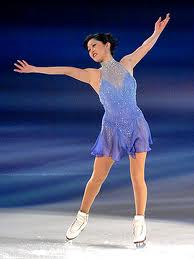 Before Michelle Kwan, before the whole Tonya Harding-Nancy Kerrigan scandal, there was a figure skater who exhibited that perfect balance of power and grace: Kristi Yamaguchi. She had the high jumps and fast spins, but she also had a style and effortless elegance no one else could match.
OK, so why am I gushing? I used to be a competitive figure skater, but no where near the level of Kristi Yamaguchi. She was a role model to me. So today I’m very pleased to share with you her new picture book, IT’S A BIG WORLD, LITTLE PIG! And yes, it’s about figure skating!
 First, let me introduce the main character, Poppy. Isn’t she cute? In her first book, she had the courage to DREAM BIG and chase after her goals.
Now, in the sequel, Poppy receives an invitation to Paris to compete in the International Games. She musters up her porcine prowess to travel far from home–with encouragement from her friends and family, of course.
When Poppy arrives in Paris, she’s overwhelmed. She doesn’t know anyone and doesn’t know where to go. But Poppy is great at making friends. She bumps into Li, a panda snowboarder. And Poppy finds out that even though they are from different countries, they “both smile in the same language.”
 According to John Sellers, children’s reviews editor for Publishers Weekly, “There’s certainly a need for books that portray, mirror and show the value in all kinds of families: same-sex families, mixed-race families, stepfamilies, families with grandparents as guardians.” I also believe that books should reflect the diversity in the world around children. In my own neighborhood, there are families from Brazil, India, the Czech Republic, Spain, Portugal, China, Taiwan, Denmark, and Mexico. So I was pleased to see that Yamaguchi’s book introduces readers to animal competitors from all over the world.
Tim Bowers illustrates with such adorableness (is that a word???), bright colors and a jovial quality. You can’t help but smile at the wonderful world he’s created.
IT’S A BIG WORLD, LITTLE PIG brings together many cool themes (besides ice): following your dreams, making friends, diversity, independence, and doing your best. And it’s all rolled up in a figure-skating package! What could be more perfect?
Well, I’ll tell you! One hundred percent of Kristi’s profits from IT’S A BIG WORLD, LITTLE PIG will benefit early childhood literacy programs supported by her Always Dream Foundation.





 Writing for Kids (While Raising Them)