You are currently browsing the monthly archive for January 2018.
 Inspiration is a slippery thing, impossible to catch when you’re trying and ironically, easiest to catch when you’re really, really busy doing something else. About a year after CLICK CLACK MOO was published, I decided it was time to take a leap of faith. I was an attorney at the time working long days and plenty of weekends to boot. I wanted to pursue writing as my career, so I finally quit my day job and shortly thereafter, we moved out of the city and out (well, up, actually) to the suburbs. I was going to write all day. All night if I wanted to! I had my own office in the house, I had plenty of writing time. No day job to get in my way! I sat and I sat and I sat—and I thought and I thought and I thought and I waited and waited and waited. You know what never showed up? INSPIRATION. I didn’t write a thing for almost a year. DIDN’T WRITE A THING. I had written so much more when I was working long hours and always pressed for time. Oddly, inspiration struck when I had no time for it back then. WHAT? NOW? A story about a worm?? It’s 1:00 a.m. and I have a brief due tomorrow! But when your brain is working, its working overtime. The harder I worked at my day job, the more my brain was spinning with ideas.
 What I learned in The Year of Not Writing (besides that we really should move back to the city), was that more often than not, inspiration shows up in the work. I write every single day. I absolutely do not write well every single day. In fact, I rarely do. Ninety percent of what I write is unusable. Horrible. Hideous. Embarrassingly bad. Boring. Unoriginal. Most of it will never see the light of day. But if I wait for inspiration, they will find my rotting corpse hunched over my desk and a blank screen on my computer. Which came first—the inspiration or the work? Very rarely, for me at least, it’s the inspiration. Usually, the uninspired work comes first and somewhere in the first draft or third draft or 18th draft, something from that work stands out, pops out, screams for attention. That’s the inspiration. Only you have to write it first. So frustrating!!
Where to start? Anywhere. I’m an introvert—so I’m listening way more than I’m talking—which is helpful. If you are chatting on your cell phone, or sitting near me on the F train, or at the next table in a restaurant… I’m eavesdropping. Bits of things, pieces of things are the best. Almost anything taken out of context can be a great story starter, title, or dialogue. I’m also partially deaf, so I mishear things all the time —which also makes for strange word pairings in my brain (and plenty of awkward conversations, which is okay, because of the introvert thing—I’m used to it.). Mistakes are great inspirations. Embarrassment is great inspiration. Fear excels at the art of inspiration. If you are not lucky enough to be a hard-of-hearing introvert, re-write an old idea. Write about a time you were deeply embarrassed or scared to death. Write about what you wished you had said in a recent awkward conversation, instead of what actually came out of your mouth (maybe that’s just me).
 In the heart of every story is conflict—or a problem. Find yours. Use yours. Give your problems away to your characters. See what they do with them. If you can’t come up with a character, use a stand-in. Here, squirrel, here’s my problem. I’m afraid of ________. Just start writing the story about the squirrel afraid of public speaking—even though this would seem to fall into the category of a problem with little consequence for a squirrel. Just write it. Ninety percent of it will be unusable, hideous, boring, nonsensical. But it will start you down a path where you don’t know what’s coming. That’s where you want to be. That’s where inspiration likes to hang out.
When I die, some poor soul will come along and have to dig through my office. If I was alive, I’d be mortified at how many bad ideas, bad writing, and manuscripts completely lacking in originality will be unearthed. That’s the work. Maybe it will inspire somebody…
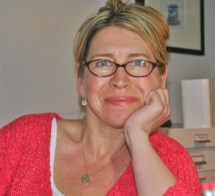 Doreen Cronin grew up in Merrick, New York, with her parents, two brothers and a sister. They lived in a red house with a big backyard and a neighborhood full of kids. Her dad was a police officer and he was very, very funny! Doreen decided that she wanted to be a police officer when she grew up, too. Or maybe even an FBI agent! When she actually did grow up, she realized she wasn’t actually brave enough to do those jobs!
It was her first-grade teacher, Mrs. Cooper, who first told Doreen that she was a writer. Mrs. Cooper gave her extra writing assignments to encourage Doreen. It was extra homework, but she loved it! She also loved the library—it was one of her favorite places to spend time.
Doreen graduated from Pennsylvania State University in 1988 and St. John’s Law School in 1998. After practicing law for a few years in downtown Manhattan, she left my job and decided to write full time. She’s been writing ever since!
Visit her online at DoreenCronin.com.

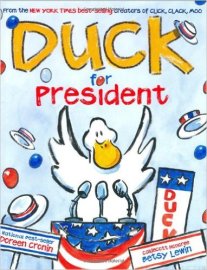
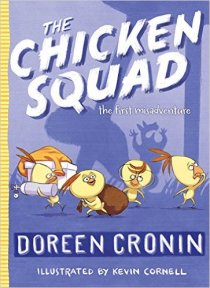
Doreen is giving away a set of signed CLICK, CLACK, MOO books (Click Clack Moo, Giggle Giggle Quack, Duck for President, Click Clack Boo)!
Leave ONE COMMENT on this blog post to enter. You are eligible to win if you are a registered Storystorm participant and you have commented once below. Prizes will be given away at the conclusion of the event.
Good luck!
Hello, Storystormers! Your guest posts will return tomorrow for a full 30 days of inspiration. Plus, there will be a couple of Post-Storystorm guest blogs, too!
In the meantime, let me announce the Storystorm Grand Prizes—feedback on your best five ideas from one of these TEN amazing picture book literary agents.
The Storystorm Pledge will be posted on February 1st for you to sign if you have at least 30 ideas. This will be your chance to officially affirm that you have completed the Storystorm challenge.
Winners of these Grand Prizes will be selected in early February from the list of Storystormers who have both registered and completed the challenge. Your name must be on both the registration and final pledge.
Without further ado…which is certainly NOT about nothing…let me introduce the Grand Prize agents to you.
Holly M. McGhee, President and Creative Director, Pippin Properties
 Holly M. McGhee still carried MADELINE around in 3rd grade—until Mrs. Carrier, her school librarian, tricked her into reading longer books by giving her one with her name on it, HOLLY IN THE SNOW. After college, Holly headed straight into the book world of New York City, where she has enjoyed being a secretary, an advertising manager, a sales rep (for one month), and in the six years prior to opening the doors at Pippin, an executive editor at HarperCollins.
Now, as the President and Creative Director of Pippin she is dedicated to shepherding books that make a difference into the world.
Ammi-Joan Paquette, Senior Agent, Erin Murphy Literary Agency
 Ammi-Joan Paquette is a senior agent with Erin Murphy Literary Agency, representing all types of children’s and YA literature. She is also the author of the Princess Juniper series, the forthcoming MG novel The Train of Lost Things, and picture books including Ghost in the House, Elf in the House, Bunny Bus, and The Tiptoe Guide to Tracking Fairies. With acclaimed author Laurie Ann Thompson, she is also the co-author of the “nonfiction with a twist” series, Two Truths and a Lie. In her agent acquisitions, Joan is particularly drawn to richly voiced, unforgettable characters and settings, as well as tightly-paced, well-plotted stories with twists and turns that keep you guessing right until the end. Visit her on the web at: ajpaquette.com. (P.S. Joan represents Tara.)
Tricia Lawrence, Agent, Erin Murphy Literary Agency
 Tricia is the “Pacific Northwest branch” of EMLA—born and raised in Oregon, and now lives in Seattle. After 22 years of working as a developmental and production-based editor (from kids books to college textbooks, but mostly college textbooks), she joined the EMLA team in March 2011 as a social media strategist.
As agent, Tricia represents picture books/chapter books that look at the world in a unique and unusual way, with characters that are alive both on and off the page, and middle grade and young adult fiction and nonfiction that offers strong worldbuilding, wounded narrators, and stories that grab a reader and won’t let go.
Tricia loves hiking, camping out in the woods, and collecting rocks. She loves BBC America and anything British. She has way too many books and not enough bookshelves. You can find Tricia’s writing about blogging, Tweeting, Facebooking, and other social media topics (for authors and the publishing industry at large) at authorblogger.net and tricialawrence.com.
Rachel Orr, Agent, Prospect Agency
 Prior to joining Prospect Agency in 2007, Rachel worked as an editor at HarperCollins Children’s Books, where she had the pleasure of working with such successful novelists as Dan Gutman and Suzanne Williams. Because of her editorial background, Rachel continues to do a lot of hands-on work with her clients before sending their projects out on submission.
Rachel loves working with clients who come from diverse backgrounds and have fresh perspectives to offer readers.
Rachel is looking for short, punchy picture books (either in prose or rhyme) that are humorous and have a strong marketing hook; non-fiction picture books (especially biographies or stories with a historical angle); and illustrators for the trade market.
Stephen Fraser, Senior Agent, The Jennifer De Chiara Literary Agency
 Stephen Fraser joined The Jennifer De Chiara Literary Agency as an agent in January 2005. He worked most recently at HarperCollins Children’s Books, where he edited such creative talents as Mary Engelbreit, Gregory Maguire, Michael Hague, Ann Rinaldi, Kathryn Lasky, Brent Hartinger, Stephen Mitchell, and Dan Gutman. He began his career at Highlights for Children and later worked at Scholastic and Simon & Schuster.
A graduate of Middlebury College in Vermont, he has a Master’s degree in Children’s Literature from Simmons College in Boston. He represents both children’s and adult books in a wide range of genres.
Erin Casey, Junior Agent, Gallt & Zacker Literary Agency
 Erin has found solace and wonder in books since she stopped gnawing on their corners. Erin graduated from Hamilton College with a B.A. in Creative Writing and an ever-growing list of books to read. Though she spent most of her education learning to appreciate, analyze, and argue points about adult fiction, working at Gallt and Zacker has allowed her to get back in touch with her inner child. Erin now reads books for all ages and is particularly drawn to work that shows the author’s world- and character-building ability. She wants to believe wholeheartedly in the world of the book, whether the setting is familiar or fantastic. She wants to experience the characters’ journey through all of her senses as well as her emotions. She wants even the simplest lines of dialogue to pluck at her heartstrings because they’re so perfectly written for that character. Erin loves that startled feeling you get upon reaching the end of a chapter in a really good book. You forget you’re reading when you’re so busy living, you know?
Kelly Sonnack, Senior Agent, Andrea Brown Literary Agency
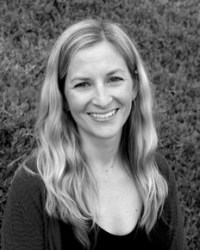 Kelly represents illustrators and writers for all age groups within children’s literature (picture books, middle grade, chapter book, YA, and graphic novels).
Picture books that Kelly represents include sweet, emotional books like Diane Adams’ TWO HANDS TO HOLD YOU and LOVE IS (both Chronicle), Elizabeth McPike’s LITTLE SLEEPYHEAD (Putnam/PRH), and Alastair Heim’s LOVE YOU TOO (Little Bee/Bonnier); funny books like Bridget Heos’s MUSTACHE BABY (Clarion/HMH), Alastair Heim’s NO TOOTING AT TEA and his upcoming THE GREAT PUPPY INVASION (both Clarion/HMH); thoughtful and imaginative books like Jessica Young’s MY BLUE IS HAPPY (Candlewick) and Sam Zuppardi’s THE NOWHERE BOX and JACK’S WORRY (both Candlewick); and original board books such as Kenny Harrison’s four-book series Hide and Seek Harry (Candlewick).
Kelly spent most of her childhood as a 3rd culture kid, growing up in Singapore. Now she lives with her husband and little ones in San Diego, and is on the Advisory Board and faculty for UCSD’s certificate in Writing and Illustrating for Children. She is also a founder of the City Heights Young Writers Workshop and is a frequent speaker at conferences, including SCBWI’s national and regional conferences. She can be found talking about all things children’s books on Facebook (agentsonnack) and Twitter (@KSonnack).
Jennifer March Soloway, Associate Agent, Andrea Brown Literary Agency
 Jennifer represents authors and illustrators of picture book, middle grade, and YA stories, and is actively building her list. Although she specializes in children’s literature, she also represents adult fiction, both literary and commercial, particularly crime, suspense and horror projects.
For picture books, she is drawn to a wide range of stories from silly to sweet, but she always appreciates a strong dose of humor and some kind of surprise at the end.
Prior to joining ABLA, Jennifer worked in marketing and public relations in a variety of industries, including financial services, health care, and toys. She has an MFA in English and Creative Writing from Mills College, and was a fellow at the San Francisco Writer’s Grotto in 2012. She lives in San Francisco with her husband, their two sons, and an English bulldog.
Jennifer regularly presents at writing conferences all over the country, including the San Francisco Writers Conference, the Northern Colorado Writers Conference, and regional SCBWI conferences.
For her latest conference schedule, craft tips and more, follow Jennifer on Twitter at @marchsoloway.
Tracy Marchini, Literary Agent, BookEnds Literary Agency
 After four years as a Literary Agents Assistant at Curtis Brown, Tracy Marchini left to pursue her own editorial business and to earn her MFA in Writing for Children from Simmons College. With ten years of experience either at an agency or working as a freelance children’s editor, she joined BookEnds in June of 2016 and is excited to grow her list of both award-winning and debut authors and illustrators.
Growing up, Tracy made it a personal goal to read every Nancy Drew Case Files in her school’s library and still has a soft spot for a good girl detective story. As an adult, she loves the sense of possibility in children’s and young adult literature – and can still empathize with the soul-crushing feeling that is mandatory gym class.
Tracy is looking for picture book, middle grade and young adult manuscripts across most genres, including contemporary, mysteries, thrillers, magical realism, historical fiction, graphic novels and non-fiction. She is also looking for picture book illustrators and author-illustrators. Follow her on Twitter @TracyMarchini.
 Liza Fleissig, with her partner Ginger Harris-Dontzin, opened the Liza Royce Agency (LRA) in early 2011. A cross-platform company providing development, representation, and strategic career management for clients in all media, their goal is to represent clients in all stages of their careers, from the most established to those developing their craft, as well as debuts. Both former partners in NYC based litigation law firms, Liza and Ginger bring a combined 40 years of negotiating experience to the field. This background, along with connections rooted in publishing, movies and television, allowed them to focus and build on a referral based clientele.
From picture books through adult projects, fiction and non-fiction, screenplays to stage works, LRA welcomes strong voices and plot driven works. Their inaugural books became available in stores January 2013. Their first was an Edgar nominee, another was an Indie Next Pick, and two others were optioned for film. LRA’s success began right out of the gate. Here’s to more great projects!
A sincere THANK YOU to all the participating agents!
Storystormers, get down to work refining, polishing and fleshing out your best ideas so you will be ready if you are randomly selected a Grand Prize Winner!
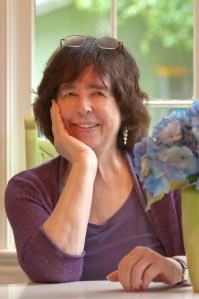 by Jane Yolen
I could go on a metaphoric streak about ideas, talking about stalking the shy idea, cultivating the wild idea, setting traps… etc. …
But honestly, ideas are thick on the ground. They are everywhere. If you’re a writer, just take a walk outside and ideas will come to you at once.
Take my hand. Here we are crossing from my house, over a set of stone steps, walking down to my daughter’s house. It is evening. There are sun-activated lights.
I think: fairy lights. What if a child going over a stone walkway to her grandmother’s house, fantasizes a story about fairies guiding her to their queen. Or perhaps fireflies are out. The child in the picture suddenly begins to see that lights are not just random, but patterned. She grows into a famous scientist studying fireflies. Or perhaps the child is lost and the lights call her home. Or. . .
See—the single idea of a child walking in the evening and lights—sun-activtated, or firefly or fairy lights—I already have the beginnings of three different stories from one idea.
And if the same story was written by, say—Patricia Polacco, Dan Santat, or me—you would get three very different stories indeed.
So it’s not the idea by itself, but what you do with it that matters.
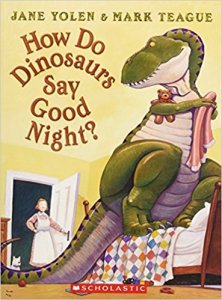 A dinosaur in a human setting. It could be HOW DO DINOSAURS DAY GOODNIGHT, DINOSAUR BOB AND HIS ADVENTURES WITH THE FAMILY LAZARDO, or DINOSAURS LOVE UNDERPANTS.
How do I know this? Well, after 366 books (#s 365 and 366 are being published March 6 of this year) I think I can say reliably that those ideas are everywhere. But if you are not alert to them, you will probably be stomping on them every time you put your feet over the side of the bed. (And what kind of monster is under your bed anyway?)
So being alert is a start.
But another important part is—take time. Time out or time in. Time for yourself, and time to just quietly keep your eyes sharp.
I call those days I am not writing, “gathering days”. When I am walking outside, I am always aware that I am breathing in stories. When I read a newspaper or book or story or poem by someone else, I find stories there as well.
When I sit in a train or a plane, and listen in in on conversations of strangers—gossip is also a story starter. You learn about individual voices by eavesdropping.
Patricia MacLachlan regularly uses things her grandchildren have said as story starters.
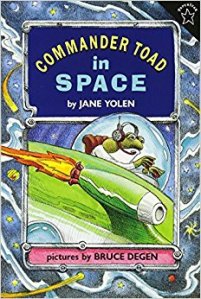 My COMMANDER TOAD books began when my son Adam was bright and brave since he was afraid of going up the stairs for bed which meant going down the long dark hall to his room.
Maurice Sendak has said that WHERE THE WILD THINGS ARE came about because of at family parties his aunts and uncles leaning over and pinching his cheeks when he was a very small and saying, “You are so cute, I am going to eat you up!”
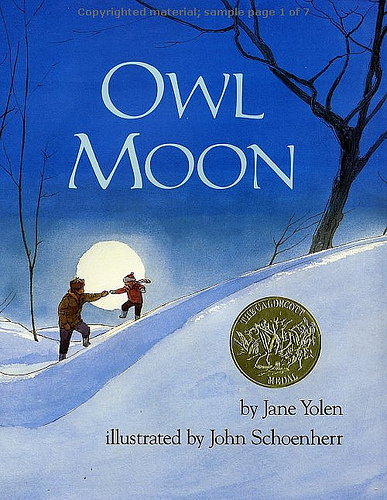
OWL MOON was a story I saw played out in my own family as my husband took our children out owling.
Oh—and when editor Bonnie Verberg called me up and said, “My son Robbie is three years old. He hates to go to bed and he loves dinosaurs. Can you do anything for him? And HOW DO DINOSAURS SAY GOODNIGHT was born. Robbie is now graduated from NYU. I like to think I had a little bit to do with that!
Yep, ideas everywhere.
So don’t ask where do you get your ideas. Ask yourself: “What can I do with all the ideas I have?”
And then go out there and cultivate that wild idea.
Jane Yolen, often called “the Hans Christian Andersen of America,” is celebrating her 365th published book in 2018. Her works, which range from very young rhymed picture books to novels for adults and every genre in between, have won an assortment of awards including two Nebulas, a World Fantasy Award, a Caldecott, the Golden Kite, three Mythopoeic awards, two Christopher Medals, the Jewish Book Award, the Kerlan Award, and the Catholic Library’s Regina Medal, as well as six honorary doctorates. She lives in Massachusetts in the winter and Scotland in the summer. She writes every day. Follow her on Twitter @janeyolen #Yolen365 or on Facebook and visit her website: JaneYolen.com.
Also see Jane’s previous Storystorm post about how a haunting photograph of the “angel” apartment building in Paris prompted a new picture book.
Jane is giving away a signed copy of OWL MOON.
Leave ONE COMMENT on this blog post to enter. You are eligible to win if you are a registered Storystorm participant and you have commented once below. Prizes will be given away at the conclusion of the event.
Good luck!
I’m not a neuroscientist, but I have theories on how the brain works. Allow me to explain.
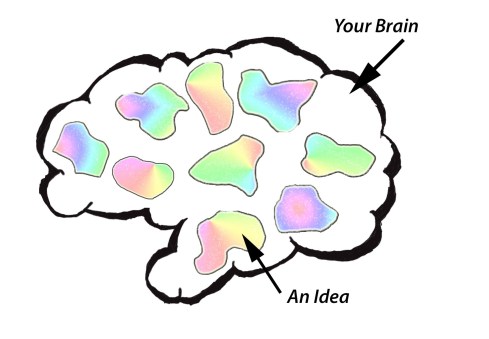
Your gray matter is full of ideas that are locked away, waiting to be released. These little nuggets can be freed by numerous methods. Here are some of my favorite ways to unlock an idea:
- Listen to NPR for an hour. It must be a show that has story segments. (Sorry Terry Gross.) Your world will be expanded and your brain will start asking questions. I listened to a story about de-extinction. It’s kind of like Jurassic Park but really happening with the Wooly Rhino. I ended up drafting a story called WOOLY AND FLEA.
- Force yourself to create a list. In seventh grade, my daughter had ten minutes of free writing at the beginning of every language arts class. The only rule, the pencil had to keep moving. Free writing is difficult for me, because I end up wanting to write “All Work and No Play Makes Johnny a Dull Boy” over and over. So, instead I recommend making lists.
— Jot down a list of characters that would make horrible protagonists.
— Titles that would make frightening bedtime stories.
— Plots that would make conservatives (or liberals) really angry.
— Unlikely friendship pairings.
— A setting you’ve never seen before in a kid’s book. - Stop twisting fairytales and twist something else. Can we all agree we have enough Goldilocks and the Three Whatevers? Why not twist “The Breakfast Club” into a picture book? Instead of “five high-school students from different walks of life endure a Saturday detention under a power-hungry principal,” how about “five dogs from different walks of life endure a Saturday at the groomers under a power-hungry stylist”? Or ghosts in a haunted house? Or fleas on the back of a wooly rhino?
- Play the what-if game with a six year old and then steal her ideas. The what-if game is simple. Just fill in the blank. What if your principal was alien? What if there was one clock that controlled time across the universe? You offer a what-if and then the child offers a what-if. The ideas will get crazier as you play. You can make it more challenging by adding “and”. What if your principal was an alien and you discovered his plot to collect specimens? Note: this game can also be played with a drunk friend if you don’t have a child handy.
- The playlist shuffle. Pluck an idea from whatever song comes up. I did this recently and got “Ebony and Ivory.” The result was an idea about a piano-playing t-rex named Wonder. Note: if you only listen to classical music, I don’t know if this will work. Maybe borrow someone else’s iPod.
- Go for a walk or take a hot shower. Kidding! Those never work for me.
- Head to your local bookstore. This works best on a Tuesday when the shelves are full of new releases. Pick up each book. Imagine what the story is about before you crack the cover. Sometimes you’ll be right. Sometimes you’ll be wrong. Sometimes you’ll have a better idea than what’s been published. Note on karma: do not walk out of this bookstore without buying something. Karma is watching.
If you do all of these things, I know a nugget of an idea will be knocked loose from your skull. Probably more than one. Once you open up the spigot, the ideas will trickle out.
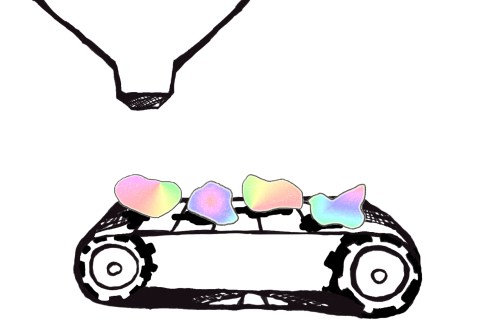
But let’s be honest, most of these ideas probably stink. If you’re lucky, you’ll be blessed with a mediocre one. Unfortunately, when the idea presents itself, you really have no way of knowing if it’s golden or just coated in a golden-like substance.
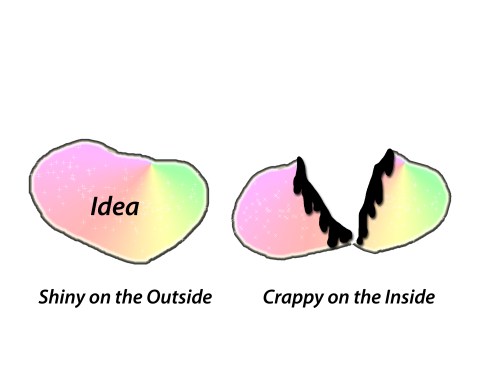
So now you have to do the real work. You have to write the manuscript. That’s the only way to know. You might realize the nugget is garbage after the first sentence, or after you complete the first draft. If it still has some shine, you revise. Then you might realize it’s crap. Or you keep moving on. Revise. Is there something these? Revise. Has it lost its luster? Revise. Revise. Revise. Have you struck gold?

Now for the unfortunate moment of truth. That golden nugget of an idea—the one that has become a well-polished, beautiful manuscript—might never sell. (That’s a completely different conversation.) Your job is to move to the next idea. And the next. And the next. I promise, your brain is full of them. Just keep turning the key.
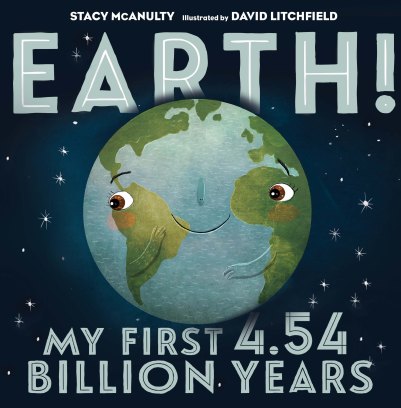
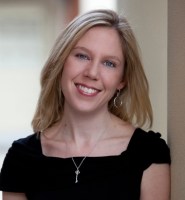 Stacy McAnulty is a children’s book author, who used to be a mechanical engineer, who’s also qualified to be a paleontologist (NOT REALLY), a correspondent for The Daily Show (why not), and a Green Bay Packer coach (totally!). She is the 2017 Ezra Jack Keats New Writer Honor Recipient for Excellent Ed, illustrated by Julia Sarcone-Roach. Her other picture books include Earth! My First 4.54 Billion Years, illustrated by David Litchfield; Brave and Beautiful, both illustrated by Joanne Lew-Vriethoff; Mr. Fuzzbuster Knows He’s the Favorite, illustrated by Edward Hemingway; and 101 Reasons Why I’m Not Taking a Bath, illustrated by Joy Ang. She’s also authored the chapter book series Goldie Blox, based on the award-winning toys, and The Dino Files. Her debut middle grade novel, The Miscalculations of Lightning Girl, will publish in May 2018. When not writing, Stacy likes to listen to NPR, bake triple-chocolate cupcakes, and eat triple-chocolate cupcakes. Originally from upstate NY, she now lives in Kernersville, NC with her 3 kids, 2 dogs, and 1 husband. Visit her online at StacyMcAnulty.com and Twitter @stacymcanulty.
Stacy is giving away a signed copy of EARTH! MY FIRST 4.54 BILLION YEARS.
Leave ONE COMMENT on this blog post to enter. You are eligible to win if you are a registered Storystorm participant and you have commented once below. Prizes will be given away at the conclusion of the event.
Good luck!
 by Josh Nash
When you are trying to make it in a business that favors good ideas, you are going to need to get some. Easier said than done, right? It’s not the 1960s anymore when you could just send away for them by mail order catalog. (Not a lot of people know that “Where the Wild Things Are” cost Maurice Sendak $8.95 and a self addressed stamped envelope.)
So where do ideas come from? Good question. I always think of the Bright Eyes lyric by Conor Oberst about being a musician and songwriter: “I’m drinking, breathing, writing, singing. Everyday I’m on the clock.”
First, when it comes to drinking and working, I recommend coffee. But you can drink whatever you want. Tea, Black Cherry Kool-aid, Orange Julius. Second, it’s the “Everyday I’m on the clock” bit that makes the most sense to me because I like the idea of never being off the clock as an artist and a writer. It is a job we never really punch out of, isn’t it? Living a creative life is a full-time job and being open to ideas means you are always on the clock.
You are on the clock during your morning commute. Four lanes of Hondas and Subarus jockeying for the exit lane may not be the ideal setting for turning illustration or story ideas over in your head, but the creative mind never clocks out. Just be careful not to drive off the highway into a ditch especially when your last phone transmission is a text to yourself that reads “bunny has a potluck but everyone brings cups.”

Keep a notebook handy at the office because even when you are on the clock, YOU ARE ON THE CLOCK! Ideas don’t quit just because you have 150 emails to answer and Dale from Accounting is waxing interminable about his adventures in home brewing. However, you don’t want to be so focused on story ideas at your day job that you end up getting fired for being a bad employee. But if you do get fired, it would be good if you had plenty of amazing story ideas to sell. So it’s a tricky balance.
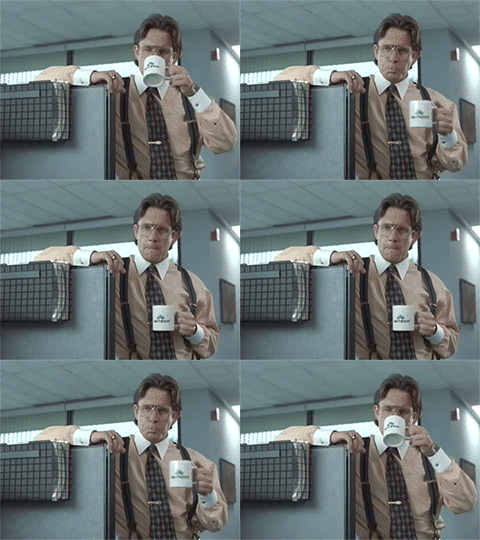
Standing in line at Starbucks? You got time to lean, you got time to clean, buddy! Ideas are working overtime at coffee shops. The right mix of caffeine and anonymous strangers milling about keep the idea synapses firing. Who is that old lady? What is her story? Who is that toddler? Why is she screaming? Why is that screaming toddler’s dad just staring at his phone while his toddler is screaming? Is he actually a cyborg dad suffering a program glitch? And there’s your idea. Write it down.
And just when you think it’s quitting time, remember that ideas work the night shift too. After you have kissed your honey or let your cat bite you goodnight, and after you have drifted into that state of half-awake, half-driving-your-bed-through-four-lanes-of-Hondas-and-Subarus because-you-are-three-hours-late-for-that-college-humanities-class-you-forgot-to-drop-in-1997, you will have one more idea. This will be a very bad idea. Do not write it down, it’s gibberish!
Ideas never take a day off. They are workaholics. All you have to do to get them is to show up, is punch your timecard and get to work. By constantly being on the clock, and making room for creative work in your daily life, whether it is writing, painting, daydreaming or doodling, ideas will come knocking at your office door, submitting their tiny résumés. And you are always considering candidates because you are always open for business. You’re always on the clock.
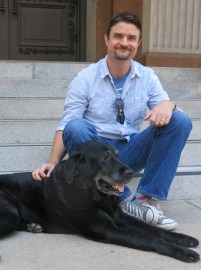
Josh is 50% eraser shavings, 50% animal cookies and 50% Café Americano. Josh is also horrible at math but he loves to draw. When he was very small, his mother read him books with words and pictures by Maurice Sendak, Garth Williams, Richard Scarry and Ezra Jack Keats. His dad provided him with piles of scrap paper, pens and pencils to make his own pictures. Josh is bigger now but he remembers those stories and pictures vividly. And he still loves to draw.
Josh has been drawing professionally since 2004 and has done so for the nice folks at Scholastic, Hooked on Phonics, and singer-songwriter Kenny Loggins.
When he isn’t drawing he can be found enjoying beautiful Northern California with his wife, traveling to a rainy European city, reading a book or doing any number of activities that don’t require math.
Visit him online at JoshuaNashIllustrates.com and on Twitter @joshuanashillus and Instagram @joshuanashillus.
Josh is giving away a signed copy of this adorable fox print.
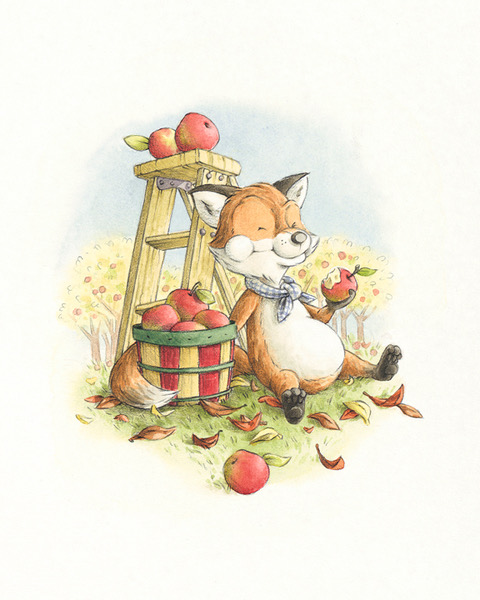
by Joshua Nash
Leave ONE COMMENT on this blog post to enter. You are eligible to win if you are a registered Storystorm participant and you have commented once below. Prizes will be given away at the conclusion of the event.
Good luck!
Where do ideas come from? Why, from caffeine of course! And books. Books and caffeine are the best combination. Join me for a virtual cup of tea while I read to you from some picture books that have deep insights into the creative process.
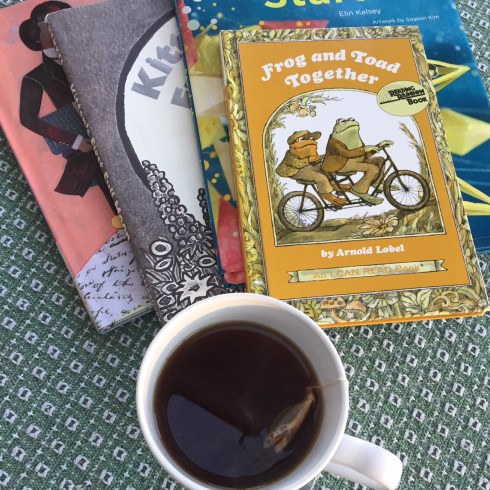
“Toad put his head very close to the ground and shouted. ‘NOW SEEDS, START GROWING!’
Frog came running up the path.
‘What’s all this noise?’ he asked.
‘My seeds will not grow,’ said Toad.
‘You are shouting too much,’ said Frog. ‘These poor seeds are afraid to grow.'”
~ Arnold Lobel, FROG AND TOAD TOGETHER
Story ideas are seeds. They are scared of loud noises. They don’t like being told they aren’t good enough to write down, or they are too much like another idea. They tend to flee when criticized, and they take their friends with them.
Don’t scare off your ideas by holding out unrealistic standards. (“You must be polished and ready to publish!” or “You must be absolutely unique!”) Let your ideas grow at their own pace. Treat them all as worthy of being jotted into your notebook, or on the back of receipt, or typed into your phone. Remember they are just seeds, and they might arrive as a single word, or an incomplete image. They will grow.

In Henkes’ Caldecott-winning title, Kitten tries, and tries, and tries to drink the big bowl of milk in the sky, and fails miserably.
“So, she went back home—and there was a great big bowl of milk on the porch, just waiting for her.”
~ Kevin Henkes, KITTEN’S FIRST FULL MOON
Inspiration can be elusive. If we chase after it, we often fail to catch it. But then, when we’ve exhausted every effort, an idea will be sitting on the porch, just waiting for us. Sometimes the best ideas come when you are sitting in traffic, or shoveling the driveway, or generally not looking for them.
Still stuck? Have a cup of tea with a friend. (Or whatever it is that you like to drink—beer, moonlight, tears of your enemies are all acceptable.)
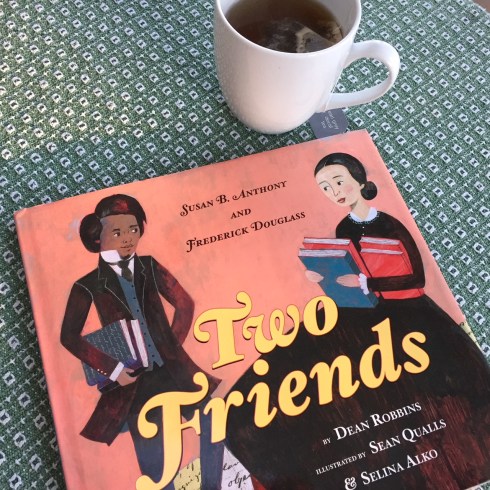
“Susan liked Fredrick’s ideas, and he liked hers.”
~ Dean Robbins, TWO FRIENDS
Sometimes it’s a simple as that, my friends. Share your ideas. You will both come away with more than you started with, just like Susan B. Anthony and Frederick Douglass do when they share tea and thoughts, in this beautiful book.
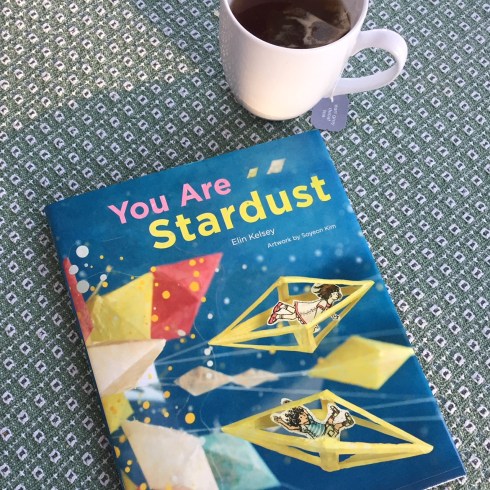
“Every tiny atom in your body came from a star that exploded long before you were born.”
~ Elin Kelsey. YOU ARE STARDUST
Finally, a reminder: It is amazing and magical to be alive and reading blog posts and brainstorming story ideas. Tap into your stardust magic. Pause as you are taking out the trash to look at the sky. Go for a walk in the woods. Take a minute right now and hold your hand up to a sun and watch photons streaming through your fingers from space.
This is also a reminder to not take yourself or your ideas too seriously. You are but a bit of leftover star swirling in a minor galaxy in an expanding universe. No one cares if that idea you just had is stupid, and you shouldn’t either. Write it down.
No one cares if you don’t have an idea right now, and you shouldn’t either. Take a nap or go for a walk. Your ideas will grow while you aren’t paying attention.
When you come back, they may be sitting on the porch.
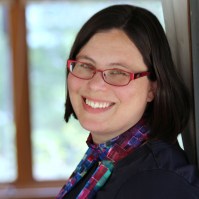 Jeanette Bradley has been an urban planner, an apprentice pastry chef, and the artist-in-residence for a traveling art museum on a train. Her debut picture book LOVE, MAMA was published by Roaring Brook Press in January 2018. It contains no cities, pastries, or trains, but was made with lots of love. She currently lives in Rhode Island with her wife and kids. Find her online at: JeanetteBradley.com, on Twitter @jeanettebradley, and on Instagram @jea_bradley.
Jeanette is giving away a copy of LOVE, MAMA.

Leave ONE COMMENT on this blog post to enter. You are eligible to win if you are a registered Storystorm participant and you have commented once below. Prizes will be given away at the conclusion of the event.
Good luck!
 It’s an honor to be here! Tara asked if I would talk about how I took SWEET DREAMS, SARAH all the way from idea to published picture book. But I kind of feel like an imposter because although the book was slated to pub in March 2017, I still have no book in hand…and the tentative October 2018 launch date may have to be pushed back again. However, I know it will be worth the wait. Plus, happily, in the last two months of the year, I got THREE new book deals. So I’m also going to share how I got the ideas for those books.
TAKEAWAY #1: You need an infinite amount of patience…and a goodly supply of chocolate…to take an idea all the way to published book.
In 2012, I turned the page to another chapter in my life. Just retired and ready to follow my dream of writing picture books, I joined Julie Hedlund’s newly-formed 12×12 Writing Challenge, dipped my toes into my first-ever critique group, and participated in Tara’s month-long idea-fest.
TAKEAWAY #2: Connecting with fellow travelers on this writing journey will provide you with support, encouragement, and joy!
Several years passed with no sign of a book deal. Determined, I refused to give up. Joined more critique groups. Took picture book writing classes. Attended webinars and conferences. And I wrote, revised, and submitted…over and over again.
TAKEAWAY #3: If you hone your craft, embrace feedback, and are tenacious…you WILL succeed!
I also kept filling those Storystorm notebooks with ideas. But where did those ideas come from?
- The idea for SWEET DREAMS, SARAH came from an internet search of “the first woman to…” Why not see if your next story is on this list of inspirational female pioneers?
TAKEAWAY #4: The internet is an unbelievable gold mine for writers and illustrators—a spiderweb that allows you to connect with people, information, and resources all over the world.
- The idea for VISITORS TO DEEP POOL came from observing animals while fly-fishing with my husband on a pristine mountain stream. It was my Day 3 story idea for Tara’s 2012 challenge and guess what? I signed the contract on Wednesday.
TAKEAWAY #5: Get out into nature—there are many stories waiting there for you!
- The idea for PIPPA’S PASSOVER PLATE came during Tara’s 2013 challenge when Kar-Ben editor Joni Sussman said she wanted more Jewish holiday stories. She passed on the rhyming story I wrote, but another house bought it…and guess what? I signed that contract last month and the editor is taking the book dummy to the Bologna Book Fair.
TAKEAWAY #6: Listen to editors/parents/teachers/kids—they will tell you what they want to read about!
- The idea for INVENTING came from a conversation with my sister. She told me about the friend of a friend whose grandfather founded an iconic company in America. I contacted the granddaughter, wrote the story, and an editor loved it. The contract for that book arrived yesterday.
TAKEAWAY #7: Let people know you are a writer and that you write stories for children—you will have an endless supply of new ideas.
- The idea for BRUSHSTROKES came from a New York Times article (my niece sent me the link last January) about an artist who had just died. An editor did make an offer, but before the contract was signed, another imprint of the same publishing house announced a book on the same person. The editor had to step back and withdraw the offer. But the manuscript is out on submission again and my fingers are crossed for another editor to fall in love with it.
TAKEAWAY #8: Peruse newspapers, magazines, journals—uncover forgotten stories and write them so you can bring history alive for kids.
- The idea for SCULPTING STORIES: THE MAGIC HANDS OF JOSÉ DE CREEFT came from watching an episode of “American Pickers” on television. I entered the manuscript last month in the NESCBWI Peg Davol Manuscript Critique Scholarship…and won!
TAKEAWAY #9: Kick back and relax—but keep a pencil and paper handy when you watch TV or a movie. You just never know where the next story idea will come from.
In fact, keep a pencil and paper handy ALWAYS! If you are like me, unwritten ideas float back to the Universe from whence they came. But no worries…just kick back and relax…watch TV, read a newspaper, chat with family and friends, take a walk in the woods…grab those ideas and write, revise, and submit so that you can kick butt with book deals in 2018 and beyond.
 Vivian Kirkfield constantly takes leaps of faith. She jumped from a perfectly good plane with her son, hiked to the summit of Pikes Peak with her husband, and parasailed over the Pacific Ocean with only seagulls for company.
A former Kindergarten teacher with a Master’s Degree in Early Childhood Education, Vivian is passionate about helping kids become lovers of books. A proud member of SCBWI, she presents literacy programs that entertain and engage parents, teachers and kids. When she’s not writing, revising, or critiquing picture book manuscripts, Vivian plays epic games of Monopoly with her nine-year old grandson, shares stories on Skype with her four-year old granddaughter, and takes walks through the idyllic New England village of Amherst, New Hampshire where she currently resides.
Her debut nonfiction picture book, SWEET DREAMS, SARAH, will be published by Creston Books in October 2018. You can find her on Twitter @viviankirkfield and Facebook, or visit her blog at Picture Books Help Kids Soar.
Vivian is giving away a picture book critique.
Leave ONE COMMENT on this blog post to enter. You are eligible to win if you are a registered Storystorm participant and you have commented once below. Prizes will be given away at the conclusion of the event.
Good luck!
 by Susan Tan
When people talk about writing, they often talk about butts in chairs. This is absolutely true and something I believe. Sometimes, half the battle of writing is just making the time to sit in your chair, and committing to staying there, even on days when your mind is blank and you hate every sentence you produce.
Sometimes, though, I think the vision of the author at their special writing desk, sitting in one place in a large chunk of time dedicated to writing, can set up daunting and maybe even unrealistic expectations. The fact of the matter is that many us have busy lives—raising families, working other jobs, and any number of commitments, which make this kind of ‘butt in chair’ time hard to pin down. I think the same is true for inspiration. Inspiration (unfortunately) doesn’t necessarily strike during the precious desk time you get. In fact, for me at least, it comes most often in motion—in the small flashes of conversation I hear as strangers walk by, in a beautiful view, a bright printed sweater I see on the subway.
So, I thought it would be fun, for this post, spot share my favorite kind of writing (which I find the best for inspiration): writing on the go.
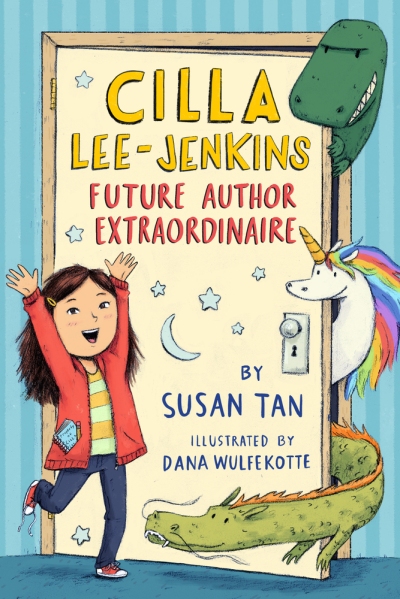
I drafted my first book, CILLA LEE-JENKINS: FUTURE AUTHOR EXTRAORDINAIRE, entirely on the go. I was in graduate school, and at the end of long days when I couldn’t stand the idea of looking at my computer anymore (or thinking about my dissertation anymore), I would get into bed, take out my iPad, and write stories from my childhood, lying down, my iPad above my head, typing with my thumbs.
Admittedly I wasn’t on the go in the literal sense. But I was writing from a place that wasn’t my “official” workspace, and that made all the difference—writing from my bed every night was a joy, a stolen moment when I turned the time before falling asleep into time just for me and the stories I felt compelled to write down.
Cilla started in those initial late night writing sessions, but didn’t stay there for long. Soon, I was writing on the bus on the way to the library, typing on my phone with my thumbs. I wrote waiting for appointments, on park benches, and on one summer trip, during a break from sightseeing on the steps of the Lincoln memorial. In some cases, I’d write chapters from my iPad or phone. In others, I’d jot down quick ideas as they came to me in a notebooks, on a work folder, and once, on a CVS receipt.
This patchwork way of writing made my book possible during an otherwise hectically busy time. What’s more, it made the act of writing fiction a treat. I delighted in finding more and more moments in between my other jobs that I could steal to focus just on the work that made me happy.
Now, out of graduate school, I work full time, and while I’ve certainly found ways to make more time for sustained butt in chair writing, a good deal of my drafting still takes place on the go. If you see me hunched over on my phone in the subway, on my way to work, I’m probably writing (I’m told it looks like I’m playing a REALLY intense game of candy crush). And writing on the go remains one of my biggest sources of inspiration. When I’m stuck, I’ll steal from what I see, and anything from a carousel, to curtains, to the snippets of someone else’s grocery list, have found their way into the Cilla books.
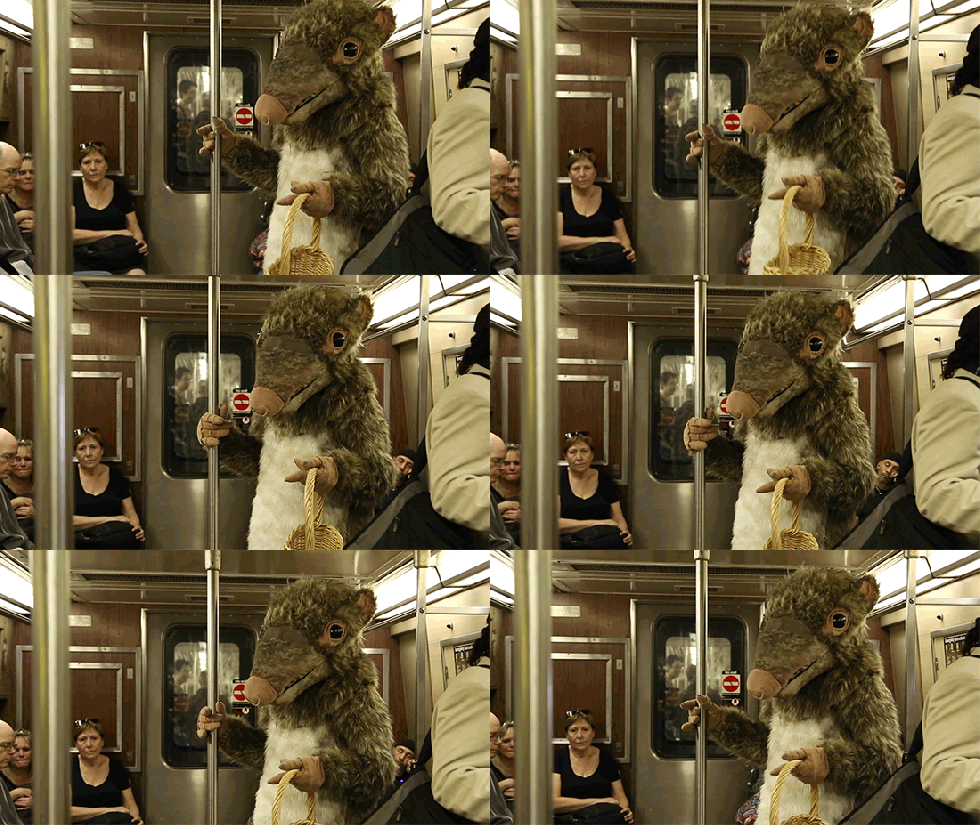
I still write in waiting rooms and on buses, too, and I still love the feel that I’m cheating somehow—making a five minute bus delay something entertaining and productive.* In fact, in the course of writing this blog post I’ve been on a park bench, in a waiting room, on a plane, and in the subway.
There’s no one way to write a book, and what works for one person might not work for another. But if you’re looking for new ways to write, and new sources of inspiration, I’d highly suggest trying to write somewhere different than you usually do. Snatch some time, even five minutes is enough, to write where you normally wouldn’t. Make the three subway stops between your house and the store, the delay at the doctors office, or the minutes you spend parked waiting to pick up someone from work or school, writing time. There’s a wonderful, energizing feel to making your office wherever you happen to be sitting (or standing or lying) at the time. And when you make time to write on the go, you never know what kind of ideas will walk across your page or screen, and into a story.
* Disclaimer: I just want to note that I firmly believe writing on the go should be FUN, not an-other source of ‘I should be writing’ stress. So if you start writing in the go, don’t be hard on yourself if you find there are times you just can’t! We all need some time spent just commuting, or listening to music, podcasts, or actually playing Candy Crush, etc.!
Susan Tan is the author of the middle grade Cilla Lee-Jenkins books, a semi-autobiographical series about a mixed-race, half-Chinese 8 year old who dreams of literary greatness: Cilla Lee-Jenkins: Future Author Extraordinaire (March 28, 2017); Cilla Lee-Jenkins: This Book is a Classic (March 27, 2018); & Cilla Lee-Jenkins: The Epic Saga (March 2019). She received her BA from Williams College, her PhD from the University of Cambridge, and was the 2015 Gish Jen Emerging Writers Fellow at the Writers’ Room of Boston. She currently lives in Somerville, enjoys frequent trips to Chinatown to eat almond cookies, and teaches at UMass Boston.
Visit her online at SusanTanBooks.com and Twitter @SusanSMTan.
Susan is giving away a 20-minute Skype visit and a set of special Cilla pins.
Leave ONE COMMENT on this blog post to enter. You are eligible to win if you are a registered Storystorm participant and you have commented once below. Prizes will be given away at the conclusion of the event.
Good luck!
by Kerri Kokias
This poster hangs above my living room couch.
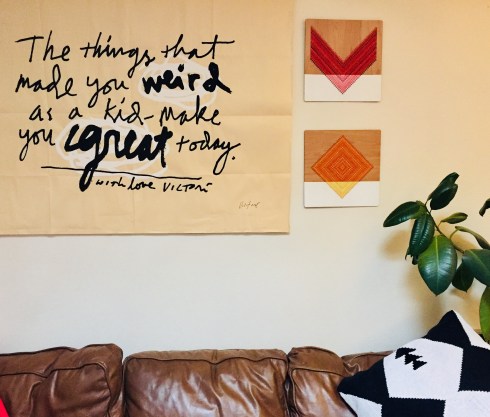
It reads, “The things that made you weird as a kid—make you great today.” It was made by artist, designer, and creativity coach, James Victore, and it’s a message I think we can all apply to coming up with story ideas this month. I see it as a more specific way to think about some of the more common mantras you hear as writing advice. Such as, “Write what you know.” Or, “Write the book you wish you had as a kid.” So, if it feels helpful to you, perhaps brainstorm some ways you were weird as a kid and how you might be able to apply these to your story ideas.
I’ll start. The first thing that comes to mind is that I was painfully shy. Like, want-to-be-invisible, freak-out-if-a-teacher-called-on-me shy.
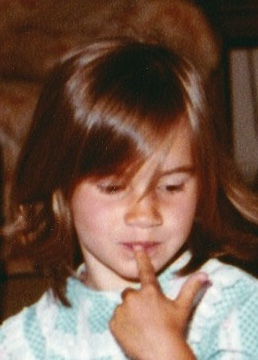
I feel like I can come up with an endless number of story ideas simply by focusing on this one personality trait and tapping into the emotions I remember having around it.
But there is another level that I think we might be able to apply this quote. First, take that thing that made you weird as a kid and look at ways it has already influenced your writing projects.
I can’t think of a single story I’ve written (yet!) that was inspired by my shyness, or prominently features shyness as a theme or dominant character trait. However, in retrospect I do wonder how much my shyness contributes to my writing style. I tend to use understated text and write illustration-driven picture books. For example, my book SNOW SISTERS! is a sparse 58 words and was written to have the illustrations portray much of the plot and character development.
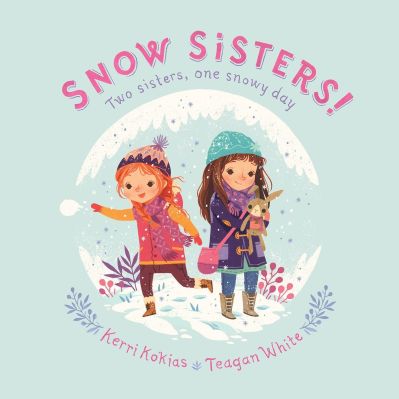
I wouldn’t necessarily consider myself a shy adult, but even today it’s natural for me to observe people more than I interact with them. I’m a writer who thinks visually before using words, and I am perfectly comfortable having the illustrations drive my stories. Knowing this about myself, I can also use these patterns in my writing style to inspire future ideas. For example, I can ask myself what types of stories are best told with sparse, understated text? I bet you have your own patterns in your writing that you can use to spark future ideas.
In summary, here are some questions from this post that you might want to consider:
- How were you weird as a kid? (Feel free to think of more than one answer!)
- How can you apply this trait, and the emotions you remember feeling around it, to new story ideas? (I know you can come up with more than one answer here.)
- Can you recognize ways this trait may already be influencing themes or patterns in your writing?
- In what ways can you channel these established themes/patterns to come up with new ideas?
Learn more about James Victore, his art, and his thoughts on creativity at JamesVictore.com. I have no doubt he has other quotes that can be used to inspire story ideas.
 Kerri Kokias credits most of her story ideas to her “fly on the wall” personality. This means she’s both a keen observer of social interactions and a nosey eavesdropper. Snow Sisters! is her first picture book. She lives in Seattle, Washington with her family. You can learn more about Kerri at KerriKokias.com or connect with her on Facebook or Twitter @KerriKokias.
Kerri is giving away a copy of her picture book, SNOW SISTERS!
Leave ONE COMMENT on this blog post to enter. You are eligible to win if you are a registered Storystorm participant and you have commented once below. Prizes will be given away at the conclusion of the event.
Good luck!
by Robin Newman
Psst, Storystorm reader! Are you hungry? I could use a snack. Got anything good in the fridge?
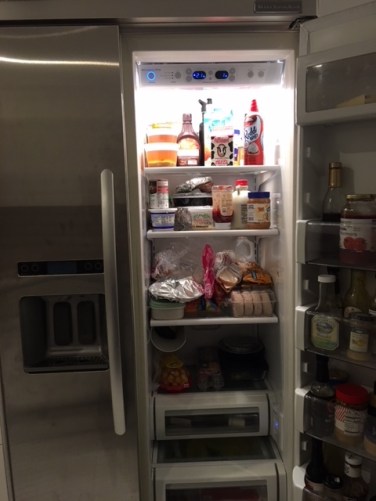
Food is a recurring theme in my books. Although writing about food has its consequences (last I checked it was about 10 pounds of carrot cake consequences), food is a wonderfully rich source of nourishment for a writer. You can steal it, share it, trade it, play with it, cook it, investigate it, idiomize it, dress it, accessorize it, travel to, for, or with it, procrastinate with it, eat it, digest it, and so on.
Food is also extremely flexible. It works equally well in fiction and nonfiction from board books to YA. It can be the conflict of your story where two squirrels are battling it out for the very last acorn on earth or be part of the setting in a brewing coffee shop romance.
By now, you must be thinking this author has gone bananas. I wouldn’t expect anything less.

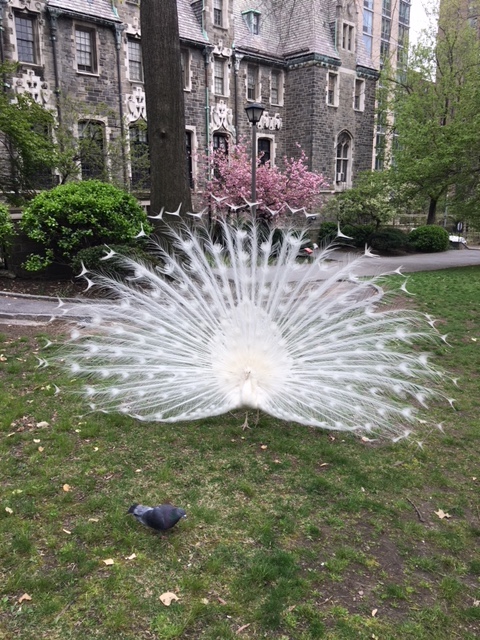
No surprise my next book is about three feathered foodies. Let me introduce you:
This is Phil.
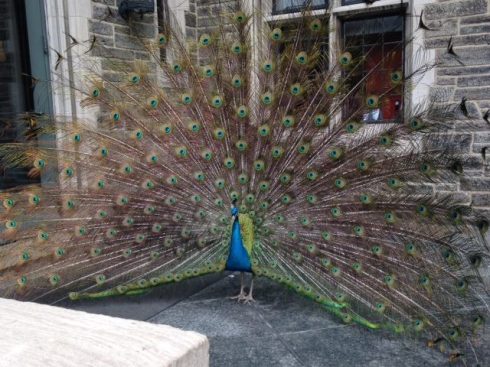
This is Jim or Harry.
Or Harry or Jim.
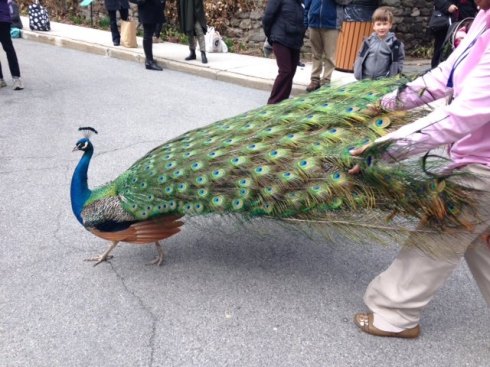
Phil, Jim and Harry are residents on the grounds of The Cathedral Church of St. John the Divine on the Upper West Side of Manhattan. They are neighborhood celebrities. When I say these birds are celebrities, I mean EVERYBODY knows them. They’ve been written up in The New York Times more times than I count. (I’d like to note that I have never been written about in The New York Times. Sniff.)
For five years my son attended The Cathedral School of St. John the Divine. From the moment I saw the birds, I knew I wanted to write about them. But then there was that small matter of what to say about the birds. Where was my story?
On one extremely fortunate day, I was attending a meeting for the school’s book fair. During the meeting one of the school administrators came into the room asking if anyone had left a sandwich in a stroller because one of the peacocks ate it. And as soon as I heard that, I knew I had my story.
NO PEACOCKS! is about Phil, Jim and Harry’s quest to taste the school’s very famous mac ‘n cheese. It’s a cheesy story of friendship and teamwork, with a mild sprinkling of criminal activity that’s perfect for influencing the impressionable minds of children ages 0 to 1000. It flies onto bookshelves September 2018.
So, I hope I’ve whet your appetite for adding an ingredient or two of food to your writing. It may sound nuttier than fruitcake but it’s sure to spice up your writing. And by golly, it sure is fun! Some food for thought . . .
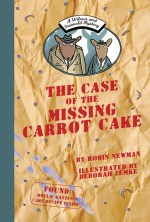
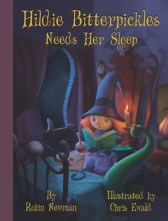
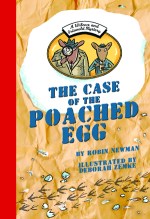
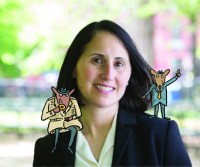 Raised in New York and Paris, Robin Newman was a practicing attorney and legal editor, but she now prefers to write about witches, mice, pigs, and peacocks. She’s the author of The Case of the Missing Carrot Cake, The Case of the Poached Egg, and Hildie Bitterpickles Needs Her Sleep. She’s a member of the SCBWI, National Writing Project Writers Council, and the Bank Street Writers Lab. She lives in New York with her husband, son, goldfish, and two spoiled English Cocker Spaniels, Cupcake and Madeleine.
Please stop by and say hello! Her website is robinnewmanbooks.com and you can follow her on Twitter @robinnewmanbook and Facebook.
And let her know about your writing success stories. She loves happy endings!
Robin is giving away The Case of the Missing Carrot Cake, The Cake of the Poached Egg, Hildie Bitterpickles Needs Her Sleep, AND a 15 minute Skype school visit.
Leave ONE COMMENT on this blog post to enter. You are eligible to win if you are a registered Storystorm participant and you have commented once below. Prizes will be given away at the conclusion of the event.
Good luck!





 Writing for Kids (While Raising Them)