You are currently browsing the monthly archive for August 2014.
Before we talk cumulative tales with guest author Brenda Reeves Sturgis, it’s time for a little blog business. The winner of EXTRAORDINARY WARREN is:
SUSAN CABAEL!
Congratulations…and be on the lookout for an email from me.
Now let’s get to a LOON-y interview with Brenda…

Your newest book, THE LAKE WHERE LOON LIVES, is a cumulative tale (like The Old Woman Who Swallowed a Fly), where each new scene builds upon the previous ones, all repeated in the text. What inspired you to write a cumulative picture book…and what special considerations does a writer have when writing such a story?
I didn’t set out to write a cumulative tale, but just set out to write what I heard in my head and in my heart.
I live on a lovely little lake in Maine and I am always elated when the loons come back to the lake in the spring. Their haunting hoots and wicked wails always leave me breathless wanting to hear more, and so when the story came to me as a gift in the middle of the night (which is my usual writing time). I just began writing, and writing and writing and what appeared was THE LAKE WHERE LOON LIVES.
In a cumulative story, each line builds and stacks on the previous sentence, and loon is written in rhyme so that made it even more challenging because every time I changed a word, the story would start to crumble and I would have to rewrite not only the sentence that I was revising but also all of the sentences before it, so that I would keep the right rhythm and meter.
I wanted to depict what a day in the life of a loon might be like, so I put in chicks, a fly, a fish that would snap at the fly, a boy on a dock that would give fishing a try, a cast, a struggle, and a splash and a swish, and then after a HUGE RUCKUS, the story starts to unwind where Mama Loon finds the SPOT on the lake that she loves best. She tucks her chicks in tight, and just like all loving Mamas do, she reads her babies a goodnight story before she settles in with a nice cup of tea by her campfire.

Little did I know when I wrote it that the illustrator would illustrate LOON so totally different than I had pictured, and I am so very glad that she did. Because in this loon story mama loon LOVES to waterski, she is daubed white and black because her chicks used her as a canvas with Loon White waterproof paint. I think the illustrator, Brooke Carton did a fabulous job with her loose illustrations which compliment the tight text very nicely.
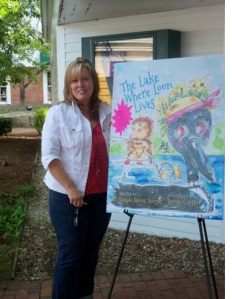 I hope your readers will enjoy reading THE LAKE WHERE LOON LIVES as much as I enjoyed writing it. Islandport Press has been wonderful to work with, and they had a book launch for LOON at The Maine Audubon Society in May, and I’ve been busy with signings and events almost every weekend since.
Why are cumulative tales beneficial for young children?
Cumulative stories teach word repetition and children therefore know what to expect in the story, which then helps them learn languague and pick out familiar words. This enhances their reading abilities, making for a stronger student and a more confident learner. A cumulative story is a perfect tool to teach a reluctant reader.
Tell us about Islandport Press. How did you find them and why was this story such a good fit for their list?
I’d heard about Islandport for years, and when I started researching their books I saw that they were Maine-and-New-England-themed, so on a whim, I submitted to them on my own, then sent an e-mail to my agent Karen Grencik saying, “By the way, I submitted to Islandport!” She answered back, “GREAT, fingers crossed!”
I got the acceptance e-mail while sitting in the Biddeford Library. I went outside, sat on the curb and cried, because up until that point, I didn’t know if I got published on a fluke, or if I had any kind of talent or chance at another book at all. It was a wonderful process, and I am so grateful to Dean Lunt the publisher, and Melissa Kim my editor. They have an amazing marketing staff, they are kind and thoughtful and amazing to their authors!
Also, on the back of LOON, something I am most proud of is a nice blurb by author Chris VanDusen.
What’s next for you, Brenda?
TOUCHDOWN, after 7 years, after winning Smart Writers, after being rejected 50 times (not once because of the writing but because of the marketing “hook”) has become a finalist for the MeeGenius Author Challenge, and whoever wins will be awarded $1500.00.
Good luck, Brenda! And thanks for giving away a copy of LOON to our blog readers.
Comment below by August 29th or a chance to win! And feel free to ask Brenda questions about cumulative stories or her work.
Is your goal to get a picture book published?
Yes? Awesome!
So I’m here to tell you, write a picture book.
Ha! That seems like DUH advice, doesn’t it?
But I don’t want you to waste your time, like I did, writing for magazines, trying to build publishing credits, if magazine writing isn’t your ultimate goal. Magazine writing is a completely different skill, and while credits are nice, they are not going to make or break you. Magazine credits prove you’re a professional and that you’ve been through the editing process, but they won’t convince anyone to buy your manuscript if it’s a sub-par story. You need to hone your picture book skills, and that only comes with writing dozens of picture books.
Agent Ammi-Joan Paquette takes clients based on their submission, first and foremost. “For me, the number one focus is on the writing: the voice, the story, the way the language sparkles and draws me in. If you’ve got that, I’ll follow you just about anywhere. All the writing credits, awards, and fancy degrees in the world—on their own—won’t make me take on an author. It’s about the writing, pure and simple.”
I received some misguided (but well-intentioned) advice when I began writing for children. I was told to place fiction in magazines in order to build my writing resume. So I gave it a shot. Then I found out how difficult it was to place stories. Not any less difficult than getting a book published! (I don’t know why I thought it would be.)
Your story must fit the theme of the magazine issue, which means you’re better off reviewing editorial calendars first, then writing to fill that need. Instead, I wrote what I wanted to write and then found it was only appropriate for a single issue, to be published in three years’ time! Magazines are often booked far in advance. Back in 2008, if I were to place that story, it would have been printed in 2011. Yikes!
Now that’s probably an extreme example, but it’s an important lesson I learned. I was veering off my intended path to publication.
A magazine story has to be more descriptive than the language in a picture book because there are far fewer illustrations to accompany the text. You’re often writing for a single spread with no page turns, and page turns are crucial to picture book pacing, humor and reader anticipation. So I was writing for a wildly different format and not for the goal I desired: to get a picture book published.
Some will argue that writing for credits is necessary prior to getting a book deal, but I say that is incorrect. As long as you have a professional-looking, easily found web presence and membership in a professional writing organization like SCBWI, that’s all you need in your bio to prove that you’re “serious”. The thing you need most of all? You know—a winning manuscript! I had zero children’s publishing credits prior to getting my agent and a book deal. I’m definitely not alone in this.
Children’s magazines are wonderful, but if they’re not your goal, you don’t need to use your precious writing time in this manner. Want a picture book deal? Write picture books! (I say books, plural, because if an agent is interested in your manuscript, that agent will ask for more of your work.)
And I hope that’s not DUH advice!
Do you agree or disagree? Share your opinion in the comments!
I know what you’re thinking—where has Tara been all July? (Well, maybe you’re not thinking that. Maybe you’re daydreaming about a fro-yo fix. And who could blame you?)
Well, it’s August and I’m back with an extraordinary interview. The talented author-illustrator Sarah Dillard turned what she thought was a picture book into an adorable early-reader chapter book. What did it take to get EXTRAORDINARY WARREN published? Let’s find out while we devour our fro-yo…
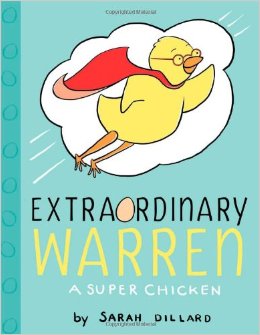 Sarah, what exactly made you realize that WARREN was destined for more than a picture book?
When I started working on Warren, I intended it to be a picture book but I felt that the story and ideas that I wanted to tell with him were a little more complex than the picture book format would comfortably allow. This is not to say that there are not complex picture books because there certainly are. But with Warren, it just seemed like he needed a little room to spread his wings. I didn’t worry about chapters though until a few drafts in. At that point it felt like there were natural breaks in the story for chapters. I have to say, when I am working on something I don’t automatically think “I am writing a picture book or this is going to be a chapter book.” I focus on the character and the story and let it unfold and then see what fits it best.
That’s great advice, to focus on character.
Thanks, Tara. I also wanted to add, that as picture books seem to be skewering younger, there is a great opportunity for illustrated early readers and chapter books to fill the gap for the beginning reader.
So what inspired Warren’s creation? How did he hatch?
Warren began as a doodle of a chicken looking at an egg. He looked curious to me and felt like a character who was looking for life’s answers. Did I draw the egg first or the chicken? I’ll never tell!

My favorite spread in WARREN is the one with the hill in separate panels. How did you come up with that unique visual concept?
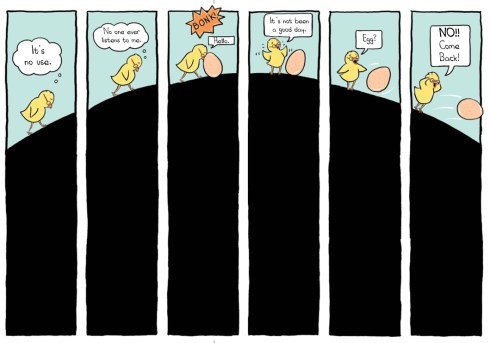
That is one of my favorite spreads too! When I started thinking about how I would do the art for this book, my art director suggested a limited palette—with three colors plus black and white. I was hesitant at first but when I realized that I could use black as more than just an outline, the art took a fun graphic turn. I felt the use of black for the hill added just the right drama for this spread. I also liked the idea of having basically one hill but several panels that show Warren’s progression up and over that hill. I think it works both literally and figuratively for this part of the story.
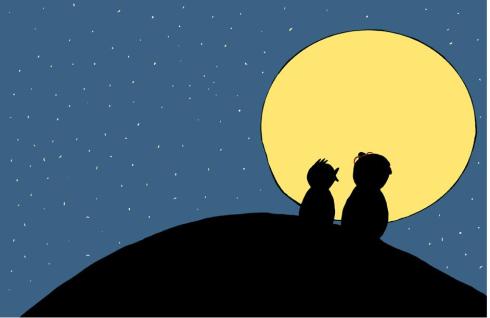
How different is it to write/illustrate your own book as opposed to just being an illustrator on a project?
I think it is quite different to illustrate my own book than illustrating someone else’s work. Illustrating someone else’s story is a huge responsibility. It is kind of like having someone say here is my beautiful child, please raise it. I am very conscious of wanting to do justice to the story as the author might have envisioned it while also bringing my own sensibility to the story.
When I am illustrating my own work having the art serve the story becomes the primary focus. I’m thinking of the images and what part they will have in telling the story as I write, so the art and the words feel inseparable to me. I think when I am working on my own books I have a stronger intuitive sense of what the story will need and am more willing to take risks to give it that. For instance, WARREN is done digitally and in a style quite different than any I have worked in, but I think it was the best approach for the book.
We’re hearing a lot about how editors want character-driven stories. What about Warren’s character makes him especially appealing?
That is a great question, and I’m glad that you find WARREN appealing! In creating WARREN, I tried to think about things that I thought about as a child, and probably still think about; the big questions—Who am I? What is my place in this world? I think we all want be special in some way but worry that maybe we are not. WARREN taps into that and hopefully it makes him someone that the reader can relate to and cheer on.

 And…are there more WARREN books planned for the future?
I’m happy to say YES! EXTRAORDINARY WARREN SAVES THE DAY will be published in October. I don’t want to give too much away, but I can say that this book will deal with another of life’s big questions. Finally, we will learn, once and for all, why the chicken crossed the road.
Thanks, Sarah!
I’ll let my blog readers know that you’re giving away a signed copy of EXTRAORDINARY WARREN: A SUPER CHICKEN—they just have to leave a comment by August 8th. Hey, that’s even better than fro-yo!
Sarah Dillard studied art at Wheaton College and illustration at Rhode Island School of Design. She lives with her husband in Waitsfield, Vermont. For more about Sarah and her books, visit SarahDillard.com.





 Writing for Kids (While Raising Them)