You are currently browsing the tag archive for the ‘Stephanie Wildman’ tag.
by Kari Ann Gonzalez and Stephanie Wildman
We are so honored to kick-off the guest blogger portion of Storystorm 2026! We (Stephanie & Kari) have bonded over our passion for getting kids excited to develop their writing skills. That excitement all starts with an idea. But as you all know, coming up with an idea can be easier said than done. Wouldn’t it be too easy if we could just say, “Okay, brain, come up with a New York Times bestselling idea…and GO!” So, here are some fun writing prompts we use with kids that we think you’ll love too.
Kari: Sometimes stories arrive as a drizzle. Sometimes a downpour. Keep writing them down. You never know what ideas will set sail. In fact, a Storystorm idea in 2020 landed me a picture book series!
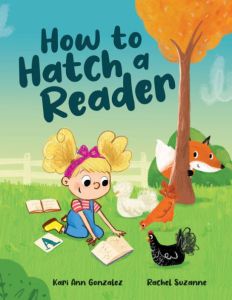
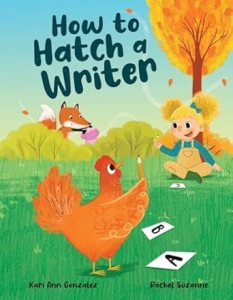
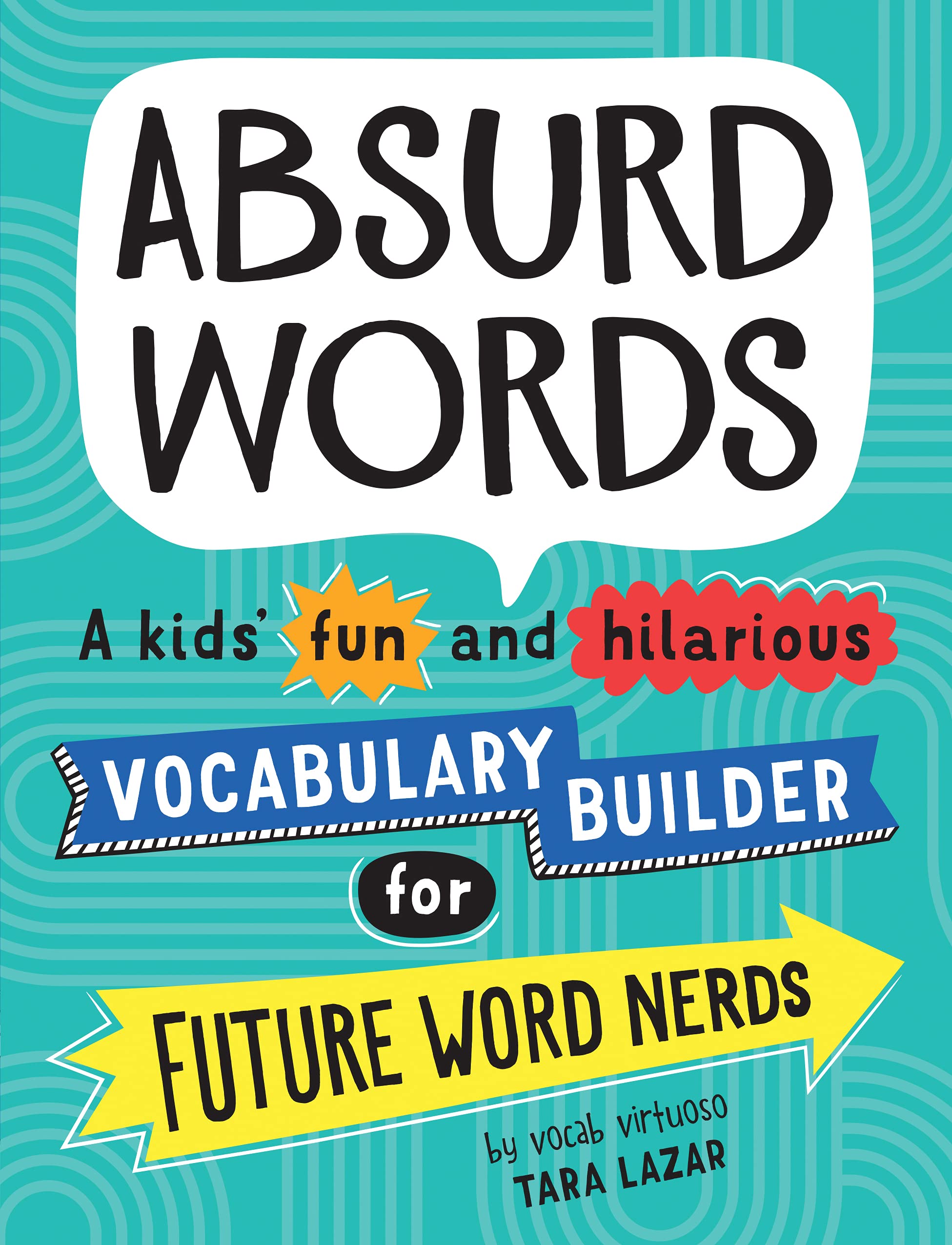
 In my latest book, HOW TO HATCH A WRITER (illustrated by Rachel Suzanne), I focus on building blocks for sentences…with a cast of plucky chickens! Every sentence tells a little story, but how do you come up with those stories? A technique I use with kids to build writing muscle is practicing sentence elaboration. I use this same technique when generating story ideas. Pick a favorite word and build a story around it. How do you pick a word? What’s the right word to start with you might ask? Anything goes! Pick a word from your new favorite picture book, the news, a word you heard taking your kids to the playground, a grocery list, or snag a word AND enrich your vocabulary with ABSURD WORDS by Storystorm creator Tara Lazar!
Then the fun really starts. Build a story around that word with these key questions: Who?, What?, When?, Where?, and Why?. Then add the juicy conflict. Stretch those writing muscles: the more you write, the more creativity follows, and you never know what story could develop.
Bonus tip: This exercise has all the building blocks for you to develop a story…but also a pitch for said story!
Extra credit: What would your character do next? BAM! Sequel idea.
Stephanie: My co-author for my latest picture book STORY POWER! (illustrated by Estefania Razo) is my grandson Simon Wildman Chung, age nine.
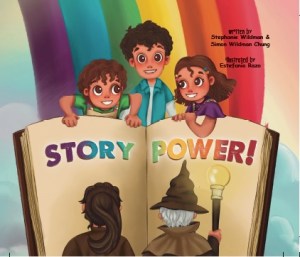
Simon is my co-author because when he was seven, he suggested the story idea to me, based on the characters—twins Flor & Roberto and their big brother Luis, who appeared in my earlier books, TREASURE HUNT, BREATH BY BREATH, and GHOST WRITER.
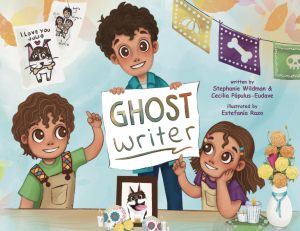
I was talking to Simon about another book I was working on when he offered his idea—that the twins are bored and want to look at screens, but, with their big brother Luis’s help, they write a story for their abuelito. (Reminder to us all—children often have the best ideas for stories! Ask them! And listen to their questions—my other books come from questions grandkids asked.)
Here are some ideas for writing prompts that kids love, and I think you will, too:
- Write about a family event.
Maybe you all had a Father’s Day dinner together—write about what happened—compare—did people see the same things at the dinner or remember them differently? Did anything funny happen? In addition to practicing writing, it’s fun to share family memories. If you don’t have a handy child available to write with, imagine yourself as that child, writing with your adult self. - Write about what you see out the window.
Might the tree be talking to an animal or flower? What would they say? Are people going by? What is happening in their lives? - Write about “What if?”
Picture a scene or an event. As Kari suggests above, write the Who?, What?, When?, Where? Why? What if something about the scenario were different with a surprising or funny twist? Junior-Writers.com offered this kind of prompt for their summer writing contest, urging writers to picture their last day of school with a twist that might lead to a fantasy story, science fiction, or a mystery. What event or scene happened to you lately? What can you imagine would be a surprising or funny twist?
Educator Dr. Shawna Della Cerra developed a resource list for parents and educators to use in conjunction with books like Story Power! and How to Hatch a Writer. Some of her ideas for kids, but that work for adults, include a Character Café and a Plot Twist Spinner:
Character Café
Children (or you!) “meet” the story character for a pretend snack and ask them questions —what would they order? What are they afraid of? What do they dream about? A perfect way to deepen character development through imagination and empathy.
Plot Twister Spinner
What it is:
A creative tool that helps children (or you!) introduce surprise elements into stories to enhance narrative flow and spark imagination. Use a physical spinner, a digital wheel, or simple prompt cards. A well-balanced spinner might include categories such as:
-
- Nouns (e.g., dragon, backpack, puddle)
- Verbs (e.g., disappears, transforms, collides)
- Events (e.g., a storm hits, someone tells a lie, a secret is revealed)
Why it works:
By combining random prompts from each category, students (and you!) generate fresh, unexpected plot turns.
We hope some of these ideas have you eager to pick up your pen, pencil, or crayon, engage your voice-to-text app, or turn to your computer keyboard. Just get your new ideas recorded! Remember, you don’t have to write the whole story today—just a few words about the idea that you are hatching. And, since we are writing like kids, don’t forget to reward your hard-earned ideas with a marathon of snacks!
 Kari Ann Gonzalez is a children’s writer who loves tending to her tiny hobby farm and stuffing her little free library full of books. Her debut picture book HOW TO HATCH A READER won the Northern Lights Picture Book award for humor, while HOW TO HATCH A WRITER has been named Hot Off The Press by CBC, and Reviewer’s Choice on Midwest Book Review’s Children’s Bookwatch. She is excited to share her newest titles, IF YOU LIVE ON A FARM, GOAT MAA-TH in 2026, and more titles to be announced soon! A flock of plucky chickens are kind enough to share their home with Kari, her husband, and their two little girls. For more information, please visit Kari’s website at karianngonzalez.com or follow her on Instagram at Kari_Gonzalez_Writes.
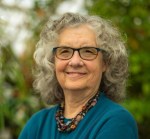 Stephanie Wildman, author of six children’s books, became a Professor Emerita after serving as the John A. and Elizabeth H. Sutro Chair at Santa Clara Law. She is a grandmother, mother, spouse, friend, good listener, who can sit “criss-cross apple sauce” thanks to her yoga practice.
Her latest book is STORY POWER! (co-authored with Simon Wildman Chung, illustrated by Estefanía Razo from Lawley Publishing). Learn more at stephaniewildman.com or follow her on Bluesky at swildmansf.bsky.social.
Thanks, Tara, for inviting New Books for Kids back to your blog. We were here last year at the start of our debut journey together talking about what else?—debut groups!
For this visit, Tara asked us to consider how we approach the craft of writing. From inspiration to polished manuscript, what is our process? You wondered, “Do we start with a theme when we write? A character? A structure? How do we revise?” Here are some answers from New Books for Kids.
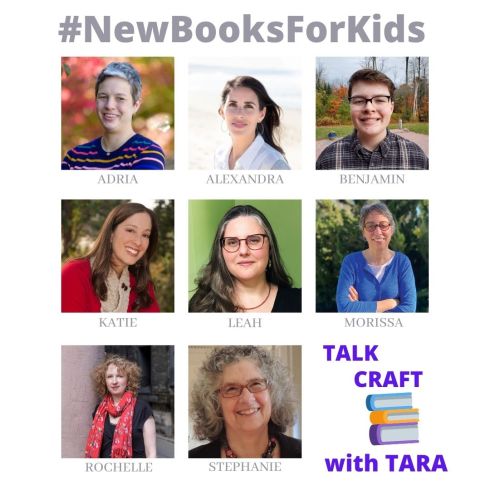
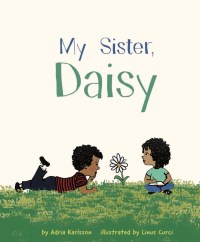
 Adria Karlsson (MY SISTER DAISY, illustrated by Linus Curci):
Almost always my books start out as ideas jotted down in a notebook, on a sticky note, or in my phone. I love novel information and when I hear something that makes me go, “Wait. What?!” – that’s usually a good indication I’m going to have to investigate further. Sometimes the ideas come from within my own thoughts when I’m tackling a problem of my own, helping a kiddo get through a tough moment, or celebrating someone’s accomplishment. It’s a long way from there to a proper story and sometimes I never do figure out how to move it out of “concept” and into “story.” Despite that, I like my collection of dysfunctional ideas and come back to them often to see if any of them have germinated. The evolution into a story often occurs when I figure out the theme that will carry the concept.
About Adria: Once upon a time, Adria Karlsson could have been found teaching people, training cats and dogs, or tutoring dyslexic kids, but now they spend their time writing and parenting. They set off on a new adventure every day to discover fresh alchemies of words and ideas that will build a good story. Visit her online at adriakarlsson.com or on Twitter: @adriakarlsson.
 Alex Katona (DINNER ON DOMINGOS, illustrated by Claudia Navarro):
When I have an idea, I just start writing. I don’t think too much about an arc, but I try to have a theme in mind. My first draft is MESSY—I try not to be too critical and just get my ideas down. After the initial thoughts are on paper, I leave it for a few days to figure out where to go next. When I come back to it, I break it apart and dissect it. I think about character development and pacing and page turns, but I continue to think about the theme. I even write the word or phrase on a post-it note and stick it near my laptop so I’m constantly reminded of it.

About Alex: Alex has been writing stories since she was young. When she’s not writing, you can find her surfing, exploring the outdoors, or reading. She lives with her husband, son, and dogs in Southern California and believes in the connective power of food. Dinner on Domingos is based on her own childhood. You can visit her at alexandrakatona.com or on Twitter @Alex_KatonaC.
 Benjamin Giroux (I AM ODD I AM NEW, illustrated by Roz MacLean):
Our youngest member finds inspiration for writing from his everyday life. He wrote the poem that became his debut book I AM ODD I AM NEW as a school assignment in which he expressed his experience living as a person with autism in a neurotypical world. The book series he’s currently working on also channels his everyday moments and was inspired by Monty, his pet snake. What in your own life inspires you?

About Benjamin: Benjamin, whose book was given the prestigious Kirkus Reviews Star, has been featured on many websites, in the Huffington Post, and on the Today Show and Good Morning America. He was named Poet Laureate of Plattsburgh, New York, and has also been the face of the National Autism Association’s antibullying campaign. His poem has been translated into several languages. He is now an award-winning songwriter. Visit him at benjamingiroux.com.
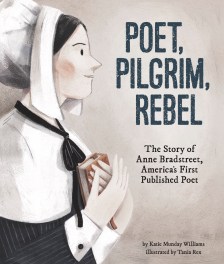
 Katie Williams (POET, PILGRIM, REBEL: The Story of Anne Bradstreet, America’s First Poet, illustrated by Tania Rex):
While the ‘craft’ of writing involves many different phases and elements, I think my favorite one is the brainstorming phase. To me, this is one of the most important parts since it determines the subject of your story. Setting, POV, main character, those all come later, but first you need your subject. There are so many ways to brainstorm ideas and none of them are wrong. Some people enjoy perusing the news looking for interesting people or events. Others might sit and meditate, seeing what comes to them naturally. For me, I love to look around and attempt to see the world with new eyes. How would my children see that clump of trees? As a hideout? A scary forest? A home to an animal? With nonfiction, it can mean looking at a historical figure with a fresh take on it. Sure, that person grew up to be famous, but what were they like as a child? What were their dreams/hopes/fears? When you look at the world in a fresh, new way, you’ll literally find story ideas everywhere!
About Katie: Katie is a Public Health Nurse, Lactation Consultant, and Author. She has always been an avid reader and was once so engrossed in reading Black Beauty that she missed her school bus home. She lives in Santa Cruz, CA with her husband and two children, where they enjoy digging for sand crabs and attempting to bring the entire beach home with them in their pants. Visit her online at katiemundaywilliams.com or on Twitter: @KatieWills79.
 Leah Rose Kessler (RAT FAIR, illustrated by Cleonique Hilsaca):
What happens when you’ve tried everything, and your story still doesn’t feel right? As counterintuitive as it sounds, my craft tip for you is to let it go. Sometimes the best thing you can do for your manuscript is set it aside. Even if it’s the story of your heart, the one you’re certain you’re destined to publish, stop working on it. Drop it like a handful of lava. Put it out of your mind.
Create a folder labeled “To Come Back To Later” and plop it in. Then walk away. Have a piece of toast. Repaint your bathroom. Learn how to ski. After enough time has passed (I’m talking months, not days), one of two things is likely to happen. Either you’ll find that you’re immersed in another manuscript and don’t feel the need to visit that folder, or you’ll go back and take a peek and realize your brain has been working on it in the background all along; all the mentor texts you’ve read, the movies you’ve watched, the life you’ve lived, will have added up into a big swirl of insight and inspiration while you weren’t even looking. You’ll be able to take your story forward in a direction you never would have been capable of if you’d kept on picking and poking at it all those months ago.

About Leah: Leah spent much of her childhood up a tree with a stack of books. These days, when she’s not reading or writing, she’s an on-again, off-again elementary school teacher and a lifelong biologist. She lives in Michigan with two humans and two cats and has a soft spot for scurrying creatures of all shapes and sizes. Her work has appeared in Cricket Media’s Babybug and Spider magazines. Leah is represented by Natascha Morris at The Tobias Literary Agency. Visit her online at leahrosekessler.com or on Twitter: @leahrosekessler.
 Morissa Rubin (DOT, DOT, POLKA DOT, forthcoming from POW! Kids Books):
As an author/illustrator my creative process is messy, intertwined, and not at all linear. Sometimes I start with words and other times it is an image or visual idea that gets me started. I am very interested in the interplay of word and image, and I usually work in one realm for a bit and then switch to the other to see if I can let both sides develop together. I want to make sure that both sides of the equation (words and art) speak to me equally, each offering a different window into the work that is emerging. As a graphic designer and long-time publication designer, I think a lot about how a concept is reflected in its visual structure. How is the sequencing, pacing, and “chunking out” of the work reflected in both the words and phrasing, and how can it also be expressed with color, texture, pattern, and composition. But at some point, I do separate passes, focusing on just the words and language one time and then doing a visual edit at another time. I keep inching along, back and forth, back and forth.
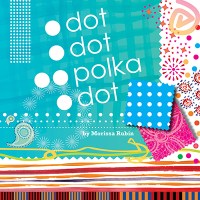
About Morissa: Morissa is a graphic designer who thinks polka dots, paisleys and plaid are better together. She received her BFA from RISD and her MS from MIT’s Visible Language Workshop. Morissa lives in Sacramento where she teaches typography and other design courses at UC Davis and Sac State. Visit her website at morissarubindesign.com/books or on Twitter: @MorissaRubin and Instagram: @morissa.s.childrensbooks.
 Rochelle Melander (MIGHTIER THAN THE SWORD: Rebels, Reformers, and Revolutionaries Who Changed the World through Writing, illustrated by Melina Ontiveros):
The idea for MIGHTIER THAN THE SWORD came from teaching writing to young people. I wanted to create a resource that would tell the stories of people who wrote to share big ideas, fight for equal rights, and heal the environment. When I researched and wrote each chapter, I started with the question: How did they use writing to change themselves and the world? These hooks guided my writing—and I used them to tell the story. When I revised, I read my words aloud, listening for juicy words and interesting twists and turns that would hook the readers. This process works well for writing and revising picture books, too. I start with the theme or question, using that to research, brainstorm, or write the story. When I revise, I listen with the imagination of a child. How will this story unfold for them? What words will appeal to them? Where will they get hooked? And where will they get lost? That helps me to find my way forward.

About Rochelle: Rochelle wrote her first book at seven and has published 11 books for adults. Mightier Than the Sword won the 2021 Cybils Award for Middle Grade nonfiction. She’s an ADHD coach, an artist educator, and the founder of Dream Keepers, a writing workshop for young people. She blogs at writenowcoach.com and rochellemelander.com. Find her on Twitter and Instagram: @writenowcoach.
 Stephanie Wildman (BRAVE IN THE WATER, illustrated by Jenni Feidler-Aguilar and translated into Spanish as VALIENTE EN EL AGUA by Cecilia Populus-Eudave):
Like several of my colleagues, I also find inspiration in the day to day. My forthcoming picture book Treasure Hunt combines two activities I do with my grandchildren. But how does one go from inspiration to polish? My most important craft tip (as a non-illustrator) is putting the manuscript (after rewrites and those ever so valuable critiques) into a picture book dummy format. That allows me to focus on page turns – will the reader want to turn to the next page? What can be pictured with this text? Are too many pages taking place in the same scene? I can better answer these questions once the manuscript is formatted like a book. And of course, read it out loud.
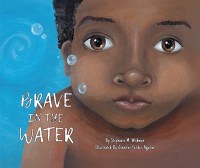
About Stephanie: Stephanie became a Professor Emerita after serving as the John A. and Elizabeth H. Sutro Chair at Santa Clara Law. In that role she authored books, law review articles, and journalistic pieces. She is a grandmother, mother, spouse, friend, good listener, and she can sit “criss-cross apple sauce” thanks to her yoga practice. Lawley Publishing will release her second children’s book Treasure Hunt (illustrated by Estefania Razo) in November 2022. Find her at stephaniewildman.com or on Twitter: @SWildmanSF.

Thank you for sharing your craft tips, authors!
Blog readers, do you have a craft or process tip that works especially well for you? Please share in the comments!
by Stephanie Wildman
Thank you, Tara, for having me on your blog. You asked me how I found my amazing debut group NewBooksForKids.com. Unlike the conventional “author-only” assemblage, we are a group of children’s book creators, including authors, illustrators, and even a Spanish-language translator.
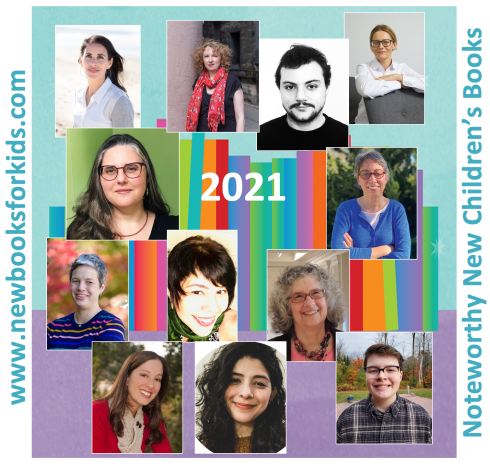
I first heard the term “debut group” from my friend and Writers Grotto colleague A.H. Kim, whose debut novel A GOOD FAMILY came out in July during the pandemic. “What’s a debut group?” I wondered. My friend Ann patiently explained that she and a group of other writers with debut books had banded together “to navigate the uncharted seas of debuting during a pandemic. We were able to share triumphs and disappointments, tips and tricks, questions and answers, all in a safe and confidential forum.” That forum was on a Facebook page (you would think I would get that hint, but I’m not a big FB user).
“But how did you find them?” I wanted to know. It turns out Ann had attended a book festival (pre-pandemic) and met another Korean-American debut author who introduced the concept to her.
Well, I would be attending no live events in a pandemic, so I turned to the 12×12 Picture Book Challenge which has a great resources page for published authors on their website (thanks to Julie Hedland and Kelli Panique). I posted a question there, but it was December and it went nowhere.
Time was running out; my picture book BRAVE IN THE WATER would debut in April. I wrote to some existing debut groups, which told me they were already full. (Good I had had all that practice in accepting rejection through the querying process.)
I was emailing with Sylvia Liu about something else, and I asked her how these groups that were already full had gotten formed. She was kind enough to explain to me that people met through the Kidlit411 Facebook group (lightbulb & FB again).
I saw a posting in the Kidlit411 Facebook group from Rochelle Melander (MIGHTIER THAN THE SWORD: Rebels, Reformers, and Revolutionaries Who Changed the World through Writing) who was looking for a debut group. The post had a few responses so I started an email thread with Rochelle and some others. But it went nowhere, too, and I decided I just needed to move on without a group.
Then weeks later, Rochelle wrote me and said she was starting a group with Adria Karlsson (MY SISTER DAISY). They had met—you guessed it—on Facebook, on the 12×12 Facebook page, which I rarely visited, not on the 12×12 Forum where I had started. “Do you want to attend a Zoom meeting?” Rochelle asked. I did!
I met Sonny Giroux, father of Benjamin Giroux, the teen author of I AM ODD, I AM NEW (who shared an agent with Adria); Morissa Rubin author/illustrator of DOT, DOT, POLKA DOT; Katie Munday Williams, who wrote POET, PILGRIM, REBEL: The Story of Anne Bradstreet, America’s First Published Poet, (who shared a publisher with Rochelle), and Adria.
We discussed size of the group and decided to invite our illustrators (and my translator) to join, and so we added Cecilia Populus-Eudave (VALIENTE EN EL AQUA); Melina Ontiveros (MIGHTIER THAN THE SWORD); Tania Rex (POET, PILGRIM, REBEL); and Linus Curci (MY SISTER DAISY).
Even though we were large enough to be a “group,” Adria wasn’t done. She reached out to Alexandra Katona (DINNER ON DOMINGOS) and Leah Rose Kessler (RAT FAIR). And now the group was complete—twelve creators and eight books to launch. We even have a pending “maybe” who would cap our group at “lucky thirteen.”
So, yes, our group has a Facebook page, which I do visit, and I’m learning to like Mark Zuckerberg after all. Mostly, I’m excited to read the books by these fantastic creators.
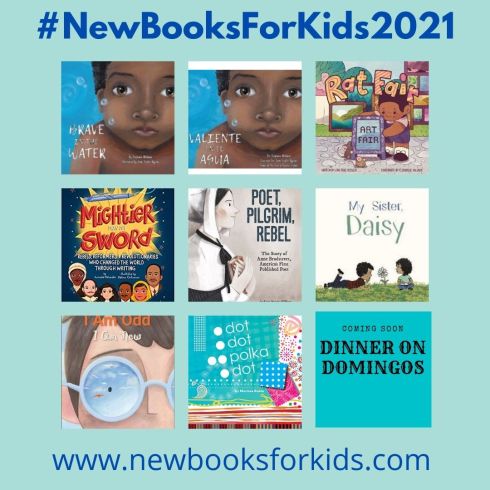
Here’s what some of them have to say about debut groups:
Leah Rose Kessler (RAT FAIR):
“I never would have gotten where I am without the advice, encouragement, and support of countless people in the book community. It was important to me to find a debut group not only to help me through the mystifying process of releasing my first book but also as a way for me to help lift up and celebrate my fellow book creators in the same way I’ve been lifted so many times before.”
Rochelle Melander (MIGHTIER THAN THE SWORD: Rebels, Reformers, and Revolutionaries Who Changed the World through Writing):
“Being part of a group like New Books for Kids has so many benefits. Of course, getting support during a book launch is invaluable. It’s so much work—and having a few more people touting your book, requesting it from their libraries and reviewing it helps so much! But most of all, it’s great to have new creative friends, people I can ask about the writing, publishing and marketing process.”
Katie Munday Williams (POET, PILGRIM, REBEL The Story of Anne Bradstreet, America’s First Published Poet):
“Knowing what a wonderful community of writers we have, I jumped at the chance to expand my network. Groups like this not only provide support and feedback, but they allow exponential promotional opportunities for an upcoming book.”
Adria Karlsson (MY SISTER DAISY):
“I didn’t know until recently that such things as debut author groups existed… probably because I’m a debut author. But once I heard about them, I wanted in. A group that could share the year, cross-promote books, and exchange information and tips with sounded amazing. I couldn’t be happier about the group we formed — it has already been such a resource.”
Benjamin Giroux (I AM ODD, I AM NEW):
“I found this group of debut authors through my agent. She thought since I am so young and have no clue what I’m doing in regards to launching a book, I could benefit from being in such a group. It has been really good support, and I am really thankful for all the advice I’ve gotten.”
Morissa Rubin (DOT, DOT, POLKA DOT):
“To be a part of a debut group is not only a practical way to share needed information, but because it is new for all of us, it adds to the thrill of seeing our books published.”
Alexandra Katona (DINNER ON DOMINGOS) (cover not yet revealed!):
“Having a group like this is helping me navigate the difficult task of book promotion, but with other like-minded authors; collaboration is key. We’re able to lift each other up and provide much-needed support and guidance.”
Thanks for telling us about your debut group, Stephanie!
Blog readers, visit them at NewBooksforKids.com, follow them on Twitter @NewBooksForKid1 and Instagram @newbooksforkids.





 Writing for Kids (While Raising Them)