 by Pat Miller
For me, ideas rarely spring to life like Athena leaping from Zeus’s forehead. When I intentionally push my imagination up against the wall, patting it down for inspiration, I get nowhere but frustrated. But I have discovered five ways to slip into the back door of The House of Inspiration.
1. Piggyback
I was delivering the annual library orientation to my primary classes. That involved repeating the same lesson 23 times. “I wish there was a book we could share that detailed the procedures in a fun way,” I thought.
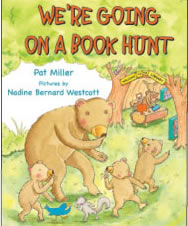 Weeks later, we were acting out the choruses of We’re Going on a Bear Hunt when it struck me. I could write an orientation book called We’re Going on a Book Hunt! The structure of the classic rhyme was a ready framework for my own bouncy tale about a class of bears who learn to use the library, complete with original choruses.
You aren’t likely to think of ideas no one has ever considered before. But you can tweak the tried-and-true to make them your own. Library shelves are home to a plethora of piggy-backed productions—Little Red Cowboy Hat and The Wolf Who Cried Boy are two more.
2. Get Emotional
My two-year-old granddaughter wanted to help make a shopping list. As I said peanut butter, eggs, bread, she made a squiggle for each. When I added tiger toes, monkey milk, and boo-boo fruit, she calmly added each to the list. Her bit-lip intensity and self-confidence charmed me. That emotional *ping* signaled to me that this incident was worth writing down.
Negative emotions *ping* as well. Recently, we received a fancy invitation to the anniversary party of a couple I didn’t know. But my husband said he was a great guy, new to their golf group. So we went. We gave them a gift, signed their bridal book, and shared a lovely dinner with a table of strangers. When we finally asked someone to point out the special couple, we realized that neither of us knew them! How did we get invited?! As we slipped out undetected, I was confused and embarrassed. *Ping!* I converted this emotional incident into a nugget for PiBoIdMo.
Build a stockpile of emotional *pings* in your notebook. Cull them from real life and from your memories. An emotional connection helps kids identify with your character. But it can be difficult to generate while pressured by a blinking cursor. Stored episodes of affection, anger, admiration, embarrassment, etc. can be the yeasty starter for developing similar emotions in your work.
 3. Mother of Invention
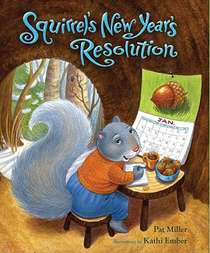
One January, my first grade teachers asked if there was a book about making New Year’s resolutions. I searched area libraries and publisher catalogs without success. Then it dawned on me that I could write that book. Two years later, I was able to supply them with Squirrel’s New Year’s Resolution in which a rookie squirrel learns about making resolutions from her friends.
Necessity is the mother of books about gluten allergies, bullies, gay parents, and overseas adoptions. Be alert when you hear (or think) “I wish there was a book about…” When I told my grown daughter I was working on this post, she said, “I wish there was a book about an Advent calendar that came to life.” I may never write it, but I added her wish to my notebook. My husband still wishes I would write a book about famous brothers. It’s in there.
On the last page of every issue of The SCBWI Bulletin, Libby Nelson compiles a librarian wish list of fiction and nonfiction topics. One of those needs could become the mother of your next brilliant inspiration.
 4. Carry a Net
One year I was coaxing my kindergarteners to guess what special day was coming up. They made random incorrect guesses, so I gave them a clue.
“It’s the day when an animal pops out of its hole to look for its shadow.”
Blank looks. These were Texas five year-olds. There are no wild groundhogs in the entire state. Then an earnest little boy waved his hand, blurting, “I know this one!”
“Great! What animal pops out of his hole next week?” I asked.
“The armadillo!” he proudly announced.
Not quite. I went on to explain about Groundhog Day, but as soon as the class left the library, I scurried into my office to record the exchange. Three years later, that conversation inspired my first children’s book, Substitute Groundhog.
My new smart phone takes dictation, but I find small tablets to be more versatile. (It’s creepily obvious if you dictate into your phone while eavesdropping.) I have little tablets in my purse, my gym bag, my car, and my kitchen. I even have a waterproof one in the shower—my best place for getting ideas. Tablets help me capture inspirations before they fly away.
5. Plant Bulbs
I read a great gardening tip about using golf tees to mark where you plant bulbs so you don’t accidentally plant over them. Bulbs look like rocks. You plant them. Water them. Then wait. And wait. Eventually you forget about them (hence the golf tees), and go about your life. One day–surprise! Leaf tips, followed in quick order by stems, buds and gorgeous flowers.
We were touring the Boston harbor when our guide waved his arm vaguely to the north and said, “Over there is the grave of the guy who invented the doughnut hole.” I jotted that fact in my little purse notebook. Later, I transferred it to my Idea Notebook where it sat for two years until I took it to the Highlights Nonfiction Workshop. There I began my research. Six months later, I wrote the manuscript as my first for Julie Hedlund’s 12×12. Her February agent requested to represent it. In July, Houghton Mifflin Harcourt acquired The Hole Story of the Doughnut.
How easily I could have let the tour guide’s remark fly away on the wind off the harbor. A quick jot in my notebook, and it was safely planted. You never know which homely idea will germinate when least expected, nurtured by future life experiences or eyes that see it in a different light later.
Reinvent the books or songs that you love. Record emotional situations and capitalize on needs around you. Keep your mental nets ready. Stash your tablets. And faithfully plant your ideas. Then you’ll gain ready admission into The Big House.

Pat was a school librarian for 22 years—the perfect job for a children’s writer. Her Substitute Groundhog received 33 rejections before the euphoric phone call from Albert Whitman. It went on to become a Junior Library Guild Book, a Scholastic Book Club selection with CD, an e-book hybrid from Weigl, and translated into French for Canadian Groundhog Day. Besides her books for children, Pat has written 20 for school librarians and is Contributing Editor for LibrarySparks magazine. Pat loves doing school visits as an author and storyteller. Visit her at PatMillerBooks.com and check out her blog at PatMillerBooks.com/blog. Comment there on her latest post to win another chance for a critique.

Pat is generously giving away two prizes!
The first—pick one of her three children’s book—with audio CD. If you win, it will be personalized to your favorite reader.
The second is a picture book critique.
Two winners will be randomly selected at the conclusion of PiBoIdMo. You are eligible for this prize if:
- You have registered for PiBoIdMo.
- You have commented ONCE ONLY on today’s post.
- You have completed the PiBoIdMo challenge. (You will have to sign the PiBoIdMo Pledge at the end of the event.)
Good luck, everyone!
 If you have “signed” the pledge by commenting AND you had also registered, then you are eligible for an “agent prize”—a.k.a. THE GRAND POOBAH OF PRIZES. You will get your 5 best ideas evaluated by a kidlit agent. They’ll tell you which ideas might be the best ones to pursue as manuscripts. (Or not.)
 Joan is a Senior Agent with EMLA, working from her home office in Massachusetts as the “East Coast branch” of the agency. She represents all forms of children’s and young adult literature, but is most excited by a strong lyrical voice, tight plotting with surprising twists and turns, and stories told with heart and resonance that will stand the test of time.
 Tricia is the “Pacific Northwest branch” of EMLA—born and raised in Oregon, and now lives in Seattle. After 18 years of working as a developmental and production-based editor (from kids book to college textbooks, but mostly college textbooks), she joined the EMLA team in March 2011 as a social media strategist.
 Marietta has experienced children’s books from every angle—teaching, marketing, publishing & bookselling. She thrives on working with authors who make readers feel their characters’ emotions and illustrators who add a different dimension to the story. She is also book curator at an independent toy store/bookstore. Read a recent publishing industry piece by Marietta
  Danielle Smith began her agent career at Foreword Literary Agents in 2013 where she represents picture books and middle grade authors and illustrators. Her enthusiasm for children’s literature began as a young child, but grew exponentially when her own two children were born and shortly thereafter she began reviewing books at her top rated children’s book review site There’s A Book. For more than five years she’s been involved professionally with books through print and online publications such as Women’s World and Parenting Magazine, as a member of the judging panel for The Cybils awards for fiction picture books, as well as locally by serving on the board of The Central Coast Writer’s Conference.
 Mira Reisberg came to launch Hummingbird Literary following a 25-year history in the field of children’s literature working as an award-winning illustrator, a writer, editor, art director, designer, a children’s literature and art education professor, and a teacher/mentor to many now successful children’s book creatives.
 Susan Hawk represents authors who write for children of all ages, babies to teenage.
 Lori Kilkelly is an agent with Rodeen Literary Management, founded by Paul Rodeen, formerly of Sterling Lord Literistic, in 2009. After working in sales for a number of years, Lori decided to follow her passion for books. She attended the Denver Publishing Institute, subsequently joining the agency as an intern in early 2010. Ascending the ranks from intern and reader to assistant, she worked with current and potential clients as well as editors and publishers. In early 2012 Lori took on the role of Social Media Manager, creating and maintaining the Rodeen Literary Facebook page as well as Twitter and Pinterest accounts, to provide promotional opportunities for RLM clients as well as keep interested parties informed about books, news and events involving RLM. In December 2012 she began representing her first client, Toni Yuly, and has subsequently taken on an additional four clients. She represents authors as well as illustrators and is actively seeking talented Middle Grade and Young Adult writers.
 Sean McCarthy began his publishing career as an editorial intern at Overlook Press and then moved over to the Sheldon Fogelman Agency. He worked as the submissions coordinator and permissions manager before becoming a full-time literary agent. Sean graduated from Macalester College with a degree in English-Creative Writing, and is grateful that he no longer has to spend his winters in Minnesota.
 Prior to becoming an agent, Jill Corcoran worked at Mattel, LA Gear, Leo Burnett Advertising and her own company, LAUNCH! New Product Marketing. With an English degree from Stanford University and a Marketing and Finance MBA from the University of Chicago School of Business, Jill has marketed everything from Barbies to Disney toys, Kellogg’s cereal to LA Gear shoes. But when she started writing books for children, and then agenting them, she knew she found her true calling.
 by
by 
 by
by 
 by
by  2. Check your ego at the door.
 by
by 


 by
by 

 by Zachariah OHora




 © 2013 by
  The photograph was of an apartment house in Paris on which a three story, three-dimensional angel with widespread wings had been carved on the facade. There was a newspaper story about how the angel had been built and survived World War II.
 Jane Yolen is an author of children’s books, fantasy, and science fiction, including Owl Moon, The Devil’s Arithmetic, and How Do Dinosaurs Say Goodnight?