I have questions.

Musical notes are named after the first seven letters of the alphabet—A thru G—but when we learn to play the piano, we begin at Middle C. Why? Why not Middle A?

Odd questions like this may keep you up at night, and, they demonstrate an unyielding curiosity. This is an excellent quality to possess as a picture book author. It keeps us akin to our young audiences, who are asking the perennial “WHY?” questions about blue skies and 8pm bedtimes.

There are things around you right now that you don’t fully understand. What are they? What have you always wanted to know more about? Chances are, others want to learn about those things, too.

Why do dogs bark and cats meow? Why are clouds fluffy? Why do I need to use soap in the bath?

Children learn about their world by living, breathing, and reading.

Of course, no one knows ALL the answers. But you—you can certainly fill in some blanks.

Speaking of blanks, I hope your Storystorm journal is now filled with plenty (maybe even a plethora) of story ideas to keep you motivated and writing through this year. The goal of this month’s challenge is to compile at least 30 story ideas, and if you haven’t, today is the time to explore your curiosity and expand that list.

I will post the “Storystorm Pledge” tomorrow, which you can sign to affirm that you indeed have 30 ideas. You’ll be able to pick up your “Winner” badge and show it off. Then, of course, we will distribute the prizes. (Although having 30 story ideas is a prize in itself, right?)

I hope 2025 turns out to be your most creative, prolific year yet.

by Anna Raff

“Wooo-hooo!”

That’s a direct quote from yours truly, the moment I read an email from my art director, offering me the opportunity to illustrate a new picture book by the fantabulous Tara Lazar—our Storystorm Grand Poobah. One glance at the title ”PARTY ANIMALS” and I knew I was going to love it.

I’d illustrated around 15 picture books at this point, with each one being near and dear to my heart. Cue my fellow kidlit creators out there who understand—with the amount of time that goes into them, you’d better feel connected! Yet for me, it felt viceral with Tara’s hilarious story. This was a book I knew I’d have a ball with—visualizing the world of these quirky characters in a way that, hopefully, readers would return to again and again.

Sometimes, it’s the stories that we feel closest too that can morph into something difficult. We assign so much importance to getting things just right, it can feel crippling. I’m no stranger to moments of panic in my work—it’s pretty much been happening my whole career. To be honest, I consider it an intregal part of my process now. After a while, I’d learned to compartmentalize it. But wow…I really wanted this book to be great. Cue the panic!

Inevitably, when I sat down to sketch PARTY ANIMALS, my ideas were flat and obvious…the absolute opposite of a party. Clearly, my usual “take a walk and it’ll be better tomorrow” tactic was not going to cut it. This project demanded more of me, a different approach.

Full disclosure, I am not much of a sketchbook keeper. Sketchbook acquirer? Yes…to the point of obsession. As a kid, I used to collect stickers, but never used them. (Anyone remember Wacky Packages?) I’m very much the same way about sketchbooks now. I keep thinking, one of these days I’ll find the sketchbook of my dreams that will transform me into a sketchbook user extraordinaire. It took me a while to figure it out, but now I accept that I’m more of a sketchbook note-taker, list-maker than a sketchbook sketcher. And that’s okay!

To get myself out of my state of panic, I settled on creating detailed dossiers for the Party Animals. (I liked the word “dossier”, since it implied lists over sketching…that work would come later. Also, it sounded sneaky.) Instead of jumping into thumbnails or character sketches and studies, I focussed on their back stories and motivations, listing everything that came to mind about them.

I started by asking myself questions. What made them tick? Did each animal have a special ability or obsession? For instance Beatrix the elephant is an expert baker. “What sort of bakes does a Party Animal make for the fabulous, oddball house parties in Tara’s text?” I wondered. (Btw, my favorite is the brain cake from the thinking party.) And what does an elephant wear to a party like that?

Or take Phoebe, the rock star musician. What instruments does she play? And if a party demands it, what could she find around the house to incorporate into her party playlist?

In the end, I wound up with a detailed encyclopedia of content that I could go back to again and again as I built the pages. A lot of it made it into the book—plenty of it did not. But all of it helped me visualize their world and calm me down. Much like a method actor might immerse themselves in a character, the dossiers got me to think like a Party Animal. And most of all, it got me out of panic mode…out of my own way.

Anna Raff is an award-winning illustrator of many books for children, including PARTY ANIMALS, IF I WERE A KANGAROO, and YOU MAKE ME SNEEZE! Her book THE DAY THE UNIVERSE EXPLODED MY HEAD was a Kirkus Best Book of the Year and New York Public Library Best Book. Anna is on the faculty of the MFA Illustration program at the School of Visual Arts, and lives in New York City, surrounded by party animals. Visit her online at AnnaRaff.com, on Instagram @annaraff and BlueSky @annaraff.bsky.social

Anna Raff is giving away a 30-minute virtual classroom visit via Zoom. 

You’re eligible to win if you’re a registered Storystorm 2025 participant and you have commented only once below.

Prizes will be distributed at the conclusion of Storystorm.

by Shari Becker

For so many of us, January represents an opportunity to reset. We make all kinds of promises to ourselves: I’m going to get more sleep. I’m going to eat more vegetables. I’m going to read more books. I’m going to finish that manuscript that’s been sitting on my desk for two years.

Of course, if you are one of those people who can make such resolutions and keep them, I applaud you.

I, however, am not such a person.

I am the person who joined a different gym every new January, declaring that this would be the year that I would really commit to getting healthy. But while the gyms changed, the outcome was always the same. I’d work out regularly for three months, and then I’d stop. A kid would get sick. I’d get sick … or tired. I’d have too much work that day. It might be raining outside, and no one wants to work out wet. Right?

One day I met a new neighbor at the dog park, and we hit it off immediately. We both loved the arts. We both loved our dogs. Our girls went to the same high school. We commiserated and laughed over our shared lack of executive function in our own lives. Since neither of our dogs were actually well behaved at the dog park, we decided that we would walk together twice a week, up and down the hills of Brookline, MA.

We did. For years. Those regular walks inspired me to set up similar walking dates with other friends. I realized that not only did I enjoy these power walks, but they were creating a structure in my week that allowed me to accomplish even more than I’d imagined.

I know, I know … Why is she talking about exercise during Storystorm?

I learned something really important from having an exercise buddy. I am someone who is more accountable to others than I am to myself–about some things at least. I really struggle to put aside and protect time for me— for the things I love and the things I NEED to do.While I have called myself a writer since the mid-1990s, you will not be surprised when I tell you there were many, many years when this writer simply did not write. I took care of kids. I did laundry. I grocery shopped. I worked. I picked up the phone every time my parents, my in-laws, or friends called during my writing time. I skipped writing time because I answered work emails or because I was on social media.

I could beat myself up about my lack of discipline. I’d be lying if I said I never did over the course of all those years. But knowing yourself and knowing what you need to create a thriving writing practice is empowering.

I need accountability.

When I have accountability, I can accomplish exciting things.

When I began Write Now!, a free, online writing accountability group for Whale Rock Workshops, I created it for myself as much as for others. I know so many writers who struggle to get in the chair when life pulls them in a million different directions.

We run our accountability groups for two and a half hours, three times a week. Everyone takes turns setting a goal for the day. We write quietly, side-by-side, and then we come back together to check out at the end.

I have been more focused on my writing in the past 4 years than I was in the previous 15. Our community of writers keeps one another accountable. We are connected. We root and cheer each other along whether a writer is completing a draft or whether a writer feels despondent over a rejection. We show up because we know there are people counting on us to be there. Counting on us to do the work so that they can do the work, too.

So as January 2025’s Story Storm comes to an end, I congratulate you. You have just participated in a month-long idea generation practice with two thousand of your fellow children’s writer friends. You have ideas with which to go forth and create.

Now, I encourage you to ask yourself what you need to maintain this momentum as you move into February. What kind of scaffolding do you need to put in place for yourself? If it is accountability you seek, find a friend or join a group like Write Now!. Block the time you need in your calendar, make it non-negotiable, and hold yourself and your writing buddy (ies) accountable.

It works. I promise.

Happy writing.

Shari Becker has been writing and creating content for children and teens for over 25 years. She began her career developing branded content for Nickelodeon and Disney-owned properties, and today she is the founder of Whale Rock Literary Workshops.

As an author, Shari writes picture books and novels. Her books have been named Junior Library Guild Selections, Bank Street Best Books, and have received starred reviews. Her latest picture book, TAKING TURNS WITH TURTLES: A Rescue Story, comes out March 2026 with Groundwood Books. Visit her at ShariBecker.com.


Shari is giving away one voucher for any 90-minute workshop at Whale Rock Workshops.

You’re eligible to win if you’re a registered Storystorm 2025 participant and you have commented only once below.

Prizes will be distributed at the conclusion of Storystorm.

by Emily Peace Harrison

In the realm of children’s literature, rhyming picture books hold a special place in my heart. It is just something about the lyrical flow of rhymes that stimulates creativity and imagination. My mom loved Dr. Seuss, and she must have read every one of those books to me a hundred times. As a child, when I was having difficulty in school, my mom would make up rhymes and songs to help me learn. The repetition and rhythm helped me remember and retain the lesson—the melodies never failed to capture my attention. It is no surprise that my debut picture book, “I’d Rather Be Me”, is full of infectious rhyme and repetition.

In many ways, writing a rhyming picture book is similar to writing a song. You’re thinking about rhyme, rhythm, and lyricism. You’re imagining the artistic effect that you want the words to have—the way they’ll wash over the reader and evoke a certain feeling. So, naturally, the first step in my writing process is to turn to music. And for me, silence is distracting, which might also have something to do with growing up as the youngest of five children in a house full of glorious chaos; there was always some type of noise to compete with.

However, many authors struggle with rhyme and meter, and querying a rhyming manuscript is a difficult task. But whether you are writing a rhyming picture book, a YA manuscript, or a science fiction novel, music and rhythm can be the catalyst you need to jump start your writing.

For most of us, music evokes emotion. Old songs trigger personal memories, transporting us back to another place and time. I remember at my son’s wedding reception, the DJ played a song that sent me straight back to high school. At that moment I was 16 again; shopping for the perfect dress before the high school dance, making plans for a group dinner beforehand, and letting loose with the freedom that only a teenager experiences.

A teacher recently shared with me a technique she uses in the classroom to help her students find inspiration to write. The teacher selects music for the entire class to listen to and instructs the students to focus on the sounds the instruments are creating and the mood of the music. One of her favorites is the FANTASIA soundtrack. While listening, the students brainstorm adjectives and adverbs to describe the mood of the music. They then use that list of words in their stories. I immediately went home and listened to the FANTASIA soundtrack – great stuff for picture books!

Music has the ability to move us—our memories and our imaginations. Here’s how you can channel that power into inspiration for your writing:

PLAY A SONG. Turn on the music that you love. Listen carefully.

  1. How does the song make you feel? Focus on the mood the song sets – joy, sadness, love, regret – write something that conveys that emotion.
  2. What do the lyrics make you think about? Do the lyrics tell a story? Try to expand on that or give it a new twist. Perhaps the lyrics give you a portrait of a character. Maybe the lyrics take you back to a time in your past; write about that memory or experience.
  3. What kind of story would use this song as a soundtrack? Imagine the story you are about to write will be made into a movie and this is the soundtrack. Use the song to envision a movie-worthy plot or character.

TODAY’S CHALLENGE:

Play a song, any you choose.
Let the music be your muse.

  1. Choose a song for inspiration. Listen from start to finish keeping the above questions in mind (play the song as many times as you need on repeat!)
  2. Write for fifteen minutes about whatever the song inspires you to imagine.

Music is a universal language.  No matter what mood you want to create, there is a melody out there that can inspire it!

Emily Peace Harrison is a children’s book author and has worked in higher education administration for nearly 20 years.  Her award-winning, debut picture book, I’D RATHER BE ME, was published in September 2024 (Belle Isle Books). Emily’s picture books, filled with beautiful illustrations and heartfelt characters, aim to inspire confidence, foster empathy, and promote self-esteem in young readers. When she’s not at her day job or crafting rhymes for her stories, Emily likes nothing better than spending time with family and friends. Visit her at EmilyPeaceHarrison.com and follow her on Instagram @emilypeace50

Emily Peace Harrison is giving away 3 copies of I’D RATHER BE ME to 3 separate winners.

You’re eligible to win if you’re a registered Storystorm 2025 participant and you have commented only once below.

Prizes will be distributed at the conclusion of Storystorm.

by Amanda Davis

“It was only when my time and energy to create
were severely limited that I realised
how central they were to me as a person.”

~ Lucy H. Pearce, author of Creatrix: She Who Makes

Hello Storystormers!

I’m so excited to be back on Tara’s blog and grateful to share my latest ponderings on the creative process. This post isn’t so much to inspire us during the creative process but to get us thinking about how we approach it. What do we do BEFORE we begin? How can we clear the brain clutter? The noise and the distractions that sit heavy in our brains as we sit down to create.

If you’re anything like me, I usually sit down to write or draw with my mind being pulled in various directions. With a limited amount of time to accomplish an unlimited amount of tasks and to do’s. My brain is filled with clutter, and I often have a hard time prioritizing and getting started. I default to my inbox and emails because it’s easy and convenient. Forgetting how central it is for me to authentically harness my creativity and flow.  With this limited mindset, how is there space to create? How can there be room for inspiration to enter? To take root?

I found this to be especially true while working on my latest picture book, SOMETIMES STORMY: A STORY ABOUT FINDING CALM AND STAYING SAFE WHEN SOMEONE YOU LOVE DRINKS TOO MUCH, which is my author-illustrator debut, releasing with Free Spirit Publishing/ Teacher Created Materials this fall.

*sneak peek of near-final cover used with permission from Free Spirit Publishers

The story was inspired by my childhood experiences living with a father who struggled with alcohol use disorder and recognizing a lack of contemporary, age-appropriate books to turn to on the topic. SOMETIMES STORMY provides an empathetic exploration of this ‘storm’ and highlights ways for children to cope with the challenges of a situation that is often out of their control.

I’m currently working on the final art for this book and each time I sit down to create, my mind is filled with clutter. Some is book related clutter like, is the story and art good enough? How will readers respond? Will anyone buy the book? Where do I start on my final art? What would my dad think about me writing the story? (he passed away when I was twelve) And some unrelated clutter like, what’s for dinner tonight? Am I doing enough with my toddler? Did anyone walk the dogs? Did I make that doctor’s appointment for my aging mother? The list goes on. Life is busy. I take all this clutter with me each time I sit down to create-leaving little space for creativity itself.

What’s your process when you sit down to write? What’s your mindset? Are you feeling ready to create? Or do you have what feels like a million other To Do’s and tasks running through your brain…pulling you away from your creativity?

As we enter the new year, we often hear talk about clearing away the clutter from the year prior. Organizing. Starting fresh with clear goals and intentions in mind. What if we took this same approach every time we sat down to create? What if we took time to clear the clutter and make space for our stories to seep through?

According to the book, Mindfulness for Creativity by Danny Penman, mindfulness and meditation practices enhance three essential skills for creativity: divergent thinking, which opens our mind to new ideas, improved attention, which makes it easier to process the usefulness of those ideas and lastly, the fostering of growth and resilience in the face of failure and setback, which we creatives know a lot about! Research also shows that just ten to twelve minutes of mindfulness/meditation a day can help boost creativity. There’s hope!

For today’s post, I’d like to put this research to the test by trying a meditation on creativity to help us clear our mind before we start to write or illustrate.

First, get out some paper and pencil and make note of the following:

  1. What gets in your way of creating? How many of these things are in your control?
  2. What is your purpose and reason for creating?
  3. How are you feeling right in this moment?

 Now, find a comfortable seat.

Settle in.

Close your eyes.

Take a couple of deep breaths in and out.

Notice how you’re feeling right now, in this moment.

Scan your body starting at the crown of your head.

Imagine your mind space opening up.

Letting go of all the things that get in the way of creating.

Let them drift off.

High above you.

Out of view.

Relax and release as you scan down through the rest of your body.

Observe what is.

Release them all with the breath. Notice, accept, and release.

Keep your eyes closed, take another couple deep breaths in and out.

Repeat these phrases in your head:

  • BREATHING IN: When I create, I am connected to myself.
  • BREATHING OUT: I will surrender to the scene, to the words that come through me.

Take a deep inhale, filing your body with the peace of this moment and with your exhale, release your creativity into the world. Bring your hands to your heart.

  • REPEAT TO YOURSELF:  I AM READY TO BEGIN!

Gently open your eyes and notice.

How are you feeling now? Make note of this in your journal. Does your mind feel just a tad more clear? Is your body more calm? Are you ready to begin your creative journey? 

You might not feel much different after just one time of trying this and that’s okay. It takes practice. But next time you rush to your creative corner, I ask you to pause. Reflect. Are you really ready to begin? Could you take a few minutes, a few breaths to clear the clutter and make harnessing your authentic creativity central to your practice?

  • YOUR CHALLENGE: For the next week, each time you sit down to create, try the above meditation. Repeat the mantras. See if you notice any more space in your mind for inspiration, focus, and ideas. Can any of these ideas be a seed for a story?
  • BONUS--declutter your physical work space as well and you might notice an extra boost in creativity!

Good luck and Happy Meditating!

Source: Can 10 Minutes of Meditation Make You More Creative

Amanda Davis is a teacher, artist, writer, and innovator who uses her words and pictures to light up the world with kindness. Amanda is the author of the award-winning picture books, 30,000 Stitches: The Inspiring Story of the National 9/11 Flag (illustrated by Sally Wern Comport), and Moonlight Memories (illustrated by Michelle Jing Chan).  SOMETIMES STORMY is her author-illustrator debut, and she has three more unannounced picture books on the way. Learn more about Amanda on her website and on Instagram, and BlueSky.

Amanda Davis is offering a 30-minute Career Consultation via Zoom.

You’re eligible to win if you’re a registered Storystorm 2025 participant and you have commented only once below.

Prizes will be distributed at the conclusion of Storystorm.

by Srividhya Venkat

How many of you read every word in a picture book? I mean EVERY word.

All picture books have a story or main text. Some picture books have an additional section at the back of the book. This is the Back Matter – information that either elaborates on the subject of the book, or provides additional relevant content. This section offers a treasure trove of information, a.k.a. ideas for potential future projects.

Back matter exists in all kinds of picture books, fiction and non-fiction, though it is more prevalent in the latter. It may include one or more of the following:

  • Author’s Note: a note from the author(s) about their personal connection with the subject and why they wrote the book.
  • Illustrator’s Note: a note from the illustrator(s) about their personal connection with the subject and why they illustrated the book.
  • Bibliography: a list of works referenced by the author to create the book.
  • Timeline: a chronological arrangement of events related to the subject of the book.
  • Glossary: a list of unusual words with their meanings
  • Further Reading: a list of books, videos, or other links that allow readers to learn more about the subject or related topics.
  • Maps, Activities (such as word games, puzzles, recipes), and Photographs: all related to the subject of the book.

So how does all this help Storystormers?

Let me explain… When I started out on my publishing journey over ten years ago, I was unmindful of the importance of the back matter in picture books. I studied picture books, but I was focused entirely on the main text. However, by 2020, things changed. Like many of us, I tried to find positivity and solace by reading and writing. A few of my fictional stories had been published and I was beginning to explore writing non-fiction, particularly picture book biographies. After attending a couple of webinars on writing this genre, I began to study picture book biographies, particularly observing elements such as hook, voice, lyricism, and emotional thread. I also finally began studying… the back matter!

It was a good thing I did because the back matter in one of those picture books led me to the subject of my first non-fiction work!

The picture book biography, MALALA: Activist for Girls’ Education (by Raphaële Frier and Aurélia Fronty, published by Charlesbridge), has an extensive back matter – timeline, information about Pakistan (Mala’s home country), background on girls’ education in Pakistan and the world, a note on leaders who inspired Malala, relevant quotes by Malala, and plenty of photographs. But one photograph in particular caught my eye!

It was the photo of Malala standing beside a man I didn’t recognize. The description read, “The crowd cheers for Nobel Peace Prize winners Malala Yousafzai and Kailash Satyarthi, an Indian activist who fights against child labor, in Oslo, Norway, after the award ceremony.”

I was taken by surprise when I read the words, “…Kailash Satyarthi, an Indian activist who fights against child labor, ….” I knew Malala, but I had never heard of Kailash Satyarthi who, like me, was from India. Who was Kailash and why hadn’t I heard of him before?

My curiosity drove me to do a quick online search. It later blossomed into several months of intensive research about the incredible work of the stalwart human being named Kailash Satyarthi. I had embarked on a journey to write my first non-fiction picture book biography of the man who stood beside Malala in that photo!

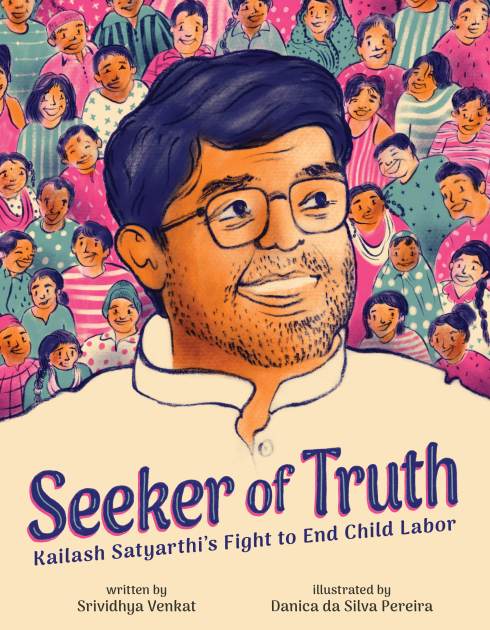
Four years later in July 2024, SEEKER OF TRUTH: KAILASH SATYARTHI’S FIGHT TO END CHILD LABOR (Illustrated by Danica da Silva Pereira) was published by Little Bee Books.

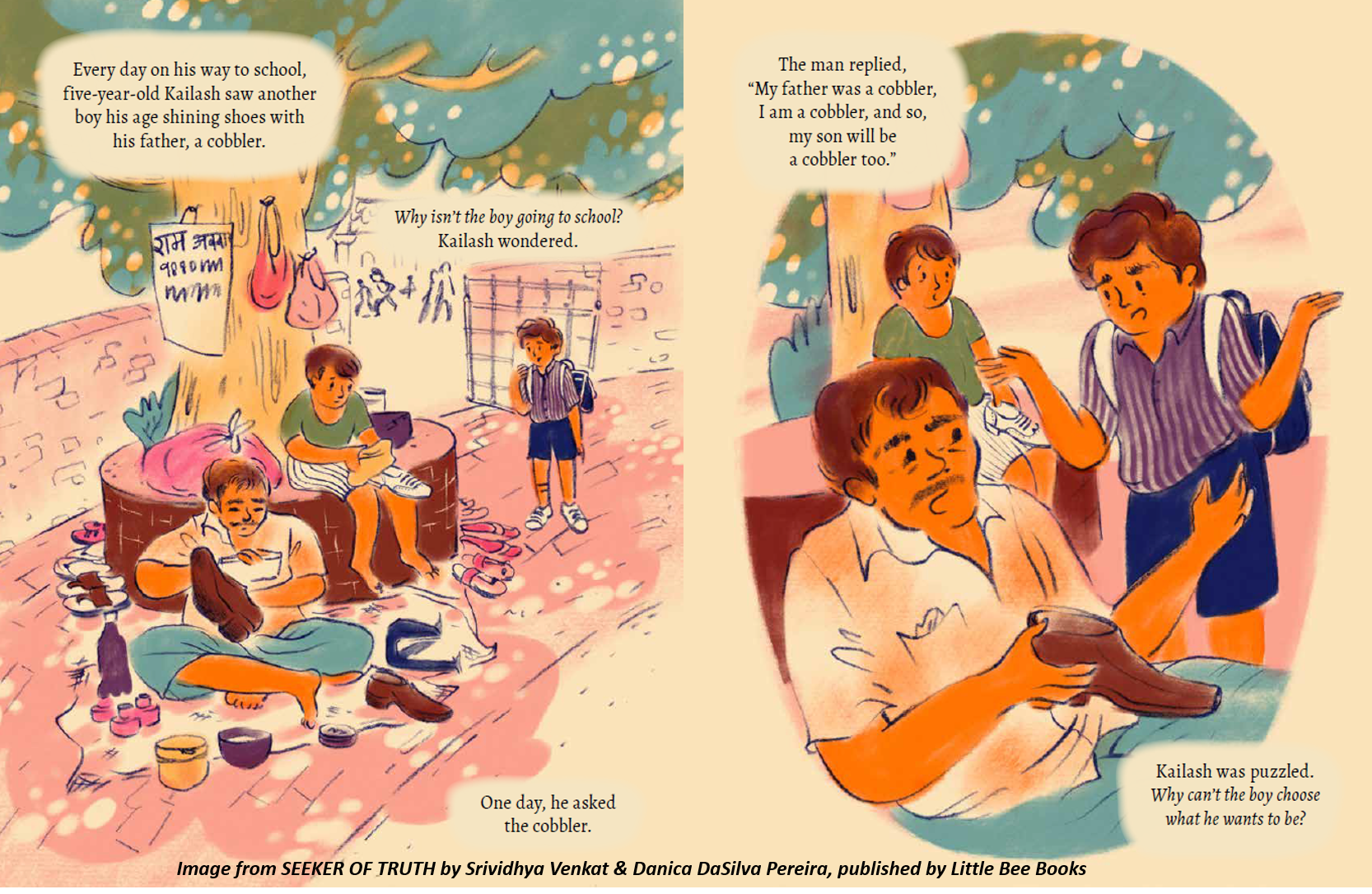
This is a picture book biography about Kailash Satyarthi, a child rights activist and social reformer from India, who has rescued over 100,000 children from exploitation and empowered them to be future leaders.

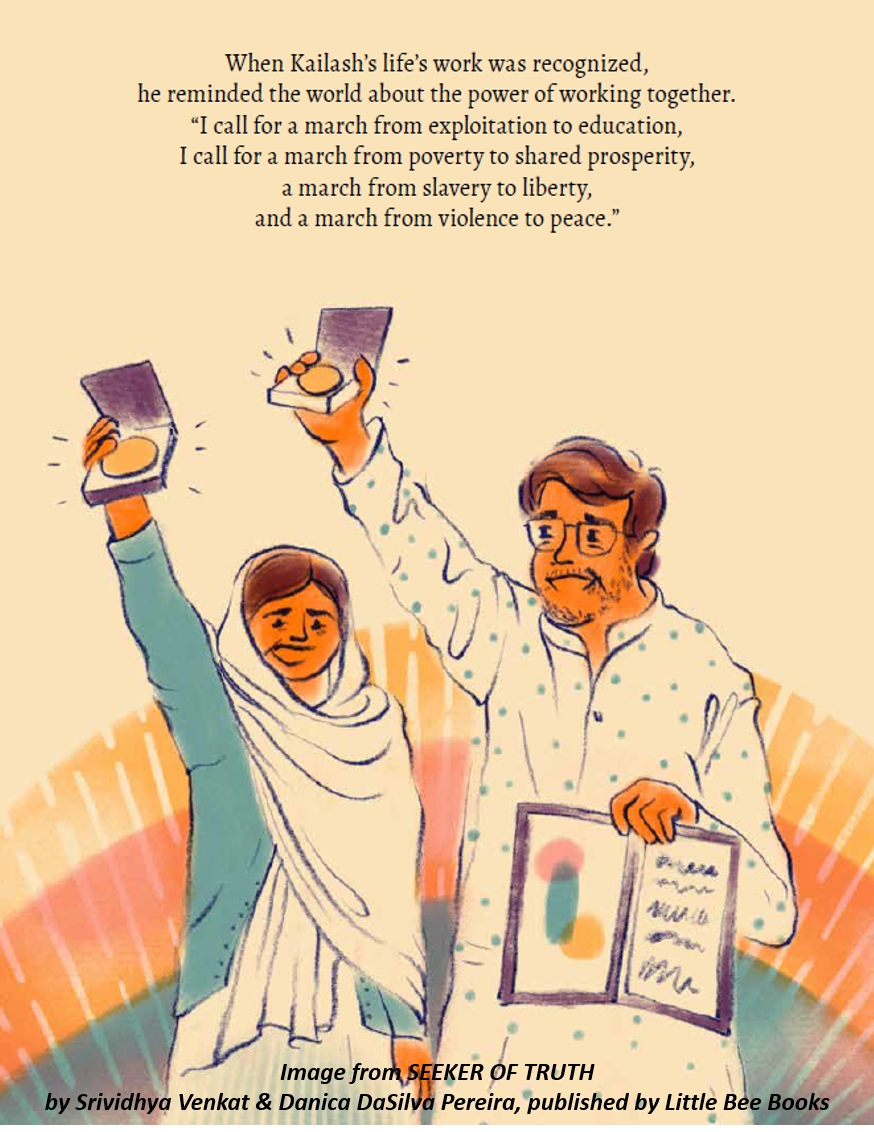
He has also helped raise awareness about child labor around the world while advocating international laws against child slavery. Kailash’s extraordinary efforts were recognized in 2014 when he was awarded the Nobel Peace Prize alongside Malala Yousafzai.

So Storystormers, the next time you read a picture book, look at the back matter closely. Does the Author’s/Illustrator’s Note inspire any thought-provoking story ideas? Could the Further Reading or Bibliography sections lead you to interesting topics to explore? What if the accompanying photographs give you some leads into future projects (as with me!)? You never know where that nugget of an idea, which inspires your next project, resides.

Never turn your back on back matter!

I wish you the very best in your writing journey!

Srividhya Venkat is a children’s writer, mom, and former early childhood educator. She has published several picture books, including Seeker of Truth (a 2025 Jane Addams Children’s Book Award finalist), Girls on Wheels (2024 RISE: A Feminist Project Booklist), and Dancing in Thatha’s Footsteps (2022 South Asia Book Award). Having grown up in India and lived across three countries, Srividhya loves stories that are unique, yet universal. You can learn more about her at SrividhyaVenkat.com and follow her on Instagram @srividhyavenkat and BlueSky @srividhyavenkat.bsky.social.

Srividhya Venkat is giving away a 30-minute AMA video call or virtual school visit, winner’s choice.

You’re eligible to win if you’re a registered Storystorm 2025 participant and you have commented only once below.

Prizes will be distributed at the conclusion of Storystorm.

 by Lisa Frenkel Riddiough

Greetings, StoryStormers!!

I must confess right off the bat that I am not one who struggles to find ideas. I have gazillions! Sometimes I have so many ideas that I become frozen and can’t move, let alone start a new manuscript.

Some of you might not like hearing that because you are searching high and low for a new idea.

So, I am here to remind you that ideas are surrounding you at this very moment.

In fact, YOU ARE THE IDEA!

The best ideas are the ones that we come by naturally. They are the ones that appear when we are just living our lives. They come from the people, places, and things that make us who we uniquely are.

I am going to walk you through an exercise where you are sure to discover at least one idea just by being you, on this random day, living in your uniquely magical world.

Are you ready?

Here we go!

Make a list of five of your favorite things. Five things that define you. They come easily to your mind. If a good friend were to see this list, they would say, “Oh, yes. This is SO YOU.”

Here are five of my favorite things:

  • Sequins
  • Felt
  • Pie
  • Sprinkles
  • Pierre ⇓⇓⇓⇓⇓⇓

If you think I live in a fantasy world, YOU’RE RIGHT!

Do you have your five things?

Now take your five things and put them through the machinery of your mind. How are these things authentically you?

Let’s take the word “sprinkles.” Here is how this word is authentically me:

I have a sprinkle drawer.

Adding sprinkles to baked goods makes my heart sing.

There is a story here.

The next step is to quick, quick, quick, come up with titles. Don’t worry about story or character or theme yet. Just titles.

Here are five titles for the word “sprinkle.”

  • The Cupcake with No Sprinkles
  • The Case of the Missing Sprinkles
  • Sprinkle, The Pixie Who Lost Her Dust
  • A Sprinkle of Kindness
  • Sprinkled with Love

My latest picture book, PIE-RATS!, illustrated by David Mottram (Viking 2024), came from this exercise. I knew I wanted to write a funny, rhyming PB about one of my favorite foods. When I settled on “pie,” I ran it through the machine of my brain until I came up with the title “pie-rats.” Pirate rats in search of pie! True confessions: I thought I had made up this word. But, alas, there are other pie-rat stories out there. Even still, I worked hard on my story and it turned into this:

Now you try it!

Write a title for each of your five things. DON’T WORRY ABOUT THE STORY YET!

Good Job.

Now, I want you to list five of your happiest, happy places. Here are mine:

  • Lake Tahoe (specifically, Sand Harbor)
  • Tennessee Valley Trail
  • My home office
  • Sitting in The Happy Chair (yes, sometimes I name my furniture!)
  • Peet’s Coffee in El Dorado Hills (also the one on Piedmont Ave.)

Now take your list and riff on titles again.

Isn’t this fun?

I’ll work with The Happy Chair.

Wow!

THE HAPPY CHAIR is its own title. Yay!

Do you have your five titles?

For our final round, take a look at the room you are sitting in right now.

Just do it.

Look around.

Find five things that spark for you.

Here’s what I see:

  • A paper punch
  • My tray of Flair pens
  • The teeny, tiny bowl that I keep my chocolate chips in
  • The bunny I painted in 1970
  • Grammy’s owl statue

You know what to do next.

Find a title!

If you are the type of person that needs a bit more time to come up with a title, just call your book GRAMMY’S OWL until you find something better.

Hey! I kind of like that title. Wow! Hmm? I wonder what Grammy’s owl is up to today? Does she have siblings? What is her favorite dessert?

Oh, sorry about that! Back to the blog post.

The point of all of this is that the life you are living every single day is filled with authentic ideas that are uniquely yours.

You don’t even have to leave your house to find picture book ideas. Just look around, make a list, put that list through the machinery of your mind, and pop out some titles.

When you write about something that is authentically YOU, you can’t go wrong. It might take you five or ten years to get that story right, but it will be worth the wait.

In 2015, I made a list of things I wanted to improve about myself. Naturally, I wrote one for each letter of the alphabet. And in 2022, that list became a book: LETTERS TO LIVE BY, illustrated by Asa Gilland (Running Press Kids).

And if you think my next picture book, EMBARRASSED FERRET (Illustrated by Andrea Tsurumi, Disney Hyperion, July 8, 2025) is all about the various embarrassing episodes of my own life, YOU’RE RIGHT!

Not only are you the idea, but also, YOU ARE THE STORY!

Lisa Frenkel Riddiough has an MFA in Writing for Children and Young Adults from Hamline University. Her projects include middle-grade, picture books, and board books. When Lisa is not sitting in The Happy Chair eating freshly sprinkled baked goods with Pierre, she can be found commiserating with her backyard squirrels. Learn more at LisaRiddiough.com and follow on Instagram @lisariddiough.

Lisa Frenkel Riddiough is giving away a signed copy of PIE-RATS!

You’re eligible to win if you’re a registered Storystorm 2025 participant and you have commented only once below.

Prizes will be distributed at the conclusion of Storystorm.
by Stef Wade

As a grown woman, I’m proud to say I’m a teacher’s pet. This was not the case as a young student, as seen by the multiple “tends to socialize and distract” comments on my old report cards. But I’ve changed my ways (for the most part). I turned the tables and owe it all to what I call…sneaky learning!

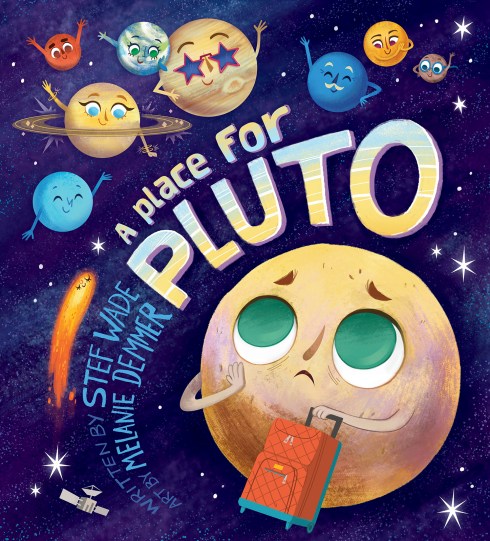
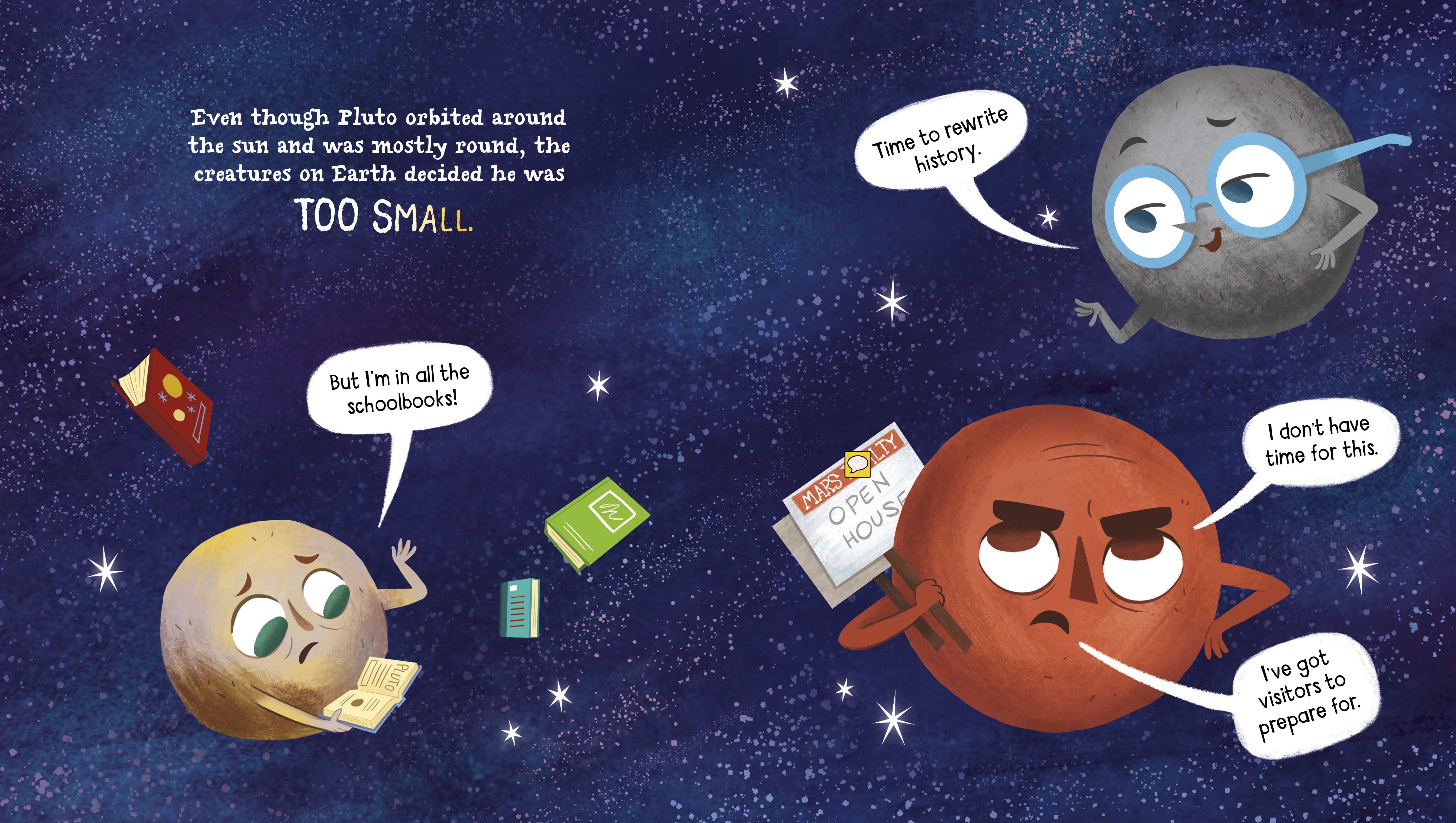
When my first picture book, A PLACE FOR PLUTO, illustrated by Melanie Demmer, debuted in 2018, it was the stardust that started my love for turning fact into fiction. What began as a story about Pluto being sad he wasn’t a planet anymore, ended up a multi-layered manuscript of friendship, belonging and a whole bunch of space facts.

Did you spot the fun facts woven in here?

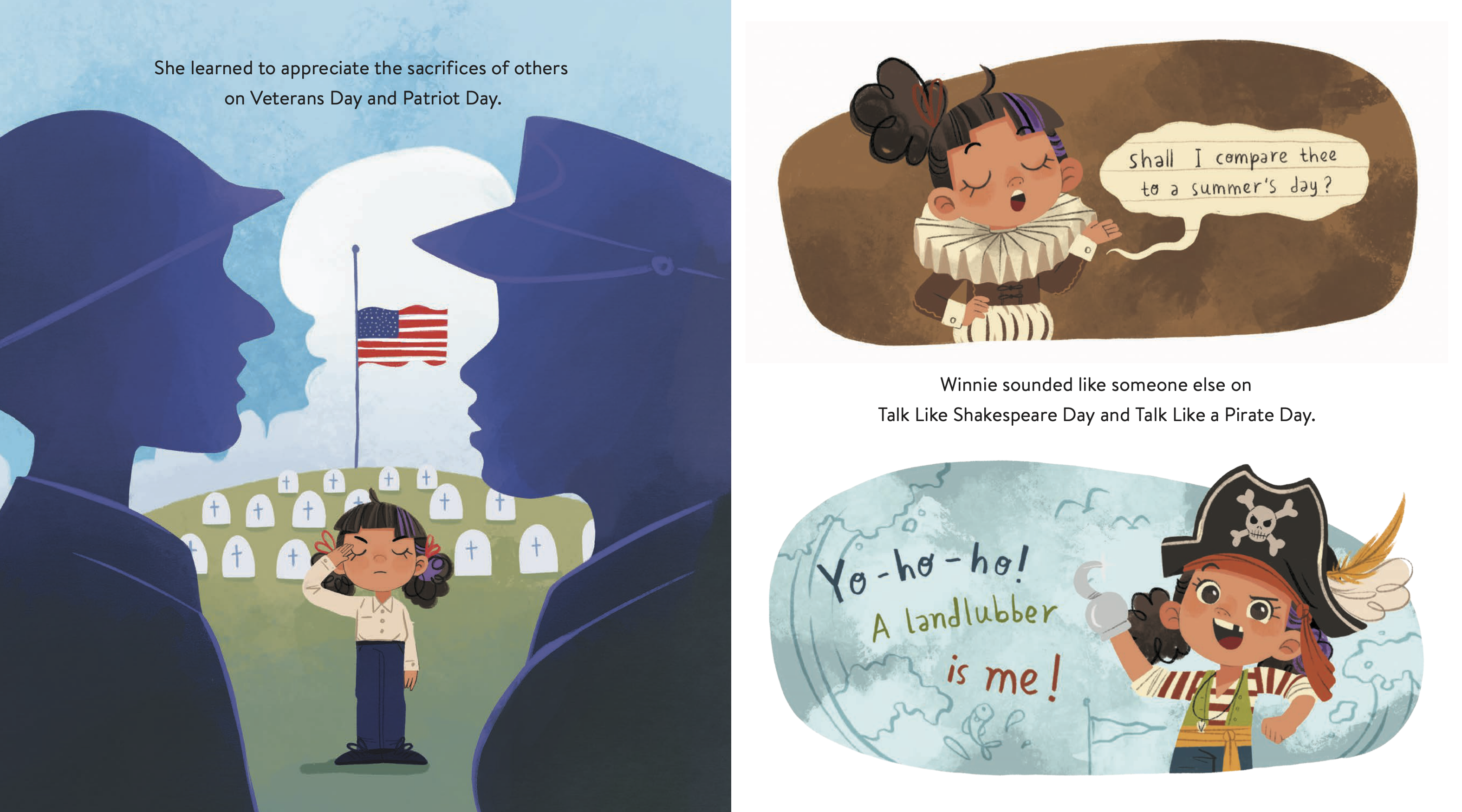
I’ve applied similar tactics to all my books, including my last release, EVERY DAY’S A HOLIDAY, illustrated by Husna Aghniya, which I’m proud to say, was a product of Storystorm! In this story, I yearned to teach readers about the wild, silly, and serious holidays here in the U.S. I ended up using the “merge two stories” technique and paired it with a young girl who couldn’t wait for her birthday and bam! EVERY DAY’S A HOLIDAY was born.


I try not to smack my readers over the head with the learning stick. Instead, I work to create funny, relatable, and likable characters to love, that just so happen to teach readers something interesting during the story.

I call my work Teacher’s Pet Fiction (the teachers love adding these stories into their curriculum!), but it has become better known as Informational Fiction and I want you to try it out today!

You ready?

Step 1: Brainstorm a fact or subject that your reader might want to learn. This can be broad like space or very specific like butterflies taste with their feet. Pick something that is interesting to your reader, but more importantly, interesting to you! Think, read, Google, ask a kid what they learned in class today – anything to get the ideas flowing.

Step 2: Research your idea. Find as many facts about this idea as possible. Write the facts down, bookmark them on your phone or computer, highlight them in a book. Remember these facts can help create your characters and your story.

Step 3: Word bank as many words as you can. Think of all the words associated with your facts. Make a list. How many of these can you incorporate into a story? Which ones must be included and which are extra?

Step 4: Create a story. We may still be in the brainstorming phase during Storystorm, but as I tell all my students during visits, an idea isn’t a story. An idea blossoms into a story. Let’s take it a little further than the idea. Can you find a problem for your main character to solve? Maybe your butterfly’s feet are so stinky that nothing tastes good! How can your facts be woven into your problem?

Even if informational fiction isn’t your jam, I hope this exercise sparks some stardust in you!

Reach for the stars…and Happy National Peanut Butter Day!

Stef Wade is the award-winning author of A PLACE FOR PLUTO, THE VERY LAST LEAF, Q & U CALL IT QUITS, MOVING TO MARS and EVERY DAY’S A HOLIDAY. She’s the recipient of the 2019 LITA Golden Duck Notable Picture Book Award, honorable mention for the Tofte/Wright Children’s Literacy Award as well as a nominee and runner-up for multiple state book awards. Stef lives out her dream every day—writing books and presenting to children across the country to share learning, love, and laughter. Stay tuned for exciting book news for 2026! You can visit her on her website at StefWade.com and Instagram: @stef.wade.

Stef Wade is giving away 2 signed copies of EVERY DAY’S A HOLIDAY and one picture book manuscript critique to three separate winners.

You’re eligible to win if you’re a registered Storystorm 2025 participant and you have commented only once below.

Prizes will be distributed at the conclusion of Storystorm.

by Margo Leipua’ala Sorenson

Rejection! Rejection! Rejection! Poor Little Cup—no one wanted to publish his story. *cue sobbing* Here was the pitch: “Everyone in the kitchen has a very important job to do, except for Little Cup. He desperately wants to help, but no one believes he can do anything that counts. He needs to prove he can be the biggest helper of all.”

Many of us have been on this very same writing journey of rejection, shoulders drooping, steps shuffling, head hanging down, and we do so get it. The hard truth, as many of us reluctantly recognize, publishing IS a business, and if LITTLE CUP didn’t strum anyone’s ukulele (you’ll know in a minute why this analogy), then, maybe I needed to “repurpose” and “rethink” the story to make it more marketable to an editor and an audience.

Just because we have actually written something—of course, we’re positive that it’s amazing and wonderful 😉—we often conveniently forget Ellen Kozak’s First Commandment for Writers: “Thou Shalt Not Fall In Love With Thine Own Words.”  After many rejections, we probably need to take a cold, hard look at the entire picture. Who is its market? Why would a parent or a librarian want to buy this book? What will make it stand out in a crowded market?

As my manuscript sat sadly on the shelf—known as the hard drive—just as Little Cup sat sadly on his cupboard shelf—I had to admit to myself that LITTLE CUP was probably too generic—oh, sure, it had “hilarious” puns, (“You need to chill out,” the refrigerator said, frostily.), but it was too “oatmeal,” as I used to tell my students, and not enough “jalapeño.” Because our family had lived in Hawai’i for ten years (note my Hawai’ian name, Leipua’ala, gifted to me in ancient Hawai’ian tradition), I thought it might be a different idea to switch the setting to Hawai’i, and pitch it to some local Hawai’i publishers. (Now you get the ukulele part.)

It was so much fun changing everything to local Hawai’ian references—Little Cup became Little Calabash—we have a calabash of our own, of course—Ethan turned into Keoki, and Keoki’s mom stirs guava frosting (not just boring buttercream), pours haupia pudding (no tepid tapioca), mixes mango cupcakes (definitely not plain vanilla), and chopsticks appear, too.

I was more than delighted when local publisher Island Heritage wanted to acquire it. My editor even came up with the idea of having a glossary explaining local food items, like starfruit and haupia pudding, that might be mysterious to Mainland young readers.

Now, you can find LITTLE CALABASH everywhere, not only in its Hawai’ian home, but kids on the Mainland enjoy it, too.


Young readers can broaden their horizons and get giggles from all the vivid, creative illustrations of talented illustrator Anneth Lagamo, who brings Little Calabash and all his kitchen friends to life. You’ll never look at a can opener in the same way, again.

If you’re struggling with a manuscript—either because you just can’t seem to finish it—or because it’s been rejected multiple times (I’m talking weight in pounds not just counting rejections 😉), you can rethink and repurpose it by: changing the setting—instead of a home, what about a factory? Or a library? Or a schoolyard? Or a garage? A forest? The ocean deep? Outer space? Instead of a regular meal, how about a birthday dinner? A picnic? Or from day to night, afternoon to morning, summer to winter…You can also consider changing the importance of your characters by switching one of your secondary characters to becoming the main character. What would happen if you changed them all into animals? Or even into inanimate objects—think what fun an illustrator could have! Maybe your narrator is not the main character—as in my picture book CALVIN GETS THE LAST WORD, in which Calvin’s dictionary is telling the story. Once we repurpose and rethink, we can bring all sorts of new angles and ideas to mind, and our story could appeal to a different reading audience or fit into a different market. When we set our imaginations free, we never know what will happen!

When you have a story that really speaks to your heart, but things aren’t happening the way you want them to, keep believing in your story, but be flexible, and try to think outside the box—let your imagination go—and repurpose and rethink. The kernel of your story is the same—(think of playwright David Mamet’s concise plot outline: “Who wants what and why? Why now? What happens if her (sic) don’t get it?”) but everything else can be dynamic and fluid. You may find yourself with a published book that will find its way into young readers’ hands, after all!

Children’s and Young Adult author Margo Sorenson is the author of thirty traditionally-published books, infamous for her hapless puns (just ask her long-suffering family). To learn more about her books, including CALVIN, featured in the NY Times, please visit: MargoSorenson.com. You can also find her on Instagram @margosorensonwriter and BlueSky @margosorenson.bsky.social.

Margo Sorenson is giving away a query critique for a manuscript for young readers.

You’re eligible to win if you’re a registered Storystorm 2025 participant and you have commented only once below.

Prizes will be distributed at the conclusion of Storystorm.

by PB25 Vibes

In PB25 Vibes, a group of creators with books launching in 2025, we are all about vibes! Finding that feeling you want to leave with the reader is at the heart of writing a picture book. Our stories are ones that are meant to evoke emotions, and as we drafted our stories, we kept a feeling—a vibe—in mind. As you read through our personal processes below, think about a vibe that you want to share in your next manuscript!

Alison McGauley, author of KENZIE’S LITTLE TREE (illustrated by Emilie Leduc, Orca Book Publishers, March 11, 2025)

The inspiration for KENZIE’S LITTLE TREE came from my daughters who have always lived with a chronically ill mom. Wanting to write a story that represents children like my own, and to empower readers to recognize their inner strength, I began with the vibe of resilience. KENZIE’S LITTLE TREE reminds us that though the world is constantly changing and oftentimes difficult, we can be bold and strong, just like the little tree. I hope that children and families feel the vibe of resilience as they read about Kenzie and her little tree.

Ha Dinh, author of THE JADE BRACELET (illustrated by Yong Ling Kang, Random House Studio, April 15, 2025)

While finishing up my debut picture book, I got the inspiration for THE JADE BRACELET as I reminisced about the jade bracelet that my late mother had gifted me as a child. The vibe for this story has always been about love and how love can manifest itself in a family tradition, memory, or even a family heirloom in the shape of a piece of jewelry as in this book, which can hold so much sentimental value and can be passed down down one generation to the next. How does love manifest in your writing?

Chelsea Tornetto, author of CHALK THE WALK (illustrated by Laurel Aylesworth, Familius, April 2025)

I’m a rhyming writer, and the meter of a story can impact the “vibe” in a big way!  For CHALK THE WALK, I used a playful, upbeat rhythm, as well as the amazing art from Laurel Aylesworth, to tell the story of two kids who change the whole VIBE of their previously dull, gray city street with just a bucket of sidewalk chalk…and spread joy and color to their neighbors.  The result is a story that leaves the reader with a sense of hope and a desire to use their own imaginations to change the world…just like the main characters!

Christine Alemshah, author of BEA’S BALIKBAYAN BOX OF TREASURES (illustrated by Dream Chen, Free Spirit Publishing, June 17, 2025)

Embracing Bea’s story vibe felt like falling in love with a new song and listening to it on repeat. Not every track on my storystorm playlist becomes a full-fledged picture book! I scroll my list often, and bold ideas that tug at my heartstrings. BEA’S BALIKBAYAN BOX OF TREASURES topped the chart because it aligned with my big why — to nurture a lifelong love of reading, cultivate connections, and help children see themselves represented in the stories they read. I challenge you to scroll through your idea list often and listen with your heart to help identify which ideas to pursue!

Costantia Manoli, author of THE FIG TREE (illustrated by Leah Giles, Roaring Brook Press/Macmillan USA, June 2025)

My aim when writing a picture book is to leave the reader with a hug-the-book-at-the-end kind of vibe. I want my readers, big and small, to see themselves reflected back in the pages. I want my readers to close the book at the end and feel connected. I want my readers to feel all the feelings. THE FIG TREE is about connecting with others – no matter what stories you’ve been told about them. How can you layer resonance, connection and emotion in your own writing to create that hug-the-book-at-the-end vibe?

Namrata Agarwal, author of THE MITHAI BOX IS NOT EMPTY (illustrated by Parvati Pillai, Holiday House, summer 2025)

Often, we face dilemmas in our lives and so does Ria in the story ‘THE MITHAI BOX IS NOT EMPTY.’ A dilemma tends to evoke a vibe of inner conflict. These inner conflicts can be a natural part of a child’s development. Wise advice can be incredibly helpful in resolving inner conflicts. Like in THE MITHAI BOX IS NOT EMPTY, thoughtful advice changed Ria’s vibe. Imagine a feeling of yours becoming a strong “vibe.”

Can you think of a story around that vibe?

Carolyn Bennett Fraiser, author of M IS FOR MASON JARS (illustrated by Sally Garland, Familius Publishing, August 2025)

I wrote M IS FOR MASON JARS on a dare. Could I think of an activity for kids on a modern-day homestead for every letter of the alphabet? Yes! I initially focused on activities that were “fun” for kids. But as I was writing (and rewriting), another vibe bubbled to the surface–“togetherness.” Everyone must work together to make a homestead successful–including the youngest. THAT was the heart of my story.

As you explore your topic, what other vibes do you feel? They might just take you in an interesting direction!

Blair Williamson, author of BIRTHDAY BASH (The Little Press, September 16, 2025)

The idea for BIRTHDAY BASH came from a moment of pure, unfiltered chaos while living on a boat. One day, as I stood in the galley, a bug scurried across the floor. What started as a simple sighting turned into a wild spiral of what-ifs in my mind, and it became a story waiting to be told. Birthday Bash captures that vibe of crazy, unpredictable fun, filled with mishaps, laughter, and, of course, a tiny bug causing a big mess. I hope this inspires anyone who’s ever found themselves swept up in a whirlwind of “what-ifs?” to write their story!

Kimberly Horch, author of SAWYER’S BIG IDEA (illustrated by Sayani Mukherjee, Magination Press, Fall 2025)

Sawyer has a million amazing ideas, but gets hyperfocused, distracted, and discouraged. As I approached his story, I knew it couldn’t end with him finishing everything. Anyone Sawyer-like knows that simply isn’t reality. But I wanted readers to leave feeling celebratory of the superpower of idea-generation. Recognizing this vibe allowed me to focus my thoughts on what moments (other than finishing) could leave him feeling “celebratory.” Thanks to an SCBWI event, I had two opportunities to pitch to Magination. Nailing the end feeling changed their feedback from “It’s a cute idea…” to “Yes!”

Amanda Davis, author-illustrator of SOMETIMES STORMY: A STORY ABOUT FINDING CALM AND STAYING SAFE WHEN SOMEONE YOU LOVE DRINKS TOO MUCH (Free Spirit Publishing/Teacher Created Materials, Fall 2025)

*sneak peek of near-final cover

When writing and illustrating SOMETIMES STORMY, I channeled my childhood and the memories of living with a parent who had alcohol use disorder. This wasn’t an easy ‘vibe’ to sit with but it’s an important and common one. According to the National Institute on Alcohol Abuse and Alcoholism, in 2023, 28.9 million people ages 12 and older had alcohol use disorder (AUD) in the past year. Despite these heavy ‘vibes’, I always kept my positive message to readers in mind: “You’re not alone and it’s not your fault.” Are you digging into difficult vibes with your current work? If so, remember your why. What’s the positive message you want to send readers? I hope this inspires you to keep going!

Leslie Johnson Piotrowski, author of THE NORTHBOUND TRAIN (illustrated by Tonya Engel, Abrams Books for Young Readers, Spring 2026)

Leaving behind your home and community can be daunting. In writing THE NORTHBOUND TRAIN, I thought of what my father went through when he moved with his family from Birmingham, Alabama to Chicago, Illinois in the 1930s, a time when millions of African Americans left the South to escape Jim Crow laws. In writing the story, I also connected with my own inner feelings of anxiety around moving to new places. I wanted children to know that they are not alone in feeling nervous about leaving home and that journeys can bring about unexpected gifts.


Now it’s your turn. Think about a vibe that affected you. Was it a moment you realized that you were stronger than you thought? Was it a time when you felt completely unified and connected with others, or when you suddenly realized the answer to a problem was standing right in front of you? Mine your memories for instances in your life that stood out for you. Notice your emotions, as these play a strong role in children’s literature. Those feelings or vibes could possibly provide the inspiration for your next story.

Alison McGauley is a special education teacher and the author of KENZIE’S LITTLE TREE (March 2025, Orca Book Publishers), illustrated by Emilie Leduc. As a chronic illness warrior, Alison is passionate about writing books that speak to children and caregivers who are impacted by illness or disability. She also loves creating stories that feature humor, SEL, and the natural world. Alison resides in Ontario, Canada with her family. Connect with Alison on her website alisonmcgauley.com, Instagram @alisonmcgauley, or Bluesky @alisonmcgauley.bsky.social. 

Ha Dihn is a mom of two, an elementary teacher, and the founder of the Happy Days in First Grade Teaching Blog. She is the author of WHERE WILDFLOWERS GROW and three books that are being published in 2025, THE JADE BRACELET (April), LY-LAN FINDS A WAY SERIES: LY-LAN AND THE NEW CLASS MIX-UP (June), and THE MOON LANTERN (September). You can follow her @HelloMrsDinh on IG. 

Chelsea Tornetto is a former world geography teacher, who has loved writing ever since she was a kid. Her first book, Conquering Content Vocabulary, was published by Scholastic in 2018, but now her passion is picture books.  She is the author of Gardens Are For Growing, God Made You Too, Seasons on the Farm, Chalk the Walk, and The World’s Best Christmas Light with more titles on the way. When she isn’t working on her own stories, she helps others follow their dreams of writing for children as a freelance editor and author coach for At Home Author.  

Christine Alemshah (she/her) is a mom,  children’s author, classically trained vocalist, and host of the Grow Your Writing Challenge. Christine writes stories championing innovation, celebrating multiculturalism, and often having a musical vibe. Her picture book BEA’S BALIKBAYAN BOX OF TREASURES releases June 17, 2025 from Free Spirit Publishing. You can follow Christine on X, Instagram, and Bluesky: @C_Alemshah and on her website. She is represented by Vicky Weber of Creative Media Agency. 

Costantia Manoli is the award winning author of TOMATOES IN MY LUNCHBOX (illustrated by Magdalena Mora, Roaring Brook Press, June 2022) and THE FIG TREE (illustrated by Leah Giles, Roaring Brook Press, June 2025). Born in the UK to Cypriot parents, Costantia spent the picture book period of her life in London, her middle grade and young adult years in Cyprus and then the USA and then back round again. Learn more about Costantia on her website, Instagram, Facebook and BlueSky. 

Namrata Agarwal is a children’s book writer. She has written picture books – Misha series and The Grasshopper and the Owl. She has also written for children’s magazines like Faces and IntellyJelly.  She is a member of SCBWI, RateYourStory and Writing Barn. Currently she lives in New Jersey with her two kids and husband. In her spare time, she enjoys reading and crafting.  You can follow Namrata on Twitter @namrataagarwal, Instagram @namrata.writer. 

Carolyn Bennett Fraiser manages a small homestead in western North Carolina and is the author of M IS FOR MASON JAR (Familius, 2025), MOON TREE (Reycraft Books, 2022),  and several other nonfiction books for the educational market. She hosts the KidLit Events Calendar on her website. Connect with her @carolynbfraiser on Facebook, BlueSky, Instagram, and X.

Blair Northen Williamson is a Book Excellence Awards Winner and Amazon #1 new release author of ISLAND GIRLS: Free the Sea of Plastic (Williamson/Holovchenko, 2022) who loves writing stories that make children laugh, stories that will spark important conversations and stories that will ignite change to protect our oceans. She is a mother and wife, a retired boat captain, and a scuba diving instructor who also loves sunrises and coffee. Williamson has two traditional books releasing this year: BIRTHDAY BASH (Williamson/Woolley, Little Press, 2025) & THE OCEAN PROTECTORS (Williamson/Holovchenko, Genius Cat Books, 2025). ​She is represented by Karen Kilpatrick of East West Literary Agency. You can connect with Blair on X @theislandwriter or IG @theislandwriter8 as well as follow her website for updates www.theislandwriter.com.

Kimberly Horch is an author, mom of five, and a self-proclaimed agent of joy. Like Sawyer in SAWYER’S BIG IDEA, she always has a dozen projects up in the air and twice as many on the floor. Kimberly writes lyrical picture books and middle grade novels in verse. Her instagram inspires kindness through books and action @thedaybrighteningcommittee; she is also on X.

Amanda Davis is a teacher, artist, writer, and innovator who uses her words and pictures to light up the world with kindness. Amanda is the author of the award-winning picture books, 30,000 Stitches: The Inspiring Story of the National 9/11 Flag (illustrated by Sally Wern Comport), and Moonlight Memories (illustrated by Michelle Jing Chan).  SOMETIMES STORMY is her author-illustrator debut, and she has three more unannounced picture books on the way. Learn more about Amanda on her website and on Instagram, Twitter (X) and BlueSky.

Leslie Johnson Piotrowski is a biracial (Black/White) author with a passion for representation and sharing her own heritage through children’s literature. A native of Chicago, she worked for many years in the public relations/communications field before she pursued fiction writing. Her debut picture book, THE NORTHBOUND TRAIN, releases Spring 2026 (Abram’s Books for Young Readers). You can follow Leslie on her website and on X @lpiotrowski80. 

The following prizes are being given away by the PB25 Vibes Group:

  1. Alison is offering a PB critique.  
  2. Ha is offering a PB critique. 
  3. Chelsea is offering a PB critique (under 1000 words). 
  4. Christine is offering a PB or chapter book critique (first 1000 words.)
  5. Costantia is offering a PB critique.
  6. Blair is offering a 30-minute virtual Ask Me Anything. 
  7. Namrata is offering a 30-minute virtual Ask Me Anything. 
  8. Carolyn is offering a 30-minute virtual Ask Me Anything. 
  9. Kimberly is offering a PB critique or MG first 1,000 words.
  10. Amanda is offering a 30-minute virtual Ask Me Anything. 
  11. Leslie is offering a PB book critique (first 1000 words)

You’re eligible to win if you’re a registered Storystorm 2025 participant and you have commented only once below.

Prizes will be distributed at the conclusion of Storystorm.

Like this site? Please order one of my books! It supports me & my work.

FLAT CAT is the winner of multiple state book awards, selected by kids!

Enter your address to receive this blog via email.

Join 14.6K other subscribers

My Books

Blog Topics

Archives