You are currently browsing the category archive for the ‘STORYSTORM 2024’ category.
by Mylisa Larsen
So, I’m off to write a picture book. I sit down at my desk, and . . . nothing. Or something that sounds exactly like me, but not in a good way. Something that’s a whole lot like the manuscript I started last week which was a lot like the one I wrote last month. (Sigh.) Now what?
We all have favorite ways of entering the writing of a picture book. I think of them as different doors. I tend to go in through the door of voice (blue door with a dragon doorknob in my imagination.) But always going in through the door I’m most comfortable with sometimes limits the kinds of picture books that I’m able to write.

And one of the glorious things about the picture book genre is that it is varied and wide-ranging. There are so many doors you could step in through. What if today you go through a door you haven’t opened before?
Here’s some doors you might try.
- Concept—a book built around an idea (weather, family, water, etc.)
- Rhythm—Can you mimic the rhythm of a process or event? Where does that take you?
- Patterns—Set up a pattern and then break it (or pay it off) in a satisfying way. Or try adding a chorus to a picture book you’re writing? Does it make it richer?
- The Physical Form of the Book—How could you use the gutter of the book as a design element? Or trim size? Shape? Flaps or folds? Cut-outs? Page turns? Endpapers?
- Character—Can you create a book where everything that happens in the book happens because of who the main character is and how she sees life and behaves?
- Personification—Can a usually inanimate object tell a story in an intriguing or comic way?
- Visuals—even if you aren’t an illustrator, could you “write” a wordless book where the story is told entirely through the visuals? It’s good practice for us word people to think more visually. Make a storyboard and break out those stick figures, if need be!
- Dialogue—Can you tell a story only with dialogue? Or letters? Or signs?
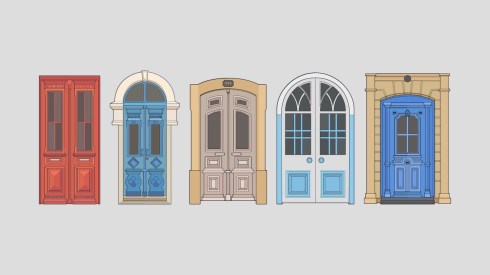
One more thing. A picture book may start by going in through a certain door, but the best picture books actually have many things going for them—great story, told in a distinctive voice with unexpected elements that surprise and delight us. So try out a new door, sure. But when you find something that you love, make sure that during revisions you take yourself (and your manuscript) in and out of several doors as you layer elements to make that book as worthy of multiple reads as you can.
Go try out a new door today. Or several. Have fun!

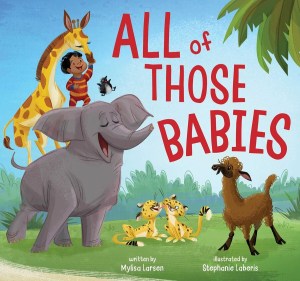
Mylisa Larsen will be giving away a signed copy of her newest picture book ALL THOSE BABIES which started by going through the door of loving odd words (when she found out baby echidnas are called puggles, she was off to the races) but then also went wandering through rhythm and rhyme doors, concept doors, and pattern doors before it was finished.
You’re eligible to win if you’re a registered Storystorm 2024 participant and you have commented only once on today’s blog post.
Prizes will be distributed at the conclusion of Storystorm.

 Mylisa Larsen has been telling stories for a long time. This has caused her to get gimlet-eyed looks from her parents, her siblings and, later, her own children when they felt that certain stories had been embellished beyond acceptable limits. She now writes children’s books where her talent for hyperbole is actually rewarded. You can visit her online at MylisaLarsen.com.
by Courtney Pippin-Mathur
Hello Storystormers!
When Tara approached me about doing art for STORYSTORM, I was thrilled. I have been a participant and an occasional guest author, but this was different. I was excited. I was determined. I was nervous.
I started with a few sketches. I love drawing gnomes, fairies and elves, so thought I would try that. I added some carrying or thinking of lightbulbs.

But it didn’t feel quite right.
When I wasn’t sketching ideas, I thought on it. Thinking on it is one of a writer’s greatest tools. You can do it anywhere. Doing dishes—Think On It. Drawing an elf for a monthly challenge—Think On It. Take a shower—Think On It.
During my Think on It sessions, I came to two conclusions:
- I wanted the character to be an animal.
- I wanted the “storm” part of STORYSTORM to be a blizzard.
So I started sketching animals. I filled up a page of various animals with lightbulb ideas.

Two stuck out to me: the lion and the bear.
When an idea or sketch is appealing to me, I draw it again.
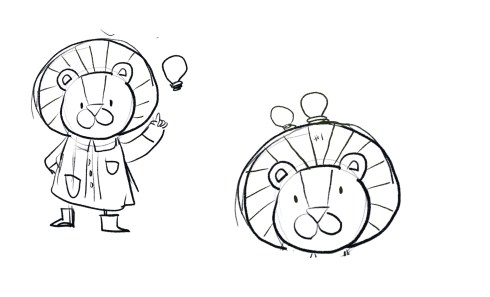
The little lion was really appealing to me; I loved his wee raincoat. But as I sketched him more, I realized I liked him BUT he wasn’t right for the STORYSTORM blizzard idea. So, I put him aside to use sometime in the future. Maybe as a picture book idea?
I went back and sketched the bear in different positions and ideas. (For the participation badges, winner badges, banner, etc.)

Then I sent it to Tara to see if she liked the idea. She did, so I started on the color. Actually it was a week or so later. My art creation process is usually a series of scribbly twists and turns instead of a simple line. It used to frustrate me, but now I accept it as part of the process and look for any extraneous sketches or ideas that I can use in the future.
When I came back to start the final art, I decided I wanted the bear to be a full sized bear instead of a little guy. So I did drew it again.

I played around with compositions and finally came to the ½ view you see in the “Participant” badge.

Added color…

Tara and I hopped on a Zoom to find the perfect font. (Which Tara is better at than me.)
And ta-da…

I was very happy with him. So much so, that I added color to the earlier sketch-version and have it on my website for my winter welcome page. (And as stickers!)


I love projects that inspire other art or illustrations and since STORYSTORM is all about inspiration, it seems perfect.
P.S. While all of these revisions were happening, I WAS THINKING ON IT. In the banner, there are several ideas (lightbulbs). Some are easy to find—like on the trees, some are closer to home, some are half-buried in the snow—you just half to go look for them. See how many you lightbulbs you can find in the banner. And good luck on finding your 30 ideas!
Courtney Pippin-Mathur is giving away one 30-minute “Ask Me Anything” Zoom plus a pack of stickers from her Etsy shop to one lucky Storystorm winner.
You’re eligible to win if you’re a registered Storystorm 2024 participant and you have commented only once on today’s blog post.
Prizes will be distributed at the conclusion of Storystorm.
 Courtney Pippin-Mathur is an author/illustrator of picture books. IT’S HOLI, written by her sister-in-law, Sanyukta Mathur, will be released February 2024 from Holt BFYR. When she’s not teaching at Highlights Foundation, writing, or making art, she’s playing with clay or working her local bookstore. Visit her at PippinMathur.com.
by Lisa Katzenberger
In my nine years of writing picture books, I’ve been most drawn to (and most successful at selling) Social Emotional Learning (SEL) picture books. Storystorm is about inspiration and idea generation, and I can share what I have learned over the years and through oodles of ideas: dig deep and share your authentic self.
I have had story ideas about everything from talking skyscrapers, to mounted police officers, to orchestra conductors. But I am none of the above, and I don’t know much about them. It was only when I started writing stories about authentic experiences with my own emotions that my stories blossomed and my work became acquired.
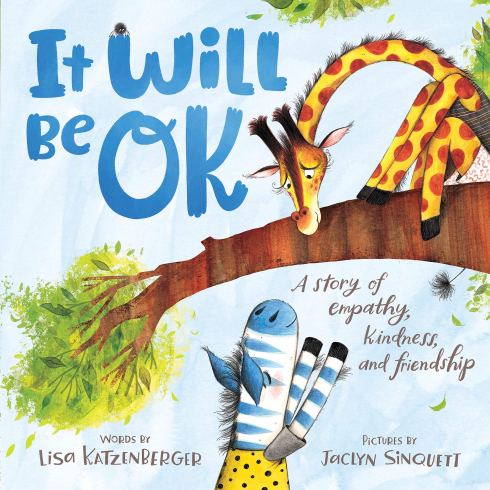
As an example, I wrote IT WILL BE OK: A Story of Kindness, Empathy, and Friendship, illustrated by Jaclyn Sinquett, about my own experience with anxiety—although I didn’t know I was doing that at the time. It wasn’t until I my publisher asked me to do a Book Talk about where I got the idea, and I spent time reflecting on the story development and revision process, that I realized what I had written: a story about how some of our emotions (like fear) can look really small to others on the outside, but still feel really big to us on the inside. Once IT WILL BE OK was published, I heard from many teachers that they used it as part of their SEL curriculum, and this story led to helpful discussions about identifying our emotions, listening to others, and being a good friend.
While I kind of stumbled upon writing an SEL story for IT WILL BE OK, I challenged myself to be more intentional with my future stories. I wanted to continue writing SEL books that could serve as a conversation starter for kids about their emotions. I certainly had some false starts—not every concept was a winner, but that’s OK! But I eventually found success with an idea that came straight from a therapy session. This picture book is I CAN DO IT EVEN IF I’M SCARED: Finding the Brave You, illustrated by Hannah George.

In this story, I talk about a Cognitive Behavioral Therapy tool I learned: Acting “As If”. The gist of this tool is about acting as if you already are the person you want to be. After it helped me, I thought kids could relate to it this way: playing pretend. So I took a very deep, emotional, private moment of my life and poured it onto the page.
So, how can you mine your own life for stories with an emotional heart? Here is an exercise to try:
- Think of a time you felt a strong emotion—as a child or an adult. It could be a joyful moment, a scary moment, a sad moment. Anything goes.
- What were you like when you first felt that emotion? This defines the character and establishes the story beginning.
- What did you do as that emotion washed through you? This describes the action and is your story middle.
- How did you feel afterwards? This presents the emotional shift and serves as your story end.
As an example, in my picture book IT WILL BE OK, the emotional shift looks like this:
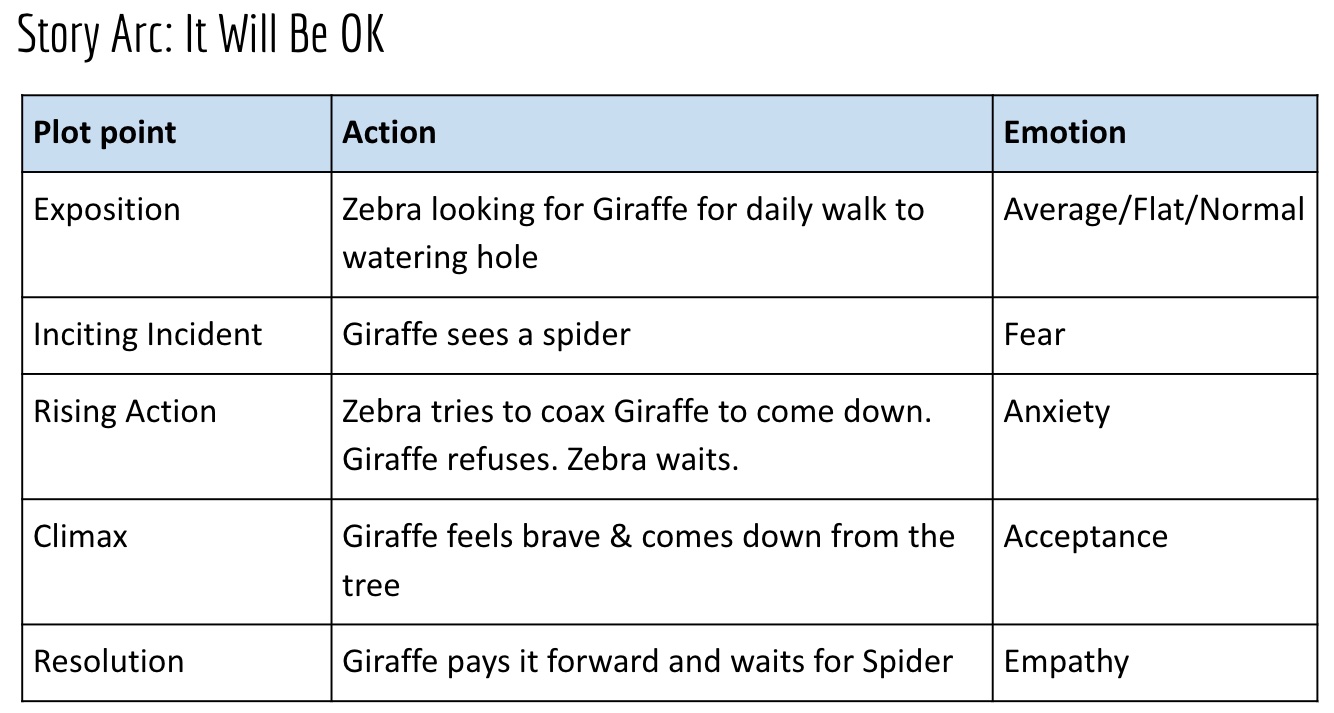
When it comes to writing SEL picture books, I advise you to look deep into your heart, and mine your emotions for experiences that kids can relate to and grow from. I’m not going to lie, this is all VERY scary for me to write and share. But when I think about a kid sitting in circle time, listening to my story and thinking, “Hey, I feel that way too. Maybe I can talk about it with someone,” it’s all worth it.
Lisa Katzenberger is giving away a fiction picture book critique to one lucky Storystorm winner.
You’re eligible to win if you’re a registered Storystorm 2024 participant and you have commented only once on today’s blog post.
Prizes will be distributed at the conclusion of Storystorm.
 Lisa Katzenberger has been writing stories since she was a kid. Books have been a part of her life since her mom took her to the local library each week and let her roam around the children’s section, picking out whatever she wanted to read. She loved escaping into stories, and she still can’t believe she gets to write them for kids now!
She’s on the faculty of The Writing Barn where she teaches picture book writing courses including Perfecting the Picture Book, Writing Social Emotional Learning Picture Books, and Write. Submit. Support.
She lives near Chicago in La Grange, Illinois with her husband and two children. Visit her website at LisaKatzenberger.com and follow her on Bluesky @lisakatzenberger.bsky.social, Instagram @lisakatz17, and X @FictionCity.
Welcome to Day Two of Storystorm! If it hasn’t happened yet, soon your world will be full of stories. You walk down the street and every bird, every dog, every odd-colored car seems like they could be the star of a picture book. I love this. Yes, the sparrow, the puggle, and the car the color of pineapple juice are there every day, but there is magic in suddenly seeing ideas, and seeing that they are everywhere. I get such a thrill from writing down all of these possibilities and figuring out what their stories might be.
Here’s how writing usually works for me:
- Write a persistent idea into a draft.
- Revise it a few times.
- And then: A significant amount of future-tripping. I imagine my agent telling me it’s the best thing she’s ever read. I picture what the book will look like when it’s done. I think about how I’ll feel when I get a call from an award committee. I dream about how it will feel to get a high five from Oprah.
While I do like the writing process, I also really like the part where I send the manuscript out and it’s no longer my problem. I like checking things off my to-do list. But I have learned I can’t rush it. Creativity isn’t an item to check off. I need to give the manuscript time. How much time? As much as it needs. Sometimes that’s a few weeks. Sometimes it’s years.
It’s like stories are artifacts we’re unburying, and some are fairly clean and close to the surface, and for some you have to dig for miles and clean off a lot of dirt before you even know what you’re looking at.
It’s a magic trick to take your invisible brain thoughts and form them into real words and stories. Of course it takes time.
Time lets me see what’s working and what’s not in a story. It’s only by letting a draft sit for a day, a week, a month, that I can understand what it’s trying to be and shape it into that thing. There are always parts that helped me get the story to where it needs to be, and then, three drafts and some time later, it’s obvious that part can be cut away. There are also always parts that stick out somehow, that take me out of the story, or just bug me. Often it takes a few drafts (and time) for me to realize that part is poking at me and needs to go. Time is what takes a manuscript from good enough to great.
At some point, the changes I’m making to a draft are small and insignificant (adding a comma, say), and there aren’t any more pointy bits that poke me when I’m reading or thinking about it. And that, finally, is when I send it out and (at least temporarily) get it off my desk.

I have a picture book coming out in June called HELP WANTED: ONE ROOSTER. I wrote the first draft of this book in 2012. It’s about a cow who is interviewing roosters for the rooster job at the farm, and they’re all terrible candidates. After many revisions, it got a book deal in 2014.
This is easy math. The book is coming out twelve years after I wrote the first draft, ten years after the book went under contract. When people say publishing is slow, they’re not kidding. So, listen: TAKE YOUR TIME. There is truly no rush.
As the years went on, I deleted characters who didn’t seem quite so funny to me any more, and replaced them with better ones. I worked and reworked why they were looking for a new rooster in the first place. I didn’t really figure out the ending until 2021—years after it was originally supposed to publish.
It took ten years from the first draft for the story to get fully unburied. I wasn’t working on it nonstop during that time—years would go by when I wouldn’t work on it at all—but it was always simmering, and the full plot of it didn’t really come to me until three years ago.
I never would have expected this book to take so long when I first got the idea. But I know that some books just take longer. And it’s always right to give them the time they need. So go forth! Write up those ideas! Some will flow right out of you, and some will take much longer, which is, frankly, fascinating. Why are they buried so deep? We’ll never know. But we are so lucky to be the ones who get to dig them out.
Julie Falatko is giving away a seat at her picture book revision class to one lucky Storystorm winner.
You’re eligible to win if you’re a registered Storystorm 2024 participant and you have commented only once below.
Prizes will be distributed at the conclusion of Storystorm.
 Julie Falatko writes books for children. She is the author of several picture books, including SNAPPSY TTHE ALLIGATOR (Did Not Ask to Be in This Book), THE GREAT INDOOORS, RICK THE ROCK OF ROOM 214, as well as the TWO DOGS IN A TRENCH COAT chapter book series. Julie lives with her family in Maine, where she maintains the Little Free Library in front of their house. Visit her at JulieFalatko.com and subscribe to her Substack newsletter.
Words—if you’re a writer, you love them. You NEED them. They’re our story building blocks.
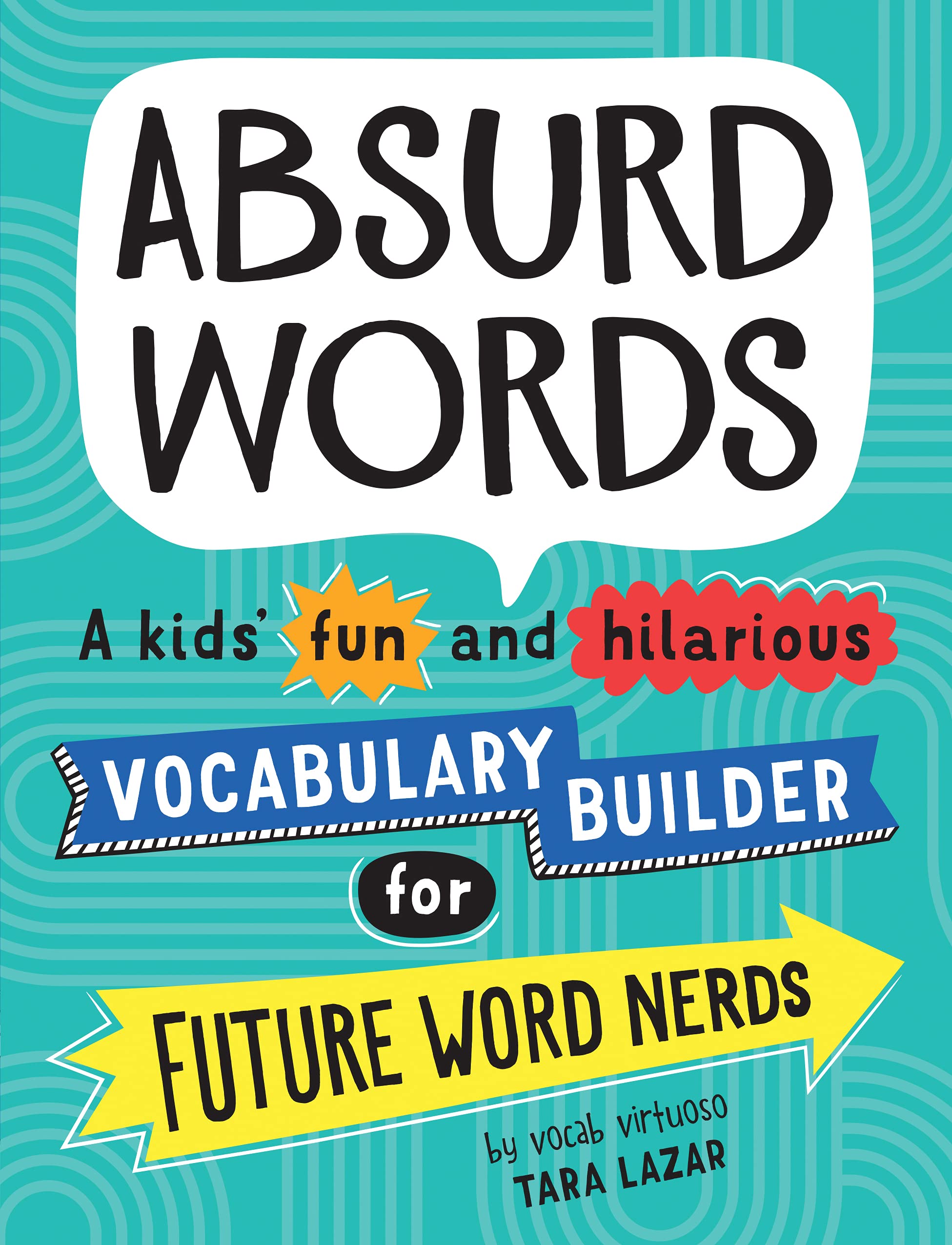
I love the sound of certain words, the way they slide off the tongue. My book ABSURD WORDS began when I ran across the word “archipelago”. I stopped reading, transfixed by the exotic and lovely term for an island chain. I wrote it down…and my “favorite word list” began.
Whenever I read a fantastic word, in a crossword puzzle, novel, or news article, I wrote it down. When I heard it in a movie, TV show, or YouTube video, I wrote it down. I wanted to keep the good words close.
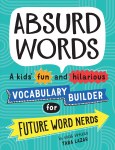 Since the Internet loves a list, I slapped the words on this website. Then when the list became the most heavily-accessed page on this site, I pitched my agent the concept for ABSURD WORDS.
I know, it’s not a picture book. A picture book brimming with substantial words isn’t fit for the age group. However, a wondrous word on its own can conjure up ideas for marvelous picture book stories!
Let’s go back to “archipelago”. This word was featured in the Christmas stop-motion classic “Rudolph the Red-Nosed Reindeer” to describe the location of The Island of Misfit Toys.
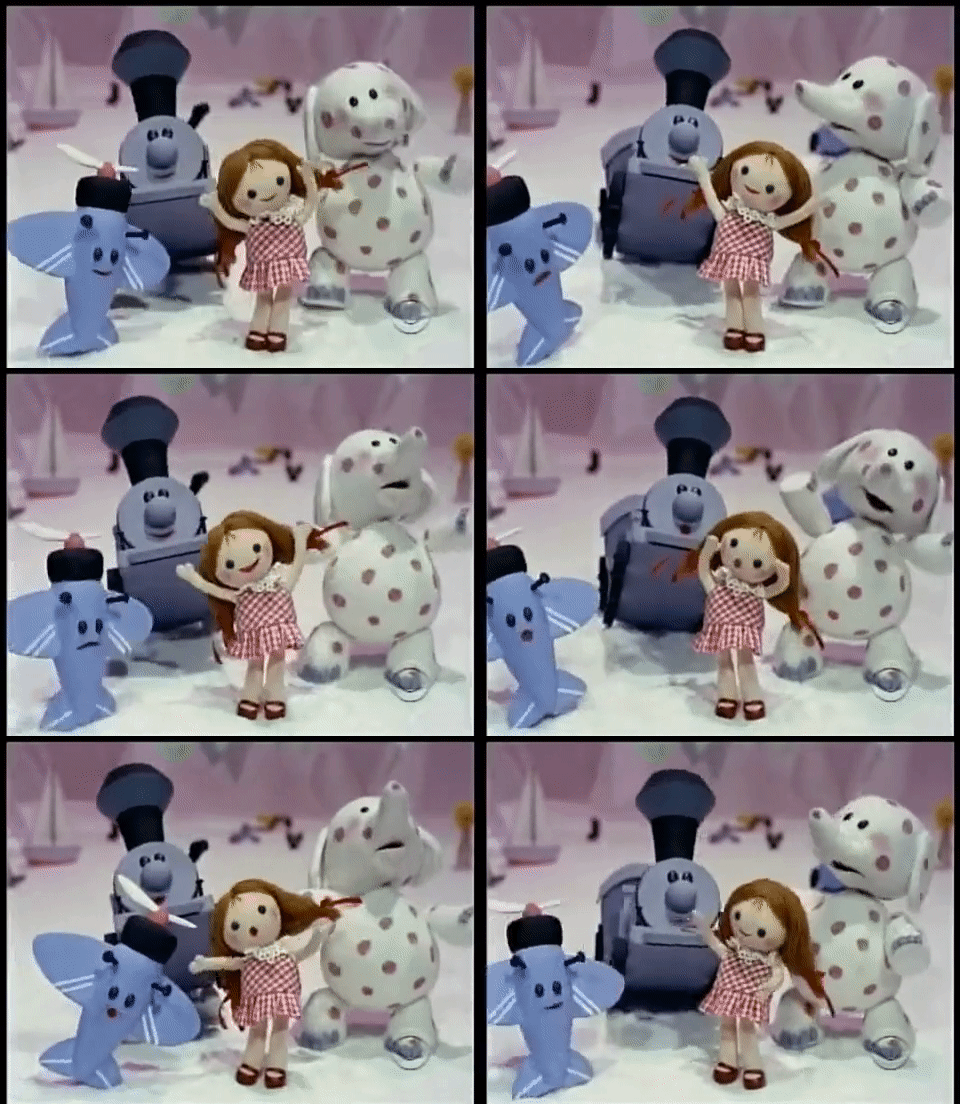
Toys! Misfits! On an island far away! Longing for a child to love them! Did all these ideas originate with the word “archipelago”? Maybe???
I don’t shy away from using difficult words in my picture books, as long as I use them sparingly and in context so their meaning can be sussed out. But I’m not suggesting you just slip “labyrinth” into your story—I am encouraging you to begin with “labyrinth” to discover where it leads. What ideas spring forth? Children love secretive places about which adults are clueless—so where does your “labyrinth” story go?
I’ve got more words to love!
- zhuzh
- scrumble
- derring-do
- sardoodledom
- swellhead
- finicky
- pareidolia
- gravitas
- moonbow
- fiddlesticks
- galactico
- jimberjawed
- shackbaggerly
- soliloquy
- nonuplets
- cahoots
- sticktoitiveness
- againwend
- flipperling
Plus, of course, the entire original list!
But you don’t necessarily need my lists. Think of your favorite word as a jump-start. Thumb through a dictionary. Devour a thesaurus.
Words can take us (and our readers) anywhere we want to go!
Tara Lazar is giving away a fiction picture book critique to one lucky Storystorm winner.
You’re eligible to win if you’re a registered Storystorm 2024 participant and you have commented only once below.
Prizes will be distributed at the conclusion of Storystorm.
Storystorm 2024 registration is now closed. You can still participate by reading the daily blog posts and jotting down ideas, but you will not be eligible for prizes.
Welcome to STORYSTORM 2024 Registration!
Seven years ago I changed the name and month of my annual writing challenge, from Picture Book Idea Month (PiBoIdMo) to STORYSTORM. Why? Answer’s here.
Although this challenge began as a picture book writer’s event, any writer interested in brainstorming new story ideas in January is invited to join the STORYSTORM challenge of 30 ideas in 31 days. Any genre, any style; student, amateur, hobbyist, aspiring author or seasoned professional.
How does STORYSTORM work? It’s simple…
- Register (instructions below).
- Read the daily posts right here on this blog, beginning January 1st.
- Write down one (or more) story idea daily. (Do not share your ideas with anyone.)
- At the end of January if you have at least 30 new ideas, you can sign the STORYSTORM PLEDGE and be eligible for PRIZES.

So are you ready?
To register, follow these steps:
- Register ON THIS BLOG POST by signing your name ONCE in the comments below (you have to scroll all the way down for the comment box). Full name or nickname—whatever name you’ll use for the entire event.
- Please leave ONE comment ONLY. Do not reply to say “hi” to a friend. Do not comment to fix a mistake. ONE COMMENT. Don’t worry if it isn’t perfect. Registering makes you eligible for prizes. Teachers participating with a class can register under the teacher’s name.
- Visit this blog daily (taralazar.com) in January for inspirational essays by guest bloggers—authors, illustrators and publishing industry professionals.
- Instead of visiting the blog directly, you can receive the daily posts via email by entering your address and clicking the “Follow Tara’s Blog” button in the left column—look under my photo for it. (You must do this if you want to receive emails. Emails DO NOT come automatically by signing your name in the comments.)
- At the end of January, if you have at least 30 ideas, sign the STORYSTORM PLEDGE (to be posted on January 31) and qualify for prizes.
Prizes include agent feedback, signed books, original art, writerly gadgets and gizmos.
Remember, do not share your ideas publicly in January. They are YOURS. No need to prove that you have them at the end of the month. The pledge you will sign is on the honor system.
Are you in? Awesome!
Other OPTIONAL activities:
- You can pick up an “Official Participant” badge (with art by Courtney Pippin-Mathur) below and affix it to any social media account or personal website you wish. (Right click to save to your computer, then upload it anywhere.)

- You can also opt to join the STORYSTORM Facebook discussion group. Everyone needs writing friends!
The Facebook group remains a year-round source of writing information and support, mostly focused on picture books, I admit, because that is where this all began.
STORYSTORM registration will remain open through JANUARY 7th.
- In the meantime, head over to the STORYSTORM ZAZZLE SHOP to pick up your official journal. All proceeds from sales will be donated to The Highlights Foundation. I’ll be adding more items, like mugs and t-shirts, throughout the month.

Thank you for joining!
I wish you a creative and prolific month ahead!
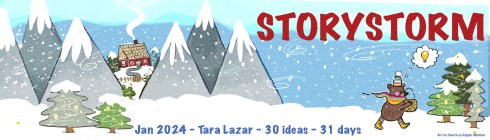
Thank you to everyone who applied to guest blog for Storystorm 2024 next month! Bloggers have been randomly selected and will be informed soon via email!
Every year for Storystorm, I’ve sold merchandise and donated the proceeds to charity, but I had always neglected to finalize the logo and artwork far enough in advance to sell the journal in December.
Last year I managed to get it done, but for unknown reasons, CaféPress’s journal was “temporarily out of stock.” Actually, it never went back in stock, and such is still the case! I spent some time with customer service, but they could neither tell me what the issue was, nor could they promise an “in stock” date.
So, I’ve moved to Zazzle! And with artwork by the talented Courtney Pippin-Mathur, there is a beary adorable journal for you to purchase now, in time to arrive for the January festivities.
This year’s Storystorm proceeds will be donated to Highlights Foundation!
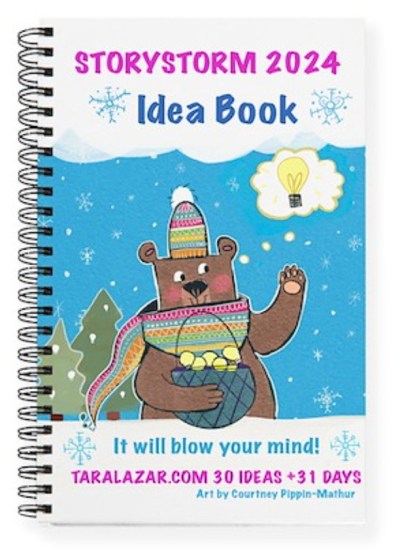
Registration will commence after Christmas, right here on this blog, so stay tuned!
Many thanks to Courtney Pippin-Mathur for her whimsical Storystorm art. I will add more things to the Zazzle shop in the coming weeks, and if there’s anything specific you’d like, please leave a comment.
Happy Holidays,
Tara





 Writing for Kids (While Raising Them)