You are currently browsing the category archive for the ‘Picture Books’ category.

Illustration from The Very Hungry Caterpillar copyright © 1969 and 1987 by Eric Carle
The Eric Carle Museum of Picture Book Art will hold its annual Carle Honor Awards Gala this Thursday, celebrating significant contributions to the picture book. For the past several years, I’ve asked the four Honor recipients a salient question about the current state of the medium. This year I’ve had this on my mind:
Considering the rise of book banning in recent times, can you re-stress the importance of picture books and letting children choose what they read by having unfettered access to all matter of literature?


Uri Shulevitz, Artist Honoree
If I had had books, I would have been the happiest kid alive. But I did not have any. Luckily, what I had was a mother, who told me stories, while we lived in Central Asia during World War II, which you can read about in my book, CHANCE. In those years of terrible hunger due to lack of food, I can say the stories gave me hope and saved my life. Banning books, stories, deprives children of spiritual sustenance.

We Need Diverse Books, Angel Honoree
Represented by Ellen Oh, Co-Founder, CEO & President
My daughter just graduated from college and is now a brand new 2nd grade teacher at a Title 1 school. The first thing we did was build up a library filled with diverse picture books. She was determined that every child that came to her classroom would be able to find a book that represented them. And she marveled at the extraordinary amount of diverse picture books we were able to find for her extremely diverse student body. We talked about how different it was from when she was little. Every day, she gets the pleasure of seeing a child grab a book from her library and hug it tightly, exclaiming “Look Ms. Oh, this book is like me!” As a reading teacher, she knows how challenging her job is, especially now. Fortunately, she is in a county that has not had any book banning or challenges. Her community of parents are supportive of all children and their right to read. I wish this were true for all children across the country but know the harm that is being caused in far too many areas of the country. Book bans are rarely about protecting the children from real harm. They are about controlling morality and power based on the prejudiced beliefs of a self-righteous minority. Which is why books with LGBT+ and BIPOC stories are overwhelmingly challenged and banned. Picture books are a fundamental building block of literacy. When marginalized children don’t see themselves in the books they read, it impacts their ability to read because visual literacy is so important for young readers. It impacts their self-worth when they don’t see themselves in the pages of a book. It impacts all children who don’t learn to recognize the importance of all diverse stories. Book bans harm all children.

KidLitTV, Bridge Honoree
Represented by Julie Gribble, Founder
It’s crucial to emphasize the significance of visual literacy, the positive impact of seeing oneself reflected in the pictures of a book, and the long-term benefits of empowering children to select books that inspire empathy and independence. We can’t afford to underestimate targeted attempts to ban books with LGBTQ+ characters, characters of color, or themes of race and racism.
Here’s what I’d like to contribute to this conversation.
This is a political issue, yet many people refrain from discussing or following politics to prevent confrontation or conflict. However, it’s important to remember that politics will impact you regardless.
Let’s discuss the recent surge in book bans and the reasons behind it.
Sensing a changing demographic led fearlessly by an empathic younger generation who believe in equality, justice, and human rights, extremist right-wing groups are leading the effort to roll back the clock.
As a creator of books that instill kindness and fairness in young readers, you and your books pose a significant threat to an entire political movement. This is a testament to the power of children’s book creators. You’re a force that can shape the future. When these readers grow up, they become voters who are more inclined to challenge right-wing extremism. By limiting the literature available to children, extremist groups are attempting to
control the perspectives and values that young readers are exposed to, thereby influencing their future voting decisions. It’s no coincidence that book bans are often implemented by the same organizations that are restricting voting access.
So, as Michelle Obama says, “Do something.”
Here are a few resources to help us do something:
- Vote!
- From PEN America: 5 Ways to Fight Book Bans
- Do you know when school board elections happen in your state? School boards
play an important role in ensuring students in your schools have access to books, and often have the power to allow or prevent book bans. - Text “READ” to 26797 for more information from Let America Read and to register to vote.
- RESOURCES to Help FIGHT Against BOOK BANS & CENSORSHIP!
- The above post includes a link to this constructive initiative: We Are Stronger Than Censorship. At the center of this campaign is the pledge to distribute over 2,000 inclusive books to areas most affected by censorship, reinforcing the vital role that diverse voices play in promoting understanding and empathy within our communities.
Let’s be fearless in this fight. Speak up and take action.

The Horn Book Inc., Mentor Honoree
Represented by Elissa Gershowitz, Executive Editor
Picture books are usually the first encounters children have with books and reading, ideally setting them on a path to: engagement, enjoyment, escapism, entertainment; creativity, compassion, critical thinking; imagination, empathy, problem-solving, and more. In short: all the reasons readers love to read! The more diverse the books, the more diverse the readers, the greater chance a young person will feel seen and understood and will be open to the experiences of others (Dr. Rudine Sims Bishop’s classic “Mirrors, Windows, and Sliding Glass Doors” analogy). All young people deserve to find their books–the ones that speak to them and keep them turning pages. (Or they can put a book down–that’s fine too!)
Many thanks to The 2024 Carle Honor recipients and The Eric Carle Museum of Picture Book Art for inspiring creators and readers of all ages.
For more info about the museum and its mission, please visit CarleMuseum.org.
Often I write a picture book without any idea of what my characters might look like, and sometimes I don’t even know WHAT they are. Are they even human?
Nope. I prefer non-humans. Monsters, aliens, purple orangutans—I feel they have more freedom in their actions than mere mortals. And that gives me more freedom, too.
Such was the case with my upcoming title, PARTY ANIMALS, illustrated by the talented Anna Raff. I asked Anna about this blank canvas I dropped onto her drafting table.
Anna, when I wrote PARTY ANIMALS, I didn’t specify what kind of animals were having a party! How did you decide upon each character’s species?
What a fun question to start with!
I had a few things in mind at the very beginning of my sketch process. Primarily, I was thinking about your wonderful text and the personalities it brought to mind. For instance, Horace—our party pooper—needed to be a stern, no-nonsense kind of guy. At first I thought he might be a mule, since he’s a bit stubborn, too. Then I started to think about scale and how funny a vast difference in size would be between the chaotic partying animals and poor Horace cowering in the corner amidst the mayhem. So I decided he should be the smallest and chose a rat—I have a history of drawing rats—knowing he might also have a pink tail. To me, that flash of pink says maybe he’s not such a big ol’ grouch after all? Our wonderful editor, Sylvie Frank, gave me the idea of giving him a toothpick walking stick, which adds even more clues to his inner character.
In addition to scale, for the other animals I was thinking about what their area of partying expertise would be. Beatrix, the elephant chef, cooks all the wacky foods for each celebration. I thought having a trunk would be helpful for her in the kitchen. Who among us home chefs hasn’t wished for an extra hand? And to be honest, I really just love drawing elephant ears.
And love of drawing is what brought me to the other two animal species: Theodore, the cat, and Phoebe…who I think is a dog?…even I’m not entirely sure! One of the things I learned in from my mentor, Marshall Arisman, is something I try to instill in my own students. You have to ask yourself, “What do I want to draw?” If you answer honestly, you end up having a much better time in the process, rather than thinking about outside influences. As with elephant ears, I love drawing dogs and cats. I also thought it might be fun for readers to imagine their own pet cat being really into crafts and decorating, and a “dog” who was also a great virtuoso/DJ!
You’ve packed a whole lot of goodies into the illustrations: little hidden gems! Do you want to reveal one or two of your favorites?
Another great question! Some people call them “carrots”.
During the-milk-has-gone-sour party, Beatrix is holding a 1960s edition of the Betty Crocker Cook Book (the space in between “cook” and “book” is not a typo!), the source of many of my family’s favorite dessert recipes when I was a kid. In fact, I just used it to bake my dad a strawberry-rhubarb pie for Father’s Day.

Another detail that was fun was switching the fabric patterns and imagery on the Party Animals’ clothing to match each party theme. Oh…and all the wacky bakes! I think the pincushion cake is my favorite.
What were some of your intentions when designing and illustrating the cover of PARTY ANIMALS?
Primarily, I wanted to emphasize each animals’ party energy, whether it be super-duper party-er or party-pooper, so readers would know what they’re in for. We’ve got the three partying animals in front, each exhibiting their party expertise, while Horace is up top amongst the balloons, acting all judgey.
At first, I had Beatrix holding up one of her more obscure bakes, the brain cake from the thinking party. But our editor and art director thought that might be a little misleading / too specific. At the time, they also mentioned the addition of the tagline, so when I was replacing the cake, that seemed like a great place for more lettering.
I knew early on that the title type needed to be prominent, in balloon lettering…you know, to scream PAR-TAY! The fact there we’re doing a second book drove my decision making, too. Before becoming an illustrator, I was a designer and art director and tapped into a few of those skills to really fine-tune the lettering, so it would feel like part of a series. That also helped with the lettering for Bea’s layer cake.
And then for the case cover, Joann had the idea of showing the aftermath of the fantabulous party on the jacket, with Horace sweeping up while the other animals crash in a sleepy heap. I played around with the lighting in the final art too, to contrast against the warm, splashy lighting of the jacket.


Thank you for all the fun, Anna!
And now here is the cover reveal for PARTY ANIMALS, releasing March 11, 2025 from Disney*Hyperion!


PARTY ANIMALS is available for pre-order anywhere, but if you’d like me to sign and personalize your copy, I’d be grateful if you placed an order via my local indie, The Bookworm, whose longtime owner passed away recently. We want to keep the store in Bernardsville, NJ running after 40 years of serving the community! You can call them at 908-766-4599.
Anna will sign copies ordered via Books of Wonder.
And now the givey! Comment below with what you like most about the cover and a random winner will be selected on August 1. That winner will receive a signed spread (by me, Tara Lazar) from the F&G (printed proof) of PARTY ANIMALS!
Good luck!
by Ronni Diamondstein
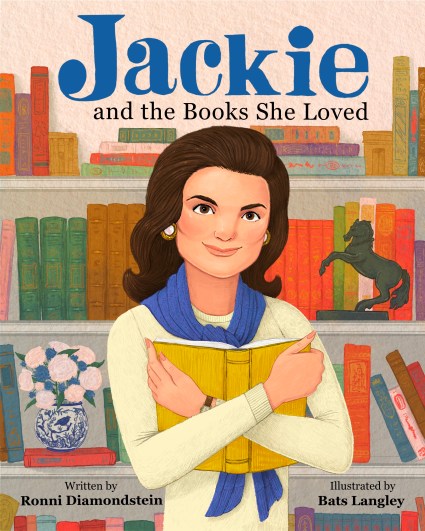
Writing JACKIE AND THE BOOKS SHE LOVED was a journey and a labor of love. I was eight years old when John F. Kennedy was inaugurated. Jackie did so much to change the role of the First Lady. I remember Jackie for the White House restoration and especially how she led the country in mourning her husband when he was assassinated in 1963.
I was always fascinated by her style and grace and admired her for becoming a book editor. After she passed away, I had an idea for a novel about her and started researching her and interviewing people who knew her. I interviewed Ted Sorenson, President Kennedy’s speech writer and counsel and had a correspondence with her cousin, John Davis.
When I spoke to Margot Datz, the illustrator of Carly Simon’s children’s books that Jackie edited, she suggested that I write a children’s book. I then wrote a long chapter book that got no traction. There were several adult books written about Jackie as an editor that I read. Having researched her for decades, I knew that she loved to read as a child and saw how books influenced her life. It was something that I had in common with her.
Then about five years ago, I thought about how reading and writing were a thread through her life. I knew that picture books bios were a great genre and began to work on this book. Emma Walton Hamilton once said, “I think you have to have a personal connection, and that’s what I am always looking to try to create: a personal way into a story.” I knew this was the story about Jackie that I wanted to tell.
I was thrilled when I signed a contract with Sky Pony Press in August 2022. JACKIE AND THE BOOKS SHE LOVED is my first book and I feel very fortunate to have worked with my editor Nicole Frail. It was a collaborative relationship. We were very much in sync regarding the revisions that needed to be made. The original manuscript was much longer and in collaboration with Nicole, the extra material was incorporated into my author’s note, back matter and a timeline.
In order to include the poem “Sea Joy” that Jackie had written when she was 10 years old, I needed permission to reprint it. I contacted her daughter, Ambassador Caroline Kennedy in Australia and two days later I heard from the Executive Director of the Kennedy Foundation that Ambassador Kennedy was happy to give me permission. I was thrilled and thought that I hope this makes Caroline Kennedy happy to know that a new generation will learn about her mother and read her poetry.
I also had included a lot of books Jackie read as a child and authors Jackie worked with and titles in the narrative. When we started to edit it, most were moved to the author’s note. And Bats Langley included them in the illustrations which was wonderful! Interestingly, at a sales presentation the team asked about references to the books that either Jackie read or edited. We already had some titles she read in the author’s note, so we decided to include a list of books. Narrowing it down to 18 titles was a taunting task; she edited nearly 100 books!
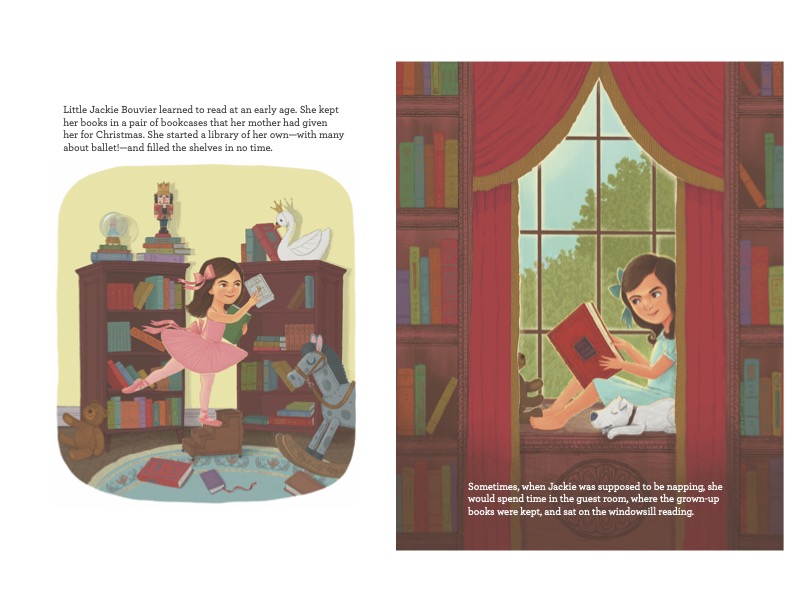
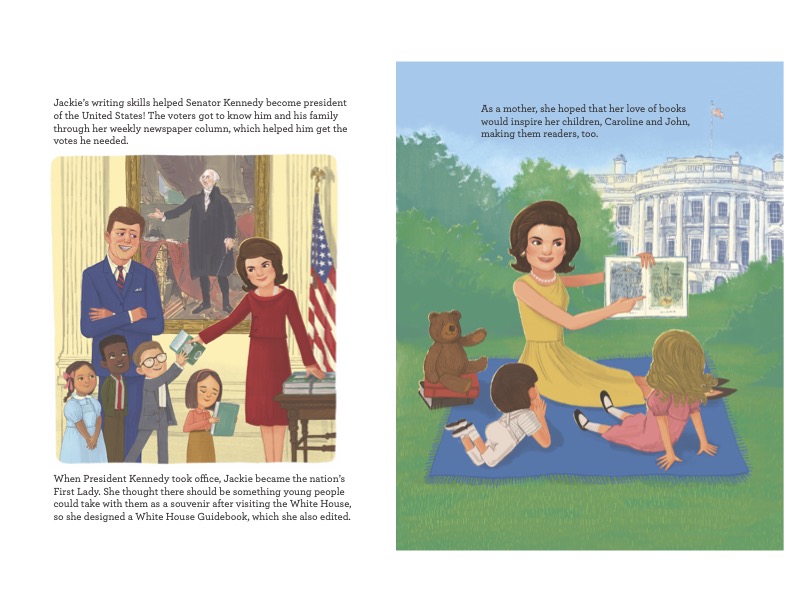
I was very lucky to be involved in the illustration process from a say in the choice of the illustrator to collaborating with him on the art. I gave illustration notes to my editor, but since I have quite an extensive collection of books about Jackie and the Kennedys with great photographs, I was very much involved with the illustrations. I shared many photographs with Bats. For example, the horse statue on the cover is just like the statue she had on her piano in her New York apartment.
One day Bats asked what Jackie’s favorite birthday cake was. Of course, I had a book called “Cooking with Madam” in my collection so I could send him pictures of Jackie’s birthday cake that you’ll find in our book!
I even had a say in the endpaper design! I love quotes and had many of Jackie’s quotes that I wanted included that couldn’t fit in the narrative so I suggested we use them on the endpapers. I knew her personal stationery was powder blue, so that was the color we chose for the endpapers.
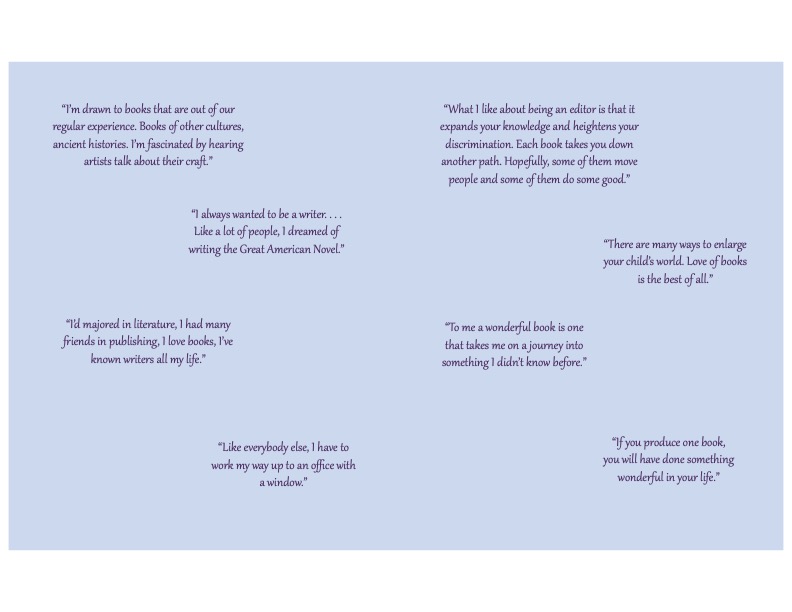
I was also very fortunate to have a virtual book launch with the Chappaqua Library Children’s Room, my local library, and I was honored to be invited by the First Ladies Library to do a virtual “Legacy Lecture” about the book.
Jackie said, “If you produce one book, you will have done something wonderful in your life.” I hope I have done this. It truly has been an adventure!
You have done it, Ronni!
Thank you for sharing the story of your book’s creation.
Blog readers, you can win a signed copy of JACKIE AND THE BOOKS SHE LOVED.
Leave one comment below to enter.
A random winner will be selected in January. Good luck!
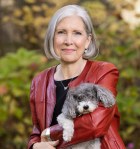 Ronni Diamondstein has spent her life surrounded by books and immersed in the world of children’s literature. An avid reader since childhood, libraries, books, and writing have been her life’s work. As a school library media specialist and teacher in the United States and abroad, Ronni has nurtured her students’ creativity by sharing her love of reading with them. She is also a freelance journalist and have published many articles and my dog Maggie Mae Pup Reporter had a column in a local magazine. She has always been fascinated by Jackie Kennedy’s love of books and her career as an editor and was inspired to tell her story. Ronni lives in Chappaqua, New York, with her toy poodle Maggie Mae. Visit her at RonniDiamondstein.com and follow her on Instagram @maggiemaepupreporter and BlueSky @ronnidiamondstein.bsky.social. Personalized, signed copies are available from Scattered Books, Chappaqua, NY.
I love wordplay, and after I featured THE THINGITY-JIG by Kathy Doherty and Kristyna Littten here, I was thrilled to learn about their fun follow-up, THE TWIST-A-ROO! (Which is of course what a child would call a kaleidoscope, because what child can even pronounce “kaleidoscope”?) More wordplay and imagination—sign me up!
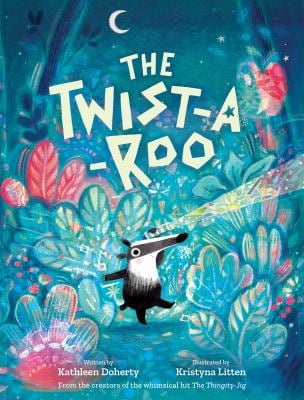
Kathy, this blog focuses a lot on inspiration for picture books. Where did this story idea originate?
My Peachtree editor wanted a companion book to THE THINGITY-JIG. We talked about another book STEAM- related based on a fable or folktale. We agreed upon a badger for the main character. Then I checked out all the fable/folktale books from the library. I poked around Pinterest for STEAM ideas and came upon a kaleidoscope. I knew that would make a gorgeous picture book. After searching through the books, an idea popped to put a modern twist on The Ant and the Grasshopper using a badger who was so obsessed with a kaleidoscope that he wasn’t preparing for winter.
Peachtree even provided an activity sheet on how to make a kaleidocope.

Oh, and here I was so obsessed with the kaleidoscope and the luminous illustrations by Kristyna Litten that I didn’t even realize the story featured STEAM elements! But I did recognize your delightful wordplay that extended beyond the title. Have you always been a wordplay lover? How did you develop that skill?
What’s STEAM-related is the use of patterns and shapes in art.
As a former classroom teacher, I read to students every day. I especially enjoyed reading THE BFG by Roald Dahl. My students would laugh themselves silly. I loved Dahl’s made up words such as: snozzcumbers, whizzpoppers, and frobscottle.
I think most picture book authors are playful. I don’t always do adulting well. At family parties, I’m the one who wants to sit at the kids’ table. Making up and silly sounds and words comes naturally. What also helps is using words with letters that have explosive sounds. These letters make sounds that explode off your lips and are funny: B, hard C, D, hard G, K, P, and T. That’s why underpants is funnier than underwear.
Wow, I never stopped to realize why that’s so! Thanks for the tip!
Some of the wordplay in THE TWIST-A-ROO makes use of these explosive sounds: “turny, twisty, tantalizing thing”… “skippy-doodled”…”wiggly, jiggly, gemmy shapes”.
When I’m writing, I like to keep my mind free of any images, because I don’t know what the illustrator is going to do… Most of the time I don’t even know who the illustrator is yet! However, you’ve worked with Kristyna Litten before. Did you have any inkling about how gorgeous she would make badger’s world? What about her approach surprised you?
Kristyna Litten is soooo talented! She draws quickly to give an energetic line quality to her illustrations, sometimes adding color and textures digitally. She’s written and illustrated many books. Her clients include Gucci, National Geographic, and Aardman Animations. I know her work well. So I knew our book would be gorgeous, but I had no idea how gorgeous! Her whimsical illustrations match the text beautifully.
I bought a kaleidoscope to use as I wrote the book. Whenever I looked through it, I saw repeated patterns with many triangular shapes. But I didn’t think Kristyna would stick with symmetrical kaleidoscope images. And I was right! She mixed and mingled shapes asymmetrically splashing them across the page. This was the first review we received from Foreword Reviews: “Bright pinks and yellows jump out from moody teal backdrops that evoke the chill of winter.”
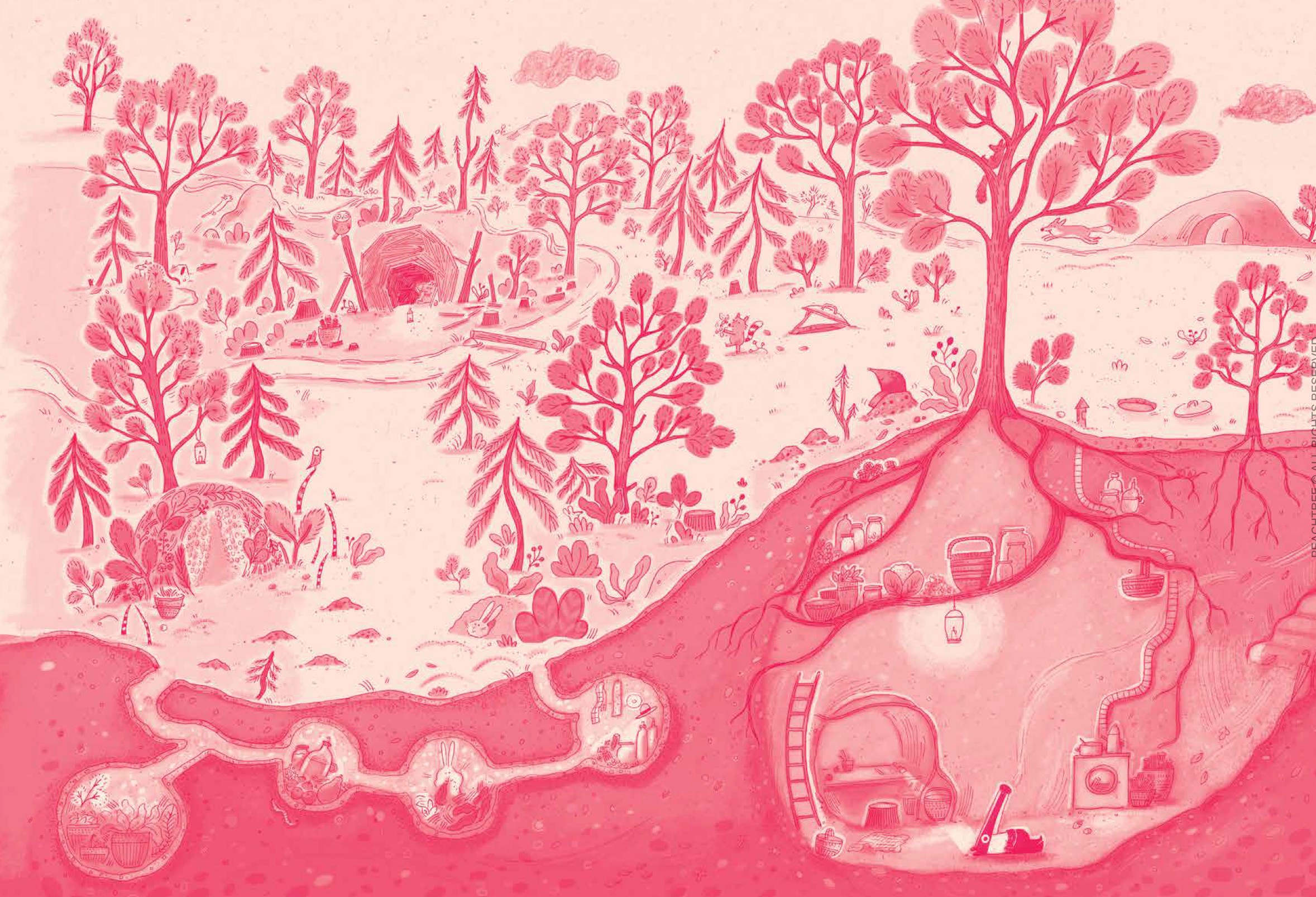
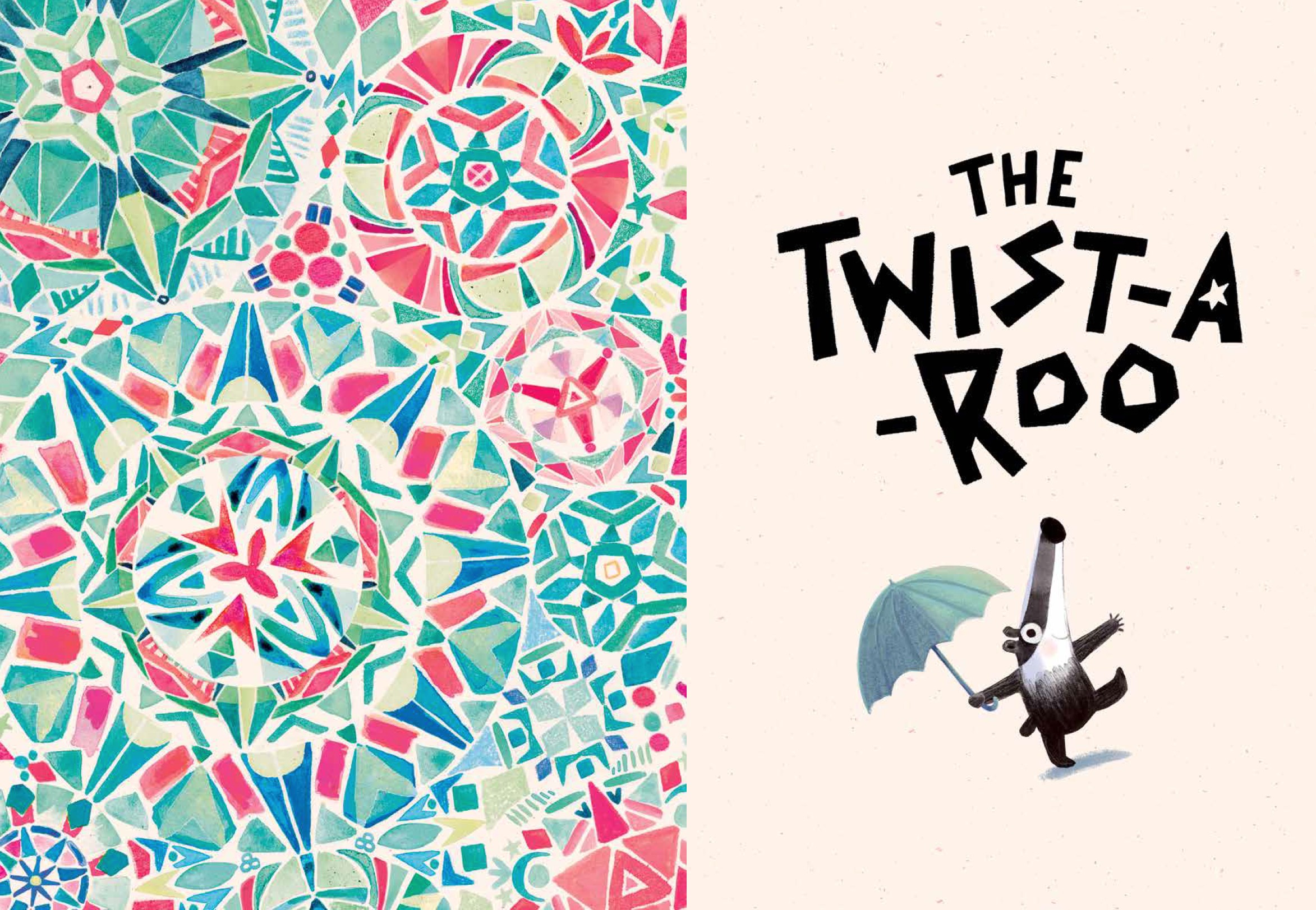
Speaking of bright pinks, can you talk about the end papers? Why are they monochromatic?
Kristyna said it’s actually both an aesthetic and technical decision. It was a design/print request to only use one color plate. So she decided on the bright pink to compliment all the blues throughout the book. She wanted something fun and different on the endpapers…a pop of color and pattern. But nothing that would distract too much from the rest of the book.
I think the pink ends provide a sense of warmth amid the wintry setting.
What do you want children to take away after reading the book?
I want kids to recognize what it’s like to have caring, sharing friends. Badger’s friends come to his aid during a snowstorm…and in return, he helps them shake the winter blues. I hope kids will feel the warmth of community as the animals come together for the common good. Also, I’d like kids to realize there is a time for work and a time for play.
Kathy, I truly love the book and thank you for sharing it with us today!
Blog readers, you can win a copy of THE TWIST-A-ROO!
Just leave a comment below and a random winner will be selected at the end of the month!
Good luck!
The winners of the past few giveaways are:
lynjekowsky, GRIEF IS AN ELEPHANT
Evelyn B, IT’S THE GREAT PUMPKIN, CHARLIE BROWN!
Cathy Lentes, MOSSY AND TWEED; Annette Schottenfeld, KITTY AND CAT
Megan Woodward, Melissa Trempe critique
 Kathleen loves bringing kids and quality literature together. She’s a reading specialist and an educational specialist in curriculum and instruction. She’s written standardized test items for Pearson Inc. in alignment with the Common Core Standards. Her love of learning has led her to graduate from four different universities.
Kathleen has taught elementary school for over 30 years. She was first published in TIME Magazine with a letter to the editor about Charles Schulz. Her work has also appeared in The Mailbox, Spider Magazine, Highlights Hello, Highlights High Five, and Highlights for Children. She’s won the Highlights Pewter Plate Award, the Highlights Celebrate National Poetry contest, and a letter of merit from SCBWI’s Magazine Merit Competition. Visit her online at kathleendohertyauthor.com.
 Kristyna Litten has written and illustrated several books for children as well as created artwork for book covers and magazines. She lives in Yorkshire, England. Follow her at Instagram.com/kristynalitten.
by Melissa Trempe
Thank you, Tara, for hosting me today to share the cover and backstory of my debut picture book LADYBUG LAUNCH: INSPIRED BY A TRUE STORY OF CHINITAS IN SPACE. It’s a story about a little chica from Chile who dreams of becoming a scientist and a chinita (ladybug) who dreams of flying to the stars. Their dreams seem out of reach, but when they refuse to give up, anything is possible. The story is based on true events and inspired by my coauthor’s high school experience. Back in 1999, Natalia Ojeda, along with her all-girls science class, convinced NASA to send their ladybug experiment to space.
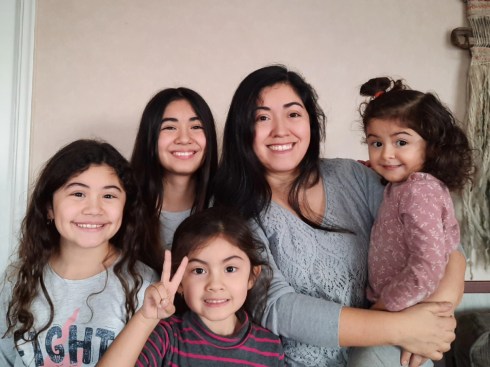
Co-author Natalia Ojeda and her daughters.
When the Universe Sends You an Idea, LISTEN!
It was 2020, and I was turning 40. When the world is shut down, how can one properly celebrate a momentous birthday? By taking a writing retreat to The Highlight’s Foundation, of course! So, there I was in cabin 15 researching insects for a humorous picture book manuscript, when something caught my eye.
Ladybugs had been to space!
Thanks to my years of participating in Tara Lazar’s Storystorm, I knew to take note! This was a picture book waiting to happen, but I had to tuck the idea away because I was busy with another project. The universe did not appreciate that decision. In the weeks that followed, I found ladybug after ladybug in my house. Then one landed on my hand! The universe was telling me to get moving, and I was finally ready to listen.
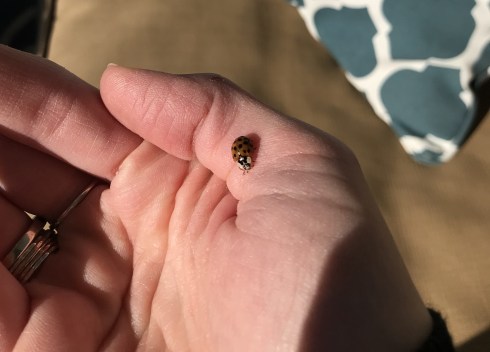
I’m so glad I snapped this picture of that pivotal moment!
So, I got to work, and drafted a humorous story about a ladybug engineer trying to build a rocket for space. I’m a sucker for backmatter, so I started digging around the internet to learn about the real space-traveling ladybugs.
I eventually discovered that the scientist behind the experiment was an all-girls class from a modest school in Santiago, Chile…You could have knocked me out of my seat with a gentle breeze! I was shocked. And the more I read, the more inspired I became.
Timing is Everything
An article celebrating the 20th anniversary of the launch had just been published in Chile one month before I had gotten the ladybug idea. What timing! Thanks to Google translate, I read quotes from the students (now grown women) who worked on the project. They all shared one common theme: this experience changed their lives.
Attending a university was not common in Chile, and many of the girls were from modest backgrounds. College and prestigious careers felt out of reach. Yet if they could work with NASA in high school, what else was possible?
Out of this small group of students, many of them became first generation college graduates with careers in medicine, law, psychology, engineering, science, and education.
A-M-A-Z-I-N-G!
I scrapped my fictional ladybug manuscript and started rewriting. Now my story was about a very real class of determined Chilean girls!
Finding My Coauthor & Agent
For days on end, I scoured Facebook for the names and faces of the women in the 20th anniversary article. Fate and a bit of ladybug luck led me to find Dr. Natalia Ojeda. She was excited to tell their story and share with the world that little people can do big things, even when the odds are against them!
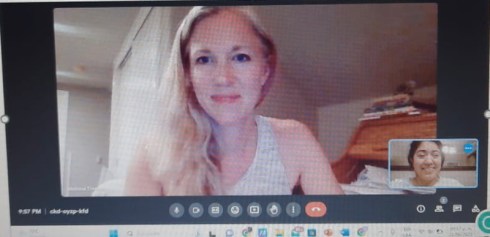
Melissa and Natalia meet on Zoom.
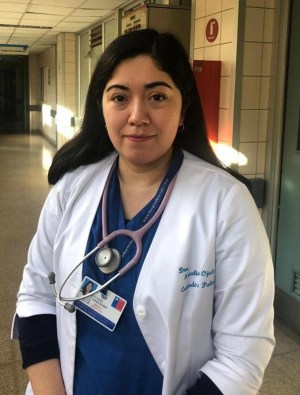
Natalia ready to help her patients in Chile.
Thanks to San Diego’s SCBWI Mayfest, I had a critique with Karen Grencik from Red Fox Literary. Luckily, I also got a 10-minute Zoom with Karen. Instead of discussing the manuscript she’d critiqued, I told her about Natalia, her amazing classmates, and ladybugs in space. Without even seeing the manuscript, Karen said, “I can sell that story. Send it to me!”
Sometimes a Story Just Isn’t Ready . . . But NEVER GIVE UP!
There was one problem. I had only been working on the manuscript for five months. It was a baby and needed work. Karen thought it was ready to go and off it flew into editors’ inboxes. For eight months, rejections trickled in. For eight months, I kept revising. I sent revisions to Natalia, and we had my poor critique partners read the story again and again and again.
Month after month, I felt the story getting stronger. In January of 2022, I had that tingly feeling that THIS was the story, and THIS was the way it needed to be told.
Our agent was ready to start round two of submissions and we gave her the new version of LADYBUG LAUNCH. Off it flew into editors’ inboxes. Within 24 hours we had interest, and within seven days we had two offers! I was in the waiting room of an appointment when Simon & Schuster’s offer came in. I ran outside, video calling Natalia and crying!
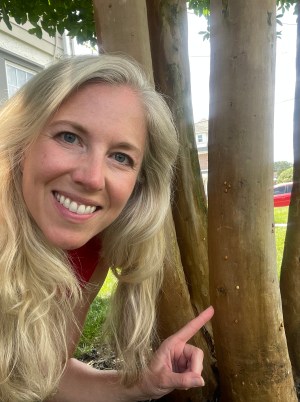
As our manuscript continued to transform, I found dozens of ladybug pupae attached to the tree outside my kitchen transforming into adult ladybugs!
ARE YOU READY FOR A COVER REVEAL?
Illustrator Manuela Montoya created the beautiful art to help tell this inspirational story!
HERE WE GO . . .
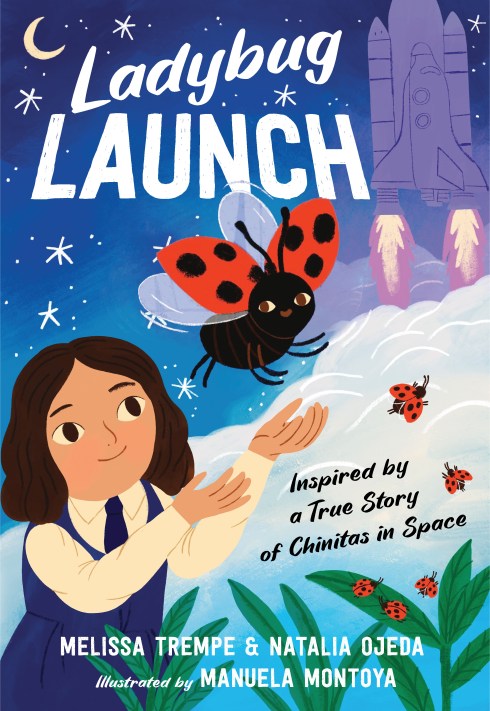
Available for PREORDER! (Book birthday—April 16, 2024.)
Isn’t the cover lovely? Please add LADYBUG LAUNCH to your must-read list, and I hope it inspires a little person in your life to follow their dreams!
Lastly, a BIG THANK YOU TO TARA for having me today! She’s the queen of kid lit comedy and an example for us all to follow. Thank you for featuring LADYBUG LAUNCH today!
Blog readers, Melissa is giving away a picture book or chapter book critique of the first 1,000 words (fiction or nonfiction, prose or verse—no art please.)
To enter leave one comment below. A random winner will be selected in December!
Good luck!
 Melissa Trempe has swum with sharks and hiked a volcano, but her greatest adventure is writing. She taught fifth and sixth grade for fourteen years, before taking a leap of faith to be a full-time author and mom extraordinaire. If you’re in need of a critique or author visit for your school, she would love to do both! Visit her website for more information at MelissaTrempe.com. Connect with her on Instagram @melissatrempe.author.
Natalia Ojeda grew up in a simple home in the southernmost country of the world: Chile. Her family had few resources, yet her faith, determination, and experience in the ladybug project helped her to overcome the odds and achieve her dream of becoming a doctor. As a mother of four girls, she wants to share her story of strength and hope with children around the world.
 Manuela Montoya was born in Medellín, Columbia. She studied graphic design and advertising in her hometown and art direction in Barcelona, Spain, where she now lives. She loves working with gouache, colored pencils, ink, and digital media. Learn more at ManuMontoya.com.
Images provided by Melissa Trempe, Natalia Ojeda, Manuela Montoya, and Margaret K. McElderry of S&S.
by Mirka Hokkanen
Before we get into the post, I wanted to say thank you for having me, Tara! I’m excited to be back, after my Storystorm post from January.
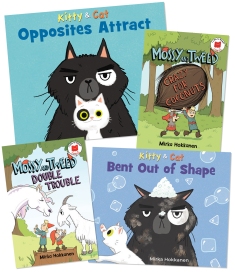 I launched my first book, MOSSY AND TWEED: Crazy for Coconuts soon after my January post, and have since then launched my second picture book KITTY AND CAT: Opposites Attract, with sequels for each book coming out this month!
In this post I thought I’d answer some questions about creating series and how I manage working on multiple books at the same time. (I also have a third series debuting Feb 2024, that I have been working on alongside these first two.)
Let me give a quick rundown of the series that I’m working on, so we have a point of reference for the rest of the post:
MOSSY AND TWEED: Early reader graphic novels. 4-8 years. Feature two gnomes who have adventures in a forest setting with a cast of animals and magical creatures. Published by Holiday House. Slapstick fun and adventure, easy to read, great for reluctant readers.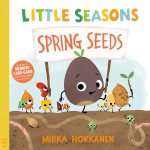
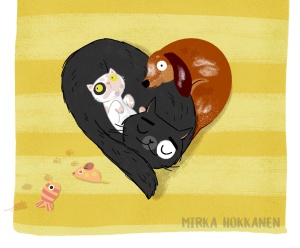
KITTY AND CAT: Concept picture books. 2-5 years. Features grumpy Cat and energetic Kitty, doing what cats do best all while teaching us basic concepts like shapes and opposites. Published by Candlewick. Lots of giggles to be had, invites multiple readings, sparse text, lots of story packed into illustrations.
LITTLE SEASONS: Nonfiction picture books. 2-6 years. Funny and informative books about life cycles in nature for little backyard explorers. Published by Odd Dot. Fun, engaging, clear & informative text and illustrations, lots of backmatter for further exploration, works with school STEM curriculum.
How did you create your book series?
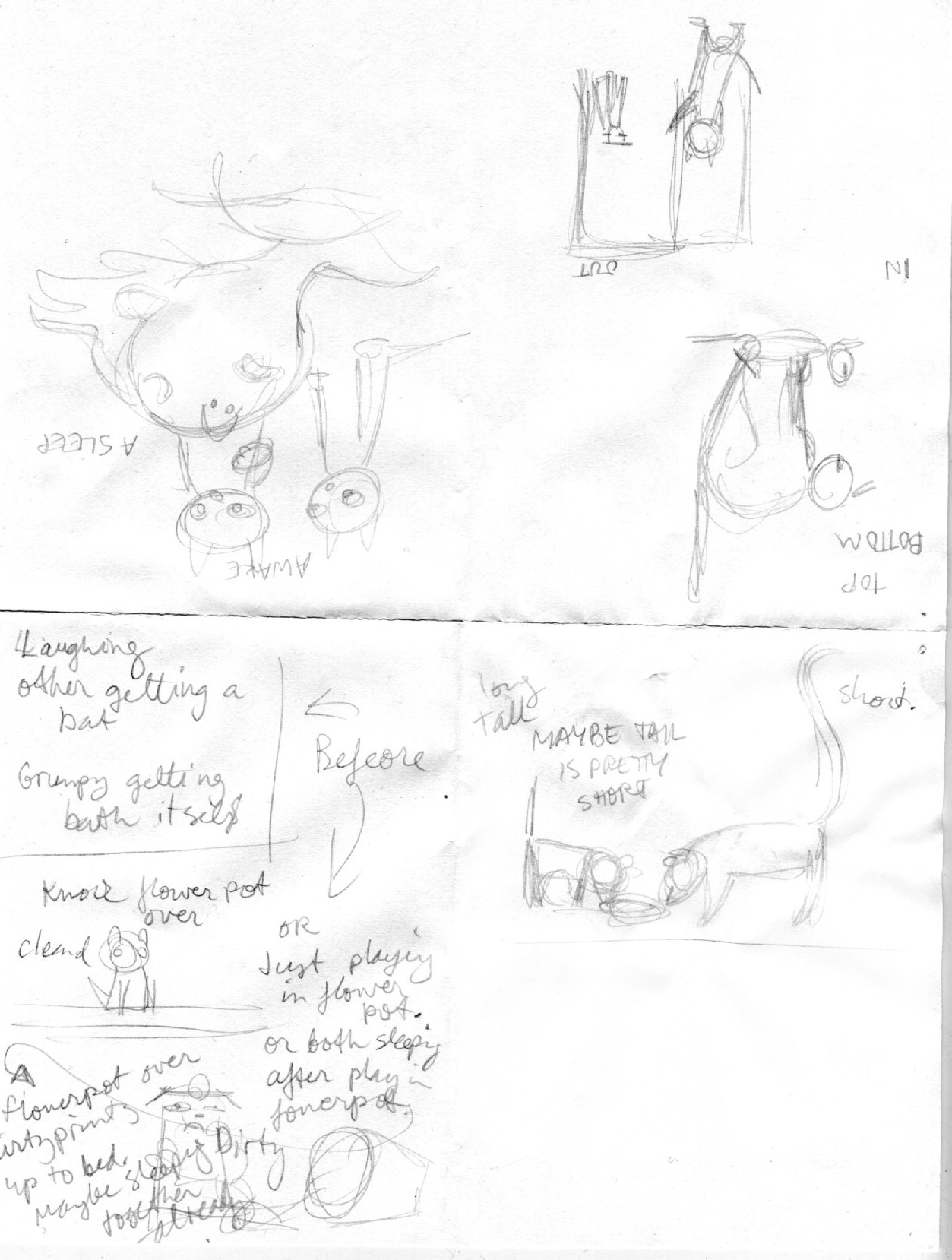 I don’t purposefully go in search of series ideas, but all of them turned into series fairly early into their creation. I think for a book to have series potential, it needs to have a strong central character (or characters) with interesting/flawed personalities, so that we can see them in different adventures, and there’s room left for personal growth (think Piggy and Elephant, Olivia, Grumpy Monkey). Or, a series can also evolve around a strong theme, like the Questioneers by Andrea Beaty. All my series fit into one or both of these categories.
I had the idea for MOSSY AND TWEED first. It was a picture book idea, but I didn’t develop it right away, and it sat in my notebook while I had the idea for KITTY AND CAT: Opposites Attract. KITTY AND CAT started out as a funny concept book about opposites with adult cats, but once I decided to add the friendship storyline of a cat and a kitten for depth, and the book became more fleshed out, I felt like one book wasn’t enough from a reader’s point of view. My experience as a reader was, if I find a great concept book for my toddler that we both enjoy reading, with fun characters, I want to learn all the concepts with my kid through these books. So it was a natural progression to create a series with different concepts. When my agent pitched the series, I had a series of four books done, of which two got picked up and we hope that there is a possibility for two or more in the near future.
Once KITTY AND CAT was out on submission and we were waiting on contracts, I pulled Mossy and Tweed out. The book turned from a picture book into a graphic novel and if I remember it was almost ready to pitch when my agent mentioned that it had series potential and we should pitch it as a series.
For the pitch, we had a complete pitch packet with script, dummy etc for MOSSY AND TWEED: Crazy for Coconuts, and then I came up with around five extra story ideas for potential series sequels that were written as brief paragraph summaries.
While I was working on MOSSY AND TWEED, an idea for a book series about different kinds of life cycles that we find in our backyards was bubbling in my head. It came to me more as a series idea, because I was really excited about it and my mind couldn’t help but bounce around to all the possibilities like tadpoles, caterpillars, seeds etc. I love finding interesting facts about things around me and learning new things, and felt like there was a gap in age appropriate nonfiction books about nature that I could read with my (then) 3-year old.
While I was working on the garden cycles idea, and formulating it into a book dummy to pitch, I was working on KITTY AND CAT books, and we pitched, and sold MOSSY AND TWEED books. We pitched the backyard books as a series, but instead of picking butterflies and tadpoles, my editor wanted to go the route of seasons and plants, so we went with seeds from the original pitch and added leaves into the contract.
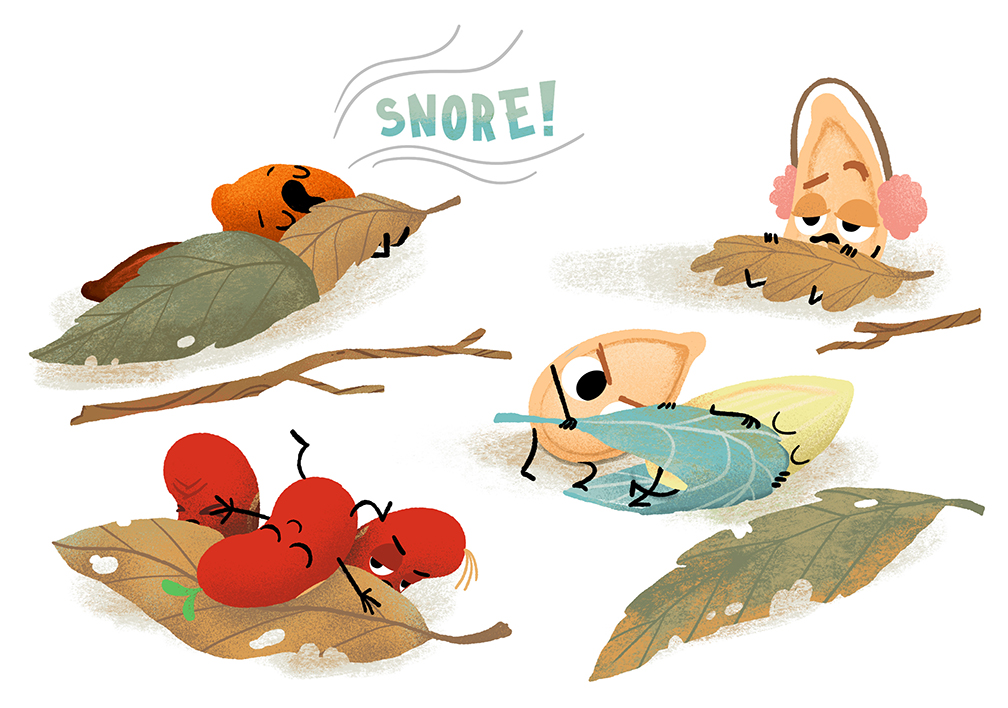
How did you manage your time working on several book series with different publishers at the same time?
The three book series sold within a year and a half of each other so I had books in various states of completion by the time we signed the last one. As we were negotiating the last contracts, I thought about how much time I needed for each book and we negotiated deadlines so I could slot and finish each book on time. Each deadline had some leeway to extend in case things got tight, and each editor was aware that I had other book commitments at the same time.
 I also have three small kids, and in case someone fell and broke their arm or got sick and had to stay home for several weeks, I wanted to make sure that there was wiggle room for emergencies and the unexpected.
My general tactic was to be aware of my deadlines, and slot books around each other. I not only had multiple stages of illustrations going on, but also needed to develop manuscripts. Two of the sequels hadn’t been written when we signed the contract, so I had to write the books before I could start illustrating them. I had a little piece of paper next to my desk with due dates for each book and when things were the most hectic, I kept an Excel sheet of book pages that had checkboxes for when manuscripts, loose sketches, final sketches, and finals were finished and turned in.
Publishing moves sloooow and editors and art directors have many books on their plate. After you turn something in for feedback, it might take months before you hear back. So that would be my time to grab the next book in line and work on a different phase of something else.
I can concentrate and work most efficiently if I work in blocks of time. So I would give myself a deadline to finish something, and then work as hard as I could to meet that deadline, turn that in, and then move onto something else for the next period of time. You have to be self motivated to set and meet those deadlines, and keep things moving along. The bonus was that I could then also communicate those timelines to my editors, so they knew when to expect things from me. And hopefully it would make their job easier and less stressful.
Things were more challenging in the beginning as I was new to publishing, getting to know each publishing team and how they work. Some of them respond quickly and some of them can take months. By the time we got to the second book for each series, it was a bit easier to foresee how long each stage was going to take with each editor and how much time I could slot to work on something else before I could expect to hear back from them.
I think what surprised me a lot was how flexible the deadlines were in the end. We had set deadlines in the contracts, but in a few cases, the publishing team took a very long time to respond and turn around revisions, and projects stretched for months and months with no new deadline set. It made me very unsure in the beginning, because I didn’t know what the expectations were of me when we missed a deadline. Now I know my editors and just roll with it, and do my best to turn things in as quickly as I can when it’s my turn. But even when feedback was taking months, there were so many projects underway, that I’ve never had to wonder what I’m going to do on a given week.
 Closing thoughts…
I feel incredibly lucky to have worked on all these books. My life has been crazy trying to balance it all and I haven’t had a ton of time for creativity outside of trying to finish them up (and book promotions for when they come out). We are just now polishing off the last of the six books with one last round of tweaks (fingers crossed). We haven’t signed for more books in any of the series, but I hope if the books sell well, we’ll have good news in the future.
In the meantime, I have another book to illustrate, and with the new time that is finally opening up on my plate next year I hope to catch my breath and look forward to developing new idea seeds into blossoming book trees. Hooray for Storystorm sweeping in at the perfect time to water those seeds in January!
Congratulations on all your books, Mirka!
Blog readers, Mirka is giving away a copy of each of her new books: MOSSY and TWEED: DOUBLE TROUBLE and KITTY AND CAT: BENT OUT OF SHAPE (US addresses only).
Just leave one comment below to enter and two random winners will be selected at the end of the month.
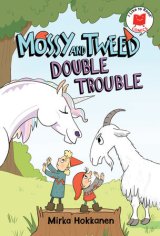
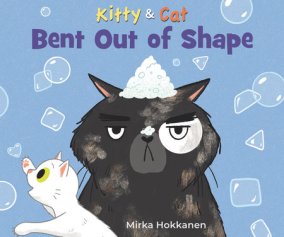
 Mirka Hokkanen is an author and illustrator who loves creating quirky characters. When not writing or illustrating, Mirka loves to knit, sew, be outdoors, make art and hang out with her family. Mirka is also a teacher on Skillshare, a licensing illustrator and a printmaker. Find her online at Mirkah.com. Mirka is posting free downloadable activity and coloring pages for her books around launch days. Find them under the Books tab in the menu on her website. And she is currently hosting a 30-day drawing tutorial series on all her social media channels to celebrate the launch of MOSSY AND TWEED and KITTY AND CAT sequels. You can find all the videos in her playlist at https://bit.ly/drawwithmirka.
It’s my 13th book so maybe I just got lazy, but I neglected to blog about my latest release, FLAT CAT.

One chilly winter night during the pandemic, I heard a loud MEOW! at our back door. I drew the curtains to find an adorable black cat. When I opened the door to put out a can of tuna, the cat slipped past me and into our house…and she never left. Smooth moves! That’s how I got the idea for the slick, sly character of FLAT CAT. Yep, FLAT CAT is based on our girl Phoebe, who is NOT AT ALL FLAT.
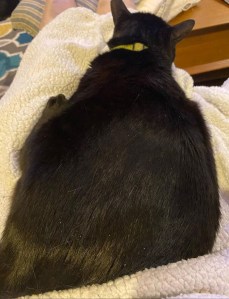
(OK, that’s not the most flattering angle.)
Flat Cat was born flat. He wasn’t squashed by an out-of-control ice cream truck, or smushed in a waffle iron. He was just flat. This slick, sly cat could stray and roam anywhere he pleased, keen and unseen. And wouldn’t you know it, Flat Cat liked it just like that.
That is until one day, when Flat Cat accidentally fell splish-splosh right in the wash. And when he emerged from the dryer, Flat Cat wasn’t flat at all. He was adorably puffy and downright fluffy! And Flat Cat wasn’t sure how he felt about that.
From acclaimed author Tara Lazar and brought to life by #1 New York Times bestselling illustrator Pete Oswald, this is a hilariously quirky and irreverent story.
I know many of you are looking forward to Storystorm in January 2024, and one of my best tips for coming up with story ideas is exactly how this book materialized: from daily life. Sure, it’s not exactly the same tale, or tail, but the spirit of FLAT CAT emerged from our family’s impromptu feline adoption.
I hope you’ll check out FLAT CAT and the activities, ask for it at your library or school, write a review, or tell a friend about it. Any way you can help get the word out would be greatly appreciated!
Now speaking of Storystorm, I have received so many inquiries from folks who want to be guest bloggers that there’s no way I can actually choose. So I have to do something a little differently this year…ask y’all to fill out a short application. This way I can collect everything in one place and randomly select bloggers. Your actual pitch for the blog post is still required, though, so I can avoid any potentially redundant posts.
I also ask that if you guest blogged in 2022 or 2023 that you refrain from applying this year so I can welcome new guests.
The Storystorm Guest Blogger Application is here, and you have until November 26 to fill it out. Guest bloggers will be notified in early December.
Now go make some smooth moves!
It’s almost Halloween!
And you know what that means, right?

On Halloween night, the Great Pumpkin will rise out of his pumpkin patch and fly through the air with his bag of toys for all the children! (This is according to Linus, and I’m afraid I can’t vouch for him. Lucy either. You can’t trust those Van Pelts. Just ask Charlie Brown and his football.)
Simon Spotlight has released a lap board book edition of everyone’s favorite Halloween special. I’m “sincerely” thrilled by this big, sturdy book full of nostalgic scenes.


There’s Snoopy fighting the Red Baron, Charlie Brown and his rocks, and smitten Sally blindly following her pumpkin patch Romeo.
This got me to thinking—what’s NOT in this Peanuts classic?
THE PARENTS.
Think about it: the Peanuts Gang always arranges escapades themselves. They produce Christmas plays, serve Thanksgiving meals (with a little help from Snoopy & Woodstock), and generally carry on without adult interference. When there is an adult nearby, we never see them; we only hear a fuzzy WAH-WAH-WAH-WAAAAH from a trombone-like ghost.
As a child, I wanted the same autonomy as Charlie Brown and his friends. I didn’t want to be told what to do. I didn’t want help from an adult. I wanted to create kid-only hijinks. And my brother and I did—unbeknownst to our parents, we hosted a casino and an auction in our basement and profited $18, which was a lot of money in 1979!
But I digress.
I took Schulz’s NO ADULTS ALLOWED format to heart when I became a picture book writer. With rare exception, parents don’t appear in my stories. They’re not necessary. The fun is all kid-led and kid-approved.
In THE MONSTORE, Zach keeps buying monster after monster to spook his little sister Gracie, but never does a parent interject with “that’s a bad idea”. In YOUR FIRST DAY OF CIRCUS SCHOOL, an older brother leads his younger brother through the ups and downs of unusual academia, but never does a parent step in to catch the sibling’s fall from great heights.
When I do picture book critiques, I’ve noticed that some writers bring parents into their stories as a voice of reason. Typically with these lines, I hear the writer themself trying to refocus their character’s attention. I interpret this device as an “I’m not sure what to do here” move. My advice is thus: take out the parent and try another method. Introduce an action that makes the characters realize (or not) their mistakes. Make their world adult-free.
My philosophy stems from the fact that children are constantly being told what to do—by their parents, their teachers, and other adults of authority. A picture book should be an escape from the real world. Another adult admonishment is unwelcome. Let the kids roam free! Let chaos ensue.
And let them figure it all out! You’ll find that those kiddos are pretty darn smart.
Many thanks to Simon Spotlight for supplying a copy of IT’S THE GREAT PUMPKIN, CHARLIE BROWN to a lucky blog reader (US).
Just leave a comment below to enter and a random winner will be selected in November.
Good luck!
by Tamara Ellis Smith & Nancy Whitesides
Nancy: Hello, Tara. Thank you! We are thrilled to be here to interview each other about our new book, GRIEF IS AN ELEPHANT, releasing with Chronicle Books this Tuesday.
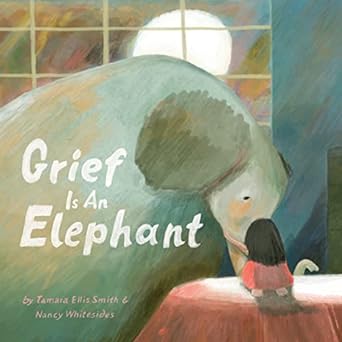
Tam, I’ve read about your fascinating childhood. Will you talk about it, and your eventual journey to becoming a writer?
Tam: Thank you from me too, Tara! I love your blog and it’s exciting to be here.
Okay, onto Nancy’s question! As a kid, I spent a lot of time—like A LOT of time—pretending. My best friend and I played Little Women. I was Jo and she was Beth. I haven’t thought about that in a long time! We played in this great span of woods for hours. I guess it was kind of a mash-up of Little House in the Big Woods and Little Women!
Imaginary play relaxed me. I felt the same way about reading. And once I was able to write, pens and paper felt even better.
I loved what you’ve shared of your childhood and how important imaginary play was for you. You’ve written this beautiful, lyrical story, GRIEF IS AN ELEPHANT. Please tell us about it.
Thank you for saying that Nancy, but my words are only half of why it’s beautiful and lyrical. You and your illustrations are the other half.
You and I have talked about this a lot—GRIEF IS AN ELEPHANT is the story of our hearts. My son’s friend died, and my friend died, and GRIEF IS AN ELEPHANT came pouring out of me.
Much later, as I was revising the story, my father went into the hospital for a surgery to mend his heart. But the surgery failed and six weeks later he died.
Grief absolutely became an elephant for me then. I breathed differently because of its weight. Megan Devine, a writer and grief advocate I really respect, said, “Loss and grief change our landscape. The terrain is forever different and there is no normal to return to. There is only the inner task of making a new and accurate map.”
GRIEF IS AN ELEPHANT is part of that map. I often talk about how I write to explore questions I have—and isn’t that just like making a map? My biggest hope is that GRIEF IS AN ELEPHANT can help kids make the map they need for their journeys too.
Thank you for sharing your grief experience, Tam. I appreciate you sharing even though it must be painful to talk about it. I also appreciate the quote you shared from Megan Devine. Please talk about your writing process and routine.
I’m a slow writer. And because of the way my life is structured, I have to write before my kids and my other job. That means getting up at 5:15 AM and writing for about an hour. I love it. One of my favorite moments of the day is watching the world get light. Being up then feels magical. Like I’m a part of the team that brings on the day.
I’ve read about successful authors waking up early to have their writing time.
I write for a long time, revise a million times, and then hopefully make a book at the end. I once took a picture of all the drafts of my first novel lined up on my street. The line was endless!
Please talk about your writing hero.
So many writers are heroes, putting their essential truths into the world, even as stories and people and perspectives are being banned across the country. But I’ll name the writer who inspired me to become one. In college I was in a play written by someone I had never heard of—María Irene Fornés. She was a playwright, a director, a feminist. She was someone courageous enough to write in a way that made sense to her. Her word choices, the structures she created—she followed her own organic logic. She made me realize I didn’t have to write like the mainstream writers I knew; that I could write about the things that were important to me in my own way.
You are definitely doing something right, Tam. I know this from reading your work and your letters to me. You are a stupendous writer. If I can only use the word stupendous for one person it would be for you.
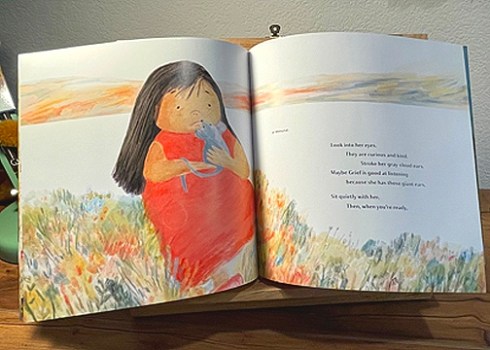
Thank you! Now I’ll jump in!
Nancy, will you describe living in the Philippines? You’re a self-taught artist and I wonder what parts of each landscape and culture and energy inform the way you see things and how you create your art?
Living in the Philippines, I remember being a sickly child and teenager, but I still loved to explore nature, climb trees, even swim in the river. I also remember when I was probably three or four, I drew a rudimentary face, and then soon afterwards drew about a hundred little faces all over the walls, as far as my arm could reach. My poor mom.
Your poor mom!
Knowing and living with two cultures informs my art, and I try to draw with curiosity and an open mind.
I incorporate environments I love if the story permits it. An example in our book is the double spread with the overview of the home, the distant hills and sky, and all the animals. This point of view is important to me because I’d seen it quite often as a child when I’d climbed to the very top of my favorite tall tree. I’d seen this landscape and loved looking at it. I wanted to set GRIEF IS AN ELEPHANT in this beautiful world and share this with the children reading our book.
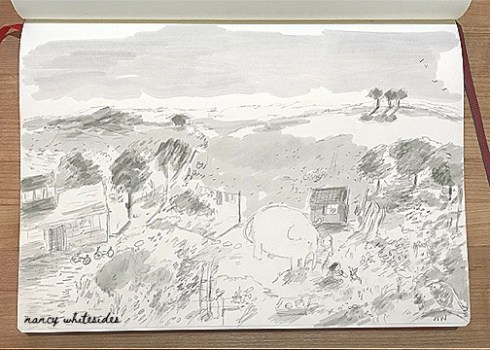
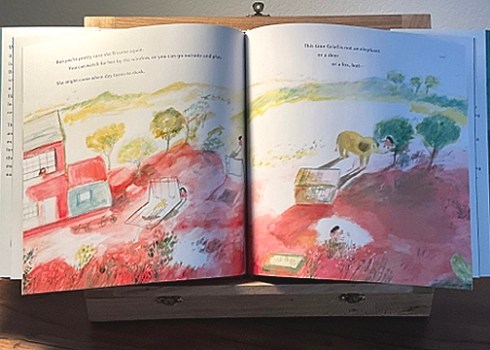
Nancy, I didn’t know that the landscape in that double spread came from your experience. Learning that kind of detail instantly makes that page, and the whole book, so much richer.
Every single time I look at our book, I am overwhelmed with the beauty of your artwork. You’ve told me some parts of your process, like how you wanted to express both a sense of grief and a sense of love in the eyes of the elephant (which you totally succeeded in doing!), but would you talk more about your illustration process?
Thank you so much, Tam. Your words helped inspire me! My illustration process begins with rereading your manuscript over and over while I imagine this world.
Next, I draw sketches, thumbnails, storyboard and a dummy. Lastly, final art—adding paint, color, and digital media.
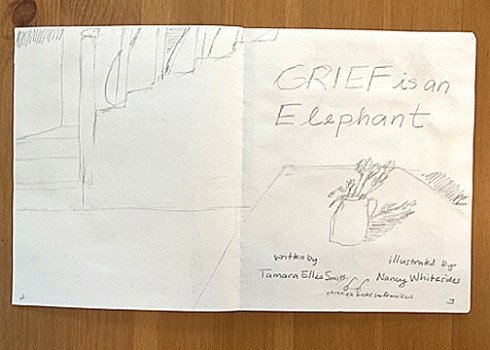
These are more or less the technical steps. The more difficult part is adding depth and emotion, and working to make the physical image come close to what was imagined.
Finally, I value the feedback our editor and art director gave me. Sometimes I thought, “Oh, that looks good.” But no, it sure didn’t. It was nowhere near where it needed to be.
I had the same experience!
Okay, last question. Can you tell us one thing that totally surprised you as you worked on GRIEF IS AN ELEPHANT?
One surprise is how you and I are matched so well including how your words and my art created this beautiful book we love, and how we have similar life experiences. I appreciate you even more.
I was also surprised by how emotional I became while working on our book. I realized even more how much love I have for the person I lost. Grief and love truly are tied together.
Absolute truth.
Thank you so much for having us here, Tara! GRIEF IS AN ELEPHANT comes out on October 24 with Chronicle Books. We’re working on some activity pages and a few other surprises, so check out our websites or Instagram to learn more!
Congratulations on this lovely bok, Tamara and Nancy!
Blog readers, Tamara and Nancy are giving away a copy of GRIEF IS AN ELEPHANT (US addresses only). Just leave one comment below to enter and a random winner will be selected at the end of the month.
The winner of the last giveaway, FIX AND STITCH, is Becki Kidd. Congrats, Becki, and expect an email from me shortly.
Tamara Ellis Smith lives in Vermont with her family. When she’s not writing books for children, she can often be found trail running on a river trail with her friends and dogs. She also hangs out on Instagram @tamaraellissmith and Pinterest @tamaras0259, and her website is tamaraellissmith.com.
 Nancy Whitesides is an author and self-taught illustrator born in Manila, and later moved to the US. Nancy’s art is imbued with colors and emotions, and often features nature and animals. Her work for GRIEF IS AN ELEPHANT was chosen for the prestigious Original Art Show at the Society of Illustrators in New York. Nancy also illustrated SMALL THINGS MENDED, written by Casey W. Robinson, forthcoming from Rocky Pond Books Spring 2024. See more of Nancy’s work at her website nancywhitesides.com and on Instagram @nancyillustrator.
by Christine Van Zandt
Those early, shut-in days of the pandemic fostered my upcoming picture book, MILKWEED FOR MONARCHS (Beaming Books, 2024). With everyone at home, we escaped to—I mean, we appreciated—our garden a bit more. Flowers and foliage. Bugs and birds. Bare patches calling out for some attention. So, off to the garden center where an “attracts butterflies” sign led us to buy our first milkweed plant. Why not?
Days later, we noticed our milkweed had critters crawling on it. Twenty-seven to be exact. Little caterpillars that would grow into monarch butterflies. We watched as they devoured leaves, buds, even stems. Their escapades, a fun distraction. Counting caterpillars became part of our daily routine.
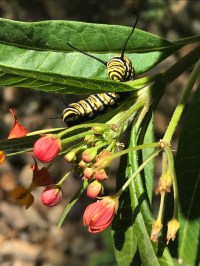
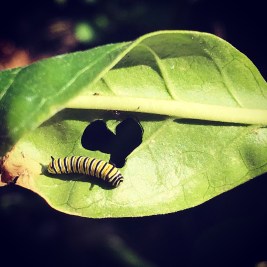
Then, one morning, all were gone!
I Googled and discovered this wasn’t supposed to happen. Toxins in the milkweed plant made the caterpillars taste bad and their bold stripes warned-off predators. (Apparently no one told our local birds and raccoons.)
Without the constant crunching, the milkweed leafed out, bloomed, and a female monarch butterfly found it. The baby-factory was back in business! We learned that monarchs need milkweed—it’s the only plant their caterpillars can eat.
Once our eggs hatched, there were a lot of very hungry caterpillars. (Eric Carle knew what he was talking about.) Back to the garden center for more milkweed. Before long, some caterpillars made chrysalises, then, weeks later, launched into gorgeous butterflies reminding me of my childhood.
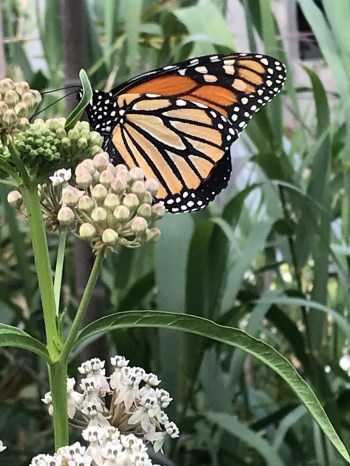

Growing up in northern California, winters brought magical moments of seeing coastal trees blanketed with western monarch butterflies. While the eastern monarch population that overwinters mainly in Mexico has suffered declines, the western monarch has been classified as an endangered species. In 2021, fewer than 2,000 of these butterflies were counted overwintering in California. Their numbers were once in the millions.
At-home pesticide use is a major factor. Gardeners want big blooms and perfect greenery, but spraying or applying systemic pesticides means we’re killing all kinds of insects and disrupting the food chain. Habitat destruction and climate change also take a toll.
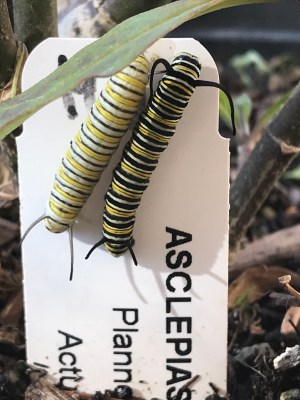
While I watched the butterfly life cycle, I wrote about it, workshopping my manuscript with critique partners. My writing was trial and error: fiction, nonfiction, prose, verse. I read every book I could find about butterflies, and began volunteering for Xerces to gain insight into insects. Then back to revisions.
The manuscript that fluttered to the top was a rhyming poem supported by facts. Spare, lyrical text shows a mama monarch returning from overwintering. We follow one egg on its journey to becoming a butterfly. This engaging read-aloud also has STEM information and fun interactive questions to support classroom or at-home learning.
My first nonfiction picture book, A BRIEF HISTORY OF UNDERPANTS, sold to Quarto Kids unagented (via a Twitter pitch party) and published around the same time that the manuscript for MILKWEED FOR MONARCHS won several top awards through SCBWI. Soon after, I received an offer for representation from the amazing Liza Fleissig at the Liza Royce Agency.
In a whirlwind, Liza sold my manuscript to Beaming Books. Working with their Senior Acquisitions Editor, Andrea Hall, has been a dream. She understood my concern but also my hopefulness and she created a beautiful book. Here’s a first look at the gorgeous cover created by illustrator extraordinaire, Alejandra Barajas!
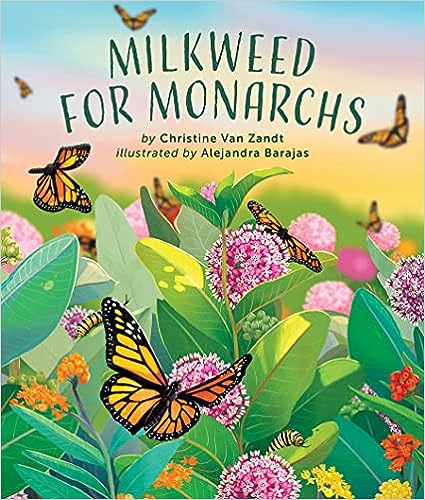
MILKWEED FOR MONARCHS is now available for preorder, for a February 6, 2024 release.
In closing, I’d like to give a big thank-you shout-out to Tara! I appreciate all Tara does for our industry and how her successful books have shown the world that funny female kid’s lit writers really do exist.
Images provided by Christine Van Zandt and Beaming Books.
Christine is giving away a 60-minute manuscript critique of the first 750 words of your book (adult or kid’s, fiction or nonfiction, prose or verse) or a picture book with 750 words or fewer. (No art please.)
Leave one comment below to enter. A random winner will be selected in September!
Good luck!
 Christine Van Zandt is a freelance editor who loves helping other writers realize their dreams of getting their books published. A small-business owner, she founded her company, Write for Success Editing Services, in 2009.
MILKWEED FOR MONARCHS is Christine’s second nonfiction picture book. She lives in Los Angeles with her family and pets. Find out more at ChristineVanZandt.com.








 Writing for Kids (While Raising Them)