You are currently browsing the category archive for the ‘Picture Books’ category.
by Sophia Gholz
Thanks for having me on the blog, Tara! I’m so happy to be here and excited to reveal the cover for my new book, TRUCK IN THE MUCK.
You asked me to share how the idea for this book formed and the truth is…it’s complicated.
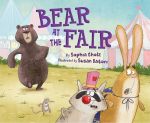
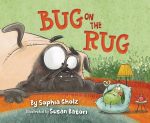 The first book in this series, BUG ON THE RUG, developed after a bout of writer’s block, a self-inflicted writing challenge, and a late-night phone call with my little brother, whom I call BUG. The second book, BEAR AT THE FAIR, flowed easily after a family trip to the nearby annual county fair. Truthfully, I never planned to write more stories in this animal world. Not because I didn’t want to, but because I’ve found chasing ideas counterintuitive to the creative process. Instead, I have to sort of allow things to form organically. If it comes, it comes, and if not. Well then, there you go. But life, as it often does, had other plans.
 Both BUG and BEAR were drafted before the pandemic and released after its peak. During those years, I often struggled with inspiration. Finding a silver lining when things are tough isn’t always easy and it’s something I thought about a lot. While I was stuck in the muck of my bubble at home, I spent many hours scrolling online. Then one day, I happened upon a beautiful image of a family traveling in their camper van…and then another picture…and another. I watched online as others explored the world with little more than a vehicle and roadmap, and I found it to be such a freeing idea. I especially loved the thought of traveling with friends, except my inner child turned the mental imagery into a van full of animals with a feathered duck at the wheel! Turns out, it was an image I just couldn’t let go of.
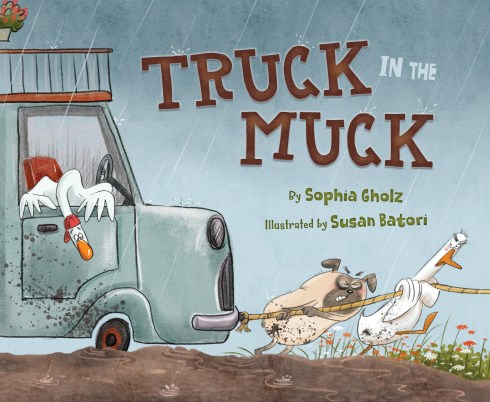
I’m so thankful to have found Duck and his easy-going personality in the silver lining of that time period. TRUCK IN THE MUCK was a much-needed reminder for me that even in muck, we can sometimes find luck…and a whole lot of fun! I fell even more in love with this story when I saw the brilliant way illustrator Susan Batori designed Duck’s truck and brought all of his buddies together. *Spoiler: keep an eye on the pages for familiar faces from BUG and BEAR.
Thanks again for having me and Duck on the blog! I hope everyone enjoys navigating muck with Duck, his sweet group of friends, and his quirky old truck.
TRUCK IN THE MUCK releases July 15th from Sleeping Bear Press!
 Sophia Gholz is a children’s book author, music lover, magic seeker, and avid reader. She enjoys writing fiction with humor and heart. When writing nonfiction, she pulls on her love of science and her strong family background in ecology. Previously, Sophia worked as an advertising copywriter and made a career managing visual artists in New York City. Sophia is the author of The Boy Who Grew a Forest, a NCSS Notable Social Studies Trade Book and Florida State Book Award gold medalist. This is Your World: The Story of Bob Ross, Bug on the Rug, ARLO and more. When she’s not writing from her home base in Florida, you can find Sophia reading, visiting schools or exploring the great outdoors with her family. For more, visit SophiaGholz.com.
 Susan Batori is a Hungarian illustrator, graphic designer and a character design addict. She studied graphic design at the Hungarian Academy of Fine Arts, Budapest, Hungary. As an art director at DDB Advertising Agency, Susan designed many print ads, websites, posters, and packages. That’s how she discovered drawing hilarious characters was much more fun. She also loves creating new digital textures, reading, watching great movies, drinking coffee, walking in a forest or pampering herself with a good salted caramel ice cream. Since 2012, Susan has been working as a freelance children’s book illustrator. For more, visit Susanbatori.myportfolio.com.
by Sheri Dillard
At the beginning of every year, my agents, Liza and Ginger, schedule a phone call with all their clients. They call it the State of the Union, and it’s a “check-in,” of sorts. We talk about manuscripts on submission, reactions to any responses so far, and thoughts on current projects.
 On one of those calls, we brainstormed story ideas. My debut picture book COWHIDE-AND-SEEK had just come out, so most of our ideas were game-inspired. The conversation was fun and lively, and I took lots of notes. But it wasn’t until Liza said, “How about tic, tac, toe?” that something clicked for me.
A story about three friends popped into my head. Three BEST friends who were always together—three in a row! But what would happen if one of those friends got left out in some way?

As a preschool teacher, I love watching young children make new friends. The kids tend to bond quickly as they explore the classroom and playground. For many, school is the first time they are around other children without their parents nearby. And sometimes, whether it’s a group of peers or a one-on-one friendship, managing new social situations can be tricky.
In my new picture book TIC, TAC, AND TOE, we see three friends having fun together. But when they find a tandem bike and it becomes clear that it won’t work with three, Tic and Tac leave Toe behind. They don’t even realize that Toe feels hurt and left out. They ride around, have fun, and sort of forget about their friend Toe. It’s only when they see something they think Toe will love that they remember him. When they find him sad and alone, they realize what they’ve done.

While reading this story, the reader might stop and say, “Oh, look at Toe. How do you think he’s feeling? Why do you think he’s feeling that way?” Asking questions while reading books can be like “practice” to help children learn how to recognize others’ feelings in real life, too. Stories about friendship, empathy, and kindness can guide kids on what it means to be a good friend.

I love how my books, so far, are connected to some of my favorite childhood games. (And I’ve got more game-inspired stories that I hope to publish someday! Maybe I’ll have my own three-in-a-row? Fingers crossed!)
What are some of your favorite childhood games? Maybe there’s a story idea in there somewhere? Good luck and have fun!

Thanks, Sheri!
TIC-TAC-TOE will be published this coming Tuesday, November 4, by Reycraft Books. But you can win a copy right here!
Leave a comment and a winner will be randomly selected next month!
 Sheri Dillard is a children’s author and preschool teacher/librarian, and she hosts regular storytimes at her local indie bookstore. She is the author of several picture books, including two game-inspired ones, COWHIDE-AND-SEEK and TIC, TAC, AND TOE.
Sheri lives in Atlanta, Georgia, with her husband Mark, and has three sons who are always (mostly) happy to join her for a board game or two.
CALL ME GEBYANESH is based on the real-life experiences of a girl, Gebyanesh Addisu, who immigrated from Ethiopia to Israel with her family when she was seven-years-old.
Although Jewish, she struggled to fit in with her different skin color and very different culture. When I first met her on a trip to Israel ten years ago, she was a high school student and greatly impressed me with her fluent English, her modesty, and her love of learning. We lost touch for a while, but resumed correspondence some years later, and when I approached her to collaborate with me on her immigration story, she was enthusiastic. We met virtually about twenty times, and when she told me about her teacher giving her a new Israeli name on her very first day of third grade, I knew we had a hook. This incident sent Gebby on a roller coaster of emotions and a search for her identity until she was a young adult—when she finally had the courage to reclaim her name and her Ethiopian heritage.
Many authors write books about living people without collaborating or co-authoring. If the subject already has a lot written about them, it may not be necessary to work directly with them to create a picture book from their story.
However, I feel extremely lucky to have been able to get Gebby’s story directly from her and to learn first-hand about her struggles and eventual triumphs. So when my editor advised naming Gebby as a co-author to give the book more authenticity, I was happy to do so. Though I did all the writing, it is Gebby’s story, and she put in many hours with me crafting it into a picture book.
P.S. Gebby is now 27 and a graduate student in Ancient History at Hebrew University in Jerusalem. I am so grateful that we have become close, life-long friends.

Arlene Rosenfeld Schenker is giving away a copy of CALL ME GEBYANESH to one lucky blog reader.
Leave a comment below and good luck!
Have you ever read THE END by David LaRochelle? (illustrated by Richard Egielski)

It’s incredibly clever! Mr. LaRochelle spins a fairytale in reverse. He begins at the end and ends at the beginning. There’s all the fairytale flavor you’d expect—a princess, a knight, a dragon—plus some sweet lemonade as a bonus.
This picture book was in heavy bedtime rotation when my kids were little. And it also inspired me to revise my own work backwards, turning lemons into lemonade.
I often get stuck in my manuscripts at the middle. Maybe you do, too. Sure, it’s where the bulk of the story takes place, but it feels like it can be purposefully pedestrian, walking from point A, to point B, to ho-hum let’s-get-on-with-it C.
Yikes, I don’t want my audience to be lulled to sleep! But as a writer, I have so much more fun writing the opening and the closing. Those scenes can really pack a whack.
So sometimes when I’m stuck in the middle, I decide to work backwards. If I have a genius idea for the conclusion, I’ll write that first. Then I ask myself, how would you logically get here? What happened one step ago?
Then I write that part.
I go from C, to B, and then back farther to A. Somehow the logic of the story falls magically into place that way.
What happened right BEFORE this scene? What makes the most sense to occur PRIOR? These simple questions can really free up your work. It’s one of my revision go-tos, inspired by THE END. (Thanks, David!)
Do you want more revision tips?
I filmed a revision video of my best ideas for Karen Ferreira’s 2025 Children’s Book Mastery Summit. It begins next week, July 28. You can check it out using my link here.
Other writing experts like Charnaie Gordon, John Fox, Brooke Van Sickle, April M. Cox, Cameron Sutter (Plottr), Vicky Weber, Joe Bunting (The Write Practice), and Daniel David Wallace will also share their expertise with you during this event.
Is this the end? Nope. It’s just the beginning (or middle) of your kidlit publication journey. I hope you’ll join me!
Today we are celebrating the author/illustrator debut of Erika Lynne Jones, ZARA IN THE MIDDLE, a multi-generational picture book about finding your voice and the strength of family. You may be familiar with her other illustrated works, such as THE LOUD LIBRARIAN or BLACK GIRLS: A Celebration of You! Now she is also be a published author.

Congratulations on your author-illustrator debut, Erika. Tell us about ZARA IN THE MIDDLE.
The story is about Zara who loves living next door to her Grandma Jane and Granny Gladys, but sometimes it’s tough being stuck in the middle of them! Both her grandmas think they know what’s best for her, and Zara is too worried she might upset them if she says what she really wants.
For context I’ll add that the three main characters are planning Zara’s birthday party, which for me adds emotion, tension and fun to the dynamic. I look forward to hearing how others relate to the story and what kinds of memories it invokes.
Is there anything in this story inspired by real life?
Yes, the story incorporates some pretty big aspects of my childhood and adult life. Zara is very much me on the inside growing up and some of those remnants remain today. I would be so concerned about everyone else being happy, and specifically happy with me, that I wouldn’t voice my truth.
While I wrap the story in humor, not feeling free to voice my opinions about things was actually quite heavy. But writing was therapeutic because I got to imagine the good that would have come out of finding my voice earlier in life. And maybe in the process, I got to leave some hints for caretakers about opportunities to stop and check in with less vocal little ones about what’s on their mind and in their hearts.
In my adult life, I’ve been blessed with one of the best moms and one of the best mother-in-laws that a person could have. When we first became a family, I noticed they expressed themselves differently, but at the same time had similar intentions to love and support us. It was fun to exaggerate aspects of their personalities to tell a heartwarming story. So yes, I had lots of real-life inspiration in this story.

Erika’s mother-in-law & mother having holiday fun
What Easter Eggs/personal touches did you add to the illustrations and text?
I had a blast infusing some of the personality traits of my mom and mother-in-law into the grandma characters. My late mother had an affinity for drinking—and recommending—prune juice and wearing pearls like Grandma Jane. Also my mother-in-law LOVES baking and makes a mean poundcake just like Granny Gladys. I thought it would be fun to have her contribute to the book, so I had her hand write one of the recipe cards in one of the spreads for me.

Did you have any “ah-ha” moments when writing?
I did actually… I was preparing for a talk I now do called “Illuminating You in the Picture Books You’re Creating”, where I encourage writers and illustrators to look at their childhood books for clues about what kinds of stories they might want to create.
While preparing for that talk, I realized I was subconsciously influenced quite a bit by books I loved reading when I was a child when creating the storyline and illustrations. For example, I loved reading Big Dog… Little Dog by P.D. Eastman. Something about the way he contrasted the characters’ traits and personalities to create tension with words and simple images enthralled me, and of course, it all worked out. I realized I did the same with Zara’s grandmothers by showing the beauty in their differences, and likewise, it all works out. Also, I found the first short story I wrote when I was five or six, and I mean it was SHORT. I found it in the back of a book called My Book About Me, which was an interactive book by Dr. Suess and Roy McKie. It just so happened to be about me having a birthday party (just like Zara). So I thought, “What synchronicity!”


What’s your favorite spread or moment in the book?
That’s tough, but I do think it’s the messy kitchen scene. I enjoyed incorporating my sense of humor into this climactic, chaotic moment. Zara’s grandmas got so carried away with their own agendas that they literally and figuratively overwhelmed her. I also had fun drawing all the little kitchen things.


One lesson I learned during the revision process was to look out for ways readers might misinterpret a book’s words and art. I tweaked the original sketch of the kitchen scene because my editors and art directors were concerned that it could be perceived that the grannies dumped flour on Zara. That was not my intention! I didn’t want the scene to pull readers from the story or take away from the story’s heart. So I revised the scene to show the family love and support, even though the grannies initially expressed it in an overwhelming way.
You can see the re-draw made for a much better flow in the spread, so ultimately the change was a win-win!
Thank you for all the behind the scenes fun, Erika!
ZARA IN THE MIDDLE releases July 8, 2025 from HarperCollins. The book is available for pre-order everywhere, but if you’d like a signed copy or other FREE Zara goodies, visit Erika’s website to learn more about her pre-order giveaway.
And we also have a giveaway right here! Comment with who you’d like to share this story with and why. A random winner will be selected to receive a signed copy of ZARA IN THE MIDDLE at the end of July!
Good luck!
When I was pregnant with my second child, I read my young daughter many “New Baby and Big Sister” books. Sing-songy books about how being a big sister is the best thing in the world! Factual books about how babies grow and are born. And more than a few books about how being a big sister is a job—complete with the responsibilities of finding Mommy clean diapers and playing quietly when the baby sleeps! (Woohoo!)
While each of these titles proved helpful in their own way, I found myself on a search for a book that emphasized the many facets of siblinghood as a lifelong bond. I wanted to read my daughter a story that recognized the unique experiences siblings share—a book filled with the kinds of moments siblings laugh about together even as adults, from squabbling and mischief-making to teaming together and resolving conflicts.
I knew the Beverly Cleary quote, “If you don’t see the book you want on the shelves, write it.”
Chock-full of hormones and fueled by ample adorable new baby + sibling moments, it was a joy to write BECAUSE OF YOU, I’M A SISTER.
Here’s the amazing cover featuring art by the incredibly talented illustrator, Lisa Chow:

Like me, Lisa is a sister and a mother of two girls. Her style is quirky. Her humor is dry. She gets excited about ideas and runs with them in a flurry of color and swirl. I’d really like to get coffee with her. And I’d also like for you to hear from her in this cover reveal post!
Thanks Jen! I would love a coffee! Anytime!
When this manuscript came across my desk, I knew it was meant to be. As a big sister and now mother of sisters, I could immediately picture all the silly and sweet and downright annoying moments I wanted to capture in this book.
For example, I definitely got my start in art by practicing on my childhood home’s living room walls. And as a big sister to two little brothers, I had to learn how to split desserts into thirds. Thirds! Do you know how hard that is?!

But my most favorite illustration in the book is a four-act story of misunderstanding and betrayal over cupcakes. You’ll have to read the book to find it!
We cannot express how lucky we feel that this story resonated with Frances Gilbert and Elizabeth Tardiff at Doubleday Books for Young Readers. They took the humor and heart in the story and amplified it, literally making dreams come true. They made Because of You, I’m a Sister an ideal gift for baby showers, new big sisters, and even grown-up siblings.
We hope you love the final product as much as we do!
BECAUSE OF YOU, I’M A SISTER is available for pre-order now for a February 10, 2026 release.
Jen Fier Jasinski is giving away either a 30-minute AMA virtual session or a copy of the book (winner’s choice) to TWO blog readers!
Please leave a comment to enter and two winners will be randomly chosen at the end of July!
Good luck!
We’ve got THREE Grand Prizes this year!
Before I announce who they are, here’s what everyone should do with all their story ideas on a regular basis:
Firstly, please gather your ideas.
Then, sort them.
- Separate pebbles from seeds.
- Sift for diamonds.
- Do your ideas pass the litmus tests?
- You may have to draw a diagram first.
Once you have ideas that you like, start fleshing them out. If you’re a Grand Prize winner, you’ll have the opportunity to share your BEST FIVE IDEAS with a kidlit agent (or Tara). They’ll respond with feedback recommending which ideas may be best to pursue as manuscripts. (Saves time writing stories that won’t be marketable!) To present your ideas in the best light, I recommend writing them out like jacket flap…you know, that marketing copy on the inside cover of a picture book. Here’s jacket flap for my June 2025 release, FLAT CAT, THE CLASS PET:
 Flat Cat was born flat. He wasn’t squashed under the lunch lady’s rolling pin. He wasn’t smushed by an avalanche of library books. He was just flat. And most of the time, Flat Cat liked it just like that.
Until one day, when Flat Cat, in the mood for a change of scenery, slips into his friend Willow’s backpack and accompanies her to school, where he gets folded into a paper airplane, passed as a secret note, and used as a bathroom pass. Will Flat Cat be able to escape the chaos? Or will he realize he is keen to be loved and adored?
Go to your local library (which may be in your own house) and read as many jacket flaps as you can to get a feel for them. You can also read jacket flap marketing text online at book retailers.
Then start writing your own for your upcoming masterpieces! If you’re a GRAND PRIZE winner, five of these pitches are what you’ll present to receive feedback.
Without further ado, here are the three winners!
Melissa Morgenlander (paired with Liza Royce Agency)
Shuba Mohan (paired with Stephen Fraser)
ET Charles [bethsbiblio] (paired with Tara Lazar)
I will be emailing you this week to arrange your prizes. Then I will be announcing the daily prizes.
I’ve been dealing with various health issues this year, so I appreciate your patience!
by Jen Fier Jasinski
After only three months and six drafts writing SIDEWALK CHALK, I received a critique from a big-name agent that said: “I’m sorry to say that I am drawing a complete blank on how this might be improved.”
I gasped.
I danced.
I queried that sucker.
I got rejected for another three years and fifteen revisions. Ah, publishing.
SIDEWALK CHALK breaks some rules. The most notable being that the manuscript is mostly illustration notes. That early “unimprovable” draft had only thirty-three words of text… and 691 words of art notes! I am an author-only and have taken many writing courses that (rightfully) advise writers to keep art notes spare, only include those that move the plot forward, and always leave room for the illustrator to add to the story.
So, yeah, 691 words of art notes felt like a risk.
But I didn’t cut them. Actually, I ended up adding more. Why? Because so much of my story idea hung in the art. The characters’ actions, not dialogue, tell this story. The setting foreground and background are integral to the plotline. The weather and chalk pile are near-characters that hold the story’s stakes and tension. In short, those heavy art notes served the story. (Importantly, I became assured of this through additional agent critiques, personalized rejections, and Revise & Resubmit (R&R) requests.)
My story was hitting. My text was not.
SIDEWALK CHALK’s premise has a classic, atmospheric tone. I ultimately realized the text needed to match it. R&Rs made this clear as they encouraged me to build the musicality of the text through more onomatopoeia, then later through internal assonance and alliteration.
Eventually, it worked:
After a box of chalk is plunked on the sidewalk, a shy child watches as neighborhood children come together to—Scribble! Scratch! and Scrawl! – transforming the plain path into a vibrant storyscape. Just as the child finds the courage to join them—Plip! Plop! Splat!—a storm sends them running, threatening their new friendship and their creation.
SIDEWALK CHALK celebrates creativity, collaboration and community.

I am thrilled SIDEWALK CHALK landed in capable, caring hands at Gnome Road Publishing! Illustrator Lea Marie Ravotti has created a precious neighborhood of kids and even though I had heavy notes, I am so impressed with how she added her own spin and sweet style to the story! I am extremely pleased with the ultimate result (60 words of text and 743 words of art notes for those curious,) and I hope readers will be, too.
SIDEWALK CHALK is now available for preorder where most books are sold, for a September 23, 2025 release.
Jen is giving away either a 30-minute AMA virtual session or a copy of the book (winner’s choice) to TWO blog readers! Please leave a comment to enter and two winners will be randomly chosen at the end of the month! Good luck!
Jen Fier Jasinski spent much of her childhood reading books and imagining new worlds. Unwilling to let go of Story Time, she grew up to become a teacher, mother, and author. Now Jen writes stories with elements of humor, heart, and above all, play. She is the author of My Piano (2023), Sidewalk Chalk (2025), My Violin (2026) and Because of You, I’m a Sister (2026). My Piano earned a starred review from School Library Journal.
When she’s not writing, Jen can be found on the sidewalks of Burke, Virginia running or playing with her kids.
by Heidi EY Stemple
My new book begins, The night before play rehearsals began, Janie couldn’t sleep.
It is now just days before my new book comes out, and like Janie, I can’t sleep. Not because I am nervous. Like Janie before the play, I can’t sleep because I am excited! I know. I know. I am not supposed to pick a favorite book. This one is, in fact, my 42nd published book. But, the subject of this book does mean it is just a little more special than the others. But, don’t tell them. I don’t want their feelings hurt! Little Janie grew up to be Jane Yolen—my mom, author of close to 450 books, mostly for children, including the Caldecott winning OWL MOON and the NYT best-selling HOW DO DINOSAURS series. It’s her origin story. It’s about her first big success as a writer. And it’s as true as anyone could write a story about someone who tells stories for a living. So, while I filled in some fuzzy details to make a book, it all hangs on the armature of the stories she has been telling me for years.

While it is clear now that my mom was always going to become a writer, there are many things that happened in her past that helped make that eventuality a reality. Firstly, her parents allowed her free access to all the books in the house. She read widely, even stuff she was too young to understand. She always credits this literary freedom as the beginning of her love of stories—especially fairy tales, adventure stories, anything Arthurian, and Alice In Wonderland. This free access to books also, she says, broadened her vocabulary and made her reach for new and interesting words and language at a very young age.
Another aspect of her early childhood as a writer that was important to add into the story was her teacher, Mrs. Jiler. “She was one of the very best teachers I ever had. She was wonderful. I don’t even think she knew how wonderful she was.” When I asked what made her the best, my mom didn’t hesitate. “She listened to the children. She encouraged us to be smarter and better. I think that how I teach writing now has a lot to do with how Mrs. Jiler ran her classroom. Everyone had a chance to do their very best—to do something great.”
And, wow, did she do something great.
 What’s it feel like, trying to honor the woman who is considered America’s Hans Christian Andersen (“Hans Jewish Andersen,” she corrects) with a picture book about her? Daunting. But, it helps that she likes it. In fact, I first read the manuscript to her when she was recovering from surgery. I hadn’t told her I was working on it, so it was a complete surprise. After a page or two, she smiled and said “I’m little Janie!” When I finished, we talked about the details that I had fleshed out from pure imagination. She told me about Mrs. Jiler and more about her neighborhood. She confirmed things and recited all the names of her classmates, some of whom made it into the book. I removed the stuff I made up and added in real facts.
I presented the manuscript to editor Yolanda Scott at Charlesbridge. She seemed to like the idea when I handed it to her (yes—a physical manuscript!) but, recently I asked her what she really thought. I’m not sure I was prepared for her answer! “I thought—oh no—a family anecdote. What are the chances it’s a picture book?” Thankfully, Yo didn’t stop there. “My second thought once I read it: Wow—a family anecdote that makes for a great picture book story about becoming a writer! Written by one accomplished writer in tribute of her accomplished writer-mom! The marketing campaign wrote itself for this one.” This is exactly why I chose Yo as my one and only submission.
On to the revision… The hardest part of writing this book was the revision. My mom has been making me revise my work since I was in elementary school. I am, to be sure, an experienced revisor (revisionist?). I consider it my superpower and lecture on the process. But, in this book, I got stuck. I tried. I worked with Yolanda’s astute notes. I struggled. I made changes. I kicked the wall. I cried. I talked to my friends and critique partners. Then, I did the smart thing—I talked to my mom. I said, “I can’t do it. I don’t think Yo likes the book. I think she is sorry she bought it. She wants an entirely different book.” And my mom said—wise woman that she is—“talk to Yo.”
 I emailed Yo and said “I don’t think you like this book. I think you wish you didn’t buy this book.” She called me within 10 minutes. Yo is wise, too. She said to me, “Heidi, this is revision. It’s supposed to be hard. But, this is a book about someone you love, so it’s even harder. I love this book and readers will love this book. You’ll get it.” I love surrounding myself with smart women. After that, I did get it.
When Madelyn Goodnight agreed to illustrate the book, I sent her pictures of my mom and of New York City in the 1940s. I even found a picture of the building my mom lived in. We counted the windows. Yo said of choosing Madelyn as the artist, “Maddie’s art is stunning and we loved her work in Traci Sorell’s Powwow Day. She’s lovely to work with, and I had a feeling she’d bring the historical backdrop of Manhattan in the 1940s to life in way that would engage today’s readers. Maddie is a member of the Chickasaw Nation, and as a publisher I’m committed to bringing Native voices to market, not only for books with Native content. I’m so pleased with the visual look of the book and can’t imagine another art style doing it justice.” See—smart women.
And now it’s a book!
Did I mention I’m excited?

How does my mom feel about this book? It comes out on her birthday, February 11, and we are celebrating with two birthday party book launches—first on pub day at The Silver Unicorn Bookstore (Acton, MA) and then at High Five Books (Florence, MA). I hope she feels honored.
My favorite “Jane-ism” (which is what her students call nuggets of wisdom she spits out without even thinking) is this:
“The storyteller in me asks: what if? And when I try to answer that, a story begins.”
So, what if I wrote a book about my mom as a child…
It’s where her story began and the book begins.
Love you JY!!
~xoxoHeidi


Heidi EY Stemple is giving away a 30-minute AMA session. Leave one comment below to enter!
Good luck!
Heidi didn’t want to be a writer when she grew up. In fact, after she graduated from college, she became a probation officer in Florida. It wasn’t until she was 28 years old that she gave in and joined the family business, publishing her first short story in a book called Famous Writers and Their Kids Write Spooky Stories. The famous writer was her mom, author Jane Yolen. Since then, she has published more than thirty-five books and numerous short stories and poems, mostly for children.
Heidi lives and writes on a big old farm in Massachusetts that she shares with a dozen deer, a family of bears, three coyotes, two bobcats, a gray fox, a red fox, tons of birds, and some very fat groundhogs. Once a year she calls and counts owls for the Audubon Christmas Bird Count. Find her online at HeidiEYStemple.com and on Instagram @heidieys.
 I was appearing at the Chappaqua Children’s Book Festival in mid-October when a woman walked up and said, “I’m a designer at Penguin Random House and I worked on Flat Cat.”
OMG! I met Opal Roengchai and now you can meet this talented woman, too! Thanks for joining me for this cover reveal, Opal.
It’s really rare for an author to have contact with the art side of the publishing house. So to start off this interview, I’d like to ask you what your title is at Penguin Random House and what your general responsibilities are?
I am a Senior Designer at PRH, working on titles under the PYR-Viking, Flamingo, and Philomel imprints.
(It was cool when I posted pics from the Ludwig Bemelmans Bar on Instagram and you commented that you worked on the Madeline books at PRH!)
Though I predominantly work on picture books and middle grade novels, I have started to design graphic novels as well. I am also the art director on projects, which means I collaborate with illustrators from sketch stage to finished book. We discuss trim size, paper stock, special effects, endpapers, etc. But my real focus is the art: Is the art illustrating the text? Is the layout good when the text is in place? Is the flow of the story working at a good pace? Those are a few of the many things I look at when reviewing the sketches.
So what is your first consideration when you think about the cover of a picture book? Do you offer guidance to the illustrator or do you just let them go for it?
It depends on the situation. I like to give the illustrator the opportunity to share their initial cover sketch ideas, but there are instances where guidance is provided if we and/or the author have a certain vision in mind. In addition, there are times when the illustrator will ask us specifically what we’re looking for and deliver accordingly.
What was that process like for the FLAT CAT: THE CLASS PET?
The cover process usually occurs after the final interior art has been delivered, allowing for possible cover concept inspiration. In this case, there was a piece in the interior that we really loved, and thought represented the story and school theme perfectly. We pulled a piece of spot art from the interior where we see Flat Cat peeking out of Willow’s backpack but had a few notes for Pete since this illustration would be used for the cover.
Essentially, the cover is our opportunity to communicate what the story is about. Being that Flat Cat was our main character, we wanted him to stand out on the cover. So, we asked the illustrator to make Flat Cat more visible as he sneaks out of Willow’s backpack and asked for more school supplies to go with the theme of the story.
Pete supplied a cover sketch that we (the editorial team and design) reviewed and sent off to you (the author) for your notes. We also shared the sketch with Sales and Marketing for any possible feedback. Overall, it’s a very collaborative effort across several departments.
From there, we either ask for further adjustments or go to final cover art. For FLAT CAT: THE CLASS PET, we had one more art comment which was to add some school-related background, which Pete took into consideration and added in the final cover art.
I remember that I wanted the subtitle to be written across the paper airplane!
Oh, yes…the sizing and placement was tricky.
Yep, no one would’ve been able to read the subtitle! This is why I’m not in the art department!
Can we talk about the awesome endpapers?
Pete is so talented and great with doing patterns on endpapers, so we asked him to share his concept and loved what he did. Then you had a great idea of adding one version of Flat Cat doing the peace sign as a little Easter egg.
Because it’s book TWO…and two fingers is also the peace sign! OK, so maybe sometimes I have decent ideas.

Kids really pick up on these details—it was definitely a nice addition to the endpapers. The peace sign version of Flat Cat was my favorite, so I added it to the back cover of the jacket as well. When designing the full jacket, I like to bring in some interior details to make it one cohesive package.

Designing the jacket is my favorite part of book design. I have a blank canvas to play with the design layout of the flaps, spine and back cover. It gives me the chance to add in some visual appeal overall. I like to think of the jacket and interior as a full package, so I’ll pull some interior art spots to front flap. Other than the visual appeal, it helps illustrate the flap copy. When it comes to the back cover, the illustrator may supply new art but depends on their schedule and timing. But in this instance, I pulled the image of Flat Cat holding up a peace sign to play homage to the endpapers and the last line of the book, which is “Smooth moves, Flat Cat.” I like the added connection of it all.
When designing, there are some other things I think about as well. For example, some books will be displayed on a shelf facing out where we see the front cover and other times the spine is facing out instead. Because of that, I really like to add a little décor to the spine to grab the reader’s attention and in this case, I added an image of Flat Cat to sit along with the title treatment.
And the whole package looks as cool as Flat Cat himself! Thanks for all that you did to help bring the book to life, Opal!
So here it is, the cover reveal for FLAT CAT: THE CLASS PET, which is due out on June 17, 2025 from Flamingo Books!


And blog readers, if you pre-order, just let me know below and you will be entered into a giveaway for a Flat Cat peace sign pin and cover magnet. I’ll giveaway 5 of these packages around Thanksgiving.

Smooth moves, Flat Cat (and Opal)!





 Writing for Kids (While Raising Them)