You are currently browsing the category archive for the ‘Picture Book Review’ category.
Every year at Pesach time,
We eat the matzah, we drink the wine.
We ask four questions one by one,
But before the seder’s done…
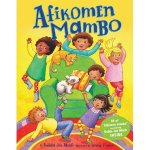
The moment Afikomen Mambo arrived, my kids fought over it. One look at the bright, happy cover and they knew there was a fun beat inside.
While Christian children have the Easter egg hunt, at Passover our children search for the afikomen, a piece of matzah traditionally broken in half at the beginning of the seder and then hidden for the children to find when the seder is over. The child who finds the afikomen is awarded a prize, and what could be a better prize than Afikomen Mambo?
Now you can hide it in a table,
Hide it in a box,
Underneath the stairway,
Or inside the kitchen clock.
You can put it in your pocket,
Put it under the TV,
But you can’t hide the afikomen from me…
The book by Rabbi Joe Black sports a catchy rhyme and even catchier CD with the mambo song–you can play the music for the kids while they peek under pillows and behind bookcases. The whimsical watercolor illustrations by Linda Prater are bright and cheerful (except for when the characters make faces at the bitter herbs!).
I’m gonna find it, I’m gonna find it,
I’m gonna find it, I’m gonna find,
Gonna find the afikomen!
This is a must-have book for Jewish families with young children. You can begin a Passover tradition with the reading of the book and singing of the Afikomen Mambo song. Kudos to Kar-Ben Publishing for producing delightfully fun books for Jewish holidays.
 Another playful book for Passover is The Matzah Man by Naomi Howland.
Hot from the oven I jumped and ran,
So clever and quick, I’m the Matzah Man!
You guessed it–it’s a take-off on the Gingerbread Man with a whole new rhyme scheme and cast of characters. There’s Grandma Tillie and her tender brisket, Auntie Bertha shopping in high heels, Grandpa Solly chopping onions, Miss Axelrod stirring her soup, and you’ll never guess who swaps roles with the tricky fox, finally outsmarting the Matzah Man.
Now if you’ll excuse me, I have to mambo while I make matzah ball soup.
Happy Passover!
 Do you have a love/hate relationship with bedtime? It’s a cozy time to snuggle and read a book with the kids, but it’s also when they refuse to settle down to sleep. Mom, can I sleep in your bed? Dad, can I have a glass of water? Could you fluff my pillow? Can we read one more book? Please? Five more minutes? Pretty please with sugar on top?
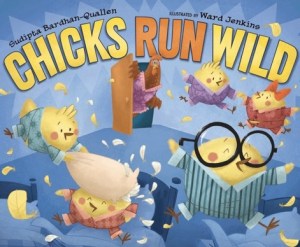
Ey yi yi. It’s enough to drive any mama hen wild! And it does in Sudipta Bardhan-Quallen’s new picture book, Chicks Run Wild.
In her Coop Sweet Coop, Mama has five chicks to put to bed. She tucks them in, gives them each a peck goodnight, but when she closes the door, they leap out of bed and cause a riotous ruckus. Feathers fly and Mama’s patience wears thin.

At first Mama scolds her chicks, but when she realizes her little ones are not ready for dreamland, she does something unexpected. Chicks Run Wild lets both parents and kids know it’s okay to break the rules every once in a while.

With a bright and cheery color palate, Ward Jenkins creates an adorable brood of five chicks with distinct personalities. One chick always has one eye opened, awaiting Mama’s departure. And there’s other fun details, like a spoof of the Beatles’ album cover Abbey Road, and Mama’s favorite read, Gone with the Wing. Sudipta’s jaunty rhyme makes you want to get up and shake your tail feathers with the family.
Bedtime is going to be a lot more fun with Chicks Run Wild. When your kids ask to read one more book, you’ll happily pick this one.
 Want it? Sure you do!
Chicks Run Wild
Story by Sudipta Bardhan-Quallen
Illustrations by Ward Jenkins
Simon & Schuster Books for Young Readers
January 2011
Venerable LA Times rock critic Robert Hilburn recently penned Corn Flakes with John Lennon and Other Tales from a Rock n’ Roll Life, a revealing memoir-style series of vignettes featuring the great rock icons of the last 50 years.
In the book, Hilburn recounts his seven-piece Times series on the most influential and prolific songwriters of the rock era, which was published earlier this decade. He chose Bob Dylan as his first subject. Hilburn wanted to learn about a songwriter’s creative process: what inspires them, how they begin to lay down the music and lyrics, if success or failure of past work influenced future songs. The interview with Dylan earned Hilburn his third Pulitzer Prize nomination. And, Dylan’s words may give other writers—perhaps even picture book writers—inspiration for their own work:
 “Some things just come to me in dreams,” Dylan told Hilburn. “But I can write a bunch of stuff down after you leave…about say, the way you are dressed. I look at people as ideas. I don’t look at them as people. I’m talking about general observation. Whoever I see, I look at them as an idea…what this person represents. That’s the way I see life. I see life as a utilitarian thing. Then you strip things away until you get to the core of what’s important.”
And picture books are indeed about what’s important; every picture book features an emotional truth, whether it be about family, friendship or fitting in. If you strip away what’s on the surface—the pirates or the penguins or the princesses—what remains is a story about the human experience.
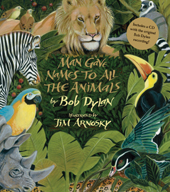
Noted illustrator Jim Arnosky found inspiration in Dylan’s music. “From the first time I heard [Man Gave Names to All the Animals], the lyrics created pictures in my mind of a land of primeval beauty,” said Arnosky. Dylan gave his permission to create a picture book, and the work was released by Sterling in September.
So that’s your inspirational thought for the day. Well, two inspirational thoughts! People and songs.
What do other people’s actions say to you? How do those actions translate to story? What music boosts your creativity?
And don’t forget, there’s much more inspiration to come when PiBoIdMo begins in November. Consider this a warm up, or as Dylan might say, a sound check.
Parents of the previous generation who wanted to bestow all their mushy, gushy love on their kids–in book form–had Robert Munsch’s Love You Forever and Sam McBratney’s Guess How Much I Love You for bedtime reading. Cuddled under the covers, snug and cozy while turning pages, is there any better way to share a deep parent-child bond?
But it’s time for those books to move over and make way for new Valentine’s classics!
I can’t think of a better gift for the holiday than a book. Candy rots their teeth, plus you end up eating most if it yourself, don’t you? (Well, I do.) And where will you store yet another Build-A-Bear that gets forgotten by March?
Valentine’s Day belongs to books. And these three are perfect picks to declare all your mushy, gushy love. And grandparents, take note. These books are just right for you and your grandkids, too.
 I Love You More Than Rainbows
by Susan Crites
Illustrated by Mark & Rosemary Jarman
Published by Thomas Nelson
With whimsical illustrations as bright as rainbows, Susan Crites’s book uses analogies children can easily understand to explain the concept of love. Kids are crazy about ice cream cones with sprinkles on top, puppies, birthday parties, sleigh riding and hot cocoa. But as great as those childhood favorites are, parental love still trumps them all.
Try inserting your child’s favorites while you read this book. With my kids, “I love you more than albino rock pythons, Sun Chips and Daphne from Scooby-Doo” might work well. Don’t ask about the snake, but I could use help finding something to rhyme with Scooby-Doo. Yabba-Dabba Doo? Anyone have a Hanna-Barbera rhyming dictionary?
But I digress…
With a jaunty rhyme that never gets too sing-songy, this book is a joy to read aloud, and the bold colors will delight a young audience.
Published by Thomas Nelson, I Love You More Than Rainbows won a Mom’s Choice Award and is available in hardcover and in board book form—at a great price, too. There’s even a Kindle version.
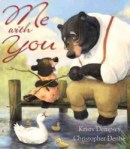 Me with You
by Kristy Dempsey
Illustrated by Christopher Denise
Published by Philomel Books
When Kristy Dempsey wrote this story, she couldn’t imagine that her editor and illustrator Christopher Denise would interpret her characters as granddaughter and grandfather. But after reading this book, you’ll agree, there’s no more perfect a pair.
Me with You celebrates the joys of being yourself around someone you love, the comfort a great relationship brings. Grandpa is always there to support his favorite young cub, even when she’s feeling selfish and gruff. The two allow each other to express themselves, always knowing their love will not waver.
Me With You also highlights the importance of spending time apart from those you love, “to be the kind of you that you can be when you’re alone.” This book is a good choice for children who are apprehensive about separation from a loved one.
This rhyming book offers a smooth, gentle beat, and the light, airy illustrations breathe of spring. Denise has mastered body language and facial expressions to demonstrate the deep bond shared by this “pair beyond compare.” A favorite page features Grandpa in a Babe Ruth pose, pointing to the outfield as his granddaughter cheers him on. (I have to mention the blades of grass, which you may think are insignificant, but I’ve never seen such luscious fields, I want to take off my shoes and run across this book.)
You don’t have to be a grandparent to fall in love with it this Valentine’s Day.
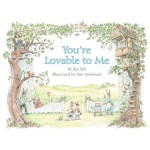
You’re Lovable to Me
by Kat Yeh
Illustrated by Sue Anderson
Published by Random House
The theme of You’re Lovable to Me is unconditional love: parents love their children no matter what they do.
Mama Bunny is having a rough day keeping track of her Bunny Babies and all their hare-y mischief. But no matter what they do, Mama Bunny reminds them that through their joy and sadness, their frolic and frustration, “You are my bunnies. And you’re lovable to me.”
Once her bunny babies are tucked in, Mama bunny crashes on the couch. Oh, how we parents can relate! Mama Bunny’s father arrives and upon seeing his exhausted daughter, he reminds her, “You’re lovable to me.”
If this review had a soundtrack, it would be Elton John’s “Circle of Life!” This book reminds our children that we were once children, too–and that everyone needs to be reminded that they are loved.
Sue Anderson illustrates in a simple, pastel style that takes advantage of white space, complementing the sweet story with a gentle, relaxed mood. The nostalgic feel of this book makes it my top pick for being a New Valentine’s Classic!
What are your New Valentine’s Classics?
Whoa, that’s a long title. But it’s accurate! I asked some of my favorite authors and illustrators to pick three stand-out picture books of 2009. It wasn’t an easy task. I know because I couldn’t decide myself! So I dumped the job on them, just like New Jersey got dumped with snow this weekend. Except they’re a lot warmer than I am, cuddled up with good books instead of buried beneath a foot of the white stuff.
Check out their amazing selections and add a new book to your holiday wish list!
Boni Ashburn
Author of Hush, Little Dragon and Over at the Castle
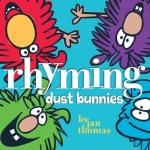 Rhyming Dust Bunnies
by Jan Thomas
Beach Lane Books
January 2009
A simple, hilarious introduction to rhyming that is not only adorable to look at, but also invites audience participation and is a perfect read-aloud. That’s right, perfect.
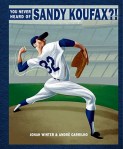 You Never Heard Of Sandy Koufax?!
by Jonah Winter and Andre Carrilho
Schwartz & Wade
February 2009
Striking illustrations coupled with a fantastic voice–this book makes you FEEL baseball. Jonah Winter is a picture-book biography genius–I had a hard time choosing between this one and Gertrude Is Gertrude Is Gertrude Is Gertrude (which has an equally excellent voice!).
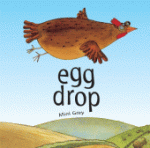 Egg Drop
by Mini Grey
Knopf Books for Young Readers
July 2009
Excellent humor of the dark, dry and deadpan sort, coupled with Grey’s gorgeous art.
This was impossibly hard! Three is too just too few. My “honor books” would be A Penguin Story by Antoinette Portis, Monkey With A Toolbelt And The Noisy Problem by Chris Monroe and Thunder Boomer! by Shutta Crum and Carol Thompson.
Jannie Ho
Illustrator of The Great Reindeer Rebellion and Light the Menorah
 Around the World with Mouk
by Marc Boutavant
Chronicle Books
November 2009
Last year when I was in France, all I could think about was getting my hands on this book (which was originally published in French), but only to find out later that Chronicle books were publishing it in the US this year. Marc Boutavant is one of my favorite illustrators; I’ve read his style described as “the modern day of Richard Scarry,” and I agree! With so many little details to look over, there is always something new to discover each time I open it.
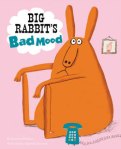 Big Rabbit’s Bad Mood
by Ramona Badescu and Delphine Durand
Chronicle Books
March 2009
Another one from Chronicle! I can’t resist Delphine Durand’s illustrations–so many funny little details to look at. I own many of her books, and am obviously a fan…(even wrote her a fan email!) Even though this story is about a grumpy rabbit, one can’t help but smile when looking at her silly characters.
 The Great Paper Caper
by Oliver Jeffers
HarperCollins Children’s Books
April 2009
I’m a great admirer of those who write AND illustrate their books. Oliver Jeffers’ illustrations are super cozy and serene, I want to live in that forest with the animals! Thumbs up to this quirky, winter mystery story.
Jacqui Robbins
Author of The New Girl…and Me
 A Book
by Mordecai Gerstein
Roaring Brook Press
April 2009
Kirkus called it “Metafiction for the picture-book set.” A young girl who lives in the book with her family struggles to find her story, trying on different genres and marveling at the giant mushy faces (that’s us) looking in on her. It’s funny, it’s smart, and it is truly unique. Plus, we read it five hundred times in the first month we had it and I never tired of it.
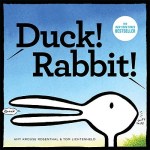 Duck! Rabbit!
by Amy Krouse Rosenthal and Tom Lichtenheld
Chronicle
March 2009
I was smitten with this book from the start. The concept is simple: is it a duck or a rabbit? Two voices argue. Giggling ensues. As I blogged in July, we get extra giggling in our house because my preschool son does not have the cognitive ability to see it both ways and so he thinks the point of the book is that some poor dope thinks that bunny’s a duck.
 Okay, I would be lying if I didn’t pick Two of a Kind, by, um, me (and Matt Phelan).
Atheneum
July 2009
I’d like to be cool enough to pretend I didn’t dance like a four year-old fairy girl whenever I turn to the page with my name on it. But I’m not. And I do. More than that, though, I still love the story and the way it makes kids nod in recognition.
Patricia Storms
Author/Illustrator of The Pirate and the Penguin
It’s really hard to pick just three books! Being a Canadian, you might wonder if my choices are Canuck books. Yup, they are…and they are all very unique and engaging.
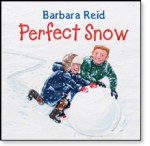 The Perfect Snow
by Barbara Reid
Scholastic
October 2009
Barbara Reid is a treasured Canadian talent who once again creates a visual delight with her plasticine illustrations. Reid creates a delightful story about the joys of creating snowmen and snow forts in the perfect snow of a winter day.
 The Imaginary Garden
by Andrew Larsen and Irene Luxbacher
Kids Can Press
March 2009
Andrew Larsen’s The Imaginary Garden is a beautiful story about the special bond between a grandchild and grandparent, and the power of the creative imagination. Luxbacher’s illustrations are magical and bursting with colour.
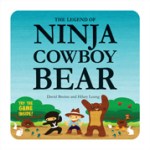 The Legend of Ninja Cowboy Bear
by David Bruins and Hilary Leung
Kids Can Press
September 2009
And finally, The Legend of Ninja Cowboy Bear is charming and fun story about friendship, and celebrating the differences in others. Hilary Leung’s illustrations are bright and utterly adorable!
Michael Sussman
Author of Otto Grows Down
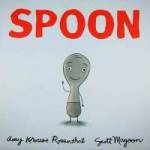 Spoon
Spoon
by Amy Krouse Rosenthal and Scott Magoon
Hyperion
April 2009
Modesty prevents me from mentioning Otto Grows Down (darn, I mentioned it!) But I also loved Spoon, which—like Otto—was illustrated by the supremely talented and charming Scott Magoon. I’m always amazed at Scott’s versatility, and once again he has employed the perfect style for this sweet and quirky story. I also admire Amy, since I’ve tried unsuccessfully for years to come up with a picture book about an inanimate object. Not an easy task, and she makes it look simple.
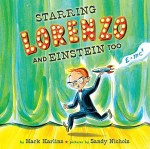 Starring Lorenzo, and Einstein Too
by Mark Karlin and Sandy Nichols
Dial
April 2009
Mark, who is the author/illustrator of many fine picture books, including Mendel’s Ladder and Music Over Manhattan, has produced an endearing story which celebrates the importance of family and the power of the imagination. The cool, retro illustrations are superb.
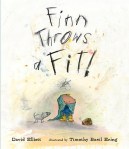 Finn Throws a Fit!
by David Eliot and Timothy Basil Ering
Candlewick
August 2009
Finally, I’m wild about David Eliot’s Finn Throws a Fit! This book is hilarious, and it’s a model for writers striving to tell a compelling story in the fewest words possible. Timothy Basil Ering’s artwork is astounding. I don’t know of a more creative illustrator working today.
So what were your favorite picture books of 2009?
Please leave a comment!
Once there were crowds, and clinging jockeys, and horses to ride against in the razor-fine seconds it took to be first across the finish line.
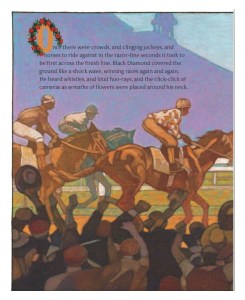 As an aspiring author, I’ve been told countless times about the importance of a first line. Never before has a picture book opening reined me in so tightly, so swiftly as Deborah Blumenthal’s Black Diamond and Blake, the story of a racehorse saved by friendship.
Black Diamond, a beloved racehorse, hero of the grandstand crowds, wins race after race. His jockey and owner feed him sweet apples, warm him with a red velvet blanket, and wrap him with such kindness that the horse only wants to win and make them proud.
But no athlete can dominate forever. Black Diamond grows sore, tired and eventually becomes injured. His fans boo instead of celebrate, ripping their losing tickets and tossing them to the ground. The sweet apples and sweet attention disappear.
A gruff, cigar-smoking man purchases Black Diamond and takes the horse to a prison rehabilitation program. The author was inspired by a New York Times article about inmates who cared for retired racehorses. “I read of the deep emotional connections that some inmates made with the animals, so that in the end, men saved horses and horses saved men,” Blumenthal explains.
At the prison, Black Diamond meets Blake, a soft-spoken man who feeds the horse cinnamon candies and takes him on long walks. The two bond in friendship. And then, one day, Blake is released and Black Diamond becomes despondent and difficult, longing for his caretaker, his best friend.
As usual, I never reveal a book’s ending, but the book is titled Black Diamond and Blake for a reason.
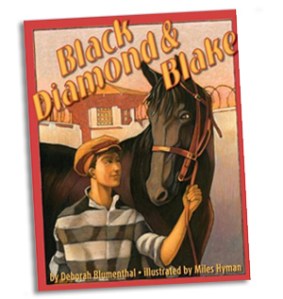 The Art-Deco-inspired illustrations by Miles Hyman render bold forms with a soft pastel stroke, a visual juxtaposition befitting this tale of a strong yet sensitive racehorse. The book is gorgeous in all respects—from the language, to the theme, to the green hills of the final spread.
Parents may appreciate Blumenthal’s beautiful words more than children (“in a minute that grew heavy with time”) and those younger than five may not be able to sit for the entire tale, although my horse-lovers, aged three and six, were mesmerized. While the publisher claims it’s appropriate for children up to age eight, I foresee this book being enjoyed by children as old as ten or twelve, especially if they love animals.
Black Diamond and Blake never gets too sappy or sentimental, but instead tells a story of friendship and second chances from the thrill of the races to the gentleness of a rolling countryside.
Black Diamond and Blake
Story by Deborah Blumenthal
Illustrations by Miles Hyman
Alfred A. Knopf, February 2009
If you’re a picture book writer, you’ve read hundreds of picture books. Maybe even thousands. (And if you haven’t, I’m sending you to bed without supper!)
I know you have favorites. But have you ever stopped to analyze why a picture book has earned your top rank? Is it the premise? The voice? The twist on the final page? Does the book’s heartfelt sentiment or cheeky sense of humor hook you? Is it all of the above?
 Timothy Knapman’s Guess What I Found in Dragon Wood stands out among recent reads. Why? When I began Knapman’s story, I assumed it had a been-there-done-that premise: boy discovers a creature in the forest. But on the third page, I was thrown.
This is no ordinary boy-meets-dragon story. It’s dragon-meets-boy.
Told from the dragon’s point of view, Dragon Wood turns a common premise upside down. When the young dragon finds a boy “called a Benjamin,” he brings it home and asks his mom if he can keep it. Slowly the dragon uncovers strange facts about the human world—the Benjamin’s striped boots aren’t his feet, his eyes leak when he’s sad, and he loves a game involving a black and white ball. But the dragons have a tough time learning soccer. They just want to burn down the goalposts and eat the ball.
In Dragon Wood, young readers know more than the main character. And kids love that. Think about it—all day long they’re in school, being told how much they don’t know. When they can be smarter than a picture book character, it’s a fun feeling. (Just like when we adults are smarter than a fifth grader.)
Knapman’s book has several things going for it: surprise, humor, a unique voice, kid sensibilities and adult appeal. Let’s not forget that a picture book should keep the grown-up—the one with the wallet who’s reading—entertained as well.
When I boil this dragon tale down, it’s a story about friendship. I could also argue that it’s a book about the importance of family and finding one’s true place in the world. These are universal themes that will never go out of style.
As I come up with ideas this month, I think about the theme at its heart. Will my theme stand the test of time? Can I write this theme with humor and an element of surprise? What have I learned from Dragon Wood that I could apply to my own unique story?
Other favorites:
 In Cressida Cowell’s That Rabbit Belongs to Emily Brown, the relationship between a little girl and her favorite toy is magic, a love that everyone can understand because they’ve experienced it, too.
In The Louds Move In by Carolyn Crimi, the author balances seven distinct characters—an entire family of Louds plus three quiet neighbors. Even the names are brilliant: Earmuffle Avenue, Miss Shushermush, Mr. Pitterpatter.
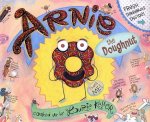 In Laurie Keller’s Arnie the Doughnut, I guffaw at its crazy, quirky humor. Arnie is alive—and the poor chocolate-frosted treat doesn’t realize that doughnuts are for eating.
Okay! Are you ready to try it? Go play with a favorite book. What do you love about it? How can you create something lovable?
So, how’s it going today?
 Hush little baby, don’t say a word.
Mama’s found a book that beats the herd.
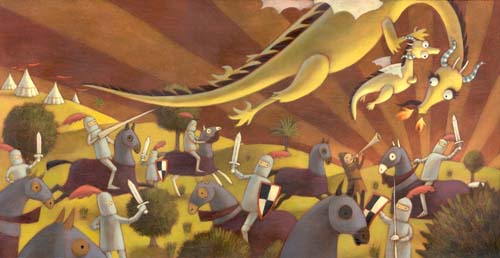
It’s got a little dragon and his mum.
She’s finding food for him, and not just crumbs.
A knight, a queen and a magician.
Yes, those folks are good nutrition.
Set to the tune of a sweet lullaby,
That author Boni Ashburn is awfully sly.
Please excuse my forced rhyme here,
Boni’s verse is better, don’t you fear.
In fact, that couplet with “nutrition”
Is the author’s, not my addition.
My three year-old just loves this book,
Hush Little Dragon boasts quite the hook.
So rush right out and grab this title,
Sorry I have nothing to rhyme with title.
Let me repeat just one more time,
Boni’s verses are better than mine.
Hush little baby, don’t say a word.
There’s a Hush sequel and maybe a third?
If Boni keeps writing books like this,
Kids everywhere will have reading bliss.
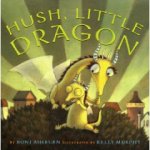 Hush, Little Dragon
Story by Boni Ashburn
Illustrations by Kelly Murphy
Abrams Books for Young Readers, March 2008
Want it? Sure you do!
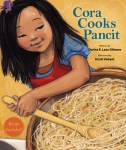
 What makes you pluck a picture book off the shelf? A clever title? The author’s name? What about a charming little girl on the cover, stirring a delicious pot of noodles? That’s what got to me with Cora Cooks Pancit by Dorina K. Lazo Gilmore.
Maybe it’s because I love to cook. Maybe the bright little dot that said “Recipe Included!” spoke to me. (And, by the way, the recipe is delicious!)
But more than anything, vibrant primary colors and Cora’s smiling eyes drew me in. Illustrator Kristi Valiant’s paintings evoke a warm feeling as Cora cooks a traditional Filipino dish with her mama for the first time.
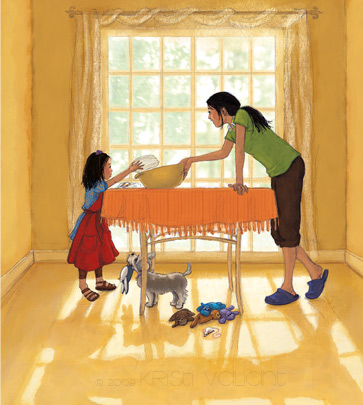
Cora is the youngest of many children and always gets the kiddie kitchen tasks, like licking the spoon clean. Valiant’s opening scene shows the family from Cora’s point of view, as she sits on the floor with the family dog. We see her family from the waist down, spread along the kitchen counter, performing their duties. It’s amazing how Valiant can make the poses so varied and expressive, only working with half a body. Some of the pencil lines remain, creating an illusion of movement—the bustle of the family kitchen.
Valiant’s image presents the conflict immediately: little Cora is not involved with family meal preparation. We feel Cora’s longing to be a “real cook.”
One day when her siblings leave the house, Cora asks to cook with Mama. Mama lets Cora choose the dish. Cora wants pancit.
Mama tells the story of how her own father taught her to make pancit, and Cora feels proud when she gets to wear her Lolo’s red apron.
What follows is a delightful, heart-warming exchange between mother/teacher and daughter/student. Valiant’s illustrations are spot-on, from facial expressions to body language. She gets every detail just right. Even Cora’s feet, slightly off-balance, reveal her trepidation as she prepares the noodles. Sunlight streams in through the kitchen window, framing Cora and Mama in a scene that highlights the special bond created with family tradition.
As usual, I won’t reveal the story’s ending. There’s an oopsie along the way, but there’s also a beaming Cora.
I was so impressed with this book’s illustrations, I asked Kristi Valiant for an interview. Luckily, she agreed to talk to me about the making of Cora and other fun illustration stuff. Watch for it soon!
 Cora Cooks Pancit
Text by Dorina K. Lazo Gilmore
Illustrations by Kristi Valiant
Shen’s Books, Spring 2009
Want it? Sure you do!
 Picture book brilliance isn’t easy to achieve, as many children’s writers know. Telling a story in 500 words–with page turns that work within a 32-page format–challenges the most talented of writers.
Let’s not forget that a picture book should appeal to both parent and child. Silliness keeps the kids begging “again!” But if a parent thinks the language is too repetitive or annoying, you’ll lose the gatekeeper. (You know, the one with the wallet.)
Sappy stories can attract Mom and Dad, but kids might declare them snoozers. I recall tearing up at a lovely, sentimental picture book while my daughter rolled her eyes. “Mom, what is wrong with you?”
So what makes a great picture book that both parent and child can call a favorite?
A balance between humor and heart, imagination and reality.
That Rabbit Belongs to Emily Brown by Cressida Cowell and Neal Layton has it all.
Emily and her stuffed pal Stanley explore the world together–they scuba-dive, swing through the rain forest, and launch into outer space. But they are constantly interrupted by a rat-a-tat-tat on their garden door. Her Royal Highness Queen Gloriana’s guardsmen keep insisting that Emily give her Bunny-Wunny to the matriarch. It is the Queen’s decree!
Now, the Queen tries to be fair about it. She offers all these new-fangled toys in exchange, upping the ante each time Emily refuses. But the Queen’s toys are “stiff and new and gold and horrible…with staring eyes and no smile at all.” Once it’s clear that Emily will not trade Stanley, the Queen resorts to extreme measures.
Emily awakens the next morning without Stanley! She knows who’s behind his disappearance and marches straight to the palace. But the Queen is not happily playing with her Bunny-Wunny. She’s crying over him.
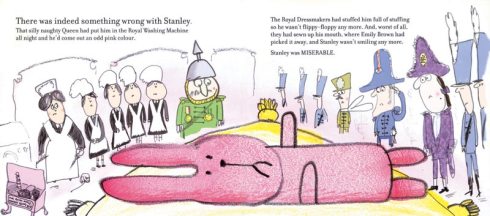
That silly, naughty Queen had Stanley re-stuffed and washed, turning him an odd pink color. They were both miserable.
As usual, I won’t tell you how it ends. You’ll just have to pick it up for yourself. And cuddle with it. And go on adventures together. Wear out the pages a bit.
That Rabbit Belongs to Emily Brown celebrates the special bond between child and toy. Almost everyone had a lovey, that one thing we couldn’t live without, dragged by a leg to grocery stores and Grandma’s. This story reminds adults that there’s still a kid inside us, longing to curl up with our own flip-floppy stuffed rabbit.
Luckily we can snuggle with a cute kid instead, reading Emily Brown over and over and over again.
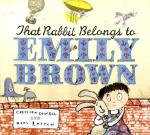 That Rabbit Belongs to Emily Brown
Written by Cressida Cowell
Illustrated by Neal Layton
Hyperion Books for Children
Want it? Sure you do!





 Writing for Kids (While Raising Them)