You are currently browsing the category archive for the ‘PiBoIdMo 2013’ category.
 by Greg Pizzoli
Last year I was super busy illustrating a book with a pretty quick turnaround. I think I got the offer in September, and the book was due January 1. So after sketches were approved and everything, I had a little less than three months to do the final artwork for a forty page book (plus covers). It was doable, but just. I wasn’t going have time for anything else. No screenprinting. No writing. Nothing.
Except . . . I had this opportunity. There was an offset printing class with an opening at the university where I teach part-time, and my department head offered me a chance to audit the class and make a book. The whole idea of the class is that you spend half a semester designing a single-sheet book to be printed on an offset press. The second half of the semester you make films, mix inks, and (under the guidance of the Master Printer) assist in printing the book.

I love offset printing and I love making books. I had worked on this press before so the learning curve wasn’t too bad. And the opportunity to make something on my own was just too appealing to pass up. So I signed up for the course and got to work on a project that had been brewing in my sketchbooks for a few years. It was pretty weird, and kind of dark, and I felt certain no publisher would ever be interested in it, so I decided to make a zine. Just an exercise in putting text and images together, simply made for the sake of making it.

Several times I almost dropped the class because of my other commitments. I was too busy to make the art for the zine the way I normally would, and I was nervous about it looking terrible when we went to print. My teacher encouraged me to stick with the class, but to simplify the art so I could produce it faster. She reminded me that I was making this just for me, not for anyone else. The idea that I wasn’t making this zine for publication freed me up considerably, and working on it was really refreshing—it was influenced much more by my design and comics interests, and it just felt different than my other work.
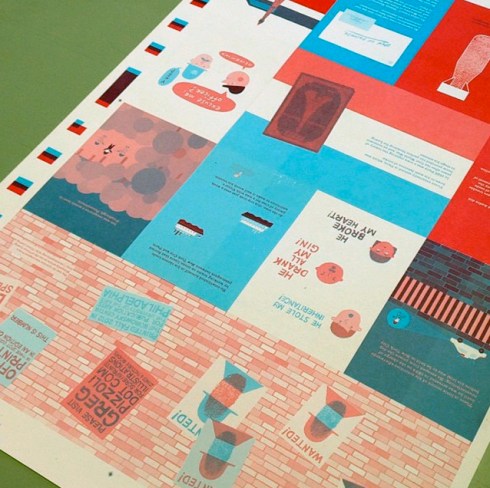
I printed the zine and mailed some out to some people I had worked with or hoped to work with someday. Not pitching the idea—but really just saying—“I love making this stuff! Here’s this weird thing I know you’d never publish that I made!”—excited to share it, but no expectations.

You might guess where this is going—within a month of sending it out, I had a two-book deal with Viking Children’s Books—both dream projects for me. I’ve been researching, writing, and drawing, and a greatly expanded version of that little pamphlet-stitch zine will be an actual picture book in stores next winter! It’s totally different than anything else I have done—and that’s exactly what made it so appealing to my new publisher.
So, looking back on that time last year I guess two things are apparent:
1) Sometimes limitations (meaning your time, or maybe the number of colors/words/pages you can use) will force you to be creative in unexpected ways and 2) Doing the work that you feel driven to do (as opposed to guessing what publishers will want) can produce work you might not expect—and even if you think no one could ever publish it—you might be wrong.
Good luck this month!

Greg Pizzoli is an author, illustrator and screen printer from Philadelphia.
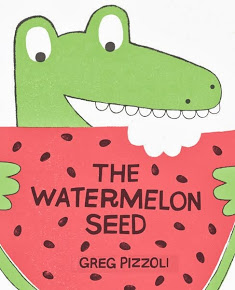 His first picture book, The Watermelon Seed, was published by Disney*Hyperion Books in 2013 and Publisher’s Weekly called it “an expert debut” in their starred review. Greg has more books in the works with Disney*Hyperion, Viking, Candlewick, and FSG.
Greg’s work has been featured in Communication Arts, 3×3 Illustration Annuals and he’s won two Portfolio Honor Awards from the Society of Children’s Book Writers and Illustrators.
After college, Greg spent two years as a full-time volunteer in AmeriCORPS from 2005-2006. In 2009, he received his MFA from the University of the Arts in Philadelphia, where he now teaches.
He recently gave up drinking (as much) coffee.
His screenprinted works have been exhibited in the United States, Canada, Spain and The Netherlands. His hand-printed artist books are in various collections throughout the country, including The Rare Book Department of the Free Library of Philadelphia.
See more of his work at GregPizzoli.com and GregPizzoli.blogspot.com. Follow him @GregPizzoli on Twitter.

Greg will send a random commenter a pair of hand screenprinted blank cards!
This prize will be given away at the conclusion of PiBoIdMo. You are eligible for this prize if:
- You have registered for PiBoIdMo.
- You have commented ONCE ONLY on today’s post.
- You have completed the PiBoIdMo challenge. (You will have to sign the PiBoIdMo Pledge at the end of the event.)
Good luck, everyone!
 by
by It’s Picture Book Idea Month, and I’m going to give you a math lesson.
Who remembers high school math? A long time ago, we may have learned about combinations of variables. As we go through PiBoIdMo, we need to explore different combinations to discern the optimal result.
Now, you’re thinking, well, no kidding. How does that help me?
Aren’t you lucky? I’m going to tell you.
- Step One: Finding the Variables
If you are like me, you try to come up with picture book ideas as complete entities: a character with a specific problem/resolution. But just like in your manuscript drafts, your first idea isn’t necessarily your best idea, and it definitely doesn’t need to be your last idea. If you allow yourself the freedom to separate your idea into it’s entities, you might end up with something better.
Think of it this way: if you come up with 30 characters over the next month (let’s call this variable C) with 30 definite story outcomes (this variable will be O), all you have is 30 ideas to work with. On the other hand, if you have 30 characters, each of whom has 30 story outcomes, you have many more possible ideas to develop. Mathematically, the total number of combinations is represented by this formula:
Number of combinations = C x O
In this case, you end up with 30 x 30 = 900 story ideas at the end of PiBoIdMo. That’s accomplishing a lot, isn’t it?
Basically, separating your ideas into building blocks—into variables—allows you to have useful partial ideas. How many times have you realized that there really needs to be a book about a certain topic? Or come up with an adorable character for whom you can’t think up a story?
Write these down. Add them to your C and O lists. Every once in a while, look over the lists and see if there is a combination you see that resonates with you that was different than what you originally imagined. Allowing these partial ideas to have value takes a lot of pressure off you as a writer and creator. It is very hard to have a good idea every day! But just because something isn’t the perfect idea doesn’t mean you can’t make it work for you.
- Step Two: Expanding the Combinations
A good book has a main character and a primary plot. Many books, however, have secondary characters. Some books have secondary plots.
What if some of your PiBoIdMo ideas don’t work as stories because you came up with a secondary character or a plot?
Some books even have a pair of main characters (mash-up, anyone?) What if one of your character ideas would be four times as strong if you combine it with another character?
If you combine even more variables, you make your work go even further:
Number of story ideas with 2 characters = C x (C-1) x O = 30 x 29 x 30 = 26,100 ideas!
(and a secondary plot on top of this…you get the idea…)
Again, allowing yourself to have incomplete ideas gives you the freedom to pursue many more possibilities.
Obviously, some of the combinations that come out of this process are not going to work. So you really won’t have tens of thousands of ideas to sort through. But hopefully, you’ve picked up on the fact that I’m trying to encourage you to look at your work over this month in a different way.
Whenever you can have a complete story idea, that’s fabulous. Run with it. But don’t get frustrated if inspiration comes in drips and drops instead of a flowing stream. It’s all going to be valuable in the end.
- Step Three: The Idea Wheels
I want to leave you with something fun. I’ve asked you to take your building block story variables and consider them in various combinations. You could create a spreadsheet and be very orderly about it, but what I really want you do to is have fun with it and let the random ideas percolate through your brains. So I’m inviting you to create your own Idea Wheels.
There’s a great site called WheelDecide.com, where you can create your own wheels of fortune, if you will. You can create one wheel for your character ideas and another for your story outcomes. Then, spin away until the wheels hit upon something that really works for you. It’s visual and fun, and if nothing else, there’s a winner every time!

You are all just beginning your PiBoIdMo journey, and it will be a long month ahead. But I hope you stick with it—I bet you’ll come out on the other side with valuable starting points for writing. Good luck!
BONUS!
Last week, this blog hosted a double cover reveal for two of my upcoming picture books. In honor of the reveals, I held a book cover caption contest. It was not easy to pick the winner because there were so many captions that were great! But after careful consideration, on the basis that this caption works so well for BOTH covers, here is the winner:
“Is this as awkward for you as it is for me?”
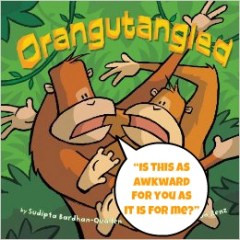
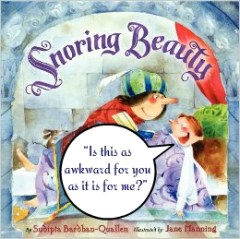
Everyone, please put your hands together for Dawn Young! Dawn wins her choice of a signed copy of ORANGUTANGLED or SNORING BEAUTY! Yay!
And one more bonus…
BONUS: If you’d like more PiBoIdMo tips, pop over to my blog at NerdyChicksRule.com for a great post about knowing what your character wants.
Sudipta Bardhan-Quallen is an award-winning children’s book author whose books include Chicks Run Wild, Pirate Princess, Hampire!, and Quackenstein Hatches a Family. She visits schools around the country to talk about the craft of writing to children of all ages. “Every book is an autobiography” is a favorite saying of hers, and a big part of her message is that everyone, grownup or child, has a story that is interesting and compelling—if you can find the right words to tell it. Sudipta lives outside Philadelphia with her children and an imaginary pony named Penny. You can learn more about her and her books on her website www.sudipta.com or at her blog www.NerdyChicksRule.com.
 by Tammi Sauer
For me, the absolute hardest part about the picture book creating process is coming up with a good idea. A wow idea. An irresistible-to-editors idea.
One approach that has worked for me is to brainstorm a list of potential titles before I even know a single word of a manuscript. I keep in mind that I don’t want a book of mine to have just any title. I always try to have a title that pops. Why? The title is a writer’s first chance to make a good impression and hook a possible agent/editor/reader.
Two of my books started with a title.
One day, while waiting for my daughter to find a book at the library, I sat down on a bench. Next to me was a book on etiquette. I flipped through the book and came across the words “princess in training.” My first thought? That would make a great idea for a picture book….and…
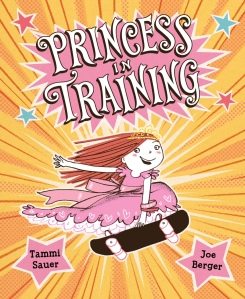
…In fall 2012, PRINCESS IN TRAINING, illustrated by Joe Berger, made its debut.
Another day, I was playing around with words that rhymed with names. As I brainstormed, the words “Quiet Wyatt” popped into my head. QUIET WYATT recently sold to Houghton Mifflin Harcourt BFYR.
My latest manuscript is the result of a title that grabbed hold and said, “You must drop everything and write this.” So I did. A good title can be very pushy. And intoxicating.
If you want to come up with a title as a starting point, consider using these strategies:
- Showcase a Main Character
examples: Vampirina Ballerina; Fancy Nancy; Scaredy Squirrel
- Focus on the Setting
examples: Cowboy Camp; In the Small, Small Pond; The Library
- Create a Sense of Suspense
examples: The Monster at the End of This Book; Do Not Open This Book
- Utilize Fun Language Play
examples: Chicks and Salsa; Hush, Little Dragon; Llama, Llama Misses Mama
Side Note: I happen to be wildly jealous of the upcoming books There Was an Old Dragon by Penny Klostermann and Tyrannosaurus Wrecks by Sudipta Bardhan-Quallen simply because I am gah-gah over those titles. Why didn’t I think of those titles?! Why?? WHY????
Your Homework Should You Choose To Accept It: Brainstorm at least five titles. That’s it. No need to know the nitty-gritty of what is to follow. Just jot down those titles and maybe, just maybe, a story will sneak up on you.
Extra Credit (because I am a true blue nerd who loves extra credit opportunities): Go to the bookstore and jot down the titles of the books you see. Perhaps one of those titles will be the perfect trigger to help you come up with your next big idea.
Tammi Sauer has sold 16 picture books to major publishing houses. Four of those books got their start through PiBoIdMo. In addition to winning awards, Tammi’s books have gone on to do great things. Cowboy Camp was developed into a musical in Katy, Texas. Mostly Monsterly was selected for the 2012 Cheerios Spoonfuls of Stories program. And Chicken Dance was released in French which makes her feel extra fancy. There’s more fun stuff at TammiSauer.com.
Sink your teeth into this prize pack that features Tammi’s latest release: one personalized copy of NUGGET & FANG, one super shiny poster with a teacher’s guide on the back, and two Nugget tattoos that look fabulous on any bicep (or fin).
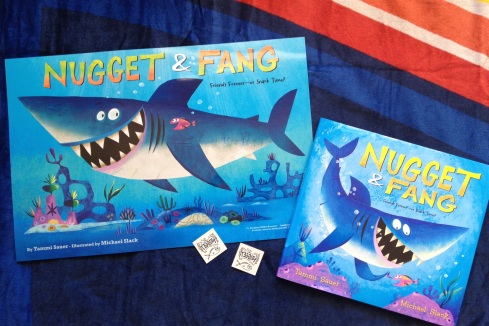
Nugget & Fang is a 2009 PiBoIdMo Success Story!
And…Tammi’s also offering a picture book critique to another lucky winner!
This prize pack and critique will be given away at the conclusion of PiBoIdMo. You are eligible for these prizes if:
- You have registered for PiBoIdMo.
- You have commented ONCE ONLY on today’s post.
- You have completed the PiBoIdMo challenge. (You will have to sign the PiBoIdMo Pledge at the end of the event.)
Good luck, everyone!
 by
by I am very honored that Tara asked me to do a post for Pre-PiBoIdMo. I am the founder of Picture Book Month and it starts tomorrow, November 1. The website, PictureBookMonth.com, features essays from thought leaders in the children’s literature community. Each day in November, a new essay is posted. This year’s Picture Book Month Champions are: David Adler, Dianna Aston, Rick Anderson, Larry Dane Brimner, Julie Danielson, Carmen Agra Deedy, Tomie dePaola, Emma Walton Hamilton, Rebecca Emberly, Sue Fliess, Zarah Gagatiga, Candace Fleming, Lee Harper, Jannie Ho, Steve Jenkins, Daniel Kirk, Jesse Klausmeier, Mercer Mayer, Bobbi Miller, Wendell Minor, Hazel G. Mitchell, Jerry Pinkney, Robert Quackenbush, April Pulley Sayre, Rob Scotton, Laura Vaccaro Seeger, Michael Shoulders, Wendi Silvano, Heidi Stemple, and Rosemary Wells. Please join the celebration!
This post appears the day before PiBoIdMo starts, reminding me of end papers in a book. When most people open a picture book, they rush straight to the story, not realizing that there is so much more that might be happening just before the story begins…
I’ve always been in love with end papers. So many authors and illustrators make such clever use of them! The first thing I do when I get a new picture book is examine the end papers. For me, well-crafted end papers denote a love and attention to detail by the author, the illustrator, and the publisher. It’s a part of the book that is lost in digital translation. End papers can demonstrate how expertly a print picture book is crafted, from beginning to end. They can be bold and fun or subtle and quiet.
Dan Santat (a 2013 Picture Book Month Champion) makes such smart use of the end papers in CARNIVORES, written by Aaron Reynolds (a 2014 Picture Book Month Champion). The book is a funny story about the perils of being at the top of the food chain. Without giving away much, the brilliant end papers begin and end the story with humor.

My very first picture book, THE CAJUN CORNBREAD BOY, which debuted in 2009, had plain white end papers. It was my first picture book and I didn’t want to ask my publisher for too much. I now have twelve picture books and eleven of them have illustrated end papers. I advocated for end papers in my picture books even though I was not the illustrator. The end papers in a book are valuable real estate. They can help begin and end the story.
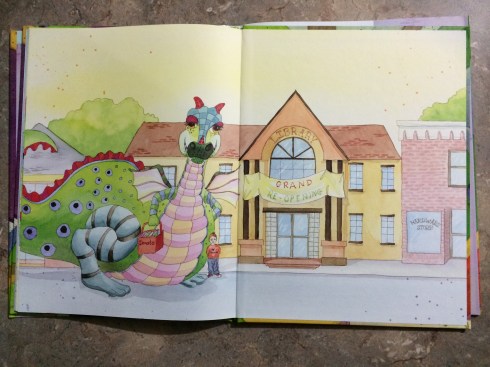
In my book, THERE’S A DRAGON IN THE LIBRARY, illustrated by Marita Gentry, the second set of end papers actually closes the story. Max is a little boy who discovers a dragon in the library. (Spoiler alert!) In the end, the dragon ends up eating all of the books and the library too. Max tames the dragon, teaches the dragon book care, and the dragon ends up building a brand new library. I live in New Orleans and Katrina was our “dragon.” We had to rebuild many libraries here and this end paper was symbolic and meaningful to me.
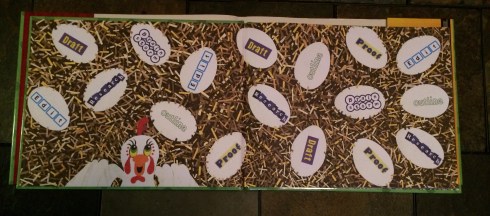
My picture book, THE LITTLE “READ” HEN, illustrated by Holly Stone-Barker, has end papers that illustrate important points in the story. The tale, a remix of “The Little Red Hen” teaches kids all the steps of writing: brainstorm, research, outline, draft, edit, and proof. Holly found a fun way to highlight those steps in the end papers on the Little “Read” Hen’s eggs.
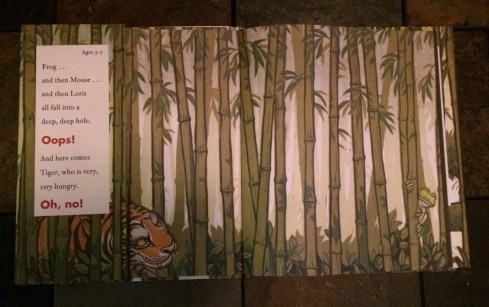
The end papers in Oh, No! written by Candace Fleming (2013 Picture Book Month Champion) and illustrated by Eric Rohmann are so ingenious, I can’t stand it! The jacket flap actually merges into the end papers, creating a seamless illustration. WOW!
If you are the author and have an idea for the end papers for your story, don’t be afraid to convey them to your publisher or illustrator. Fully illustrated end papers can add such a depth to a picture book and can provide even more real estate for the author and illustrator to tell the story or highlight important elements in a story. Here are some great examples of end papers in recent picture books in no particular order:
- RETURN OF THE LIBRARY DRAGON by Carmen Agra Deedy and illustrated by Michael P. White
- THE FANTASTIC FLYING BOOKS OF MR. MORRIS LESSMORE by William Joyce
- SPOON by Amy Krouse Rosenthal and illustrated by Scott Magoon
- CRAFTY CHLOE by Kelly DiPucchio and illustrated by Heather Ross
- WUMBERS by Amy Krouse Rosenthal and illustrated by Tom Lichtenheld
- MR. TIGER GOES WILD by Peter Brown
So the next time you open a picture book, look at the end papers. In what ways could you use end papers to visually enhance your picture book? How can you use the beginning and the end to improve the overall design of your picture book?
As you celebrate PiBoIdMo and Picture Book Month, read LOTS of picture books. Comment below and share with us your favorite end papers from picture books. Here’s to Picture Books! Read * Share * Celebrate!
Dianne de Las Casas is an award-winning author, storyteller, and founder of Picture Book Month. Her performances, dubbed “revved-up storytelling” are full of energetic audience participation. The author of 22 books and the 2013 recipient of the Ann Martin Book Mark award, her children’s titles include The Cajun Cornbread Boy, There’s a Dragon in the Library, The House That Witchy Built, The Little “Read” Hen, and The House That Santa Built. Visit her website at diannedelascasas.com. Visit Picture Book Month at PictureBookMonth.com.
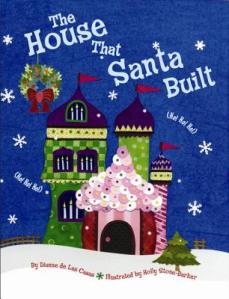 Dianne is generously offering a signed copy of THE HOUSE THAT SANTA BUILT to a lucky PiBoIdMo’er!
This prize will be given away at the conclusion of PiBoIdMo. You are eligible for this prize if:
- You have registered for PiBoIdMo.
- You have commented ONCE ONLY on today’s post.
- You have completed the PiBoIdMo challenge. (You will have to sign the PiBoIdMo Pledge at the end of the event.)
Good luck, everyone!
 by
by Only two more days, everyone! Only two more days until you crack open your notebook and brilliant picture book ideas start flowing out of you!
Or…maybe not.
I want to prepare you for the possibility that your ideas might hide from you. It happens.
And it’s possible that, on Day 12 of PiBoIdMo, instead of having 12 ideas, you will be looking at a notebook with two lame ideas, while everyone around you keeps shouting about how they have 52 ideas, and three of them have already sold and one was optioned by HBO to be a series, which pre-emptively won an Emmy.
It happens.
Remember: PiBoIdMo is a competition with yourself. Those people who come up with lots of ideas? That’s great. But you should be inspired by that, because every time someone comes up with an idea, it sends out idea ripples, and pretty soon a bunch of them are going to hit you. I promise. You’ll be sitting on a park bench, and suddenly you’ll get four good ideas for picture books. (You already know that you need to have something with you at all times to write down these ideas, right? Your phone, an index card, back of your hand? And if you’re in the shower, you’re going to have to repeat “basketball-playing hedgehogs” for three minutes nonstop until you can get yourself to a pencil and paper, so you don’t forget.)
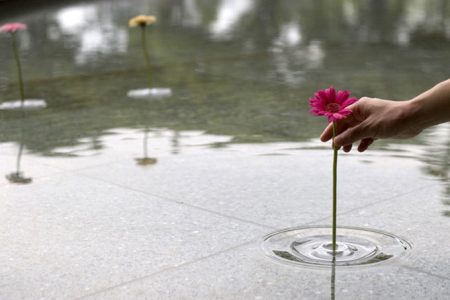
Idea ripples? Click image for the “floating vase,” Tara’s PiBoIdMo Product Pick.
I’ll tell you what won’t work: sitting at your desk, paper in hand, saying, “THINK! THINK! WHAT’S A GOOD IDEA?”
Good picture book ideas are sneaky. They like to jump on you when you’re not ready. (You’re ready, though, right? You’ve got that paper/smartphone/old envelope?)
How do you find the picture book ideas if they don’t want to be found? You have to be sneaky right back.
The first thing you need to do is get out of the house. Or away from your desk, at least. Move. Exercise. Story ideas love to jump out and scare you when you’re exercising.
The next thing you need to do is remember that picture books don’t have to be serious (although they can be) and they can have a lot of nonsense in them. And, although you might hear differing opinions, they have a lot of talking animals. Or talking crayons and pens. Or talking sausages.

So go on a walk, and imagine every non-talking thing you encounter can talk. What would it say? What does the sidewalk say (“Don’t step on my cracks!”) and the grass (“whoosh-swish”) and the snow (“I am very precise and clean and I don’t like it when the dogs stop by to…you know.”)?
What happens if you take some of these newly-talking objects and put them together into one story? Can a park bench be friends with a pigeon? Can a sneaker be friends with a toenail? What happens when a rock steals a light bulb’s banana?
These ideas might not make sense, but if you’re stuck, you have to go to the weird place sometimes.
Here’s the last thing I’ll tell you about ideas: they like to hang out together. They’re a social group. So, once you find one, you’re going to find a lot more. Those people who are talking about how they found 133 ideas? It’s because they stumbled on an Idea Class Reunion, or an Idea Flash Mob or something. But these ideas, there are a lot of them out there. Now, go be sneaky and find where they are.
Julie Falatko sneaks up on picture book ideas from her home in Maine. You can find her at WorldofJulie.com and on Twitter @JulieFalatko. Her debut picture book—which began as a PiBoIdMo Idea—Snappsy the Alligator (Did Not Ask to Be in This Book) is being published by Viking Children’s in 2015.
Julie is offering one lucky PiBoIdMo’er a picture book critique!
This prize will be given away at the conclusion of PiBoIdMo. You are eligible for this prize if:
- You have registered for PiBoIdMo.
- You have commented ONCE ONLY on today’s post.
- You have completed the PiBoIdMo challenge. (You will have to sign the PiBoIdMo Pledge at the end of the event.)
Good luck, everyone!
 by Kayleen West
As a child, my mother used to tell everyone, “She’s such a daydreamer (adding a disapproving sigh).” I used to hate it, but she was right; I do dream big—and love it, it’s what creative people do best. You may be the same. When communicating in words or pictures it is the way we bless others. We invite others into our dreams and adventures, make them smile, laugh or indulge a little. I am a dreamer. I do dream of a better world-it can be ugly. I can’t save children from pain and disappointment, but if my books help a child smile, laugh, or feel better about themselves or their situation, I have contributed.
I started living this dream job in late 2010. I began late in life (I’m 48) but threw everything into it. I hope to bring many book babies into the world. There is nothing better than adding positives to a child’s life, and what better way than through picture books.
When Tara asked me to share my success story, I was eager to have the opportunity to publicly thank her. I never forgot PiBoIdMo had been instrumental in the birth of my new book, and had helped me form a good habit. You know, we can be slogging away in this industry, unaware of the impact we can have on others. She may blush at this but Tara should be credited with sowing seeds of success with her creative challenge. It is an unpaid gig but something to be very proud of. So thank you Tara!
Creative Challenges
I love creative challenges. They motivate me to be brave, step out in the new, learn, and grow as an artist. I tend to throw myself in 200% believing for something great—no loss in trying right?
Participating in the November 2011 PiBoIdMo I made a commitment to find a minimum of 30 picture book ideas. I focussed more on creating the habit daily rather than the quantity. Giving it my usual 200% I finished with almost double my intended goal. I was also left with the motivation to write more often.
Loaded with a smorgasbord of ideas and incredibly inspired, I began developing a few. You’ll never guess which one made it into publication first? Answer: the very last one—my last idea became my first publishing house success. WITHOUT ME, published by Wombat Books, has just been pre-released this month and will be launched in November. Sometimes we give up just before success. I wonder what if I had not completed the 30 days? Okay, let’s not go there.

I blogged about this challenge. Click the image to read!
Thinking up ideas wasn’t difficult as I am often flooded with inspiration if I look for it. My challenge is always deciding which ideas to develop and not all at once. I get pretty enthusiastic. Many of the ideas that presented themselves from PiBoldMo were worth exploring, and so I have worked to develop more of them. Anyone else need an extra lifetime for writing?
I haven’t submitted many at all. After signing with Wombat Books, everything took off like crazy (personally and professionally), including a second, third, and possibly a forth picture book contract in the past 12 months! Do note that two of these I am illustrating only. I only say this to show you that contract work can snowball once you get started. Sometimes publishers want to see you will follow through and are easy to work with.
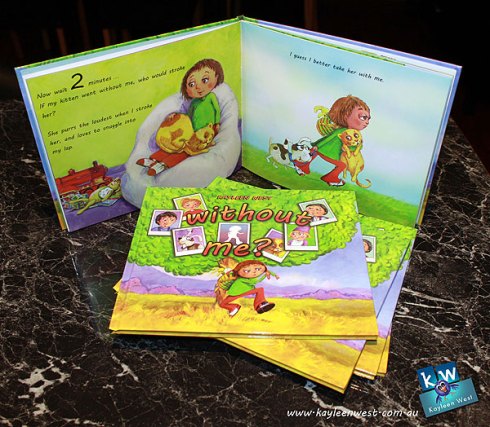
 At the time I was working on my very first picture book, ADOPTIVE FATHER (a personal non-profit project) which was very important and a lot was going on, but I decided that PiBoldMo was a good investment of my time—was I right OR WHAT?
I hope this inspires you to throw yourself into PiBoldMo 2013 and see what you come up with. I pray my success story encourages you to sign up, be inspired and birth a publishing winner this November.
Hopefully we will be reading about your book next year.
Although an initial childhood dream was to write and illustrate for children, Kayleen West was encouraged to venture into a career of an exhibiting fine artist and later a graphic designer.
Returning to her original passion, Kayleen is now a published children’s Author and Illustrator working on her forth children’s book. She also writes Christian content for magazines and blogs.
Her work has won many awards and hangs in private and corporate collections in France, United States, Italy, in the Australian Embassy in Ireland and in government collections in Australia.
Visit her at KayleenWest.com.au, fan her Facebook Author/Illustrator page, follow her on Twitter, and learn more about her PiBoIdMo success book, WITHOUT ME?.
Kayleen is giving away TWO signed picture books! ADOPTIVE FATHER and WITHOUT ME?.
Both prizes will be given away at the conclusion of PiBoIdMo. You are eligible for these prizes if:
- You have registered for PiBoIdMo.
- You have commented ONCE ONLY on this post.
- You have completed the PiBoIdMo challenge. (You will have to sign the PiBoIdMo Pledge at the end of the event.)
Good luck, everyone!
 by Betsy Devany
When Tara approached me to do a guest post, I was thrilled. And then I sat down and thought: Oh, dear. How best can I contribute as a pre-published author, who shares her writing room with a life-sized gorilla named Norman and a slew of beloved stuffies?
So I went back through my own PiBoldMo notes/ideas. While I’d followed prior years’ posts, I didn’t officially commit until 2011. I’d spent months revising a number of novels, and I missed working on picture books. Coming up with a new idea(s) every day was like treating myself to a mango/banana smoothie from Cold Stone. I told myself, at the time, that if I actually did that, maybe while enjoying a Love It smoothie, a picture book idea would come to me. I’d have a sparking new voice before I got back home, acting like I had not just gone to Cold Stone and indulged myself, once again.
So with a self-promise to more vigorously support Cold Stone, I took a leap of faith, and added my name to the 2011 PiBoldMo roster.
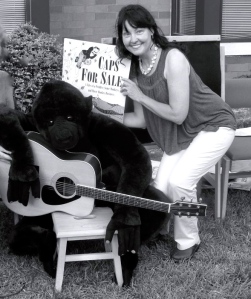 Every day, I read the guest post. I studied the advice, soaked in the inspiration, and highlighted what spoke to me. I kept a pen and paper nearby at all times. As ideas came, I stretched some further, adding bits of dialogue or notes about conflict. With other ideas, I described the image or images that led to the “light bulb,” all of which seemed to come when I was driving, walking, or paying with my grandkids, i.e. just being silly. Silly like having tea parties with Norman, my granddaughter and seventeen unicorns. Silly like wearing funny glasses and too-small gowns, riding on stick horses while speaking in a British accent. Silly like doing puppet shows in which you act out picture books gone wild. With all of this, I embraced the child within—with my grandkids along for the fun, of course. I do not hold private tea parties for the gorilla, the unicorns, and myself. (Well, okay, I may have done this once.)
Two words of advice: Have fun.
 Open your heart and forget what your neighbors might think when they see you dashing through your yard riding a stick pony and shouting, “Yee-haw! Grandma’s gonna wrestle you wild thing!” Ignore their looks when you’re tossing balls to a giant stuffed gorilla. And if your dress-up outfit suggests you’ve forgotten that you’re now a responsible adult, smile and wave. They might even join you! Enjoying-your-life moments take us to the magical place where ideas shift like cotton-candy clouds, all for the taking. Reach out and grab one!
Or . . . you can dice potatoes, because the act of dicing potatoes can also land you in the Magical and Marketable World of Ideas.
On day twenty-four of PiBoldMo 2011, I was doing exactly that, trying to look like I knew the official ins-and-outs of all things potato. It was Thanksgiving, and my daughters, whose adept cooking skills strongly suggest I did not give birth to them, stood there watching me.
“No, Mom. Smaller chunks,” said my youngest.
“Use the other knife, and hold it this way,” said the eldest. “Are you sure you’re our mother?”
“Yes,” I said. Chop, chop, chop.
“I’m shocked that we didn’t starve as children,” said one sister to the other.
“At least I can write,” I said when the “light bulb” went off. “Lucy!” I shouted.
“Who’s Lucy?” asked the youngest. “It’ll be midnight before we’re sitting at the table eating turkey.”
“Lucy . . . she has dolls, all these dolls, and . . .” I swapped the knife for a pen. “One is really smelly and . . .”
My youngest gave her sister an uneasy look. “You’re the paramedic. I think Mom needs medical attention.”
“I think those potatoes need attention,” my eldest said, right after she forever-fired me from cooking the annual Thanksgiving dinner. In truth, we took a family vote. And when my eldest said, “Raise your hand if you think we should fire Mom from cooking Thanksgiving dinner from here on out.” My arm slapped the ceiling first.
The vote was unanimous.
“Thank you, PiBoldMo!” I said, fleeing the kitchen in pursuit of this new smelly idea.
While SMELLY BABY seemed to rise from a pot of unevenly diced potatoes, it wasn’t that simple. Ideas latch on to us, long before the switch goes on. And the more you write, the more the ideas come. Which is why my father, who was a published author, always said, “Write every day, but also live and enjoy your life. The ideas will come, when you’re not so busy chasing them.”
SMELLY BABY grew in my subconscious, its seed planted from working in an old-fashioned toy store, where electronic toys don’t exist. Lucy quietly evolved after talking to hundreds of children I’ve met at the store, children who’ve shared stories of their dollies and smelly stuffies. I love these stories—every single one of them. So listen. Listen to what kids say. Sincere interest (and delight) in what children have to say has left me with a tub full of notes and bits of dialogue, all scribbled on tiny slips of paper. It’s my Idea Treasure Chest. “You have to think of your writing as an IRA, and make daily deposits,” my father also loved to tell me. If all those slips of paper had monetary value, I would be a millionaire, though what makes my life rich is writing for children.
By November’s end my 2011 calendar was filled with stars—one for every idea I came up with. It was so much fun, I gave no thought to which ideas might blossom into a marketable story.
And then one did.
Smelly Baby’s story bubbled and boiled. It was a joy to work on. Playing with the words. Roaring at the images the words evoked. Living with these characters that became (and remain) real to me. This little spark of a PiBoldMo idea grew and grew until it gathered enough strength and heart to capture the attention of not only Christy Ottaviano at Christy Ottaviano Books/Henry Holt, but also the renowned illustrator, Christopher Denise, who calls it “laugh out loud funny.” Publication is set for Spring 2016.
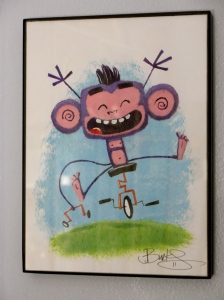 In 2011, I also won an original painting by James Burks (the illustrator of Tara’s book THE MONSTORE). Little (PiBoldMo) Monkey hangs on my wall, and reminds me to play every day. Reminds me to mount a red tricycle, even if my legs are too long. It reminds me to trust in myself, and that if I lift my bare feet off the pedals, I won’t fall off.
Can you see the steep hill? See all of us on our tricycles, waiting for Tara to lower the flag? Little Monkey can. He’s waiting to shout, “1-2-3, Go! Go write daily. Reach for those ideas on your way down.” Having bare feet works the best, as does shouting ‘Whee!’ as you catch a new idea.
It’s almost November 1st, so get out your tricycle, your stars, your pen and your paper.
You’re in for a fun ride.
I’ll be waving at you as we coast down the PiBoldMo hill together.
Betsy Devany wrote her first picture book, The Cat Who Ate Green Peas, at the age of nine. While she wishes the self-illustrated manuscript were still in her possession, she is certain that elements of it have found their way into her writing today. Today, she writes picture books, chapter books, middle grade and young adult novels. Her picture book featuring Norman the gorilla won the 2011 Barbara Karlin Grant Runner-up. Betsy has been honored nine times since 2007 in the prestigious writing competition, New Voices in Children’s Literature: Tassy Walden Award. She is honored to work with the lovely Emily van Beek at Folio Literary.
Almost eight years to the month of joining SCBWI, Betsy received her first book contract. Smelly Baby, illustrated by Christopher Denise, is forthcoming from Christy Ottaviano Books/Henry Holt with publication set for Spring 2016.
To learn more about Betsy (or Norman), visit her at BetsyDevany.com, follow her on Twitter, or read about Norman’s retirement and how his replacement was found.
Betsy is giving away TWO picture book critiques!
Both prizes will be given away at the conclusion of PiBoIdMo. You are eligible for these prizes if:
- You have registered for PiBoIdMo.
- You have commented ONCE ONLY on this post.
- You have completed the PiBoIdMo challenge. (You will have to sign the PiBoIdMo Pledge at the end of the event.)
Good luck, everyone!
 by
by This might sound strange coming from me, but PiBoIdMo is my favorite writing challenge. Yes, I know I am the founder and host of 12 x 12, but let’s face it—writing picture book drafts is work. Fun, but also work.
PiBoIdMo—just letting your creativity run wild and capturing every little flutter and fancy of your imagination is just plain FUN. Freeing. Fabulous. (See how I used the rule of three there???)
For those of you who ARE planning to do 12 x 12 in 2014, I almost consider participating in PiBoIdMo a mandatory first step. Where else are you going to mine the ideas for 12 picture book drafts?
I made this little video for the sole purpose of reminding everyone to lighten up, have fun, and ENJOY fishing for those awesome ideas—some of which will one day turn into picture books! Many thanks to Tara for bringing us the joy of PiBo each year!!
.
Julie Hedlund is a Children’s author, founder of the 12 x 12 Picture Book Challenge, a monthly contributor to the Brain Burps about Books podcast and the “Field Guide to 21st Century Publishing” for the Children’s Book Insider.
Julie is generously giving away two prizes!
The first is GOLD MEMBERSHIP in 12 x 12 for 2014!
The second is a signed print copy of her Little Bahalia release A TROOP IS A GROUP OF MONKEYS.
Both prizes will be given away at the conclusion of PiBoIdMo. You are eligible for these prizes if:
- You have registered for PiBoIdMo.
- You have commented on this post.
- You have completed the PiBoIdMo challenge. (You will have to sign the PiBoIdMo Pledge at the end of the event.)
Good luck, everyone!
 by
by Many of us struggle throughout the year to find the time to write. We struggle to utter the words, “I am a writer.” We feel like we are not progressing. We don’t feel like we have a real writing routine and we fail to write daily.
But for the month of November you are given a gift. It’s like going to the writer’s spa.
Your challenge: create one idea for a picture book each day. One. That’s it. You can do it.
You’ll be amazed at what this little challenge can do for your writer’s morale. Once you put up that antennae you become a lightning rod for inspiration. Thirty days of inspiration! Fill yourself up. Gather. Slather. Enjoy.
This year will be my third participating in PiBoIdMo and I cannot wait. One look at my desk and you will see…I am ready.
I know. I just made you panic. You are thinking, “I haven’t done anything to prepare my desk! Am I supposed to? Am I failing at this challenge already?!”
Hush, my fellow Type A’s.
Deep breath. Remember, you are going to the writer’s spa. It’s time to indulge your writer’s spirit. So put on some calming music and read through my list of ways to prepare your writing space for PiBoIdMo.
Marcie’s 5 Tips for Preparing your Writing Space for PiBoIdMo
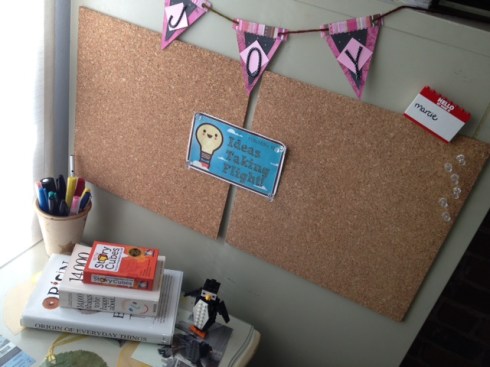
1) Clean the Clutter.
If your brain is cluttered there is no room for new ideas. Same can be true for your work space.So clear it all out. You have a week. It’s not an impossible task. And shhhh…no one said you can’t shove it all under the bed or into the oven (don’t fool yourself, you aren’t going to do any cooking during PiBoIdMo…just cooking up ideas!). You can always bring back the clutter on Dec 1st.
2) Gather your Gear.
Make a small pile of resources.These are items that will help you with ideas when you are depleting. As a marathoner, I think of this pile as my “Mile 20 pile”. When it’s November 25th you might need one of these “idea joggers”. Some of my favorites are:
 Origin of Everyday Things (Sterling, 2006)
14,000 things to be happy about. by Barbara Ann Kipfer (Workman, 1990)
Rory’s Story Cubes game (Gamewright, 2010)
3) Schedule some Search Parties.
That’s right. It’s time to explore. Get out. Go to a museum, a cemetery, a garden, etc. And now that the government shutdown is over, you can even go to a National Park or monument! Schedule it now before the month even begins…and don’t cancel. If you are like me, your area has some wonderful places to visit that you never go. Maybe you only go to these places when you have visitors in from out of town. But this month, try to schedule two to four “search parties”. Go and let the ideas come to you.
4) Harvest the Heap of Ideas.
You are going to need some place to collect all of your 30 ideas. There is no right or wrong way here, it really has to do with what works best for you. The first year I used index cards bound by a rubber band. I loved it because it gave me a full card, front and back, for one idea. Plus, it left room for me to make notes on the card as the idea grew in the coming year. It also allowed me to isolate each idea and not create idea gridlock. My second year I used a notebook. I know this is what most people do. However, I am the type of person who can easily stick a notebook on a shelf and forget it exists. This year I plan to use a bulletin board. As I create an idea, I will write it on a slip of paper and pin it to the board. That way I can have the ideas visible throughout the coming year and therefore they are more apt to be made into stories in 2014. We’ll see how it goes. Again, it really is a personal thing and it might take some experimentation. The most important aspect is that you write every idea (even if it seems awful) down!
5) Connect with your Cause.
In the coming week, think about why you want to write picture books. Look for a trinket or talisman that reminds you of your crusade. Give it a prominent place on your desk. I, personally, have many reasons why I write for children, but one particular reminder has sat on my shelf by my desk all year. It is a red mud-caked LEGO brick. One year ago Hurricane Sandy ripped through my area and changed life for many. As I was supposed to run the NYC Marathon (which was canceled, albeit too late in my opinion), my entire team chose on November 4, 2012 to travel to Staten Island, not for the start of the marathon, but to help with clean up. For hours I helped one family empty their basement of their muddied belongings. Heaps of mud-soaked toys, holiday decorations, and memories. Before taking a wheelbarrow-full to the already overflowing piles on the curb, I pocketed this red LEGO brick. To me it symbolizes the hardships in life that affect us all, even children. If I can ease that, even slightly, I will have done what I set out to do.

In previous chapters Marcie Colleen has been a teacher and a theatre educator, but now she splits her days between chasing the Picture Book Writer dream and chasing toddlers on the playground as a nanny. Both are equally glamorous!
Her blog, The Write Routine and her Teacher’s Guides, can be found at www.thisismarciecolleen.com. (She created a teacher’s guide for Tara Lazar’s THE MONSTORE.) You can also follow her on Twitter. Additionally, Marcie is the Education Consultant for Picture Book Month (www.picturebookmonth.com) and contributes monthly, as a Blogette, to The Picture Book Academy’s blog (www.picturebookacademy.com/blogettes), posting on humor in picture books.
She lives with her fiancé and their mischievous sock monkey in Brooklyn, NYC.





 Writing for Kids (While Raising Them)