You are currently browsing the category archive for the ‘PiBoIdMo 2013’ category.
 by Pat Miller
For me, ideas rarely spring to life like Athena leaping from Zeus’s forehead. When I intentionally push my imagination up against the wall, patting it down for inspiration, I get nowhere but frustrated. But I have discovered five ways to slip into the back door of The House of Inspiration.
1. Piggyback
I was delivering the annual library orientation to my primary classes. That involved repeating the same lesson 23 times. “I wish there was a book we could share that detailed the procedures in a fun way,” I thought.
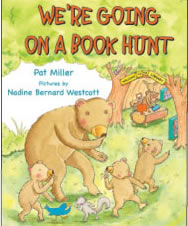 Weeks later, we were acting out the choruses of We’re Going on a Bear Hunt when it struck me. I could write an orientation book called We’re Going on a Book Hunt! The structure of the classic rhyme was a ready framework for my own bouncy tale about a class of bears who learn to use the library, complete with original choruses.
You aren’t likely to think of ideas no one has ever considered before. But you can tweak the tried-and-true to make them your own. Library shelves are home to a plethora of piggy-backed productions—Little Red Cowboy Hat and The Wolf Who Cried Boy are two more.
2. Get Emotional
My two-year-old granddaughter wanted to help make a shopping list. As I said peanut butter, eggs, bread, she made a squiggle for each. When I added tiger toes, monkey milk, and boo-boo fruit, she calmly added each to the list. Her bit-lip intensity and self-confidence charmed me. That emotional *ping* signaled to me that this incident was worth writing down.
Negative emotions *ping* as well. Recently, we received a fancy invitation to the anniversary party of a couple I didn’t know. But my husband said he was a great guy, new to their golf group. So we went. We gave them a gift, signed their bridal book, and shared a lovely dinner with a table of strangers. When we finally asked someone to point out the special couple, we realized that neither of us knew them! How did we get invited?! As we slipped out undetected, I was confused and embarrassed. *Ping!* I converted this emotional incident into a nugget for PiBoIdMo.
Build a stockpile of emotional *pings* in your notebook. Cull them from real life and from your memories. An emotional connection helps kids identify with your character. But it can be difficult to generate while pressured by a blinking cursor. Stored episodes of affection, anger, admiration, embarrassment, etc. can be the yeasty starter for developing similar emotions in your work.
 3. Mother of Invention
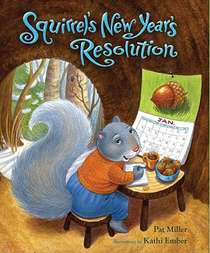
One January, my first grade teachers asked if there was a book about making New Year’s resolutions. I searched area libraries and publisher catalogs without success. Then it dawned on me that I could write that book. Two years later, I was able to supply them with Squirrel’s New Year’s Resolution in which a rookie squirrel learns about making resolutions from her friends.
Necessity is the mother of books about gluten allergies, bullies, gay parents, and overseas adoptions. Be alert when you hear (or think) “I wish there was a book about…” When I told my grown daughter I was working on this post, she said, “I wish there was a book about an Advent calendar that came to life.” I may never write it, but I added her wish to my notebook. My husband still wishes I would write a book about famous brothers. It’s in there.
On the last page of every issue of The SCBWI Bulletin, Libby Nelson compiles a librarian wish list of fiction and nonfiction topics. One of those needs could become the mother of your next brilliant inspiration.
 4. Carry a Net
One year I was coaxing my kindergarteners to guess what special day was coming up. They made random incorrect guesses, so I gave them a clue.
“It’s the day when an animal pops out of its hole to look for its shadow.”
Blank looks. These were Texas five year-olds. There are no wild groundhogs in the entire state. Then an earnest little boy waved his hand, blurting, “I know this one!”
“Great! What animal pops out of his hole next week?” I asked.
“The armadillo!” he proudly announced.
Not quite. I went on to explain about Groundhog Day, but as soon as the class left the library, I scurried into my office to record the exchange. Three years later, that conversation inspired my first children’s book, Substitute Groundhog.
My new smart phone takes dictation, but I find small tablets to be more versatile. (It’s creepily obvious if you dictate into your phone while eavesdropping.) I have little tablets in my purse, my gym bag, my car, and my kitchen. I even have a waterproof one in the shower—my best place for getting ideas. Tablets help me capture inspirations before they fly away.
5. Plant Bulbs
I read a great gardening tip about using golf tees to mark where you plant bulbs so you don’t accidentally plant over them. Bulbs look like rocks. You plant them. Water them. Then wait. And wait. Eventually you forget about them (hence the golf tees), and go about your life. One day–surprise! Leaf tips, followed in quick order by stems, buds and gorgeous flowers.
We were touring the Boston harbor when our guide waved his arm vaguely to the north and said, “Over there is the grave of the guy who invented the doughnut hole.” I jotted that fact in my little purse notebook. Later, I transferred it to my Idea Notebook where it sat for two years until I took it to the Highlights Nonfiction Workshop. There I began my research. Six months later, I wrote the manuscript as my first for Julie Hedlund’s 12×12. Her February agent requested to represent it. In July, Houghton Mifflin Harcourt acquired The Hole Story of the Doughnut.
How easily I could have let the tour guide’s remark fly away on the wind off the harbor. A quick jot in my notebook, and it was safely planted. You never know which homely idea will germinate when least expected, nurtured by future life experiences or eyes that see it in a different light later.
Reinvent the books or songs that you love. Record emotional situations and capitalize on needs around you. Keep your mental nets ready. Stash your tablets. And faithfully plant your ideas. Then you’ll gain ready admission into The Big House.

Pat was a school librarian for 22 years—the perfect job for a children’s writer. Her Substitute Groundhog received 33 rejections before the euphoric phone call from Albert Whitman. It went on to become a Junior Library Guild Book, a Scholastic Book Club selection with CD, an e-book hybrid from Weigl, and translated into French for Canadian Groundhog Day. Besides her books for children, Pat has written 20 for school librarians and is Contributing Editor for LibrarySparks magazine. Pat loves doing school visits as an author and storyteller. Visit her at PatMillerBooks.com and check out her blog at PatMillerBooks.com/blog. Comment there on her latest post to win another chance for a critique.

Pat is generously giving away two prizes!
The first—pick one of her three children’s book—with audio CD. If you win, it will be personalized to your favorite reader.
The second is a picture book critique.
Two winners will be randomly selected at the conclusion of PiBoIdMo. You are eligible for this prize if:
- You have registered for PiBoIdMo.
- You have commented ONCE ONLY on today’s post.
- You have completed the PiBoIdMo challenge. (You will have to sign the PiBoIdMo Pledge at the end of the event.)
Good luck, everyone!
I call the agents who participate in PiBoIdMo “agent prizes”, but let me make one thing clear: you do not get to bring them home with you.
Oh, sure, I know how you’d love to cuddle up with an agent, dress them in adorable footie pajamas and read them bedtime stories, but alas, they are remaining in their respective homes. For now. Who knows? If they really LOVE your ideas, maybe they’d like to snuggle beside you? But I digress…
At the conclusion of PiBoIdMo, on December 1st, I will post the “PiBo Pledge”. Leave a comment on the pledge post if you have completed the challenge with at least 30 ideas. You do not have to submit those ideas to prove that you have them. You’re on the honor system. It’s OK, I trust you.
 If you have “signed” the pledge by commenting AND you had also registered, then you are eligible for an “agent prize”—a.k.a. THE GRAND POOBAH OF PRIZES. You will get your 5 best ideas evaluated by a kidlit agent. They’ll tell you which ideas might be the best ones to pursue as manuscripts. (Or not.)
Don’t worry–you’ll get a few days to pick your 5 best ideas and flesh them out before sending to your assigned agent.
This year we have NINE NOTABLE AGENTS participating! This means there are NINE GRAND PRIZES! I hope to add more, but these are who we have thus far.
Now…let me introduce you…let me make you smile… (wait, that’s let me entertain you…oopsie…but I bet you’re smiling anyway)…
.
Ammi-Joan Paquette, Erin Murphy Literary Agency (EMLA)
 Joan is a Senior Agent with EMLA, working from her home office in Massachusetts as the “East Coast branch” of the agency. She represents all forms of children’s and young adult literature, but is most excited by a strong lyrical voice, tight plotting with surprising twists and turns, and stories told with heart and resonance that will stand the test of time.
An EMLA client herself, Joan is also the author of numerous books for children, most recently the picture books Ghost in the House (Candlewick, 2013) and Petey and Pru and the Hullabaloo (Clarion, 2013), and the novels Paradox (Random House, 2013) and Rules for Ghosting (Walker, 2013). When she is not on the phone, answering email, or writing, you will most likely find Joan curled up with a book. Or baking something delicious. Or talking about something delicious she’s baked. Really, after books and food, what else is there worth saying?
You can read more about Joan’s writing and agenting process here.
.
Tricia Lawrence, Erin Murphy Literary Agency (EMLA)
 Tricia is the “Pacific Northwest branch” of EMLA—born and raised in Oregon, and now lives in Seattle. After 18 years of working as a developmental and production-based editor (from kids book to college textbooks, but mostly college textbooks), she joined the EMLA team in March 2011 as a social media strategist.
As associate agent, Tricia represents picture books/chapter books that look at the world in a unique and unusual way, with characters that are alive both on and off the page, and middle grade and young adult fiction and nonfiction that offers strong worldbuilding, wounded narrators, and stories that grab a reader and won’t let go.
Tricia loves hiking, camping out in the woods, and collecting rocks. She loves BBC America and anything British. She has way too many books and not enough bookshelves. You can find Tricia’s writing about blogging, Tweeting, Facebooking, and other social media topics (for authors and the publishing industry at large) here and here.
.
Marietta Zacker, Nancy Gallt Literary Agency
 Marietta has experienced children’s books from every angle—teaching, marketing, publishing & bookselling. She thrives on working with authors who make readers feel their characters’ emotions and illustrators who add a different dimension to the story. She is also book curator at an independent toy store/bookstore. Read a recent publishing industry piece by Marietta here.
.
.
Danielle Smith, Foreword Literary
 Danielle Smith began her agent career at Foreword Literary Agents in 2013 where she represents picture books and middle grade authors and illustrators. Her enthusiasm for children’s literature began as a young child, but grew exponentially when her own two children were born and shortly thereafter she began reviewing books at her top rated children’s book review site There’s A Book. For more than five years she’s been involved professionally with books through print and online publications such as Women’s World and Parenting Magazine, as a member of the judging panel for The Cybils awards for fiction picture books, as well as locally by serving on the board of The Central Coast Writer’s Conference.
Danielle is also a writer, represented by Pam van Hylckama Vlieg for her middle grade novel The Protectorate. She’s a member of SCBWI and can frequently be found on Twitter talking about anything from children’s books to the BBC’s Sherlock to her own parenting woes & joys.
Read more about Danielle here.
.
Mira Reisberg, Hummingbird Literary
 Mira Reisberg came to launch Hummingbird Literary following a 25-year history in the field of children’s literature working as an award-winning illustrator, a writer, editor, art director, designer, a children’s literature and art education professor, and a teacher/mentor to many now successful children’s book creatives.
Her mission is to successfully represent all age-levels to create wonderful books that bring meaning and/or joy to children’s and young adult lives. Hummingbird Literary will have a limited number of clients so that Mira and her team can focus on building long-term careers and fruitful relationships.
Learn more about Mira and Hummingbird here.
.
Susan Hawk, The Bent Agency
 Susan Hawk represents authors who write for children of all ages, babies to teenage.
Susan comes to TBA from Children’s Book Marketing, where she worked for over 15 years, most recently as the Marketing Director at Henry Holt Books for Young Readers, and previous to that as the Library Marketing Director at Penguin Young Readers Group. She’s also worked as a children’s librarian and a bookseller.
Susan handles books for children exclusively: picture books, chapter books, middle grade and YA, fiction and non-fiction. She wants a book to stay with her long after she finishes reading, and she’s looking for powerful, original writing. She’s open to mystery, scifi, humor, boy books, historical, contemporary (really any genre). Her favorite projects live at the intersection of literary and commercial. In non-fiction she’s looking for books that relate to kid’s daily lives and their concerns with the world. In picture books, she’s looking particularly for author-illustrators, succinct but expressive texts, and characters as indelible as her childhood favorites Ferdinand, Madeline and George and Martha.
Read more about Susan here.
.
Lori Kilkelly, Rodeen Literary Management
 Lori Kilkelly is an agent with Rodeen Literary Management, founded by Paul Rodeen, formerly of Sterling Lord Literistic, in 2009. After working in sales for a number of years, Lori decided to follow her passion for books. She attended the Denver Publishing Institute, subsequently joining the agency as an intern in early 2010. Ascending the ranks from intern and reader to assistant, she worked with current and potential clients as well as editors and publishers. In early 2012 Lori took on the role of Social Media Manager, creating and maintaining the Rodeen Literary Facebook page as well as Twitter and Pinterest accounts, to provide promotional opportunities for RLM clients as well as keep interested parties informed about books, news and events involving RLM. In December 2012 she began representing her first client, Toni Yuly, and has subsequently taken on an additional four clients. She represents authors as well as illustrators and is actively seeking talented Middle Grade and Young Adult writers.
Please visit here for more on Lori and Rodeen Literary Management.
.
Sean McCarthy, McCarthy Literary
 Sean McCarthy began his publishing career as an editorial intern at Overlook Press and then moved over to the Sheldon Fogelman Agency. He worked as the submissions coordinator and permissions manager before becoming a full-time literary agent. Sean graduated from Macalester College with a degree in English-Creative Writing, and is grateful that he no longer has to spend his winters in Minnesota.
He is drawn to flawed, multifaceted characters with devastatingly concise writing in YA, and boy-friendly mysteries or adventures in MG. In picture books, he looks more for unforgettable characters, off-beat humor, and especially clever endings. He is not currently interested in high fantasy, message-driven stories, or query letters that pose too many questions.
You can visit Sean here and follow him on Twitter here for his thoughts on publishing news, the inevitable hipsterfication of Astoria, and the Mets’ starting lineup.
.
Jill Corcoran, Jill Corcoran Literary Agency
 Prior to becoming an agent, Jill Corcoran worked at Mattel, LA Gear, Leo Burnett Advertising and her own company, LAUNCH! New Product Marketing. With an English degree from Stanford University and a Marketing and Finance MBA from the University of Chicago School of Business, Jill has marketed everything from Barbies to Disney toys, Kellogg’s cereal to LA Gear shoes. But when she started writing books for children, and then agenting them, she knew she found her true calling.
Jill represents Picture Books, Chapter Books, Middle Grade and Young Adult plus a select list of adult non-fiction. Visit her agency website here.
.
Interesting story—back in 2009, I met Jill in person at the NJ-SCBWI annual conference after chatting via social media for months. We never really got a chance to talk in depth, so I asked if I could email her some of my picture book ideas so she could give me feedback on which might be the best to pursue as manuscripts. She agreed and I sent her a bunch of ideas, one of which was for THE MONSTORE. And the rest, they say, is history.
My experience with Jill is how these “agent prizes” came to be. I know how valuable it is to receive guidance from someone who really knows the market. Now that I have an agent myself (Ammi-Joan Paquette), I’m lucky enough to bounce ideas off her before I do any writing. But if you don’t have an agent, just how can you discern a lukewarm idea from a HOT one? Hopefully these agent prizes will give you a head start in that department.
,
Yay! So those are our agents, folks.
Now I should end on a humorous note, but you know, running PiBoIdMo just wipes the witty right outta me sometimes.
Maybe…yabba dabba do?
 by
by Welcome to your 19th day of PiBoIdMo, everyone! Wow, you guys are amazing, and maybe a tiny bit crazy! You’re going through with this thing! How are you doing? Are ideas coming to you? Has the well run dry? If so, here’s one I was saving for a rainy day: “alpaca inherits disused windmill.” You can have it. Don’t tell Tara!
Now freshen up your coffee because we’re going to talk about…
Inspiration
It’s a scam. That’s my honest two cents. I don’t even know why I put it in bold type. Here are some reasons it stinks.
Oracles
The shenanigans start with a young lady in Ancient Greece. She’s 14—high time she married the aging polygamist down the road, says dad! But our girl is a step ahead of the game. She just got a job relaying divine messages from Apollo, and she has to remain a virgin for him! I don’t know about you but I’m already suspicious.
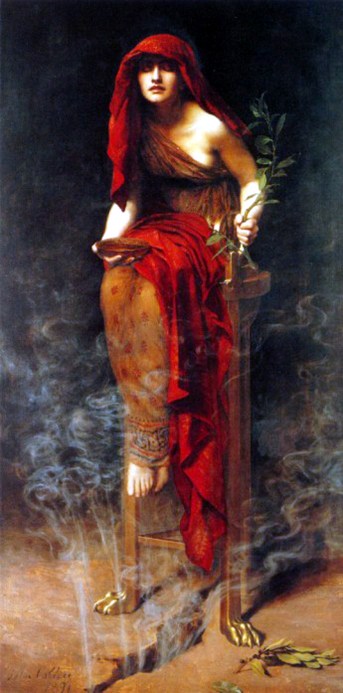
Does girlfriend get to have clandestine sex with gods? Maybe. Does she hang out in a cave breathing intoxicating fumes? Once a week, which is a good thing or a bad thing, depending on how you feel about vaping. She’s the most revered figure in ancient Greek society. That means gold jewelry, fancy dinners and spa days. And she’s free to speak gibberish, which handlers translate for her credulous visitors: “She said ‘you may never not defeat the Spartans/why does this lamb stew taste so amazing?’”
Sure, Apollo told her to say that. I almost forgot: she gets three months’ vacation. No surprise oracles started popping up on every corner. I’m declaring it the world’s first really great grift.
Romantics
If you’re picturing the rock band from Detroit with a singing drummer, I’m not talking about them. They’re legit. I’m talking about the artists and writers of late 18th and early 19th-century Europe. They were obsessed with finding inspiration, especially after a juicy excerpt from William Blake’s Songs of Innocence and Experience ran in Marie Claire’s September 1794 issue.
According to the Romantics, artists harness the divine when they create their work. Not everyone can do it, though. God only talks to geniuses! How did that theory serve our creative forebears? It justified chronic procrastination. It was also good for starting drunken fights about who’s a genius and who isn’t. And it was a compelling argument when begging your dentist for opium, as you see in the following historical exchange:
PERCY SHELLEY: I wish I had more opium.
SHELLEY’S DENTIST: I’m sorry, Lord Shelley, I cannot responsibly give you any more opium.
SHELLEY: I guess you don’t want me to realize my genius.
(SHELLEY’S DENTIST sighs, gives SHELLEY more opium.)
I apologize if I’m bursting anyone’s bubble with this. I just want you to be aware that a person who goes on about inspiration is hoping to rob you or use you to get drugs. Does this apply to my fellow guest-bloggers? I don’t know them all personally, but I’m going to say yes. Maybe not Jane Yolen, she’s a hard worker. It’s certainly true of the illustrators. You’re better off trusting a carney.
So where does this leave you? At your desk, where you belong! And when you lack an idea? My advice is, have a sandwich. Take a nap. Try again tomorrow. Stay away from gods and dentists. Listen to Jane Yolen.
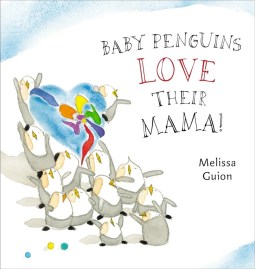 Melissa Guion is the author and illustrator of BABY PENGUINS EVERYWHERE! (Philomel 2012) which was selected for The Original Art 2012 and has just been reissued as a board book. Her second book, BABY PENGUINS LOVE THEIR MAMA, arrives in January.
Visit Melissa online at MelissaGuion.com or follow her on Twitter @MelissaGuion.
Melissa is giving away a signed copy of BABY PENGUINS EVERYWHERE! and (vegan, opium-free) penguin gummies to snack on while you read it.
This prize will be given away at the conclusion of PiBoIdMo. You are eligible for this prize if:
- You have registered for PiBoIdMo.
- You have commented ONCE ONLY on today’s post.
- You have completed the PiBoIdMo challenge. (You will have to sign the PiBoIdMo Pledge at the end of the event.)
Good luck, everyone!
 by
by I grew up in the kitchen with my mama and grandmas and aunties. When I was a little girl my mama sprinkled flour across the counter and let me draw pictures in it while she baked. As I got older, I got to do more grown-up jobs. She taught me how to read recipes, measure ingredients and decipher spices.
I loved being in the kitchen because that’s where I found the greatest samples of food and the best stories cooking.
When I sat at the table with my grandma rolling lumpia, she would tell me about her childhood growing up in the Philippines and Hawaii. Grandma would giggle about the days when my grandpa would dedicate songs to her on the radio. She would share techniques for Filipino cooking, which is as much about the process as it is about the ingredients.
When I would pull up a stool to the counter, my mama would tell me about her adventures in the kitchen with her dad. I learned about our Italian-American heritage. I discovered the secret pasta sauce recipe. My mama unraveled the stories of her dreams, failures and the roots of her faith.
We bonded right there in the kitchen.
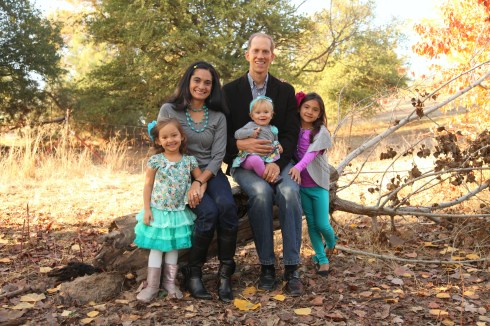
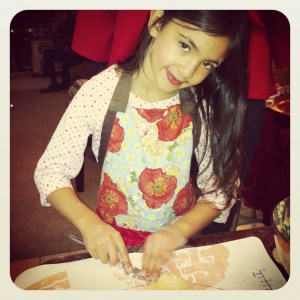
As a mama of three girls, I spend a lot of time in the kitchen today. We create, we taste, we dream up stories. One day I heard that familiar scrape of the stool across the kitchen tile. My middle daughter, who is named after an Italian chef, wanted to help mama. I happened to be making a Flourless Chocolate Truffle Torte. When she saw the chocolate swirling in the mixing bowl, she looked up at me very earnestly and said, “When does the licking begin?”
A classic line that will go down in history in our family. I am sure it’s also a line that will climb into one of my manuscripts one day.
And that’s just what happens in the kitchen: stories are born. My latest book, CORA COOKS PANCIT, details the story of a Filipino girl who learns to cook her family’s favorite noodle dish with her mama and uncovers some family history in the process. The story came out of my own experience cooking with my grandma Cora.
I happen to have a hand-scrawled copy of my grandma’s pancit recipe. I believe recipes are also a kind of story, a narrative of ingredients and traditions. That’s why we decided to include the recipe for the dish in the back of my book. When I do school visits, I talk about the ingredients with the kids and we cook pancit together.
I also included some details in the book from a Filipino friend who grew up in California’s Central San Joaquin Valley. One day when we were cooking together she told me about her dad who cooked for the hundreds of farmworkers who picked strawberries and grapes in the fields. This added another layer to my original manuscript because I could share a piece of California history as well.
The kitchen can also be a place to test out a lot more than just recipes. If your writer’s brain is blocked, droopy, stuck or uninspired, go feed it. Throw open the cupboards, dig in the refrigerator, turn up the burner and make something. I call it cooking therapy. Sometimes just the act of making myself a snack or cooking up a meal gets my creative juices flowing. While I’m cooking, I’m working out the kinks in my plot or adding nuances to my characters – sometimes consciously, sometimes subconsciously.
Julia Child said, “This is my invariable advice to people: Learn how to cook. Try new recipes. Learn from your mistakes. Be fearless, and above all, have fun.”
Sounds like great advice for writers too.
Bon appétit!
A SPOONFUL OF WRITING PROMPTS TO HELP YOU COOK UP YOUR NEXT MANUSCRIPT:
- Describe the most delicious meal you can imagine. What are the smells, the colors, the tastes that inspire you there?
- Sketch a scene in words or pictures from your childhood that involved food. Was there a traditional dish or meal you often made with your family?
- If you were inviting a famous chef to dinner, what you would you serve? Invite your own children or perhaps your inner child to be a part of that story.
- What food makes your stomach turn or your nose turn up? Write a story about a child avoiding or facing that food.
- Go in the kitchen. Make yourself a snack. Dig in. Then imagine what would happen if that tantalizing snack came alive.
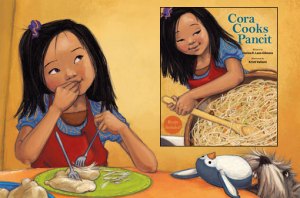 Dorina is the author of three books for children, including CORA COOKS PANCIT which won the Asian Pacific American Librarian Association’s “Picture Book of the Year.” Her poetry has also been published in Cricket magazine.
Dorina loves creating healthy recipes for her family and friends. To balance all that eating, she runs half marathons with her hubby and knits. When Dorina is not writing or stirring up stories in the kitchen, she is the director of The Haitian Bead Project. The project features upcycled jewelry made by Haitian artisans who are rising out of poverty. Dorina loves working with the Haitian women and sharing their stories in the U.S.
Visit Dorina online at DorinaGilmore.com, Twitter @DorinaGilmore or check out some of her recipes on the Health-full blog at MissionFitness.co.
Dorina is giving away a signed copy of CORA COOKS PANCIT!
This prize will be given away at the conclusion of PiBoIdMo. You are eligible for this prize if:
- You have registered for PiBoIdMo.
- You have commented ONCE ONLY on today’s post.
- You have completed the PiBoIdMo challenge. (You will have to sign the PiBoIdMo Pledge at the end of the event.)
Good luck, everyone!
 by
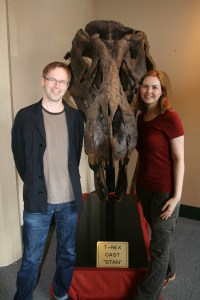
by Daniel and I started developing picture books as a team back in 2004. Our earliest picture books were practice vehicles, helping us learn how to create a picture book as well as how best to work together. Our third collaboration landed us an agent and our fourth got us a book deal. Along the way, Daniel and I have discovered a few best practices for successful creative partnerships.
1. Give each other space.
When we started out, we thought we had to muddle through every detail of the development process together—from idea to execution. Soon enough, we felt suffocated by the project, and frustrated with each other. So we changed it up. We’d ruminate on our current task independently and then come to each discussion meeting with solid recommendations on hand.
 2. Check your ego at the door.
Even giving each other ample space, our discussions can become quite heated. Naturally, each of us is convinced our approach is the right one. We’ve learned that we can’t hash things out immediately. It’s most harmonious if we present our recommendations with minimal commentary, and then each go back in our respective caves to consider all angles. After some reflection, I often realize that Daniel’s proposed solutions for the story are better than mine, or something he brought up leads me to rethink and rewrite for the better.
3. Try to have fun!
Sometimes we make the mistake of approaching our sessions with too much seriousness. Yes, publishing is a business, but the ideas flow best when we relax and let our creative sides go off on tangents. One of those tangents could be exactly what we need.
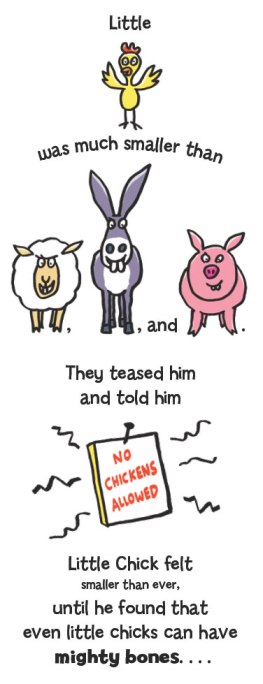
Lenore and Daniel Jennewein live and work together in Frankfurt, Germany. CHICK-O-SAURUS REX is their debut picture book as a team. Daniel is also the illustrator of IS YOUR BUFFALO READY FOR KINDERGARTEN? and TEACH YOUR BUFFALO TO PLAY TO DRUMS, both by Audrey Vernick. Lenore also writes novels for teens under the name Lenore Appelhans, including THE MEMORY OF AFTER and CHASING BEFORE.
Visit them at LenoreAppelhans.com and DanielJennewein.com.
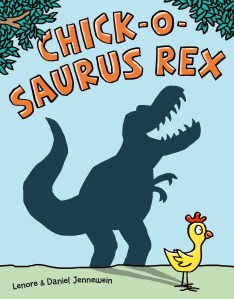 The Jenneweins are giving away a signed copy of CHICK-O-SAURUS REX plus a personalized illustration by Daniel.
This prize bundle will be given away at the conclusion of PiBoIdMo. You are eligible for this prize if:
- You have registered for PiBoIdMo.
- You have commented ONCE ONLY on today’s post.
- You have completed the PiBoIdMo challenge. (You will have to sign the PiBoIdMo Pledge at the end of the event.)
Good luck, everyone!
 by
by Bad news for me: Tara asked me to write about inspiration. I’m not sure if it’s the dreary November weather or my travel-fried brain, but I feel neither inspired nor inspiring.
Good news for you: You don’t need me, not when you’ve got the collective human experience at your fingertips. When I type the word “inspiration” into Google, I get over 130,000,000 hits. Everything you could possibly want is there: dictionary definitions, memorable quotations from Eleanor Roosevelt and the Dalai Lama, Scripture verses, YouTube videos of TED talks, and, last but certainly not least, Kid President.
Lest you think I’m making excuses to avoid writing about inspiration, I’m not. I am going to write. It’s just that I’ve decided to tell you that it’s okay not to feel inspired.
I’ve learned that for me, writing has little to do with inspiration and everything to do with hard work. Don’t get me wrong–there IS inspiration, if you define inspiration as the source of those ideas that seem to come out of nowhere, and I’m happy when those moments come. But that kind of inspiration comes in fits and snatches, and flits away as quickly as it comes.
That word Inspiration is a tricky one. Define it too narrowly, in the sense that Inspiration conjures up Muses and magic and sparkly things, and you might be setting yourself up to wait far too long between productive writing times.
Of course, there’s another way to see inspiration other than as the occasional blessing from a capricious Muse. Let’s define “inspiration” as “something that makes you put your butt in the chair.” (Butt In Chair, or BIC, as you probably know, is from Jane Yolen.)
Here are some things that make me sit my writerly butt down:
Hope
When I started writing, almost all submissions and responses were handled via the U.S. Postal Service. More days than not, nothing came in the mail. Nevertheless, that moment of reaching for the mailbox door every day and pulling it open always felt happy and hopeful. And sometimes there was something lovely in there! I like that hopeful feeling (even though these days I get it when I check CallerID to see if it’s my agent) and I don’t get to have it if I don’t do the work first.
Deadlines
My 18-year-old daughter, faced with a looming deadline the other night for one of her college applications, whipped out an essay in about forty-five minutes, and it was actually quite good. Deadlines mean you don’t have the luxury of feeling inspired; you just have to do the work.
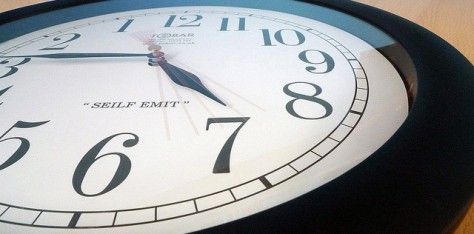
The Ticking Clock
I’m not old-old; I’m not even sure I’m quite in the middle-aged category. But I probably have fewer days ahead of me than I have behind me. As Rabbi Hillel said, “If not now, when?” I’m pretty sure he wasn’t referring to me finishing my hippo manuscript, but it works for me.
My Kids
My four teenagers may think they’re too old for picture books (though they respectfully read mine when I ask them) but they definitely are not too old to see me setting and reaching new goals. When I feel like quitting (generally because I’m depending on a visit from a Muse who has taken off on a one-way trip to Tahiti) I remember I don’t want my kids to see me quit. They can see me struggle, and they can see me change my direction, but I don’t want them to see me quit.
Kid Readers
This. Yes. More addictive—and more important—than chocolate to my writerly soul.


This list is incomplete, of course. I didn’t list the embarrassing ones or the ones I should probably save for a therapist. (I own those; I just don’t think you need or want to read about them.) I’m curious—what’s on your list? What inspires you to sit down and write when your Muse is on Mars?
 Despite the oft-quoted adage to write what you know, Anne Marie Pace has never been a bear, a vampire, or a ballerina. She is the author of NEVER EVER TALK TO STRANGERS and A TEACHER FOR BEAR, both published by Scholastic Book Clubs; and the VAMPIRINA BALLERINA series, illustrated by LeUyen Pham, published by Disney-Hyperion. Someday, she hopes to write books about what she does know: whistling, baking blue-ribbon-winning chocolate chip cookies, and schlepping teenagers around in a minivan, if she can find a way to make any of that interesting. She lives with her family in Virginia. Visit Anne Marie online at AnneMariePace.com or the Vampirina Ballerina Facebook page at Facebook.com/VampirinaBallerina.

And that’s why we have PiBoIdMo!
You’re halfway through the month. How are you doing with the challenge? Check in by commenting below!
 by
by Recently, I had a bout of writer’s block. It didn’t last horribly long, but as any writer who has been through it will tell you, any amount of time spent struggling to write can be extremely frustrating. Yeah, yeah. I know. What does this have to do with inspiration? I’m glad you asked. Or, more to the point, I’m glad I pretended that you asked. I thought I would talk a little about the lack of inspiration.
Why? Because I like to do things differently, but also because it is something that we all deal with at some point in our writing career. Every writer has a day when they sit down at their desk and stare at the blank page, the computer screen, the tablet and think, “Oh, god! What am I going to write?” Well, I’ll tell you. Anything.

There can be a lot of reasons that inspiration goes missing for a while. It is important in times like these not to lose sight of the smaller goal as we strive for the larger. In this case, we aren’t trying to complete the project. We are looking for inspiration, so that we can get writing again.
How do we do this? We get back to the basics. An artist may spend 5-10 minutes drawing quick sketches to get their creative juices going. We, as writers, can do the same. They don’t have to be good, or interesting. We don’t need to keep them around, or show them to anyone. We need to write them.

So, to that end, here are my 10 ideas for jump-starting your brain.
- Describe a photo. What happened just before it? Just after?
- Draw a picture. It doesn’t matter if you are an artist or not. Draw something you see. Remember we don’t need to show this to anyone.
- Describe yourself without using the pronoun I.
- Write down 10 questions about your project.
- Describe your writing area using only adjectives.
- Look up the lyrics to a favorite song. Try to write the story it tells.
- Describe what you ate for your last meal.
- Take a favorite story and change the ending. Happily ever after? Not any more. (Insert maniacal laugh here)
- Create a list of your favorite heroes from film, TV, or literature and describe them. If you’re not into the hero thing, make a list of villains.
- Change your perspective. If you write at home, go to a coffee shop or library. If you write inside, go outside. If you write via computer, try writing on a notepad, or vice-versa. Try writing while in a closet or under a bed. Remember: you never know when inspiration will strike.
Most importantly, keep writing. Don’t worry about what comes out. Ten minutes of writing today could lead to that brilliant story tomorrow. Happy writing!
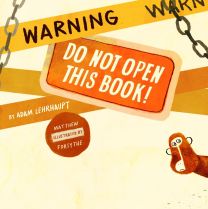 Adam has traveled to six continents, performed on Broadway, and lived on a communal farm. He firmly believes that opening a book is a good thing, even if there are monkeys in it. Adam currently lives in the suburbs of Philadelphia, PA, with his wife and two sons. In his spare time, Adam does a bit of writing. His writing spans multiple styles, from poetry to fiction to nonfiction, and is primarily geared towards children. Adam’s first book, Warning: Do Not Open This Book!, is available now anywhere books are sold. View the book trailer here.
Visit him online at AdamLehrhaupt.com, like him on Facebook and follow him on Twitter @Lehrhaupt.
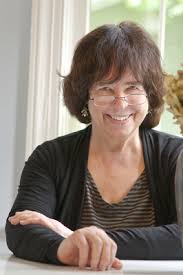 © 2013 by Jane Yolen
I have a Muse who works overtime, or at least that’s how it looks from the outside. But I think about something my late husband once said. An ardent birder and, in his retirement, a bird recordist whose tapes now reside in both the Cornell Library of Natural Sounds and the British Natural History Museum, he was known in the birding community as “a lucky birder.” That meant he seemed to find more rarities and more hard-to-see birds than anyone else. But his response was, “I show up.” And that’s what I think the Muse actually is: the writer showing up every day and doing the hard work of writing.
If you write FOR a particular market or FOR a particular editor you will often miss the mark. But if you write because your fingers have danced across the keyboard, because a character has tapped you on the shoulder, because a story has settled in your heart, then even if you never sell it you have done the work you were meant to do. And sometime, dear readers, real magic happens.
Let me tell you about a picture book I recently wrote because of a haunting photograph I saw on line. If I had stopped to think about its saleability, I wouldn’t have started it. But I plunged in.
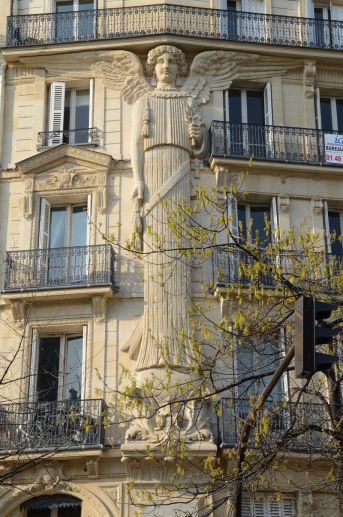 The photograph was of an apartment house in Paris on which a three story, three-dimensional angel with widespread wings had been carved on the facade. There was a newspaper story about how the angel had been built and survived World War II.
I knew there was a story there, and three things leaped out at me: angel, Paris, World War II.
Before I knew it, I was beginning to write a picture book (40 page picture book at first which I eventually got down to the more ordinary 32 page format), called “The Stone Angel.” It was about a Jewish family and the daughter about six or seven narrates. The Nazis come in, the yellow stars, escape to the forest where they live with Partisans, and then their escape across the mountains to Spain and then to Britain where they stay in the country till war’s end. And on their return, the father’s job is reinstated and he finds an apartment in, yes, the angel building.
A picture book? Really? Not a novel? It sounds like the plot of a novel. Yeah, I kept hearing that in my head and I kept dismissing the idea. I finished the picture book, sent it editor Jill Santopolo who was doing my fairy tale novels. It was not her kind of thing at all.
And in two weeks, she’d bought the book, found an illustrator, helped me shrink the text to a 32 pager (saying, “I love this as a 40 page book and if we can’t make it work at 32 pages with the same power, I can make the case for the longer picture book.”).
But sometimes the magic works.
© 2013 by Jane Yolen, all rights reserved
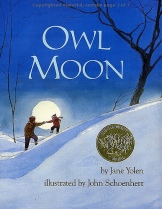 Jane Yolen is an author of children’s books, fantasy, and science fiction, including Owl Moon, The Devil’s Arithmetic, and How Do Dinosaurs Say Goodnight?
She is also a poet, a teacher of writing and literature, and a reviewer of children’s literature. She has been called the Hans Christian Andersen of America and the Aesop of the twentieth century.
Jane Yolen’s books and stories have won the Caldecott Medal, two Nebula Awards, two Christopher Medals, the World Fantasy Award, three Mythopoeic Fantasy Awards, the Golden Kite Award, the Jewish Book Award, the World Fantasy Association’s Lifetime Achievement Award, and the Association of Jewish Libraries Award among many others.
Her website JaneYolen.com presents information about her over three hundred books for children. It also contains essays, poems, answers to frequently asked questions, a brief biography, her travel schedule, and links to resources for teachers and writers. It is intended for children, teachers, writers, storytellers, and lovers of children’s literature.
The best part of the whole picture book making process, for me, is that moment when the idea comes—that SPARK happens—and there’s ignition!
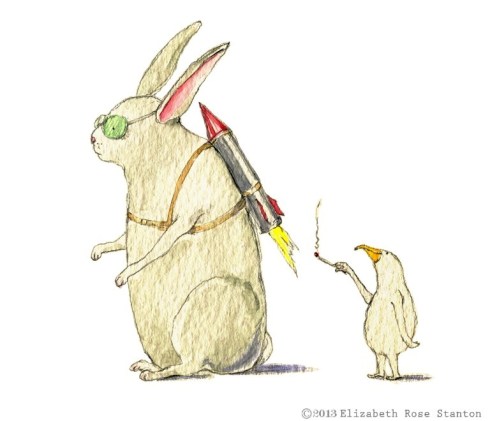
It’s mystical, it’s mysterious, it’s magical, it’s COSMIC!
But how do we get to that point where this happens—where “channel D” opens and the idea pops?
For me, it’s just one of those things that can’t be forced. I’m guaranteed not to think up any ideas when I tell myself I have to come up with an idea.
So how do I get primed for the muses to start singing? If I knew a sure-fire secret formula, I would certainly share it with you. But I do know two powerful “tools” that seem to work for me: procrastination and doodling. . . and the beauty of it is, you don’t have to be an artist or illustrator to do either one!
Each one works in it’s own way. There’s research showing that procrastination can lead to creativity, and that doodling can help us think. Combine the two and you set yourself up for some creative thinking!
Certainly, there are merits to doing both independently, but I’ve found when I combine the two, my ideas—always in the form of characters—begin to appear. I call it procrastidoodling, and it’s what I was doing when I came up with the star of my picture book, HENNY.

A few years ago, I was assiduously avoiding an assignment for a class I was taking by drawing all sorts of birds. As I doodled along, I found myself thinking about how silly it is that some birds have wings that are relatively useless—birds like dodos and ostritches and chickens. . .
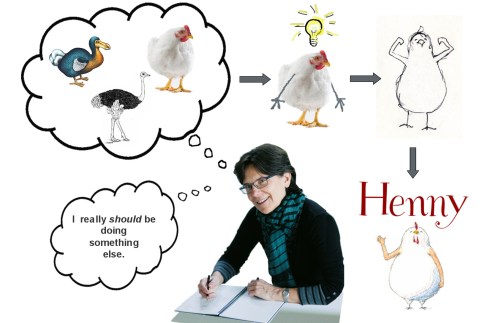
. . .when out popped a doodle of a chicken with arms! Much more useful, I thought. So I started thinking about all the things a chicken with arms could do…and Henny was born!

Since then, all sorts of characters have popped into my life—and all of them started out as procrastidoodles.

So try this: First, do something you think is frivilous. Waste some time watching a funny video, go for a walk, get relaxed. Then start doodling. Maybe listen to some favorite music while you do it. The trick is not to have any expectations about what you doodle. Trust me, it will free you up to get those ideas flowing. See how many Piboidmo ideas you get.
Who knows, maybe one of them will lead you, like the White Rabbit did Alice, down the rabbit hole to a whole new world—where your picture book will come alive!
Oh—and here’s a great TED talk on doodling. Why not procrastinate for a bit and watch it?
Thank you ! And thank you, Tara, for this opportunity to participate in PiBoIdMo. Have fun everyone!
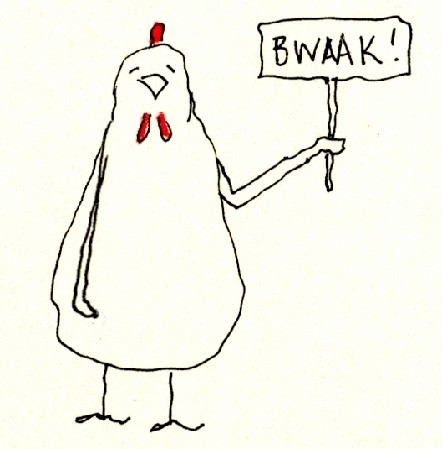
 Elizabeth grew up in Western New York State, studied art history in college, and went on to graduate school to earn a professional degree in architecture. While raising her kids, she kept herself sane by drawing portraits—mostly of other people’s kids—and did some fine art and scientific illustration. Upon completion of her maternal duties, she discovered that all of her architect- brain-cells had died, so she turned to drawing and painting full-time—FOR other people’s kids—and hasn’t looked back since.
Her debut picture book, HENNY (Simon & Schuster/Paula Wiseman Books), will be released in early January. She recently signed a contract for a new picture book, due out in 2015, about a little pig named Peddles, also with Simon & Schuster.
Elizabeth is represented by Joanna Volpe of New Leaf Literary & Media in New York, and is a member of SCBWI International, and SCBWI Western Washington.
Visit her at PensPaperStudio.com, her blog, or follow her on Twitter @penspaperstudio.
Elizabeth is giving away a signed copy of HENNY once it’s released!
This prize will be given away at the conclusion of PiBoIdMo. You are eligible for this prize if:
- You have registered for PiBoIdMo.
- You have commented ONCE ONLY on today’s post.
- You have completed the PiBoIdMo challenge. (You will have to sign the PiBoIdMo Pledge at the end of the event.)
Good luck, everyone!





 Writing for Kids (While Raising Them)