You are currently browsing the category archive for the ‘Children’s Writing’ category.
 by
by If you’re like me, writing is work. By this I mean it is my job, my primary source of income (therefore, work) but also that it is just plain HARD. There is nothing so depressing as trying to come up with something new and fresh to write about—and coming up with nothing.
That happens to me a lot.
So what do you do?
Well, I really don’t know the answer. But here are some tricks I use to muddle through those times when I have nothing to write about.
1) Start with character. I truly believe that the most important aspect of a picture book, what drives its popularity the most, is a charismatic main character. The premise, the setting, the cutesy word play and rhyme—all of these are secondary to character. So if you need to brainstorm only one thing, work on that viable character list.
The trick to creating a truly charismatic main character is to blend flaws with flair. Don’t just come up with fifty cute character traits. Give your main character some faults, some defects—he will be infinitely more interesting.
2) Something old into something new. There are so many examples of authors who take an old idea and make it into something modern and fresh. The entire genre of fractured fairy tales is built on the premise that recognizable is always a benefit for marketing, but recognizable AND fresh is money in the bank. Now I’m not at all recommending that all you do is read a collection of Grimm’s fairy tales and add a hippopotamus to each story (don’t do that, because it was my idea first). But if you can take inspiration from something your audience will recognize and then take it to a brand new place, where is the downside?
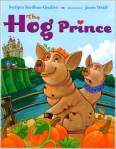 Some examples of this in my own work:
THE HOG PRINCE – we know it’s a frog prince, not a hog prince, but Eldon does not.
QUACKENSTEIN – isn’t every monster story better with a duck?
THE TWELVE WORST DAYS OF CHRISTMAS – believe it or not, in addition to a Christmas song, this is a sibling story
3) Look at your own life. And I mean this as way to eliminate bad ideas. When you’re having a hard time with inspiration, there is the temptation to use your own children or grandchildren as your muses. Trust me, this is a bad idea. Because as cute as their latest antics are to you, they very rarely make for good picture books. Save yourself. Don’t do it.
4) Exercise. Well, do a writing exercise at least. When you’re really stuck you could reinforce your writing ability by taking a book that is perhaps not one of your favorites and then rewriting it the way it should be. Obviously, you can’t then try to publish your version of Dora the Explorer (because Nora the Explorer or even Eleanora the Explorer is simply not going to be fresh enough to merit a whole new franchise!). But the exercise will show you that you are not only able to create a new story but one that is better than something that was actually published (which means there is hope for you yet) and, again, you never know where that road will lead.
5) When all else fails, take a breath. Sorry, guys, sometimes the ideas are not going to come. No matter how much you force it. When you are really and truly stuck, stop trying so hard. Instead, work on revising older manuscripts—maybe you can whip one of those into shape. Or perhaps the something old that you will turn into something new will come from your own pile of older ideas.
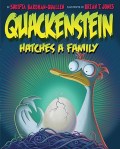
 Sudipta Bardhan-Quallen is the author of 18 non-fiction books for children and several picture books. Her newest release, QUACKENSTEIN HATCHES A FAMILY, will be followed by CHICKS RUN WILD in January. Enter the CHICKS contest at sudipta.com!
 by Ame Dyckman
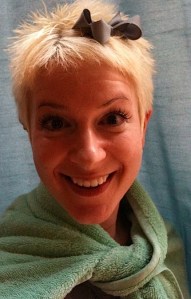
Hi, guys! Need picture book ideas? Me, too. So, I’m not going to be a grown-up today.
Today, I’m going to be a kid.
Wanna play? Go grab a towel. Tie it around your shoulders like mine.
Got your cape on? It’s time to:
Open all the cereal boxes—search for hidden passageways—whisper secrets to a dog—attempt a world record—pick up pennies—make a newspaper hat—sit on top of the monkey bars—build a fort—get fooled by pyrite—try to fool someone else with pyrite—sneak up on pigeons—blow a kazoo—roll down a hill—split your pants—eat a crust-less sandwich—pop bubble wrap—taste paste—rescue worms from puddles—draw the sky as a stripe—pee-pee dance—forget to flush—break a geode—spell Mississippi—beg a cookie—give sticky kisses—staple things—juggle oranges—throw a tantrum—wiggle a tooth—catch a frog—fall down laughing—wear olives on your fingers—race a friend—declare Backwards Day—cross your heart—mix baking soda and vinegar—collect pebbles—spin in circles—lose a sock—thumb wrestle—demand a do-over—run from bees—spray the hose—wish for stilts—build another fort—slide down the stairs—beat pots and pans—dig for buried treasure—help a robot friend who accidentally turned himself off—deny being tired—
Whew! I’m tired. I’ve got some ideas, though. Hope you do, too. Feel free to borrow from the list above. (Except the second-to-the-last-one. I already used that one.)
You can take your cape off now.
No? You’re going to wear yours a little longer?
Me, too!
 Ame Dyckman is represented by Super Agent Scott Treimel, Scott Treimel NY. Her debut picture book, BOY AND BOT (illustrated by Dan Yaccarino), will be released by Knopf in Spring, 2012. Ame loves cryptozoology, peanut butter, and screaming at Japanese game shows on TV. She lives in New Jersey (“Go, NJ SCBWI!”) with her husband, daughter, black cats, hermit crabs, fish, and obnoxious-yet-endearing pet squirrel.
As a prize, Ame is offering a chat about… ANYTHING! From getting an agent/book contract to advice on love, money, and your manuscript, Ame answers ALL! (For entertainment purposes only.)
 by Pam Calvert
So, today you’re supposed to be eating lots of turkey, stuffing, mashed potatoes, dressing, pies (emphasis on the plural here)…AND talking (not fighting) with your relatives. Enjoying your day! But still…it IS Picture Book Idea Month and so you’re also supposed to be thinking of a blockbuster picture book idea today as well. But I’m not thinking about today. No. I’m thinking about tomorrow.
 BLACK FRIDAY!
Mwahahahaaaa!
And in honor of Black Friday, I’m going to veer off from the normal “how I get my ideas” blog post to a more material slant—something all picture book writers should have sitting with them when they’re about to brainstorm. Something you should ask for Christmas so you can weave all those good ideas into editor-loving stories. It’s something I bought myself (SPLURGED on) several years ago and it helped me brainstorm two of my upcoming picture books.
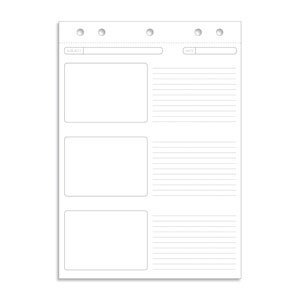
It’s called the Magna Storyboard Pad (pictured). Notice it has three areas where you can draw and lines for writing. “But WAIT!” you say. “I’M NOT AN ILLUSTRATOR!”
Well, I’m not either, but if you’re going to be a picture book author, you better be visualizing your story even before you start writing. This pad forces you to think in pictures. A lot of times, it’s easy for me to get swept away by my words when I should be visualizing my story first. And since I bought this pad, thinking in pictures has never been easier. And another secret?
No one has to see your pictures!
But I’ll show you some of mine so you’ll feel better about your artistic talent (because it’s gotta be better).
When I started on the sequel to my math adventure, MULTIPLYING MENACE, my editor told me I needed to meld one of my contracted stories with an earlier version of the sequel, MULTIPLYING MENACE DIVIDES. The contracted story was entitled, THE FROG PRINCE IN FRACTIONLAND. That meant I had to apply frogs throughout my original (that didn’t even have a frog in the background.) And I had to apply fractions throughout. This required pictures. Oh yeah, and I needed another villain. Panicking, I grabbed my math books, desperately searching for an idea. But then I remembered the storyboard pads. I hadn’t used them (even though it was at the top of my things to do list). I started with the new villain…

Her name was Diva Divine in a feeble attempt to use a play on words with division. Of course, through revision her name ended up being Matilda, but this is what she ended up looking like in the book:

There’s quite a bit of resemblance and I never had a talk with the illustrator, Wayne Geehan, about the witch. He suspected what she’d be like from her actions. But without my visualization on paper, her character may not have come out so well.
Now, the witch was the easy part. So much fun. I had her reading In Stye magazine and wearing Jimmy Ooze shoes (um…that never made it in the book…ha!).
The next part was thinking in fractions. So, I plotted out every element. Here’s one page example when I had to show how the division magic worked with dividing twelve kittens. I brainstormed some ways I could show this on the storyboard paper:
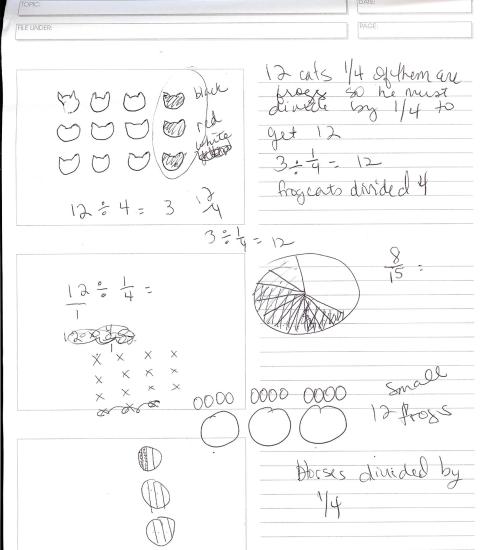
Not only did I brainstorm dividing the kittens into frogs, but I had to divide things by fractions, which makes a larger number. In the storyboard picture I used frogs, but they ended up being pigs. Here’s the finished page of the kittens.

After I completed this story, I was hooked! I would never again brainstorm without my storypad.
Here’s another example using my newest PRINCESS PEEPERS book entitled, PRINCESS PEEPERS PICKS A PET. These are the initial thoughts. Notice, I’m terrible at illustrating, but the ideas flow much more freely when I use it, and I can tell if my story would lend itself well to illustration. You need at least sixteen different scene changes for a picture book.
Here is Peepers trying to find a pet for the pet show:
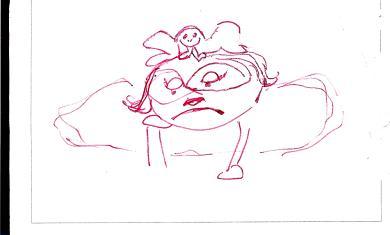
She’s frustrated because she can’t find anything (that’s a frog on her head!) In the finished book, she does find the frog and it looks like this:

Before I leave you with your Black Friday find, I’ll show you my newest picture book idea brainstorm.
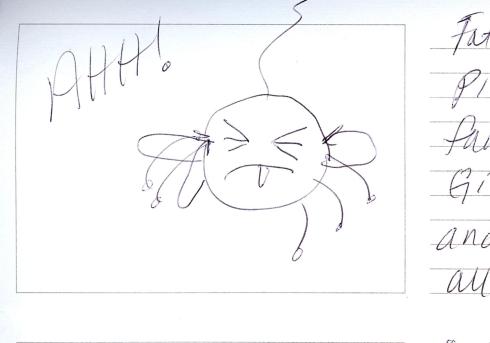
HAPPY THANKSGIVING!
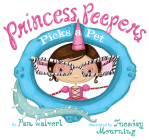
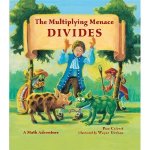 Pam Calvert has written picture books and stories for over ten years. Her picture books include MULTIPLYING MENACE: THE REVENGE OF RUMPELSTILTSKIN and PRINCESS PEEPERS, a Scholastic Book Clubs selection and listed as a Texas Mockingbird picture book pick. Her newest picture books will be out in the spring of 2011 entitled, MULTIPLYING MENACE DIVIDES and PRINCESS PEEPERS PICKS A PET. She’s writing new picture books as well as longer stories from her home in Houston, Texas.
 by Tammi Sauer
One of the ways I come up with picture book ideas is to push myself to put a twist on the familiar. This technique worked out well for me with my latest book MOSTLY MONSTERLY (Simon & Schuster, 2010) and my upcoming book ME WANT PET (Simon & Schuster, 2012).
The initial seed for MOSTLY MONSTERLY came from my editor wanting a young, funny Valentine’s Day book about friendship. She encouraged me to try to write one. Oh, the thrill! Oh, the pressure. I went to the library and read Every Valentine’s Day Picture Book Ever Written.
I discovered that most of those books were about cutesy things like kittens and puppies and mice. I knew my story had to be different, so I thought as un-cutesy as possible. And came up with monsters. Bernadette is an ordinary monster on the outside, but, underneath her fangs and fur, she has a deep, dark secret. She—gasp!—has a sweet side.
 Even though my editor and I eventually decided to tweak out the Valentine’s Day references and make the book marketable year-round, the story is still very much the same. But it never would have come about if I wasn’t trying to find a way to make my story stand out from the competition.
ME WANT PET sprang from my desire to write a book about a kid who really wanted a pet. There was only one problem. Every publishing house already had a pet book. Once again, I knew my story had to be unique if I wanted any chance of selling it. So I brainstormed. And read, read, read, read, read, read. And thunked my head on the keyboard.
One day, it hit me. My pet story wasn’t going to be about a typical kid who wanted a typical pet. Mine would star a cave boy in pursuit of the perfect prehistoric pet. Ooga!
So give it a try. Come up with a basic topic (Valentine’s Day, pets, siblings, pirates, first day of school, etc.). See what else is already out there. Then brainstorm a way that sets your story apart.
 Tammi Sauer spends the bulk of her free time hanging out with cowboys, chickens, monsters, ducks, princesses, three disgruntled chipmunks, and the occasional cave boy. Her next book, MR. DUCK MEANS BUSINESS (Simon & Schuster, 2011), debuts in January. To learn more about Tammi, please visit her at www.tammisauer.com.
Tammi will be giving away a signed copy of MOSTLY MONSTERLY at the conclusion of PiBoIdMo.
 by
by I’ll let you in on a secret—I’m not really an author. Actually, I’m a poet who has managed to trick a bunch of people (including some very nice editors and a terrific agent) into believing I’m an author. I’m sneaky like that.
For me, the work of writing prose is hard. All those words! My novels tend to shrink a lot, before they grow. I revise and edit myself so heavily that the pages melt away. My background in poetry, and my love of precise language, doesn’t lend itself well to the mad dash—the word-sprint—you have to do when you draft a novel.
But picture books? Ahhhhhh, picture books! Picture books are so much like poems. With their economy of language and their image-heavy text, picture books do much the same work poetry does. I actually enjoy the feeling of trying and failing and shelving an idea, because with picture books, you can just start over again with something else. I love seeing art come in from my illustrator, finding out what my words looked like inside an artist’s head. But best of all, I love the beginning of a picture book, the burst of a new project.
I have a huge junk file on my laptop called JUNK, and it is absolutely filled with documents that are “new beginnings.” Empty documents with only a title or a single line in them.
See, as a poet, I don’t really come up with “ideas for picture books” so much as I dream up little spurts of language, lines of text from which a picture book can grow. For me, the beginning is more about the way a few words sound together than it is about an “idea.”
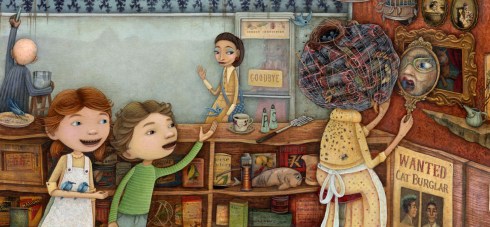
Let me explain. I’ll use as my example my first book. INSIDE THE SLIDY DINER grew out of my career as a waitress, so if I had begun with an idea, I’d have written down, “make a picture book about a diner.” Instead I wrote down, “Inside the Slidy Diner, the Greasy Spoon of stuck.” I didn’t even know it was a picture book when I began it. At first I thought of it as the first line of a prose poem. I had no idea that I’d invent a character named Edie, or that the diner would be a kind of pseudo-magical place, or that there would be a funny cast of characters. I only had the internal rhyme of “sliiiiiiidy diiiiiiner” and the alliteration of “ssssssspoon of sssssstuck.” But the story sprang from that language.
Likewise, the JUNK file I mentioned earlier is full of lines that I’m not sure about yet. In each case, I don’t know what my idea is exactly, or what the story is about. I only know that I liked the way a few words sounded in my head. Maybe you can help me puzzle them out. Here are a few:
 1. Doctor Delete
2. The spoon of wishful thinking
3. What the wind wants
4. The Boring Book
5. My Iffiest Scritch
6. Dirty Curls
7. Boy Who Caught His Death
See what I mean? These are not ideas. They could still head off in a million different directions. They’re just words, that sound nice, in the right order.
So now, as an exercise, for other folks who are equally language driven, I might suggest that instead of trying to think up a picture book idea every day, you can also try to revisit the way you describe things each day. You could spend the entire month describing the same thing differently, day after day.
Because each description might, in the end, give way to a different book! Language drives tone and voice, and those things can drive your idea and your story instead of things happening the other way around. For me, it’s much easier to make up a story to match a voice than it is to find a voice for a story.
Make sense?
Try it right now! It’ll only take a second. Go look at something—a squirrel, maybe, or the ground at your feet, or your closet door, and instead of trying to think of the idea it might lead to, try to think of different sets of words for what you see.
 That squirrel? How might you describe him? Don’t try to be smart, just think of different ways to talk about him. Using as many different words as you can. It’s okay if they’re lame. Maybe that squirrel is:
1. A fidgety bit
2. A tree rat
3. Too loud
4. Fluffytail, the adorable poufypie
5. The fattest squirrel in the tree
6. The squirrel who lost his tail
7. A nut-thief
8. A nuisance
9. The one who wouldn’t leave
10. Harold
See what I mean? By the time you revisit your titles, Fidgity Bit might be a funny board book about a kid who can’t sit still, and Tree Rat might be about a rat who moves from New York to the country and wants to fit in with the squirrels, and Harold might be about a geeky squirrel who wants to study for the LSAT instead of finding nuts all fall.
For me, it is hard to think of new ideas, and far simpler (and more fun) to think of new ways to say things, and then figure out what they might mean.
Give it a try! Or a whirl! Or a go! Or set your pen scratching! Or dive into your dictionary! Or head off into the word mines! Or take a dip in the language lake.
Or… or… or…
Oops! There I go again…
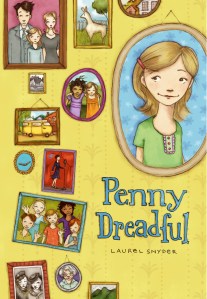
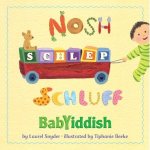 Laurel Snyder is the author, most recently, of a picture book, BAXTER, THE PIG WHO WANTED TO BE KOSHER, and a novel, PENNY DREADFUL. Her next book, Nosh, Schlep, Schluff: BabYiddish will be out in January. She is also the author of a book of poems (for grownups), THE MYTH OF THE SIMPLE MACHINES. Laurel lives in Atlanta and online at http://laurelsnyder.com and she tweets obsessively, if haphazardly. Follow her @laurelsnyder!
BAXTER art by David Goldin, SLIDY DINER art by Jaime Zollars (who also did the cover for MYTH). PENNY DREADFUL cover by Abigail Halpin, NOSH art by Tiphanie Beeke
 by Jo Swartz
The expression “A picture is worth a thousand words” for me, is very true. Sometimes inspiration comes from an idea, sometimes the words just come, but mostly the idea creeps up on me and surprises me when I least expect it out of something else. The only scary feeling accompanying it is “can I pull it off?”. Will the finished product turn out as fabulous as I imagine it?
Lately I have been quite surprised by the source of 3 of my newest picture books—all ‘works in progress’. They each began as a simple, single drawing. One was for a licensing line I am hoping to develop, another was just a portfolio sketch based on a fairy tale, and my shiniest new idea began while trying to think of a single picture to show my illustrative abilities for the upcoming SCBWI conference in New York. Aaack! Since, only one picture is allowed. I had to create one that would encapsulate my style and ability which for me meant I needed to create a concept where I showed beautifully costumed people, and talking animals. (At least I think so…who knows if this will be the image I use).
As I was working out what the picture should look like, my family became the source of inspiration for the theme, and suddenly there it was—the whole picture book. Right now, it is just all pictures in my head and very few words…but they are on their way. And I hope I can ‘pull it off’.
 I don’t know how authors who don’t draw plan out a picture book. I don’t think I could without pictures early on in the process, even sketching out a rough stick figure dummy about what is going on in each page really helps me.
Even if you don’t draw—collage can do the trick. Just one picture can give you so much. Setting, characters, emotions.
This post is pretty late in the PiBoIdMo challenge, and if you are doing well with it—you have probably found that the more ideas you get, the more ideas you get! I think the challenge is great for training the mind to see opportunities for a story. Suddenly you find something humorous—whether it is a picture or a comment you heard while eavesdropping, the juxtaposition of something, irony, all these things can create a wonderfully original story, and sometimes something you never thought or intended to become a story—suddenly does.
I would also like to add for the illustrators out there—that not all picture books need to have words, either.
The story idea that I got while working on the licensing project has no words. I think of it like a silent movie. I just found that the illustrations told it all and words added nothing.
So, whether you draw, write, or both, don’t wait for your muse. If the one for writing isn’t showing up that day for work, try calling on one that handles the pictures to guide you. And if you are too scared to work with her—try the one for song, history, and so on. Or, do something completely different…but keep your mind ready for when the idea pops in. Mine likes to wake me in the middle of the night—so it is a good idea to always have a pen and notebook nearby!
The thing with inspiration is you never know what you’re going to get. None of the stories I am most pleased with, I intended, or planned, or saw coming. And whatever you do…have fun with the whole process—it will show in the work.
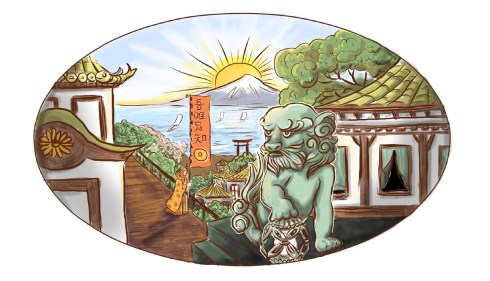 Jo Swartz is a writer/illustrator in Toronto. She works with both traditional media (mainly watercolor & ink) and digitally. She has several WIPs at various stages of completion. Jo is a former fashion designer, and has worked internationally in ready-to-wear and haute-couture in Paris, and a former creative director/graphic artist. This is her 3rd career. Jo’s work can be found at www.littlejolit.com and you can follow her on twitter http://www.twitter.com/littlejolit. She has recently been featured at Smith Micro’s Manga Studio site.
 by James Burks
It’s day 18 of PiBoIdMo and I’m here to give you inspiration or at least a small push towards the finish line. I’m sure that, at some point in your life, most of you have put together a puzzle. It could have been a small puzzle with only a hundred pieces, or a ginormous puzzle with a bazillion pieces. Regardless of the size, if you can put together a puzzle then you can put together a story. So let’s get started.
To put together a story puzzle, the first things you need are the pieces. That’s where your ideas come in. Every single idea you come up with is a piece of the story puzzle. This includes characters, settings, or lines of dialogue; you name it, they are all pieces of the puzzle. And here’s the best part: there are no wrong pieces. If a piece doesn’t seem to fit into the puzzle you’re working on, you can set it aside to use later.
Here’s an example of a recent story puzzle that I put together:
About a year ago, I sat down and tried to come up with my next great idea. I had just sold my first two stories to different publishers and was trying to come up with a third story that my agent could send out. I had the first piece of my story puzzle: a squirrel. I spent the next few days creating more pieces. I gave the squirrel a name (another puzzle piece), and I came up with a bunch of stuff that he loved to do (more puzzle pieces). After a few days I took all the pieces and arranged them into a simple story, drew some rough drawings (for illustrators, these are more pieces), and sent it off to my agent. My agent thought it needed something more, though, and at the time I didn’t know what that was. So I set the entire puzzle aside and went off to work on another project.

After about a month, my agent called and asked if I had come up with any new ideas. I hadn’t. Or at least that’s what I thought. After hanging up the phone I started running through a bunch of random ideas while surfing the internet. I remember contemplating Amelia Earhart (I think the biopic was coming out or had just came out), went from there to Penguins, then to the South Pole, and from there to a bird migrating south for the winter. (It’s always a good idea to let your brain off its leash once in a while and let it run free. You never know what it might bring back.) Something about a bird flying south for the winter ended up sticking with me.
I didn’t know it just yet but I had just found another piece to my story puzzle.
From there, everything seemed to magically fall into place. I took the bird migrating south for the winter and stuck him with the squirrel from my earlier story. A small part of my story puzzle took shape.
Then I started to ask myself a series of questions to fill in the rest:
Why do they have to migrate south together for the winter? There had to be a reason and it had to be big. I asked myself what would happen if Squirrel was forced to go along after he unintentionally sacrificed his entire winter stash of food to save Bird from an attacking cat. He would have no other choice; if he didn’t go with Bird then he’d starve.
But, where was the conflict? What was going to make my story interesting? Maybe they were like the odd couple. I imagined Bird as a total free spirit who just wanted to have fun, while Squirrel was a bit neurotic and was all about responsibility. Squirrel can’t stand Bird, but they’re stuck together. A natural conflict of personality that would provide for some humorous scenes.
This left one last question. How would the two characters change by the end of the story? What would their character arc be? In the case of this story, I decided to have Bird learn to be a little more responsible and Squirrel learn to have a little more fun. The story, at its heart, would be about finding a balance between having fun and being responsible. And by the time the journey ended, they might even become friends.
At that point I could pretty much see the overall structure of my puzzle. The edges were complete and all the major parts were coming together. All I had to do was fill in the missing pieces in the middle, which solidified as I wrote the outline and got to know the characters better. Two weeks later I sent it off to my agent, we made some minor tweaks, and eventually sold it to a major publisher. (Deal announcement pending; I’m drawing and writing the book for release sometime in 2012.)

I hope you find inspiration in my recent experience and are able to put together some great story puzzles of your own. Just remember that there are no wrong pieces. You may not use every idea or piece you think of right now, but every piece (used or not) helps you build your puzzle. Now go forth and conquer the book world!
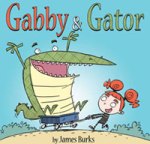 James Burks has spent the last 15 years working in the animation industry on various movies and television shows, including The Emperor’s New Groove, Atlantis, Treasure Planet, Home on the Range, Space Jam, The Iron Giant, Wow Wow Wubbzy, and most recently on Fan Boy and Chum Chum. His first graphic novel for kids, GABBY AND GATOR, was published by Yen Press in September 2010 and is a Junior Library Guild selection. James is currently working on a picture book with Lerner/Carolrhoda entitled BEEP AND BAH (2012), and the graphic novel mentioned above.
James is giving away a signed copy of GABBY & GATOR! Leave a comment to enter. A winner will be randomly selected one week from today.
Thanks to James for the PiBoIdMo 2010 logo and badges!
 by Mark Ury
Blogging always seems to include sharing some sad truth about yourself, whether it’s your obsession with trash TV or one too many trips to the freezer for more mint chocolate chip ice cream (P.S. these are examples and any resemblance to my life is coincidental). So here’s my share: I can’t draw.
Admitting you can’t draw isn’t much of anything, really. Over 90% of the world can’t draw. But context is everything. Admitting I can’t draw to my bowling friends isn’t worth a second glance (P.S. I don’t bowl), whereas sharing it with picture book writers and illustrators is like asking your bowling friends to switch to five-pin balls since your wrist is to weak to use the grown-up sizes (P.S. this has never happened). It’s kinda sad and wimpy.
Now, don’t feel embarrassed for me (P.S. you are not my mother). I have at my disposal an entire platform to compensate for my lack of artistic skills. With it, I can inspire myself to great heights and pen imaginative stories that kids everywhere read and love. But, sleazily cross-promoting my venture is not what this post is about (P.S. unless you find my venture intriguing and possibly useful, in which case we should have coffee and be friends). No. This blog post is NOT about (shameful) marketing or even (sad) admissions of inferior uses of pencils. It’s about music. Or, more specifically, it’s about how music helps me get the feeling of a story long before (and sometimes after) I’ve seen the images or typed the words.
It’s quite possible you are already familiar with how music can shape your work. If so, perhaps you might be better off reading Sarah Dillard’s post—it has cute bunnies. But if you’re like me (P.S. heaven help you), you may only be modestly aware of how music can be used to give your story the tone or pitch your characters are longing for (and, eventually, if you score that deal with HarperCollins, your readers).
For the longest time, I *thought* what was inspiring the tone of my writing were the images I would paper on my walls, stash in my notebook, or hide under my pillow (P.S. the images under my pillow were not at all being hidden from my mother). Weathered photos of Sid Vicious and Marianne Faithful propelled my early poetry. An image of Kate Spade holding one of her early designs became the central figure in one of my (wretched and unfinished) screenplays, and a stark image of Vanessa Redgrave has been taunting me to start my graphic novel (P.S. yes, you read correctly that I can’t draw).
But, upon reflection (.PS. while searching for a theme for this blog post), only recently did I notice that while images were influencing *what* I was writing about, the actual tone came from the music around me.

This story, about memory and love, was shaped by This is the Kit’s Two Wooden Spoons—an earthy and lush little song that I couldn’t get off of replay on my iPod. And my story about a gruesomely self-centered girl rose from the the chill of Radiohead’s There There (P.S. This is ironic since Thom Yorke wrote the song as a kind of bedtime story for his son. P.P.S. I am glad I am not Thom Yorke’s son).

Music has shaped my copywriting and creative direction, too. Commercials, ads—even the design of products and services—have musical DNA from bouncy ABBA tunes, 80s Brit-pop, and recently, the alt-country acoustics of Kathleen Edwards. And why not? Music is this perfect mix of math and emotion, logic and passion. It’s the ideal stimulant for a tired mind and great whip to a lazy idea (P.S. my ideas need constant flogging). Mostly, it’s a great friend to writers, who need to balance structure and character with some sort of texture or flavor that they can’t quite articulate.
So here’s my suggestion: include music in your work. Better yet—let it muscle itself between your sketches and copy. Replay favorites and dig up old tunes. Drift through lyrics and free associate. Use sound to create new stories (don’t you WANT the East-End boys and West-End girls to meet?), vivid places (just what does the town in Simon & Garfunkel’s My Little Town look like?), and beguiling characters (surely Tom from Suzanne Vega’s Tom’s Diner is worth examining?). Most of all, let music do what it’s meant to do: alter your rhythm. Great stories don’t come from staid patterns.
As for me, I’m wrapping this post feeling less insecure about my poor pencilmanship. (This is quite possibly because I’m listening to The Wild Strawberries and thinking of pie rather than having stared down my limitations (P.S. It is.).) Either way, music saved the day, again.
 Mark Ury is the cofounder of Storybird, an occasional writer, and almost always nibbling chocolate.
 by Salina Yoon
Toys, toys, toys! I love toys! They are often the inspiration to my novelty books—board books with interactive features. They are designed to be touched, pulled, squeezed and played with, so my books and toys are like cousins.
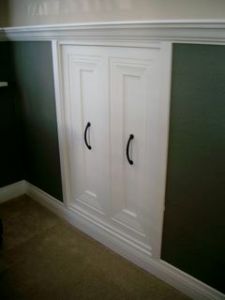 Colored stacking rings, the Connect Four game, wooden puzzles, rubber duckies, and even a football has inspired a book idea! And sometimes, it’s not even a toy at all. Random objects will inspire me. My husband’s toolbox, kitchen utensils, scrap fabric, a greeting card, and even a funny jack-o-lantern on Halloween! I can’t get away from ideas creeping into my head because I’m surrounded by objects. Needless to say, I develop a ton of ideas every year. About a dozen are usually good enough to publish. And the others crawl back into my deep, dark dummy closet of doom. (See photo!)
 My books are concept- and format-driven, so I’m not looking for story ideas. I look for fun concepts that allow a child to interact in a meaningful way from the physical design of the book. Rock & Roll COLORS is an excellent example. The book has a hidden track within each narrow page that allow a shiny disk to roll back and forth when the book is tilted. It makes a nice, satisfying clunking sound when the disk hits the edge. Each side of the page has an image with die-cuts, so the foil comes shining through. Each spread focuses on one color, and both images on the page are that same color. It’s so simple, but effective!
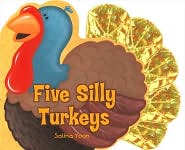 So how does this help you if you’re not developing novelty books? I say keep an open mind! Even simple objects can inspire, if you let them. For the PiBoIdMo challenge, all you need are concepts.
Surrender to your imagination! I don’t actively try to create ideas as much as allowing ideas to come into my head. Allow your mind to be free! Relax. Smile. Enjoy the process. Like the Chinese finger trap, the harder you pull, the stronger it resists. Don’t stress too much about trying to think up great ideas. When they come a-knockin’, just invite them in!
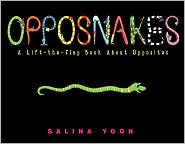 Salina Yoon is the creator of over 150 innovative books for young children. She has been named a finalist for the CBC’s Children’s Choice Book Awards for K-2nd Best Book of the Year, for Opposnakes (S&S/Little Simon), received the Oppenheim Toy Portfolio Gold Seal awards for Little Scholastic TOYS (Scholastic/Cartwheel) and Rock & Roll COLORS (Scholastic/Cartwheel), and the Nick Jr. Family Magazine Best Book of the Year award for My First Menorah (S&S). An author search on B&N, Amazon or IndieBound is the best way to track Salina’s books down. There are lots and lots of new titles releasing soon! (And Salina promises to have an updated website in Spring, 2011.)
Today’s inspiration from author-illustrator Adam F. Watkins is purely visual. You figure out the story—and you can also win this signed illustration. Just leave a comment! A winner will be randomly selected one week from today.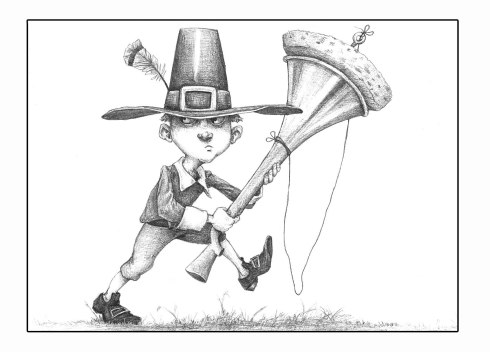 Adam lives in southern Ohio with his wife Amy and daughter Lucy. He graduated from the Columbus College of Art and Design in 2004, where he majored in illustration. He studied under C.F. Payne his junior and senior years. He worked for an advertising agency in Cincinnati after graduation and is now a full-time freelancer. He loves children’s books and the outdoors. Adam hopes to one day share his illustrations and stories with kids all over the world.
Some awards he has acquired along the way:
2003 – Society of Illustrators student show
2004 – Best in Show, Art of Illustration Show
2006 – Gold Addy Award





 Writing for Kids (While Raising Them)