You are currently browsing the category archive for the ‘Children’s Books’ category.
 by
by Okay, so I have my picture book idea for today. Yay! But I kind of feel the need to get another one in…to get ahead, you know?
And then I worry if I am following the rules or not. Am I even allowed to think of 30 ideas in ONE day, or is it a MUST that I pace myself and only create one idea per day? And what happens if I get a good idea that’s so amazingly HOT that I must write a draft NOW? Not next month. Not next week. Not tomorrow. NOW.
I MUST DROP EVERYTHING AND FOLLOW THIS IDEA NOW.
And then I realize that PiBoIdMo is not about rules.
Break the rules if you need to. Just break ’em.
 PiBoIdMo is about getting on a first name, maybe even nick-name basis with your muse.
(And really, some of the best children’s books don’t really follow the rules, now do they?)
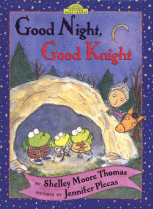
I mean, some books have amazing vocabulary for being an easy reader. (Uh-hum….mine for example.) I put in the word “Methinks” in my easy reader series, Good Night, Good Knight. And I got to keep it in! I also put in some words that may or may not be real words, but they sounded so nice together and were words that are fun when they dance on your tongue.
Really, there is only one rule when writing a book for kids. It’s got to encourage the reader to TURN THE PAGE. It’s got to engage the child in the story enough that they WANT to learn to read it themselves.
(Well, maybe there are two rules…*Get Kids to Turn the Page* and *Inspire Kids to Read.*)
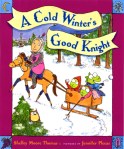 Shelley Moore Thomas is also known as the StoryQueen. I know what you’re thinking…does she really wear a ridiculous crown, fake jewels and a velvet cape? Does she really play with puppets? Well, er um…yes…and yes. But wait! Don’t go! It’s not as strange as it sounds. She’s a writer for children and, well, we do weird things sometimes. Her latest book is A Cold Winter’s Good Night.
It’s not always about the cute bunnies.

I’ve been drawing a lot of bunnies lately. Well, actually one bunny in particular.
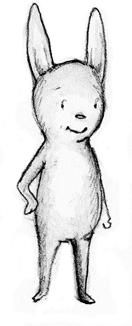 He is very persistent and keeps showing up when I’m doodling, waiting for his chance to star in a story. He is not what I am supposed to be drawing right now. I am supposed to be drawing chickens and mice and Christmas trees as well as coming up with a brilliant picture book idea everyday, none of which have had anything to do with bunnies so far. But he keeps showing up, begging for attention like a puppy who wants to go for a walk.
I have nothing against him, I think he is kind of cute. It’s just that I have no time right now for cute little bunnies. I really need to be working on these other things, before I can pay any attention to him.

So I am just trying to ignore him. And the more that I try to ignore him, the more I find myself thinking about him. Where did he COME from? Why does he keep BOTHERING me? What does he WANT? What does he NEED? WHO is this BUNNY?
Ideas are funny things. Sometimes it seems that you will never have another good idea again no matter how hard you try. Sometimes you need to wheedle an idea out of a germ of a thought. And sometimes they just burst through the door and kick you in the head. Who knows which ideas will grow into a full fledged story and which ones will just fizzle away. The best that you can do is listen to them, push them if they need it and give them a chance to shine.

I don’t know yet who this bunny is or if he will ever grow into his own story. All I know is that he’s been bugging me and pretty soon I am going to have to do something about it. The other characters are starting to complain.

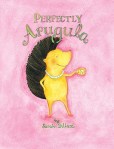
 Sarah Dillard is an award-winning author/illustrator. Her latest book is Perfectly Arugula.
You can win Sarah’s signed illustration of Bunny and Mouse above! Leave a comment to enter. (One entry per person.) A winner will be randomly selected one week from today. Good luck!
 by
by I don’t know about you, but I’m a little weird. I like to make up words and twist them around, and call things and people by funny names. Sometimes this amuses other people, and it always amuses me. That’s one of the keys to storytelling: having fun with words and concepts, and not being afraid to put in your own little bit of wackiness.
Now, I love picture books, but when it comes to writing I tend to be a novel person. I write long. So I was a bit surprised when an idea for a picture book popped into my head and demanded to be written. It was inspired by my dog Emma. (Isn’t she cute?)
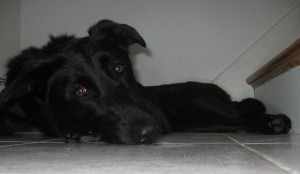 Ever since my husband and I adopted Emma over the summer, it’s become a hobby of mine to come up with silly names for her. Miss Emma Dog. The Furry One. Emmakin Skywalker. She doesn’t seem to mind.
Emma gets very excited when she thinks she’s going for a walk. One morning, when she was trying to speed up the process by whimpering, I told her: “Hold on, Dogosaurus. We’re going.”
As we were on our walk, that word kept bouncing around in my head. Dogosaurus. And when I glanced over at Emma’s shadow, with its long snout and sharp teeth, it didn’t seem that far-fetched that a dog could turn into a dinosaur. And wow, what a whole lot of chaos that would be! Thus the idea was born.
At this point, the manuscript is still in its infancy. It’s gone through some major revisions, and I’m sure it’ll go through several more before it’s anywhere near done. But the initial idea, the initial weirdness, keeps me inspired to continue working on the story.
So as you’re thinking of ideas this month, why not try embracing your weirdness? Maybe there are things you do or say that people roll their eyes at? Use them! Maybe there’s a joke you made up that makes you laugh every single time you tell it? Mine it! The idea might be strange and silly, and it might entertain only you, but you never know where your inner weirdness can take you.
Anna Staniszewski lives near Boston with her husband and their adorably insane black Lab. She’s represented by Ammi-Joan Paquette of the Erin Murphy Literary Agency. Anna’s debut novel, MY UN-FAIRY TALE LIFE, will be published by Sourcebooks Jabberwocky in September 2011. You can visit her at www.annastan.com.
 by
by As adults, it’s easy for us to get entrenched in the necessities of day-to-day living whether it be money, bills, work, deadlines, marketing, dinner, laundry, family time, and the list goes on… I know because I’m guilty. As a TV producer for World Wrestling Entertainment, Inc. for ten years, I was immersed in work, concentrating on my career, traveling around the globe, and trying to hold my own alongside 7 foot, 400 lb. men.
But everything changed when I started to hang around two little guys who weighed less than 30 lbs. After the birth of my two boys, I realized the importance of seeing beauty in the ordinary and opening my eyes to things I hadn’t before. I became curious and observant and enjoyed to watch a caterpillar inch along the sidewalk or the clouds drift along the sky. I gained a renewed sense of humor in gas and poop jokes and rediscovered what fun it can be to blow bubbles in your chocolate milk.
As I began to think like a kid, ideas and creativity flowed in my head like Roaring Rapids at Six Flags. I found all of my inspiration for writing came from my two boys. As a result, I felt an urge to express myself on paper.
 In fact, the idea for my first picture book, The Bug That Plagued the Entire Third Grade, came to me when one of my sons had that dreaded stomach virus that makes its way around a house until it’s hit every family member! When family and friends called to see how he was doing, I would say, “He caught the bug.” It’s something we all say when we’re sick, but it made me stop and wonder why we say that. Something clicked, so I expanded on the play on words of getting sick and catching an insect. Hence… “The Bug” was born.
The idea for my second picture book, Oh the Possibilities, a work-for-hire I wrote for John Hancock’s Back to School campaign, can also be credited to my two boys. John Hancock was looking for a children’s book about that age-old question, “What do I want to be when I grow up?” Everyone always takes the time to tell me how my boys are “all boy.” And they truly are, fascinated by everything from super-heroes to dinosaurs to trucks to dragons. I was thinking about professions and thought, what boy doesn’t dream of being a dragon, right? I built off that, so when my character, Miles, realizes he only has human genes and must decide on something soon, he runs through all the possibilities.
As my writing career was starting to take shape, I discovered one of the most dramatic shifts we can make as picture book writers is to see life through a child’s eyes. After all, who are our readers? Picture books are targeted toward 4 through 8 year olds and the rule of thumb is that children want to read about characters their own age or a bit older. So how do you get inside the head of a five year old? I don’t know about you, but I’m the type of person who can’t remember what happened yesterday, so there’s not much chance of me tapping into my own childhood memories and bringing to the surface what I was feeling when I was five. So the best way for me to identify with my main characters is to hang out with my readers. There’s nothing like picking up a crayon and coloring, blowing bubbles, whizzing down a slide, and running my fingers in a sandbox for inspiration.
Chances are, if we’re writing for children, we like to think of ourselves as young at heart. So as you’re wracking your brain for 30 ideas in 30 days, think of some of the children you come into contact with each day, whether it be your own, nieces and nephews, grandkids, or friends’ kids. However, this time, instead of watching from the sidelines, join the race or purposely plan an outing in the rain so you can stomp in the puddles together. Chances are you might just find inspiration from all the pint-sized fun, and reap the rewards, bigger than you ever imagined.
 Lori Calabrese is an award-winning children’s author. Her first picture book, The Bug That Plagued the Entire Third Grade, was awarded DFP’s Best Children’s Book Award. She writes for various children’s magazines, is the National Children’s Books Examiner at Examiner.com and enjoys sharing her passion for children’s books at festivals, schools and events. Visit her website to learn more: www.loricalabrese.com.
Lori has generously donated a rhyming picture book critique as one of the PiBoIdMo prizes. A random winner will be chosen in early December, from those who have completed the 30-ideas-in-30 days challenge.
 by
by Last year, I participated in PiBoIdMo. At the end of the month, I had about 34 ideas on my list. Participants were writing to Tara with comments like “Oh, I am jumping out of my socks with excitement to get started developing all these FABULOUS ideas into picture books” and “I have 30+ of the best ideas on the planet and I am certain they will be lining the shelves of bookstores by spring.”
I looked at my list. And I thought “Blech.” I don’t have a single good idea. I was irritable. And jealous. Why is everyone else feeling so motivated and inspired, and I am feeling like an utter failure? I even joked on my blog:
While other people have come up with 30 wonderful diverse ideas for PiBoIdMo, I have a list of 30 pathetic variations on the Three Bears theme.
Goldifox and the Three Hares
Tawnylocks, Goldi’s Little Known Twin
Goldi-Rocks and The Three Bear Band
Well, the joke is on me. Because guess what? I ended up selling GOLDI ROCKS AND THE THREE BEARS to Putnam!
So, here is my humble advice. Don’t dismiss any of your ideas.
Finding the perfect idea is like mining. What may not seem at first to be a dazzling gem, may end up being your diamond in the rough. You have to sift carefully through what you’ve collected. Show your list to some trusted people. Even if you don’t win the agent prize, you can still get feedback. Ask a writer friend or critique partner to view your list. Ask your kids! Get a second opinion. And a third.
I may have missed the initial sparkle, but let me tell you… my blog followers did not. They commented in droves “The GOLDI ROCKS one shines.” I was too visually impaired to see it, but they realized it right away and let me know I’d struck gold.
And keep your list going all year. Add to it, when the littlest inkling crosses your mind.
GOLDI ROCKS was idea #28.
You never know when you are going to hit your jackpot.
 Corey Rosen Schwartz is the author of Hop! Plop!, an Eric Carle Museum Picture Book of Distinction. Her next book, THREE NINJA PIGS, is due for release in 2012 (not soon enough in Tara’s opinion). It will be followed by GOLDI ROCKS AND THE THREE BEARS, which would never have been conceived were it not for PiBoIdMo. Corey spends her free time Facebooking all the funny things that come out of her five and six year old’s mouths. (You never know what comment will inspire a PB!)
Corey has generously donated a picture book critique as one of the PiBoIdMo prizes. A random winner will be chosen in early December, from those who have completed the 30-ideas-in-30 days challenge.
Those of us you who were children once upon a time will surely remember how frustrating it was suddenly to have been plunked down in a world where everyone knew more than you did—about everything. Children spend a great deal of time trying to figure things out: where does snow come from? Why can’t dogs talk? What happens next? Or, as we say in our family: “Who ordered the veal cutlet?”*
Kids develop their own little GPS-like subroutines, constantly recalculating to keep themselves on track—but sometimes, inevitably, they get it wrong. Misperceptions and missed information lead to misunderstandings . . . and—I won’t sugar-coat this—little misunderstandings often lead to:
Major Disappointment!
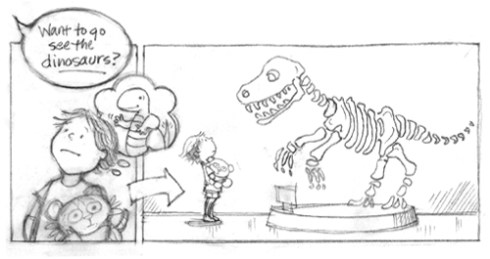 Total Humiliation!
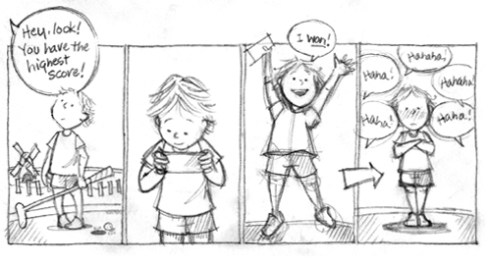 Nightmares!
 (Yeah, I was grown before I figured that one out.)
Thank goodness for picture books!
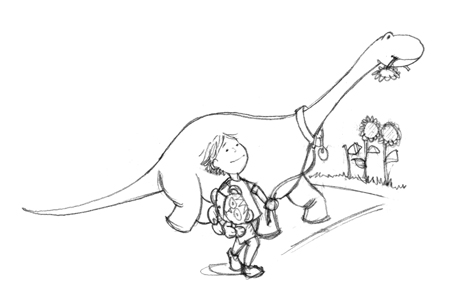
In a picture book, you can check out your own real-live dinosaur any time from the Storybook Lending Zoo.
 You can have the queen invite the golfer with the highest score to the palace for tea, and meet the prince, who is even worse at Goony Golf than you are.
 You can become a super-hero in training, and rid the world of evil, baby-eating furniture.
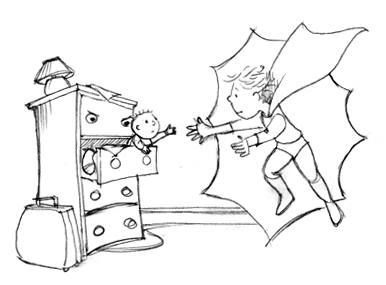 How cool is that? As children’s book writers and illustrators, we get to do this all the time. So, having aired three of my own neuroses . . . er, picture book ideas . . . here is a tip for today: think back to those times in your childhood when things were not quite what you expected them to be—and imagine what it would take to discover a new, old friend . . . or have the last laugh . . . or fly to the rescue.
And then, for the love of heaven, explain to the little person in your life that dinosaurs are really extinct; that, as silly as it sounds, low score wins at Goony Golf; and that, yes, if necessary, a very tiny baby can sleep safely in a dresser drawer . . . but only if you take the drawer OUT of the dresser first!
*A line from Mel Brooks’ Silent Movie . . . um, maybe you had to be there.
 Bonnie Adamson’s latest illustration project is BEDTIME MONSTER (¡A dormir, pequeño monstruo!) by Heather Ayris Burnell, released in September by Raven Tree Press.
Visit Bonnie’s soon-to-be-completely-overhauled website at www.bonnieadamson.net, or hang out with her on Twitter, where she co-hosts #kidlitchat on Tuesday nights and #kidlitart (for children’s book illustrators and friends) every Thursday.
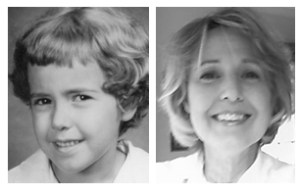 Bonnie then, practicing her skeptical glare; and now—-an older and wiser children’s book illustrator.
Prize Alert! Leave a comment to enter. One randomly-selected winner will choose one of the three picture-book-inspired sketches above for Bonnie to paint in watercolor (Dinosaur, Royalty, Superhero). One entry per person! Winner will be selected one week from today. Good luck!
 by
by A great road trip game is called “No, It Wasn’t.” It’s played with partners. One begins telling a story—any story. The other interrupts as often as desired with, “No, it wasn’t”—or any grammatically-correct contradiction.
It may sound like this:
1: One morning, Jane went for a walk.
2: No, she didn’t.
1: That’s right. It wasn’t a walk. She was running. For exercise.
2: No, it wasn’t.
1: Actually, it was because someone was chasing her. A bad guy.
2: No, it wasn’t.
1: No, it was the police. Jane is the bad guy.
And so on. The challenge to the storyteller is to instantly change direction, as often as they’re prompted. As the story continues, the predictable story lines usually fall away, and the requirement to make changes opens the doors to great creativity. A new story begins to emerge, one that goes in radical new directions. In the example with Jane above, it would’ve originally been a story about her going to visit her friends. In only three twists, Jane is on the run from the police.
This can be a useful brainstorming game for writers too. Maybe you won’t end up writing the story in the direction the game led you, but it does force you to explore more options than Jane simply being out for a walk.
If you’re already working on a premise, write a quick logline for it. In your first sentence, try a “no, it wasn’t,” and see where it leads you.
Or start fresh. Choose a main character, any main character, then give them something to do. And so your game begins.
Need a prompt?
Here it is: When (Main Character) came home that day an old friend was waiting.
No, it wasn’t.
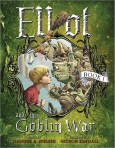 Jennifer A. Nielsen’s debut novel Elliot and the Goblin War was released in October 2010. And it comes with a warning–as of today, only 7 children who have ever read this book have lived to tell about it. If you’re very brave, perhaps you’re willing to take your chance with it.
The next book in the series, Elliot and the Pixie Plot will be released in May 2011. It’s pretty much like the first book, except it has a different plot. Different artwork too. Because that’d be pretty lame if they just used the same art all over again.
 by
by I’ve always been fascinated by the idea of being little. I am a little sister (my sister is five years older than me). Now that we’re adults and friends that difference is pretty much nonexistent, but when we were young, five years was the Grand Canyon. All I wanted to do was spend time with my big sister, doing the things that she got to do. And all she wanted to do was… anything else. I even wrote a story about it in second grade called “It’s Not Fair!”
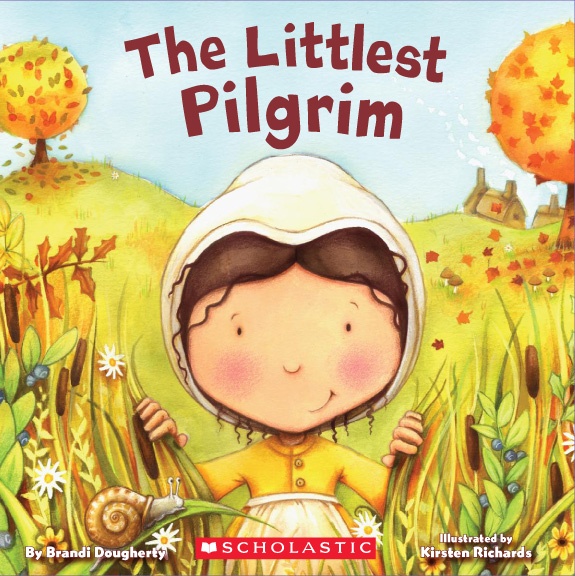 That’s where I got the idea for my first picture book The Littlest Pilgrim. Well, truth be told, the title actually popped into my head during a meeting and I thought it was cute and wanted to write a story around it. But it didn’t take long for me to circle back to my memories about being little. So, I wrote a story about Mini who is the littlest pilgrim in her village and she just wants to help. Everyone tells her she’s too little for all the grown-up chores and duties, so she strikes out on her own and finds something she isn’t too little for: making a friend.
After The Littlest Pilgrim came out and hit the New York Times Best Seller list (you still have to pinch me about that one!), I was thrilled to be able to write another “littlest” book. As I started thinking about holiday themes, a picture of me in my first grade Christmas play popped into my mind.
 I was one of the stars in the night sky (the yellow star in the green skirt, to be exact) leading Mary and Joseph to Bethlehem. I had one line to recite in the play. And I was a very shy kid, so it was kind of terrifying to stand on that big, bright stage and speak my one line. I loved the idea of turning that around and writing about Max (the littlest kid in his class, of course). Max wants nothing more than to be the star of his school Christmas play and have a million lines to recite, but he ends up being the actual star with only one line.
So, as you can see I like to take memories of my own experiences from childhood and turn them slightly to the right or to the left – adjusting the lens a little bit and discovering a different character or story hidden there.
Now it’s your turn. Peruse a class picture from elementary school, dig through that box of handprint turkeys and leaf collages, or just reach back in your mind and find a childhood memory that you can turn to the right or to the left. Who or what is hidden there?
In addition to her two picture books, Brandi Dougherty is the author of three middle grade novels: Miss Fortune (Scholastic, 2010), The Friendship Experiment (Scholastic, 2009), and The Valentine’s Day Disaster (Scholastic, 2008). She worked in publishing in New York for eight years and now resides in San Francisco where she is mom to an adorable and rather spoiled dog. Visit her at www.brandidougherty.com.
 by Karen Collum
We creative types often talk about that moment when inspiration strikes. We get an idea, a phrase, an image, a scent, a sound that somehow switches something on in our brains and before we know it words are churning out faster than electric shocks on a trampoline. The concept of inspiration ‘striking’, however, is misleading. It sounds so passive, so unpredictable, so out of our control.
I’d like you to think about another sort of strike for a moment; a lightning strike. It’s true, lightning can strike people almost anywhere and at anytime, and we often hear amazing tales of the same person being struck more than once, but there are well-known factors that can increase or decrease the likelihood of being struck by lightning. I believe the same applies to the strike of inspiration. Here are a few ways you can increase the likelihood of being struck by inspiration (but please don’t use this advice in a storm as you are quite likely to get struck by lightning and although that might make a great story, it would in fact be terrible!):
1. Stand tall and in the open
Everyone knows that lightning strikes tall objects and the wisest thing to do in a storm is lie low. The opposite is true when waiting for inspiration to strike. Stand out in the open field of life, arms outstretched and reaching for the sky. Stand tall, lift your gaze above what is immediately in front of you and look around. Don’t be afraid to be different. Look at a picture, a scene, a group of people from a different perspective. Ask ‘what if?’ questions. Dare to look beyond what you first see. For me that often means taking a mental step back from the scene and surveying it as an observer. Why is that person frowning? Why is the lady in the car crying? Where is that person in a hurry to get to? Do this often enough and inspiration will surely strike.
2. Have your umbrella up
Umbrellas in a lightning storm are a no-no, especially if yours has a metal tip on the end, but for a writer, having your umbrella up means you are ready and waiting to be struck by inspiration. You are aware of what’s going on around you and that there may just be one tiny thing that will spark your creativity in amongst the mundane. I try to have my umbrella up all the time, consciously searching for things that might be useful. I listen carefully to the conversations that my children have and try to absorb their pattern of speech. I also have a notebook handy at all times so I can capture the strike when it happens. When I’m outside playing with my kids I watch for interesting things in my environment. Just the other day I saw a slow and steady march of butterflies heading to some important but unknown place, one at a time. Inspiration can strike on even the gentlest of wings.
3. Get on the phone
During a lightning storm it’s advisable to stay off the phone as lightning can travel down the phone line and end up quite painfully in your ear. As a writer, however, it’s essential that you connect and network with other creative people. Have conversations about interesting things, bounce ideas off one another, share with trusted creative friends what you’re working on. I don’t believe inspiration happens in a vacuum and by connecting with one another we can create surges of inspiration for all of us.
Don’t just wait for inspiration to strike. Stand tall, have your umbrella up and get on the phone. You might just find those thirty PiBoIdMo ideas flowing faster than you ever thought possible.
 Karen Collum lives in Brisbane, Australia and is a stay-at-home mum to three pre-school boys. She is about to welcome a baby girl to the family in December. She is also a picture book author and co-convenor of the international online picture book chat group, #pblitchat. (You can find details about #pblitchat at http://picturebooksonly.wordpress.com.) Karen’s debut picture book SAMUEL’S KISSES is due for release in late November by New Frontier Publishing. You can follow Karen on Twitter (@KarenCollum) or find more about her and her books on her website http://www.karencollum.com.au.
Venerable LA Times rock critic Robert Hilburn recently penned Corn Flakes with John Lennon and Other Tales from a Rock n’ Roll Life, a revealing memoir-style series of vignettes featuring the great rock icons of the last 50 years.
In the book, Hilburn recounts his seven-piece Times series on the most influential and prolific songwriters of the rock era, which was published earlier this decade. He chose Bob Dylan as his first subject. Hilburn wanted to learn about a songwriter’s creative process: what inspires them, how they begin to lay down the music and lyrics, if success or failure of past work influenced future songs. The interview with Dylan earned Hilburn his third Pulitzer Prize nomination. And, Dylan’s words may give other writers—perhaps even picture book writers—inspiration for their own work:
 “Some things just come to me in dreams,” Dylan told Hilburn. “But I can write a bunch of stuff down after you leave…about say, the way you are dressed. I look at people as ideas. I don’t look at them as people. I’m talking about general observation. Whoever I see, I look at them as an idea…what this person represents. That’s the way I see life. I see life as a utilitarian thing. Then you strip things away until you get to the core of what’s important.”
And picture books are indeed about what’s important; every picture book features an emotional truth, whether it be about family, friendship or fitting in. If you strip away what’s on the surface—the pirates or the penguins or the princesses—what remains is a story about the human experience.
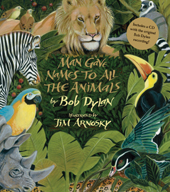
Noted illustrator Jim Arnosky found inspiration in Dylan’s music. “From the first time I heard [Man Gave Names to All the Animals], the lyrics created pictures in my mind of a land of primeval beauty,” said Arnosky. Dylan gave his permission to create a picture book, and the work was released by Sterling in September.
So that’s your inspirational thought for the day. Well, two inspirational thoughts! People and songs.
What do other people’s actions say to you? How do those actions translate to story? What music boosts your creativity?
And don’t forget, there’s much more inspiration to come when PiBoIdMo begins in November. Consider this a warm up, or as Dylan might say, a sound check.





 Writing for Kids (While Raising Them)