You are currently browsing the category archive for the ‘Author Interview’ category.
Picture Book Confessional
by Jacqui Robbins
Here is a confession: I have problems. And I want you to have them too.
I know it’s PiBoIdMo. But I don’t get ideas, really. I get problems, and characters that have them.
It starts with a voice whispering. Usually it’s one line.
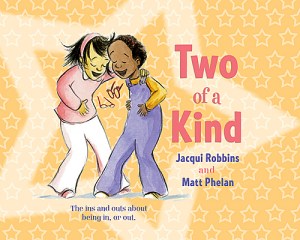 “Kayla and Melanie are two of a kind.”
There’s a rhythm in the line and it gets stuck in my head. I try to ignore the voice, but it chases me around. It talks at me while I drive, when I run, when I’m on my fiftieth game of Sorry with my son. I hear the voice, and I start to fall in love with the character behind it. “Who is this poor girl who wants so badly to be the third in the two of a kind?”
Well, once I’m in love with my character, I can’t just leave her there, stuck in her problem. I have to write her out of it.
“What can she do?” I ask myself. And the book is born.
You’ve been thinking of picture book ideas all month. If you’re anything like me, you’ve used up your “been saving this one a while” ideas. You’ve gone through your “Hmm, that might be good” ideas and are starting in on your “well, it’s something, I guess” ideas. By next week, you’ll be on your “please, lord, don’t let anyone read this even if I’m dead I’ll be so embarrassed” ideas.
So today, try this. Start with a character.
Who is he? Where does he spend most of his time? What does he think about? What does his voice sound like in your head?
Now, what does he love more than anything else in the world?
Well, he can’t have it.
Why?
Ooh, now he has a problem. Poor guy. You can’t just leave him there. There’s only one thing to do.
Write him out of it.
 Jacqui Robbins has filed resumes, sold books, written grants, worked the grill at a snack bar, and taught students from ages 6 months to 65 years.
Jacqui’s first book, The New Girl…And Me was published in June, 2006 (illustrated by Matt Phelan, Atheneum/Richard Jackson Books). Jacqui’s next book, Two of a Kind, came out in July, 2009 (also illustrated by Matt Phelan, Atheneum).
“The value of an idea lies in the using of it.” – Thomas Alva Edison
“In my experience, there’s no such thing as luck.” – Ben Kenobi
Happy Friday the Thirteenth and happy Picture Book Idea Month! My name is Ryan Hipp, I am an author-illustrator of picture books and today’s guest writer for Tara’s blog.
Black cats crossing your path, 13’s abounding, broken mirrors shattering, and walking under ladders are dangerous portents. To an author, these omens cannot compare to the terror of writer’s block! Today I will present the two most important words in picture book publishing: Ideas and luck…and I’ll share why I feel both of those words are meaningless superstitions.
Really.
Let’s start with IDEAS.
When people enjoy a book, they often say, “what a great idea.” As someone who makes books for kids, I often get asked, “where do you get your ideas?”
I answer, “Finding ideas is not the challenge for me. The challenge is knowing what idea is the one to build on.” (Tara’s note: see the PiBoIdMo grand prize announcement.)
I don’t know why I have come to this conclusion, but I never understood why so many people focus on the “idea” as being so critical to a successful book. I have exactly 47 great ideas and even more acceptably average ones; more than enough ideas to feed my family for the next 60 years. Unfortunately, before you can spend ideas, you have to invest them––and the exchange rate in the publishing world is blood, sweat, and tears.
Sometimes people want to share with me that they also, “have a great idea for a book.”
Similarly, I am not impressed with people with ideas. Never. Ideas are cheap. They come too easily to all of us. The truth is, there is not a shortage on ideas. Everyone has ideas. Everyone. I am more impressed with something more rare and valuable than an idea: perseverance, practice, dedication, commitment, hard work, and patience. The best idea in the world is a moot point until you start climbing that mountain and joining the other hard workers on the summit.
I don’t want to discount the importance of ideas. Every good book starts with a good idea; but they are just building blocks, not a castle. So my advice is to keep dreaming, and keep generating ideas; but don’t forget the more important step: bring those ideas to life.
Now let’s move on to LUCK.
“Luck is simply how something is explained after it has happened. It isn’t real,” says editor Tim Travaglini.
Your car breaking down is not bad luck. Finding a silver dollar on the ground is not good luck. These events are simply the eventuality of your radiator overheating and someone else having a hole in their pocket. It is that simple. Things happen.
I sometimes hear authors and illustrators humbly say, “I was in the right place at the right time,” when answering questions about their “good luck” in the world of publishing. Needless to say, talent and work may have played a more significant part. To get a picture book deal, good luck is not real. Bad luck is not real. Perseverance, practice, dedication, commitment, hard work, and patience are real.
So on this day filled with luck in this month filled with ideas, I ask of you: keep building, keep working, and have an unlucky Friday the Thirteenth!
 Ryan Hipp is a published author-illustrator of picture books who lives in Grand Rapids, MI. His style is whimsical and obtainable for all ages. Another big part of Ryan’s career is giving presentations: Ryan has developed seminars for teachers, parents, and students––to get kids excited about creativity and to help adults facilitate creativity in kids, too.
(Ryan created the PiBoIdMo logos, so let’s hear a Hipp-Hipp Hooray!)
This week author/illustrator Carin Berger visited our public library with her box of tricks: thousands of pieces of cut paper in wavy, curvy shapes. Children grabbed the pieces—cut from catalogs, magazines, newspapers and ephemera—and arranged them on black construction paper to create animals, rain forests, people, trains, robots…just like Ms. Berger does in her books. She’s a collage artist—quite possibly the world’s most delightful vocation.
Did Ms. Berger always know she wanted to be an author/illustrator? Not necessarily, although she was always interested in telling a story through images.
Carin shared with us a book she created when she was 10 years old, called The Naughty Jester. Already she was using cut paper to help tell her tale, and her talent is apparent, even at this young age.


Carin didn’t start writing children’s books until she had a child of her own. When her infant daughter didn’t sleep well, she stayed up in the wee hours writing silly poetry, illustrating her words with collage. Turns out the notion wasn’t so silly and the sleepy little project became her first book, Not So True Stories and Unreasonable Rhymes.
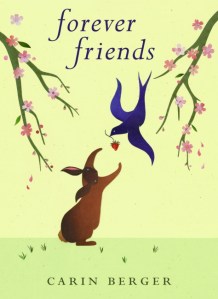 Ms. Berger told us secrets. If you look at the items the naughty jester is juggling, you’ll find those same images repeated in her books. The blue bird is one of the main characters in her Spring 2010 title Forever Friends. And her daughter’s name Thea appears in every book. You have to look hard to find it.
So today’s idea tip is to walk over to that pile of junk mail on your kitchen counter (come on, you know it’s there) and start cutting. Take an interesting pattern, perhaps from a clothing catalog, and cut a fancy little shape. Not just a circle or square, but perhaps a swirl like a wisp of a cloud on a windy day. When you’ve collected enough shapes, put them down on a piece of paper and shuffle them around. Overlap them or spread them out.
What did you make? Is it a character? A place? A strange object that needs a function? What does it do and why? What could appear in the negative space?
Now, if you’ll excuse me, I’m busy with scissors and glue.
So how’s it going today?
Reach for a Memory
by Nan Marino
When it comes to writing, there are good and bad days. On a good day, you’ve got tons of ideas. Words flow. The sun shines. Everything is easy. But there are times when idea spigot gets a little clogged. Don’t worry. It happens to everyone.
On days when I’m looking for the mental equivalent of bottle of liquid Drano, I reach back to my childhood memories. First I think of a particular moment and try to recall the feelings surrounding it. Then I write. When I’m done, I move things around, alter it a little (or a lot), and turn it into fiction.
My debut middle grade novel, Neil Armstrong is My Uncle and Other Lies Muscle Man McGinty Told Me, is filled with altered memories. When I was about ten, a boy who lived on my street challenged the entire block to a game of kickball. All of us against one kid! In real life after about five minutes, we got bored watching him chase after the ball, and we moved onto something else. In my book, that game stretches out for an entire week.
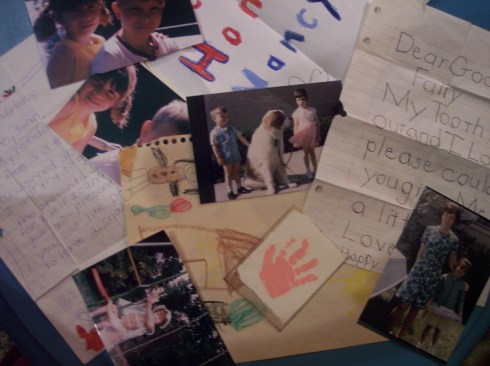
Childhood memories make great writing prompts. Below are more memories I incorporated into my book. Feel free to write about any of them to get your creative juices flowing:
The Ice Cream Truck: When 4th or 5th graders send me drawings of scenes from my book, someone always draws the ice cream truck scene. Everyone connects with Mr. Softee. It’s an iconic symbol of summer. Remember waiting for the ice cream truck to come around? Did you have a favorite flavor ice cream?
Kickball, baseball, handball: Did you play? Were you one of those kids who took it seriously or did you sit on the sidelines?
Barbeques: I like barbeques because they happen over and over again. We eat the same kind of food and gather together with the same group of family or friends. It creates that feeling of endless summer days. What happened at your barbeques? Did you have an uncle who made great cherry pies? Was there a neighbor who sang a special song?
Dandelions: Nothing separates adults and children more than their feelings about dandelions. It’s the first flower you probably picked, and the first one you gave to someone you loved. I dare you to find one person under the age of ten who thinks it makes perfectly good sense to spend your precious weekend hours trying to eradicate them from your front lawn.
Songs and Dances: Madonna or Nirvana? Springsteen or Sinatra? A single song can take you back to that day when you were seven… Need more inspiration? Download it and dance!
Historical events: What happened when you were young? Do you remember the first time a man walked on the moon, the bicentennial, the assassination of John Lennon, the Berlin Wall coming down, the first Gulf War, the Y2K scare? From a child’s eyes, these events are seen differently.
Your secret place: Was it up in a tree? Behind the couch? Or up on the garage roof?
Remembering ordinary moments from your childhood is a great way to begin writing. Next time you need some inspiration for your fiction, reach for a memory.
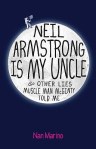 Nan Marino spent her childhood climbing trees and hanging out on garage roofs in the town of Massapequa Park, New York. Since then, she’s ventured a hundred miles south to the Jersey shore where she works as a librarian and lives with her husband and their dog. Neil Armstrong Is My Uncle and Other Lies Muscle Man McGinty Told Me, published by Roaring Brook Press (May 2009), is her first novel.
Waiting for the Big Idea? Don’t!
by Ruth Spiro
 What do a macramé owl, Celia Chompers, and a town called Fate have in common? Nothing, really, except that they’re all written in my little green notebook.
I’ve always been amused by that iconic light bulb that appears above a cartoon character’s head to symbolize a bright idea; too bad it doesn’t actually happen in real life. (Although, it may be a good thing––imagine the effect on global warming…) When I first started writing, I often sat at my desk, waiting for that moment to occur––the Big Idea. When I tired of waiting, I did something else: Walked the dog, read the newspaper, baked some cookies. I soon noticed it was at those times that “ideas” began to appear.
I’d write these “ideas” on scraps of paper and throw them into my purse. Later, I might find them while digging for the dry cleaning ticket; sometimes, the scraps ended up being used for bubble gum disposal. I needed a notebook.
 Every writer should have a notebook. Not one of those fancy, leather-bound ones. You know, the kind that’s so nice, you hate to mess it up by writing in it? No, I recommend the little spiral ones that usually sell for 39¢. And, they’re easy to find in your purse, because the end of the spiral wire is always sticking out, just waiting to jab you. Perfect.
You may be wondering why I’ve put the word “idea” in quotes. (See? Like that.) It’s because the things I write in my notebook are actually “details.” (There, I did it again.) They’re observations, snippets of conversation, or even cool names I notice in the obituaries, like Celia Chompers. (By the way, if any of her relatives are reading this, I’m sorry for your loss.) They don’t have to be full-blown ideas, just the potential for an idea. Takes some of the pressure off, doesn’t it?
Don’t wait around for your Big Idea. Take a walk, buy a notebook and start collecting details. Put them together, take them apart, pick one and just start writing. Oh, and feel free to use the macramé owl. It’s been hanging around for a very long time.
Got any details you’d like to recycle?
Let’s have a Detail Swap.
Leave a detail as a comment below.
Leave a penny, take a penny. You know how that goes.
Ruth Spiro is the author of the award-winning picture book, Lester Fizz, Bubble-Gum Artist. (Reviewed on this blog.) It’s the story of a boy who feels he doesn’t fit in with his family of artists, until he discovers his own unique talent in an unexpected medium––bubble gum! Her articles and essays have appeared in The Writer, FamilyFun, Child, and Chicago Parent, and her stories have also been published in popular anthologies, notably The Right Words at the Right Time, Volume 2, edited by Marlo Thomas, and several Chicken Soup for the Soul titles.
A frequent speaker at schools and conferences, Ruth may be contacted through her web site at www.ruthspiro.com.
What Tara Doesn’t Know…
by Karma Wilson
 Shhh…don’t tell Tara, but she’s become one of my biggest inspirations. More specifically, her alphabetical list of 365+ Things Kids Like has become one of my biggest inspirations. In fact, I never would have guessed that a blog entry could become so central to my writing process.
Whenever I sit down to write children’s poetry I have two websites up at all times. One is a rhyming dictionary and the other is Tara’s list.
I scroll down the list and I try to come up with one poem for each item.
For me, when writing poetry, it is often the basic idea that eludes me. Sometimes all I need is a word or a thought and WALA, presto-chango, alakazam—a poem finally makes its way into my befuddled brain matter! I used to ask my kids, “What should I write a poem about?” But now, instead of harassing my “couldn’t care less” tweens and teens I just click open Tara’s list.
Here’s an example of a poem inspired by the first entry…acrobat.
AcroBat
He flies through the air
With greatest of ease
He flies and he doesn’t
need a trapeze!
He dips and darts
through the darkest of night
he doesn’t needs nets
and he doesn’t need lights.
He hangs upside down
for hours, no less.
Who is this gymnast?
Who? Can you guess?
He sees with his sonar
imagine that!
The amazing, stupendous,
Acro Bat!
So, if you’re just desperately thirsty for an idea I’ve found Tara’s list a wellspring of inspiration.
Karma Wilson is the author of more than 20 popular picture books, including Bear Snores On, Baby Cakes, A Frog in the Bog and a new volume of poetry called What’s the Weather Inside?
Karma is generously giving away one of her books as part of PiBoIdMo! (Your choice: Don’t Be Afraid, Little Pip or Mama Always Comes Home.) Please leave a comment to be entered in the drawing. A winner will be randomly picked at the conclusion of our month-long idea extravaganza. Good luck!
So how’s it going today?
THE IDEA BOX
by Susan Taylor Brown
I’m a collector. I can’t go on a walk without finding something I have to pick up and take home with me for my idea box. A stick. A rock. A broken toy. I also have a hard time throwing things away so an item headed for Goodwill might find its way into my idea box. It’s a great way to jumpstart my tired brain. Whenever I find something new or old or interesting, I toss it in the box.

Does something in my idea box jump out at you?
What kind of creature has a purple feather? What would a little kid be carrying around in that black jewelry box? Does that green silk scarf belong to a magician? What would those sunglasses be if they weren’t normal sunglasses? Who lost their yo-yo?
By asking myself questions about things in my prop box I can get my writing motor revved up again.
Whose black gloves are these?
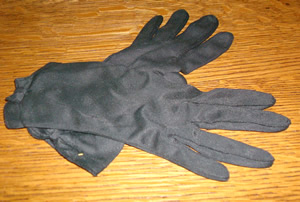
What kid is trying to solve the case of his grandmother’s missing brooch?

I know this is all about PiBoIdMo 2009 and I know you haven’t had a chance to build an idea box of your own yet. But wait. You probably already DO have one. Or even two. If you have a junk drawer where you toss items that don’t have a home, you have a good start on an idea box. Here’s my junk drawer.

Your turn. Go open any drawer in your house right now, junk or otherwise, grab something out of it and then write about it as though it were something entirely different.
What if the box of matches was really a bed for teeny tiny fairies?
What if the string was a rope to help a princess escape from the castle.
What if the ribbon was a rare snake that had been stolen from the zoo?
That’s all it takes. An ordinary object and a question, “What if?”
You get the idea.
Susan Taylor Brown is the author of all sorts of things including:
Hugging the Rock, Verse Novel (Tricycle, 2006)
Oliver’s Must-do List, Picture Book (Boyds Mills Press, 2005)
Robert Smalls Sails to Freedom, Easy Reader (Millbrook, 2006)
Can I Pray With My Eyes Open? Picture Book (Hyperion, 1999)
Enrique Esparza, Boy at the Alamo, Picture Book (Millbrook, forthcoming)
My #1 tip for PiBoIdMo 2009? Celebrate the Weird Stuff in life. It’s good material for stories.
 Late one evening a weird thing happened to me. After my husband and I tucked our kids in, we heard an unexpected knock at the door. I opened it and found a kid standing on my front porch. He was selling newspaper subscriptions in an effort to go to…Cowboy Camp. I looked at this kid with his everywhere hair and thick glasses and uncowboy-like everything and knew I had a story.
Another weird thing happened a few summers ago. I was visiting my sister who, at the time, lived in a gorgeous area outside of Plymouth, Massachusetts. I loved every bit of the trip—except for my early morning wake-up call.
Each day the sun would come up around 4:30AM and the rooster who lived on the nearby farm would let me know it. Each morning my dislike for that rooster grew. And grew. I got to hoping that bird was missing out on a lot of barnyard fun since he had to make sure he was ready to greet the early morning sun in such a loud and enthusiastic way.
Sooo…since I was up anyway…I started brainstorming. What did that rooster miss out on? What had the other animals been up to when he was catching his zzzzzs? Then I knew—a barnyard talent show.
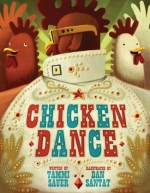 The joke’s on me, though. In Chicken Dance the rooster didn’t sleep through the talent show after all. Instead, he ends up being one of the stars of the story as everyone who partakes in the competition is out for the grand prize—tickets to see Elvis Poultry in Concert: The Final Doodle-Doo.
Not all of my ideas show up at my door or wake me up at 4:30 in the morning. How I wish that were the case! But many of them do begin with Weird Stuff.
Today I want you to brainstorm some of the weird things in your life.
Do you live with a Giant Madagascar Hissing Cockroach? Do you come from an enormous family? Did you grow up on a pig farm? Have you had a strange run-in with a squirrel? With a rhino?
Go on. You know you’re weird, too. Get some paper and let’s celebrate it.
Tammi Sauer is the author of seven picture books (and counting). You can find her online at www.tammisauer.com and www.elvispoultrybooks.com.
Tammi’s Picture Books:
Cowboy Camp (Sterling, 2005)
Chicken Dance (Sterling, 2009)
Mostly Monsterly (S&S, 2010)
Mr. Duck Means Business (S&S, forthcoming)
Princess-in-Training (Houghton Mifflin Harcourt, forthcoming)
Oh, Nuts! (Bloomsbury, forthcoming)
Bawk and Roll (Sterling, forthcoming)
BUGS MAKE IT BIG IN GRAPHIC NOVELS…HERE’S HOW
by Aaaron Reynolds & Neil Numberman
(Interior. Aaron Reynolds, a writer of children’s books and graphic novels, is sitting at his writing desk. He’s typing, but suddenly stops when a shadow falls over his screen. It’s a kid, about ten or eleven.)
Aaron: (looking up) Hey.
Kid: Hey. Whatcha doin’?
Aaron: Um…writing. Who are you? What are you doing in my writing room?
Kid: I’m just some random kid.
Aaron: Ah. A random kid in my writing room. Okay.
Kid: Yeah. Act like I’m not here. (pause…Aaron starts to get back to work, but is interrupted) Aren’t you an author?
Aaron: (turning back around) Ignore you, huh? That’s gonna be tricky. Yeah. I write kid’s books and graphic novels.
Kid: Graphic novels? Like comic books?
Aaron: Kinda.
Kid: Whatcha writing now?
Aaron: An article about how a graphic novel gets made, but I wanted to write it LIKE a graphic novel, so that’s what I’m doing.
Kid: But…there’s no pictures. A graphic novel has lots of pictures.
Aaron: Not at first. Not mine anyway.
Kid: What?
Aaron: Seriously. I don’t draw.
Kid: I must have the wrong house then. I thought the dude that lives here makes graphic novels.
Aaron: I do. But I don’t draw them….I write them.
(Kid pauses while he thinks about this, then…)
Kid: That’s messed up.
Aaron: No, it’s not.
Kid: You can’t make a graphic novel without being able to draw.
Aaron: Well, I do. Like my new graphic novel…it’s called Joey Fly, Private Eye…
Kid: Way to work that in there. Nice plug. Smooth.
Aaron: Yeah, thanks. Well, Joey Fly starts out like this. A script, just like this one.
Kid: Just the stuff people say?
Aaron: Mostly. I also write in what I see happening in each scene.
(Kid flops into a big cushy chair and puts his feet on Aaron’s writing desk, makes himself at home. He looks at Aaron like he’s lost his mind.)
Aaron: See? Like that. It’s called “stage directions.”
Kid: Oh cool! Like actions and stuff!
Aaron: Yeah, exactly.
Kid: Do it again.
(Kid gets up, kind of excited now. He’s putting it all together in his head, but then he notices a fresh sandwich on Aaron’s desk. Goes over, lifts the bread…he’s kinda hungry…but decides he doesn’t like tuna. Flops back down in the chair.)
Kid: Hey, that’s awesome how you made me do all that stuff! And I do hate tuna.
Aaron: It’s a script. In the graphic novel, I write the story. I come up with the characters. In Joey Fly, Private Eye, I create what happens, what characters are in it, all that stuff. Then I put it into a story…a script like this.
Kid: But it’s not a graphic novel. No pictures.
Aaron: Not yet. It will be soon. But first, I break it into panels.
Kid: Panels?
Panel
Aaron: Like this. Chunks. How I imagine it will get broken into boxes in the finished graphic novel. This helps me figure out the flow and pacing of the story, helps me cut extra junk that’s not needed, and helps the illustrator figure out how he’s gonna lay out the pictures on the page.
Panel
Kid: Cool. I notice you use lots of words like “gonna” and “whatcha” and stuff. My Language Arts teacher would go nuts on you for that.
Panel
Aaron: Yeah, well… I try to write how people really talk. I think that’s important, especially for a graphic novel. It all depends on the character. Like, Joey Fly says some gonnas, but he also uses lots of detective-y phrases…
Panel
Joey: Life in the bug city. It ain’t easy. Crime sticks to this city like a one-winged fly on a fifty-cent swatter.
Panel
Aaron: Like that. That’s his opening line in the book.
Kid: Okay, that’s pretty funny.
Panel
Aaron: Well, I try.
Panel
Kid: But it’s still not a graphic novel.
Panel
Aaron: Man, for a random kid who shows up in my writing room, you’re seriously pushy.
Panel
Kid: Do you know many eleven-year-olds? We’re all like this.
Aaron: That’s right. Not being one, I forget sometimes.
Panel
Aaron: Well, now that it’s all broken into panels, I give it to my publisher. And once she’s happy with it, she sends it off to the illustrator and he starts drawing.
Panel
Kid: You tell him what to draw?
Aaron: No.
Panel
Kid: You tell him what the characters should look like?
Aaron: No.
Panel
Kid: What do you tell him?
Aaron: Nothing. Most of the time, we never even meet.
Panel
(pause…the kid’s mouth is hanging open.)
Panel
Kid: That is seriously messed up.
Panel
Aaron: That’s how it works. Unless you are the writer and the illustrator (which I’m not…I don’t draw, remember?), that’s how it works.
Panel
Kid: So what happens then?
Aaron: The illustrator looks at it and begins to sketch out what he thinks the characters look like.
Panel
Aaron: Like, for Joey Fly, Private Eye, the illustrator is a guy named Neil Numberman.
Panel
Neil: Hey kid. What’s up? Hey Aaron.
Panel
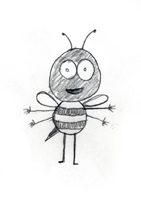
Aaron: Hey Neil. So, Neil might decide after reading this script that you look like this:
Panel
Kid: That’s me?
Neil: Yep.
Panel
Kid: You made me a bug!
Neil: Well, we’re talking about Joey Fly, Private Eye, so I’m thinking in bugs. It’s my job to use my imagination, to come up with my ideas of what Aaron’s characters and story look like.
Panel
Kid: Cool.
Panel
Neil: And as I start drawing and figuring out what it all looks like, Aaron’s story moves away from being a script and I start creating real characters…

Neil: …and pretty soon, I take Aaron’s written words and begin to put them into the mouths of the characters I’ve created.


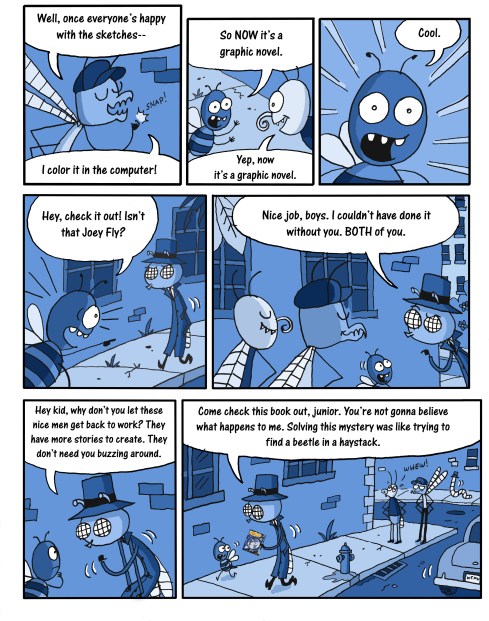
Aaron Reynolds is a human, not a bug, but he often writes about bugs. He is the author of Chicks and Salsa, Superhero School, Buffalo Wings, and, of course, the Joey Fly, Private Eye graphic novels.
Neil Numberman is a termite currently residing in New York City. Joey Fly, Private Eye is his first graphic novel, but he is also the author/illustrator of the picture book Do NOT Build a Frankenstein.

So there you are, folks. That’s how to make a graphic novel. Thanks, Aaron & Neil. (And Joey & Sammy, too.)
PiBoIdMo’ers, maybe you’d like to approach your next picture book idea in graphic terms. Your story doesn’t have to be a novel to fit the format. Author/illustrator Sarah Dillard penned Perfectly Arugula in this style, with perfect results.
So, how’s it going today?
It’s Day 2 of PiBoIdMo. I hope you already have idea one down with more brewing. So go grab your coffee (and spoon) and sit down for the next piece of juicy inspiration.
(Yeah, today I’m making you sit down. Tomorrow I might make you jump up and run outside again. Ya never know. This month is gonna be crazy. Crazy like a Fox in Socks!)
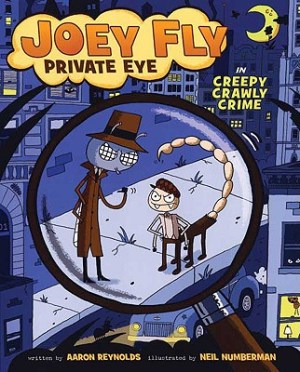 Today author Aaron Reynolds and illustrator Neil Numberman are stopping by to talk about their new book Joey Fly Private Eye (in Creepy Crawly Crime).
And since it’s Day 2, I’ve even got 2 blog posts for you!
First, I asked Aaron and Neil where the idea for Joey Fly originated and how it developed.
Aaron: It started for me with just a title…which was, at the time, Joey Off, Private Fly (get it, Off? Off bug spray?…get it?) Anyway, I loved the idea of a goofy mystery, having grown up with a steady diet of Scooby Doo and movies like Clue (and I’m a huge Agatha Christie fan). Bugs seemed the perfect cast of characters…all freaky and different, each with their own personalities and weird physical traits. From there, the story just took off.
See that, folks? The idea started with just a title.
Neil: When I first got Aaron’s script, I started buying all the film noir movies I could get my hands on, and creepy insect books from dusty old bookstores. That, and a couple books on city architecture in the 40s, and I felt good to go! I had my arsenal of bug characters and buildings to fill the street scenes, and noir-esque shots to compose many of the panels. I knew I wanted some Martin Handford (he of Where’s Waldo fame) type shots in there, too, because his books were always the greatest to sit and stare at for hours, and I want to bring that to Bug City.
OK, let me get this straight. Old movies and dusty books?
Eureka, picture book writers! Run to your local thrift store! (Sorry, I’m making you jump up today anyway. I told you things might get crazy!)
Got your idea yet? Well stay tuned, kidlit lovers. Aaron and Neil will be back later today with a graphic novel about how to create a graphic novel.





 Writing for Kids (While Raising Them)