You are currently browsing Tara Lazar’s articles.
by Leigh Anne Carter
Hello Storystormers! Today we’re going to dig deep and ask ourselves: What am I not ready for?
Get really honest! It could be something inevitable that you’re dreading. It could be something you keep putting off. Whatever it is, sit with it and write or sketch your thoughts. Whenever I’ve taken time to think about a truth that comes from inside myself, I can usually find a story I want to tell.
Maybe it’s small: a toothpaste spot on the bathroom mirror that needs to be cleaned. Is it serious? A work presentation or a close friend is moving away. You could be feeling annoyed, overwhelmed, nervous, or unprepared. Use that emotion to fuel your brainstorming.
Now how could that be worked into a story that a kid can relate to? Housework turns into chores or homework. Presentations turn into show and tell. Friends can move during all stages of life. You decide on tone. It can be punny, serious, inspirational—whatever works!

YETI IS NOT READY FOR SCHOOL is my debut picture book and it began from a Storystorm idea. But it boiled down to what my kidself struggled with. A memory from my first day of kindergarten began with me nervous to go in the classroom. But once I saw a friend, I was ready to go inside and enjoy what felt impossible. How could I turn that into a story that would inspire and be marketable? I have always loved stories about ghosts and monsters, so it felt right that I should write about a yeti who was not ready for her first day of school. After lots of revision and hard work, Yeti is now coming to a bookstore near you this summer!
Because I love seeing examples, here are even more picture books to give you different ideas on how you can work “readiness” into a story.

A perfect example: DON’T WASH WINSTON (Ashley Belote) shows a boy who goes to great lengths to prevent his teddy bear from a trip inside the scary washing machine. It’s not until a certain turn of events that he realizes Winston might feel better after a bath. A self-realized journey to being ready!

Try flipping it around: A character is ready. In THE LONGEST LETSGOBOY (Derick Wilder and Cátia Chien), a family pet knows his time is near. Told from the dog’s perspective on his last walk with his Little, he makes sure she will be okay after he is gone. He knows he is ready for the next part of his journey and the reader is gifted with a beautiful, bittersweet conclusion.

Maybe it’s a small part of your story: ALL THE GREATNESS IN YOU (Tameka Fryer Brown and Alleanna Harris) celebrates a child from their family’s voice. They share things that make him great, but one spread advises sometimes he might feel like he’s not ready to face certain obstacles. It ends on encouragement: “Tomorrow, should life make you doubt or forget who you are, or fear something new…Remember your can-do! Depend on that bounce-back! Believe all the greatness in you.”

Whether your character seeks out help from others or discovers answers on their own, part of being ready is acknowledging what is challenging. Through their story they can determine what they need to triumph. Honesty can help us use our own experiences and emotions to inspire a story.
Are you ready to listen, dig deep, and plant your next story seed? I think I know the answer.

 Leigh Anne Carter is a writer and illustrator of stories for young readers. Her debut picture book YETI IS NOT READY FOR SCHOOL will be published July 2025 (Random House Children’s Books) with a second Yeti story coming in 2026. If she’s not at her desk working, you can find her lost in a book or the forest. She lives and works in North Carolina.
Find Leigh Anne online at LACarter.com and follow her on social @lacarterbooks.

Leigh Anne Carter is giving away either a signed copy of her debut picture book or a picture book critique, one winner’s choice.
You’re eligible to win if you’re a registered Storystorm 2025 participant and you have commented only once below.
Prizes will be distributed at the conclusion of Storystorm.
by Jennifer Chambliss Bertman
The idea of coming up with a new story idea (or 30!) can be intimidating. My favorite go-to tactic when I’m faced with an intimidating challenge is: make it fun. How can we make brainstorming fun? For me, that often means turn it into a game!
In this post, I’m going to share how I turn a simple word puzzle, in this case the word ladder, into a word-association brainstorming spree. If you’re unfamiliar with word ladder puzzles, you’re given two words with the same number of letters and you have to find a path from one to the other by changing one letter at a time, the goal being to make as few changes as possible. If your two words are TIME and WELT, for example, then the word ladder to get from one to the other might look like this:
- TIME
- TILE
- TILT
- WILT
- WELT
Since our goal is brainstorming, not puzzle solving, I’m going to start with one word, and then build a ladder by changing one letter at a time until I end up with five different words. Your starting word can be anything you want, and any length, but the longer your word, the harder it might be to find new words by changing one letter. I also recommend doing the word ladder part fairly quickly. Try not to worry about whether or not the words you’re making are “good”—there are no right or wrong answers here, and sometimes it’s the options that appear unlikely that lead us to the most interesting places. Follow your instincts and have fun!
Here is a word ladder I made, starting with the word BOOK:
- BOOK
- BOOT
- BOAT
- GOAT
- COAT
I like these five words well enough, so I’m ready to move on to the brainstorming part.
Look at your list of words. What do they bring to mind for you? Do any spark ideas for characters? Can you imagine connections between different words? How many of the words can you string together to form a story? Explore questions that come up for you as you make different associations.
Here’s the mental path I followed as I looked at my words:
I picture a goat, wearing a coat and boots, in a boat, and holding a book. What is his story? Where is he going? What kind of boat is he in? Maybe it’s a rowboat. If he’s wearing a coat and boots, it must be cold. Why is he outside, in the boat, if it’s cold? Maybe he doesn’t want to be in the boat, but he’s trying to find some peace and quiet away from noisy brothers and sisters so he can read his book. His plan is to row into the middle of the lake so he can read. What challenges could he face? Maybe the weather, or maybe there’s a hole in the boat. Or maybe a sibling has stowed away under a blanket in the rowboat, with the intention of surprising their brother. They wait until the goat stops in the middle of the lake and finally starts to read, and then the sibling throws off the blanket and bleats, “Maaaah!” What happens next? Maybe the goat is so startled, he falls into the water. Maybe the boat capsizes and they both fall into the water. Maybe that’s when it starts to rain. What happens next?
Is this a good idea for a story? I don’t know, but I’m kind of delighted by the idea of this goat who only wants to read his book in peace and quiet. Maybe I’ll write his story, just to entertain myself, and see where that takes me.

But let’s return to that original word list and see what other mental paths it might lead me down:
Maybe the main character is not a goat, but a child. Maybe it’s the child who wants to read a book in peace and quiet, and they live on a farm and are being followed by a goat who is a nuisance. Maybe, after some conflict, the story resolves with the child reading aloud to the goat.
Or . . .
Maybe the boat is a toy—a bath-time toy? Maybe this is a story about playing in the tub and not wanting to get out. Maybe there is also a goat bath-time toy. And bath-time . . . boots? Coat? Okay, maybe not. But that’s okay! Your ultimate goal is idea generation, not using all five words. Maybe this is an absurd story with another character trying more and more ridiculous things to entice the main character out of the tub. Maybe some of those ridiculous things are boots and a coat and a book! Hmmm . . .
Or . . .
Maybe “goat” isn’t about the animal but G.O.A.T, Greatest of All Time. Maybe the main character wants to be the Greatest of All Time at something. What might that be? What obstacle could they face? Or maybe they want to meet the Greatest of All Time. Maybe this is a story about someone preparing to meet their hero. Who would that be? Why does this person mean so much to the main character? What is the situation that brings the main character and their hero together? How might their meeting go?
You can see how the original list of five words can take you in many different directions. And they are all worthy of your imagination! Try not to judge your ideas in this very early stage. Explore and experiment with whatever ideas appeal to you. Don’t think about marketability, or whether this is something an agent or editor would like, or if anthropomorphized characters are a hard sell these days, or if there are too many bath-time books in the market already . . . Save that thinking for later, after you’ve drafted your story and put it aside for a while.
Right now, your goal is simple: Play with words! Entertain your inner child. Be silly. Be absurd. And most importantly: Make it fun!
 Jennifer Chambliss Bertman is the New York Times bestselling author of the Book Scavenger series, Sisterhood of Sleuths, and the picture book A Good Deed Can Grow, illustrated by Holly Hatam. Her books have received many honors, such as being named Indie Next picks, Amazon Books of the Year, Bank Street College Book of the Year, NCTE Notable Book, among other accolades. She holds an MFA in Creative Writing from St. Mary’s College and has worked in a variety of roles with children and in publishing. A native of the San Francisco Bay Area, Jennifer now lives in Colorado with her family. You can subscribe to her newsletter on Substack, follow her on Instagram, Blue Sky, or visit her website for more information about her and her books.

Jennifer Chambliss Bertman is giving away three signed copies of her picture book, A GOOD DEED CAN GROW, illustrated by Holly Hatam, to three separate winners.
You’re eligible to win if you’re a registered Storystorm 2025 participant and you have commented only once below.
Prizes will be distributed at the conclusion of Storystorm.
It’s Day One of Storystorm 2025!
Hooray!

From PARTY ANIMALS, illustrated by Anna Raff
You remembered, right?
Did you put it on your Google Calendar?

Don’t despair if you didn’t. I admit, I’m not the most organized person, either. I suppose it’s those creative genes that make me a whirlwind, haphazard mess. Every year when I get through Storystorm, I marvel at how I accomplished organizing it. Because “Tara” and “organized” have never gone together. It’s more like “Tara” and “slapdash” around here. My husband encourages me to plan things out, but I can never get my act together.
This is why I adore Google Calendar. I can take two seconds to throw something on it and then I look like a genius. Like when I start a free trial subscription of a streaming service—I mark the calendar a few days before it expires so I receive a reminder to cancel before I get charged.
I also color-code entries. All my school visits are banana yellow so I can easily flip through the weeks and see when they’re coming up. Doctor appointments are basil green. Deadlines are tomato red.
Perhaps, like me, you play Wordle. (Allow me this quick diversion, as it does have a point.)
December 30th’s word was STARE.

And this is what I want you to add to your Google Calendar: time to stop and STARE out the window.
You see, daydreaming is typically something we do when we’re supposed to be doing something ELSE. In a boring lecture? STARE out the window. Washing the dishes? STARE out at the garden. PBS Pledge Drive interrupting your show? STARE at the ceiling.
Nobody daydreams on purpose. Yet now, I am encouraging you to SCHEDULE IT ON YOUR CALENDAR.
Time to let your mind wander and play is essential to being a creator. So why leave that precious time to chance? Pencil in an hour every week (or however often you want) to do nothing but STARE. Leave a sign on your door that says, “Working!” Because YOU ARE!
I like to STARE in specific places. Like sitting on my front porch with a cup of tea. Ahh, it’s calm and relaxing. I have no real agenda other than to let my mind be. I don’t know where it will meander, but it is inevitably someplace surprising. (But don’t be so flabbergasted that you neglect to write it down!)
So go ahead, schedule a STARE session.
Bonus is that you can color-code it in any hue you wish.
More than you want to know about Tara is here.
Tara Lazar is giving away a fiction picture book critique to one lucky Storystorm winner.
You’re eligible to win if you’re a registered Storystorm 2025 participant and you have commented only once below.
Prizes will be distributed at the conclusion of Storystorm.
It’s that time of the year again!
Welcome to STORYSTORM 2025 Registration!

Eight years ago I changed the name and month of my annual writing challenge, from Picture Book Idea Month (PiBoIdMo) to STORYSTORM. Why? Answer’s here.
Although this challenge began as a picture book writer’s event, any writer interested in brainstorming new story ideas in January is invited to join the STORYSTORM challenge of 30 (or 31 or more) ideas in 31 days. Any genre, any style; student, amateur, hobbyist, aspiring author or seasoned professional.
How does STORYSTORM work? It’s simple…
- Register (instructions below).
- Read the daily posts right here on this blog, beginning January 1st.
- Write down one (or more) story idea daily. (Do not share your ideas with anyone.)
- At the end of January if you have at least 30 new ideas, you can sign the STORYSTORM PLEDGE and be eligible for PRIZES.
So are you ready?
To register, follow these steps:
- Register ON THIS BLOG POST by signing your name ONCE in the comments below (you must scroll all the way down, past previous comments, for the comment box). Full name or nickname—whatever name you’ll use for the entire event. Please leave ONE comment ONLY. Do not reply to say “hi” to a friend. Do not comment to fix a mistake. ONE COMMENT. Don’t worry if it isn’t perfect. Registering makes you eligible for prizes. Teachers participating with a class can register under the teacher’s name.
- Visit this blog daily (taralazar.com, you’re already here) in January for inspirational essays by guest bloggers—authors, illustrators and publishing industry professionals.
- Instead of visiting the blog directly, you can receive the daily posts via email by entering your address and clicking the “Follow Tara’s Blog” button in the left column—look under my photo for it. (You must do this if you want to receive emails. Emails DO NOT come automatically by signing your name in the comments.)
- At the end of January, if you have at least 30 ideas, sign the STORYSTORM PLEDGE (to be posted on January 31) and qualify for prizes.
Prizes include agent feedback, signed books, original art, writerly gadgets and gizmos.
Remember, do not share your ideas publicly in January. They are YOURS. No need to prove that you have them at the end of the month. The pledge you will sign is on the honor system.
Are you in? Awesome!
Other OPTIONAL activities:
- You can pick up the “Official Participant” badge (with art by Anna Raff) below and affix it to any social media account or personal website you wish. (Right click to save to your computer, then upload it anywhere.)

- You can also opt to join the STORYSTORM Facebook discussion group. Everyone needs writing friends!
The Facebook group remains a year-round source of writing information and support, mostly focused on picture books, I admit, because that is where this all began.
STORYSTORM registration will remain open through JANUARY 7th.
- In the meantime, head over to the STORYSTORM ZAZZLE SHOP to pick up your official journal. All proceeds from sales will be donated to Highlights Foundation. I’ll be adding more items, like mugs and t-shirts, throughout the month.

Thank you for joining!
I wish you a creative and prolific month ahead!

Just a quick message…
Storystorm registration will begin after Christmas (as a blog post right here), but you can get your official Storystorm Journal NOW from Zazzle!
Designed by illustrator Anna Raff, this spiral notebook features a dancing-in-the-rain Beatrix from PARTY ANIMALS, our book that debuts in March 2025.
All proceeds from journal sales, approximately $1 each, will be donated to Highlights Foundation and their mission to positively impact children by amplifying the voices of storytellers who inform, educate, and inspire children to become their best selves.
Storystorm itself is free to all, but merchandise is sold to benefit charity.
Thank you! Happy Holidays and see you soon!
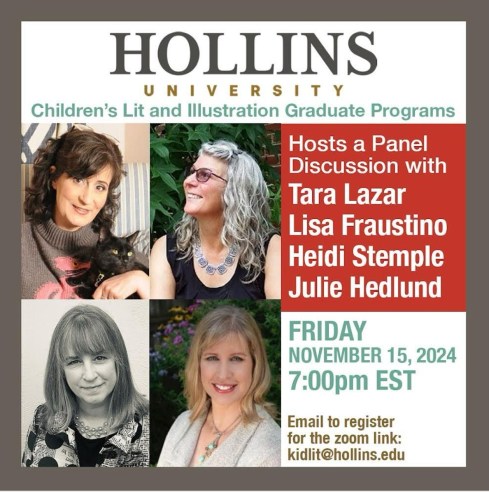
Please join us on Friday! Just email kidlit@hollins.edu for more info!
Once again, I’ve received so many requests to guest blog, that I’m asking for those writers interested in appearing in January 2025’s Storystorm to please fill out this application.
This way I can collect all of your details in one place and randomly select bloggers, making it fair for all. Your actual pitch for the blog post is still required, though, so I can avoid any potentially redundant posts.
I also ask that if you guest blogged in 2023 or 2024 that you refrain from applying this year so I can welcome new guests.
The Storystorm Guest Blogger Application is here, and it will be open until the end of November. Guest bloggers will be notified by email in early December.
Thank you!

 I was appearing at the Chappaqua Children’s Book Festival in mid-October when a woman walked up and said, “I’m a designer at Penguin Random House and I worked on Flat Cat.”
OMG! I met Opal Roengchai and now you can meet this talented woman, too! Thanks for joining me for this cover reveal, Opal.
It’s really rare for an author to have contact with the art side of the publishing house. So to start off this interview, I’d like to ask you what your title is at Penguin Random House and what your general responsibilities are?
I am a Senior Designer at PRH, working on titles under the PYR-Viking, Flamingo, and Philomel imprints.
(It was cool when I posted pics from the Ludwig Bemelmans Bar on Instagram and you commented that you worked on the Madeline books at PRH!)
Though I predominantly work on picture books and middle grade novels, I have started to design graphic novels as well. I am also the art director on projects, which means I collaborate with illustrators from sketch stage to finished book. We discuss trim size, paper stock, special effects, endpapers, etc. But my real focus is the art: Is the art illustrating the text? Is the layout good when the text is in place? Is the flow of the story working at a good pace? Those are a few of the many things I look at when reviewing the sketches.
So what is your first consideration when you think about the cover of a picture book? Do you offer guidance to the illustrator or do you just let them go for it?
It depends on the situation. I like to give the illustrator the opportunity to share their initial cover sketch ideas, but there are instances where guidance is provided if we and/or the author have a certain vision in mind. In addition, there are times when the illustrator will ask us specifically what we’re looking for and deliver accordingly.
What was that process like for the FLAT CAT: THE CLASS PET?
The cover process usually occurs after the final interior art has been delivered, allowing for possible cover concept inspiration. In this case, there was a piece in the interior that we really loved, and thought represented the story and school theme perfectly. We pulled a piece of spot art from the interior where we see Flat Cat peeking out of Willow’s backpack but had a few notes for Pete since this illustration would be used for the cover.
Essentially, the cover is our opportunity to communicate what the story is about. Being that Flat Cat was our main character, we wanted him to stand out on the cover. So, we asked the illustrator to make Flat Cat more visible as he sneaks out of Willow’s backpack and asked for more school supplies to go with the theme of the story.
Pete supplied a cover sketch that we (the editorial team and design) reviewed and sent off to you (the author) for your notes. We also shared the sketch with Sales and Marketing for any possible feedback. Overall, it’s a very collaborative effort across several departments.
From there, we either ask for further adjustments or go to final cover art. For FLAT CAT: THE CLASS PET, we had one more art comment which was to add some school-related background, which Pete took into consideration and added in the final cover art.
I remember that I wanted the subtitle to be written across the paper airplane!
Oh, yes…the sizing and placement was tricky.
Yep, no one would’ve been able to read the subtitle! This is why I’m not in the art department!
Can we talk about the awesome endpapers?
Pete is so talented and great with doing patterns on endpapers, so we asked him to share his concept and loved what he did. Then you had a great idea of adding one version of Flat Cat doing the peace sign as a little Easter egg.
Because it’s book TWO…and two fingers is also the peace sign! OK, so maybe sometimes I have decent ideas.

Kids really pick up on these details—it was definitely a nice addition to the endpapers. The peace sign version of Flat Cat was my favorite, so I added it to the back cover of the jacket as well. When designing the full jacket, I like to bring in some interior details to make it one cohesive package.

Designing the jacket is my favorite part of book design. I have a blank canvas to play with the design layout of the flaps, spine and back cover. It gives me the chance to add in some visual appeal overall. I like to think of the jacket and interior as a full package, so I’ll pull some interior art spots to front flap. Other than the visual appeal, it helps illustrate the flap copy. When it comes to the back cover, the illustrator may supply new art but depends on their schedule and timing. But in this instance, I pulled the image of Flat Cat holding up a peace sign to play homage to the endpapers and the last line of the book, which is “Smooth moves, Flat Cat.” I like the added connection of it all.
When designing, there are some other things I think about as well. For example, some books will be displayed on a shelf facing out where we see the front cover and other times the spine is facing out instead. Because of that, I really like to add a little décor to the spine to grab the reader’s attention and in this case, I added an image of Flat Cat to sit along with the title treatment.
And the whole package looks as cool as Flat Cat himself! Thanks for all that you did to help bring the book to life, Opal!
So here it is, the cover reveal for FLAT CAT: THE CLASS PET, which is due out on June 17, 2025 from Flamingo Books!


And blog readers, if you pre-order, just let me know below and you will be entered into a giveaway for a Flat Cat peace sign pin and cover magnet. I’ll giveaway 5 of these packages around Thanksgiving.

Smooth moves, Flat Cat (and Opal)!

Illustration from The Very Hungry Caterpillar copyright © 1969 and 1987 by Eric Carle
The Eric Carle Museum of Picture Book Art will hold its annual Carle Honor Awards Gala this Thursday, celebrating significant contributions to the picture book. For the past several years, I’ve asked the four Honor recipients a salient question about the current state of the medium. This year I’ve had this on my mind:
Considering the rise of book banning in recent times, can you re-stress the importance of picture books and letting children choose what they read by having unfettered access to all matter of literature?


Uri Shulevitz, Artist Honoree
If I had had books, I would have been the happiest kid alive. But I did not have any. Luckily, what I had was a mother, who told me stories, while we lived in Central Asia during World War II, which you can read about in my book, CHANCE. In those years of terrible hunger due to lack of food, I can say the stories gave me hope and saved my life. Banning books, stories, deprives children of spiritual sustenance.

We Need Diverse Books, Angel Honoree
Represented by Ellen Oh, Co-Founder, CEO & President
My daughter just graduated from college and is now a brand new 2nd grade teacher at a Title 1 school. The first thing we did was build up a library filled with diverse picture books. She was determined that every child that came to her classroom would be able to find a book that represented them. And she marveled at the extraordinary amount of diverse picture books we were able to find for her extremely diverse student body. We talked about how different it was from when she was little. Every day, she gets the pleasure of seeing a child grab a book from her library and hug it tightly, exclaiming “Look Ms. Oh, this book is like me!” As a reading teacher, she knows how challenging her job is, especially now. Fortunately, she is in a county that has not had any book banning or challenges. Her community of parents are supportive of all children and their right to read. I wish this were true for all children across the country but know the harm that is being caused in far too many areas of the country. Book bans are rarely about protecting the children from real harm. They are about controlling morality and power based on the prejudiced beliefs of a self-righteous minority. Which is why books with LGBT+ and BIPOC stories are overwhelmingly challenged and banned. Picture books are a fundamental building block of literacy. When marginalized children don’t see themselves in the books they read, it impacts their ability to read because visual literacy is so important for young readers. It impacts their self-worth when they don’t see themselves in the pages of a book. It impacts all children who don’t learn to recognize the importance of all diverse stories. Book bans harm all children.

KidLitTV, Bridge Honoree
Represented by Julie Gribble, Founder
It’s crucial to emphasize the significance of visual literacy, the positive impact of seeing oneself reflected in the pictures of a book, and the long-term benefits of empowering children to select books that inspire empathy and independence. We can’t afford to underestimate targeted attempts to ban books with LGBTQ+ characters, characters of color, or themes of race and racism.
Here’s what I’d like to contribute to this conversation.
This is a political issue, yet many people refrain from discussing or following politics to prevent confrontation or conflict. However, it’s important to remember that politics will impact you regardless.
Let’s discuss the recent surge in book bans and the reasons behind it.
Sensing a changing demographic led fearlessly by an empathic younger generation who believe in equality, justice, and human rights, extremist right-wing groups are leading the effort to roll back the clock.
As a creator of books that instill kindness and fairness in young readers, you and your books pose a significant threat to an entire political movement. This is a testament to the power of children’s book creators. You’re a force that can shape the future. When these readers grow up, they become voters who are more inclined to challenge right-wing extremism. By limiting the literature available to children, extremist groups are attempting to
control the perspectives and values that young readers are exposed to, thereby influencing their future voting decisions. It’s no coincidence that book bans are often implemented by the same organizations that are restricting voting access.
So, as Michelle Obama says, “Do something.”
Here are a few resources to help us do something:
- Vote!
- From PEN America: 5 Ways to Fight Book Bans
- Do you know when school board elections happen in your state? School boards
play an important role in ensuring students in your schools have access to books, and often have the power to allow or prevent book bans. - Text “READ” to 26797 for more information from Let America Read and to register to vote.
- RESOURCES to Help FIGHT Against BOOK BANS & CENSORSHIP!
- The above post includes a link to this constructive initiative: We Are Stronger Than Censorship. At the center of this campaign is the pledge to distribute over 2,000 inclusive books to areas most affected by censorship, reinforcing the vital role that diverse voices play in promoting understanding and empathy within our communities.
Let’s be fearless in this fight. Speak up and take action.

The Horn Book Inc., Mentor Honoree
Represented by Elissa Gershowitz, Executive Editor
Picture books are usually the first encounters children have with books and reading, ideally setting them on a path to: engagement, enjoyment, escapism, entertainment; creativity, compassion, critical thinking; imagination, empathy, problem-solving, and more. In short: all the reasons readers love to read! The more diverse the books, the more diverse the readers, the greater chance a young person will feel seen and understood and will be open to the experiences of others (Dr. Rudine Sims Bishop’s classic “Mirrors, Windows, and Sliding Glass Doors” analogy). All young people deserve to find their books–the ones that speak to them and keep them turning pages. (Or they can put a book down–that’s fine too!)
Many thanks to The 2024 Carle Honor recipients and The Eric Carle Museum of Picture Book Art for inspiring creators and readers of all ages.
For more info about the museum and its mission, please visit CarleMuseum.org.
Often I write a picture book without any idea of what my characters might look like, and sometimes I don’t even know WHAT they are. Are they even human?
Nope. I prefer non-humans. Monsters, aliens, purple orangutans—I feel they have more freedom in their actions than mere mortals. And that gives me more freedom, too.
Such was the case with my upcoming title, PARTY ANIMALS, illustrated by the talented Anna Raff. I asked Anna about this blank canvas I dropped onto her drafting table.
Anna, when I wrote PARTY ANIMALS, I didn’t specify what kind of animals were having a party! How did you decide upon each character’s species?
What a fun question to start with!
I had a few things in mind at the very beginning of my sketch process. Primarily, I was thinking about your wonderful text and the personalities it brought to mind. For instance, Horace—our party pooper—needed to be a stern, no-nonsense kind of guy. At first I thought he might be a mule, since he’s a bit stubborn, too. Then I started to think about scale and how funny a vast difference in size would be between the chaotic partying animals and poor Horace cowering in the corner amidst the mayhem. So I decided he should be the smallest and chose a rat—I have a history of drawing rats—knowing he might also have a pink tail. To me, that flash of pink says maybe he’s not such a big ol’ grouch after all? Our wonderful editor, Sylvie Frank, gave me the idea of giving him a toothpick walking stick, which adds even more clues to his inner character.
In addition to scale, for the other animals I was thinking about what their area of partying expertise would be. Beatrix, the elephant chef, cooks all the wacky foods for each celebration. I thought having a trunk would be helpful for her in the kitchen. Who among us home chefs hasn’t wished for an extra hand? And to be honest, I really just love drawing elephant ears.
And love of drawing is what brought me to the other two animal species: Theodore, the cat, and Phoebe…who I think is a dog?…even I’m not entirely sure! One of the things I learned in from my mentor, Marshall Arisman, is something I try to instill in my own students. You have to ask yourself, “What do I want to draw?” If you answer honestly, you end up having a much better time in the process, rather than thinking about outside influences. As with elephant ears, I love drawing dogs and cats. I also thought it might be fun for readers to imagine their own pet cat being really into crafts and decorating, and a “dog” who was also a great virtuoso/DJ!
You’ve packed a whole lot of goodies into the illustrations: little hidden gems! Do you want to reveal one or two of your favorites?
Another great question! Some people call them “carrots”.
During the-milk-has-gone-sour party, Beatrix is holding a 1960s edition of the Betty Crocker Cook Book (the space in between “cook” and “book” is not a typo!), the source of many of my family’s favorite dessert recipes when I was a kid. In fact, I just used it to bake my dad a strawberry-rhubarb pie for Father’s Day.

Another detail that was fun was switching the fabric patterns and imagery on the Party Animals’ clothing to match each party theme. Oh…and all the wacky bakes! I think the pincushion cake is my favorite.
What were some of your intentions when designing and illustrating the cover of PARTY ANIMALS?
Primarily, I wanted to emphasize each animals’ party energy, whether it be super-duper party-er or party-pooper, so readers would know what they’re in for. We’ve got the three partying animals in front, each exhibiting their party expertise, while Horace is up top amongst the balloons, acting all judgey.
At first, I had Beatrix holding up one of her more obscure bakes, the brain cake from the thinking party. But our editor and art director thought that might be a little misleading / too specific. At the time, they also mentioned the addition of the tagline, so when I was replacing the cake, that seemed like a great place for more lettering.
I knew early on that the title type needed to be prominent, in balloon lettering…you know, to scream PAR-TAY! The fact there we’re doing a second book drove my decision making, too. Before becoming an illustrator, I was a designer and art director and tapped into a few of those skills to really fine-tune the lettering, so it would feel like part of a series. That also helped with the lettering for Bea’s layer cake.
And then for the case cover, Joann had the idea of showing the aftermath of the fantabulous party on the jacket, with Horace sweeping up while the other animals crash in a sleepy heap. I played around with the lighting in the final art too, to contrast against the warm, splashy lighting of the jacket.


Thank you for all the fun, Anna!
And now here is the cover reveal for PARTY ANIMALS, releasing March 11, 2025 from Disney*Hyperion!


PARTY ANIMALS is available for pre-order anywhere, but if you’d like me to sign and personalize your copy, I’d be grateful if you placed an order via my local indie, The Bookworm, whose longtime owner passed away recently. We want to keep the store in Bernardsville, NJ running after 40 years of serving the community! You can call them at 908-766-4599.
Anna will sign copies ordered via Books of Wonder.
And now the givey! Comment below with what you like most about the cover and a random winner will be selected on August 1. That winner will receive a signed spread (by me, Tara Lazar) from the F&G (printed proof) of PARTY ANIMALS!
Good luck!





 Writing for Kids (While Raising Them)